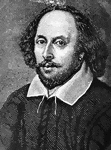
The Chandos portrait of William Shakespeare, an English poet and playwright, widely regarded as the greatest writer in the English language and the world's pre-eminate dramatist. This portrait is attributed to Joseph Taylor, and dated to about 1610. The National Portrait Gallery located in London, who own it, say it is the only painting with any real claim to have been done from life. His surviving works consist of 38 plays, 154 sonnets, two long narratives poems, and several other poems. His plays have been translated into every major living language, and are performed more often than those of any other playwright.

William Shakespeare

The Chandos portrait of William Shakespeare, an English poet and playwright, widely regarded as the…
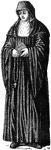
Benedictine refers to the spirituality and consecrated life in accordance with the Rule of St Benedict, written by Benedict of Nursia in the sixth century.

Benedictine Nun

Benedictine refers to the spirituality and consecrated life in accordance with the Rule of St Benedict,…
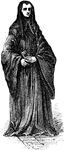
Within Roman Catholicism, a monk is a member of a religious order who lives a communal life in a monastery, abbey, or priory under a monastic rule of life (such as the Rule of St. Benedict) and under the vows of poverty, chastity, and obedience. St. Benedict of Nursia is considered to be the founder of western monasticism. He established the first monastic community in the west and authored the Rule of St. Benedict, which is the foundation for the Order of St. Benedict and all of its reforms such as the Cistercians and the Trappists.

Benedictine Monk

Within Roman Catholicism, a monk is a member of a religious order who lives a communal life in a monastery,…
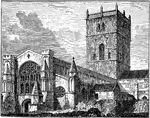
The monastic community was founded by Saint David, Abbot of Menevia, who died in AD589. Between AD645 and 1097, the community was attacked many times by raiders, including the Vikings, however it was of such note as both a religious and intellectual centre that King Alfred summoned help from the monastic community at St David's in rebuilding the intellectual life of the Kingdom of Wessex.

St. David's Cathedral

The monastic community was founded by Saint David, Abbot of Menevia, who died in AD589. Between AD645…
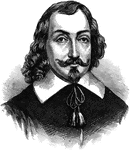
Samuel de Champlain, "The Father of New France", was a French navigator, geographer, cartographer, draughtsman, soldier, explorer, ethnologist, diplomat, chronicler, and the founder of Quebec City on July 3, 1608, of which he was the administrator for the rest of his life.

Samuel de Champlain

Samuel de Champlain, "The Father of New France", was a French navigator, geographer, cartographer, draughtsman,…
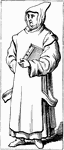
The Carthusian Order, also called the Order of St. Bruno, is a Roman Catholic religious order of enclosed monastics. The order was founded by Saint Bruno of Cologne in 1084 and includes both monks and nuns. The order has its own Rule, called the Statutes, rather than the Rule of St Benedict (as is often erroneously reported) and combines eremitical and cenobitic life.

A Carthusian

The Carthusian Order, also called the Order of St. Bruno, is a Roman Catholic religious order of enclosed…
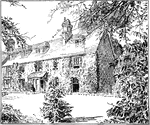
George Herbert (April 3, 1593 – March 1, 1633) was a Welsh poet, orator and a priest. He went to college with the intention of becoming a priest, but his scholarship attracted the attention of King James I. Herbert served in parliament for two years. In 1630, in his late thirties he gave up his secular ambitions and took holy orders in the Church of England, spending the rest of his life as a rector of the little parish of St. Andrew Bemerton, near Salisbury.

George Herbert's Rector House, Bemerton

George Herbert (April 3, 1593 – March 1, 1633) was a Welsh poet, orator and a priest. He went…
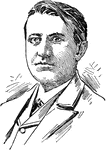
Thomas Alva Edison (February 11, 1847 – October 18, 1931) was an American inventor and businessman who developed many devices that greatly influenced life around the world, including the phonograph and the long-lasting, practical electric light bulb.

Thomas Alva Edison

Thomas Alva Edison (February 11, 1847 – October 18, 1931) was an American inventor and businessman…

The Culpeper Minutemen chose the coiled snake ready to strike and the words from Gadsden's flag, but then raised another defiant fist at England by adding the words: "Liberty or Death."

The Culpepper Flag

The Culpeper Minutemen chose the coiled snake ready to strike and the words from Gadsden's flag, but…
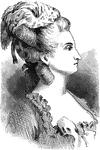
Anne Vallayer-Coster (1744-1818) was an eighteenth-century French painter. Known as a prodigy artist at a young age, she achieved fame and recognition very early in her career, being admitted to the Royal Academy in 1770, at the age of twenty-six. Despite the negative reputation that still-life painting had at this time, Vallayer-Coster's highly developed skills, especially in the depiction of flowers, soon generated a great deal of attention from collectors and other artists. Her "precocious talent and the rave reviews" earned her the attention of the court, where Marie-Antoinette took a particular interest in Vallayer-Coster's paintings.

Anne Vallayer-Coster

Anne Vallayer-Coster (1744-1818) was an eighteenth-century French painter. Known as a prodigy artist…
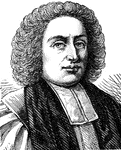
Joseph Butler (May 18, 1692 O.S. – June 16, 1752) was an English bishop, theologian, apologist, and philosopher. He is known, among other things, for his critique of Thomas Hobbes's egoism and John Locke's theory of personal identity. During his life and after his death, Butler influenced many philosophers, including David Hume, Thomas Reid, and Adam Smith. He is most famous for his Fifteen Sermons Preached at the Rolls Chapel (1726) and Analogy of Religion, Natural and Revealed (1736).

Bishop Joseph Butler

Joseph Butler (May 18, 1692 O.S. – June 16, 1752) was an English bishop, theologian, apologist, and…
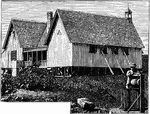
John Coleridge Patteson (April 1, 1827 – September 20, 1871) was an Anglican bishop and martyr. On 20 September 1871 he was murdered on the island of Nukapu in the Solomon Islands, where he had landed alone. Natives killed him as revenge against the abduction of some natives by white men months earlier. His death became a cause celebre in England and increased interest both in missionary work and in improvement of the working conditions in Melanesia. His life is celebrated in the Church of England as a saintly one.

Bishop Patteson's House, Norfolk Island

John Coleridge Patteson (April 1, 1827 – September 20, 1871) was an Anglican bishop and martyr. On…
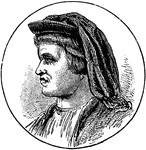
Lorenzo de' Medici (January 1, 1449 – 9 April 1492) was an Italian statesman and de facto ruler of the Florentine Republic during the Italian Renaissance. Known as Lorenzo the Magnificent by contemporary Florentines, he was a diplomat, politician and patron of scholars, artists, and poets. His life coincided with the high point of the early Italian Renaissance; his death marked the end of the Golden Age of Florence. The fragile peace he helped maintain between the various Italian states collapsed with his death; two years later the French invasion of 1494 began and led to nearly 400 years of foreign occupation of the Italian peninsula.

Lorenzo de' Medici

Lorenzo de' Medici (January 1, 1449 – 9 April 1492) was an Italian statesman and de facto ruler of…
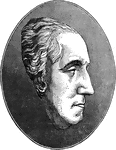
Houdon's portrait sculpture of Washington was the result of a specific invitation by Benjamin Franklin to cross the Atlantic specifically to visit Mount Vernon, so that Washington could model for him. Washington sat for wet clay life models and a plaster life mask in 1785.

Houdon's Mask of Washington

Houdon's portrait sculpture of Washington was the result of a specific invitation by Benjamin Franklin…
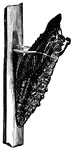
Illustration of a pupa attached to a wall. A pupa (Latin pupa for doll, pl: pupae or pupas) is the life stage of some insects undergoing transformation. The pupal stage is found only in holometabolous insects, those that undergo a complete metamorphosis, going through four life stages; embryo, larva, pupa and imago.

Pupa

Illustration of a pupa attached to a wall. A pupa (Latin pupa for doll, pl: pupae or pupas) is the life…
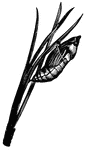
Illustration of a pupa attached to a leaf. A pupa (Latin pupa for doll, pl: pupae or pupas) is the life stage of some insects undergoing transformation. The pupal stage is found only in holometabolous insects, those that undergo a complete metamorphosis, going through four life stages; embryo, larva, pupa and imago.

Pupa

Illustration of a pupa attached to a leaf. A pupa (Latin pupa for doll, pl: pupae or pupas) is the life…
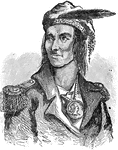
Tecumseh (March 1768 – October 5, 1813), also Tecumtha or Tekamthi, was a famous Native American leader of the Shawnee. He spent much of his life attempting to rally various Indian tribes in a mutual defense of their lands, which eventually led to his death in the War of 1812.

Tecumseh

Tecumseh (March 1768 – October 5, 1813), also Tecumtha or Tekamthi, was a famous Native American…
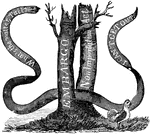
Newspapers and speakers especially condemned the "land embargo" — the cutting-off trade with Canada. The trade so suddenly thrown into confusion by it was represented in a caricature by a bewildered serpent which had been suddenly stopped in its movements by two trees, marked, respectively, "Embargo" and "Non-Importation Act." The wondering snake is puzzled to know what has happened, and the head cries out, "What's the matter, tail?" The latter answers, "I can't get out." A cock, representing France, stands by, joyfully.

Non Importation Act

Newspapers and speakers especially condemned the "land embargo" — the cutting-off trade with Canada.…
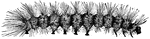
An illustration of a yellow woolly bear caterpillar. The Yellow woolly bear caterpillar, Spilosoma virginica, is the larva of the Virginia tiger moth. It has a diet of a wide range of low-growing plants, including ground cover like grass and clover. This species tends to have two to three life cycles per year, with one hibernating for the winter in temperate climates.

Yellow Woolly Bear Caterpillar

An illustration of a yellow woolly bear caterpillar. The Yellow woolly bear caterpillar, Spilosoma virginica,…
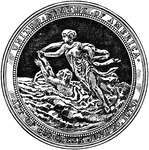
The Congressional Life Saving Medal (in gold and silver) was authorized by an Act of Congress on June 20, 1874 to be bestowed to a U.S Citizen who rescues or attempts the rescue of any person from drowning, shipwreck or other peril of the water, or to the rescuer of a U.S. citizen.

Life Saving medal

The Congressional Life Saving Medal (in gold and silver) was authorized by an Act of Congress on June…
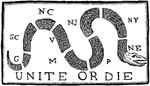
"Unite or Die." This snake device first appeared when the Stamp Act excitement was at its height.

A Union Device

"Unite or Die." This snake device first appeared when the Stamp Act excitement was at its height.

The Fall Army Worm (Spodoptera frugipeda) is part of the order of Lepidoptera and are the caterpillar life stage of a moth. They are native to tropical regions of the western hemisphere, from the United States to Argentina. They are regarded as pests and are known to wreak havoc with crops if left to multiply. Their name is derived from their feeding habits. The army worms are some of the most destructive pests to agricultural crop in the world. Once the food supply is exhausted the entire "army" of worms will move to the next available food source.

Army Worm

The Fall Army Worm (Spodoptera frugipeda) is part of the order of Lepidoptera and are the caterpillar…
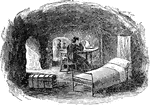
During the siege, Union gunboats lobbed over 22,000 shells into the town and army artillery fire was even heavier. As the barrages continued, suitable housing in Vicksburg was reduced to a minimum. A ridge, located between the main town and the rebel defense line, provided a diverse citizenry with lodging for the duration. Over 500 caves were dug into the yellow clay hills of Vicksburg. Whether houses were structurally sound or not, it was deemed safer to occupy these dugouts.

Cave Life in Vicksburg

During the siege, Union gunboats lobbed over 22,000 shells into the town and army artillery fire was…
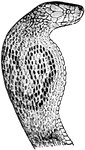
Cobras are venomous snakes of the familys Elapidae, of several genera, but particularly Naja. (Non-cobra elapidae include the taipans, brown snakes, tiger snakes, fierce snakes, coral snakes, mambas and sea snakes.) Cobras generally inhabit tropical and desert regions of Asia and Africa. When feeling threatened, cobras can rear up and flatten their heads into an instantly recognisable warning posture. The rest of the time their heads are symmetrical and they look much like any other snake bites.

Cobra Head

Cobras are venomous snakes of the familys Elapidae, of several genera, but particularly Naja. (Non-cobra…
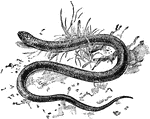
The scheltopusik or European legless lizard (Ophisaurus apodus) belongs to the genus of glass lizards: reptiles that resemble snakes but are actually lizards.

Scheltopusik

The scheltopusik or European legless lizard (Ophisaurus apodus) belongs to the genus of glass lizards:…
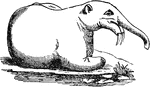
Deinotherium ("terrible beast"), also called the Hoe tusker was a gigantic prehistoric relative of modern-day elephants that appeared in the Middle Miocene and continued until the Early Pleistocene. During that time it changed very little. In life it probably resembled modern elephants, except that its trunk was shorter, and it had downward curving tusks attached to the lower jaw. Deinotherium is the third largest land mammal known to have existed; only Indricotherium and Mammuthus sungari were larger. Males were generally between 3.5 and 4.5 meters (12 and 15 feet) tall at the shoulders although large specimens may have been up to 5m (16ft). Their weight is estimated to have been between 5 and 10 tonnes (5.5 and 11 US Standard tons), with the largest males weighing in excess of 14 tonnes (15.4 US Standard tons). Deinotherium's range covered parts of Asia, Africa, and Europe.

Deinotherium

Deinotherium ("terrible beast"), also called the Hoe tusker was a gigantic prehistoric relative of modern-day…
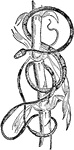
Dipsa is a tiny, extremely poisonous snake from Medieval bestiaries. They were said to be said to be so poisonous that their victim would die before becoming aware he'd been bitten.

Dipsa

Dipsa is a tiny, extremely poisonous snake from Medieval bestiaries. They were said to be said to be…
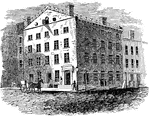
In August of 1775, Americans took possession of cannons from the Battery at the tip of Manhattan and exchanged fire with the HMS Asia (1764). They retaliated by firing a 32-gun broadside on the city, sending a cannon ball through the roof of Fraunces Tavern. When the victorious Americans re-occupied the city, it was Fraunces Tavern that hosted Washington and his officers in a victory banquet. On Dec. 4, 1783, Washington was again at Fraunces Tavern to say farewell to his officers in the Long Room. Saving America from the fate of many republics that turned quickly to military dictatorship, Washington resigned his post and returned to civilian life until chosen first President of the United States.

Fraunces Tavern

In August of 1775, Americans took possession of cannons from the Battery at the tip of Manhattan and…
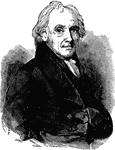
Mason Locke Weems (October 11, 1756 – May 23, 1825), generally known as Parson Weems, was an American printer and author. He is best known as the source of some of the apocryphal stories about George Washington, including the famous tale of the cherry tree ("I cannot tell a lie, I did it with my little hatchet"). The Life of Washington, Weems' most famous work, contained the story.

Mason Locke Weems

Mason Locke Weems (October 11, 1756 – May 23, 1825), generally known as Parson Weems, was an American…
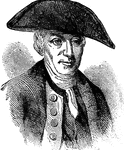
Abraham Whipple (26 September 1733 – 27 May 1819) was an American revolutionary naval commander. Whipple was born near Providence, Rhode Island and chose to be a seafarer early in his life. He embarked upon a career in the lucrative West Indies trade, working for Moses and John Brown. In the French and Indian War period, he became a privateersman and commanded privateer Game Cock from 1759 to 1760. In one six-month cruise, he captured 23 French ships. He sunk the first British ship of the American Revolution. The first to unfurl the Star Spangled Banner in London, he was also the first to build and sail an ocean-going ship 2000 miles down river from Ohio to the Caribbean, opening trade to the Northwest Territory.

Abraham Whipple

Abraham Whipple (26 September 1733 – 27 May 1819) was an American revolutionary naval commander.…
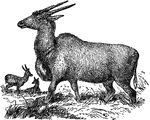
The common eland (Taurotragus oryx, also known as the southern eland) is a savannah and plains antelope found in East and Southern Africa. Common eland live on the open plains of Southern Africa and along the foothills of the great South African plateau. They eat grass, branches and leaves and are diurnal but tend to be inactive during the heat of day. Herds usually have 30 to 80 individuals, but are known to exceed 400. The common eland has an unusual social life, leaving or joining herds as necessary without forming close ties. Predators in the wild are predominantly lions and the endangered African wild dog.

Eland

The common eland (Taurotragus oryx, also known as the southern eland) is a savannah and plains antelope…
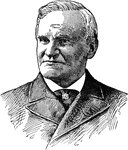
Francis Parkman (September 16, 1823 &ndash; November 8, 1893) was an American historian, best known as author of <em>The Oregon Trail: Sketches of Prairie and Rocky-Mountain Life</em> and his monumental seven volume <em>France and England in North America</em>.

Francis Parkman

Francis Parkman (September 16, 1823 – November 8, 1893) was an American historian, best known…
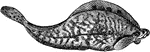
Flounder (also; fluke) are flatfish that live in ocean waters ie., Northern Atlantic and waters along the east coast of the United States and Canada, and the Pacific Ocean, as well. While flounders have both eyes situated on one side of the head, they are not born this way. Their life involves metamorphosis. During metamorphosis, one eye migrates to the other side of the body so that both eyes are situated on the upward-facing side of its body. After metamorphosis, flounder lie on one side on the ocean floor; either the left or right side might face upward depending on the species.

Flounder

Flounder (also; fluke) are flatfish that live in ocean waters ie., Northern Atlantic and waters along…
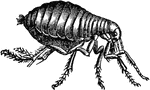
An illustration of a common flea. Once the flea reaches adulthood its primary goal is to find blood - adult fleas must feed on blood in order to reproduce. Adult fleas only have around a week to find food once they emerge, though they can survive two months to a year between meals. A flea population is unevenly distributed, with 50 percent eggs, 35 percent larvae, 10 percent pupae and 5 percent adults. Their total life cycle can take as little as two weeks, but may be lengthened to many months if conditions are unfavorable. Female fleas can lay 500 or more eggs over their life, allowing for phenomenal growth rates.

Flea

An illustration of a common flea. Once the flea reaches adulthood its primary goal is to find blood…
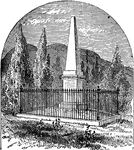
Eleazer Derby Wood (1783 &ndash; September 17, 1814) was an American Army officer in the War of 1812. He was distinguished at Fort Erie, where he lost his life in a sortie. Colonel Wood was much beloved by General Brown, who caused a handsome marble monument to be erected to his memory at West Point. Also, he was the namesake of Fort Wood on Bedloe's Island in New York Harbor on which the Statue of Liberty was built. He is also the namesake of Wood County, Ohio.

Colonel Eleazer Derby Wood's Monument at West Point

Eleazer Derby Wood (1783 – September 17, 1814) was an American Army officer in the War of 1812.…
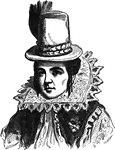
Pocahontas (c. 1595 &ndash; March 21, 1617) was a Native American woman who married an Englishman, John Rolfe, and became a celebrity in London in the last year of her life.

Pocahontas

Pocahontas (c. 1595 – March 21, 1617) was a Native American woman who married an Englishman, John…

The Great Seal of the State of New Mexico, 1850. The seal pictures the American Bald Eagle and the Mexican Eagle holding a cactus in its talons and a snake in its mouth. Below them is a banner with the state motto, 'Crescit Eundo' meaning "It grows as it goes."

Seal of New Mexico

The Great Seal of the State of New Mexico, 1850. The seal pictures the American Bald Eagle and the Mexican…
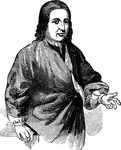
Nikolaus Ludwig von Zinzendorf und Pottendorf, Imperial Count of Zinzendorf and Pottendorf, (May 26, 1700 – May 9, 1760), German religious and social reformer and bishop of the Moravian Church, was born at Dresden. Zinzendorf had a naturally alert and active mind, and an enthusiastic temperament that made his life one of ceaseless planning and executing. Like Martin Luther, he was often carried away by strong and vehement feelings, and he was easily upset both by sorrow and joy. He is commemorated as a hymnwriter and a renewer of the church by the Evangelical Lutheran Church in America on their Calendar of Saints on May 9.

Nicolaus Ludwig Zinzendorf

Nikolaus Ludwig von Zinzendorf und Pottendorf, Imperial Count of Zinzendorf and Pottendorf, (May 26,…
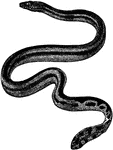
The Sea Snake (Pelamis bicolor) is a tropical sea snake known for its black color on top and yellow belly.

Sea Snake

The Sea Snake (Pelamis bicolor) is a tropical sea snake known for its black color on top and yellow…
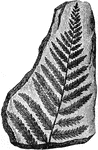
An illustration of a fossil of a toothed fern. Ferns are vascular plants differing from the more primitive lycophytes by having true leaves (megaphylls), and they differ from seed plants (gymnosperms and angiosperms) in their mode of reproduction &mdash; lacking flowers and seeds. Like all other vascular plants, they have a life cycle referred to as alternation of generations, characterized by a diploid sporophytic and a haploid gametophytic phase.

Leaf Indentations

An illustration of a fossil of a toothed fern. Ferns are vascular plants differing from the more primitive…
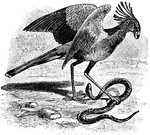
The Secretary Bird (Sagittarius serpentarius) is a bird of prey known for hunting snakes and other reptiles.
Secretary Bird

The Secretary Bird (Sagittarius serpentarius) is a bird of prey known for hunting snakes and other reptiles.

An illustrative look on the life cycle of a gnat. A,larva; b, pupa; c, perfect insect emerging; d,male; and e, female gnat.

Life Cycle of a Gnat

An illustrative look on the life cycle of a gnat. A,larva; b, pupa; c, perfect insect emerging; d,male;…
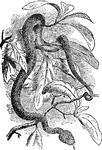
An illustration of an atheris burtoni, a species of viper. These snakes are found all over the world, except in Australia and Madagascar. All have relatively long hinged fangs that permit deep penetration and injection of venom.

Viper

An illustration of an atheris burtoni, a species of viper. These snakes are found all over the world,…
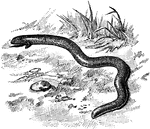
The four-toed worm lizard (Chirotes canaliculatus) is a reptile of the Amphisbaenidae family of usually legless lizards.

Four-Toed Worm Lizard

The four-toed worm lizard (Chirotes canaliculatus) is a reptile of the Amphisbaenidae family of usually…
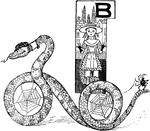
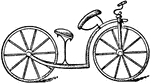
A girl amazed by the sight of a bicycle made out of a snake and spider-webs.

Snake Bike

A girl amazed by the sight of a bicycle made out of a snake and spider-webs.

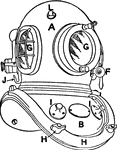
A front view of a diving helmet. A, Helmet; B, Breastplate; F, Emergency cock; G, Glasses in frame; H, Metal screws and bands; I, Metal tabs; J, Hooks for keeping weight ropes into position; and L, Eyes to which air pipe and life line are secured.

Diving Helmet (Front)

A front view of a diving helmet. A, Helmet; B, Breastplate; F, Emergency cock; G, Glasses in frame;…
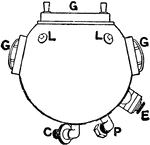
Top view of diving helmet. C, Air inlet valve; E, Regulating outlet valve; G, Glasses in frames; L, Eyes to which air pipe and life line are secured; and P, Connection for telephone cable.

Diving Helmet (Top)

Top view of diving helmet. C, Air inlet valve; E, Regulating outlet valve; G, Glasses in frames; L,…

A motorcycle (bike, motor bicycle, cycle or motorbike) is a single-track, two-wheeled motor vehicle powered by an engine.

Motor Bicycle

A motorcycle (bike, motor bicycle, cycle or motorbike) is a single-track, two-wheeled motor vehicle…
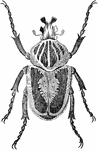
The Goliath beetles are among the largest insects on Earth, if measured in terms of size, bulk and weight. They are members of subfamily Cetoniinae, within the scarab beetle family. Goliath beetles can be found in many of Africa's tropical forests, where they feed primarily on tree sap and fruit. Little appears to be known of the larval cycle in the wild, but in captivity, Goliathus beetles have been successfully reared from egg to adult using protein-rich foods such as commercial cat and dog food. Goliath beetles measure from 60&ndash;110 millimetres (2.4&ndash;4.3 in) for males and 50&ndash;80 millimetres (2.0&ndash;3.1 in) for females, as adults, and can reach weights of up to 80&ndash;100 grams (2.8&ndash;3.5 oz) in the larval stage, though the adults are only about half this weight. The females range from a dark brown to silky white, but the males are nomally brown/white/black or black/white.

Goliath Beetle

The Goliath beetles are among the largest insects on Earth, if measured in terms of size, bulk and weight.…
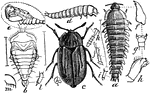
"Carrion-beetle (Silpha inaequalis). a, larva; d, same; f, g, h, mandible, labium, and maxilla of larva; i, j, anal process and antenna of same; m, one of the lateral processes. b, pupa; e, same; l, anal process of same. c, beetle; k, anterior tarsus of same." -Whitney, 1911

Carrion Beetle

"Carrion-beetle (Silpha inaequalis). a, larva; d, same; f, g, h, mandible, labium, and maxilla of larva;…
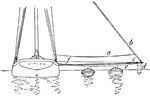
&quot;Riding-boom. A boat-boom or long spar working in a hinge or goose-neck, designed to be lowered from abreast the fore-rigging to a horizontal position at right angles with the keel of the vessel ... a, life-line; b, lift; c, riding-boom; d, rope ladder; e, outhaul; f, after-boom guy.&quot; -Whitney, 1911

Riding Boom

"Riding-boom. A boat-boom or long spar working in a hinge or goose-neck, designed to be lowered…
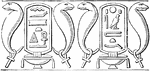
They are generally of smaller dimensions in the interior, so that the walls or columns of the same chamber contain several rows of such representations. Between and over them are often found ornamented bands like friezes, and at the bottom of the walls, as in the case of the columns, are introduced more decorations, representing lotus-plants.

Mural Frieze-like Decoration from the Temple of Esneh

They are generally of smaller dimensions in the interior, so that the walls or columns of the same chamber…
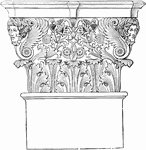
The structural tendency which prevails in the capitals of all orders to change from the circular form of the shaft into the square is modified in the Ionic by the voluted nature of the capital, and in the Corinthian by representations of vegetable life.

Corinthian Capital

The structural tendency which prevails in the capitals of all orders to change from the circular form…
The Serpent Symbol is a snake signifying the essence of eternity.

Serpent Symbol

The Serpent Symbol is a snake signifying the essence of eternity.

The bicycle, bike, or cycle is a pedal-driven, human-powered vehicle with two wheels attached to a frame, one behind the other.

Bicycle

The bicycle, bike, or cycle is a pedal-driven, human-powered vehicle with two wheels attached to a frame,…
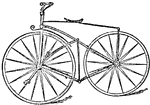
The bicycle, bike, or cycle is a pedal-driven, human-powered vehicle with two wheels attached to a frame, one behind the other.

Bicycle

The bicycle, bike, or cycle is a pedal-driven, human-powered vehicle with two wheels attached to a frame,…


An illustration of Humber's "spider" bicycle.

Humber's "Spider" Bicycle

An illustration of Humber's "spider" bicycle.

An illustration of a rudge racing bicycle.

Rudge Racing Bicycle

An illustration of a rudge racing bicycle.

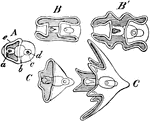
Echinopaedia is the name for the early or larval stages of echinoderms like sea stars and sea urchins. "A, common primitive form of Echinodermata, whence B, B', a vermiform holothurid, and C, C', a pluteiform ophiurid or echinid (pluteus) larva are derived: a, mouth; b, stomach; c, intestine; d, anus; e, ciliated band." -Whitney, 1911

Echinopaedia

Echinopaedia is the name for the early or larval stages of echinoderms like sea stars and sea urchins.…
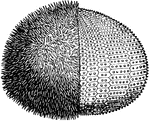
"Sea-urchin (Echinus esculentus). Left side in natural state; right side with spines removed, showing the bare plates." -Whitney, 1911

European Edible Sea Urchin

"Sea-urchin (Echinus esculentus). Left side in natural state; right side with spines removed, showing…