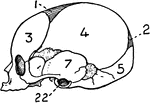
A side view of the human skull at birth.

Infant skull

A side view of the human skull at birth.

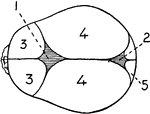
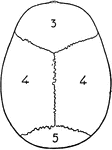
A top down view of the human skull at birth.

Infant skull

A top down view of the human skull at birth.

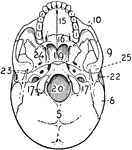
A bottom view of an adult human skull.

Adult skull

A bottom view of an adult human skull.

A top down view of a human skull.

Adult skull

A top down view of a human skull.

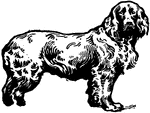
"The field spaniel, a dog to which very great attention has been paid by breeders and fanciers, who have lengthened its body and shortened its legs at the expense of symmetry."—Finley, 1917

Field Spaniel

"The field spaniel, a dog to which very great attention has been paid by breeders and fanciers, who…
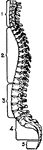
Side view of a human spinal column.

Spinal column

Side view of a human spinal column.

"Side view of the axis, the second cervical vertebra."—Finley, 1917

Axis

"Side view of the axis, the second cervical vertebra."—Finley, 1917

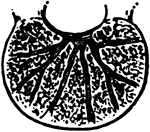
A section of a human vertebra, showing structure.

Section of Vertebra

A section of a human vertebra, showing structure.

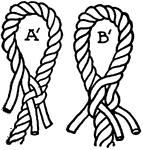
"For making an eye splice, the end of the rope is unlaid and the strands are bent upon the body of the rope so as to form an 'eye' of the size desired."—Finley, 1917

Eye-splice

"For making an eye splice, the end of the rope is unlaid and the strands are bent upon the body of the…
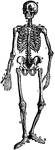
The Human Skeleton. Labels: a, parietal bone; b, frontal; c, cervical vertebrae; d, sternum; e, lumbar vertebrae; f, ulna; g, radius; h, wrist or carpal bones; i, metacarpal bones; k, phalanges; l, tibia; m, fibula; n, tarsal bones; o, metatarsal; p, phalanges; , patella; r, femur; s, haunch (hip) bone; t, humerus; u, clavicle.

The Human Skeleton

The Human Skeleton. Labels: a, parietal bone; b, frontal; c, cervical vertebrae; d, sternum; e, lumbar…
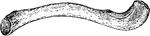
The human clavicle bone (anterior portion of the shoulder girdle).

The Human Clavicle

The human clavicle bone (anterior portion of the shoulder girdle).

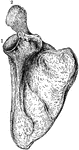
The human scapula bone (shoulder blade). Labels: 1, glenoid cavity; 2, end of the spine of scapula.
The Human Scapula

The human scapula bone (shoulder blade). Labels: 1, glenoid cavity; 2, end of the spine of scapula.

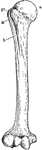
The human humerus bone, the longest and largest bone of the upper leg. Labels: a, rounded head; gt, greater tuberosity; lt, lesser tuberosity; b, groove for attachment of biceps tendon.

The Human Humerus

The human humerus bone, the longest and largest bone of the upper leg. Labels: a, rounded head; gt,…
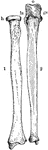
The Ulna and Radius. Labels: 1, radius; 2, ulna; o, olecranon process, on the anterior surface of which are seen the large (gs) and the small (ls) cavities for the reception of the lower end of the humerus and of the head of the radius, respectively; h, head of radius.

The Human Ulna and Radius

The Ulna and Radius. Labels: 1, radius; 2, ulna; o, olecranon process, on the anterior surface of which…
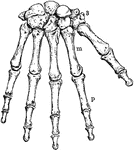
Bones of the Wrist and Hand. Labels: m, metacarpal bones; p, phalanges; 3, bones of wrist.

The Human Wrist and Hand Bones

Bones of the Wrist and Hand. Labels: m, metacarpal bones; p, phalanges; 3, bones of wrist.
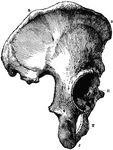
The Os Innominatum, or nameless bone, so called from bearing no resemblance to any known object, is a large irregular shaped bone, which, with its fellow of opposite side, forms the sides and front wall of the pelvic cavity. Labels: R, O, crest of ilium, just below O is seen the anterior superior spinous process; J, tuberosity of ischium; t, part of pubes, between J and T is seen the thyroid foramen: H, acetabulum, below H is seen end of ubic bone which, with its fellow of opposite side, forms the symphysis pubis.

Part of the Human Pelvic Bone

The Os Innominatum, or nameless bone, so called from bearing no resemblance to any known object, is…
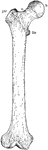
The Femur (upper leg bone) is the longest, largest, and strongest bone in the skeleton. Labels: b, rounded head; n, neck; gtr, greater trochanter; ltr, lesser trochanter.

Human Femur Bone

The Femur (upper leg bone) is the longest, largest, and strongest bone in the skeleton. Labels: b, rounded…
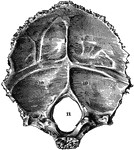
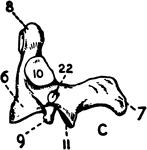
Occipital bone of the human skull, inner surface. It is situated at the back and base of the skull. Labels: 9,9, and 10,10, depression for reception of lobes of brain; 11, foramen magnum.

Occipital Bone of the Human Skull

Occipital bone of the human skull, inner surface. It is situated at the back and base of the skull.…
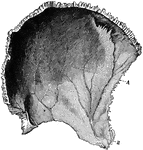
Parietal bone of the human skull, inner surface. The parietal bones form the greater part of the sides and roof of the skull. Labels: A, parietal depression; E, furrow for ramification of arteries.

Parietal Bone of the Human Skull

Parietal bone of the human skull, inner surface. The parietal bones form the greater part of the sides…
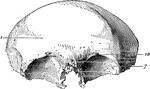
Frontal bone of the human skull, outer surface. The frontal bone forms the forehead, roof of the orbital cavities, and the nasal cavity. Labels: 1, frontal eminence; 7, roof of orbital cavitiy; 10, orbital arch.

Frontal Bone of the Human Skull

Frontal bone of the human skull, outer surface. The frontal bone forms the forehead, roof of the orbital…
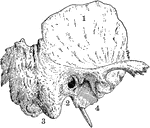
Temporal bone of the human skull. The temporal bones are situated at the sides and base of the skull. Labels: 1, squamous portion; 2, placed below external opening of auditory canal in petrous portion; 3, placed below mastoid portion; 4, placed below glenoid cavity for reception of condyle of lower jaw.

Temporal Bone of the Human Skull

Temporal bone of the human skull. The temporal bones are situated at the sides and base of the skull.…
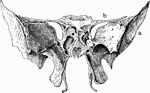
Sphenoid bone, situated the anterior part of the base of the skull, articulating with all the other cranial bones, which it binds firmly and solidly together. Labels: a, greater wing; b, lesser wing.

Sphenoid Bone of the Human Skull

Sphenoid bone, situated the anterior part of the base of the skull, articulating with all the other…
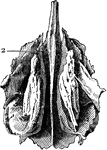
Ethmoid bone, posterior surface. The ethmoid bone is an exceedingly light, spongy bone, placed between the two orbits and at the root of the nose, contributing to form a part of each of these cavities. Label: 2, cribriform, or perforated plate.

Ethmoid Bone of the Human Skull

Ethmoid bone, posterior surface. The ethmoid bone is an exceedingly light, spongy bone, placed between…
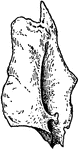
Lachrymal Bone. The lachrymal are the smallest and most fragile bones fo the face. They are situated at the front part of the inner wall of the orbit.

Human Lachrymal Facial Bone

Lachrymal Bone. The lachrymal are the smallest and most fragile bones fo the face. They are situated…
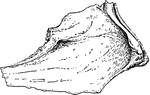
Vomer bone, a single bone placed at the back part of the nasal cavity, and forms part of the septum of the nasal fossae.

Human Vomer Nasal Bone

Vomer bone, a single bone placed at the back part of the nasal cavity, and forms part of the septum…
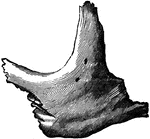
Malar (cheek) bone. The malar bones form the prominence of the cheek, and part of the outer wall and floor of the orbit.

Human Malar (Cheek) Bone

Malar (cheek) bone. The malar bones form the prominence of the cheek, and part of the outer wall and…
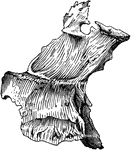
Palate bone. Palate bones form the back part of the roof of the mouth; part of the floor and outer wall of the nasal fossae, and a very small portion of the floor of the orbit.

Human Palate Bone

Palate bone. Palate bones form the back part of the roof of the mouth; part of the floor and outer wall…
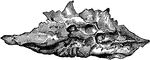
Inferior turbinated bone, convex surface. The inferior turbinated bones are situated on the outer wall of each side of the nostril. Teach consists of a layer of thin, spongy bone, curled upon itself like a scroll.

Human Nostril Bone

Inferior turbinated bone, convex surface. The inferior turbinated bones are situated on the outer wall…
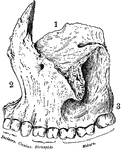
Superior maxillary bone. With it's fellow on the opposite side, it forms the whole of the upper jaw. Each bone assists in forming part of the floor of the orbit, the floor and outer wall of the nasal fossae, and the greater part of the roof of the mouth. Labels: 1, orbital surface; 2, facial surface; 3, alveolar process.

Human Maxillary (Upper Jaw) Bone

Superior maxillary bone. With it's fellow on the opposite side, it forms the whole of the upper jaw.…
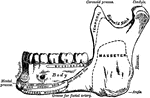
Inferior Maxillary Bone (lower jaw). It is the largest and strongest bone in the face and serves for the reception of the lower teeth.

Human Maxillary (Upper Jaw) Bone

Inferior Maxillary Bone (lower jaw). It is the largest and strongest bone in the face and serves for…
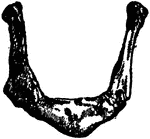
The hyoid, os hyoides, or tongue bone, is an isolated, U-shaped bone lying in front of the throat, just above the Adam's apple; it supports the tongue, and give attachment to some of its numerous muscles.

Human Hyoid Bone

The hyoid, os hyoides, or tongue bone, is an isolated, U-shaped bone lying in front of the throat, just…
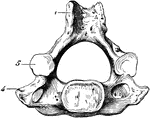
A cervical vertebra of the spine, inferior surface. Labels: 1, spinous process, slightly bifid; 4, transverse process; 5, articular process, inferior surface. Below the arch, or hollow portion, is seen the solid portion, or body.

Human Cervical Vertebra Bone

A cervical vertebra of the spine, inferior surface. Labels: 1, spinous process, slightly bifid; 4, transverse…
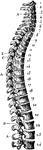
Side view of spinal column, without sacrum and coccyx. Labels: 1 to 7, cervical vertebrae; 8 to 19, dorsal vertebrae; 20 to 24, lumbar vertebrae; A, A, spinous processes; C, D, transverse processes; E, intervertebral aperture or foramen; a, atlas; 2, axis.

Human Spinal Column

Side view of spinal column, without sacrum and coccyx. Labels: 1 to 7, cervical vertebrae; 8 to 19,…
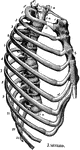
Thorax. The thorax, or chest, is an elongated conical-shaped cage, formed by the sternum and costal cartilages in front, the 12 ribs on each side, and the bodies of the 12 dorsal vertebrae behind. It contains and protects the principal organs of respiration and circulation. Labels: 1 to 12, ribs; d, d, costal cartilages; e, upper end of sternum; b, middle portion of sternum; 1 a, first dorsal vertebra; 12 a, twelfth dorsal vertebra; 7 a, seventh cervical vertebra; 1 to 7, true ribs; 8 to 12, false ribs; 11, 12, floating ribs. 10th rib is defective; it should be attached to the costal cartilage.

Human Thorax (Chest)

Thorax. The thorax, or chest, is an elongated conical-shaped cage, formed by the sternum and costal…
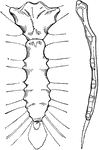
Sternum, front and side view. The sternum, or breast bone, is a flat narrow bone, situated in the median line in the front of the chest, and consisting, in the adult, of 3 portions.

Human Sternum Bone

Sternum, front and side view. The sternum, or breast bone, is a flat narrow bone, situated in the median…
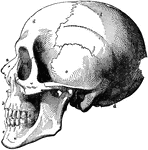
The skull. Labels: a, nasal bone; b, superior maxillary; c, inferior maxillary; d, occipital; e, temporal; f, parietal; g, frontal bone.

Human Skull

The skull. Labels: a, nasal bone; b, superior maxillary; c, inferior maxillary; d, occipital; e, temporal;…
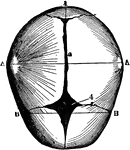
The skull at birth, superior suerface. The cranial bones of the infant at birth are not fullyformed and their edges are separated by membranous intervals. Labels: 1, posterior fontanelle; 2, sagital suture; 4, anterior fontanelle; A, A, bi-parietal diameter; B, B, bi-temporal diamter.

Human Skull at Birth

The skull at birth, superior suerface. The cranial bones of the infant at birth are not fullyformed…
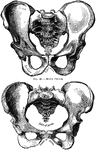
Male pelvis (top) and female pelvis (bottom). The pelvis is stronger and more massively constructed than either the cranial or thoracic cavity. It is composed of 4 bones, the ossa innominata, forming sides and front, and the sacrum and coccyx, completing it behind. The female pelvis differs from that of the male in making it better adapted for giving birth. The most notable differences are that the female pelvis is wider in every direction, giving more room for the child to pass and shallower, which lessens the distance through which the child has to be propelled; and lastly, the bones are thinner and smoother.

Human Pelvis, Male and Female

Male pelvis (top) and female pelvis (bottom). The pelvis is stronger and more massively constructed…
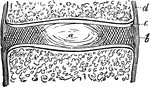
A mixed articulation (slightly movable). In this form, the bony surfaces are usually joined together by broad, flattened disks of fibro-cartilage, as in the articulations between the bodies of the vertebrae. Labels: a, b, disk of fibro-cartilage; c, articular cartilage; d, bone.

Human Joint, Mixed Articulation

A mixed articulation (slightly movable). In this form, the bony surfaces are usually joined together…
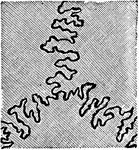
A toothed, or dentated suture. This is one type of immovable articulation. It is found in the union of the cranial bones of the skull, such as the suture between the frontal and parietal bones.

Human Joint, Dentated Suture

A toothed, or dentated suture. This is one type of immovable articulation. It is found in the union…
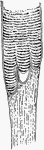
Diagram of muscle fiber with sarcolemma attached. Muscular tissue is the tissue by means of which the active movements of the body are produced. All muscular tissue consists of fibers, and whenever a muscle fiber contracts, it tends to bring its two ends, with whatever may be attached to them, together.

Muscle Fiber

Diagram of muscle fiber with sarcolemma attached. Muscular tissue is the tissue by means of which the…
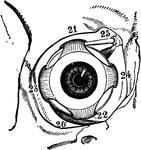
Muscles of right eyeball within the orbit, seen from the front. Labels: 21, superior rectus; 22, inferior rectus; 23, external rectus; 24, internal rectus; 25, superior oblique; 26, inferior oblique.

Muscles of the Human Eyeball

Muscles of right eyeball within the orbit, seen from the front. Labels: 21, superior rectus; 22, inferior…
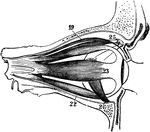
Muscles of eyeball, seen from side. Labels: 19, elevator muscle of eyelid; 22, inferior rectus; 23, external rectus; 24, internal rectus; 25, superior oblique; 26, inferior oblique.

Muscles of the Human Eyeball

Muscles of eyeball, seen from side. Labels: 19, elevator muscle of eyelid; 22, inferior rectus; 23,…
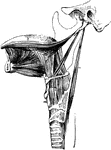
Muscles of the tongue. The chief muscles connecting the tongue and tongue bone to the lower jaw are the genio-glossus and stylo-glossus.

Muscles of the Human Tongue

Muscles of the tongue. The chief muscles connecting the tongue and tongue bone to the lower jaw are…
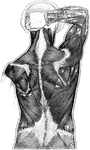
Muscles of the back. Labels: 50, latissimus dorsi; 51, trapezius; 52, deltoid. The muscles of the back are in 5 layers, one beneath another. The two largest and most superficial are the trapezius and the latissimus dorsi.

Muscles of the Human Back

Muscles of the back. Labels: 50, latissimus dorsi; 51, trapezius; 52, deltoid. The muscles of the back…
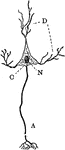
Diagram of a neuron. Labels: A, axon arising from the cell-body and branching at its termination; D, dendrites; C and N, cell-body composed of C, cytoplasm, and N, nucleus.

Diagram of a Neuron

Diagram of a neuron. Labels: A, axon arising from the cell-body and branching at its termination; D,…
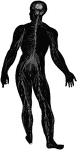
Diagram illustrating the general arrangement of the cerebrospinal nervous system.

Diagram of the Human Nervous System

Diagram illustrating the general arrangement of the cerebrospinal nervous system.
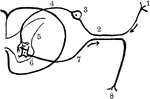
Reflex arc, as it is approximately in man. Labels: 1, nerve terminal, or sensory epithelium; 2, dendrite of sensory neuron; 3, cell body in dorsal root ganglion; 4, axon of sensory neuron; 5, dendrite of motor neuron; 6, cell body in ventral horn; 7, axon of motor neuron; 8, end organ (e.g., muscle-cell, gland-cell, etc.).

Nerve Reflex Arc

Reflex arc, as it is approximately in man. Labels: 1, nerve terminal, or sensory epithelium; 2, dendrite…
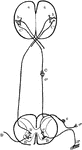
Diagram of nervous system. Labels: a, a, cortex of cerebral hemispheres; b, b, cell body and dendrites of upper motor neuron, situated in cerebral cortex; b', axon of upper motor neuron, branching at its termination near the dendrites of lower motor neuron, situated in the ventral horn of gray matter in the spinal cord; B', axon of lower motor neuron passing to its termination in a voluntary muscle fiber B"; C, cell body and dendrites of supper sensory neuron, situated in the medulla oblongata; C'C', axons of upper sensory neurons, terminating in cortex; c, cell body of lower sensory neuron situated in the dorsal root ganglion; c''', dendrite of lower motor neuron, conducting impulses from the periphery to the central nervous system; c", long axon of lower sensory neuron, conducting impulses toward the brain; c', short axon of lower sensory neuron, conducting impulses direct to ventral horn. (For the sake of simplicity the connection with the cerebellum are omitted.)

Nervous System Diagram

Diagram of nervous system. Labels: a, a, cortex of cerebral hemispheres; b, b, cell body and dendrites…

"A verticle section of one form of blast-furnace is represented [here]. the crucible (C) is the part of the furnace in which the molten matte and slag collect. The body of the furnace consists of two concentric shells (cs), made either of wrought iron or of steel, between which cold water (W) is caused to circulate to precent the inner shell becoming heated...Pipes called tuyeres (T) enter the furnace a short distance above the hearth...Above the body of the furnace extend the hood (H) and the stack (S). A door (D), used in charging the furnace, is placed in the hood." -Brownlee 1907

Blast-furnace

"A verticle section of one form of blast-furnace is represented [here]. the crucible (C) is the part…
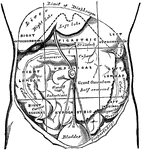
Regions of the abdomen and their contents (edge of costal cartilages in dotted outline)."For convenience of description the abdomen may be artificially divided into nine regions by drawing two circular lines around the body parallel with the cartilages of the ninth ribs, and the highest point of the crests of the ilia; and two vertical lines from the cartilage of the eighth rib on each side to the center of Poupart's ligament. The vicar contained in these different regions are as follows: -- Right Hypochondriac - the right lobe of the liver and gall-bladder, hepatic flexure of the colon, and part of the right kidney. Right Lumbar - ascending colon, part of the right kidney, and some convolutions of the small intestines. Right Inguinal (Iliac) - the caecum, appendix caeci. Epigastric Region - the middle and pyloric end o the stomach, left lobe of the liver, the pancreas, the duodenum, part of the kidneys and the suprarenal capsules. Umbilical Region - the transverse colon, part of the great omentum and mesentery, transverse part of the duodenum, and some convolutions of the jejunum and ileum, and part of both kidneys. Hypogastric Region - convolutions of the small intestines, the bladder in children, and in adults if distended, and the uterus during pregnancy. Left Hypochondriac - the splenic end of the stomach, the spleen and extremity of the pancreas, the splenic flexure of the colon, and part of the left kidney. Left Lumbar - descending color, part of the omentum, part of the left kidney, and some convolutions of the small intestines. Left Inguinal (Iliac) - sigmoid flexure of the colon." — Kimber, 1907.

Regions of the Abdomen and their Contents

Regions of the abdomen and their contents (edge of costal cartilages in dotted outline). "For convenience…
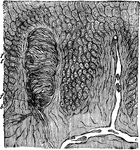
Section of skin showing two papillae and deeper layers of epidermis. The papillae contain blood vessels as well as the termination of nerve fibers in the shape of little bodies called tactile corpuscles. The papillae seem chiefly to exist for the purpose of giving the skin its sense of touch. Labels: a, vascular papilla, with capillary loop passing from subjacent vessel, c; b, nerve-papilla, containing tactile corpuscle, t; d, nerve passing up to tactile body; f, f, section of spirally winding nerve fibers.

Section of Epidermis (Skin)

Section of skin showing two papillae and deeper layers of epidermis. The papillae contain blood vessels…
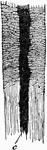
Piece of human hair, highly magnified. Labels: a, cuticle; b, fibrous substance; c, medulla.

Piece of Human Hair

Piece of human hair, highly magnified. Labels: a, cuticle; b, fibrous substance; c, medulla.
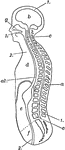
Diagrammatic longitudinal section of the trunk and head. Labels: 1,1, the dorsal cavity; a, the spinal portion; b, the cranial enlargement; c, c, the bodies of the vertebrae forming the partition between the dorsal and ventral cavities; 2, 2, the ventral cavity, subdivided into thoracic cavity (d), abdominal cavity (e), and pelvic cavity (f); g, the nasal cavity; h, the mouth, or buccal cavity. The alimentary canal (al) is represented running through the whole length of the ventral cavity.

Trunk and Head of Human Body

Diagrammatic longitudinal section of the trunk and head. Labels: 1,1, the dorsal cavity; a, the spinal…
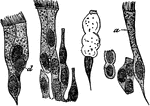
Ciliated epithelium from the human trachea, highly magnified. Labels: a, large ciliated cell; d, cell, with two nuclei."In ciliated epithelium the cells, which are generally columnar in shape, bear at their free extremities little hair-like processes which are agitated incessantly with a lashing or vibrating motion. These minute and delicate processes are named cilia, and may be regarded as active prolongations of the cell-protoplasm." —Kimber, 1907

Ciliated Epithelium Cells

Ciliated epithelium from the human trachea, highly magnified. Labels: a, large ciliated cell; d, cell,…
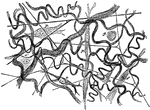
Subcutaneous areolar tissue from a young rabbit, highly magnified. The white fibers are in wavy bundles, the elastic fibers form an open network. Labels: p, p, vacuolated cells; g, granular cells; c, c, branching lamellar cells; c', a flattened cells, of which only the nucleus and some scattered granules are visible; f, fibrillated cell."If we make a cut through the skin of some part of the body where there is no subcutaneous fat, as in the upper eyelid, and proceed to raise it from the parts lying beneath, we observe that it is loosely connected to them by a soft filmy substance of considerable tenacity and elasticity. This is areolar tissue. It is also found, in like manner, under the serous and mucous membranes, and serves to attach them to the parts which they line or cover. Proceeding further, we find this areolar tissue lying between the muscles, the blood-vessels, and other deep-seated parts; also forming investing sheaths for the muscles, the nerves, the blood-vessels, and other parts. It both connects and insulates entire organs, and, in addition, performs the same office for the finer parts of which these organs are made up. It is thus one of the most general and most extensively distributed of the tissues." —Kimber, 1907

Subcutaneous Areolar Tissue from a Young Rabbit

Subcutaneous areolar tissue from a young rabbit, highly magnified. The white fibers are in wavy bundles,…

Fibrous tissue, from the longitudinal section of a tendon. "The fibrous tissue is met with in the form of ligaments, connecting the bones together at the joints, and in the form of sinews or tendons, by means of which the muscles are attached to the bones. It also forms fibrous membranes which invest and protect different parts or organs of the body." —Kimber, 1907

Fibrous Tissue of a Tendon

Fibrous tissue, from the longitudinal section of a tendon. "The fibrous tissue is met with in the form…
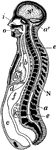
Diagrammatic longitudinal section of the body. Labels: a, the neural tube, with its upper enlargement in the skull cavity at a'; N, the spinal cord; N', the brain; ee, vertebrae forming the solid partition between the dorsal and ventral cavities; b, the pleural, and c, the abdominal division of the ventral cavity, separated from one another by the diaphragm, d; i, the nasal, and o, the mouth chamber, opening behind into the pharynx, from which one tube leads to the lungs, l, and another to the stomach, f; h, the heart; k, a kidney; s, the sympathetic nervous chain. From the stomach, f, the intestinal tube leads through the abdominal cavity to the posterior opening of the alimentary canal.

Longitudinal Section of Body

Diagrammatic longitudinal section of the body. Labels: a, the neural tube, with its upper enlargement…
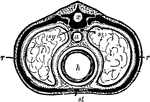
A Diagrammatic section across the body in the chest region. Labels: x, the dorsal tube, which contains the spinal cord; the black mass surrounding it is a vertebra; a, the gullet (esophagus), a part of the alimentary canal; h, the heart; sy, sympathetic nervous system; ll, lungs; the dotted lines around them are the pleurae; rr, ribs; st, the breastbone.

Section Across the Body in the Chest Region

A Diagrammatic section across the body in the chest region. Labels: x, the dorsal tube, which contains…
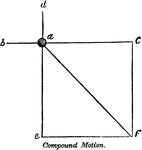
"Compound motion is that which is produced by two or more forces, acting in different directions, on the same body, at the same time." -Comstock 1850

Compound Motion

"Compound motion is that which is produced by two or more forces, acting in different directions, on…