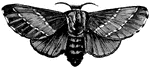
The Lackey moth, Malacosoma neustria, is a member of the genus Malacosoma, common across southern Britain and central Europe. Malacosoma species are notable for their caterpillars which are brightly coloured and form silken tents to regulate their temperature. Malacosoma neustria caterpillars are brown with blue, orange and white stripes. The adults are a fairly uniform brown. The larvae feed mainly on trees and shrubs from within their tents. In Britain the flight period is from July to August.

Lackey Moth

The Lackey moth, Malacosoma neustria, is a member of the genus Malacosoma, common across southern Britain…
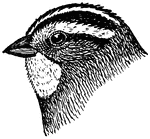
The White-throated Sparrow, Zonotrichia albicollis, is a passerine bird of the American sparrow family Emberizidae. The White-throated Sparrow is 17 cm (6.75 inches) in length with a wingspan of 23 cm (9 inches) Typical weight is 26 grams (0.91 oz). There are two adult plumage variations known as the tan-striped and white-striped forms. On the white-striped form the crown is black with a white central stripe. The supercilium is white as well. The auriculars are gray with the upper edge forming a black eye line.

White-throated Sparrow

The White-throated Sparrow, Zonotrichia albicollis, is a passerine bird of the American sparrow family…
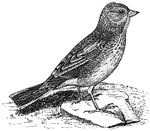
The Vesper Sparrow, Pooecetes gramineus, is a medium-sized sparrow. It is the only member of the genus Pooecetes (Baird 1858). Adults have light brown upperparts and light underparts, both with darker streaking. They have a white eye ring and a long dark brown tail which shows white outer feathers in flight. Their breeding habitat is open grassy areas across most of North America. The nest is an open cup on the ground under a clump of grass. These birds migrate to the southern and central United States and Mexico.

Vesper Sparrow

The Vesper Sparrow, Pooecetes gramineus, is a medium-sized sparrow. It is the only member of the genus…
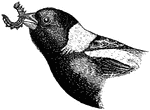
The Bobolink, Dolichonyx oryzivorus, is a small New World blackbird and the only member of genus Dolichonyx. Adults are 16-18 cm long with short finch-like bills. Adult males are mostly black, although they do display creamy napes, and white scapulars, lower backs and rumps. Adult females are mostly light brown, although their coloring includes black streaks on the back and flanks, and dark stripes on the head; their wings and tails are darker. Their breeding habitats are open grassy fields, especially hay fields, across North America. In high-quality habitats, males are often polygynous. Females lays 5 to 6 eggs in a cup-shaped nest, which is always situated on the ground and is usually well-hidden in dense vegetation. Both parents feed the young.

Bobolink (Male)

The Bobolink, Dolichonyx oryzivorus, is a small New World blackbird and the only member of genus Dolichonyx.…
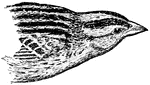
The Bobolink, Dolichonyx oryzivorus, is a small New World blackbird and the only member of genus Dolichonyx. Adults are 16-18 cm long with short finch-like bills. Adult males are mostly black, although they do display creamy napes, and white scapulars, lower backs and rumps. Adult females are mostly light brown, although their coloring includes black streaks on the back and flanks, and dark stripes on the head; their wings and tails are darker. Their breeding habitats are open grassy fields, especially hay fields, across North America. In high-quality habitats, males are often polygynous. Females lays 5 to 6 eggs in a cup-shaped nest, which is always situated on the ground and is usually well-hidden in dense vegetation. Both parents feed the young.

Bobolink (Female)

The Bobolink, Dolichonyx oryzivorus, is a small New World blackbird and the only member of genus Dolichonyx.…

The Whip-poor-will or whippoorwill, Caprimulgus vociferus, is a medium-sized (22-27 cm) nightjar from North and Central America. The Whip-poor-will is commonly heard within its range, but less often seen. It is named onomatopoeically after its call. This bird is sometimes confused[1] with the related Chuck-will's-widow (Caprimulgus carolinensis) which has a similar but lower-pitched and slower call. Adults have mottled plumage: the upperparts are grey, black and brown; the lower parts are grey and black. They have a very short bill and a black throat. Males have a white patch below the throat and white tips on the outer tail feathers; in the female, these parts are light brown.

Whip-poor-will

The Whip-poor-will or whippoorwill, Caprimulgus vociferus, is a medium-sized (22-27 cm) nightjar from…
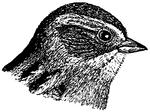
The Swamp Sparrow, Melospiza georgiana, is a medium-sized sparrow. Adults have streaked rusty and black upperparts with a grey breast, light belly and a white throat. They have a rust-coloured cap and wings. Their face is grey with a dark line through the eye. They have a short bill and fairly long legs. Their breeding habitat is marshes, including salt marshes, across eastern North America and central Canada. The bulky nest is attached to marsh vegetation, often with leaves arching over the top. On the central Atlantic coast, in the southern parts of their summer range, they are permanent residents. Other birds migrate to the southern United States.

Swamp Sparrow

The Swamp Sparrow, Melospiza georgiana, is a medium-sized sparrow. Adults have streaked rusty and black…
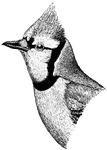
The Blue Jay (Cyanocitta cristata) is a passerine bird, and a member of the family Corvidae native to North America. It belongs to the "blue" or American jays, which are, among the Corvidae, not closely related to other jays. It is adaptable, aggressive and omnivorous, and has been colonizing new habitat for many decades.

Blue Jay

The Blue Jay (Cyanocitta cristata) is a passerine bird, and a member of the family Corvidae native to…
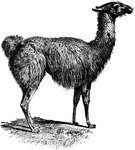
The guanaco (Lama guanicoe) is a camelid animal native to South America that stands between 107 and 122 centimeters (3.5 and 4 feet) at the shoulder and weighs about 90 kg (200 lb). The colour varies very little, ranging from a light brown to dark cinnamon and shading to white underneath. Guanacos have grey faces and small straight ears. They are extremely striking with their large, alert brown eyes, streamlined form, and energetic pace. They are particularly ideal for keeping in large groups in open parklands.

Guanaco

The guanaco (Lama guanicoe) is a camelid animal native to South America that stands between 107 and…
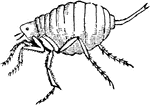
The chigoe flea (Tunga penetrans) is a parasitic arthropod found in tropical climates, especially South America and the West Indies. At 1 mm long, the chigoe flea is the smallest known flea. Breeding female chigoes burrow into exposed skin and lay eggs, causing intense irritation. After this point, the skin lesion looks like a 5 to 10 mm white spot with a central black dot, which are the flea's exposed hind legs, respiratory spiracles and reproductive organs.

Chigoe Flea (Male)

The chigoe flea (Tunga penetrans) is a parasitic arthropod found in tropical climates, especially South…

The chigoe flea (Tunga penetrans) is a parasitic arthropod found in tropical climates, especially South America and the West Indies. At 1 mm long, the chigoe flea is the smallest known flea. Breeding female chigoes burrow into exposed skin and lay eggs, causing intense irritation. After this point, the skin lesion looks like a 5 to 10 mm white spot with a central black dot, which are the flea's exposed hind legs, respiratory spiracles and reproductive organs.

Chigoe Flea (Female)

The chigoe flea (Tunga penetrans) is a parasitic arthropod found in tropical climates, especially South…
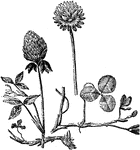
An illustration of white clover (left) and red clover (right). Clover (Trifolium), or trefoil, is a genus of about 300 species of plants in the pea family Fabaceae. The genus has a cosmopolitan distribution; the highest diversity is found in the temperate Northern Hemisphere, but many species also occur in South America and Africa, including at high altitudes on mountains in the tropics. They are small annual, biennial, or short-lived perennial herbaceous plants. The leaves are trifoliate (rarely 5- or 7-foliate), with stipules adnate to the leaf-stalk, and heads or dense spikes of small red, purple, white, or yellow flowers; the small, few-seeded pods are enclosed in the calyx

Clover

An illustration of white clover (left) and red clover (right). Clover (Trifolium), or trefoil, is a…
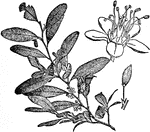
Coca is a plant in the family Erythroxylaceae, native to north-western South America. The plant plays a significant role in traditional Andean culture. Coca leaves contain cocaine alkaloids, a basis for the drug cocaine, which is a powerful stimulant. Coca should not be confused with the similarly named South American cocoa bean from which chocolate is made. The plant resembles a blackthorn bush, and grows to a height of 2–3 m (7–10 ft). The branches are straight, and the leaves, which have a green tint, are thin, opaque, oval, and taper at the extremities. A marked characteristic of the leaf is an areolated portion bounded by two longitudinal curved lines, one line on each side of the midrib, and more conspicuous on the under face of the leaf. The flowers are small, and disposed in little clusters on short stalks; the corolla is composed of five yellowish-white petals, the anthers are heart-shaped, and the pistil consists of three carpels united to form a three-chambered ovary. The flowers mature into red berries.

Coca Flower

Coca is a plant in the family Erythroxylaceae, native to north-western South America. The plant plays…
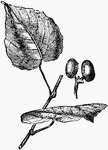
An illustration of an anamirta cocculus leaf. Anamirta cocculus is an Southeast Asian and Indian climbing plant. Its fruit, Cocculus indicus, is the source of picrotoxin, a poisonous alkaloid with stimulant properties. The plant is large-stemmed (up to 10cm in diameter); the bark is "corky gray" with white wood. The "small, yellowish-white, sweet-scented" flowers vary between 6 to 10 centimeters across; the fruit produced is a drupe, "about 1 cm in diameter when dry".

Anamirta cocculus

An illustration of an anamirta cocculus leaf. Anamirta cocculus is an Southeast Asian and Indian climbing…
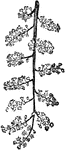
An illustration of an anamirta cocculus branch with flowers. Anamirta cocculus is an Southeast Asian and Indian climbing plant. Its fruit, Cocculus indicus, is the source of picrotoxin, a poisonous alkaloid with stimulant properties. The plant is large-stemmed (up to 10cm in diameter); the bark is "corky gray" with white wood. The "small, yellowish-white, sweet-scented" flowers vary between 6 to 10 centimeters across; the fruit produced is a drupe, "about 1 cm in diameter when dry".

Anamirta cocculus Flowers

An illustration of an anamirta cocculus branch with flowers. Anamirta cocculus is an Southeast Asian…
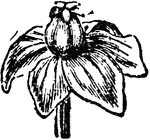
An illustration of an anamirta cocculus female flower. Anamirta cocculus is an Southeast Asian and Indian climbing plant. Its fruit, Cocculus indicus, is the source of picrotoxin, a poisonous alkaloid with stimulant properties. The plant is large-stemmed (up to 10cm in diameter); the bark is "corky gray" with white wood. The "small, yellowish-white, sweet-scented" flowers vary between 6 to 10 centimeters across; the fruit produced is a drupe, "about 1 cm in diameter when dry".

Anamirta cocculus Flower (Female)

An illustration of an anamirta cocculus female flower. Anamirta cocculus is an Southeast Asian and Indian…

An illustration of an anamirta cocculus fruit. Anamirta cocculus is an Southeast Asian and Indian climbing plant. Its fruit, Cocculus indicus, is the source of picrotoxin, a poisonous alkaloid with stimulant properties. The plant is large-stemmed (up to 10cm in diameter); the bark is "corky gray" with white wood. The "small, yellowish-white, sweet-scented" flowers vary between 6 to 10 centimeters across; the fruit produced is a drupe, "about 1 cm in diameter when dry".

Anamirta cocculus Flower (Female)

An illustration of an anamirta cocculus fruit. Anamirta cocculus is an Southeast Asian and Indian climbing…
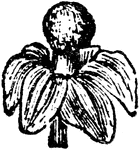
An illustration of an anamirta cocculus male flower. Anamirta cocculus is an Southeast Asian and Indian climbing plant. Its fruit, Cocculus indicus, is the source of picrotoxin, a poisonous alkaloid with stimulant properties. The plant is large-stemmed (up to 10cm in diameter); the bark is "corky gray" with white wood. The "small, yellowish-white, sweet-scented" flowers vary between 6 to 10 centimeters across; the fruit produced is a drupe, "about 1 cm in diameter when dry".

Anamirta cocculus Flower (Male)

An illustration of an anamirta cocculus male flower. Anamirta cocculus is an Southeast Asian and Indian…
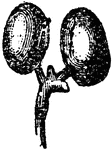
An illustration of an anamirta cocculus male flower with the sephals removed. Anamirta cocculus is an Southeast Asian and Indian climbing plant. Its fruit, Cocculus indicus, is the source of picrotoxin, a poisonous alkaloid with stimulant properties. The plant is large-stemmed (up to 10cm in diameter); the bark is "corky gray" with white wood. The "small, yellowish-white, sweet-scented" flowers vary between 6 to 10 centimeters across; the fruit produced is a drupe, "about 1 cm in diameter when dry".

Anamirta cocculus Fruit

An illustration of an anamirta cocculus male flower with the sephals removed. Anamirta cocculus is an…
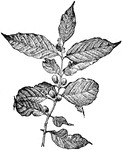
Coffea arabica is a species of coffee indigenous to Ethiopia and Yemen. It is also known as the "coffee shrub of Arabia", "mountain coffee" or "arabica coffee". Coffea arabica is believed to be the first species of coffee to be cultivated, being grown in southwest Arabia for well over 1,000 years. It is considered to produce better coffee than the other major commercially grown coffee species, Coffea canephora (robusta). Arabica contains less caffeine than any other commercially cultivated species of coffee. Wild plants grow to between 9 and 12 m tall, and have an open branching system; the leaves are opposite, simple elliptic-ovate to oblong, 6-12 cm long and 4-8 cm broad, glossy dark green. The flowers are white, 10-15 mm in diameter and grow in axillary clusters. The fruit is a drupe (though commonly called a "berry") 10-15 mm in diameter, maturing bright red to purple and typically contain two seeds (the coffee 'bean').

Coffea Arabica

Coffea arabica is a species of coffee indigenous to Ethiopia and Yemen. It is also known as the "coffee…
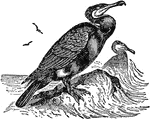
The Double-crested Cormorant (Phalacrocorax auritus) is a member of the cormorant family of seabirds. It occurs along inland waterways as well as in coastal areas, and is widely distributed across North America, from the Aleutian Islands in Alaska down to Florida and Mexico. Measuring 70–90 cm (28–35 in) in length, it is an all-black bird which gains a small double crest of black and white feathers in breeding season. It has a bare patch of orange-yellow facial skin. Five subspecies are recognized.

Double-crested Cormorant

The Double-crested Cormorant (Phalacrocorax auritus) is a member of the cormorant family of seabirds.…
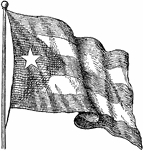
The flag of Cuba was adopted on May 20, 1902, containing a field with five blue and white stripes, and a red triangle at the hoist with a white 5-pointed star. The flag was designed in 1848 for the liberation movement, which sought to detach Cuba from Spain. The flag was briefly hoisted in 1850 at Cardenas but was not officially adopted until 1902, when independence was granted by the US.

Cuban Flag

The flag of Cuba was adopted on May 20, 1902, containing a field with five blue and white stripes, and…

The Burning of Washington took place in 1814, during the Anglo-American War of 1812. British forces occupied Washington, D.C. and set fire to many public buildings. The facilities of the U.S. government, including the White House, were largely destroyed.

Remains of the Capitol After the Fire of 1814

The Burning of Washington took place in 1814, during the Anglo-American War of 1812. British forces…

The Burning of Washington took place in 1814, during the Anglo-American War of 1812. British forces occupied Washington, D.C. and set fire to many public buildings. The facilities of the U.S. government, including the White House, were largely destroyed.

Remains of the White House After the Fire of 1814

The Burning of Washington took place in 1814, during the Anglo-American War of 1812. British forces…
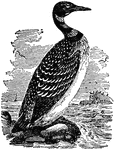
The Great Northern Diver, known in North America as the Common Loon (Gavia immer), is a large member of the loon, or diver, family. Adults can range from 61-100 cm (24-40 inches) in length with a 122-152 cm (4-5-foot) wingspan, slightly smaller than the similar White-billed Diver or "Yellow-billed Loon". The weight can vary from 1.6 to 8 kg (3.6 to 17.6 lbs). On average a Common Loon is about 81 cm (32 inches) long, has a wingspan of 136 cm (54 inches), and weighs about 4.1 kg (9 lbs).

Great Northern Diver

The Great Northern Diver, known in North America as the Common Loon (Gavia immer), is a large member…
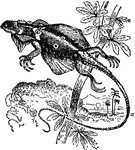
Draco volans, or the Flying Dragon, is a member of the genus of gliding lizards Draco. It can spread out folds of skin attached to its movable ribs to form "wings" that it uses to glide from tree to tree over distances upwards of 8 meters (25 feet); however, like all modern reptiles, it lacks the ability to sustain powered flight, and is capable only of gliding. Its wings are brightly colored with orange, red and blue spots and stripes, and they provide camouflage when folded. The flying dragon can reach lengths as long as 19 - 23 cm. It feeds on arboreal ants and termites.

Flying Dragon

Draco volans, or the Flying Dragon, is a member of the genus of gliding lizards Draco. It can spread…
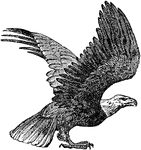
The Bald Eagle (Haliaeetus leucocephalus) is a bird of prey found in North America that is most recognizable as the national bird and symbol of the United States of America. This sea eagle has two known sub-species and forms a species pair with the White-tailed Eagle. Its range includes most of Canada and Alaska, all of the contiguous United States and northern Mexico. It is found near large bodies of open water with an abundant food supply and old-growth trees for nesting.

Bald Eagle

The Bald Eagle (Haliaeetus leucocephalus) is a bird of prey found in North America that is most recognizable…
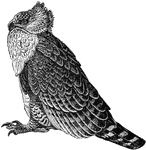
The Martial Eagle (Polemaetus bellicosus), is Africa's largest eagle and is the only member of the genus Polemaetus. t is a very large eagle, with a length of 76-90 cm (30-36 in), an average weight of 5.2 kg (11.6 lbs) and a wingspan of 190-260 cm (6.25-8.5 ft). The adult's plumage has dark brown upperparts, head and upper chest. The body underparts are white streaked with black. The underwing coverts are brown, with pale flight feathers, also streaked with black. The female is usually larger and more streaked than the male. The immature is paler above and has white underparts. It reaches adult plumage in its seventh year.

Martial Eagle

The Martial Eagle (Polemaetus bellicosus), is Africa's largest eagle and is the only member of the genus…

This house, located on the 500 block of Market Street, served as the executive mansion of the United States, while the nation's capital was located in Philadelphia, PA. Two Presidents occupied the house while in office, George Washington from 1790 to 1797, and John Adams, from 1797 to 1800.

The President's House in Philadelphia (1794)

This house, located on the 500 block of Market Street, served as the executive mansion of the United…


View of Mount Desert Island from Blue Hill Bay.

Mount Desert Island from Blue Hill Bay

View of Mount Desert Island from Blue Hill Bay.

Andrew Dickson White (November 7, 1832 – November 4, 1918) was a U.S. diplomat, author, and educator, best known as the co-founder of Cornell University. In 1869 White gave a lecture on "The Battle-Fields of Science", arguing that history showed the negative outcomes resulting from any attempt on the part of religion to interfere with the progress of science. Over the next 30 years he refined his analysis, expanding his case studies to include nearly every field of science over the entire history of Christianity, but also narrowing his target from "religion" through "ecclesiasticism" to "dogmatic theology."

Andrew Dickson White

Andrew Dickson White (November 7, 1832 – November 4, 1918) was a U.S. diplomat, author, and educator,…
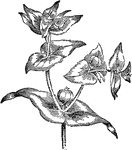
Euphorbia lathyris (Caper Spurge or Paper Spurge) is a species of spurge native to southern Europe (France, Italy, Greece, and possibly southern England), northwest Africa, and eastward through southwest Asia to western China. Other names occasionally used include Gopher Spurge, Gopher Plant or Mole Plant.It is an erect biennial (occasionally annual) plant growing up to 1.5 m tall, with a glaucous blue-green stem. The leaves are arranged in decussate opposite pairs, and are lanceolate, 5-15 cm long and 1-2.5 cm broad, glaucous blue-green with a waxy texture and pale greenish-white midrib and veins. The flowers are green to yellow-green, 4 mm diameter, with no petals. The seeds are green ripening brown or grey, produced in globular clusters 13-17 mm diameter of three seeds compressed together.

Caper Spurge

Euphorbia lathyris (Caper Spurge or Paper Spurge) is a species of spurge native to southern Europe (France,…
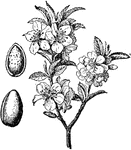
The almond is native to Iran, from northwestern Saudi Arabia, north through western Jordan, Israel, Lebanon, western Syria, to southern Turkey. It is a small deciduous tree, growing to between 4 and 10 meters in height, with a trunk of up to 30 centimeters in diameter. The young shoots are green at first, becoming purplish where exposed to sunlight, then grey in their second year. The leaves are 1 cm long and 1.2–4 cm broad, with a serrated margin and a 2.5 cm petiole. The flowers are white or pale pink, 3–5 cm diameter with five petals, produced singly or in pairs before the leaves in early spring. The fruit is a drupe 3.5–6 cm long, with a downy outer coat. The outer covering or exocarp, (fleshy in other members of Prunus such as the plum and cherry), is instead a leathery grey-green coating called the hull, which contains inside a hard shell, and the edible seed, commonly called a nut in culinary terms. Generally, one seed is present, but occasionally there are two. In botanical terms, an almond is not a true nut. The reticulated hard woody shell (like the outside of a peach pit) surrounding the edible seed is called the endocarp. The fruit is mature in the autumn, 7–8 months after flowering.

Almond Tree and Fruit

The almond is native to Iran, from northwestern Saudi Arabia, north through western Jordan, Israel,…
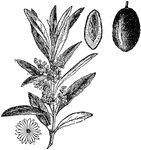
The Olive (Olea europaea) is a species of small tree in the family Oleaceae, native to the coastal areas of the eastern Mediterranean region, from Lebanon, Syria and the maritime parts of Asia Minor and northern Iran at the south end of the Caspian Sea. Its fruit, the olive, is of major agricultural importance in the Mediterranean region as the source of olive oil. The Olive tree is an evergreen tree or shrub native to the Mediterranean, Asia and parts of Africa. It is short and squat, and rarely exceeds 8–15 meters in height. The silvery green leaves are oblong in shape, measuring 4–10 cm long and 1–3 cm wide. The trunk is typically gnarled and twisted.The small white flowers, with four-cleft calyx and corolla, two stamens and bifid stigma, are borne generally on the last year's wood, in racemes springing from the axils of the leaves. The fruit is a small drupe 1–2.5 cm long, thinner-fleshed and smaller in wild plants than in orchard cultivars. Olives are harvested at the green stage or left to ripen to a rich purple colour (black olive). Canned black olives may contain chemicals that turn them black artificially.

Olive Branch

The Olive (Olea europaea) is a species of small tree in the family Oleaceae, native to the coastal areas…
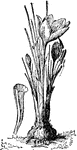
Crocus (plural: crocus, crocuses) is a genus of perennial flowering plants, native to a large area from coastal and subalpine areas of central and southern Europe (including the islands of the Aegean), North Africa and the Middle East, across Central Asia to western China. The genus Crocus is placed botanically in the iris family (Iridaceae). The plants grow from corms and are mainly hardy perennials, and are found in a wide range of habitats, including woodland, scrub and meadows. There are about eighty species of crocus (of which approximately 30 are cultivated). Their cup-shaped, solitary, salverform flowers taper off into a narrow tube. Their color varies enormously, although lilac, mauve, yellow and white are predominant. The grass-like, ensiform leaf shows generally a white central stripe along the leaf axis. The leaf margin is entire. All crocuses typically have three stamens. The spice saffron is obtained from the stigmas of Crocus sativus, an autumn/fall-blooming species.

Crocus

Crocus (plural: crocus, crocuses) is a genus of perennial flowering plants, native to a large area from…
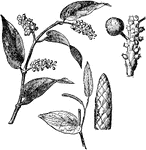
Cubeb (Piper cubeba), or tailed pepper, is a plant in genus Piper, cultivated for its fruit and essential oil. It is mostly grown in Java and Sumatra, hence sometimes called Java pepper. The fruits are gathered before they are ripe, and carefully dried. Commercial cubebs consist of the dried berries, similar in appearance to black pepper, but with stalks attached — the "tails" in "tailed pepper". The dried pericarp is wrinkled, its color ranges from grayish-brown to black. The seed is hard, white and oily. The odor of cubebs is described as agreeable and aromatic. The taste, pungent, acrid, slightly bitter and persistent. It has been described as tasting like allspice, or like a cross between allspice and black pepper.

Cubeb

Cubeb (Piper cubeba), or tailed pepper, is a plant in genus Piper, cultivated for its fruit and essential…
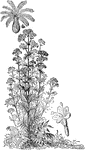
Valerian (Valeriana officinalis, Valerianaceae) is a hardy perennial flowering plant, with heads of sweetly scented pink or white flowers. The flowers are in bloom in the northern hemisphere from June to September. Valerian was used as a perfume in the sixteenth century. Native to Europe and parts of Asia, Valerian has been introduced into North America. It is consumed as food by the larvae of some Lepidoptera (butterfly and moth) species including Grey Pug.

Valerian

Valerian (Valeriana officinalis, Valerianaceae) is a hardy perennial flowering plant, with heads of…
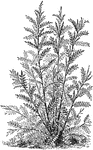
Licorice is the root of Glycyrrhiza glabra, from which a sweet flavour can be extracted. The liquorice plant is a legume (related to beans and peas) and native to southern Europe and parts of Asia. It is an herbaceous perennial, growing to 1 m in height, with pinnate leaves about 7–15 centimetres (3–6 inches) long, with 9–17 leaflets. The flowers are 0.8–1.2 cm (1/3 to 1/2 inch) long, purple to pale whitish blue, produced in a loose inflorescence. The fruit is an oblong pod, 2–3 centimetres (about 1 inch) long, containing several seeds.

Licorice

Licorice is the root of Glycyrrhiza glabra, from which a sweet flavour can be extracted. The liquorice…
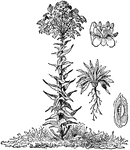
Woad (or glastum) is the common name of the flowering plant Isatis tinctoria in the family Brassicaceae. It is commonly called dyer's woad, and sometimes incorrectly listed as Isatis indigotica (a newer and invalid name for the same plant). It is occasionally known as Asp of Jerusalem. Woad is also the name of a blue dye produced from the plant. Woad is native to the steppe and desert zones of the Caucasus, Central Asia to eastern Siberia and Western Asia (Hegi), but is now found in southeastern and some parts of Central Europe as well. It has been cultivated throughout Europe, especially in Western and southern Europe, since ancient times.

Woad

Woad (or glastum) is the common name of the flowering plant Isatis tinctoria in the family Brassicaceae.…
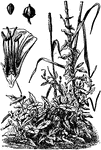
Convolvulus is a genus of about 250 species of flowering plants in the bindweed family Convolvulaceae, with a cosmopolitan distribution. Common names include bindweed and morning glory, both names shared with other closely related genera. They are annual or perennial herbaceous vines and (a few species) woody shrubs, growing to 0.3-3 m tall. The leaves are spirally arranged, and the flowers trumpet-shaped, mostly white or pink, but blue, violet, purple or yellow in some species. Many of the species are problematic weeds, which can swamp other more valuable plants by climbing over them, but some are also deliberately grown for their attractive flowers. However, some other species are globally threatened.

Bindweed

Convolvulus is a genus of about 250 species of flowering plants in the bindweed family Convolvulaceae,…

The Most Reverend William White (April 4, 1748 N.S. – July 17, 1836) was the first and fourth Presiding Bishop of the Episcopal Church, USA (1789; 1795–1836), the first Bishop of the Diocese of Pennsylvania (1787–1836), and the second United States Senate Chaplain (appointed December 9, 1790).

William White

The Most Reverend William White (April 4, 1748 N.S. – July 17, 1836) was the first and fourth…

The Jacob Purdy House was used as General George Washington's headquarters in 1778 and possibly in 1776 during the Battle of White Plains of the American Revolutionary War.

Jacob Purdy House

The Jacob Purdy House was used as General George Washington's headquarters in 1778 and possibly in 1776…

While Washington was inspecting the terrain, seeing where it was best to station his troops, he ran into several light horseman and told him that the British were advancing. Washington rode back to camp to prepare his men. He quickly stationed a couple hundred Continentals and a couple of artillery pieces onto Chatterton Hill, to support the militia. The skirmishers, who had the job of slowing the British advance, retired soon after Washington reinforced Chatterton Hill.

Chatterton's Hill, From the Railway Station

While Washington was inspecting the terrain, seeing where it was best to station his troops, he ran…
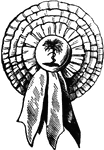
Ornaments made of blue silk ribbon with a button in the center bearing the image of a palmetto tree. They were worn by ladies of Charleston immediately after the passage of the ordinance of succession.

Palmetto Cockade

Ornaments made of blue silk ribbon with a button in the center bearing the image of a palmetto tree.…
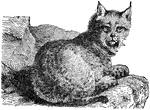
A lynx is any of four medium-sized wild cats. All are members of the genus Lynx, but there is considerable confusion about the best way to classify felids at present, and some authorities classify them as part of the genus Felis. The Caracal, despite sometimes being called Persian Lynx or African Lynx, does not belong to this genus. Lynx have short tails and characteristic tufts of black hair on the tip of the ears. They have a ruff under the neck, which has black bars (not very visible), resembling a bow tie. They have large paws padded for walking on snow and long whiskers on the face. The body color varies from medium brown to gold-ish to beige-white; and occasionally, is marked with dark brown spots, especially on the limbs. All species of lynx also have white fur on their chests, bellies and on the insides of their legs which are extensions of the chest and belly fur. Also, the lynx's coloring, fur height and paw size varies by its climate range- in the Southwest US, the fur and color are short-haired, dark and the paws are smaller and less padded, as the lynx ranges to its colder Northern climes, the fur gets progressively thicker (for warmth), the color gets lighter (for camouflage) and its paws enlarge and become more padded for snowy environments.

Lynx

A lynx is any of four medium-sized wild cats. All are members of the genus Lynx, but there is considerable…
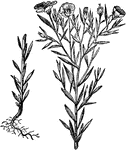
Flax (also known as common flax or linseed) (binomial name: Linum usitatissimum) is a member of the genus Linum in the family Linaceae. It is native to the region extending from the eastern Mediterranean to India and was probably first domesticated in the Fertile Crescent. Flax is an erect annual plant growing to 1.2 m tall, with slender stems. The leaves are glaucous green, slender lanceolate, 20–40 mm long and 3 mm broad. The flowers are pure pale blue, 15–25 mm diameter, with five petals; they can also be bright red. The fruit is a round, dry capsule 5–9 mm diameter, containing several glossy brown seeds shaped like an apple pip, 4–7 mm long.

Flax

Flax (also known as common flax or linseed) (binomial name: Linum usitatissimum) is a member of the…
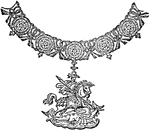
An illustration of the Order of the Garder's collar and George. The collar is an accessory worn around the neck, over the mantle. Like the mantle, it was introduced in the 15th and 16th centuries. Made of pure gold, it weighs 30 troy ounces (0.933 kg). The collar is composed of gold knots alternating with enamelled medallions showing a rose encircled by the Garter. During King Henry VII's reign, each garter surrounded two roses—one red and one white—but he changed the design such that each garter encircled only one red rose. The George, which is worn suspended from the collar, is a colorfully enameled three-dimensional figure of St George the Martyr on horseback slaying a dragon.

Order of the Garter's Collar and George

An illustration of the Order of the Garder's collar and George. The collar is an accessory worn around…

An illustration of the Order of the Garder's garter. The Garter is worn on ceremonial occasions around the left calf by knights and around the left arm by ladies, and is depicted on several insignia. The Garter is a buckled dark-blue (originally light-blue) velvet strap, and bears the motto in gold letters. The garters of Stranger Knights and Ladies were once set with several jewels.

Order of the Garter's Garter

An illustration of the Order of the Garder's garter. The Garter is worn on ceremonial occasions around…

The Seal of the State of Massachusetts. The seal has a shield in the center with a Algonquin Native American holding a bow and arrow. Around the shield, is a blue ribbon with the state motto, 'Ense Petit Placidam Sub Libertate Quietem" which means "By the sword we seek peace, but only under liberty."

Seal of Massachusetts

The Seal of the State of Massachusetts. The seal has a shield in the center with a Algonquin Native…

The Great Seal of the State of Michigan. This seal shows the Michigan's coat of arms held by an elk and a moose. The white ribbon holds the state motto, 'Si Quaeris Peninsulam Amoenam Circumspice' which means "If you seek a pleasant peninsula, look about you."

Seal of Michigan

The Great Seal of the State of Michigan. This seal shows the Michigan's coat of arms held by an elk…

The Great Seal of the State of Utah, 1896. The seal shows a bald eagle holding a shield. The shield has a beehive with the motto "Industry."

Seal of Utah

The Great Seal of the State of Utah, 1896. The seal shows a bald eagle holding a shield. The shield…
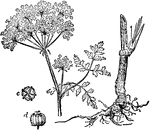
Northern Water Hemlock is a species of Cicuta, native to northern and central Europe, northern Asia and northwestern North America. It is a perennial herbaceous plant which grows up to 1–2 m tall. The stems are smooth, branching, swollen at the base, purple-striped, and hollow except for partitions at the junction of the leaves and stem. In cross section the stems have one flat side and the other sides are rounded. The leaves are alternate, tripinnate, only coarsely toothed, unlike the ferny, lacy leaves found in many other members of the family Apiaceae. The flowers are small, white and clustered in umbrella shaped inflorescences typical of the family. The many flowered umbellets have unequal pedicels that range from 5 to 11 cm long during fruiting. An oily, yellow liquid oozes from cuts to the stems and roots.

Northern Water Hemlock

Northern Water Hemlock is a species of Cicuta, native to northern and central Europe, northern Asia…
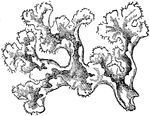
celand moss (Cetraria islandica) is a lichen whose erect or ascending foliaceous habit gives it something of the appearance of a moss, whence probably the name. It is often of a pale chestnut color, but varies considerably, being sometimes almost entirely greyish white; and grows to a height of from 3 to 4 in., the branches being channelled or rolled into tubes, which terminate in flattened lobes with fringed edges.

Iceland Moss

celand moss (Cetraria islandica) is a lichen whose erect or ascending foliaceous habit gives it something…

Diocletian's Palace (Dioklecijanova palaca in Croatian) is a building in Split in Croatia that was built by the emperor Diocletian at the turn of the fourth century AD. The Latin name of the city, Spalatum, was drawn from that of the nearby Greek colony Aspalathos, which in turn was named after a white thorn common in the area. Contrary to popular belief, it has nothing to do with the Latin word for palace, palatium.

Palace of Diocletian, Plan

Diocletian's Palace (Dioklecijanova palaca in Croatian) is a building in Split in Croatia that was built…
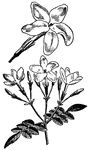
Jasminum grandiflorum (chameli in Hindi) is a species of jasmine native to South Asia. In India, its leaves are widely used as an Ayurvedic herbal medicine and its flowers are used to adorn the coiffure of women. In Pakistan, it grows wild in the Salt Range and Rawalpindi District at 500-1500 m altitude. It is closely related to, and sometimes treated as merely a form of, Jasminum officinale. It is a scrambling deciduous shrub growing to 2–4 m tall. The leaves are opposite, 5–12 cm long, pinnate with 5–11 leaflets. The flowers are produced in open cymes, the individual flowers are white having corolla with a basal tube 13–25 mm long and five lobes 13–22 mm long. The flower's fragrance is unique and sweet. It is widely cultivated as an ornamental plant in warm temperate and subtropical regions.

Jasminum grandiflorum

Jasminum grandiflorum (chameli in Hindi) is a species of jasmine native to South Asia. In India, its…

The Basilica di Santa Maria del Fiore is the cathedral church (Duomo) of Florence, Italy, begun in 1296 and with major construction completed in 1436. The basilica is notable for its dome designed by Filippo Brunelleschi, its exterior facing of polychrome marble panels in various shades of green and pink bordered by white.

Section of the Dome of Duomo, Florence

The Basilica di Santa Maria del Fiore is the cathedral church (Duomo) of Florence, Italy, begun in 1296…
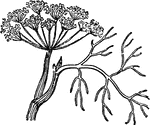
Dill (Anethum graveolens) is a short-lived perennial herb. It is the sole species of the genus Anethum, though classified by some botanists in a related genus as Peucedanum graveolens (L.) C.B.Clarke. It grows to 40–60 cm (16–24 in) 1 inch, with slender stems and alternate, finely divided, softly delicate leaves 10–20 cm (3.9–7.9 in) long. The ultimate leaf divisions are 1–2 mm (0.039–0.079 in) broad, slightly broader than the similar leaves of fennel, which are threadlike, less than 1 mm (0.039 in) broad, but harder in texture. The flowers are white to yellow, in small umbels 2–9 cm (0.79–3.5 in) diameter. The seeds are 4–5 mm (0.16–0.20 in) long and 1 mm (0.039 in) thick, and straight to slightly curved with a longitudinally ridged surface.

Dill

Dill (Anethum graveolens) is a short-lived perennial herb. It is the sole species of the genus Anethum,…
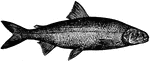
The Shad-Waiter (Coregonus quadrilateralis) is a whitefish in the Salmonidae family of salmon.

Shad-Waiter

The Shad-Waiter (Coregonus quadrilateralis) is a whitefish in the Salmonidae family of salmon.
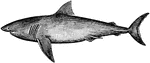
The Great White Shark (Carcharodon carcharias) is a large shark in the Lamnidae family of mackerel and white sharks.

Great White Shark

The Great White Shark (Carcharodon carcharias) is a large shark in the Lamnidae family of mackerel and…
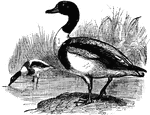
The Common Shelduck (Tadorna tadorna) is a duck distinguished by its red bill and white, brown, and green feathers. It belongs to the Anatidae family of ducks, geese, and swans.

Common Shelduck

The Common Shelduck (Tadorna tadorna) is a duck distinguished by its red bill and white, brown, and…