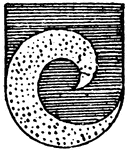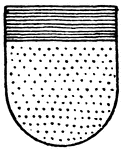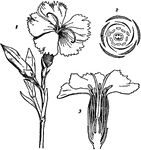
"Quarterly, first and fourth argent, a chevron gules, second and third gules, a cross argent (that is, the field red and the cross silver or white)." -Whitney, 1911

Quarterly Shield

"Quarterly, first and fourth argent, a chevron gules, second and third gules, a cross argent (that is,…
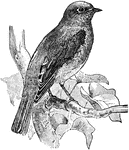
The Eastern Bluebird (Sialia sialis) is a medium-sized bird in the Turdidae family of thrushes.

Eastern Bluebird

The Eastern Bluebird (Sialia sialis) is a medium-sized bird in the Turdidae family of thrushes.
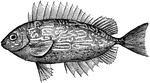
The Spiny Rabbitfish (Siganus spinus) is a perciform fish in the Siganidae family of spinefoots.

Spiny Rabbitfish

The Spiny Rabbitfish (Siganus spinus) is a perciform fish in the Siganidae family of spinefoots.
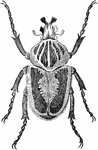
The Goliath beetles are among the largest insects on Earth, if measured in terms of size, bulk and weight. They are members of subfamily Cetoniinae, within the scarab beetle family. Goliath beetles can be found in many of Africa's tropical forests, where they feed primarily on tree sap and fruit. Little appears to be known of the larval cycle in the wild, but in captivity, Goliathus beetles have been successfully reared from egg to adult using protein-rich foods such as commercial cat and dog food. Goliath beetles measure from 60–110 millimetres (2.4–4.3 in) for males and 50–80 millimetres (2.0–3.1 in) for females, as adults, and can reach weights of up to 80–100 grams (2.8–3.5 oz) in the larval stage, though the adults are only about half this weight. The females range from a dark brown to silky white, but the males are nomally brown/white/black or black/white.

Goliath Beetle

The Goliath beetles are among the largest insects on Earth, if measured in terms of size, bulk and weight.…
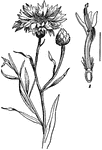
It is an annual plant growing to 40-90 cm tall, with grey-green branched stems. The leaves are lanceolate, 1-4 cm long. The flowers are most commonly an intense blue colour, produced in flowerheads (capitula) 1.5-3 cm diameter, with a ring of a few large, spreading ray florets surrounding a central cluster of disc florets.

Cornflower

It is an annual plant growing to 40-90 cm tall, with grey-green branched stems. The leaves are lanceolate,…
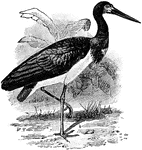
The Abdim's Stork (Ciconia abdimii) is a large bird in the Ciconiidae family of storks.

Abdim's Stork

The Abdim's Stork (Ciconia abdimii) is a large bird in the Ciconiidae family of storks.

A cottage with a lovely garden and white picket fence. Sunflowers bloom and grape vines grow wild.
Cottage

A cottage with a lovely garden and white picket fence. Sunflowers bloom and grape vines grow wild.

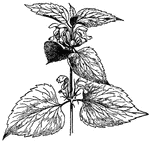
Lamium album (White Deadnettle) is a flowering plant in the family Lamiaceae, native throughout Europe and western Asia, growing in a variety of habitats from open grassland to woodland, generally on moist, fertile soils. It is a herbaceous perennial plant growing to 50-100 cm tall, with green, four-angled stems. The leaves are 3-8 cm long and 2-5 cm broad, triangular with a rounded base, softly hairy, and with a serrated margin and a petiole up to 5 cm long; they appear superficially similar to those of the Stinging nettle Urtica dioica but do not sting, hence the common name "dead nettle". The flowers are white, produced in whorls ('verticillasters') on the upper part of the stem, the individual flowers 1.5-2.5 cm long

Lamium Album

Lamium album (White Deadnettle) is a flowering plant in the family Lamiaceae, native throughout Europe…
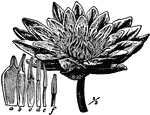
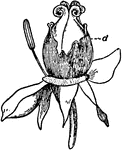
An illustration of a white water lily and the transition from petals to stamens.

White Water Lily

An illustration of a white water lily and the transition from petals to stamens.

Paeonia) is the only genus in the flowering plant family Paeoniaceae. They are native to Asia, southern Europe and western North America. Most are herbaceous perennial plants 0.5–1.5 metres tall, but some are woody shrubs up to 1.5–3 metres tall. They have compound, deeply lobed leaves, and large, often fragrant flowers, ranging from red to white or yellow, in late spring and early summer. In the past, the peonies were often classified in the family Ranunculaceae, alongside Hellebores and Anemones.

Peony Bud

Paeonia) is the only genus in the flowering plant family Paeoniaceae. They are native to Asia, southern…
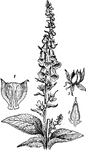
An illustration of: 1, Coralla cut open showing the four stamens; 2, Unripe fruit (lengthwise); 3, ripe capsule split open; and the foxglove plant. Digitalis is a genus of about 20 species of herbaceous perennials, shrubs, and biennials that are commonly called foxgloves. The genus was traditionally placed in the figwort family Scrophulariaceae, but upon review of phylogenetic research, it has now been placed in the much enlarged family Plantaginaceae. The genus is native to Europe, western and central Asia, and northwestern Africa. The scientific name means "finger-like" and refers to the ease with which a flower of Digitalis purpurea can be fitted over a human fingertip. The flowers are produced on a tall spike, are tubular, and vary in colour with species, from purple to pink, white, and yellow. The best-known species is the Common Foxglove, Digitalis purpurea. It is a biennial, often grown as an ornamental plant due to its showy flowers, that range in colour from purples through to whites, with variable marks and spotting. The first year of growth produces only the long, basal leaves. In the second year, the erect leafy stem 0.5-2.5 m tall develops.

Foxglove

An illustration of: 1, Coralla cut open showing the four stamens; 2, Unripe fruit (lengthwise); 3, ripe…

Kyanite, whose name derives from the Greek word kyanos, meaning blue, is a typically blue silicate mineral, commonly found in aluminium-rich metamorphic pegmatites and/or sedimentary rock. Kyanite is a diagnostic mineral of the Blueschist Facies of metamorphic rocks.

Kyanite

Kyanite, whose name derives from the Greek word kyanos, meaning blue, is a typically blue silicate mineral,…
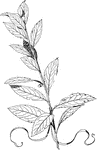
The Laural is an Evergreen that blossoms a yellowish white and its fruit ball is egg shaped in a blue black color.

Laurel Ornament

The Laural is an Evergreen that blossoms a yellowish white and its fruit ball is egg shaped in a blue…
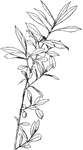
The Olive Ornament is an Evergreen that blossoms a small white oval fruit, greenish black.

Olive Ornament

The Olive Ornament is an Evergreen that blossoms a small white oval fruit, greenish black.
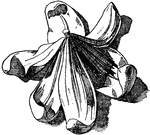
The White Lily is used as an ornament design in flat and relief forms.

White Lily

The White Lily is used as an ornament design in flat and relief forms.

The Blue-Bell flower is used as an ornament design in flat and relief forms.

Blue-Bell Flower

The Blue-Bell flower is used as an ornament design in flat and relief forms.

The Per Pale Ordinary has the right half side in argent (silver) and the left half in per fesse azure (blue) and or.

Per Pale Ordinary

The Per Pale Ordinary has the right half side in argent (silver) and the left half in per fesse azure…
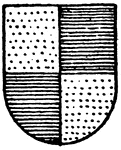
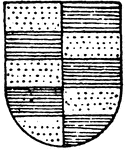
The Quarterly Ordinary has colors of or and azure (blue).

Quarterly Ordinary

The Quarterly Ordinary has colors of or and azure (blue).

The Per Pale is a pattern of five sections on each side in the colors or and azure (blue), counterchanged.

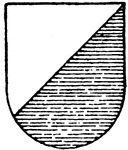
Per Pale Ordinary

The Per Pale is a pattern of five sections on each side in the colors or and azure (blue), counterchanged.

The Azure Ordinary has a chief point in vair.

Azure Ordinary

The Azure Ordinary has a chief point in vair.

The Per Bend Sinister Ordinary has colors of argent (silver) and azure (blue).

Per Bend Sinister Ordinary

The Per Bend Sinister Ordinary has colors of argent (silver) and azure (blue).
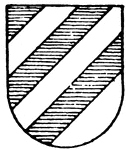
The Bendy Sinister of Six Ordinary is in azure (blue) and argent (silver) colors.

Bendy Sinister of Six Ordinary

The Bendy Sinister of Six Ordinary is in azure (blue) and argent (silver) colors.

The Lozengy Ordinary has colors of argent (silver) and azure (blue).

Lozengy Ordinary

The Lozengy Ordinary has colors of argent (silver) and azure (blue).

The Fusilly Ordinary is in argent (silver) and azure (blue).

Fusilly Ordinary

The Fusilly Ordinary is in argent (silver) and azure (blue).

The Or Ordinary in pile azure (blue).

Or Ordinary

The Or Ordinary in pile azure (blue).

The Chevronny of Six Ordinary is in azure (blue) and argent (silver) colors.
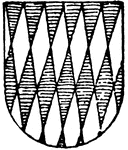
Chevronny of Six Ordinary

The Chevronny of Six Ordinary is in azure (blue) and argent (silver) colors.
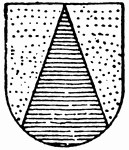
The Gyronny of Eight is in or and azure (blue).

Gyronny of Eight Ordinary

The Gyronny of Eight is in or and azure (blue).

The Argent Ordinary is a gyron design in an azure (blue) color, moving from the dexter (right) side.

Argent Ordinary

The Argent Ordinary is a gyron design in an azure (blue) color, moving from the dexter (right) side.

The Per Pall Ordinary is reversed in or, argent (silver), and azure (blue) colors.

Per Pall Ordinary

The Per Pall Ordinary is reversed in or, argent (silver), and azure (blue) colors.

The Pily Barwise Ordinary is in argent (silver) and azure (blue).

Pily Barwise Ordinary

The Pily Barwise Ordinary is in argent (silver) and azure (blue).

The Per Fesse Escartely Ordinary is in azure (blue) and or.

Escartely Per Fesse Ordinary

The Per Fesse Escartely Ordinary is in azure (blue) and or.

The Per Bend Indented is in azure (blue) and argent (silver) colors.

Per Bend Indented Ordinary

The Per Bend Indented is in azure (blue) and argent (silver) colors.
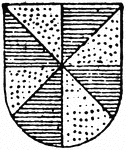
The Per Pale Potented is in argent (silver) and azure (blue).

Per Pale Potented Ordinary

The Per Pale Potented is in argent (silver) and azure (blue).

The Per Fesse Nebuly is in azure (blue) and argent (silver).

Per Fesse Nebuly Ordinary

The Per Fesse Nebuly is in azure (blue) and argent (silver).

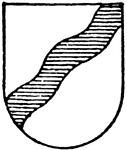
The Argent Ordinary is a bend on the sinister (left) side in a wavy azure (blue) color.

Argent Ordinary

The Argent Ordinary is a bend on the sinister (left) side in a wavy azure (blue) color.

The Azure Ordinary is a gurge issuing from the sinister (left) base.

Azure Ordinary

The Azure Ordinary is a gurge issuing from the sinister (left) base.

The Barry of Five Ordinary is of azure (blue) and argent (silver) colors.

Barry of Five Ordinary

The Barry of Five Ordinary is of azure (blue) and argent (silver) colors.

The Or Ordinary is chiefly colored in azure or blue.

Or Ordinary

The Or Ordinary is chiefly colored in azure or blue.

Dianthus is a genus of about 300 species of flowering plants in the family Caryophyllaceae, native mainly to Europe and Asia, with a few species extending south to north Africa, and one species (D. repens) in arctic North America. The species are mostly perennial herbs, a few are annual or biennial, and some are low subshrubs with woody basal stems. The leaves are opposite, simple, mostly linear and often strongly glaucous grey-green to blue-green. The flowers have five petals, typically with a frilled or pinked margin, and are (in almost all species) pale to dark pink. One species, D. knappii, has yellow flowers with a purple center.

Dianthus

Dianthus is a genus of about 300 species of flowering plants in the family Caryophyllaceae, native mainly…
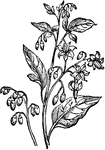
The Bittersweet (Solanum dulcamara) is a perennial vine in the Solanaceae family of nightshades.

Bittersweet

The Bittersweet (Solanum dulcamara) is a perennial vine in the Solanaceae family of nightshades.
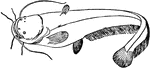
The wels catfish is a scaleless fresh and brackish water catfish recognizable by its broad, flat head and wide mouth. The mouth contains lines of numerous small teeth, two long barbels on the upper jaw and four shorter barbels on the lower jaw. It has a long anal fin that extends to the caudal fin, and a small sharp dorsal fin positioned relatively far forward. It uses its sharp pectoral fins to capture prey. With these fins, it creates an eddy to disorient its victim, which it then simply engulfs in its enormous throat. It has very slippery green-brown skin. Its belly is pale yellow or white. Wels catfish can live for at least thirty years and have very good hearing.

Wels Catfish

The wels catfish is a scaleless fresh and brackish water catfish recognizable by its broad, flat head…
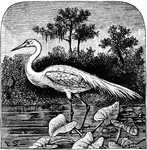
The Great Egret (Ardea alba) is a large wading bird of the Ardeidae family of herons.

Great Egret

The Great Egret (Ardea alba) is a large wading bird of the Ardeidae family of herons.

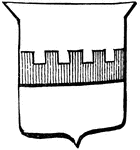
The white represents silver or "argent," the fesse is the band going across. It is gules or red and its shape is called battlement. "Argent, a Fesse Embattled Gules." -Whitney, 1911

Battlement

The white represents silver or "argent," the fesse is the band going across. It is gules or red and…
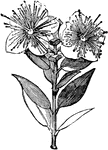
The Myrtle (Myrtus) is a genus of one or two species of flowering plants in the family Myrtaceae, native to southern Europe and north Africa. They are evergreen shrubs or small trees, growing to 5 m tall. The leaves are entire, 3-5 cm long, with a fragrant essential oil. The star-like flowers have five petals and sepals, and numerous stamens. Petals are usually white. The fruits are globose blue-black berries containing several seeds. The flowers are pollinated by insects, and the seeds dispersed by birds that feed on the berries.

Myrtle

The Myrtle (Myrtus) is a genus of one or two species of flowering plants in the family Myrtaceae, native…
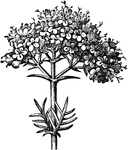
Valerian is a hardy perennial flowering plant, with heads of sweetly scented pink or white flowers. The flowers are in bloom in the northern hemisphere from June to September. Valerian was used as a perfume in the sixteenth century.

Valerian Inflorescence

Valerian is a hardy perennial flowering plant, with heads of sweetly scented pink or white flowers.…
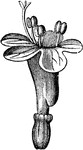
Valerian is a hardy perennial flowering plant, with heads of sweetly scented pink or white flowers. The flowers are in bloom in the northern hemisphere from June to September. Valerian was used as a perfume in the sixteenth century.

Valerian Flower

Valerian is a hardy perennial flowering plant, with heads of sweetly scented pink or white flowers.…
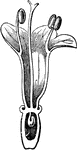
An illustration of a longitudinal sectional view of the valerian flower. Valerian is a hardy perennial flowering plant, with heads of sweetly scented pink or white flowers. The flowers are in bloom in the northern hemisphere from June to September. Valerian was used as a perfume in the sixteenth century.

Valerian Flower (Longitudinal Section)

An illustration of a longitudinal sectional view of the valerian flower. Valerian is a hardy perennial…
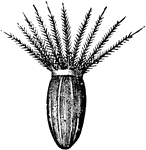
An illustration of the valerian seed with attached pappus. In a composite flower, Pappus is the part of individual disk and ray flowers that surrounds the base, in the same manner as the calyx does in a non-compound flower. The pappus may be like bristles or tiny hairs, teeth, or scales, and is usually too small to see without magnification. Valerian is a hardy perennial flowering plant, with heads of sweetly scented pink or white flowers. The flowers are in bloom in the northern hemisphere from June to September. Valerian was used as a perfume in the sixteenth century.

Valerian Seed with Pappus

An illustration of the valerian seed with attached pappus. In a composite flower, Pappus is the part…
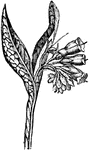
Comfrey (also comphrey) is an important herb in organic gardening, having many medicinal and fertilizer uses. Comfrey (Symphytum officinale L.) is a perennial herb of the family Boraginaceae with a black, turnip-like root and large, hairy broad leaves that bears small bell-shaped white, cream, purple or pink flowers. It is native to Europe, growing in damp, grassy places, and is widespread throughout the British Isles on river banks and ditches.

Comfrey

Comfrey (also comphrey) is an important herb in organic gardening, having many medicinal and fertilizer…
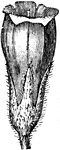
Comfrey (also comphrey) is an important herb in organic gardening, having many medicinal and fertilizer uses. Comfrey (Symphytum officinale L.) is a perennial herb of the family Boraginaceae with a black, turnip-like root and large, hairy broad leaves that bears small bell-shaped white, cream, purple or pink flowers. It is native to Europe, growing in damp, grassy places, and is widespread throughout the British Isles on river banks and ditches.

Comfrey Flower

Comfrey (also comphrey) is an important herb in organic gardening, having many medicinal and fertilizer…
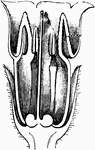
Comfrey (also comphrey) is an important herb in organic gardening, having many medicinal and fertilizer uses. Comfrey (Symphytum officinale L.) is a perennial herb of the family Boraginaceae with a black, turnip-like root and large, hairy broad leaves that bears small bell-shaped white, cream, purple or pink flowers. It is native to Europe, growing in damp, grassy places, and is widespread throughout the British Isles on river banks and ditches.

Comfrey (Longitudinal Section)

Comfrey (also comphrey) is an important herb in organic gardening, having many medicinal and fertilizer…
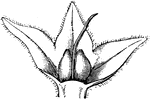
Comfrey (also comphrey) is an important herb in organic gardening, having many medicinal and fertilizer uses. Comfrey (Symphytum officinale L.) is a perennial herb of the family Boraginaceae with a black, turnip-like root and large, hairy broad leaves that bears small bell-shaped white, cream, purple or pink flowers. It is native to Europe, growing in damp, grassy places, and is widespread throughout the British Isles on river banks and ditches.

Sepal and Fruit of Comfrey

Comfrey (also comphrey) is an important herb in organic gardening, having many medicinal and fertilizer…
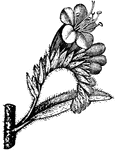
Echium vulgare (Viper's Bugloss) is a species of Echium native to most of Europe, and western and central Asia. It is a biennial or monocarpic perennial plant growing to 30-80 cm tall, with rough, hairy, lanceolate leaves. The flowers start pink and turn vivid blue and are 15-20 mm in a branched spike, with all the stamens protruding. Stamens remain red and stand out against the blue flowers. It flowers between May and September. It is found in dry, bare and waste places.

Viper's Bugloss Inflorescence

Echium vulgare (Viper's Bugloss) is a species of Echium native to most of Europe, and western and central…
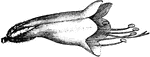
Echium vulgare (Viper's Bugloss) is a species of Echium native to most of Europe, and western and central Asia. It is a biennial or monocarpic perennial plant growing to 30-80 cm tall, with rough, hairy, lanceolate leaves. The flowers start pink and turn vivid blue and are 15-20 mm in a branched spike, with all the stamens protruding. Stamens remain red and stand out against the blue flowers. It flowers between May and September. It is found in dry, bare and waste places.

Viper's Bugloss Flower

Echium vulgare (Viper's Bugloss) is a species of Echium native to most of Europe, and western and central…
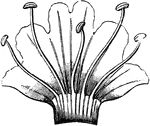
Echium vulgare (Viper's Bugloss) is a species of Echium native to most of Europe, and western and central Asia. It is a biennial or monocarpic perennial plant growing to 30-80 cm tall, with rough, hairy, lanceolate leaves. The flowers start pink and turn vivid blue and are 15-20 mm in a branched spike, with all the stamens protruding. Stamens remain red and stand out against the blue flowers. It flowers between May and September. It is found in dry, bare and waste places.

Viper's Bugloss Corolla and Stamens

Echium vulgare (Viper's Bugloss) is a species of Echium native to most of Europe, and western and central…
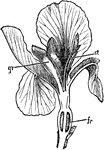
Iris is a genus of between 200-300 species of flowering plants with showy flowers. It takes its name from the Greek word for a rainbow, referring to the wide variety of flower colors found among the many species. As well as being the scientific name, iris is also very widely used as a common name; for one thing, it refers to all Iris species, but some plants called thus belong to closely related genera. In North America, a common name for irises is flags, while the subgenus Scorpiris is widely known as junos, particularly in horticulture.

Iris

Iris is a genus of between 200-300 species of flowering plants with showy flowers. It takes its name…
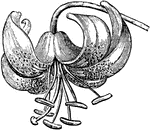
Lilium martagon (Martagon or Turk's cap lily) is a species of lily. It has a widespread native region extending from central Europe east through northern Asia to Mongolia and Korea. Several subspecies have been named. The plant is stem-rooting, growing between 1 m and 2 m tall. The flower colour is typically a pink-purple, with dark spots, but is quite variable, extending from near white to near black. The flowers are scented. Numerous flowers are borne on each plant, and up to 50 can be found on vigorous plants.

Turk's Cap Lily

Lilium martagon (Martagon or Turk's cap lily) is a species of lily. It has a widespread native region…
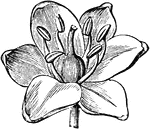
Scilla (squill) is a genus of bulb-forming perennial herbs in the Hyacinthaceae. The 90-odd species are found in woodlands, subalpine meadows, and seashores across the Old World. Their flowers are usually blue, but white, pink, and purple types are known; most flower in early spring, but a few are autumn-flowering.

Scilla

Scilla (squill) is a genus of bulb-forming perennial herbs in the Hyacinthaceae. The 90-odd species…

"In heraldry, one of the furs, represented with its peculiar spots black on a white ground (argent, spots sable)." -Whitney, 1911

Ermine

"In heraldry, one of the furs, represented with its peculiar spots black on a white ground (argent,…
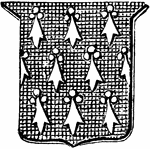
"In heraldry, a fur of a black ground with white spots (sable, spots argent): reverse of ermine. Also called counter-ermine, contre-ermine." -Whitney, 1911

Ermines

"In heraldry, a fur of a black ground with white spots (sable, spots argent): reverse of ermine. Also…