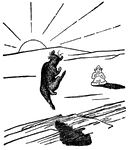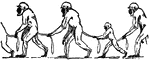
Image from the story, "Legend of Evil." The monkeys walk together holding each other's tails.

Legend of Evil

Image from the story, "Legend of Evil." The monkeys walk together holding each other's tails.
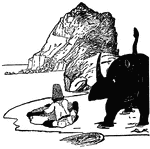
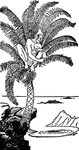
Image from the story, <em>How the Rhinoceros Got His Skin.</em>

How the Rhinoceros Got His Skin

Image from the story, How the Rhinoceros Got His Skin.

Image from the story, <em>How the Rhinoceros Got His Skin.</em>

How the Rhinoceros Got His Skin

Image from the story, How the Rhinoceros Got His Skin.

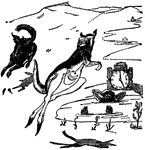
Image from the story, <em>The Sing-Song of Old Man Kangaroo.</em>

Old Man Kangaroo

Image from the story, The Sing-Song of Old Man Kangaroo.

Image from the story, <em>The Sing-Song of Old Man Kangaroo.</em>

Old Man Kangaroo

Image from the story, The Sing-Song of Old Man Kangaroo.

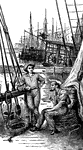
Image from the story, <em>The Castaways</em>. Jake seated himself on a coil of hope and reasoned with Ben Clark.

Castaways

Image from the story, The Castaways. Jake seated himself on a coil of hope and reasoned with…
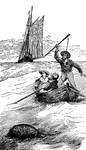
Image from the story, <em>The Castaways</em>. Ben held the oars while Jake poised the spear for a cast.

Castaways

Image from the story, The Castaways. Ben held the oars while Jake poised the spear for a cast.
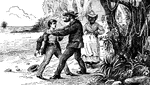
Image from the story, <em>The Castaways</em>. Jake seized Ben by the shoulders to prevent him from swimming for the boat.

Castaways

Image from the story, The Castaways. Jake seized Ben by the shoulders to prevent him from swimming…
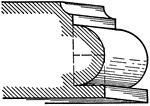
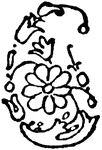
A roman moulding, called a <em>Torus.</em> It is composed of a semicircle and a fillet. The smicircle projects from the fillet an amount equal to its radius. The concave addition above the fillet and the projection below the half round shows a combination of mouldings used in the base of a <em>Doric Column</em>.

Torus

A roman moulding, called a Torus. It is composed of a semicircle and a fillet. The smicircle…

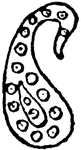
"Also known as the cone, the palm leaf, the river loop, the crown jewel, the seal, the almond, the feather, the boquet, and the flame. There is a vast difference of opinion as to the origin and meaning of this motif. Some authorities claim it was intended for the fir cone, which served as an emblem of immortality and was revered by the ancients; some say it was intended for the palm leaf, which has been handed down by the Greeks as a symbol of victory; others say it was intended to represent a loop which the river Indus makes on a vast plain in upper Cashmere as seen from the Mosque. By some it is said to represent the crown jewels or chief ornament in the old Iranian crown, which is a composite jewel of pear shape. Tradition tells us that the signing of documents in such a manner was a custom well known in the East. This design has also been called the almond, the feather, the bouquet, and the flame on account of its fancied resemblance to these objects. We have selected the name "pear" because the image it conveys is more clearly recognized by the western mind. It is that which its shape most suggests. The Pear design is common in many kinds of rugs, especially in those of Persia and Kurdistan, but it varies greatly in varieties of form and size. The large size is usually employed in the Caucasus and Southern Persia, while the small size is used more frequently in Central and Western Persia. In the Saraband, Shiraz, Herat, Khorasan, and Senna, it frequently covers the whole field. In the two former alternate rows usually have the stems of the pears turned in opposite directions, while in the three latter the stems are usually turned in the same direction."

Pear Design

"Also known as the cone, the palm leaf, the river loop, the crown jewel, the seal, the almond, the feather,…
"Also known as the cone, the palm leaf, the river loop, the crown jewel, the seal, the almond, the feather, the boquet, and the flame. There is a vast difference of opinion as to the origin and meaning of this motif. Some authorities claim it was intended for the fir cone, which served as an emblem of immortality and was revered by the ancients; some say it was intended for the palm leaf, which has been handed down by the Greeks as a symbol of victory; others say it was intended to represent a loop which the river Indus makes on a vast plain in upper Cashmere as seen from the Mosque. By some it is said to represent the crown jewels or chief ornament in the old Iranian crown, which is a composite jewel of pear shape. Tradition tells us that the signing of documents in such a manner was a custom well known in the East. This design has also been called the almond, the feather, the bouquet, and the flame on account of its fancied resemblance to these objects. We have selected the name "pear" because the image it conveys is more clearly recognized by the western mind. It is that which its shape most suggests. The Pear design is common in many kinds of rugs, especially in those of Persia and Kurdistan, but it varies greatly in varieties of form and size. The large size is usually employed in the Caucasus and Southern Persia, while the small size is used more frequently in Central and Western Persia. In the Saraband, Shiraz, Herat, Khorasan, and Senna, it frequently covers the whole field. In the two former alternate rows usually have the stems of the pears turned in opposite directions, while in the three latter the stems are usually turned in the same direction."

Pear Design

"Also known as the cone, the palm leaf, the river loop, the crown jewel, the seal, the almond, the feather,…
"Also known as the cone, the palm leaf, the river loop, the crown jewel, the seal, the almond, the feather, the boquet, and the flame. There is a vast difference of opinion as to the origin and meaning of this motif. Some authorities claim it was intended for the fir cone, which served as an emblem of immortality and was revered by the ancients; some say it was intended for the palm leaf, which has been handed down by the Greeks as a symbol of victory; others say it was intended to represent a loop which the river Indus makes on a vast plain in upper Cashmere as seen from the Mosque. By some it is said to represent the crown jewels or chief ornament in the old Iranian crown, which is a composite jewel of pear shape. Tradition tells us that the signing of documents in such a manner was a custom well known in the East. This design has also been called the almond, the feather, the bouquet, and the flame on account of its fancied resemblance to these objects. We have selected the name "pear" because the image it conveys is more clearly recognized by the western mind. It is that which its shape most suggests. The Pear design is common in many kinds of rugs, especially in those of Persia and Kurdistan, but it varies greatly in varieties of form and size. The large size is usually employed in the Caucasus and Southern Persia, while the small size is used more frequently in Central and Western Persia. In the Saraband, Shiraz, Herat, Khorasan, and Senna, it frequently covers the whole field. In the two former alternate rows usually have the stems of the pears turned in opposite directions, while in the three latter the stems are usually turned in the same direction."

Pear Design

"Also known as the cone, the palm leaf, the river loop, the crown jewel, the seal, the almond, the feather,…
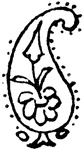
"Also known as the cone, the palm leaf, the river loop, the crown jewel, the seal, the almond, the feather, the boquet, and the flame. There is a vast difference of opinion as to the origin and meaning of this motif. Some authorities claim it was intended for the fir cone, which served as an emblem of immortality and was revered by the ancients; some say it was intended for the palm leaf, which has been handed down by the Greeks as a symbol of victory; others say it was intended to represent a loop which the river Indus makes on a vast plain in upper Cashmere as seen from the Mosque. By some it is said to represent the crown jewels or chief ornament in the old Iranian crown, which is a composite jewel of pear shape. Tradition tells us that the signing of documents in such a manner was a custom well known in the East. This design has also been called the almond, the feather, the bouquet, and the flame on account of its fancied resemblance to these objects. We have selected the name "pear" because the image it conveys is more clearly recognized by the western mind. It is that which its shape most suggests. The Pear design is common in many kinds of rugs, especially in those of Persia and Kurdistan, but it varies greatly in varieties of form and size. The large size is usually employed in the Caucasus and Southern Persia, while the small size is used more frequently in Central and Western Persia. In the Saraband, Shiraz, Herat, Khorasan, and Senna, it frequently covers the whole field. In the two former alternate rows usually have the stems of the pears turned in opposite directions, while in the three latter the stems are usually turned in the same direction."

Pear Design

"Also known as the cone, the palm leaf, the river loop, the crown jewel, the seal, the almond, the feather,…
"Also known as the cone, the palm leaf, the river loop, the crown jewel, the seal, the almond, the feather, the boquet, and the flame. There is a vast difference of opinion as to the origin and meaning of this motif. Some authorities claim it was intended for the fir cone, which served as an emblem of immortality and was revered by the ancients; some say it was intended for the palm leaf, which has been handed down by the Greeks as a symbol of victory; others say it was intended to represent a loop which the river Indus makes on a vast plain in upper Cashmere as seen from the Mosque. By some it is said to represent the crown jewels or chief ornament in the old Iranian crown, which is a composite jewel of pear shape. Tradition tells us that the signing of documents in such a manner was a custom well known in the East. This design has also been called the almond, the feather, the bouquet, and the flame on account of its fancied resemblance to these objects. We have selected the name "pear" because the image it conveys is more clearly recognized by the western mind. It is that which its shape most suggests. The Pear design is common in many kinds of rugs, especially in those of Persia and Kurdistan, but it varies greatly in varieties of form and size. The large size is usually employed in the Caucasus and Southern Persia, while the small size is used more frequently in Central and Western Persia. In the Saraband, Shiraz, Herat, Khorasan, and Senna, it frequently covers the whole field. In the two former alternate rows usually have the stems of the pears turned in opposite directions, while in the three latter the stems are usually turned in the same direction."

Pear Design

"Also known as the cone, the palm leaf, the river loop, the crown jewel, the seal, the almond, the feather,…
"Also known as the cone, the palm leaf, the river loop, the crown jewel, the seal, the almond, the feather, the boquet, and the flame. There is a vast difference of opinion as to the origin and meaning of this motif. Some authorities claim it was intended for the fir cone, which served as an emblem of immortality and was revered by the ancients; some say it was intended for the palm leaf, which has been handed down by the Greeks as a symbol of victory; others say it was intended to represent a loop which the river Indus makes on a vast plain in upper Cashmere as seen from the Mosque. By some it is said to represent the crown jewels or chief ornament in the old Iranian crown, which is a composite jewel of pear shape. Tradition tells us that the signing of documents in such a manner was a custom well known in the East. This design has also been called the almond, the feather, the bouquet, and the flame on account of its fancied resemblance to these objects. We have selected the name "pear" because the image it conveys is more clearly recognized by the western mind. It is that which its shape most suggests. The Pear design is common in many kinds of rugs, especially in those of Persia and Kurdistan, but it varies greatly in varieties of form and size. The large size is usually employed in the Caucasus and Southern Persia, while the small size is used more frequently in Central and Western Persia. In the Saraband, Shiraz, Herat, Khorasan, and Senna, it frequently covers the whole field. In the two former alternate rows usually have the stems of the pears turned in opposite directions, while in the three latter the stems are usually turned in the same direction."

Pear Design

"Also known as the cone, the palm leaf, the river loop, the crown jewel, the seal, the almond, the feather,…
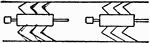
Chinese, viciousness, poison. In India it is believed that if a scorpion creeps over the body it causes leprosy and that if one bears the tattooed image of a scorpion he is free from leprosy as well as from the bite of that insect. As a design it is quite common in the borders of Caucasian fabrics, especially the Shirvans.

Scorpion or Spider

Chinese, viciousness, poison. In India it is believed that if a scorpion creeps over the body it causes…
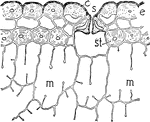
This image shows the cross-section of the outer cells of a leaf of pine. S, stoma; E, epidermis; C, cuticle; ST, stereome; and M, Mesophyll Cells.

Pine Leaf

This image shows the cross-section of the outer cells of a leaf of pine. S, stoma; E, epidermis; C,…
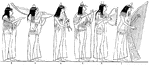
This image shows a group of ancient egyptian street musicians. (1) Woman with a tall light harp with fourteen strings. (2) Cithara. (3) Te-bouni, or banjo. (4) Double flute. (5) Shoulder Harp. (6) Singer, clapping hands.

Ancient Egyptian Music

This image shows a group of ancient egyptian street musicians. (1) Woman with a tall light harp with…
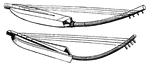
This image shows two different forms of the ancient banjo. It is equipped with 4 string, and has a curved body.

Ancient Banjo

This image shows two different forms of the ancient banjo. It is equipped with 4 string, and has a curved…
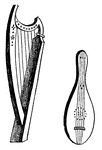
This image shows harps used by minstrel's in the thirteenth century.

Harp

This image shows harps used by minstrel's in the thirteenth century.

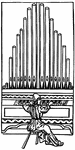
This image shows an ancient pipe organ. A pipe organ is a keyboard instrument that makes its sound by forcing air through wood or metal pipes.

Pipe Organ

This image shows an ancient pipe organ. A pipe organ is a keyboard instrument that makes its sound by…
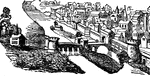
This image shows Orleans in the fifteenth century. Orleans is a city and commune in north-central France.
Orleans

This image shows Orleans in the fifteenth century. Orleans is a city and commune in north-central France.

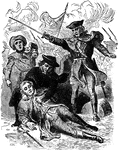
This image shows the death of Louis-Joseph de Montcalm. Montcalm was the commander of the French forces in North America during the Seven Years' War. He is most remembered for his role in the Fall of Quebec, and remains a controversial figure.

Montcalm

This image shows the death of Louis-Joseph de Montcalm. Montcalm was the commander of the French forces…
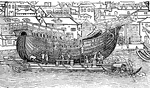
An image of a ship being built in Spain during the 1400's before Columbus' exploration.

Ship Building

An image of a ship being built in Spain during the 1400's before Columbus' exploration.
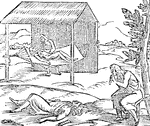
An image of people curing the sick in Hispaniola, during Columbus' exploration there.

Hispaniola

An image of people curing the sick in Hispaniola, during Columbus' exploration there.

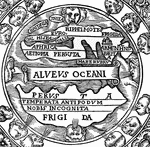
An image from <em>Macrobii Ambrosii Aurelii Theodosii</em> in <em>Somnium Scipionis, Lib. II.</em>.

Macrobius

An image from Macrobii Ambrosii Aurelii Theodosii in Somnium Scipionis, Lib. II..

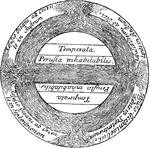
An image from <em>Theodosii Macrobii Opera</em>.

Macrobius

An image from Theodosii Macrobii Opera.

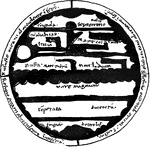
An image after <em>Atlas</em>, as a "mappemonde tiree d'un manuscrit de Macrobe du Xeme siecle."

Macrobius

An image after Atlas, as a "mappemonde tiree d'un manuscrit de Macrobe du Xeme siecle."

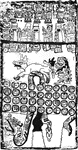
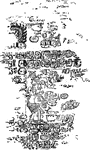
Image of Codex Cortesianus.

Codex

Image of Codex Cortesianus.

Image of Codex Persianus.

Codex Perezianus

Image of Codex Persianus.

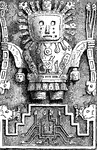
Enlarged drawing of the bas-relief on the broken doorway. Details that show Tiahuanacu existed.

Tiahuanacu Image

Enlarged drawing of the bas-relief on the broken doorway. Details that show Tiahuanacu existed.
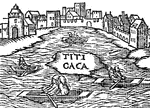
Image of Lake Titicaca during Inca empire.

Lake Titicaca

Image of Lake Titicaca during Inca empire.

Stone image of the feathered-serpent deity of ancient Mesoamerica, a god of Mexican and Central America.
Quetzalcoatl

Stone image of the feathered-serpent deity of ancient Mesoamerica, a god of Mexican and Central America.

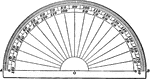
"The outer edge is a semicircle, with center at 0, and is divided into 360 parts. Each division is one-half of one degree, and, for convenience, the degrees are numbered from 0 to 180 from both A and B." &mdash; Hallock, 1905

Protractor

"The outer edge is a semicircle, with center at 0, and is divided into 360 parts. Each division is one-half…
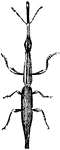
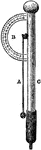
Image of the straight-snouted weevil, or Brentus Anchorago

Straight-Snouted Weevil

Image of the straight-snouted weevil, or Brentus Anchorago

"The electrometer of Henley, sometimes called Henley's quadrant Henley electrometer, may be taken as the type of single pendulum electroscopes. It consists essentially of a pendulum A hinged to meter a verticle support C, which carries a vertical graduated semicircle B, by means of which the deviation of A from the vertical can be indicating the state of electrification of the prime conductors of electric machines. The stem is screwed into the conductor, and the divergence of the pendulum indicated roughly the charge." &mdash; Encyclopedia Britannica, 1893

Henleys Electrometer

"The electrometer of Henley, sometimes called Henley's quadrant Henley electrometer, may be taken as…
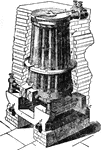
"The Duplex is made in two equal parts, each being capable of being worked alone. Each section consists of a semicircle of upright tubes forming the boiler proper, fitted with the diaphragm a, horizontal pipes forming the furnace f, a flow pipe b and a return pipe c, and an outlet d for removing sedimentary deposits from the interior." &mdash; Encyclopedia Britannica, 1893

Duplex Tubular Boiler

"The Duplex is made in two equal parts, each being capable of being worked alone. Each section consists…
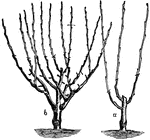
"This image gives a good idea of how these drawf trees are to be manipulated, a showing the first year's development from the maiden tree after being headed back, and b the form assumed a year or two later." &mdash; Encyclopedia Britannica, 1893

Dwarf-Tree Pruning

"This image gives a good idea of how these drawf trees are to be manipulated, a showing the first year's…
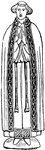
"An ecclesiastical vestment, worn during the celebration of mass, at processions, vespers, and other soleminities. The cope was originally a cloak worn for ordinary purposes. In form it is a semicircle, without sleeves and with a hood." — Chambers' Encyclopedia, 1875

Cope

"An ecclesiastical vestment, worn during the celebration of mass, at processions, vespers, and other…
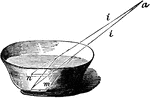
"The following simple experiment illustrates the effect of refraction:&mdash;Place a silver coin, m, at the bottom of the basin. The rays, i i, proceeding to the eye from the silver surface, render the coin visible. The point a, the eye, is then moved farther bck, so that the edge of the basin obstructs the direct rays, and of course the coin is no longer seen. If an attendant carefully pours water into the basin, so that the object is not moved, it will presently, as the water rises in the basin, become again visible. This arises from the refraction of the rays by the water, the image, indeed, appearing at n instead of at m." &mdash;Wells, 1857

Refraction

"The following simple experiment illustrates the effect of refraction:—Place a silver coin, m,…
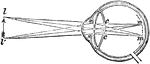
"A representation of the manner in which the image is formed in the eye of a near-sighted person. The curvature of the cornea, s s, and of the crystalline lens, c c, is so great that the image is formed at m m in advance of the retina." —Wells, 1857

Near-sighted

"A representation of the manner in which the image is formed in the eye of a near-sighted person. The…
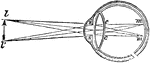
"A representation of the manner in which the image is formed upon the retina in the perfect eye. The curvature of the cornea, s s, and of the crystalline lens, c c, is just sufficient to cause the rays of light proceeding from the image, e e, to converge the right focus, m, upon the retina." —Wells, 1857

Perfect Eye

"A representation of the manner in which the image is formed upon the retina in the perfect eye. The…
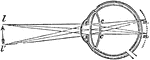
"A representation of the manner in which the image is formed in the eye, when the cornea or crystalline lens is flattened. The perfect image would be produced at m m, behind the retina, and, of course, beyond the point necessary to secure perfect vision." —Wells, 1857

Flattened Eye

"A representation of the manner in which the image is formed in the eye, when the cornea or crystalline…
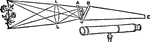
"A modification of the simple kaleidoscope was introduced by Sir David Brewster, whereby the images of large and distant objects can be introduced into the picture. This is effected by removing the object box and replacing it by a tube carrying at its outer end a double convex lens, represented by LL. By a screw adjustment the lens can be so placed as to focus the distant object exactly in the plane of the sector AOB, and so bring its image into the very best position for producing symmetrical patterns. When this instrument is directed towards a tree in full bloom, a very beautiful effect is produced, which can be varied by gradually moving the instrument. This form was called by Brewster the telescopic kaleidoscope." —The Encyclopedia Britannica, 1910

Convex Lens

"A modification of the simple kaleidoscope was introduced by Sir David Brewster, whereby the images…
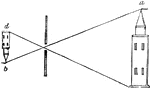
"Camera obscura strictly signifies a darkened chamber, because the room must be darkened, in order to observe its effects. To witness the phenomena of this instrument, let a room be closed in every direction, so as to exclude the light. Then from an aperture, say of an inch in diameter, admit a single beam of light, and the images of external things, such as trees and houses, and persons walking the streets, will be seen inverted on the wall opposite to where the light is admitted, or on a screen of white paper, placed before the aperture. The reason why the image is inverted will be obvious, when it is remembered that the rays proceeding from the extremities of the object must converge in order to pass through the small aperture; and as the rays of light always proceed in straight lines, they must cross each other at the point of admission. Thus the pencil a, coming from the upperpart of the tower, and proceeding straight, will represent the image of the part at b, while the lower part c, for the same reason, will be represented at d." &mdash;Comstock, 1850

Camera Obscura

"Camera obscura strictly signifies a darkened chamber, because the room must be darkened, in order to…
"Camera obscura strictly signifies a darkened chamber, because the room must be darkened, in order to observe its effects. To witness the phenomena of this instrument, let a room be closed in every direction, so as to exclude the light. Then from an aperture, say of an inch in diameter, admit a single beam of light, and the images of external things, such as trees and houses, and persons walking the streets, will be seen inverted on the wall opposite to where the light is admitted, or on a screen of white paper, placed before the aperture. The reason why the image is inverted will be obvious, when it is remembered that the rays proceeding from the extremities of the object must converge in order to pass through the small aperture; and as the rays of light always proceed in straight lines, they must cross each other at the point of admission. Thus the pencil a, coming from the upperpart of the tower, and proceeding straight, will represent the image of the part at b, while the lower part c, for the same reason, will be represented at d." &mdash;Comstock, 1850

Camera Obscura

"Camera obscura strictly signifies a darkened chamber, because the room must be darkened, in order to…
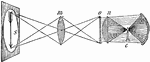
"Let a candle c, be placed on the inside of a box or tube, so that its light may pass through the plano-convex lens n, and strongly illuminate the object o. This object is generally a small transparent painting on a slip of glass, which slides through an opening in the tube. In order to show the figures in the erect position, these paintings are inverted, since their shadows are again inverted by the refraction of the convex lens m." —Comstock, 1850

Magic Lantern

"Let a candle c, be placed on the inside of a box or tube, so that its light may pass through the plano-convex…
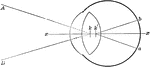
"Diagram illustrating the points at which incident rays meet the retina. xx, optic axis; k, first nodal point; k', second nodal point; b, point where the image of B would be formed, were the eye properly accommodated for it; a, the retinal point where the image of A would be formed." —Martin, 1917

Retina

"Diagram illustrating the points at which incident rays meet the retina. xx, optic axis; k, first nodal…
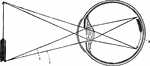
Diagram of the eye. 1: Lines of light from end of arrow; 2: Small, inverted image in the eye.

Eye Diagram

Diagram of the eye. 1: Lines of light from end of arrow; 2: Small, inverted image in the eye.
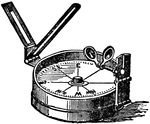
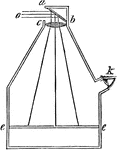
"At sea the declination is generally observed by means of an azimuth compass invented by Kater. It consists of a magnet with a graduated compass card attached to it. At the side of the instrument opposite the eye there is a frame which projects upwards from the plane of the instrument in a nearly vertical direction, and this frame contains a wide rectangular slit cut into two parts by a wire extending lengthwise. The eye-piece is opposite this frame, and the observer is supposed to point the instrument in such a manner that the wire above mentioned shall bisect the sun's visible disk. There is a totally reflecting glass prism which throws into the eye-piece an image of the scale of the graduated card, so that the observer, having first bisected the sun's disk by the wire, must next read the division of the scale which is in the middle of the field of view." &mdash;The Encyclopedia Britannica, 1903

Azimuth Compass

"At sea the declination is generally observed by means of an azimuth compass invented by Kater. It consists…
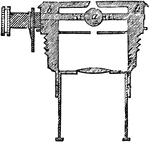
"a is the sphere, placed in half-holes on the axis bb, so that when its principal axis is parallel to the axis the telescope it gives only one image of the object. In a direction perpendicular to that axis it must be so placed that when it is moved by rotation of the axis bb the separation of the images shall be parallel to that motion. The angle of rotation is measured on the grduated circle C. The angle between the objects measured is = r sin 20, where r is a constant to be determined for each magnifying power employed." &mdash;The Encyclopedia Britannica, 1903

Micrometer

"a is the sphere, placed in half-holes on the axis bb, so that when its principal axis is parallel to…
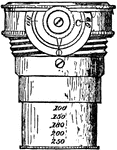
"a is the sphere, placed in half-holes on the axis bb, so that when its principal axis is parallel to the axis the telescope it gives only one image of the object. In a direction perpendicular to that axis it must be so placed that when it is moved by rotation of the axis bb the separation of the images shall be parallel to that motion. The angle of rotation is measured on the grduated circle C. The angle between the objects measured is = r sin 20, where r is a constant to be determined for each magnifying power employed." &mdash;The Encyclopedia Britannica, 1903

Micrometer

"a is the sphere, placed in half-holes on the axis bb, so that when its principal axis is parallel to…
This doodad is an image of two flowers set among leaves.

Doodad

This doodad is an image of two flowers set among leaves.

This image comtains floral arrangements, hearts and several different kinds of leaves.

Banner

This image comtains floral arrangements, hearts and several different kinds of leaves.

This banner contains an image of several stocks of wheat.

Banner

This banner contains an image of several stocks of wheat.

This dooda contains an image of a small pot containing to overflowing vines and two flowers.

Doodad

This dooda contains an image of a small pot containing to overflowing vines and two flowers.

This banner contains an image of archery arrows, floral arrangements and a symbol in the middle.

Banner

This banner contains an image of archery arrows, floral arrangements and a symbol in the middle.

This banner contains an image of flowers, vines and flags placed in the center.

Banner

This banner contains an image of flowers, vines and flags placed in the center.

This banner contains images of leaves in two different vases. There are two birds in the center of the image.

Banner

This banner contains images of leaves in two different vases. There are two birds in the center of the…
This banner contains images of leaves on each side of the center image, which are two fish looking at eachother.

Banner

This banner contains images of leaves on each side of the center image, which are two fish looking at…