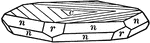
"Hexagonal-rhombohedral. Crystals usually thick to thin tabular. Basal planes prominent, often showing triangular markings." — Ford, 1912

Hematite

"Hexagonal-rhombohedral. Crystals usually thick to thin tabular. Basal planes prominent, often showing…
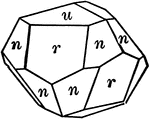
"Hexagonal-rhombohedral. Crystals usually thick to thin tabular. Basal planes prominent, often showing triangular markings. Edges of plates sometimes beveled with rhombohedral and pyramidal forms." — Ford, 1912

Hematite

"Hexagonal-rhombohedral. Crystals usually thick to thin tabular. Basal planes prominent, often showing…
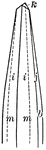
"Orthorhombic. Acicular pyramidal; consisting of a prism terminated by a combination of a very steep pyramid and brachydome." — Ford, 1912

Aragonite

"Orthorhombic. Acicular pyramidal; consisting of a prism terminated by a combination of a very steep…
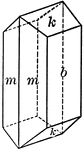
"Orthorhombic. Tabular; consisting of prominent brachypinacoid faces modified by a prism and a low brachydome." — Ford, 1912

Aragonite

"Orthorhombic. Tabular; consisting of prominent brachypinacoid faces modified by a prism and a low brachydome."…
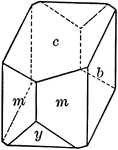
"Monoclinic. Crystals are usually prismatic in habit and have as prominent forms, clinopinacoid, base, prism, with often smaller orthodomes." — Ford, 1912

Orthoclase

"Monoclinic. Crystals are usually prismatic in habit and have as prominent forms, clinopinacoid, base,…
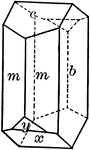
"Monoclinic. Crystals are usually prismatic in habit and have as prominent forms, clinopinacoid, base, prism, with often smaller orthodomes." — Ford, 1912

Orthoclase

"Monoclinic. Crystals are usually prismatic in habit and have as prominent forms, clinopinacoid, base,…
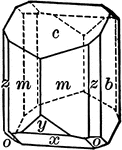
"Monoclinic. Crystals are usually prismatic in habit and have as prominent forms, clinopinacoid, base, prism, with often smaller orthodomes." — Ford, 1912

Orthoclase

"Monoclinic. Crystals are usually prismatic in habit and have as prominent forms, clinopinacoid, base,…
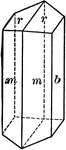
"Monoclinic. Crystals prismatic in habit; the prism faces make angles of 55 and 125 degrees with each other." — Ford, 1912

Amphibole

"Monoclinic. Crystals prismatic in habit; the prism faces make angles of 55 and 125 degrees with each…
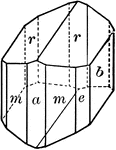
"Monoclinic. Crystals prismatic in habit; the prism faces make angles of 55 and 125 degrees with each other." — Ford, 1912"

Amphibole

"Monoclinic. Crystals prismatic in habit; the prism faces make angles of 55 and 125 degrees with each…
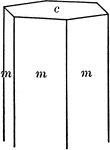
"Hexagonal. Strong prismatic habit. Frequently vertically striated and grooved. Forms usually present consist only of prism of first order and base." — Ford, 1912

Beryl

"Hexagonal. Strong prismatic habit. Frequently vertically striated and grooved. Forms usually present…
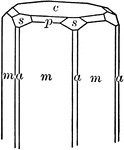
"Hexagonal. Strong prismatic habit. Frequently vertically striated and grooved. Forms usually present consist only of prism of first order and base. Small pyramid faces of both the first and second orders sometimes occur, but the pyramid faces are rarely prominent." — Ford, 1912

Beryl

"Hexagonal. Strong prismatic habit. Frequently vertically striated and grooved. Forms usually present…
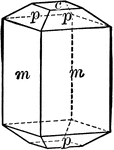
"Tetragonal. Prismatic in habit. Often vertically striated. Common forms are prisms of first and second orders, pyramid of first order and base." — Ford, 1912

Vesuvianite

"Tetragonal. Prismatic in habit. Often vertically striated. Common forms are prisms of first and second…
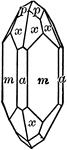
"Tetragonal. Crystals usually show a simple combination of prism and pyramid of the first order. The prism of the second order and a ditetragonal pyramid also at times observed." — Ford, 1912

Zircon

"Tetragonal. Crystals usually show a simple combination of prism and pyramid of the first order. The…
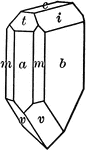
"Orthohombic, hemimorphic. Crystals usually tabular parallel to the brachypinacoid. They show prism faces and are terminated above usually by a combination of macrodomes and brachydomes and base, and below by a pyramid." — Ford, 1912

Calamine

"Orthohombic, hemimorphic. Crystals usually tabular parallel to the brachypinacoid. They show prism…
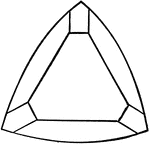
"Hexagonal-rhombohedral; hemimorphic. Crystals usually prismatic, vertically striated. A triangular prism, with three faces, prominent, which with the tendency of the prism faces to be vertically striated and to round into each other gives the crystals usually a cross section like a spherical triangle." — Ford, 1912

Tourmaline

"Hexagonal-rhombohedral; hemimorphic. Crystals usually prismatic, vertically striated. A triangular…
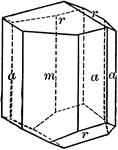
"Hexagonal-rhombohedral; hemimorphic. Crystals usually prismatic, vertically striated. A triangular prism, with three faces, prominent, which with the tendency of the prism faces to be vertically striated and to round into each other gives the crystals usually a cross section like a spherical triangle. Crystals are commonly terminated by base and low positive and negative rhombohedrons; sometimes scalenohedrons are present. When the crystals are doubly terminated they usually show different forms at the opposite ends of the vertical axis." — Ford, 1912

Tourmaline

"Hexagonal-rhombohedral; hemimorphic. Crystals usually prismatic, vertically striated. A triangular…
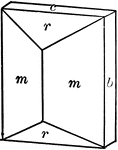
"Orthohombic. Habit prismatic, showing usually a combination of prism with large angle, brachypinacoid, base and macrodome." — Ford, 1912

Staurolite

"Orthohombic. Habit prismatic, showing usually a combination of prism with large angle, brachypinacoid,…
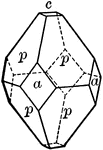
"Tetragonal. Usually shows a combination of prism of second order, pyramid of first and basal plane." — Ford, 1912

Apophyllite

"Tetragonal. Usually shows a combination of prism of second order, pyramid of first and basal plane."…
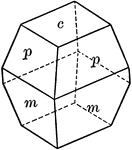
"Monoclinic. Crystals varied in habit. Often with prominent basal plane which is steeply inclined and which in combination with short prism and pyramid faces gives a thin wedge-shaped crystal." — Ford, 1912

Titanite

"Monoclinic. Crystals varied in habit. Often with prominent basal plane which is steeply inclined and…
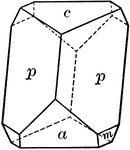
"Monoclinic. Crystals varied in habit. Often with prominent basal plane which is steeply inclined and which in combination with short prism and pyramid faces gives a thin wedge-shaped crystal." — Ford, 1912

Titanite

"Monoclinic. Crystals varied in habit. Often with prominent basal plane which is steeply inclined and…
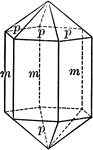
"Hexagonal; tri-pyramidal. Crystals usually long prismatic in habit; sometimes short prismatic or tabular. Usually terminated by prominent pyramid of first order and frequently a basal plane." — Ford, 1912

Apatite

"Hexagonal; tri-pyramidal. Crystals usually long prismatic in habit; sometimes short prismatic or tabular.…
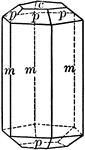
"Hexagonal; tri-pyramidal. Crystals usually long prismatic in habit; sometimes short prismatic or tabular. Usually terminated by prominent pyramid of first order and frequently a basal plane." — Ford, 1912

Apatite

"Hexagonal; tri-pyramidal. Crystals usually long prismatic in habit; sometimes short prismatic or tabular.…
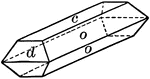
"Orthohombic. Crystals usually tabular parallel to base; often diamond shaped because of the presence of a short prism. Both macro- and brachydomes usually present, either beveling the corners of the diamond-shaped crystals, or if the prism faces are wanting, beveling the edges of the tavles and forming rectangular prismatic-shaped crystals elongated parallel to either the brachy- or macro-axis." — Ford, 1912

Barite

"Orthohombic. Crystals usually tabular parallel to base; often diamond shaped because of the presence…
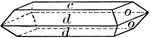
"Orthohombic. Crystals usually tabular parallel to base; often diamond shaped because of the presence of a short prism. Both macro- and brachydomes usually present, either beveling the corners of the diamond-shaped crystals, or if the prism faces are wanting, beveling the edges of the tavles and forming rectangular prismatic-shaped crystals elongated parallel to either the brachy- or macro-axis." — Ford, 1912

Barite

"Orthohombic. Crystals usually tabular parallel to base; often diamond shaped because of the presence…
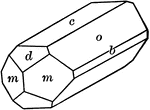
"Orthorhombic. Crystals resemble closely those of barite. Commonly tabular parallel to the base or prismatic parallel to the brachy- or macro-axis with prominent development of the domes. Crystals which are elongated parallel to the brachy-axis are frequently terminated in front by four faces in nearly equal development, consisting of 2 prism faces and 2 of the macrodome." — Ford, 1912

Celestite

"Orthorhombic. Crystals resemble closely those of barite. Commonly tabular parallel to the base or prismatic…
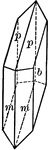
"Monoclinic. Crystals usually tabular parallel to clinopinacoid; in diamond-shaped crystals with edges beveled by prism and pyramid faces." — Ford, 1912

Gypsum

"Monoclinic. Crystals usually tabular parallel to clinopinacoid; in diamond-shaped crystals with edges…
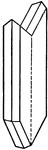
"Monoclinic. Crystals usually tabular parallel to clinopinacoid; in diamond-shaped crystals with edges beveled by prism and pyramid faces. Other forms rare. Sometimes twinned." — Ford, 1912

Gypsum

"Monoclinic. Crystals usually tabular parallel to clinopinacoid; in diamond-shaped crystals with edges…
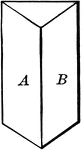
A triangular prism.

Triangular prism

A triangular prism.

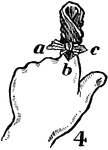
A hand with the index finger bandaged.

Hand with bandaged finger

A hand with the index finger bandaged.

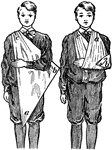
"A sling for the arm made from a triangular bandage." —Davison, 1910

Boy with sling

"A sling for the arm made from a triangular bandage." —Davison, 1910

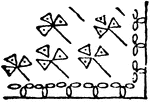
Composed of small flowers with three triangular petals and a long stem. Has the appearance somewhat of a shamrock leaf. It may be found in any of the Asia Minor rugs, especially in the field of the Konieh and Ladik. In the former it is nearly always present and for this reason is sometimes known as the Konieh design.

Rhodian or Lily Design

Composed of small flowers with three triangular petals and a long stem. Has the appearance somewhat…
Composed of small flowers with three triangular petals and a long stem. Has the appearance somewhat of a shamrock leaf. It may be found in any of the Asia Minor rugs, especially in the field of the Konieh and Ladik. In the former it is nearly always present and for this reason is sometimes known as the Konieh design.

Rhodian or Lily Design

Composed of small flowers with three triangular petals and a long stem. Has the appearance somewhat…
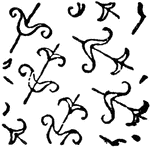
Composed of small flowers with three triangular petals and a long stem. Has the appearance somewhat of a shamrock leaf. It may be found in any of the Asia Minor rugs, especially in the field of the Konieh and Ladik. In the former it is nearly always present and for this reason is sometimes known as the Konieh design.

Rhodian or Lily Design

Composed of small flowers with three triangular petals and a long stem. Has the appearance somewhat…
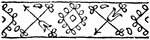
Composed of small flowers with three triangular petals and a long stem. Has the appearance somewhat of a shamrock leaf. It may be found in any of the Asia Minor rugs, especially in the field of the Konieh and Ladik. In the former it is nearly always present and for this reason is sometimes known as the Konieh design.

Rhodian or Lily Design

Composed of small flowers with three triangular petals and a long stem. Has the appearance somewhat…
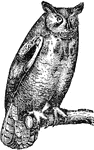
A large group of birds of prey, including fully 150 species, about forty of which inhabit America. They are distinguished chiefly on account of their nocturnl habits. The different species have a short head, a circular or triangular facial disc, large eyes and ears, the outer toe reversible, aand, owing to the soft plumage, a noiseless flight.

Owl

A large group of birds of prey, including fully 150 species, about forty of which inhabit America. They…
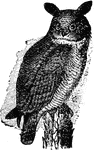
A large group of birds of prey, including fully 150 species, about forty of which inhabit America. They are distinguished chiefly on account of their nocturnl habits. The different species have a short head, a circular or triangular facial disc, large eyes and ears, the outer toe reversible, aand, owing to the soft plumage, a noiseless flight.

Owl

A large group of birds of prey, including fully 150 species, about forty of which inhabit America. They…
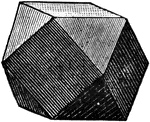
A solid with fourteen faces formed by cutting off the corners of a cube parallel to the coxial octahedron far enough to leave the original faces squares, while adding eight triangular faces at the truncations.

Cuboctahedron

A solid with fourteen faces formed by cutting off the corners of a cube parallel to the coxial octahedron…
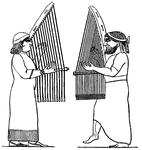
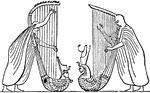
The Assyrians held music in honor, and empoyed it for liturgical purposes, as well as those of social and private life. Among the discoveries at Nineveh and Babylon are many of a musical character. Strong bearded men are playing upon harps which are of a triangular form, but of a different structure from most.

Assyrian Music

The Assyrians held music in honor, and empoyed it for liturgical purposes, as well as those of social…
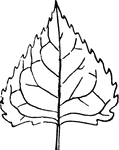
A trowel or triangular shaped leaf.

Deltoid Leaf

A trowel or triangular shaped leaf.

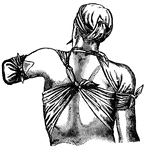
This illustration shows a method of applying a triangular bandage to the chest, shoulder, head and elbow.
Triangular Bandage

This illustration shows a method of applying a triangular bandage to the chest, shoulder, head and elbow.

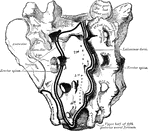
A large, triangular bone at the base of the vertebral column at the upper and back part of the pelvic cavity.

Sacrum

A large, triangular bone at the base of the vertebral column at the upper and back part of the pelvic…
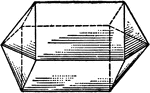
"Science has succeeded in classifying the thousands of known crystals in six systems, to each of which belongs a number of forms having some property in common. In order to classify these different crystals, the existence of certain lines within the crystal, called axes, is assumed, around which the form can be symmetrically build up. These axes are assumed to intersect in the center of the crystal, and to pass through from one side to the other." — Hallock, 1905

First Right Square Prism

"Science has succeeded in classifying the thousands of known crystals in six systems, to each of which…
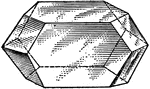
"Science has succeeded in classifying the thousands of known crystals in six systems, to each of which belongs a number of forms having some property in common. In order to classify these different crystals, the existence of certain lines within the crystal, called axes, is assumed, around which the form can be symmetrically build up. These axes are assumed to intersect in the center of the crystal, and to pass through from one side to the other." — Hallock, 1905

Second Right Square Prism

"Science has succeeded in classifying the thousands of known crystals in six systems, to each of which…
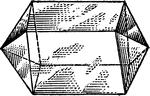
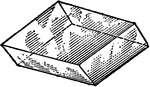
"Right rhombic prism." — Hallock, 1905

Prism

"Right rhombic prism." — Hallock, 1905

"Doubly oblique prism." — Hallock, 1905

Prism

"Doubly oblique prism." — Hallock, 1905

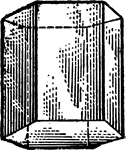
"Science has succeeded in classifying the thousands of known crystals in six systems, to each of which belongs a number of forms having some property in common. In order to classify these different crystals, the existence of certain lines within the crystal, called axes, is assumed, around which the form can be symmetrically build up. These axes are assumed to intersect in the center of the crystal, and to pass through from one side to the other." — Hallock, 1905

Hexagonal Prism

"Science has succeeded in classifying the thousands of known crystals in six systems, to each of which…
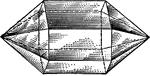
"Science has succeeded in classifying the thousands of known crystals in six systems, to each of which belongs a number of forms having some property in common. In order to classify these different crystals, the existence of certain lines within the crystal, called axes, is assumed, around which the form can be symmetrically build up. These axes are assumed to intersect in the center of the crystal, and to pass through from one side to the other." — Hallock, 1905

Six-sided Pyramid

"Science has succeeded in classifying the thousands of known crystals in six systems, to each of which…
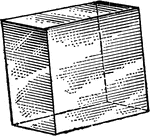
"Science has succeeded in classifying the thousands of known crystals in six systems, to each of which belongs a number of forms having some property in common. In order to classify these different crystals, the existence of certain lines within the crystal, called axes, is assumed, around which the form can be symmetrically build up. These axes are assumed to intersect in the center of the crystal, and to pass through from one side to the other." — Hallock, 1905

Rhombohedron

"Science has succeeded in classifying the thousands of known crystals in six systems, to each of which…
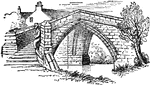
"A strange triangular bridge at Croyland was probably built for or by a religious body. This structure stands at the confluence of the Welland, the Nyne, and the Catwater drain; three pointed arches, having their abutments at the angles of an equilateral triangle, meet in the middle, giving three watercourses and three roadways." — Encyclopedia Britanica, 1893

Croyland Bridge

"A strange triangular bridge at Croyland was probably built for or by a religious body. This structure…
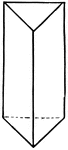
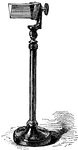
A triangular prism.

Prism

A triangular prism.

A triangular prism on a stand.

Prism

A triangular prism on a stand.

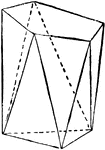
A solid having two parallel polygonal bases connected by triangular faces.

Prismatoid

A solid having two parallel polygonal bases connected by triangular faces.

"This primitive-looking instrument was played horizontally, being born upon the performer's shoulder. between it and the grand vertical harps in the frescos of the time of Rameses III, More than 3000 years old, paintings discovered by the Laveller Bruce, there are varieties that permit us to bind the whole, from the simplest bow-form to the almost triangular harp, in to one family." — Encyclopediia Britannica, 1893

Harp

"This primitive-looking instrument was played horizontally, being born upon the performer's shoulder.…
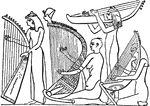
"This primitive-looking instrument was played horizontally, being born upon the performer's shoulder. between it and the grand vertical harps in the frescos of the time of Rameses III, More than 3000 years old, paintings discovered by the Laveller Bruce, there are varieties that permit us to bind the whole, from the simplest bow-form to the almost triangular harp, in to one family." — Encyclopediia Britannica, 1893

Harp

"This primitive-looking instrument was played horizontally, being born upon the performer's shoulder.…
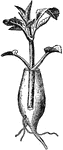
"Fahlias and paeonies may be grafted by inserting young shoots into the neck of one of the fleshy roots of each kind respectively the best method of doing so being to cut a triangular section near the upper end of the root, just large enough to admit the young shoot when slightly pared away in two sides to give it a similar form." — Encyclopedia Britannica, 1893

Root-Grafting

"Fahlias and paeonies may be grafted by inserting young shoots into the neck of one of the fleshy roots…
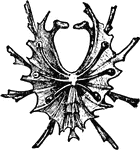
"Entosternum of one of the mygalomorphous spiders; ventral surface. Ph.N., pharyngeal notch. The posterior median process with its repetition of triangular segments closely resembles the same process in Limulus." — The Encyclopedia Britannica, 1910

Entosternum

"Entosternum of one of the mygalomorphous spiders; ventral surface. Ph.N., pharyngeal notch. The posterior…
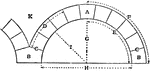
"The blocks, which are technically known as voussoirs, should be of a wedge shape, the center or top block being the keystone A; the lower blocks B B which rest on the supporting pier are the springers, the upper surface of which is called the skewback, C C; the side blocks, as D, are termed the hauches. The lower surface or soffit of the arch is the intrados, E, and the upper surface the entrados, F. The rise of the arch is the distance from the springing to the soffit, G, the width between the springers is called the span, H, and the radius I. The triangular spaces between the arches are termed spandrils, K." — The Encyclopedia Britannica, 1910

Arch

"The blocks, which are technically known as voussoirs, should be of a wedge shape, the center or top…
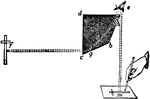
"An optical instrument employed to facilitate the sketching of objects from nature by producing a reflected picture of them upon paper. Wollaston's apparatus is one of the commonest. The essential part is a totally-reflecting prism with four angles, one of which is 90 degrees, the opposite one 135 degrees, and the other two each 67 degrees. One of the two faces which contain the right angle is turned towards the object to be sketched." — Winston's Encyclopedia, 1919

Camera Lucida

"An optical instrument employed to facilitate the sketching of objects from nature by producing a reflected…
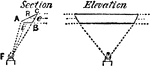
"Fresnel next conceived the admirable improvement of employing the principle of "total" or internal reflexion by glass prisms. The ray Fi falling on a prismoidal ring, ABC, is refracted and bent in the direction iR, and falling on the side AC, at an angle of incidence greater than the critical, is totally relfected in the direction Re, and, impinging on the side BC at e, it undergoes a second refraction, and emerges horizontally. The highest ray FA after refraction by AB and reflexion by AC must (in order to avoid superfluous glass) pass along AB, and after a second refraction at B emerge horizontally. The lowest ray FB after refraction by AC and a second refraction by BC also emerge horizontally." —The Encyclopedia Britannica, 1910

Reflecting Prism

"Fresnel next conceived the admirable improvement of employing the principle of "total" or internal…
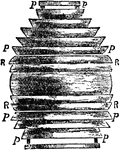
"First Application of Total Reflexion to Fixed Lights. In this apparatus Fresnel substituted his totally reflecting prism p and lens R for Marcet's reflector, and thus distributed the whole light equally over the horizon by means of dioptric agents alone. This was the first application of total reflexion to lighthouse apparatus, and this beautiful instrument continues till now in universal use." —The Encyclopedia Britannica, 1910

Dioptric Light

"First Application of Total Reflexion to Fixed Lights. In this apparatus Fresnel substituted his totally…