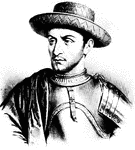
(1423-1483) King of France form 1461-1483 who united most of France under one crown. He also laid the foundations for absolute monarchy in France, patronized the arts and sciences, and founded three universities.

Louis XI of France

(1423-1483) King of France form 1461-1483 who united most of France under one crown. He also laid the…
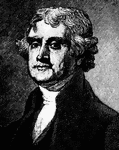
(1743-1826) Third President of the United States 1801-1809. Wrote the first draft of the Declaration of Independence

Thomas Jefferson

(1743-1826) Third President of the United States 1801-1809. Wrote the first draft of the Declaration…
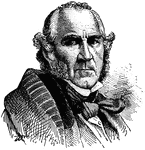
(1793-1863) Leader of Texas who fought in the War of 1812. He was the governor of Texas once it became a state but was disposed because he refused to swear allegiance to the Confederate States of America.

Sam Houston

(1793-1863) Leader of Texas who fought in the War of 1812. He was the governor of Texas once it became…
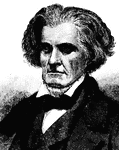
(1782-1850) Vice-president under John Quincy Adams and Andrew Jackson from 1825-1832

John Caldwell Calhoun

(1782-1850) Vice-president under John Quincy Adams and Andrew Jackson from 1825-1832
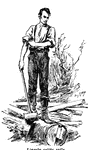
(1809-1865) U.S. President 1960-1865

Abraham Lincoln

(1809-1865) U.S. President 1960-1865

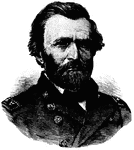
(1822-1885) Eighteenth president of the Unites States1869-1876 and Civil War general for the Union.
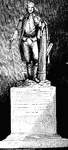
General Ulysses S. Grant

(1822-1885) Eighteenth president of the Unites States1869-1876 and Civil War general for the Union.
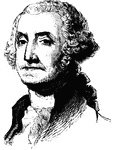
(1732-1799) First president of the United States 1789-1797

George Washington

(1732-1799) First president of the United States 1789-1797

(1732-1799) First president of the United States 1789-1797

George Washington

(1732-1799) First president of the United States 1789-1797

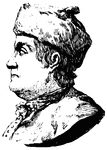
(1706-1790) United States diplomat, inventor, politician, and printer. Invented the Franklin stove, lighting rod and bifocal glasses. Served in the Constitutional Convention of 1787

Dr. Benjamin Franklin

(1706-1790) United States diplomat, inventor, politician, and printer. Invented the Franklin stove,…
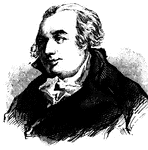
(1752-1816) United States diplomat and statesman and the New York delegate to the Continental Congress. US Senator from New York.

Gouverneur Morris

(1752-1816) United States diplomat and statesman and the New York delegate to the Continental Congress.…
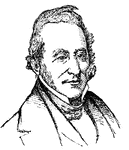
Thomas Hart Benton (March 14, 1782 – April 10, 1858), nicknamed "Old Bullion", was a U.S. Senator from Missouri and a staunch advocate of westward expansion of the United States. He served in the Senate from 1821 to 1851, becoming the first member of that body to serve five terms. Benton was an architect and champion of westward expansion by the United States, a cause that became known as Manifest Destiny.

Thomas H. Benton

Thomas Hart Benton (March 14, 1782 – April 10, 1858), nicknamed "Old Bullion", was a U.S. Senator…
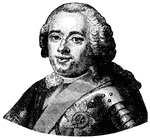
William IV (1765 – 1837) was King of the United Kingdom of Great Britain and Ireland and King of Hanover from 1830 until his death.

King William IV of England

William IV (1765 – 1837) was King of the United Kingdom of Great Britain and Ireland and King of Hanover…
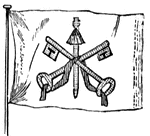
Flag of the Papal States, 1881

Papal States, flag

Flag of the Papal States, 1881

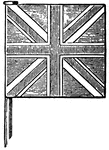
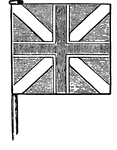
United Kingdom, First union jack

United Kingdom, First Union Jack

United Kingdom, First union jack

United Kingdom, Union jack

United Kingdom, Union jack

United Kingdom, Union jack

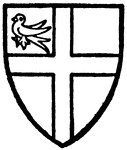
Andrew Harcla, the march-warden, whom Edward II made an earl and executed as a traitor, bore the arms of St. George with a martlet sable in the quarter.

Andrew Harcla

Andrew Harcla, the march-warden, whom Edward II made an earl and executed as a traitor, bore the arms…
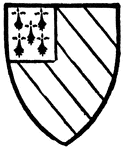
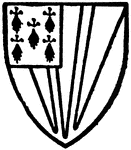
Bishopsdon bore Bendy of six pieces, gold and azure, with a quarter ermine.

Bishopsdon

Bishopsdon bore Bendy of six pieces, gold and azure, with a quarter ermine.

Basset of of Drayton bore gold three piles (or pales) gules with a quarter ermine.

Basset

Basset of of Drayton bore gold three piles (or pales) gules with a quarter ermine.

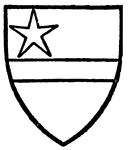
Odingseles bore Silver a fesse gules with a molet gules in the quarter.

Odingseles

Odingseles bore Silver a fesse gules with a molet gules in the quarter.

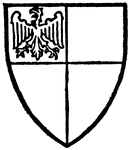
Lord Bardolf bore Quaterly gules silver with an eagle gold in the quarter

Phelip Lord Bardolf

Lord Bardolf bore Quaterly gules silver with an eagle gold in the quarter

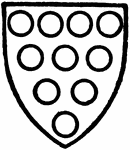
Zouche bore Gules bezantry with a quarter ermine

Zouche

Zouche bore Gules bezantry with a quarter ermine

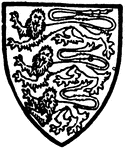
The herald for England bore Gulles three lions' legs razed silver, the paws downward. With the strange bearing of the lions whip-like tail cut-off at the rump

England

The herald for England bore Gulles three lions' legs razed silver, the paws downward. With the strange…
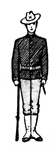
United States soldier, 1901

United States: Soldier 1901

United States soldier, 1901

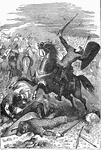
Death of Harold at the Battle of Hastings, 1066.

Battle of Hastings

Death of Harold at the Battle of Hastings, 1066.

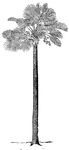
The palm is indigenous to the Southern states.

Palm

The palm is indigenous to the Southern states.

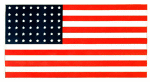
48-star flag.

United States, 1923

48-star flag.

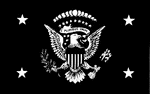
Flag of the President of the United States, 1923

President's flag, 1923

Flag of the President of the United States, 1923

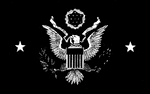
Flag of the Secretary of State, 1923

Secretary of State, 1923

Flag of the Secretary of State, 1923

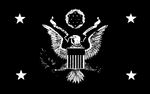
Flag of the Secretary of War, 1923

Secretary of War, 1923

Flag of the Secretary of War, 1923

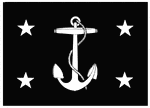
Flag of the Secretary of Navy, 1923. For Asst. Secretary, white flag with blue stars and anchor.
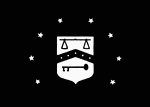
Secretary of Navy, 1923

Flag of the Secretary of Navy, 1923. For Asst. Secretary, white flag with blue stars and anchor.

Flag of the Secretary of Treasury, 1923. For Asst. Secretary, white flag with blue stars and anchor.
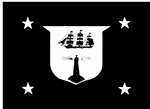
Secretary of Treasury, 1923

Flag of the Secretary of Treasury, 1923. For Asst. Secretary, white flag with blue stars and anchor.

Flag of the Secretary of Commerce, 1923. For Asst. Secretary, white flag with blue stars and anchor.
Secretary of Commerce, 1923

Flag of the Secretary of Commerce, 1923. For Asst. Secretary, white flag with blue stars and anchor.
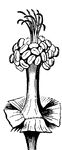
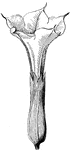
In the Stramonium, the five sepals are united into a cup or tube.

Flower

In the Stramonium, the five sepals are united into a cup or tube.

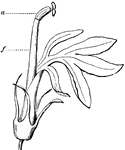
The stamens are united in this Lobelia.

Flower

The stamens are united in this Lobelia.

The stamens are united in this Mallow.

Flower

The stamens are united in this Mallow.

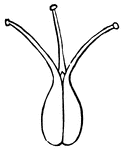
Pistils united in St. John's Wort, (Gray, 1858).

Pistil

Pistils united in St. John's Wort, (Gray, 1858).

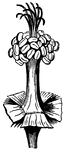
Stamens of Mallow united in a tube.

Stamen

Stamens of Mallow united in a tube.

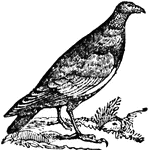
The Turkey vulture is found over the whole United States, but is more numerous in the southern region (Smiley, 1839).

Turkey Vulture

The Turkey vulture is found over the whole United States, but is more numerous in the southern region…
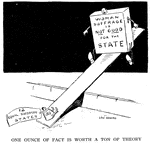
"One ounce of fact is worth a ton of theory."

Women's Suffrage Cartoon - Ounce of Fact

"One ounce of fact is worth a ton of theory."

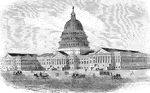
United States Capitol building.

U.S. Capitol

United States Capitol building.

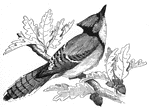
Blue jays are abundant in the central and eastern states. They are characterized by blue-gray feathers and crest upon the head.

Blue Jay

Blue jays are abundant in the central and eastern states. They are characterized by blue-gray feathers…
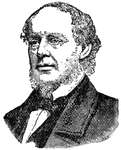
Chase was Secretary of the Treasury under President Lincoln and became Chief Justice of the United States.
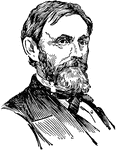
Salmon P. Chase

Chase was Secretary of the Treasury under President Lincoln and became Chief Justice of the United States.

(1828-1879) Union soldier who helped lead troops in Sherman's March to the Sea

Jefferson C. Davis

(1828-1879) Union soldier who helped lead troops in Sherman's March to the Sea

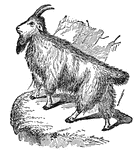
A goat is allied to the sheep. The Rocky Mountain goat is a native of the western portion of the United States, where it is also known as the goat antelope.

Rocky Mountain Goat

A goat is allied to the sheep. The Rocky Mountain goat is a native of the western portion of the United…
"The Statue of Liberty was given by the Frenchmen to the people of the United States. The statue cost more than $200,000 and was paid for by 10,000 Frenchman."

The Statue of Liberty

"The Statue of Liberty was given by the Frenchmen to the people of the United States. The statue cost…
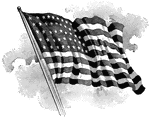
The United States Flag.

US Flag

The United States Flag.

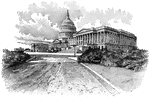
The Capitol of the United States in Wasington, D.C.

The Capitol Building in Washington D.C.

The Capitol of the United States in Wasington, D.C.

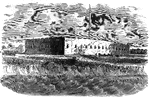
Fort Pulaski, on Cockspur Island at the entrance to the Savannah River, Georgia, was built by the United States Government in 1829-31, for the defense of Tybee Roads and the Savannah River approach to the city of Savannah, Georgia. In January, 1861, it was seized and occupied by the military authorities of the State of Georgia, and held by them until transferred to the Confederate Government, by whom it was strongly armed and garrisoned. In form it was pentagonal; its walls were forty feet high, and presented two faces on the sea approach. The full armament of the fort consisted on the lower tier of 65 32-pounders, and the upper tier of 53 24-pounders, 4 18-pounders flanking howitzers, 1 13-inch mortar, 12 8-inch columbiads, and 7 10-inch mortars. The interior of the fort was well supplied with massive furnaces for heating shot, officers' quarters, soldiers' barracks, magazines, and a tolerable supply of shot and powder.

Fort Pulaski

Fort Pulaski, on Cockspur Island at the entrance to the Savannah River, Georgia, was built by the United…
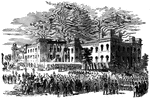
At the time this picture was drawn the handsome arsenal of the government of Charleston, South Carolina, was an object of great interest. An immense amount of ammunition was stored there, and raids upon it were expected at any moment. It was watched and guarded with great care by detachments of the Washington Light Infantry. It was afterward seized by the State authorities on December 28, 1860.

United States Arsenal at Charleston

At the time this picture was drawn the handsome arsenal of the government of Charleston, South Carolina,…
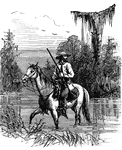
Cowboy on horseback traveling through a swamp in the south central states.

Cowboy on Horseback

Cowboy on horseback traveling through a swamp in the south central states.

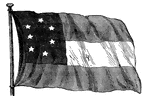
The Confederate Flag

Confederate Flag

The Confederate Flag

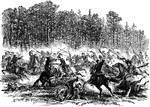
"Gallant charge of the Sixth Regiment, United States Regular Cavalry, upon the Confederate Stuart's Cavalry- the Confederates scattered in confusion and sought safety in the woods, May 9th, 1862. At three o'clock P.M. on May 9th, 1862, eighty men of the Sixth Regular Cavalry had advanced to Slatersville, when a considerable force of the enemy was observed directly in front. The Sixth charged upon the Confederates, and obliged them to retreat precipitately. The charge made by the Federal cavalry at the commencement of the skirmish was splendidly executed, and elicited the praise of the general in command of the troops. The Confederate cavalry was advancing toward the Federals when they formed in line and waited the approach of the enemy. when he had arived sufficiently near they made dash upon him, cutting their way through the line and causing the utmost confusion to prevail, after which they returned to quarters by a road leading through the woods on the right of the enemy." — Frank Leslie, 1896

Sixth Regiment

"Gallant charge of the Sixth Regiment, United States Regular Cavalry, upon the Confederate Stuart's…
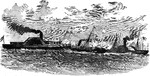
"Desperate engagement, april 24th, 1862, between the United States gunboat "Varuna," Commander Boggs, and the Confederate steam ram "J. C. Breckinridge," and the gunboat "Governor Moore." Captain Boggs of the "Varuna," finding that the Confederate ram "J. C. Breckinridge" was about to run into him, put the vessel in such a position that in being damaged he could repay it with interest. On came the ram, all clad with iron about the bow, and hit the "Varuna" in the port waist, cutting and crushing in her side. she dropped alongside and cleared out to butt again. She hit the "Varuna" a second time, and while in a sinking condition the "Varuna" poured her 8-inch shells into her so fast that the Confederate was set on fire and driven on shore." — Frank Leslie, 1896

Gunboat collision

"Desperate engagement, april 24th, 1862, between the United States gunboat "Varuna," Commander Boggs,…
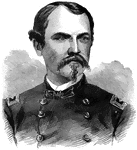
"General Averill, born in Cameron, Steuben County, N. Y., November 5th, 1832, was graduated at the United States Military Academy in June, 1855, and assigned to the mounted riflemen. He was promoted to be first lieutenant of the mounted riflemen, May 14th, 1861, and was on staff duty in the neighborhood of Washington, participating in the battle of Bull Run and other engagements, until August 23rd, 1861, when he was appointed colonel of the Third Pennsylvania Cavalry. He was engaged with the Army of the Potomac in its most important campaigns. In March, 1863, he began the series of cavalry raids in Western Virginia that made his name famous. His services were continuous up to May, 1865, whn he resigned, having been brevetted major general in the meantime." — Frank Leslie, 1896

General W. W. Averill

"General Averill, born in Cameron, Steuben County, N. Y., November 5th, 1832, was graduated at the United…
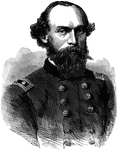
"General Granger, born in New York, in 1821, died in Santa Fe, N. M., January 10th, 1876, was graduated at the United States Military Academy in 1845; took part in the principal battles of the Mexican War. When the Civil War began he served on the staff of General McClellan in Ohio; then in Missouri; was brevetted major for gallant services at Wilson's Creek; and on September 2nd, 1861, became colonel of the Second Michigan Cavalry; on March 26th, 1862 he was made a brigadier general, and commanded the cavalry in the operations that led to the fall of Corinth. He became a major general of volunteers on September 17th, 1862. He distinguished himself in the battles of Chickamauga and Missionary Ridge. On January 15th, 1866, he was mustered out of the volunteer service." — Frank Leslie, 1896

General Gordon Granger

"General Granger, born in New York, in 1821, died in Santa Fe, N. M., January 10th, 1876, was graduated…
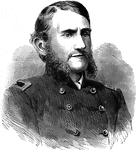
"General Kilpatrick, born near Deckertown, N. J., January 14th, 1836, died in Valparaiso, Chili, December 4th, 1881, was graduated from the United States Military Academy in 1861; was appointed a captain of volunteers, May 9th; promoted first lieutenant of artillery in the Regular Army, May 14th, 1861; was wounded at Big Bethel and disabled for several months; was engaged in various skimishes in the Wester virginia campaign and at the second battle of Bull Run; took part in the battle of Gettysburg, earning there the brevet of lieutenant colonel in the United States Army; was brevetted colonel for bravery at Resaca, and promoted major general of volunteers, June 18th, 1865. He resigned his volunteer commission on January 1st, 1886." — Frank Leslie, 1896

General Judson Kilpatrick

"General Kilpatrick, born near Deckertown, N. J., January 14th, 1836, died in Valparaiso, Chili, December…
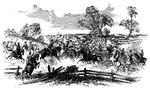
"Desperate skirmish at Old Church, near Tunstall's Station, VA., between a squadron of the Fifth United States Cavalry and Stuart's Confederate Cavalry, June 13th, 1862- death of the Confederate Captain Latane. The Confederate cavalry raid was first to Old Church, where they had a skirmish with a squadron of the Fifth United States Cavalry, who gallantly cut their way through the greatly superior numbers of the enemy, killing a Confederate captain. The Confederates then proceeded to Garlick's Landing, on the Pamunkey River, and only four miles from the White House; thence to Baltimore Crossroads, near New Kent Courthouse, on their way to Richmond, which they reached by crossing the Chickahominy, between Bottom's Bridge and James River."— Frank Leslie, 1896

Old Church

"Desperate skirmish at Old Church, near Tunstall's Station, VA., between a squadron of the Fifth United…

"First and last review of the First Regiment, South Carolina [African American] Volunteers, on Hilton Head, S. C., under Colonel Fessenden, U. S. A., June 25th, 1862. Our correspondent at Hilton Head wrote us: "I witnessed the parade entire, as well as the company drills in the manual of arms, etc., afterward, and I must acknowledge my complete surprise at the discipline and even vim evinced by the sable crowd. Dressed in the regulation uniform of the United States Army, tall and strong men generally speaking, they, considering that the regiment had not been fully armed but about ten days, spoke well for officers and men."" — Frank Leslie, 1896

First Regiment

"First and last review of the First Regiment, South Carolina [African American] Volunteers, on Hilton…
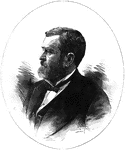
General Grant, eighteenth President of the United States, born at Point Pleasant, Clermont County, Ohio, April 27th, 1822; died on Mount McGregor, near Saratoga, N. Y., July 23rd, 1885.

Ulysses Grant

General Grant, eighteenth President of the United States, born at Point Pleasant, Clermont County, Ohio,…
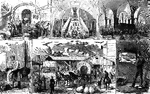
"The Great Bakery for the United States Army at the Capitol, Washington, D. C.- sketched by our special artist. The public buildings in Washington, during the threatened invasion by the Confederates, were barricaded and fortified. So great was the apprehension of a raid upon the city, that the passageways of the Treasury and the Captiol wre defended by howitzers. The iron plates cast for the dome of the Capitol were set up as breastworks between the columns, where they were supported by heavy timbers. The statuary and the pictures were protected by heaving planking; and the basement of the building was used as a kitchen. When the regiments began to pour in, the public buildings were given as quarters to the troops which came to defend them. The basement of the Capitol, which we illustrate, became first a storehouse, and then a bakery." — Frank Leslie, 1896

Great Bakery

"The Great Bakery for the United States Army at the Capitol, Washington, D. C.- sketched by our special…