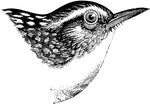
"Long-billed Marsh Wren. T. palustris. Above clear brown, unbarred, the middle of the back with a large black patch sharply streaked with white (these white stripes sometimes deficient). Crown of head usually darker that the back, often quite blackish, and continuous with the black interscapular patch. a dull white superciliary line. Wings fuscous, the inner secondaries blackish on the outer webs, often barred or indented with light brown. Tail evenly barred with fuscous and the color of the back. Under parts white, usually quite pure on the belly and middle line of the breast and throat, but much shaded with brown on the sides, flanks, and crissum. Bill blackish above, pale below; feet brown." Elliot Coues, 1884

Long-billed Marsh Wren

"Long-billed Marsh Wren. T. palustris. Above clear brown, unbarred, the middle of the back with a large…
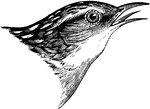
"Short-billed Marsh Wren. Cistothorus platensis. Upper parts brown, the crown and most of the back blackish, streaked with white. below, whitish, shaded with clear brown across the breast and along the sides, and especially on the flanks and crissum, the latter more or less indistinctly barred with dusky (often inappreciable). A whitish line over the eye. Wings and tail marked as in the last species. Upper tail-coverts decidedly barred. Bill blackish above, whitish below, extremely small, scarcely half as long as the head; feet brown." Elliot Coues, 1884

Short-billed Marsh Wren

"Short-billed Marsh Wren. Cistothorus platensis. Upper parts brown, the crown and most of the back blackish,…
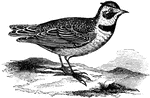
"Shore Lark or Horned Lark. Upper parts in general pinkish-brown, this pinkish or vinaceous or liliaceous tint brightest on the nape, lesser wing-coverts, and tail-coverts, the rest of the upper parts being duller and more grayish-brown, boldly variegated with dark brown streaks; middle pair of tail-feathers and several of the inner secondaries rufous-brown, with darker centres. Under parts, from the breast backward, white; the sides strongly washed with the color of the upper parts, and mottling of same across the lower part of the breast. A large, distinct, shield-shaped black area of the breast. Tail-feathers, except the middle pair, black, the outermost edged with whitish. Wings quills, except the innermost, plain fuscous, the outer web of the 1st primary whitish. Lesser wing-coverts usually tipped with grayish-white. Top of head like nape; bar across front of vertex, thence extended along sides of crown, and produced into a tuft, or "horn" black; front and line over eye, also somewhat produced to form part of the tuft, white or yellowish; a broad bar from nostrils along the lores, thence curving below the eye and widening as it descends in front of the auriculars, black; rest of the sides of the head and whole throat white or sulphury-yellow. Bill plumbeous-blackish, bluish-plumbeous at base below (sometimes there yellowish); feet and claws black; iris brown." Elliot Coues, 1884

Shore Lark

"Shore Lark or Horned Lark. Upper parts in general pinkish-brown, this pinkish or vinaceous or liliaceous…
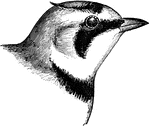
"Shore Lark or Horned Lark. Upper parts in general pinkish-brown, this pinkish or vinaceous or liliaceous tint brightest on the nape, lesser wing-coverts, and tail-coverts, the rest of the upper parts being duller and more grayish-brown, boldly variegated with dark brown streaks; middle pair of tail-feathers and several of the inner secondaries rufous-brown, with darker centres. Under parts, from the breast backward, white; the sides strongly washed with the color of the upper parts, and mottling of same across the lower part of the breast. A large, distinct, shield-shaped black area of the breast. Tail-feathers, except the middle pair, black, the outermost edged with whitish. Wings quills, except the innermost, plain fuscous, the outer web of the 1st primary whitish. Lesser wing-coverts usually tipped with grayish-white. Top of head like nape; bar across front of vertex, thence extended along sides of crown, and produced into a tuft, or "horn" black; front and line over eye, also somewhat produced to form part of the tuft, white or yellowish; a broad bar from nostrils along the lores, thence curving below the eye and widening as it descends in front of the auriculars, black; rest of the sides of the head and whole throat white or sulphury-yellow. Bill plumbeous-blackish, bluish-plumbeous at base below (sometimes there yellowish); feet and claws black; iris brown." Elliot Coues, 1884

Shore Lark

"Shore Lark or Horned Lark. Upper parts in general pinkish-brown, this pinkish or vinaceous or liliaceous…
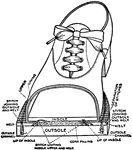
"Cross-section of Goodyear welt shoe, showing the different parts and their relation to each other." -Hill, 1921

Parts of a Welt Shoe

"Cross-section of Goodyear welt shoe, showing the different parts and their relation to each other."…
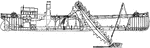
"Longitudinal section of hopper dredger, employed on the River Clyde. The vessel steams to place of working and is moored by the Steam Winches A A at bow and stern to buoys, the Bucket Ladder B is then lowered by steam power, and thereafter Buckets set in motion by gearing C C. The depth of water at which the Bucket Ladder dredges is regulated by the Hoisting Shears and Chain Barrel D D, driven by shafting E E from the Engines. The Buckets discharge the material by the shoot F into the Hopper G. The dredged material is discharged by the doors of the Hopper being opened by the Lifting Chains H H. These doors are hinged on to the side of Vessel, and suspended at centre by the Lifting Chains, which are connected to geared Crab Winches I I." -Hill, 1921

Hopper Dredger

"Longitudinal section of hopper dredger, employed on the River Clyde. The vessel steams to place of…
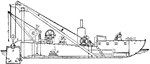
"Sectional view of diving bell and barge, employed on the River Clyde. All the appliances are worked by steam, rendering manual labour unnecessary. A is the Bell, which is raised and lowered by means of the Chain and Steam Winch B. c c are Seats within the Bell; d d, Footboards. E, Air-pipe entering the Bell at f, the air being supplied by Air-pump G driven by the Engine H. J is a Steam Crane for raising or lowering material. K K, Steam Winches for working moorings and shifting position of the barge." -Hill, 1921

Barge with Diving Bell

"Sectional view of diving bell and barge, employed on the River Clyde. All the appliances are worked…
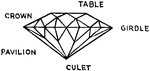
The diamond is cut to show the stone's brilliance, creating different parts to the cut: table, crown, girdle, pavilion, culet.

Diamond Cut

The diamond is cut to show the stone's brilliance, creating different parts to the cut: table, crown,…
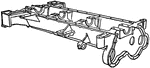
"Crankcase showing bearings. The heart of the automobile is the engine. It is built around the crankcase, which is its foundation or base." -Bodmer, 1917

Building an Automobile, Step 01: Crankcase

"Crankcase showing bearings. The heart of the automobile is the engine. It is built around the crankcase,…
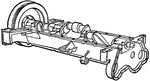
"Crankcase with crank-shaft and fly-wheel added. The crankshaft serves the same purpose in an automobile as the pedals do on a bicycle. The fly-wheel on the end helps it to keep turning at an even speed." -Bodmer, 1917

Building an Automobile, Step 02: Crank-Shaft and Fly-Wheel

"Crankcase with crank-shaft and fly-wheel added. The crankshaft serves the same purpose in an automobile…
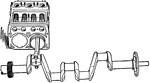
"Cylinders showing piston in place and connected to crankshaft. Gasoline vapor is exploded in the cylinders. This pushes the piston down, and as the piston is connected to the crankshaft it starts the crankshaft turning. The piston and the rod that connect it to the crankshaft are just like the feet and limbs of any one riding a bicycle." -Bodmer, 1917

Building an Automobile, Step 03: Cylinders Showing Piston and Crankshaft

"Cylinders showing piston in place and connected to crankshaft. Gasoline vapor is exploded in the cylinders.…
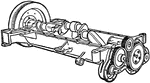
"The gears or 'cogwheels' are for running the fan, the pump and other parts." -Bodmer, 1917

Building an Automobile, Step 04: Cogwheels

"The gears or 'cogwheels' are for running the fan, the pump and other parts." -Bodmer, 1917
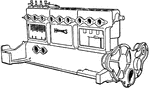
"Cylinder added to crankcase. The cylinders are next bolted down to the crankcase, the pistons and crankshaft having been connected. A cover is placed over the gears to keep them clean." -Bodmer, 1917

Building an Automobile, Step 05: Cylinder Added to Crankcase

"Cylinder added to crankcase. The cylinders are next bolted down to the crankcase, the pistons and crankshaft…
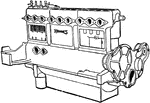
"An oil pan or reservoir is attached to the bottom of the crankcase to hold oil for the engine." -Bodmer, 1917

Building an Automobile, Step 06: Reservoir Added

"An oil pan or reservoir is attached to the bottom of the crankcase to hold oil for the engine." -Bodmer,…
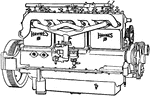
"The carburetor furnishes the gasoline vapor for the cylinders. It is connected to the engine by a crooked pipe called the intake manifold. After the gasoline has been exploded a valve opens and allows the burned gases to escape through another pipe, called the exhaust manifold." -Bodmer, 1917

Building an Automobile, Step 07: Carburetor

"The carburetor furnishes the gasoline vapor for the cylinders. It is connected to the engine by a crooked…
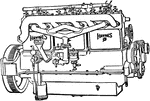
"Oil pump and filler added to motor. Oil is poured in the spout which is at the left of the carburetor. It runs down into the reservoir and is pumped up through the engine a little at a time." -Bodmer, 1917

Building an Automobile, Step 08: Oil Pump and Filler

"Oil pump and filler added to motor. Oil is poured in the spout which is at the left of the carburetor.…
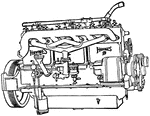
"The electric generator makes electricity to be used for starting the engine and lighting the car." -Bodmer, 1917

Building an Automobile, Step 09: Electric Generator

"The electric generator makes electricity to be used for starting the engine and lighting the car."…
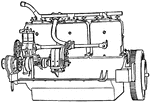
"The magneto gives an electric spark, which explodes the gasoline in the cylinders. The water pump keeps water flowing around the cylinders to prevent them from getting too hot. This water comes back to the pump through the radiator at the front of the car. Wind blows through the radiator and cools off the water. The tire pump on up-to-date cars is run by the engine. It does not pump except when the gears, which are shown in the picture, are pulled together." -Bodmer, 1917

Building an Automobile, Step 10: Magneto

"The magneto gives an electric spark, which explodes the gasoline in the cylinders. The water pump keeps…
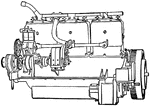
"An electric motor starts the engine by turning the fly-wheel. This makes it unnecessary to get out and crank the car by hand." -Bodmer, 1917

Building an Automobile, Step 11: Motor

"An electric motor starts the engine by turning the fly-wheel. This makes it unnecessary to get out…
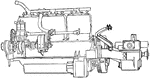
"The transmission is added. The transmission makes it possible to reverse the car. It also enables the driver to go into high-speed gear when on level roads and low-speed gear for starting and for pulling hills." -Bodmer, 1917

Building an Automobile, Step 12: Transmission

"The transmission is added. The transmission makes it possible to reverse the car. It also enables the…

"Double-drop pressed steel frame. The frame on which the car is built." -Bodmer, 1917

Building an Automobile, Step 13: Frame

"Double-drop pressed steel frame. The frame on which the car is built." -Bodmer, 1917
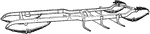
"Addition of semi-elliptic and three-fourths-elliptic springs to frame. Large springs are placed at the front and rear of the frame. The make the car ride smoothly." -Bodmer, 1917

Building an Automobile, Step 14: Elliptic Springs

"Addition of semi-elliptic and three-fourths-elliptic springs to frame. Large springs are placed at…
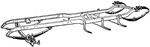
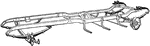
"Adding the front axle." -Bodmer, 1917

Building an Automobile, Step 15: Front Axle

"Adding the front axle." -Bodmer, 1917

"Showing addition of full-floating rear axle." -Bodmer, 1917

Building an Automobile, Step 16: Rear Axle

"Showing addition of full-floating rear axle." -Bodmer, 1917
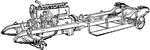
"Completed engine and transmission is next fastened to the frame and connected to the rear axle by the drive shaft." -Bodmer, 1917

Building an Automobile, Step 17: Engine and Transmission Attached to the Frame

"Completed engine and transmission is next fastened to the frame and connected to the rear axle by the…
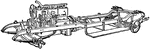
"Showing addition of gasoline tank and gas lead to carburetor." -Bodmer, 1917

Building an Automobile, Step 18: Gasoline Tank

"Showing addition of gasoline tank and gas lead to carburetor." -Bodmer, 1917
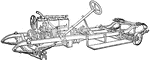
"Showing how steering gear is connected." -Bodmer, 1917

Building an Automobile, Step 19: Steering Gear

"Showing how steering gear is connected." -Bodmer, 1917
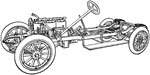
"Wheels are next added to chassis." -Bodmer, 1917

Building an Automobile, Step 20: Wheels

"Wheels are next added to chassis." -Bodmer, 1917

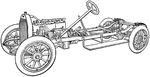
"Completed chassis with radiator added. The water which keeps the engine from getting too hot is pumped around the cylinders and then through the radiator. The wind blows through the little openings in the radiator, and cools off the water. Then the water is pumped around the cylinders again." -Bodmer, 1917

Building an Automobile, Step 21: Radiator

"Completed chassis with radiator added. The water which keeps the engine from getting too hot is pumped…
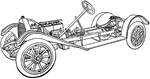
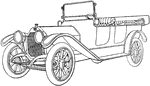
"The steps and fenders are next attached." -Bodmer, 1917

Building an Automobile, Step 22: Fenders

"The steps and fenders are next attached." -Bodmer, 1917

"The finished car." -Bodmer, 1917

Building an Automobile, Step 23: Finished Car

"The finished car." -Bodmer, 1917

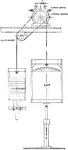
"General arrangement of roping for gearless traction elevator installation." -Bodmer, 1917

Gearless Traction Elevator

"General arrangement of roping for gearless traction elevator installation." -Bodmer, 1917
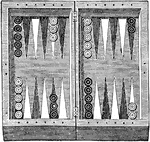
"Backgammon, a game played by two persons upon a table or board made for the purpose, with pieces or men, dice-boxes, and dice. The table is in two parts, on which are twenty-four black and white spaces called points. Each player has fifteen men of different colors for the purpose of distinction. The movements of the men are made in accordance with the numbers turned up by the dice. It is said to have been invented in the tenth century." -Vaughan, 1906

Backgammon Board

"Backgammon, a game played by two persons upon a table or board made for the purpose, with pieces or…
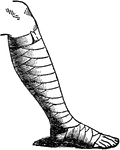
"Roller Bandage. Bandage, a surgical wrapper of some kind applied to a limb or other portion of the body to keep parts in position, exert a pressure, or for other purpose." -Vaughan, 1906

Roller Bandage

"Roller Bandage. Bandage, a surgical wrapper of some kind applied to a limb or other portion of the…
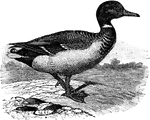
The Mallard (Anas platyrhynchos), probably the best-known and most recognizable of all ducks, is a dabbling duck which breeds throughout the temperate and sub-tropical areas of North America, Europe, Asia, New Zealand (where it is currently the most common duck species), and Australia. It is strongly migratory in the northern parts of its breeding range, and winters farther south. For example, in North America it winters south to Mexico, but also regularly strays into Central America and the Caribbean between September and May

Mallard Duck

The Mallard (Anas platyrhynchos), probably the best-known and most recognizable of all ducks, is a dabbling…
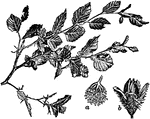
"Branch of Common Beech. a.-- flower; b.-- fruit. Beech, the common name of trees well known in various parts of the world, including America, New Zealand, and Terra del Fuego." -Vaughan, 1906

Common Beech

"Branch of Common Beech. a.-- flower; b.-- fruit. Beech, the common name of trees well known in various…
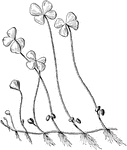
Four leaf clover is found in central and southern Europe, Caucasia, western Siberia, Afghanistan, S.W. India, China, Japan and North America. Considered a weed in some parts of the United States where it has been well established in the north eastern States for over 100 years.

Four Leaf Clover

Four leaf clover is found in central and southern Europe, Caucasia, western Siberia, Afghanistan, S.W.…
An illustration of a four leaf clover sporocarp with valves opened. Four leaf clover is found in central and southern Europe, Caucasia, western Siberia, Afghanistan, S.W. India, China, Japan and North America. Considered a weed in some parts of the United States where it has been well established in the north eastern States for over 100 years.

Four Leaf Clover Sporocarp with Valves Opened

An illustration of a four leaf clover sporocarp with valves opened. Four leaf clover is found in central…
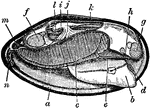
"Longitudinal Section through a Fresh-water Mussel. a, edge of mantle; b, foot, with position of ganglion indicated; c, gills; d, mouth; e, tentacles or palps; f, posterior adductor muscle; g, anterior adductor; h, head-ganglion; i, ventricle of heart; j, auricle of heart; k, rectum; l, kidney; m, exhalent aperture; n, inhalent aperture." -Vaughan, 1906

Mussel Anatomy

"Longitudinal Section through a Fresh-water Mussel. a, edge of mantle; b, foot, with position of ganglion…
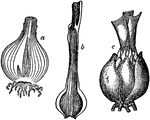
"a.-- Truncated bulb of onion; b.-- onion leaf dissected off; c.-- bulb of lily. Bulb, a modified leaf-bud, formed on a plant upon or beneath the surface of the ground, emitting roots from its base, and producing a stem from its center." -Vaughan, 1906

Various Bulbs

"a.-- Truncated bulb of onion; b.-- onion leaf dissected off; c.-- bulb of lily. Bulb, a modified leaf-bud,…
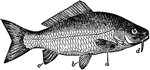
"Carp (Cyprinus carpio). a.-- fore fin; b.-- hind fin; c.-- anal fin; d.-- large barbule. Carp, a genus of soft-finned abdominal fish distinguished by the small mouth, toothless jaws, and gills of three flat rays." -Vaughan, 1906

Common Carp

"Carp (Cyprinus carpio). a.-- fore fin; b.-- hind fin; c.-- anal fin; d.-- large barbule. Carp, a genus…
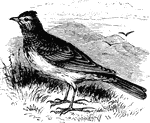
"Sky-Lark. Upper parts grayish-brown, the feathers with darker centers; under parts whitish, tinged with buff across breast and along sides, and there streaked with dusky; a pale superciliary line; wings with much whitish edging; outer tail-feather mostly white, the next one or two with white borders." Elliot Coues, 1884

Skylark

"Sky-Lark. Upper parts grayish-brown, the feathers with darker centers; under parts whitish, tinged…
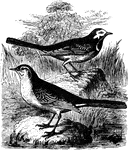
A (Motacilla alba) or White Wagtail (upper) and a (Motacilla flava) Yellow Wagtail (lower) sitting on the rocks in a grassy area. "The White Wagtail - Head black, with a broad mask of white across forehead and along side; the black extending on the fore-breast; wings blackish, with much white edging and tipping of the quills and greater coverts; tail black, the two lateral feathers on each side mostly white; back and sides ashy; lower parts mostly white; bill and feet black. In winter black more restricted, in part replaced by gray. The Yellow Wagtail has characters of the Motacilla alba; tail shorter, not exceeding the wing length; hind claw lengthened and straightish; hind toe and claw nearly as long as the tarsus. Coloration chiefly yellow and greenish." Elliot Coues, 1884

A White and Yellow Wagtail Sitting on the Rocks

A (Motacilla alba) or White Wagtail (upper) and a (Motacilla flava) Yellow Wagtail (lower) sitting on…
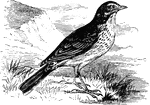
"Meadow Pipit or Anthus pratensis. Upper parts greenish-brown distinctly marked with blackish-brown centres of the feathers; wing-quills and coverts clove-brown, edged with greenish-gray. Tail-feathers dark brown, edged with the greenish shade of the back, the outer one obliquely white for nearly half its length, and others with white at the end. Cheeks olivaceous, speckled with dusky. Under parts brownish-white with a tinge of green, marked on the breast and sides with brownish-black streaks running forward as a maxillary chain; chin, belly, and under tail-coverts unmarked. Bill dusky above and at end, the rest livid flesh-color; feet obscure flesh-color; iris blackish." Elliot Coues, 1884

Meadow Pipit

"Meadow Pipit or Anthus pratensis. Upper parts greenish-brown distinctly marked with blackish-brown…
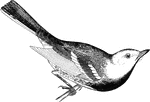
"Black Throated Green Warbler or Dendroica virens. Back and crown clear yellow-olive; forehead, superciliary line, and whole sides of head rich yellow (in high plumage, middle of back with dusky marks, and dusky or dark olive lines through eyes and auriculars, and even bordering the crown); chin, throat, and breast jet black, prolonged behind as streaks on the sides; other under parts white; usually yellow-tinged; wings and tail dusky, former with two white bars and much whitish edging, latter with outer feathers nearly all white; bill and feet blackish." Elliot Coues, 1884

Black Throated Green Warbler

"Black Throated Green Warbler or Dendroica virens. Back and crown clear yellow-olive; forehead, superciliary…
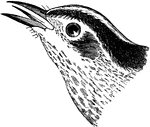
"Black and White Creeper or Mniotilta varia. Black; edges of feathers of upper parts, coronal, superciliary, and maxillary stripes, tips of greater and median wing-coverts, outer edges of inner secondaries and inner edges of quills and tail-feathers, and spots on inner webs of lateral tail-feathers, white; under parts mostly white with black streaks on sides and crissum; bill and feet black. Similar: less black in proportion to the white, being mostly white below." Elliot Coues, 1884

Black and White Creeper

"Black and White Creeper or Mniotilta varia. Black; edges of feathers of upper parts, coronal, superciliary,…
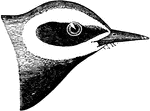
"Blue Golden-Winged Warbler or Helminthophila chrysoptera. Upper parts slaty-blue, or or fine bluish-gray; crown, and large wing-patch formed by confluent wing-bars, rich yellow; a broad stripe on side of head and patch on chin, throat and fore-breast, black, the eye-stripe bordered above and below with white; under parts generally, excepting the black breast-plate, white, often tinted with yellowish, and shaded on the sides with ashy. Exposed surfaces of wings and tail like upper parts; great white blotches on three lateral tail-feathers; bill black; feet dark." Elliot Coues, 1884

Blue Golden-Winged Warbler

"Blue Golden-Winged Warbler or Helminthophila chrysoptera. Upper parts slaty-blue, or or fine bluish-gray;…
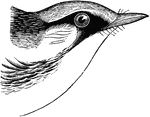
"Chestnut-sided Warbler, Dendroica pensylvanica. Back streaked with black and pale yellow (sometimes ashy or whitish); whole crown pure yellow, immediately bordered with white, then enclosed with black; sides of head and neck and whole under parts pure white, former with an irregular black crescent before the eye, one horn extending backward over the eye to border the yellow crown and be dissipated on the sides of the nape, the other reaching downward and backward to connect with a chain of pure chestnut streaks that run the whole length of the body, the under eyelid and auriculars being left white; wing-bands generally fused into one large patch, and, like the edging of the inner secondaries, much tinged with yellow; tail-spots white, as usual; bill blackish, feet brownish." Elliot Coues, 1884

Chestnut-sided Warbler

"Chestnut-sided Warbler, Dendroica pensylvanica. Back streaked with black and pale yellow (sometimes…
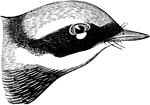
"Black -and-Yellow Warbler. Magnolia Warbler. Back black, usually quite pure and uninterrupted in the spring, more or less mixed with olive in the winter; rump yellow; upper tail-coverts black , often skirted with olive and ashy. Whole crown of head clear ash; sides of head black, including a very narrow frontlet; the eyelids and a stripe behind the eye, between the ash and black, white. Entire under parts rich yellow, excepting the white crissum, heavily streaked with black across the breast and along the sides, the streaks on the breast so thick as to form a nearly continuous black border to the immaculate yellow throat. Wings fuscous, with lining, white edging of the inner webs of all the quills, of the outer webs of the inner secondaries, and with a large white patch formed by the tips of the median coverts and tips of the median coverts and tips and outer edges of the coverts. Tail blackish, with square white spots on the middle of the inner webs of al the feathers excepting the middle pair. Bill blackish; feet dark."

Magnolia Warbler

"Black -and-Yellow Warbler. Magnolia Warbler. Back black, usually quite pure and uninterrupted in the…
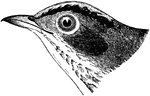
"Golden-crowned Wagtail Warbler. Golden-crowned Accentor. Golden-crowned Thrush. Oven-bird. Seiurus aurocapillus. Entire upper parts, including the wings and tail, uniform bright olive-green, without markings. Top of head with black lateral stripes, bounding a golden-brown or dull orange space. A white ring round eye; no white superciliary stripe. Under parts white, thickly spotted with dusky on the breast, the spots lengthening into streaks on the sides; a narrow black maxillary line; under wing-coverts tinged with yellow. Legs flesh-colored." Elliot Coues, 1884

Ovenbird

"Golden-crowned Wagtail Warbler. Golden-crowned Accentor. Golden-crowned Thrush. Oven-bird. Seiurus…
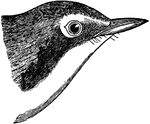
"Kentucky Warbler. Oporornis formosus. Clear olive-green; entire under parts bright yellow, olive-shaded along sides; crown black, separated by a rich yellow superciliary line(which curls around the eye behind) from a broad black bar running form bill below eye thence down the side of the neck; wings and tail unmarked, glossed with olive; feet flesh-colored." Elliot Coues, 1884

Kentucky Warbler

"Kentucky Warbler. Oporornis formosus. Clear olive-green; entire under parts bright yellow, olive-shaded…
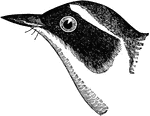
"Geothlypis trichas. Common Yellowthroat. Yellow-throated Ground Warbler. Maryland Yellow-throat. Upper parts rich olive, inclining to grayish on the head, brightest on the rump. Wings and tail brown, edged with the color of the back. Chin, throat, and breast, with under wing- and tail-coverts, rich yellow. middle under parts dull whitish, shaded on the sides. A broad mask on the front and sides of the head, bordered behind by hoary-ash. Bill black; feet flesh-colored." Elliot Coues, 1884

Common Yellowthroat

"Geothlypis trichas. Common Yellowthroat. Yellow-throated Ground Warbler. Maryland Yellow-throat. Upper…
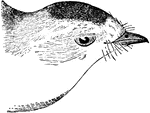
"Myiodioctes pussies. Blacked-capped Fly-catching Warbler. Upper parts, including exposed edging of the wings and tail, bright yellowish-olive; under parts, including front and sides of the head and superciliary line, rich yellow, shaded with olive on the sides. A squarish, glossy blue-black patch on the crown. Wings and tail plain fuscous, with greenish edging, unmarked with with other color. Upper mandible dark; under mandible and feet light." Elliot Coues, 1884

Black-capped Fly-catching Warbler

"Myiodioctes pussies. Blacked-capped Fly-catching Warbler. Upper parts, including exposed edging of…
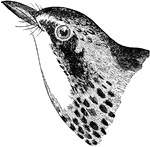
"Myiodioctes canadensis. Canadian Fly-catching Warbler. Canada Warbler. Bluish-ash; crown speckled with lanceolate black marks, crowded and generally continuous on the forehead; the latter divided lengthwise by a slight yellow line; short superciliary line and edges of eyelids yellow; lores black, continuous with black under the eye, and this passing as a chain of black streaks down the side of the neck and prettily encircling the throat like a necklace of jet; excepting these streaks and the white under tail-coverts, the entire under parts are clear yellow; wings and tail unmarked; feet flesh-colored." Elliot Coues, 1884

Canada Warbler

"Myiodioctes canadensis. Canadian Fly-catching Warbler. Canada Warbler. Bluish-ash; crown speckled with…
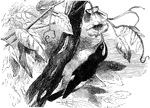
"Certhiola flaveola. Honey Creeper. Dark brown above; long superciliary line and under parts dull white; breast, edging of wing, and rump, bright yellow; wings dusky, with a white spot at base of primaries, and whitish edging of the quills; tail dusky, tipped with white; bill and feet black; eyes blue." Elliot Coues, 1884

Honey Creeper

"Certhiola flaveola. Honey Creeper. Dark brown above; long superciliary line and under parts dull white;…
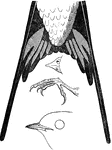
"Fig 181 - Generic details of Hirundo horreorum(Barn Swallow)Deep lustrous steel-blue; forehead and entire under parts rufous, generally deepest on the forehead and throat; an imperfect steel-blue collar. Wings and tail blackish, with steel-blue or somewhat greenish gloss; the lateral pair of tail-feathers much lengthened and filiform at the end, all but central pair with white spot." Elliot Coues, 1884

Barn Swallow Details

"Fig 181 - Generic details of Hirundo horreorum(Barn Swallow) Deep lustrous steel-blue; forehead and…
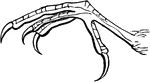
Side view of the Barn Swallow's claw. "Hirundo horreorum. Barn Swallow. Tarsi shorter than middle toe and claw, above feathered for a little distance; basal joint of middle toe partly adherent to both lateral toes." Elliot Coues, 1884

Barn Swallow Claw

Side view of the Barn Swallow's claw. "Hirundo horreorum. Barn Swallow. Tarsi shorter than middle toe…
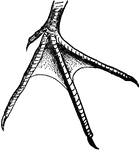
"... basal webs generally run out to the end of the first, or along part of the second, phalanx of the toes; usually farther between the outer and middle that between the middle and inner toes. Such a foot is well illustrated by the semipalmated plover (Aegialites semipalmatus), semipalmated sandpiper(Ereunetes pusillus, fig 48)." Elliot coues, 1884

Half-Webbed Foot of a Sandpiper

"... basal webs generally run out to the end of the first, or along part of the second, phalanx of the…
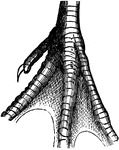
The semipalmated (half-webbed) bases of toes on the foot of a Willet. "... basal webs generally run out to the end of the first, or along part of the second, phalanx of the toes; usually farther between the outer and middle that between the middle and inner toes." Elliot Coues, 1884

Half-Webbed Foot of a Willet

The semipalmated (half-webbed) bases of toes on the foot of a Willet. "... basal webs generally run…
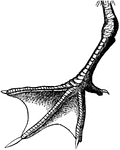
"In the palmate or ordinary webbed foot, all the front toes are united by ample webs." Elliot Coues, 1884

Webbed Foot of a Tern

"In the palmate or ordinary webbed foot, all the front toes are united by ample webs." Elliot Coues,…