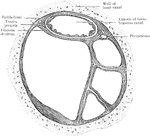
Transverse section of human semicircular canal.

Section of Semicircular Canals

Transverse section of human semicircular canal.

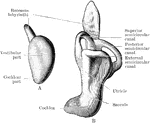
A, Left labyrinth of a human embryo of about four weeks; B, left labyrinth of a human embryo of about 5 weeks.

Development of Labyrinth

A, Left labyrinth of a human embryo of about four weeks; B, left labyrinth of a human embryo of about…
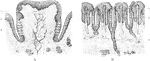
A, Section through papilla vallata of a human tongue. B, Section through part of the papilla foliata of a rabbit. Labels: 1, papilla; 2, vallum; 3, taste buds; 4, papillae; 5, taste buds; 6, ducts of serous gland.

Tongue of Human and Rabbit

A, Section through papilla vallata of a human tongue. B, Section through part of the papilla foliata…
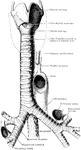
The trachea and bronchi. The thyroid body is indicated by a dotted line.

Trachea and Bronchi

The trachea and bronchi. The thyroid body is indicated by a dotted line.

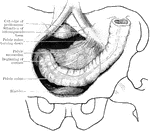
The iliac and pelvic colons, from a formalin-hardened male body, aged 30. The pelvic colon was usually long; its course is shown, as well as that of the beginning of the rectum, by dotted lines. It first ran across the upper surface of the bladder to the right pelvic wall, then recrossed the pelvis in a line posterior to is first crossing; finally it returned towards the middle line, and passed into the rectum. As a rule, after crossing to the right side of the pelvis, the pelvic colon turns backwards and inwards to reach the middle line, where it passes into the rectum.

Iliac and Pelvic Colons

The iliac and pelvic colons, from a formalin-hardened male body, aged 30. The pelvic colon was usually…
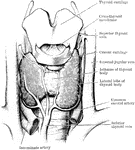
Dissection of the thyroid body and of the parts in immediate relation to it.

Thyroid Body

Dissection of the thyroid body and of the parts in immediate relation to it.

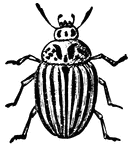
The Colorado potato beetle (Leptinotarsa decemlineata), also known as the Colorado beetle, ten-striped spearman, the ten-lined potato beetle) is an important pest of potato crops. It is approximately 10 mm (0.4 inches) long, with a bright yellow/orange body and 5 bold brown stripes along the length of each of its elytra, and it can easily be confused with its close cousin and look-alike, the false potato beetle. The beetle was described in 1824 by Thomas Say from specimens collected in the Rocky Mountains on buffalo-bur, Solanum rostratum. The origin of the beetle is somewhat unclear, but it seems to be that Colorado and Mexico are a part of its native distribution in the southwestern North America

Colorado Potato Beetle

The Colorado potato beetle (Leptinotarsa decemlineata), also known as the Colorado beetle, ten-striped…
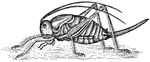
Crickets, family Gryllidae (also known as "true crickets"), are insects somewhat related to grasshoppers and more closely related to katydids or bush crickets (family Tettigoniidae). They have somewhat flattened bodies and long antennae. There are about 900 species of crickets. They tend to be nocturnal and are often confused with grasshoppers because they have a similar body structure including jumping hind legs.

Cricket

Crickets, family Gryllidae (also known as "true crickets"), are insects somewhat related to grasshoppers…
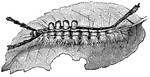
Orgyia leucostigma, the White-marked tussock moth, is a moth in the family Lymantriidae. The caterpillar is very common especially in late summer in eastern North America, as far west as Texas, Colorado, and Alberta. There are two or more generations a year in eastern North America (Wagner 2005). They overwinter in the egg stage. Eggs are laid in a single mass over the cocoon of the female, and covered in a froth (Wagner 2005). Up to 300 eggs are laid at a time. he larvae are brightly coloured, with tufts of hair-like setae. The head is bright red, the body has yellow or white stripes, with a black stripe along the middle of the back. There are bright red defensive glands on the hind end of the back. Four white toothbrush-like tufts stand out from the back, and there is a grey-brown hair pencil at the hind end. Touching the hairs will set off an allergic reaction in many humans (Wagner 2005). Young larvae skeletonize the surface of the leaf, while older larvae eat everything except the larger veins (Rose and Lindquist, 1982). They grow to about 35 mm.

White-marked Tussock Caterpillar

Orgyia leucostigma, the White-marked tussock moth, is a moth in the family Lymantriidae. The caterpillar…
The Brown-tail (Euproctis chrysorrhoea) is a moth of the family Lymantriidae. It is distributed throughout Europe. The wings of this species are pure white, as is the body, apart from a tuft of brown hairs at the end of the abdomen. The brown colouration extends along most of the back of the abdomen in the male. In the female, the back of the abdomen is white but the tuft of brown hairs is much bigger. Ths wingspan is 36-42 mm. The species flies at night in July and August and is attracted to light.

Brown-tail Moth Web

The Brown-tail (Euproctis chrysorrhoea) is a moth of the family Lymantriidae. It is distributed throughout…
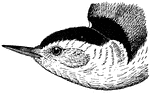
The White-breasted Nuthatch (Sitta carolinensis) is a small songbird of the nuthatch family which breeds in old-growth woodland across much of temperate North America. It is a stocky bird, with a large head, short tail, powerful bill and strong feet. The upperparts are pale blue-gray, and the face and underparts are white. It has a black cap and a chestnut lower belly. The nine subspecies differ mainly in the color of the body plumage.

White-breasted Nuthatch

The White-breasted Nuthatch (Sitta carolinensis) is a small songbird of the nuthatch family which breeds…
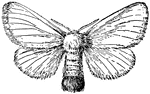
The Brown-tail (Euproctis chrysorrhoea) is a moth of the family Lymantriidae. It is distributed throughout Europe. The wings of this species are pure white, as is the body, apart from a tuft of brown hairs at the end of the abdomen. The brown colouration extends along most of the back of the abdomen in the male. In the female, the back of the abdomen is white but the tuft of brown hairs is much bigger. Their wingspan is 36-42 mm. The species flies at night in July and August and is attracted to light.

Brown-tail Moth

The Brown-tail (Euproctis chrysorrhoea) is a moth of the family Lymantriidae. It is distributed throughout…
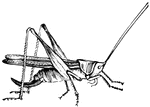
Crickets, family Gryllidae (also known as "true crickets"), are insects somewhat related to grasshoppers and more closely related to katydids or bush crickets (family Tettigoniidae). They have somewhat flattened bodies and long antennae. There are about 900 species of crickets. They tend to be nocturnal and are often confused with grasshoppers because they have a similar body structure including jumping hind legs.

Cricket

Crickets, family Gryllidae (also known as "true crickets"), are insects somewhat related to grasshoppers…
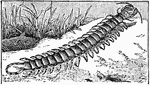
Centipedes are arthropods belonging to the class Chilopoda and the Subphylum Myriapoda. They are elongated metameric animals with one pair of legs per body segment. A key trait uniting this group is a pair of venom claws or forcipules formed from a modified first appendage. This also means that centipedes are an exclusively predatory taxon, which is uncommon.

Centipede

Centipedes are arthropods belonging to the class Chilopoda and the Subphylum Myriapoda. They are elongated…
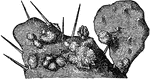
An illustration of Cochineal living on cactus. Cochineal is the name of both crimson or carmine dye and the cochineal insect (Dactylopius coccus), a scale insect in the suborder Sternorrhyncha, from which the dye is derived. This type of insect, a primarily sessile parasite, lives on cacti from the genus Opuntia, feeding on moisture and nutrients in the cacti. The insect produces carminic acid which deters predation by other insects. Carminic acid can be extracted from the insect's body and eggs to make the dye. Cochineal is primarily used as a food colouring and for cosmetics.

Cochineal

An illustration of Cochineal living on cactus. Cochineal is the name of both crimson or carmine dye…
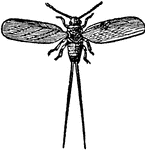
An illustration of a male Cochineal. Cochineal is the name of both crimson or carmine dye and the cochineal insect (Dactylopius coccus), a scale insect in the suborder Sternorrhyncha, from which the dye is derived. This type of insect, a primarily sessile parasite, lives on cacti from the genus Opuntia, feeding on moisture and nutrients in the cacti. The insect produces carminic acid which deters predation by other insects. Carminic acid can be extracted from the insect's body and eggs to make the dye. Cochineal is primarily used as a food colouring and for cosmetics.

Cochineal (Male)

An illustration of a male Cochineal. Cochineal is the name of both crimson or carmine dye and the cochineal…
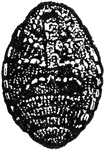
An illustration of a female Cochineal. Cochineal is the name of both crimson or carmine dye and the cochineal insect (Dactylopius coccus), a scale insect in the suborder Sternorrhyncha, from which the dye is derived. This type of insect, a primarily sessile parasite, lives on cacti from the genus Opuntia, feeding on moisture and nutrients in the cacti. The insect produces carminic acid which deters predation by other insects. Carminic acid can be extracted from the insect's body and eggs to make the dye. Cochineal is primarily used as a food colouring and for cosmetics.

Cochineal (Female)

An illustration of a female Cochineal. Cochineal is the name of both crimson or carmine dye and the…
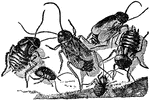
An illustration of a male (right) and female (left) cockroach. Cockroaches (or simply "roaches") are insects of the order Blattaria. This name derives from the Latin word for "cockroach", blatta. There are about 4,000 species of cockroach of which 30 species are associated with human habitations and about four species are well known as pests.

Cockroach

An illustration of a male (right) and female (left) cockroach. Cockroaches (or simply "roaches") are…
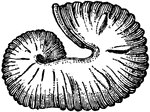
Scaphites equalis is a species of extinct cephalopods that thrived during the Cretaceous period. "A genus of ammonites, or fossil ammonoid cephalopods of scaphoid shape, typical of the family <i>Scaphitidae</i>; the scaphites. The have the early walls regularly involute, but the last whorl detached, and straight for some distance, when it becomes again recurved toward the body." &mdash;Whitney, 1889

Scaphites equalis, Extinct Cephalopod Fossil

Scaphites equalis is a species of extinct cephalopods that thrived during the Cretaceous period. "A…
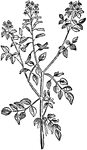
Watercresses are fast-growing, aquatic or semi-aquatic, perennial plants native from Europe to central Asia, and one of the oldest known leaf vegetables consumed by human beings. These plants are members of the Family Brassicaceae or cabbage family, botanically related to garden cress and mustard &mdash; all noteworthy for a peppery, tangy flavor.

Watercress

Watercresses are fast-growing, aquatic or semi-aquatic, perennial plants native from Europe to central…
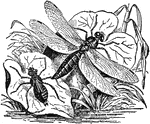
An illustration of a dragon fly (right) and a nymph (left). A dragonfly is a type of insect belonging to the order Odonata, the suborder Epiprocta or, in the strict sense, the infraorder Anisoptera. It is characterized by large multifaceted eyes, two pairs of strong transparent wings, and an elongated body. Dragonflies are similar to damselflies, but the adults can be differentiated by the fact that the wings of most dragonflies are held away from, and perpendicular to, the body when at rest. n biology, a nymph is the immature form of some insects, which undergoes incomplete metamorphosis (hemimetabolism) before reaching its adult stage; unlike a typical larva, a nymph's overall form already resembles that of the adult. In addition, while a nymph moults it never enters a pupal stage. Instead, the final moult results in an adult insect.

Dragon Fly and Nymph

An illustration of a dragon fly (right) and a nymph (left). A dragonfly is a type of insect belonging…
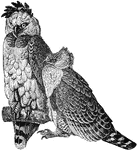
The American Harpy Eagle (Harpia harpyja) is a neotropical eagle, often simply called the Harpy Eagle. It is the only member of the genus Harpia. It is the largest and most powerful raptor found in the Americas, usually inhabiting tropical lowland rainforests in the upper (emergent) canopy layer. Its name references the harpies from Ancient Greek mythology. These were wind spirits that took the dead to Hades, and were said to have a body like an eagle and the face of a human.

American Harpy Eagle

The American Harpy Eagle (Harpia harpyja) is a neotropical eagle, often simply called the Harpy Eagle.…
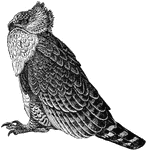
The Martial Eagle (Polemaetus bellicosus), is Africa's largest eagle and is the only member of the genus Polemaetus. t is a very large eagle, with a length of 76-90 cm (30-36 in), an average weight of 5.2 kg (11.6 lbs) and a wingspan of 190-260 cm (6.25-8.5 ft). The adult's plumage has dark brown upperparts, head and upper chest. The body underparts are white streaked with black. The underwing coverts are brown, with pale flight feathers, also streaked with black. The female is usually larger and more streaked than the male. The immature is paler above and has white underparts. It reaches adult plumage in its seventh year.

Martial Eagle

The Martial Eagle (Polemaetus bellicosus), is Africa's largest eagle and is the only member of the genus…
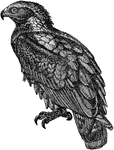
The Golden Eagle (Aquila chrysaetos) is one of the best known birds of prey in the Northern Hemisphere. Like all eagles, it belongs to the family Accipitridae. Once widespread across the Holarctic, it has disappeared from many of the more heavily populated areas. It has a wingspan averaging over 2 m (7 ft) and up to 1 m (3 ft) in body length.

Golden Eagle

The Golden Eagle (Aquila chrysaetos) is one of the best known birds of prey in the Northern Hemisphere.…
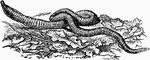
An illustration of an earthworm. The basic body plan of an earthworm is a tube, the digestive system, within a tube, the muscular outer body. The body is annular, formed of segments that are most specialized in the anterior. Earthworms have a simple circulatory system. They have two main blood vessels that extend through the length of their body: a ventral blood vessel which leads the blood to the posterior end, and a dorsal blood vessel which leads to the anterior end. Most earthworms are decomposers feeding on undecayed leaf and other plant matter, others are more geophagous.

Earthworm

An illustration of an earthworm. The basic body plan of an earthworm is a tube, the digestive system,…
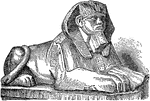
A Sphinx is a zoomorphic mythological figure which is depicted as a recumbent lion with a human head.
Sphinx

A Sphinx is a zoomorphic mythological figure which is depicted as a recumbent lion with a human head.

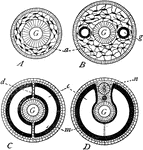
Diagrams of the body layers and cavities in A, coelenterates; B, flatworms; C, annelids; D, vertebrates. Labels: G, gastric cavity; g, cavity of the gonad; a, primary body cavity (blastocoele) filled with branched cells (mesenchyme); c, secondary body cavity (coelom); d, dorsal mesentery; m, mesenchyme filling space of original primary body cavity; n, nerve tube.

Body Layers and Cavities

Diagrams of the body layers and cavities in A, coelenterates; B, flatworms; C, annelids; D, vertebrates.…
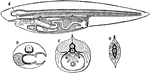
Diagrammatic sections of the ideal vertebrate. A, sagittal section showing the brain and spinal cord on the dorsal side of the notochord, and the alimentary canal and viscera on the ventral side of it. B, transverse section of the head, showing a gill arch and filaments of the left and a gill cleft on the right. C, transverse section of the trunk, showing the gut, the genital glands, and the excretory organs in the body cavity. D, transverse section of the tail.

Section of Vertebrate

Diagrammatic sections of the ideal vertebrate. A, sagittal section showing the brain and spinal cord…
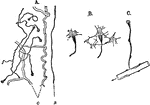
Structure of the protonephridium (excretory organ) of a flatworm. A, part of the excretory apparatus of a tapeworm; R, edge of body; c, collecting tubules. B, terminal cells with flame of cilia. C, diagram of terminal cell, excretory capillary, and canal.

Protonephridium

Structure of the protonephridium (excretory organ) of a flatworm. A, part of the excretory apparatus…
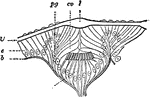
Section through the cup-shaped eye of a gastropod. Labels: e, epithelium covering body; cv, vitreous body; R, retina; N, nerve.

Eye of Gasteropod

Section through the cup-shaped eye of a gastropod. Labels: e, epithelium covering body; cv, vitreous…
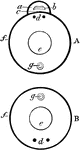
A, Diagrammatic transverse section through the body of a vertebrate. B, A similar section through a highly organized invertebrate animal. Labels: a, neural canal; b, cerebrospinal nerve center; c, notochord; d, sympathetic nerve center; e, alimentary canal; f, visceral canal wall; g, haemal system.

Vertebrate and Invertebrate

A, Diagrammatic transverse section through the body of a vertebrate. B, A similar section through a…
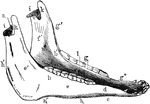
Inferior maxilla of a horse-anterolateral view. Labels: a, body; b, b', rami; c, neck; d, mental foramen; e, buccinator; e', masseter surface; f, f', inner surface of ramus; g, molor alveoli; g', anterior border; g', bar, bounding diastema; h, h', h', posterior border. The angle lies between h' and h'; i, condyles; km coronoid processes; l, maxillary space; m, inferior dental foramen; n, sigmoid notch.

Inferior Maxilla of a Horse

Inferior maxilla of a horse-anterolateral view. Labels: a, body; b, b', rami; c, neck; d, mental foramen;…
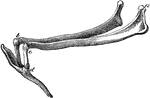
The hyoid series is composed of five distinct pieces- a body, or hyoid bone proper, two cornua or horns and two cornicula or lesser horns. Shown us the left aspect of the hyoid series of bones in a horse. Labels: a, proximal, end of left cornu; b, distal end of right cornu; c, proximal end of corniculum; d, hyoid bone. The left heel process points downwards and backwards, the spur process in the opposite direction.

Hyoid Series of Bones in a Horse

The hyoid series is composed of five distinct pieces- a body, or hyoid bone proper, two cornua or horns…
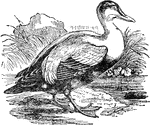
The Common Eider, Somateria mollissima, is a large (50-71cm body length) sea-duck, which is distributed over the northern coasts of Europe, North America and eastern Siberia. It breeds in Arctic and some northern temperate regions, but winters somewhat farther south in temperate zones, when it can form large flocks on coastal waters. The eider's nest is built close to the sea and is lined with the celebrated eiderdown, plucked from the female's breast. This soft and warm lining has long been harvested for filling pillows and quilts, but in more recent years has been largely replaced by down from domestic farm-geese and synthetic alternatives.

Eider Duck

The Common Eider, Somateria mollissima, is a large (50-71cm body length) sea-duck, which is distributed…
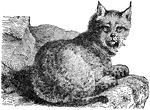
A lynx is any of four medium-sized wild cats. All are members of the genus Lynx, but there is considerable confusion about the best way to classify felids at present, and some authorities classify them as part of the genus Felis. The Caracal, despite sometimes being called Persian Lynx or African Lynx, does not belong to this genus. Lynx have short tails and characteristic tufts of black hair on the tip of the ears. They have a ruff under the neck, which has black bars (not very visible), resembling a bow tie. They have large paws padded for walking on snow and long whiskers on the face. The body color varies from medium brown to gold-ish to beige-white; and occasionally, is marked with dark brown spots, especially on the limbs. All species of lynx also have white fur on their chests, bellies and on the insides of their legs which are extensions of the chest and belly fur. Also, the lynx's coloring, fur height and paw size varies by its climate range- in the Southwest US, the fur and color are short-haired, dark and the paws are smaller and less padded, as the lynx ranges to its colder Northern climes, the fur gets progressively thicker (for warmth), the color gets lighter (for camouflage) and its paws enlarge and become more padded for snowy environments.

Lynx

A lynx is any of four medium-sized wild cats. All are members of the genus Lynx, but there is considerable…
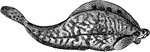
Flounder (also; fluke) are flatfish that live in ocean waters ie., Northern Atlantic and waters along the east coast of the United States and Canada, and the Pacific Ocean, as well. While flounders have both eyes situated on one side of the head, they are not born this way. Their life involves metamorphosis. During metamorphosis, one eye migrates to the other side of the body so that both eyes are situated on the upward-facing side of its body. After metamorphosis, flounder lie on one side on the ocean floor; either the left or right side might face upward depending on the species.

Flounder

Flounder (also; fluke) are flatfish that live in ocean waters ie., Northern Atlantic and waters along…
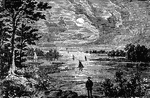
Lynnhaven Bay is a relatively small body of water in Virginia separated from the rest of the Chesapeake Bay by a small inlet.

Lynnhaven Bay, Virginia

Lynnhaven Bay is a relatively small body of water in Virginia separated from the rest of the Chesapeake…
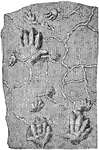
An illustration of a fossil containing Chirotherium tracks. Chirotherium (also known as Cheirotherium) or 'hand-beast', is the name of a creature which may be known only from fossil imprints of its tracks (trace fossils). These look, by coincidence, remarkably like the hand of an ape/human or bear, with the outermost toe having evolved to extend out to the side like a thumb, although probably only providing a firmer grip in mud. Its tracks were first found in 1834, in red sandstone in Thuringia, Germany, dating from 240 million years ago (mya). This creature was probably an archosaur, related to the ancestors of the dinosaurs.

Chirotherium Tracks

An illustration of a fossil containing Chirotherium tracks. Chirotherium (also known as Cheirotherium)…
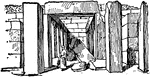
The Great Sphinx is a statue with the face of a man and the body of a lion. Blocks of stone weighing upwards of 200 tons were quarried in the construction phase to build the adjoining Sphinx Temple. It is located on the west bank of the Nile River within the confines of the Giza pyramid field. The Great Sphinx faces due east, with a small temple between its paws.

Ruins of the Sphinx Temple

The Great Sphinx is a statue with the face of a man and the body of a lion. Blocks of stone weighing…
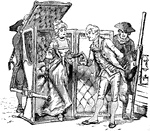
The sedan or litter is a wheelless, human-powered vehicle used to carry one person sitting inside.
Sedan

The sedan or litter is a wheelless, human-powered vehicle used to carry one person sitting inside.

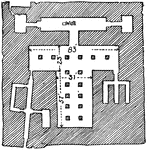
The Great Sphinx is a statue with the face of a man and the body of a lion. Blocks of stone weighing upwards of 200 tons were quarried in the construction phase to build the adjoining Sphinx Temple. It is located on the west bank of the Nile River within the confines of the Giza pyramid field. The Great Sphinx faces due east, with a small temple between its paws.

Plan of the Sphinx Temple

The Great Sphinx is a statue with the face of a man and the body of a lion. Blocks of stone weighing…
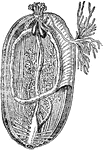
An interior view of a sea cucumber. The sea cucumber (also known as trepang, b&ecirc;che-de-mer, balate, or ambiguously, sea slug) is an echinoderm of the class Holothuroidea, with an elongated body and leathery skin, which is found on the sea floor worldwide. It is also named because of its cucumber-like shape. The body contains a single, branched gonad. Like all echinoderms, sea cucumbers have an endoskeleton just below the skin, calcified structures that are usually reduced to isolated microscopic ossicles (or sclerietes) joined by connective tissue.

Sea Cucumber

An interior view of a sea cucumber. The sea cucumber (also known as trepang, bêche-de-mer, balate,…
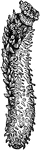
An illustration of a sea cucumber. The sea cucumber (also known as trepang, b&ecirc;che-de-mer, balate, or ambiguously, sea slug) is an echinoderm of the class Holothuroidea, with an elongated body and leathery skin, which is found on the sea floor worldwide. It is also named because of its cucumber-like shape. The body contains a single, branched gonad. Like all echinoderms, sea cucumbers have an endoskeleton just below the skin, calcified structures that are usually reduced to isolated microscopic ossicles (or sclerietes) joined by connective tissue.

Holothuria Tubule

An illustration of a sea cucumber. The sea cucumber (also known as trepang, bêche-de-mer, balate,…
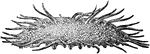
An illustration of a Oneirophanta Mutabilis, a type of sea cucubmer. The sea cucumber (also known as trepang, b&ecirc;che-de-mer, balate, or ambiguously, sea slug) is an echinoderm of the class Holothuroidea, with an elongated body and leathery skin, which is found on the sea floor worldwide. It is also named because of its cucumber-like shape. The body contains a single, branched gonad. Like all echinoderms, sea cucumbers have an endoskeleton just below the skin, calcified structures that are usually reduced to isolated microscopic ossicles (or sclerietes) joined by connective tissue.

Oneirophanta Mutabilis

An illustration of a Oneirophanta Mutabilis, a type of sea cucubmer. The sea cucumber (also known as…
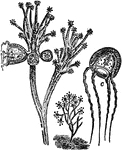
An illustration of a small jellyfish. Jellyfish are free-swimming members of the phylum Cnidaria. ellyfish don't have specialized digestive, osmoregulatory, central nervous, respiratory, or circulatory systems. They digest using the gastrodermal lining of the gastrovascular cavity, where nutrients are absorbed. They do not need a respiratory system since their skin is thin enough that the body is oxygenated by diffusion. They have limited control over movement and mostly free-float, but can use the hydrostatic skeleton of the water pouch to accomplish vertical movement through pulsations of the disc-like body.

Jellyfish

An illustration of a small jellyfish. Jellyfish are free-swimming members of the phylum Cnidaria. ellyfish…
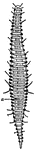
"Demoscolecida, a group of minute marine worm-like creatures. The body tapers towards each end and is marked by a number f well define ridges." -Britannica, 1910

Demoscolecida

"Demoscolecida, a group of minute marine worm-like creatures. The body tapers towards each end and is…

A pixy named Thomas alarmed that a human has just invaded his lawn by jumping over Thomas' wall.

Pixy and a Man

A pixy named Thomas alarmed that a human has just invaded his lawn by jumping over Thomas' wall.
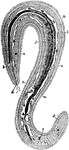
Illustration of a male green spoonworm. A, Generative pore with spermatozoa; B, Anterior blind end of intestine attached to the parenchymatous tissue by muscular strands; C, Green wandering cells containing chlorophyll; D, Parenchymatous connective tissue; Epidermis, I, Intestine; J, Vas deferens; L, Internal opening of vas deferens; M, The left anal vesicle; and M, Spermatozoa in the body-cavity.

Bonellia Viridis (Male)

Illustration of a male green spoonworm. A, Generative pore with spermatozoa; B, Anterior blind end of…
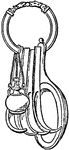
Four stringils in which the hollow for collecting the oil or perspiration from the body may be observed.
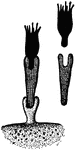
Four Stringils

Four stringils in which the hollow for collecting the oil or perspiration from the body may be observed.

&quot;Ehrlich's diagrams illustrating the mechanism of immunity and cytolysis. The figures in black indicate substances with toxic action. c shows the structure of the complement and intermediary body of bacteriolytic and cytolytic sera.&quot; -Whitney, 1911

Cytolysis, Stage 3

"Ehrlich's diagrams illustrating the mechanism of immunity and cytolysis. The figures in black…
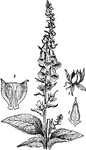
An illustration of: 1, Coralla cut open showing the four stamens; 2, Unripe fruit (lengthwise); 3, ripe capsule split open; and the foxglove plant. Digitalis is a genus of about 20 species of herbaceous perennials, shrubs, and biennials that are commonly called foxgloves. The genus was traditionally placed in the figwort family Scrophulariaceae, but upon review of phylogenetic research, it has now been placed in the much enlarged family Plantaginaceae. The genus is native to Europe, western and central Asia, and northwestern Africa. The scientific name means "finger-like" and refers to the ease with which a flower of Digitalis purpurea can be fitted over a human fingertip. The flowers are produced on a tall spike, are tubular, and vary in colour with species, from purple to pink, white, and yellow. The best-known species is the Common Foxglove, Digitalis purpurea. It is a biennial, often grown as an ornamental plant due to its showy flowers, that range in colour from purples through to whites, with variable marks and spotting. The first year of growth produces only the long, basal leaves. In the second year, the erect leafy stem 0.5-2.5 m tall develops.

Foxglove

An illustration of: 1, Coralla cut open showing the four stamens; 2, Unripe fruit (lengthwise); 3, ripe…
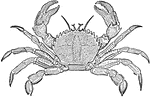
The velvet crab (alternatively velvet swimming crab or devil crab) is the largest swimming crab found in British coastal waters, with a carapace width of up to 100 mm. The body is coated with short hairs, giving the animal a velvety texture, hence the common name. It is one of the major crab species for UK fisheries. The velvet crab lives from southern Norway to Western Sahara in the North Sea and north Atlantic as well as western parts of the Mediterranean Sea, on rocky bottoms from the shoreline to a depth of about 65 m. The last pair of pereiopods are flattened to facilitate swimming.

Velvet Crab

The velvet crab (alternatively velvet swimming crab or devil crab) is the largest swimming crab found…
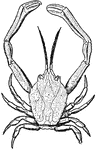
Corystes cassivelaunus, the masked crab, helmet crab or sand crab, is a burrowing crab of the North Atlantic and North Sea from Portugal to Norway, which also occurs in the Mediterranean Sea. It may grow up to 4 cm long (carapace length). The name "masked crab" derives from the patterns on the carapace which resemble a human face, in a similar manner to heikegani.

Masked Crab

Corystes cassivelaunus, the masked crab, helmet crab or sand crab, is a burrowing crab of the North…
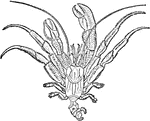
Hermit crabs are decapod crustaceans of the superfamily Paguroidea. They are not closely related to true crabs. Hermit crabs are quite commonly seen in the intertidal zone, for example in tide pools. Most species of hermit crabs have long soft abdomens which are protected from predators by the adaptation of carrying around a salvaged empty seashell, into which the whole crab's body can retract. Most frequently hermit crabs utilize the shells of sea snails, marine gastropod mollusks. The tip of the hermit crab's abdomen is adapted to clasp strongly onto the columella of the snail shell. As the hermit crab grows in size, it has to find a larger shell and abandon the previous one.

Hermit Crab

Hermit crabs are decapod crustaceans of the superfamily Paguroidea. They are not closely related to…
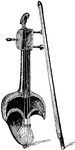
"Sarinda. A Hindu viol, which has a body made of a single wooden block, elliptical in general contour, flat in front and arched at the back, which is hollowed out to a shell." -Whitney, 1911

Sarinda

"Sarinda. A Hindu viol, which has a body made of a single wooden block, elliptical in general contour,…
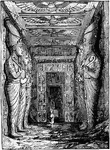
In 1959 an international donations campaign to save the monuments of Nubia began: the southernmost relics of this ancient human civilization were under threat from the rising waters of the Nile that were about to result from the construction of the Aswan High Dam. This image gives a perspective view of the entrance hall, in which are seen eight standing colossal statues 33 feet high, supported by square piers.1

Entrance to the Great Temple at Abu Simbel

In 1959 an international donations campaign to save the monuments of Nubia began: the southernmost relics…
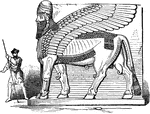
The Sumerian word lama, which is rendered in Akkadian as lamassu, refers to a beneficient protective female deity. The corresponding male deity was called alad, in Akkadian, &scaron;&ecirc;du. In art they were depicted as hybrids, as winged bulls or lions with the head of a human male (Centauroid). There are still surviving figures of &scaron;&ecirc;du in bas-relief and some statues in museums. Notable examples of &scaron;&ecirc;du/lamassu held by museums include those at the British Museum, Mus&eacute;e du Louvre, National Museum of Iraq, Metropolitan Museum of Art and one extremely large example kept at the Oriental Institute, Chicago. They are generally attributed to the ancient Assyrians.

Winged Bull from Nimrud

The Sumerian word lama, which is rendered in Akkadian as lamassu, refers to a beneficient protective…
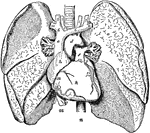
The human thoracic viscera.

Thoracic Viscera

The human thoracic viscera.

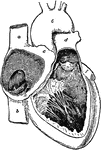
Cavities of the right side of the heart.

Heart Cavities

Cavities of the right side of the heart.

Caryatides are a blending of architecture and sculpture, but they are not of frequent occurrence. These Caryatides are human figures which serve as supports instead of a column, and a similar purpose is answered by male figures, which are technically called Atlantes.

Caryatis from the Erechtheum at Athens

Caryatides are a blending of architecture and sculpture, but they are not of frequent occurrence. These…