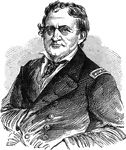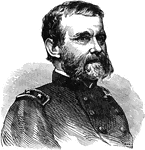
William Buel Franklin (February 27, 1823 – March 8, 1903) was a career United States Army officer and a Union Army general in the American Civil War.

William Buel Franklin

William Buel Franklin (February 27, 1823 – March 8, 1903) was a career United States Army officer…
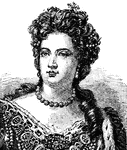
Anne (6 February 1665 – 1 August 1714) became Queen of England, Scotland and Ireland on 8 March 1702. On 1 May 1707, under the Acts of Union 1707, England and Scotland were united as a single state, the Kingdom of Great Britain. Anne became its first sovereign, while continuing to hold the separate crown of Queen of Ireland. Anne reigned for twelve years until her death in August 1714.

Queen Anne of Great Britain

Anne (6 February 1665 – 1 August 1714) became Queen of England, Scotland and Ireland on 8 March…
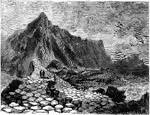
The Giant's Causeway is an area of about 40,000 interlocking basalt columns, the result of an ancient volcanic eruption. It is located on the northeast coast of Northern Ireland, about two miles (3 km) north of the town of Bushmills. It was declared a World Heritage Site by UNESCO in 1986, and a National Nature Reserve in 1987 by the Department of the Environment for Northern Ireland. In a 2005 poll of Radio Times readers, the Giant's Causeway was named as the fourth greatest natural wonder in the United Kingdom. The tops of the columns form stepping stones that lead from the cliff foot and disappear under the sea. Most of the columns are hexagonal, although there are also some with four, five, seven and eight sides. The tallest are about 12 meters (36 ft) high, and the solidified lava in the cliffs is 28 meters thick in places.

Giant's Causeway

The Giant's Causeway is an area of about 40,000 interlocking basalt columns, the result of an ancient…
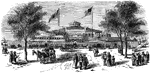
An illustration of Castle Garden, known today as Castle Clinton or Fort Clinton. Castle Clinton or Fort Clinton was once a circular sandstone fort now located in Battery Park at the southern tip of Manhattan, New York City, in the United States. It subsequently became a beer garden, a theater, the first immigration station (predating Ellis Island), a very popular public aquarium, and finally a national monument.

Castle Garden

An illustration of Castle Garden, known today as Castle Clinton or Fort Clinton. Castle Clinton or Fort…
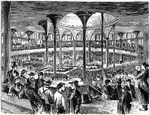
An illustration of the interior of Castle Garden, known today as Castle Clinton or Fort Clinton. Castle Clinton or Fort Clinton was once a circular sandstone fort now located in Battery Park at the southern tip of Manhattan, New York City, in the United States. It subsequently became a beer garden, a theater, the first immigration station (predating Ellis Island), a very popular public aquarium, and finally a national monument.

Castle Garden (Interior)

An illustration of the interior of Castle Garden, known today as Castle Clinton or Fort Clinton. Castle…
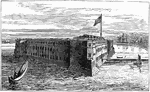
The Fort Zachary Taylor State Historic Site, better known simply as Fort Taylor, (or Fort Zach to locals), is a Florida State Park and National Historic Landmark centered on a Civil War-era fort located near the southern tip of Key West, Florida. Construction of the fort began in 1845 as part of a mid-1800s plan to defend the southeast coast through a series of forts. The fort was named for United States President Zachary Taylor in 1850, a few months after President Taylor's sudden death in office. Yellow fever epidemics and material shortages slowed construction of the fort, which continued throughout the 1850s.

Fort Taylor

The Fort Zachary Taylor State Historic Site, better known simply as Fort Taylor, (or Fort Zach to locals),…
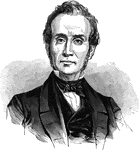
Theodore Frelinghuysen (March 28, 1787 – April 12, 1862) was an American politician, serving as New Jersey Attorney General, United States Senator, and Mayor of Newark, New Jersey before running as a candidate for Vice President with Henry Clay on the Whig ticket in the election of 1844.

Theodore Frelinghuysen

Theodore Frelinghuysen (March 28, 1787 – April 12, 1862) was an American politician, serving as New…
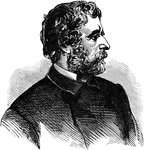
John Charles Frémont (January 21, 1813 – July 13, 1890), was an American military officer, explorer, the first candidate of the Republican Party for the office of President of the United States, and the first presidential candidate of a major party to run on a platform in opposition to slavery.

John Charles Fremont

John Charles Frémont (January 21, 1813 – July 13, 1890), was an American military officer, explorer,…
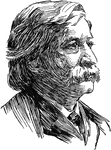
Melville Weston Fuller (February 11, 1833 – July 4, 1910) was the Chief Justice of the United States between 1888 and 1910.

Melville Weston Fuller

Melville Weston Fuller (February 11, 1833 – July 4, 1910) was the Chief Justice of the United States…
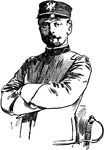
Frederick N. Funston (11 September 1865 – 19 February 1917) also known as Fred Funston, was a General in the United States Army, best known for his role in the Spanish-American War and the Philippine-American War.

Frederick Funston

Frederick N. Funston (11 September 1865 – 19 February 1917) also known as Fred Funston, was a…
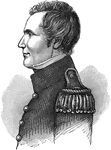
Edmund Pendleton Gaines (March 20, 1777 - June 6, 1849) was a United States army officer who served with distinction during the War of 1812, the Seminole Wars and the Black Hawk War.

Edmund Pendleton Gaines

Edmund Pendleton Gaines (March 20, 1777 - June 6, 1849) was a United States army officer who served…
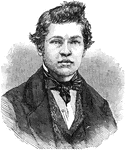
James Abram Garfield (November 19, 1831 - September 19, 1881) was the twentieth President of the United States. He was assassinated six months after he assumed the presidency. Pictured here, Garfield is sixteen years old.

James Abram Garfield at Sixteen

James Abram Garfield (November 19, 1831 - September 19, 1881) was the twentieth President of the United…
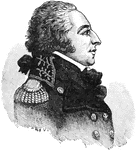
Edmond-Charles Genêt (January 8, 1763 - July 14, 1834), also known as Citizen Genêt, was a French ambassador to the United States during the French Revolution.

Edmond Charles Genest

Edmond-Charles Genêt (January 8, 1763 - July 14, 1834), also known as Citizen Genêt, was…
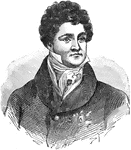
George IV (George Augustus Frederick; 12 August 1762 - 26 June 1830) was king of the United Kingdom of Great Britain and Ireland and Hanover from 29 January 1820 until his death.

George IV

George IV (George Augustus Frederick; 12 August 1762 - 26 June 1830) was king of the United Kingdom…
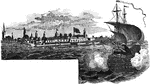
Fort George, the name of four defensive works connected with warfare in the United States.

Fort George, Old New York City

Fort George, the name of four defensive works connected with warfare in the United States.
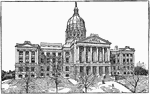
The Georgia State Capitol, in Atlanta, Georgia, in the United States, is an architecturally and historically significant building. It was founded in 1889.

Georgia State Capitol, Atlanta

The Georgia State Capitol, in Atlanta, Georgia, in the United States, is an architecturally and historically…
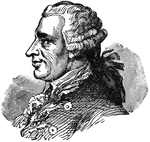
Conrad Alexandre Gérard de Rayneval (12 December 1729—16 April 1790), also known as Conrad Alexandre Gérard, was a French diplomat, born at Masevaux in upper Alsace (now Haut-Rhin). He is best known as the first French diplomatic representative to the United States. His brother Joseph Matthias Gérard de Rayneval was also a diplomat. Early in 1778, under instructions from Vergennes, he conducted the negotiations with the American representatives, Benjamin Franklin, Silas Deane, and Arthur Lee, which resulted in the signing of the Treaty of Alliance and the Treaty of Amity and Commerce with the United States on February 6, 1778. In March, 1778, he sailed to America with d'Estaing's fleet, as the first accredited Minister from France to the United States. This post he held until superseded by the Chevalier de la Luzerne, in September, 1779.

Conrad Alexandre Gérard

Conrad Alexandre Gérard de Rayneval (12 December 1729—16 April 1790), also known as Conrad…
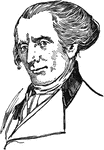
Elbridge Gerry was an American statesman and diplomat. As a Democratic-Republican he was selected as the fifth Vice President of the United States, serving under James Madison. He was one of the signers of the Declaration of Independence.

Elbridge Gerry

Elbridge Gerry was an American statesman and diplomat. As a Democratic-Republican he was selected as…
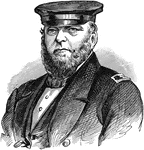
Louis Malesherbes Goldsborough (February 18, 1805 - February 20, 1877) was an admiral in the United States Navy during the Civil War.

Louis Malesherbes Goldborough

Louis Malesherbes Goldsborough (February 18, 1805 - February 20, 1877) was an admiral in the United…
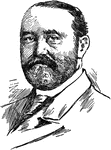
Frederick Dent Grant (May 30, 1850 - April 12, 1912) was a soldier and United States minister to Austria-Hungary. Grant was the first son of General of the Army and President of the United States Ulysses S. Grant and Julia Grant.

Frederick Dent Grant

Frederick Dent Grant (May 30, 1850 - April 12, 1912) was a soldier and United States minister to Austria-Hungary.…
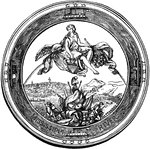
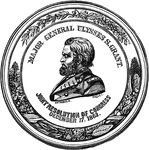
A Congressional Gold Medal awarded to Ulysses S. Grant.

The Grant Medal (front)

A Congressional Gold Medal awarded to Ulysses S. Grant.

A Congressional Gold Medal awarded to Ulysses S. Grant.

The Grant Medal (back)

A Congressional Gold Medal awarded to Ulysses S. Grant.

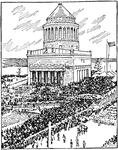
The tomb of General Ulysses S. Grant, the eighteenth President of the United States.

Tomb of General Ulysses S. Grant

The tomb of General Ulysses S. Grant, the eighteenth President of the United States.
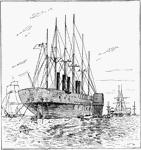
The Great Eastern laying the Atlantic Cable.

The Great Eastern

The Great Eastern laying the Atlantic Cable.

Francis Hoyt Gregory (October 9, 1780 - October 4, 1866) was an officer in the United States Navy during the War of 1812 through to the Civil War, serving then as a Rear Admiral.

Francis Hoyt Gregory

Francis Hoyt Gregory (October 9, 1780 - October 4, 1866) was an officer in the United States Navy during…
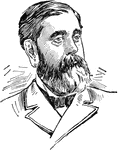
Walter Quintin Gresham (March 17, 1832 - May 28, 1895) was an American statesman and jurist.

Walter Quinton Gresham

Walter Quintin Gresham (March 17, 1832 - May 28, 1895) was an American statesman and jurist.
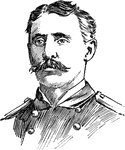
Charles Vernon Gridley (24 November 1844 - 25 May 1898) was an officer in the United States Navy during the American Civil War and the Spanish-American War.

Charles Vernon Gridley

Charles Vernon Gridley (24 November 1844 - 25 May 1898) was an officer in the United States Navy during…
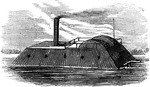
The second USS <em>Louisiana</em> was a propeller-driven iron hull steamer in the United States Navy during the American Civil War.

The Louisiana

The second USS Louisiana was a propeller-driven iron hull steamer in the United States Navy…
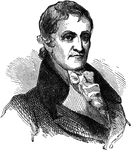
Joseph Habersham (July 28, 1751 - November 17, 1815) was an American businessman, Georgia politician, soldier in the Continental Army, and Postmaster General of the United States.

Joseph Habersham

Joseph Habersham (July 28, 1751 - November 17, 1815) was an American businessman, Georgia politician,…
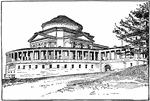
The Hall of Fame for Great Americans at Bronx Community College, the original "Hall of Fame" in the United States, is a New York landmark institution founded in 1900 to honor prominent Americans who have had a significant impact on this nation's history.

The Hall of Fame for Great Americans

The Hall of Fame for Great Americans at Bronx Community College, the original "Hall of Fame" in the…

John Hancock (January 23 1737 [O.S. January 12, 1736] - October 8, 1793) was a Massachusetts merchant and prominent patriot of the American Revolution, but is most famous for his prominent signature on the United States Declaration of Independence.

John Hancock

John Hancock (January 23 1737 [O.S. January 12, 1736] - October 8, 1793) was a Massachusetts merchant…
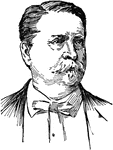
Winfield Scott Hancock (February 14, 1824 - February 9, 1886) was a career U.S. Army officer and the Democratic nominee for President of the United States in 1880.

Winfield Scott Hancock

Winfield Scott Hancock (February 14, 1824 - February 9, 1886) was a career U.S. Army officer and the…
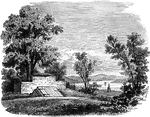
The grave site of William Henry Harrison in Northbend, Ohio.

Harrison's grave

The grave site of William Henry Harrison in Northbend, Ohio.

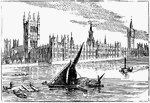
After a fire in 1834, the present Houses of Parliament were built over the next 30 years. They were the work of the architect Sir Charles Barry (1795&ndash;1860) and his assistant Augustus Welby Pugin (1812&ndash;52). The design incorporated Westminster Hall and the remains of St Stephen's Chapel. The Palace of Westminster, also known as the Houses of Parliament or Westminster Palace, in London, England, is where the two Houses of the Parliament of the United Kingdom (the House of Lords and the House of Commons) meet. The palace lies on the north bank of the River Thames in the London borough of the City of Westminster, close to other government buildings in Whitehall.

The New Houses of Parliament

After a fire in 1834, the present Houses of Parliament were built over the next 30 years. They were…
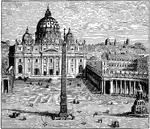
The Basilica of Saint Peter is located within the Vatican City. It occupies a "unique position" as one of the holiest sites and as "the greatest of all churches of Christendom". The Apostolic Palace, also called the Sacred Palace, the Papal Palace or the Palace of the Vatican, is the official residence of the Pope in the Vatican City.

St. Peter's Church and Vatican Palace, Rome

The Basilica of Saint Peter is located within the Vatican City. It occupies a "unique position" as one…
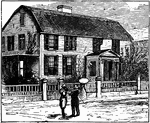
Samuel Seabury graduated from Yale in 1748; studied theology with his father; studied medicine in Edinburgh from 1752 to 1753; was ordained deacon by the bishop of Lincoln and priest by the bishop of Carlisle in 1753; was rector of Christ Church, New Brunswick, New Jersey from 1754 to 1757, rector in Jamaica, New York from 1757 to 1766, and of St Peter's, Westchester (now annexed to The Bronx) from 1766 to 1775.

Bishop Seabury's House, Springfield, CT

Samuel Seabury graduated from Yale in 1748; studied theology with his father; studied medicine in Edinburgh…
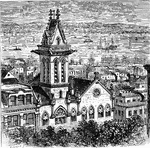
Trinity School is a private, preparatory, co-educational day school for grades K-12 located in New York City, USA, and a member of both the New York Interschool and the Ivy Preparatory School League. Founded in 1709 in the Tower of the old Trinity Church at Broadway and Wall Street, the school is the fifth oldest in the United States and the oldest continually operational school in New York City.

Trinity School

Trinity School is a private, preparatory, co-educational day school for grades K-12 located in New York…
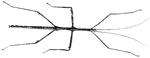
The Phasmatodea (sometimes called Plasmodia) are an order of insects, whose members are variously known as stick insects (in Europe), walking sticks or stick-bugs (in the United States of America), phasmids, ghost insects and leaf insects (generally the family Phylliidae). The ordinal name is derived from the Greek "phasma" meaning an apparition or phantom, and refers to the resemblance of many species to sticks or leaves. Their natural camouflage can make them extremely difficult to spot. A few species (for example those in the genus Anisomorpha) are capable of secreting a substance from glands on the metathorax that can cause an intense burning irritation of the eyes (and in some cases temporary blindness) and mouth of potential predators on contact.

Stick Insect

The Phasmatodea (sometimes called Plasmodia) are an order of insects, whose members are variously known…
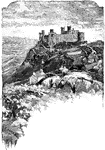
Harlech Castle, located in Harlech, Gwynedd, Wales, is a concentric castle, constructed atop a cliff close to the Irish Sea. Architecturally, it is particularly notable for its massive gatehouse. Built by King Edward I during his conquest of Wales, the castle was subject to several assaults and sieges during its period of active use as a fortification. The seven-year siege of the castle, during the War of the Roses, has been memorialised in the famous song, "Men of Harlech".

Harlech Castle

Harlech Castle, located in Harlech, Gwynedd, Wales, is a concentric castle, constructed atop a cliff…
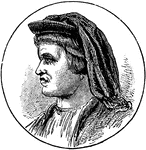
Lorenzo de' Medici (January 1, 1449 – 9 April 1492) was an Italian statesman and de facto ruler of the Florentine Republic during the Italian Renaissance. Known as Lorenzo the Magnificent by contemporary Florentines, he was a diplomat, politician and patron of scholars, artists, and poets. His life coincided with the high point of the early Italian Renaissance; his death marked the end of the Golden Age of Florence. The fragile peace he helped maintain between the various Italian states collapsed with his death; two years later the French invasion of 1494 began and led to nearly 400 years of foreign occupation of the Italian peninsula.

Lorenzo de' Medici

Lorenzo de' Medici (January 1, 1449 – 9 April 1492) was an Italian statesman and de facto ruler of…
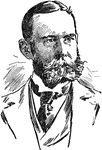
John Milton Hay (October 8, 1838 - July 1, 1905) was an American statesman, diplomat, author, journalist, and private secretary and assistant to Abraham Lincoln.

John Milton Hay

John Milton Hay (October 8, 1838 - July 1, 1905) was an American statesman, diplomat, author, journalist,…
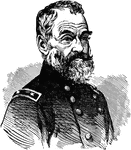
Samuel Peter Heintzelman (September 30, 1805 - May 1, 1880) was a United States Army General. He served in the Seminole War, the Mexican-American War, the Cortina Troubles, and the American Civil War, rising to the command of a corps.

Samuel Peter Heintzelman

Samuel Peter Heintzelman (September 30, 1805 - May 1, 1880) was a United States Army General. He served…
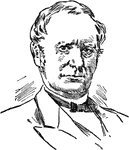
Thomas Andrews Hendricks (September 7, 1819 - November 25, 1885) was a U.S. Representative and a Senator from Indiana, a Governor of Indiana, and the twenty-first Vice President of the United States (serving with Grover Cleveland).

Thomas Andrews Hendricks

Thomas Andrews Hendricks (September 7, 1819 - November 25, 1885) was a U.S. Representative and a Senator…
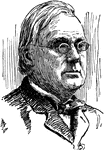
George Frisbie Hoar (August 29, 1826 - September 30, 1904) was a prominent United States politician and United States Senator from Massachusetts.

George Frisbie Hoar

George Frisbie Hoar (August 29, 1826 - September 30, 1904) was a prominent United States politician…
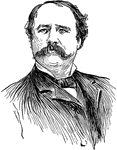
Garret Augustus Hobart (June 3, 1844 - November 21, 1899) was the twenty-fourth Vice President of the United States.

Garret Augustus Hobart

Garret Augustus Hobart (June 3, 1844 - November 21, 1899) was the twenty-fourth Vice President of the…
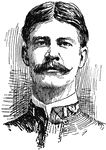
Richmond Pearson Hobson (17 August 1870 - 16 March 1937) was a United States Navy Rear Admiral who served from 1905-1915 as a U.S. Representative from Alabama.

Richmond Pearson Hobson

Richmond Pearson Hobson (17 August 1870 - 16 March 1937) was a United States Navy Rear Admiral who served…
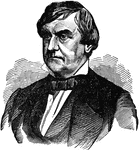
General Joseph Holt (January 6, 1807 - August 1, 1894) was a leading member of the Buchanan administration and was Judge Advocate General in the United States Army, most notably during the Lincoln assassination trials.

General Joseph Holt

General Joseph Holt (January 6, 1807 - August 1, 1894) was a leading member of the Buchanan administration…
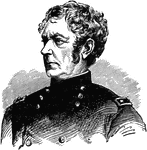
Joseph Hooker (November 13, 1814 - October 31, 1879) was a career United States Army officer, fought in the Mexican-American War, and was a major general in the Union Army during the American Civil War.

Joseph Hooker

Joseph Hooker (November 13, 1814 - October 31, 1879) was a career United States Army officer, fought…
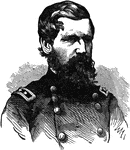
Oliver Otis Howard (November 8, 1830 - October 26, 1909) was a career United States Army officer and a Union General in the American Civil War.

Oliver Otis Howard During the Civil War

Oliver Otis Howard (November 8, 1830 - October 26, 1909) was a career United States Army officer and…
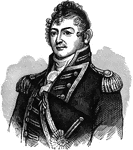
Isaac Hull (March 9, 1773 - February 13, 1843), was a Commodore in the United States Navy.

Isaac Hull

Isaac Hull (March 9, 1773 - February 13, 1843), was a Commodore in the United States Navy.
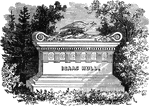
Isaac Hull (March 9, 1773 - February 13, 1843), was a Commodore in the United States Navy.

Isaac Hull's Monument

Isaac Hull (March 9, 1773 - February 13, 1843), was a Commodore in the United States Navy.
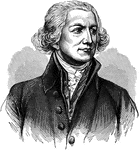
George Izard (21 October 1776 - 22 November 1828) was a General in the United States Army during the War of 1812 and a Governor of the Arkansas Territory.

George Izard

George Izard (21 October 1776 - 22 November 1828) was a General in the United States Army during the…
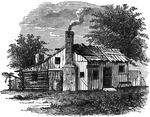
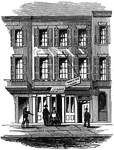
The birthplace of Andrew Jackson, President of the United States.

Birthplace of Andrew Jackson

The birthplace of Andrew Jackson, President of the United States.

During the War of 1812, when British forces threatened New Orleans, Jackson took command of the defenses, including militia from several western states and territories.

Jackson's Headquarters, New Orleans

During the War of 1812, when British forces threatened New Orleans, Jackson took command of the defenses,…
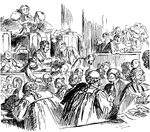
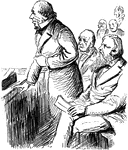
An illustration of the Court of Common Pleas.

Court of Common Pleas

An illustration of the Court of Common Pleas.

Benjamin Disraeli, 1st Earl of Beaconsfield, (21 December 1804 – 19 April 1881), was a British Conservative statesman and literary figure. He served in government for three decades, twice as Prime Minister. An Anglican, he was nonetheless the first and thus far only Prime Minister of Jewish heritage. Disraeli's greatest lasting achievement was the creation of the modern Conservative Party after the Corn Laws schism of 1846.

Benjamin Disraeli

Benjamin Disraeli, 1st Earl of Beaconsfield, (21 December 1804 – 19 April 1881), was a British Conservative…

From the painting, "First Reading of the Emancipation Proclamation of President Lincoln" by Francis Bicknell Carpenter. From left to right: Edwin Stanton (Secretary of War), Salmon Chase (Secretary of the Treasury), Abraham Lincoln (President of the United States), Gideon Welles (Secretary of the Navy), Caleb B. Smith (Secretary of the Interior), William Seward [sitting] (Secretary of State), Montgomery Blair (Postmaster General), and Edward Bates (Attorney General).

Emancipation Proclamation

From the painting, "First Reading of the Emancipation Proclamation of President Lincoln" by Francis…
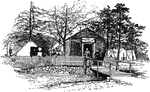
A Sanitary Commission lodge near Alexandria, Virginia during the Civil War.

Sanitary Commission

A Sanitary Commission lodge near Alexandria, Virginia during the Civil War.

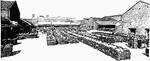
A cotton press yard of the Cotton Centennial in the 1884 World's Fair in New Orleans, Louisiana.

Cotton Centennial

A cotton press yard of the Cotton Centennial in the 1884 World's Fair in New Orleans, Louisiana.
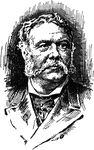
(1829-1886) American politician and twenty-first President of the United States, succeeding James Garfield.

Chester Alan Arthur

(1829-1886) American politician and twenty-first President of the United States, succeeding James Garfield.