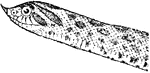
A dweller in high, dry upland fields, where the soil is so slightly compacted that burrowing is easy, for nothing delights it more than to worm its way through light soils.

Hog Nosed Snake

A dweller in high, dry upland fields, where the soil is so slightly compacted that burrowing is easy,…
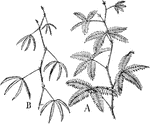
Figure A shows the leaf position of the light sensitive plant, Mimosa in sunlight. Figure B shows it in darkness.

Mimosa

Figure A shows the leaf position of the light sensitive plant, Mimosa in sunlight. Figure B shows it…
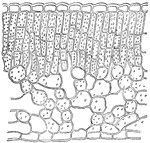
This illustration shows a section of a leaf of Rhododendron. Note the compact palisade tissue which results from intense light.

Rhododendron

This illustration shows a section of a leaf of Rhododendron. Note the compact palisade tissue which…
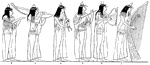
This image shows a group of ancient egyptian street musicians. (1) Woman with a tall light harp with fourteen strings. (2) Cithara. (3) Te-bouni, or banjo. (4) Double flute. (5) Shoulder Harp. (6) Singer, clapping hands.

Ancient Egyptian Music

This image shows a group of ancient egyptian street musicians. (1) Woman with a tall light harp with…
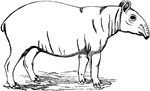
This illustration shows the largest of the four species of tapir and the only one native to Asia. The animal is easily identified by its markings, most notably the light-colored "saddle" which extends from its shoulders to its rump.

Malayan Tapir

This illustration shows the largest of the four species of tapir and the only one native to Asia. The…
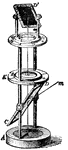
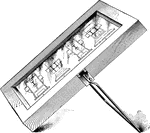
This is an illustration of a polariscope. Polariscopes are tools used to measure the polarisation of light.

Polariscope

This is an illustration of a polariscope. Polariscopes are tools used to measure the polarisation of…
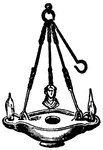
A lamp used by the ancient Romans for light.

Roman Lamp

A lamp used by the ancient Romans for light.

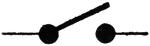
The electrical symbol for lighting switches.

Lighting Switch

The electrical symbol for lighting switches.

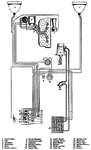
Auto-lite starting and lighting system on Overland Light Fours, model 90-4.

Overland

Auto-lite starting and lighting system on Overland Light Fours, model 90-4.

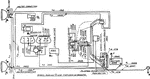
Gray & Davis starting and lighting installation on the Chandler 1917 light-weight six.

Gray and Davis

Gray & Davis starting and lighting installation on the Chandler 1917 light-weight six.
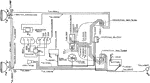
Gray & Davis starting and lighting installation on the Chandler 1917 light-weight six.

Gray and Davis

Gray & Davis starting and lighting installation on the Chandler 1917 light-weight six.
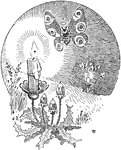
A moth being attracted to candle light.

Moth

A moth being attracted to candle light.

"A printing frame that is well adapted to sheets not over 17 in. x 21 in. The frame is placed face downwards and the back A is removed by unhooking the brass spring clips B, B, and lifting it out. The tracing is laid on the glass C, with the inked side touching the glass. A sheet of the prepared paper, perfectly dry, is laid on the tracing with the yellow side downwards." — Hallock, 1905. The painting frame is used to hold the original in contact with the light-sensitive paper in the blueprint reproduction process.

Painting Frame

"A printing frame that is well adapted to sheets not over 17 in. x 21 in. The frame is placed face downwards…
"A style of classical ornament, so called, in the 13th century from its having been rediscovered in the excavations made in the baths of Titus and other ancient Roman buildings, the Italian word grotto applying to any subterranean chamber. This light, fantastic style was much in favor during the Renaissance. It abounds in all kinds of transformations, from the animal to the vegetable, and mingles all the natural kingdoms in the most fanciful and picturesque confusion." — Chambers, 1881

Grotesque

"A style of classical ornament, so called, in the 13th century from its having been rediscovered in…
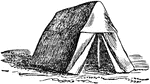
"The Roman soldiers seem to have used two sorts of tents, one, a tent proper, of canvas or some analogous material, and constructed with two solid upright poles, and a roof piece between them; the other more resembling a light hut, of a wooden skeleton, covered by bark, hides, mud, straw, or any material which afforded warmth." — Chambers, 1881

Roman Tent

"The Roman soldiers seem to have used two sorts of tents, one, a tent proper, of canvas or some analogous…
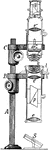
An optical instrument, various forms of which have been contrived for exhibiting the polarization of light.

Polariscope

An optical instrument, various forms of which have been contrived for exhibiting the polarization of…
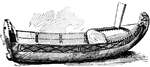
A small canoe shaped "boat" made of light materials and covered in reindeer skin. It is drawn by a single reindeer and it used to journeyover the snow in the winter. Usually about five feet long, one foot deep, and eighteen inches high. The rider sits up against the stern.

Lapland Pulk

A small canoe shaped "boat" made of light materials and covered in reindeer skin. It is drawn by a single…
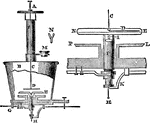
"D is a needle, formed of light silver wire, suspended by a fine glass fiber, from a torsion head A. Below the needle is a piece of sheet metal NE, divided half through by a notch in the middle, and then bent in opposite directions on both sides of the notch, so that, when looked at end on, it appears like a Y." — Encyclopedia Britannica, 1893

Dellman's Electrometer

"D is a needle, formed of light silver wire, suspended by a fine glass fiber, from a torsion head A.…
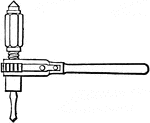
"A ratchet brace is a powerful instrument, and carries in itself the screw for obtaining the requisite pressure. Small holes can be drilled under a light pressure with rapid rotation on the part of the drill." — Encyclopedia Britannica, 1893

Ratchet Brace

"A ratchet brace is a powerful instrument, and carries in itself the screw for obtaining the requisite…

"The drag is a useful, light three-pronged tool which may be used for loosening the soil amongst vegetable crops as well as flower garden plants, and may also be sometimes employed, if the tines are sufficiently narrow and pointed, to drag off weeds from the surface." — Encyclopedia Britannica, 1893

Drag

"The drag is a useful, light three-pronged tool which may be used for loosening the soil amongst vegetable…
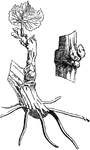
"This mode of propagation is performed by cutting the branches into short lengths, each containing one well-matured bud or eye, with a short portion of the stem above and below. It is a common mode of propagating vines, the eyes being in this case cut from the ripened leafless wood. The eyes (a) are planted just below the surface in pots of light soil, which are placed in a hot bed or propagating pit, and in due time each pushed up a young shoot which forms the future stem, while convert it into an independent plant." — Encyclopedia Britannica, 1893

Single Eye

"This mode of propagation is performed by cutting the branches into short lengths, each containing one…
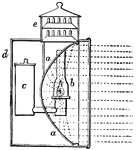
A parabolic reflection lantern.

Lantern

A parabolic reflection lantern.

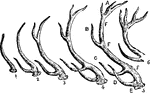
"The annexed cut represents the horns of the stag at different ages. During the first year, there is only a light protuberance; the second year is marked by the brow antler (1); the third year, by the bad antler (2); the fourth, by the tray antler (3); the fifth, by the crockets (4); the sixth, by the beam antler (5), the various parts of which are termed (A) crockets, (B) tray, (C) bay, (D) brow, (E) pearls, (F) the beam of the antler; seventh year (6)." — Chambers' Encyclopedia, 1875

Stag Horns

"The annexed cut represents the horns of the stag at different ages. During the first year, there is…
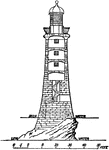
"Section of Eddystone Light-house." — Chambers' Encyclopedia, 1875

Eddystone Light-house

"Section of Eddystone Light-house." — Chambers' Encyclopedia, 1875

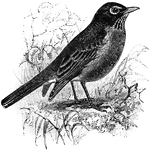
A large robin with a red and light brown breast.

American Robin

A large robin with a red and light brown breast.

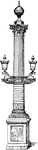
A decorative light post.

Light Post

A decorative light post.

"An optical instrument employed for exhibiting the images of objects in their forms and colors, so that they may be traced and a picture drawn, or may be represented by photography. A simple camera obscura is presented by a darkened chamber into which no light is permitted to enter excepting by a small hole in the window-shutter. A picture of the objects opposite the hole will then be seen on the wall or on a white screen placed opposite the opening." — Winston's Encyclopedia, 1919

Camera Obscura

"An optical instrument employed for exhibiting the images of objects in their forms and colors, so that…
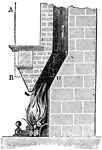
"A representation of a section of a grate and chimney. C D represents the light and warm column of air within the chimney, and A B the cold and heavy column of air outside the chimney. The column A B being cold and heavy presses down, the column C D being light and warm rushes up, and the greater the difference between the weight of these two columns, the greater will be the draught." —Wells, 1857

Grate

"A representation of a section of a grate and chimney. C D represents the light and warm column of air…
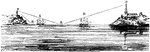
"Let S be the position of the spectator; O and B the position of distant objects. The rays O R and B R which proceed from them, strike the surface of the water very obliquely, and the light which is reflected in the direction R S is sufficient to make a sensible impression upon the eye. But in regard to objects such as A placed near the spectator, they are not seen reflected, because the rays A R' which proceed from them strike the water with but little obliquity; and consequently, the part of their light which is reflected in the direction R' S, towards the spectator, is not sufficient to produce a sensible impression upon the eye." —Wells, 1857

Reflection

"Let S be the position of the spectator; O and B the position of distant objects. The rays O R and B…
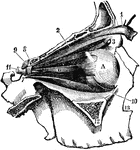
"The external bones of the temple are supposed to be removed in order to render visible the muscular arrangements. The muscle, 1, raises the eye-lid, and is constantly in action while we are awake. During sleep, the muscle being in repose and relaxed, the eye-lid falls and protects the eye from the action of light. The muscle, 4, turns the eye upwards; 5, downwards; 6, outwards; and a corresponding one on the inside, not seen in the figure, turns it inwards. No. 2 and 10 turn the eye round its axis. No. 11 is the great optic nerve, which conveys the sensation to the brain. If this nerve were cut, notwithstanding the eye might be in other respects perfect, the sense of sight would be destroyed." —Wells, 1857

Eye Muscles

"The external bones of the temple are supposed to be removed in order to render visible the muscular…
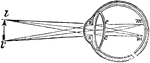
"A representation of the manner in which the image is formed upon the retina in the perfect eye. The curvature of the cornea, s s, and of the crystalline lens, c c, is just sufficient to cause the rays of light proceeding from the image, e e, to converge the right focus, m, upon the retina." —Wells, 1857

Perfect Eye

"A representation of the manner in which the image is formed upon the retina in the perfect eye. The…
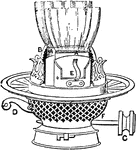
"An improved form of the lamp, in which a portion of the cone B is removed to show the two parallel flat wicks A, A, which have each a separate slit or opening in the cone. C is the coincident winder for raising or lowering the wicks in the tubes, by which the wicks can be moved separately or simultaneously as desired. D is a lever for raising the extinguishers E, whereby not onl is the light instantly extinguished, but the wicks are also covered and protected from dirt, while all evaporation by the wick-holder is prevented." —The Encyclopedia Britannica, 1910

Duplex Burner

"An improved form of the lamp, in which a portion of the cone B is removed to show the two parallel…
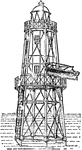
"An iron pile light erected at Haneda, in the Bay of Yedo, Japan." —The Encyclopedia Britannica, 1910

Lighthouse

"An iron pile light erected at Haneda, in the Bay of Yedo, Japan." —The Encyclopedia Britannica,…
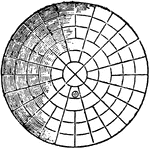
"In 1763, or at latest before 1777, parabolic reflectors were first used for lighthouse illumination by Mr. Hutchinson, dockmaster of Liverpool. In his work on Practica Scamanship, published in 1777, he states that the Mersey lights were fitted with reflectors formed of small fucets of silvered glass, and made, as he says "as nearly as they can be to the parabolic curve." This is unquestionably the earliest published notice of the use of parabolic reflectors for lighthouse illumination." —The Encyclopedia Britannica, 1910

Parabolic Reflector

"In 1763, or at latest before 1777, parabolic reflectors were first used for lighthouse illumination…
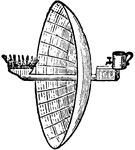
"In 1763, or at latest before 1777, parabolic reflectors were first used for lighthouse illumination by Mr. Hutchinson, dockmaster of Liverpool. In his work on Practica Scamanship, published in 1777, he states that the Mersey lights were fitted with reflectors formed of small fucets of silvered glass, and made, as he says "as nearly as they can be to the parabolic curve." This is unquestionably the earliest published notice of the use of parabolic reflectors for lighthouse illumination." —The Encyclopedia Britannica, 1910

Parabolic Reflector

"In 1763, or at latest before 1777, parabolic reflectors were first used for lighthouse illumination…
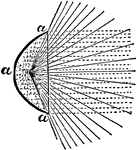
"It will be seen that the parabolic mirror a is at best but a very imperfect instrument, for even if the radiant were strictly a mathematical point, the cone of rays (shown undotted) escaping past the lips of the mirror must be lost." —The Encyclopedia Britannica, 1910

Paraboloid

"It will be seen that the parabolic mirror a is at best but a very imperfect instrument, for even if…
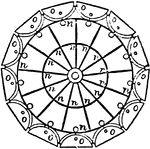
"In order to produce, on the catoptric system, a fixed light showing all round the circle, a number of reflectors are fixed round the outside of a stationary chandelier n. As the ordinary paraboloid has about 14 degrees of divergence, twenty-five reflectors were needed to light up continuously (though not equally) the whole horizon." —The Encyclopedia Britannica, 1910

Revolving Light

"In order to produce, on the catoptric system, a fixed light showing all round the circle, a number…
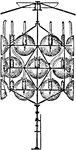
"If again the light was to revolve, then a revolving chandelier was employed having a certain number of flat faces, on each of which was fixed a number separate lamps and reflectors with their axes parallel to each other. When the chandelier revolved, and one of the flat sides was turned towards the sailor, he would, when at some distance from the shore, receive a flash at once form each of the mirrors which were on that face, but when the face was turned away from him a dark period would intervene until the next face came round again." —The Encyclopedia Britannica, 1910

Revolving Light

"If again the light was to revolve, then a revolving chandelier was employed having a certain number…
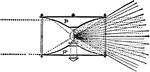
"In order strictly to equalize a fixed light over the whole horizon, which could not possibly be done with separate reflectors, Marcet proposed this ingenious instrument, which is generated by the revolution of the parabolic profile pp' round its parameter as a vertical axis, instead of round a horizontal axis, as in all former reflectors." —The Encyclopedia Britannica, 1910

Parabolic Profile

"In order strictly to equalize a fixed light over the whole horizon, which could not possibly be done…
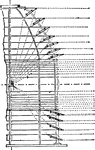
"Catadioptric Fixed Light.—This apparatus, in which a central burner is used, consists of a dioptric cylindric refractor with zones of silvered mirror above and below similar in profile to Bordier Marcet's reflector. By the adoption of the refractor the whole of the wasteful divergence which occurs in Marcet's reflector is prevented. We have here a geometrically perfect combination, but it is not so physically, because metallic reflexion is used. This physical defect Fresnel obviated in his next design." —The Encyclopedia Britannica, 1910

Catadiopteric Light

"Catadioptric Fixed Light.—This apparatus, in which a central burner is used, consists of a dioptric…
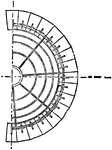
"Catadioptric Fixed Light.—This apparatus, in which a central burner is used, consists of a dioptric cylindric refractor with zones of silvered mirror above and below similar in profile to Bordier Marcet's reflector. By the adoption of the refractor the whole of the wasteful divergence which occurs in Marcet's reflector is prevented. We have here a geometrically perfect combination, but it is not so physically, because metallic reflexion is used. This physical defect Fresnel obviated in his next design." —The Encyclopedia Britannica, 1910

Catadiopteric Light

"Catadioptric Fixed Light.—This apparatus, in which a central burner is used, consists of a dioptric…
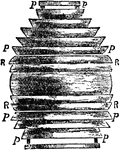
"First Application of Total Reflexion to Fixed Lights. In this apparatus Fresnel substituted his totally reflecting prism p and lens R for Marcet's reflector, and thus distributed the whole light equally over the horizon by means of dioptric agents alone. This was the first application of total reflexion to lighthouse apparatus, and this beautiful instrument continues till now in universal use." —The Encyclopedia Britannica, 1910

Dioptric Light

"First Application of Total Reflexion to Fixed Lights. In this apparatus Fresnel substituted his totally…
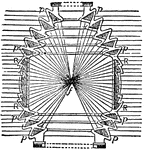
"Fresnel's Revolving Light. —In this form of revolving light the central burner is surrounded by annular lenses L, and a compound arrangement of inclined trapezoidal lenses L' and plane silvered mirrors M. The inclined lenses fit closely to each other and form a pyramidal dome, and the light, intercepted by them, is sent upwards in inclined beams until, falling upon the plane mirrors M, it is sent outwards in horizontal parallelized beams. All these optical agents are made to revolve round the central lamp, and the sailor receives a full flash when the axis of one of the emerging beams passes his eye, and as soon as it passes him he is in darkness until the next beam comes round." —The Encyclopedia Britannica, 1910

Fresnels Revolving Light

"Fresnel's Revolving Light. —In this form of revolving light the central burner is surrounded by annular…
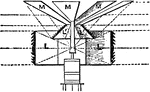
"Fresnel's Revolving Light. —In this form of revolving light the central burner is surrounded by annular lenses L, and a compound arrangement of inclined trapezoidal lenses L' and plane silvered mirrors M. The inclined lenses fit closely to each other and form a pyramidal dome, and the light, intercepted by them, is sent upwards in inclined beams until, falling upon the plane mirrors M, it is sent outwards in horizontal parallelized beams. All these optical agents are made to revolve round the central lamp, and the sailor receives a full flash when the axis of one of the emerging beams passes his eye, and as soon as it passes him he is in darkness until the next beam comes round." —The Encyclopedia Britannica, 1910

Fresnels Revolving Light

"Fresnel's Revolving Light. —In this form of revolving light the central burner is surrounded by annular…
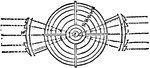
"Fresnel's Revolving Light. —In this form of revolving light the central burner is surrounded by annular lenses L, and a compound arrangement of inclined trapezoidal lenses L' and plane silvered mirrors M. The inclined lenses fit closely to each other and form a pyramidal dome, and the light, intercepted by them, is sent upwards in inclined beams until, falling upon the plane mirrors M, it is sent outwards in horizontal parallelized beams. All these optical agents are made to revolve round the central lamp, and the sailor receives a full flash when the axis of one of the emerging beams passes his eye, and as soon as it passes him he is in darkness until the next beam comes round." —The Encyclopedia Britannica, 1910

Fresnels Revolving Light

"Fresnel's Revolving Light. —In this form of revolving light the central burner is surrounded by annular…
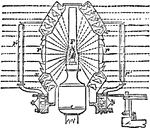
"Fresnel's Revolving Light. —In this form of revolving light the central burner is surrounded by annular lenses L, and a compound arrangement of inclined trapezoidal lenses L' and plane silvered mirrors M. The inclined lenses fit closely to each other and form a pyramidal dome, and the light, intercepted by them, is sent upwards in inclined beams until, falling upon the plane mirrors M, it is sent outwards in horizontal parallelized beams. All these optical agents are made to revolve round the central lamp, and the sailor receives a full flash when the axis of one of the emerging beams passes his eye, and as soon as it passes him he is in darkness until the next beam comes round." —The Encyclopedia Britannica, 1910

Fresnels Revolving Light

"Fresnel's Revolving Light. —In this form of revolving light the central burner is surrounded by annular…
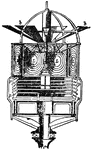
"In 1835 Mr. Stevenson, in a report to the Northern Lighthouse Board, proposed to add fixed reflecting prisms p below the lenses of Fresnel's revolving light, and he communicated this proposal to M. L. Fresnel, who approved of his suggestion, and assisted in carrying out the design in 1843. This combination added, however, but little to the power of the flash, and produced both a periodically flashing and constantly fixed light; but it must be remembered that the prism for fixed lights was the only kind of reflecting prism then known." —The Encyclopedia Britannica, 1910

Stevensons Revolving Light

"In 1835 Mr. Stevenson, in a report to the Northern Lighthouse Board, proposed to add fixed reflecting…
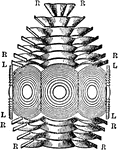
"Holophotal Catadioptric Apparatus Revolving round a Central Flame.—If in place of Fresnel's compound arrangement of trapezoidal lenses and plane mirrors there are substituted mirrors R, R generated by the revolution of a parabolic profile round a horizontal axis, all the light will be at once sent out in parallel beams by them and the lenses L, and the apparatus is therefore geometrically perfect, but metallic instead of glass agents are still employed." —The Encyclopedia Britannica, 1910

Holophotal Catadioptric

"Holophotal Catadioptric Apparatus Revolving round a Central Flame.—If in place of Fresnel's compound…
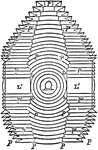
"Holophotal Fixed Light varied by Flashes.—Fresnel's double agents are here also dispensed with by the single agency of panels of fixed light apparatus p', p' and cylindrical refractors L', L', alternating with panels of holophotal apparatus p, p, L, L, both of which revolve together round the central burner." —The Encyclopedia Britannica, 1910

Holophotal Light

"Holophotal Fixed Light varied by Flashes.—Fresnel's double agents are here also dispensed with by…
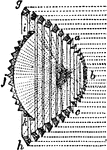
"Perfect Form of Dioptric Holophote for an Oil Flame.—By combining the back prisms ga, hc just described with a semi-holophote abc subtending 180 degrees and a portion of the dioptric spherical mirror ijk, no light is lost on the burner, and all the rays are parallelized, so that this apparatus, being all of glass, is both geometrically and physically perfect." —The Encyclopedia Britannica, 1910

Dioptric Holophote

"Perfect Form of Dioptric Holophote for an Oil Flame.—By combining the back prisms ga, hc just described…
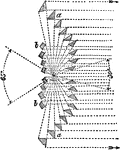
"Professor Swan's Designs.—Among several ingenious arrangements and new forms of agents proposed by Professor Swan is the mode of sending rays from prisms through interstices left between other prisms placed in front, and also a form of agent which he termed the triesoptric prism, in which the rays would undergo two refractions and three reflexions. a are the front and b the triesoptric prisms. The two upper and lower prisms a are constructed of flint glass of high refractive power. It will be observed from the drawing that this ingenious arrangement is nevertheless open to objection, for cones of light of 30 degrees in front and of 65 degrees at the back are lost through the interstices." —The Encyclopedia Britannica, 1910

Swans Designs

"Professor Swan's Designs.—Among several ingenious arrangements and new forms of agents proposed by…
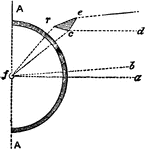
"Condensing Straight Prisms.—These, either by reflexion or refraction or both, cause a ray fr proceeding in any compass bearing from a fixed light apparatus AA to emerge in the direction, e.g., parallel to the corresponding ray fb, which proceeds in the same compass bearing from another part of the apparatus and so of any other ray fc which is bent parallel to the ray fa." —The Encyclopedia Britannica, 1910

Straight Prisms

"Condensing Straight Prisms.—These, either by reflexion or refraction or both, cause a ray fr…
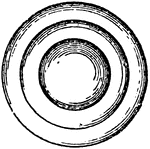
"Differential Lens.—Horizontal divergence may be obtained to any required amount by varying the radius of curvature of the inner face of an annular lens. The outer face is the same as that of an ordinary annular lens, which the other face, though straight in the vertical, is ground to the required curve in the horizontal plane. The rays f'fc falling upon the lens x converge to the vertical focal plane ff and afterwards diverge through the smaller horizontal angle x'f'x', and so for any other case." —The Encyclopedia Britannica, 1910

Differential Lens

"Differential Lens.—Horizontal divergence may be obtained to any required amount by varying the radius…
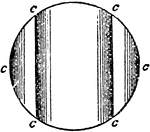
"Differential Lens.—Horizontal divergence may be obtained to any required amount by varying the radius of curvature of the inner face of an annular lens. The outer face is the same as that of an ordinary annular lens, which the other face, though straight in the vertical, is ground to the required curve in the horizontal plane. The rays f'fc falling upon the lens x converge to the vertical focal plane ff and afterwards diverge through the smaller horizontal angle x'f'x', and so for any other case." —The Encyclopedia Britannica, 1910

Differential Lens

"Differential Lens.—Horizontal divergence may be obtained to any required amount by varying the radius…
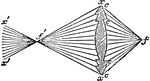
"Differential Lens.—Horizontal divergence may be obtained to any required amount by varying the radius of curvature of the inner face of an annular lens. The outer face is the same as that of an ordinary annular lens, which the other face, though straight in the vertical, is ground to the required curve in the horizontal plane. The rays f'fc falling upon the lens x converge to the vertical focal plane ff and afterwards diverge through the smaller horizontal angle x'f'x', and so for any other case." —The Encyclopedia Britannica, 1910

Differential Lens

"Differential Lens.—Horizontal divergence may be obtained to any required amount by varying the radius…
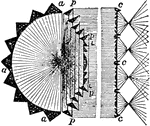
"Fixed Conensing Light for a Single Sector, 1850.—The holophote Light pLp throws its whole light on straight condensing prisms c, each of which distributes the rays over the required sector." —The Encyclopedia Britannica, 1910

Condensing Light

"Fixed Conensing Light for a Single Sector, 1850.—The holophote Light pLp throws its whole light on…
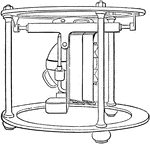
"Condensing Apparatus for Steamer's Side Lights.—By means of this application of the condensing principle all the light can be distributed with strict equality over 112 degrees, which is the arc prescribed for steamers by the Board of Trade. Several of the Transatlantic and other steamers have adopted this kind of apparatus, which is hung on gimbals and placed in iron towers, having an entry from below the deck, which can be made use of in bad weather." —The Encyclopedia Britannica, 1910

Condensing Apparatus

"Condensing Apparatus for Steamer's Side Lights.—By means of this application of the condensing…
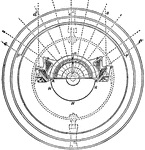
"Condensing Apparatus for Steamer's Side Lights.—By means of this application of the condensing principle all the light can be distributed with strict equality over 112 degrees, which is the arc prescribed for steamers by the Board of Trade. Several of the Transatlantic and other steamers have adopted this kind of apparatus, which is hung on gimbals and placed in iron towers, having an entry from below the deck, which can be made use of in bad weather." —The Encyclopedia Britannica, 1910

Condensing Apparatus

"Condensing Apparatus for Steamer's Side Lights.—By means of this application of the condensing principle…
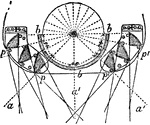
"Condensing Quadrant.—The fixed apparatus bbb, with spherical mirror behind, throws its rays directly through the angle of 90 degrees afa', while the supplementary rays falling on the straight condensing prisms p, p, p', p' are sent out parallel to the corresponding rays in the unobstructed central quadrant of the main apparatus. The whole light will therefore be condensed equally over 90 degrees." —The Encyclopedia Britannica, 1910

Condensing Quadrant

"Condensing Quadrant.—The fixed apparatus bbb, with spherical mirror behind, throws its rays directly…
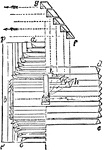
"Condensing Octant.—The central fixed apparatus bb with spherical mirror dd throws its rays directly over the angle of 45 degrees pgp, while the supplemental rays fall upon the straight condensing prisms p, each of which spreads the incident rays parallel to the corresponding rays in the central angle pgp. In this way the whole of the front hemisphere of rays is parallelized in the vertical plane and spread equally over the 45 degree in azimuth." —The Encyclopedia Britannica, 1910

Condensing Octant

"Condensing Octant.—The central fixed apparatus bb with spherical mirror dd throws its rays directly…