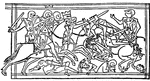
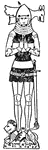
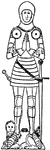
Heavily armored knights engaged in battle.

Knights Armor

Heavily armored knights engaged in battle.

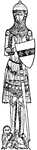
"Brass Armor of Sir John de Creke." — The Encyclopedia Britannica, 1910

Brass Armor

"Brass Armor of Sir John de Creke." — The Encyclopedia Britannica, 1910

"Brass Armor of Sir John de Foxley." — The Encyclopedia Britannica, 1910

Brass Armor

"Brass Armor of Sir John de Foxley." — The Encyclopedia Britannica, 1910

"Brass Armor of Sir John Lisle at Thruxton." — The Encyclopedia Britannica, 1910

Brass Armor

"Brass Armor of Sir John Lisle at Thruxton." — The Encyclopedia Britannica, 1910

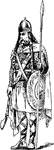
A chief of a Frankish tribe, wearing full battle armor. He stands looking to his right holding a long spear, Germanic spear, in his left hand and a short axe in his right. A decorated shield rest on his left hip and a cape rests on his shoulders. His hair is in long braids and his helmet is tall and pointed, resembling a crown. His sandals wrap around his leg up to his knee.

A Frankish Chief in Full Armor

A chief of a Frankish tribe, wearing full battle armor. He stands looking to his right holding a long…
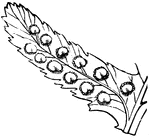
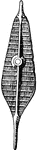
A small piece (pinnule) of a Shield-Fern: a row of fruit-dots on each side of the midrib, each covered by its kidney shaped indusium.

Shield-Fern

A small piece (pinnule) of a Shield-Fern: a row of fruit-dots on each side of the midrib, each covered…
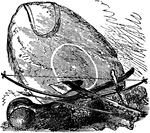
A shield and assortment of Native American weapons.

Shield and Weapons

A shield and assortment of Native American weapons.

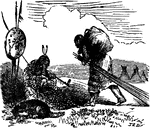
A native American man and woman.

Warrior and Squaw

A native American man and woman.

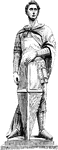
This sculpture by the great artist, Donatello, is of a man dressed in armor holding a shield in front of him. The statue is made of marble and is now located in S. Michele, Florence.

Saint George

This sculpture by the great artist, Donatello, is of a man dressed in armor holding a shield in front…
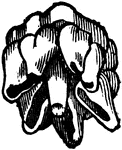
Horsetail, view of under side of the shield-shaped body, bearing a circle of spore-cases.

Horsetail

Horsetail, view of under side of the shield-shaped body, bearing a circle of spore-cases.

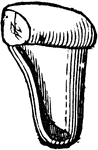
Horsetail, view spore-case from the under side of the shield-shaped body.

Horsetail

Horsetail, view spore-case from the under side of the shield-shaped body.

A Greek shield.

Greek Shield

A Greek shield.

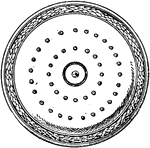
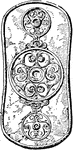
A shield from the Bronze Age.

Bronze Age shield

A shield from the Bronze Age.

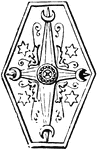
A Roman scutum shield.

Roman scutum

A Roman scutum shield.

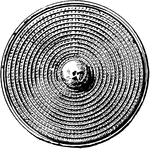
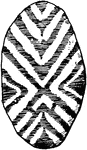
A Celtic shield.

Celtic Shield

A Celtic shield.

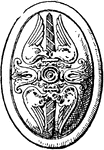
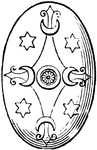
A Roman clipeus.

Roman clipeus

A Roman clipeus.

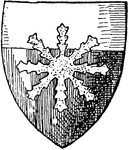
"The best known heraldic shield is that called the heater-shaped, a type common during the thirteenth and fourteenth centuries."—Finley, 1917

Heater shield

"The best known heraldic shield is that called the heater-shaped, a type common during the thirteenth…
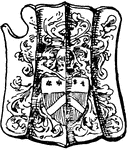
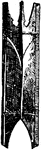
A tournament shield.

Tournament shield

A tournament shield.

A shield from the Philippines.

Phillipine shield

A shield from the Philippines.

An Australian shield.

Australian shield

An Australian shield.

A Sumatran shield.

Sumatran shield

A Sumatran shield.

Quarter Eagle ($2.50) United States coin from 1796. Obverse has a right-facing image of Liberty wearing a triangular cap. Reverse shows an heraldic eagle with U.S. shield holding a bundle of arrows and an olive branch in its talons.

Gold Quarter Eagle Coin, 1796

Quarter Eagle ($2.50) United States coin from 1796. Obverse has a right-facing image of Liberty wearing…
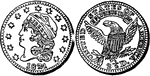
Quarter Eagle ($2.50) United States coin from 1803. Obverse has a right-facing image of Liberty wearing a turban-shaped cap surrounded by 13 equally-spaced stars. Reverse shows an eagle with U.S. shield holding a bundle of arrows in its right talon and an olive branch in its left.

Gold Quarter Eagle Coin, 1803

Quarter Eagle ($2.50) United States coin from 1803. Obverse has a right-facing image of Liberty wearing…
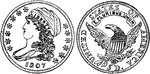
Half Eagle ($5.00) United States coin from 1807. Obverse has a left-facing image of Liberty wearing a turban-shaped cap with 13 stars - 7 facing. Reverse shows an eagle and shield with the eagle holding arrows in its left talon and an olive branch in it right. E PLURIBUS UNUM on a banner above the eagle.

Gold Half Eagle Coin, 1807

Half Eagle ($5.00) United States coin from 1807. Obverse has a left-facing image of Liberty wearing…
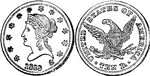
Eagle ($10.00) United States coin from 1838. Obverse has a left-facing image of Liberty wearing a coronet inscribed with LIBERTY and is surrounded by 13 equally-spaced stars. Reverse shows an eagle with shield, without motto, holding a bundle of arrows and an olive branch in its talons, inscription surrounding image - UNITED STATES OF AMERICA.

Gold Eagle Coin, 1838

Eagle ($10.00) United States coin from 1838. Obverse has a left-facing image of Liberty wearing a coronet…
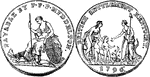
Kentucky Issue (unknown) Kentucky State coin from 1796. Obverse has a seated female with a staff and shield and is inscribed around the figure PAYABLE BY P.P.P. MYDDLETON. Reverse shows a group of 4 figures in a field. The inscription which surrounds the image - BRITISH SETTLEMENT KENTUCKY 1796

Silver Kentucky Issue Coin, 1796

Kentucky Issue (unknown) Kentucky State coin from 1796. Obverse has a seated female with a staff and…
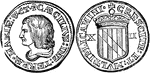
Maryland XII Pence (XII Pence) Maryland Colony coin from 1659. Obverse has an image of Lord Baltimore surrounded by the inscription - +CAECILIVS:DNS:TERRAE-MARIAE:&CT;. The reverse shows the Baltimore family shield, the denomination in roman numerals to either side of the shield. The inscription surrounding the image - CRESCITE:ET:MVLTIPLICAMINI. This coin was also struck in copper.

Silver Maryland XII Pence Coin, 1659

Maryland XII Pence (XII Pence) Maryland Colony coin from 1659. Obverse has an image of Lord Baltimore…
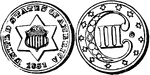
Trime (3 cents) United States coin from 1851. Obverse has the Union shield lying on top of a six-pointed star and is inscribed with - UNITED STATES OF AMERICA with the date at the bottom. Reverse shows by a large, scrolled letter C enclosing the Roman numeral III (denoting value). This image is surrounded 13 equally-spaced stars.

Silver Trime Coin, 1851

Trime (3 cents) United States coin from 1851. Obverse has the Union shield lying on top of a six-pointed…
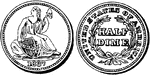
Half Dime (5 cents) United States coin from 1837. Obverse has right-facing Liberty seated beside a shield holding a staff with a cap in her left hand. Reverse shows the inscription HALF DIME surrounded by a wreath. Both images are surrounded by the inscription - UNITED STATES OF AMERICA.

Silver Half Dime Coin, 1837

Half Dime (5 cents) United States coin from 1837. Obverse has right-facing Liberty seated beside a shield…
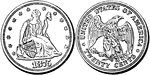
Fifth Dollar (20 cents) United States Coin from 1857. Obverse has the image of Liberty beside a shield holding a staff with a cap in her left hand and surrounded by 13 equally-spaced stars. Reverse is an eagle with NO shield with head right-facing surrounded by the inscription - UNITED STATES OF AMERICA TWENTY CENTS.

Silver Fifth Dollar Coin, 1875

Fifth Dollar (20 cents) United States Coin from 1857. Obverse has the image of Liberty beside a shield…
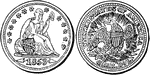
Quarter (25 cents) United States coin from 1853. Obverse has the image of a Liberty seated beside a shield, holding a staff with a cap in her left hand surrounded by 13 stars and the date at the bottom. Reverse shows an eagle with a left-turned head, holding arrows and an olive branch with rays over its head surrounded by the inscription - UNITED STATES OF AMERICA QUAR. DOL.

Silver Quarter Coin, 1853

Quarter (25 cents) United States coin from 1853. Obverse has the image of a Liberty seated beside a…
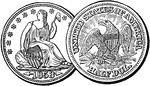
Half Dollar (50 cents) United States coin from 1853. Obverse has the image of a Liberty seated beside a shield, holding a staff with a cap in her left hand surrounded by 13 stars and with arrowheads at the date below the image. Reverse shows an eagle with a left-turned head, holding arrows and an olive branch with rays over its head surrounded by the inscription - UNITED STATES OF AMERICA HALF DOL.

Silver Half Dollar Coin, 1853

Half Dollar (50 cents) United States coin from 1853. Obverse has the image of a Liberty seated beside…
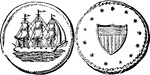
Cent (1 cent) Obverse has the image of a right facing sailing ship. Reverse shows a shield surrounded by 13 equally-spaced stars. Sometimes referred to as the "Carolina Piece"; reason unknown.

Copper Cent Coin, 1659

Cent (1 cent) Obverse has the image of a right facing sailing ship. Reverse shows a shield surrounded…
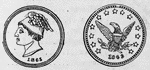
War token with head with winged cap obverse and eagle with shield reverse. These little mementoes of the War of the Rebellion represent the small currency chiefly in use during that period. They were all privately issued, and the Government did not interfere. Merchants displayed their cards on them (often with appropriate characteristic devices), and freely used them in their business. Others partook of the general type, were supplied in suitable quantities to the purchaser, and were "current everywhere." They continued in circulation until about 1867 when their use was prohibited by law.

War Token, 1863

War token with head with winged cap obverse and eagle with shield reverse. These little mementoes of…
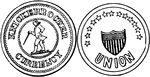
War token with walking figure and "KNICKERBOCKER CURRENCY" obverse and shield and "UNION" reverse. These little mementoes of the War of the Rebellion represent the small currency chiefly in use during that period. They were all privately issued, and the Government did not interfere. Merchants displayed their cards on them (often with appropriate characteristic devices), and freely used them in their business. Others partook of the general type, were supplied in suitable quantities to the purchaser, and were "current everywhere." They continued in circulation until about 1867 when their use was prohibited by law.

War Token, Civil War Period

War token with walking figure and "KNICKERBOCKER CURRENCY" obverse and shield and "UNION" reverse. These…
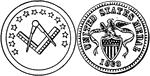
War token buiders square and compass obverse and shield and "UNITED STATES MEDAL" reverse. These little mementoes of the War of the Rebellion represent the small currency chiefly in use during that period. They were all privately issued, and the Government did not interfere. Merchants displayed their cards on them (often with appropriate characteristic devices), and freely used them in their business. Others partook of the general type, were supplied in suitable quantities to the purchaser, and were "current everywhere." They continued in circulation until about 1867 when their use was prohibited by law.

War Token, 1863

War token buiders square and compass obverse and shield and "UNITED STATES MEDAL" reverse. These little…
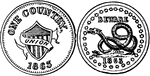
War token with union shield and "ONE COUNTRY" obverse and snake and "BEWARE" reverse. These little mementoes of the War of the Rebellion represent the small currency chiefly in use during that period. They were all privately issued, and the Government did not interfere. Merchants displayed their cards on them (often with appropriate characteristic devices), and freely used them in their business. Others partook of the general type, were supplied in suitable quantities to the purchaser, and were "current everywhere." They continued in circulation until about 1867 when their use was prohibited by law.

War Token, 1865

War token with union shield and "ONE COUNTRY" obverse and snake and "BEWARE" reverse. These little mementoes…
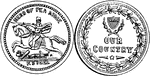
War token with Sigel on hourseback and "HERO OF PEO RIDGE" obverse and shield and "OUR COUNTRY" reverse. These little mementoes of the War of the Rebellion represent the small currency chiefly in use during that period. They were all privately issued, and the Government did not interfere. Merchants displayed their cards on them (often with appropriate characteristic devices), and freely used them in their business. Others partook of the general type, were supplied in suitable quantities to the purchaser, and were "current everywhere." They continued in circulation until about 1867 when their use was prohibited by law.

War Token, Civil War Period

War token with Sigel on hourseback and "HERO OF PEO RIDGE" obverse and shield and "OUR COUNTRY" reverse.…
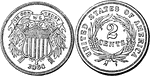
Two Cent (2 cent) United States coin from 1864. Obverse has a shield on crossed arrows, surmounted by a scroll and wreath. The scroll reads - IN GOD WE TRUST, and the date is inscribed below the shield. Reverse shows the value in a wreath of wheat and is surrounded by the inscription - UNITED STATES OF AMERICA.

Brass Two Cent Coin, 1864

Two Cent (2 cent) United States coin from 1864. Obverse has a shield on crossed arrows, surmounted by…
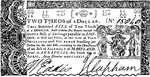
Two Thirds of a Dollar (2/3 dollar) Maryland currency from 1774. Image on the right shows a shield with a farmer on the left and a fisherman on the right.

Paper Money, Two Thirds of a Dollar Bill, 1774

Two Thirds of a Dollar (2/3 dollar) Maryland currency from 1774. Image on the right shows a shield with…
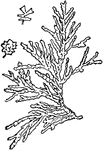
Leaves - simple; indeterminate in position because of their smallness and closeness. They are scale-like, somewhat egg-shape, overlapping each other, and closely pressed in four rows up and down the very flat branchlets. Each leaf has at its centre a raised gland, easily distinguished if held between the eye and the light. Bark - fibrous. The "spray" (formed from the flat branchlets) is itself flat and very delicate and of a dull green. Cones - about one fourth of an inch in diameter, round, variously placed, compact, purplish as they ripen; opening when ripe toward the centre line (i. e., not toward its base). Scales - fleshy, shield-shaped and apparently fastened near their centres, with the edge several-pointed, and with a sharp point or knob in the centre. Seeds - usually four to eight under each scale, oval, with wide wings at the sides. Found - in deep, cold swamps (filling them densely and exclusively), from Southern Maine along the coast to Florida, and along the Gulf coast to Mississippi. General Information - A tapering evergreen tree, thirty to seventy feet high, with light and durable wood, largely used in boat-building, for wooden-ware, shingles, etc.

Genus Chamaecyparis, Spach. (White Cedar)

Leaves - simple; indeterminate in position because of their smallness and closeness. They are scale-like,…
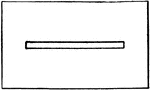
An erasing shield of thin metal is convenient in erasing desired shapes.

Straight Line Erasing Shield

An erasing shield of thin metal is convenient in erasing desired shapes.
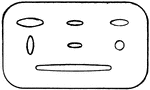
This erasing shield can erase multiple sizes and shapes.

Oval Erasing Shield

This erasing shield can erase multiple sizes and shapes.

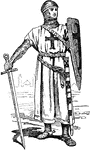
The costume of a knight of the First Crusade.

Knight

The costume of a knight of the First Crusade.

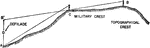
Determining a defilade (natural shield) in military by use of topography.

Defilade

Determining a defilade (natural shield) in military by use of topography.

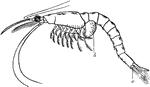
"Mysis flexuosa, from side. b., Brood-pouch borne on posterior thoracic limbs; o., otocyst in tail. Note eight pairs of similar biramose thoracic feet. The last two thoracic segments are not covered by the shield." -Thomson, 1916

Mysis Flexuosa

"Mysis flexuosa, from side. b., Brood-pouch borne on posterior thoracic limbs; o., otocyst in tail.…
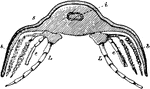
"Vertical cross-section of a Trilobite (Calymene). i., Intestine; s., shield; L., endopodite; e., exopodite; b., epipodial parts." -Thomson, 1916

Trilobite

"Vertical cross-section of a Trilobite (Calymene). i., Intestine; s., shield; L., endopodite; e., exopodite;…
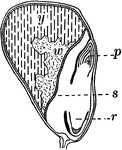
"Lengthwise section of grain of corn. y, yellow, oily part of endosperm; w, white, starchy part of endosperm; p, plumule; s, the shield (cotyledon), in contact with the endosperm for absorption of food from it; r, the primary root." -Bergen, 1896

Corn Grain

"Lengthwise section of grain of corn. y, yellow, oily part of endosperm; w, white, starchy part of endosperm;…
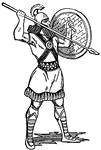
An Assyrian spearman with shield and spear.

Assyrian Spearman

An Assyrian spearman with shield and spear.

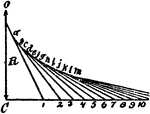
An illustration showing how to construct Shield's anti-friction curve. "R represents the radius of the shaft, and C1, 2, 3, et., is the center line of the shaft. From o, set off the small distance oa; and set off a1 - R. Set off the same small distance from a to b, and make b2 = R. Continue in the same way with the other points, and the anti-friction curve is thus constructed.

Construction Of Shield's Anti-friction Curve

An illustration showing how to construct Shield's anti-friction curve. "R represents the radius of the…
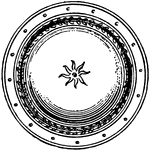
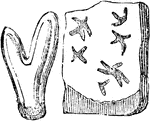
A round, handheld shield used as military armor.

Shield

A round, handheld shield used as military armor.

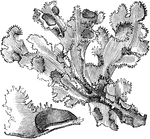
"5. shield of Opegrapha scripta; 6. thallus of the same." -Lindley, 1853

Lichen

"5. shield of Opegrapha scripta; 6. thallus of the same." -Lindley, 1853

"Shields of Baeomyces rufus." -Lindley, 1853

Asci

"Shields of Baeomyces rufus." -Lindley, 1853

"Cetraria islandica: a a. its shields; b. a shield magnified and divided vertically." -Lindley, 1853
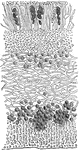
Iceland Moss

"Cetraria islandica: a a. its shields; b. a shield magnified and divided vertically." -Lindley, 1853

"A greatly magnified view of a perpendicular section of Parmelia aipolia, showing the thecae in the shield, a; b, the hypothecium and some gonidia beneath it; c, the medullary region; and d, the gonimic layer." -Lindley, 1853

Leaf Lichen

"A greatly magnified view of a perpendicular section of Parmelia aipolia, showing the thecae in the…
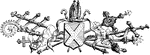
A doodad with scepters, a shield, and a crown.

Royal Doodad

A doodad with scepters, a shield, and a crown.

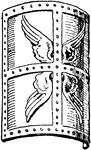
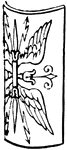
The scutum was a semi-cylindrical shield used by ancient Roman legionaries.

Scutum

The scutum was a semi-cylindrical shield used by ancient Roman legionaries.

The scutum was a semi-cylindrical shield used by ancient Roman legionaries.

Scutum

The scutum was a semi-cylindrical shield used by ancient Roman legionaries.

The scutum was a semi-cylindrical shield used by ancient Roman legionaries.

Scutum

The scutum was a semi-cylindrical shield used by ancient Roman legionaries.

The scutum was a semi-cylindrical shield used by ancient Roman legionaries.

Scutum

The scutum was a semi-cylindrical shield used by ancient Roman legionaries.