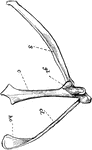
"Right pectoral arch of a bird. s, scapula; c, coracoid; gl, glenoid, the cavity for head of humerus; cl, clavicle; hc, hypecleidium. In situ, the right end of the figure should tilt up a little.The pectoral arch is that bony structure by which the wings are borne upon the axial skeleton. It is to the fore limb what the pelvic arch is to the hind limb; but is disconnected from the back-bone and united with the breastbone, whereas the reverse arrangement obtains in the pelvic, which is fused with the sacral region of the spine. Each pectoral arch of birds consists (chiefly) of three bones: the scapula and coracoid, forming the shoulder-girdle proper, or scapular arch; and the accessory clavicles, or right and left half of the clavicular arch." Elliot Coues, 1884

The Right Pectoral Arch of a Bird

"Right pectoral arch of a bird. s, scapula; c, coracoid; gl, glenoid, the cavity for head of humerus;…
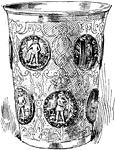
An illustration of a "silver Medal-cup (The medals are all of the Duke of Brunswick-Wolfenbuttel.)" -Century, 1886

Medal Cup

An illustration of a "silver Medal-cup (The medals are all of the Duke of Brunswick-Wolfenbuttel.)"…
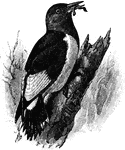
The Red-headed Woodpecker, Melanerpes erythrocephalus, is a small or medium-sized woodpecker from temperate North America. Their breeding habitat is open country across southern Canada and the eastern-central United States.

Red-Headed Woodpecker

The Red-headed Woodpecker, Melanerpes erythrocephalus, is a small or medium-sized woodpecker from temperate…
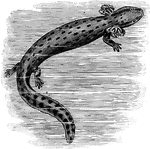
The Common Mudpuppy (Necturus maculosus) is a species of aquatic salamander found throughout the northeastern United States, and parts of Canada. Mudpuppies prefer shallow water with many places to hide, but have been found at depths of up to 90 feet. The mating season is late autumn, however eggs are not laid until late spring when 50 to 100 eggs are deposited in a nest cavity under a rock or other object. It takes 1 to 2 months for the eggs to hatch and 4 to 6 years for the young to reach maturity. Mudpuppies may live for up to 20 years.

Common Mudpuppy

The Common Mudpuppy (Necturus maculosus) is a species of aquatic salamander found throughout the northeastern…
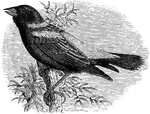
"Dolichonyx oryzivorus. Bobolink. Meadow-wink. Skunk Blackbird (Northern States), Reed-bird (Middle States), Rice-bird (Southern States). Male, in breeding plumage: Black; cervix buff; scapulars, rump and upper tail-coverts ashy-white; interscapulars streaked with black, buff, and ashy; outer quills edged with yellowish; bill blackish-horn; feet brown. The faultless full dress of black, white, and buff is worn only for a brief period; and even in spring and summer, most males are found to have yellowish touches in the black, especially of the under parts. The "delirious song" is only heard while the males re trooping their way to their breeding-grounds, and before the midsummer change of feather." Elliot Coues, 1884

Bobolink

"Dolichonyx oryzivorus. Bobolink. Meadow-wink. Skunk Blackbird (Northern States), Reed-bird (Middle…
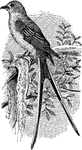
"Milvulus forficatus. Swallow-tailed Flycatcher. Scissor-tail. Crown patch orange or scarlet. General color hoary-ash, paler or white below; sides at insertion of wings scarlet or bloody-red, and other parts of the body variously tinged with the same, or a paler salmon-red. Wings blackish, with whitish edgings. Tail black, but several of the long feathers extensively white or rosy; these are narrow and linear, sometimes widening somewhat in spoon-shape." Elliot Coues, 1884

Swallow-tailed Flycatcher

"Milvulus forficatus. Swallow-tailed Flycatcher. Scissor-tail. Crown patch orange or scarlet. General…
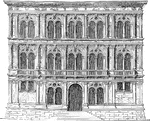
"A certain originality and freedom of intervention is perceptible in the buildings of the early period of the Venetian Renaissance style; the old style is happily blended with the new, which during the first stage is still imbued with Romanesque conceptions."The Vendramin were a rich merchant family of Venice, Italy. What is now the most prominent "Palazzo Vendramin" in Venice, the splendid Ca' Vendramin Calergi by Mauro Codussi on the Grand Canal, was in fact only inherited by the family in 1739, and is now the casino, also famous as the place where Richard Wagner died in 1883. Some rooms are kept as a museum commemorating Wagner's stay. The 16th century Ca' Vendramin di Santa Fosca in the Cannaregio quarter, now also a hotel, is where Gabriele Vendramin's collection was housed. Yet another is the 16th or possibly 17th century "Palazzo Vendramin dei Carmini", in Dorsoduro, most of which is now occupied by part of the University of Venice.

Vendramin Palace at Venice

"A certain originality and freedom of intervention is perceptible in the buildings of the early period…
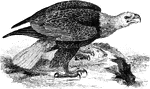
"Haliaetus leucocephalus. White-headed Sea Eagle. "Bald Eagle." "Bird of Washington". Adult: Dark brown; quills black; head and tail white; bill, eyes, and feet yellow. Three years are required for the perfection of the white head tail of the "bald" eagle. The first year, the young are "black" eagle; very dark colored, with fleecy white bases of the feathers showing here and there; bill black; iris brown feet yellow. The next year, they are "gray" eagles, and usually larger than the old birds, the largest known specimens being of this kind." Elliot Coues, 1884

Bald Eagle

"Haliaetus leucocephalus. White-headed Sea Eagle. "Bald Eagle." "Bird of Washington". Adult: Dark brown;…

The Panthéon (Latin Pantheon, from Greek Pantheon, meaning "Every god") is a building in the Latin Quarter in Paris, France. It was originally built as a church dedicated to St. Genevieve, but after many changes now combines liturgical functions with its role as a famous burial place. It is an early example of Neoclassicism, with a façade modeled on the Pantheon in Rome, surmounted by a small dome that owes some of its character to Bramante's "Tempietto". Located in the 5th arrondissement on the Montagne Sainte-Geneviève, the Panthéon looks out over all of Paris. Its architect, Jacques-Germain Soufflot, had the intention of combining the lightness and brightness of the gothic cathedral with classical principles. Soufflot died before his work was achieved, and his plans were not entirely followed. The transparency he had planned for his masterpiece was not attained. Nevertheless, it is one of the most important architectural achievements of its time and the first great neoclassical monument."Toward the end of the reign of Louis XV. a reaction set in, which was caused partly by the excess and caprice displayed in the application of this style, and partly by the tide again setting in the direction of the antique. This evidence by the Colonnades de la Place de Concorde, and by the Church of Ste. Geneviève, which was begun by Soufflot in the year 1755, and subsequently received the name of Pantheon [shown here]. From thenceforth imitations of ancient buildings came into vogue, as they also did in other countries."

West Front of the Pantheon at Paris

The Panthéon (Latin Pantheon, from Greek Pantheon, meaning "Every god") is a building in the Latin…
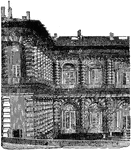
The Palazzo Pitti, in English sometimes called the Pitti Palace, is a vast mainly Renaissance palace in Florence, Italy. It is situated on the south side of the River Arno, a short distance from the Ponte Vecchio. The core of the present palazzo dates from 1458 and was originally the town residence of Luca Pitti, an ambitious Florentine banker.The palace was bought by the Medici family in 1549 and became the chief residence of the ruling families of the Grand Duchy of Tuscany. It grew as a great treasure house as later generations amassed paintings, plates, jewelry and luxurious possessions.In the late 18th century, the palazzo was used as a power base by Napoleon, and later served for a brief period as the principal royal palace of the newly united Italy. The palace and its contents were donated to the Italian people by King Victor Emmanuel III in 1919, and its doors were opened to the public as one of Florence's largest art galleries. Today, it houses several minor collections in addition to those of the Medici family, and is fully open to the public."Columns, pilasters, and mouldings are intermingled and intertwined in a fantastic and meaningless manner, the cornices are often interrupted; the essentially component parts of the architecture are frequently mutilated; for instance, columns and wall-pilasters are executed in rustic work, i. e., formed of extensively projecting hewn stones, yet are furnished with a capital and base as is shown [in this image], which is an illustration taken from the Late Italian Renaissance. For the sake of peculiarity, the various component elements assumed a form diametrically opposed to their original designation; mere decorative and secondary details were raised to the rank of essentials, whilst the real principal forms sank to an entirely subordinate position."

Part of the Back of the Pitti Palace at Florence

The Palazzo Pitti, in English sometimes called the Pitti Palace, is a vast mainly Renaissance palace…
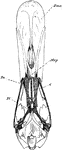
"Desmognathous skull of mallard duck, Anas boscas, nat. size, from nature, by Dr. R.W. Shufeldt, U.S.A. Letters before. In the "bound-palate" type, the vomer in either abortive, or so small that it disappears; when existing it is usually slender and tapers to a point in front; the maxillo-palatines are united across the median line, either directly or by means of ossification in the nasal septum; the posterior ends of the palatines and the anterior ends of the pterygoids articulate directly with the rostrum (as in schizognathism). This type is simply and perfectly exhibited by a duck in which the maxillo-palatine is a broad flat plate united with its fellow in mid-line; the oval sessile basipterygoid facets are far forward, opposite the very ends of the pterygoids." Elliot Coues, 1884

Mallard Duck Skull

"Desmognathous skull of mallard duck, Anas boscas, nat. size, from nature, by Dr. R.W. Shufeldt, U.S.A.…
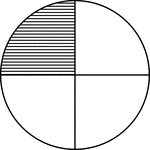
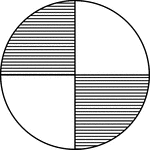
A circle divided into quarters with one quarter shaded.

Fraction Pie Divided into Quarters

A circle divided into quarters with one quarter shaded.

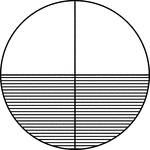
A circle divided into quarters with two quarters shaded.

Fraction Pie Divided into Quarters

A circle divided into quarters with two quarters shaded.

A circle divided into quarters with two quarters shaded.

Fraction Pie Divided into Quarters

A circle divided into quarters with two quarters shaded.

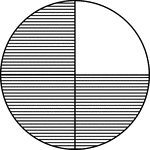
A circle divided into quarters with three quarters shaded.

Fraction Pie Divided into Quarters

A circle divided into quarters with three quarters shaded.

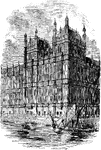
"In England, as in Germany, architectural activity has assumed various phases in modern times. With few exceptions, the numerous newly-constructed churches are built in the Gothic style of the thirteenth and fourteenth centuries; whilst public secular buildings, for which a certain simplicity is appropriate, such as school and university buildings, asylums, &c., as well as large country-houses, are either constructed in the Pointed or in the Late Gothic, or so-called Perpendicular or Tudor style, with flat-arched, curved, or even horizontal heads to the openings. Other public buildings, as, for instance, the Houses of Parliament, which is the most important modern building in London, are carried out in this style. The Renaissance style has recently been frequently employed, especially for dwelling-houses."The Palace of Westminster, also known as the Houses of Parliament, is a complex of buildings in London. It is the seat of the two houses of the Parliament of the United Kingdom (the House of Lords and the House of Commons). The palace lies on the north bank of the River Thames in the London borough of the City of Westminster, close to the government buildings of Whitehall.

New Houses of Parliament, London

"In England, as in Germany, architectural activity has assumed various phases in modern times. With…
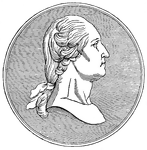
George Washington, born in Virginia, February 22nd, 1732 was the eldest of five children. He was inquisitive, docile and diligent with a talent for leadership. His first surveying job established his reputation in that field. At nineteen, he was appointed military inspector with the rank of major. He continued for many years of service in his military career finally retiring to private life in 1758. On January 6th, 1759, he married Mrs. Martha Custis, a widow. With the revolution approaching he was commissioned to take command of the army. He leadership skills were to carry him though the years of difficulty ahead. The succesful siege of Yorktown was a victory that put a finish to the war. On the 25th of November, 1783, a peace treaty with Britain was ratified. Once again he retired to private life, spending the next several years devoted to his family and farm. In 1787 he was chosen as president of the convention to revise the federal system held at Philadelphia. With the new constitution about to go into operation, Washington was unanimously chosen as the first president of the United States.

George Washington

George Washington, born in Virginia, February 22nd, 1732 was the eldest of five children. He was inquisitive,…
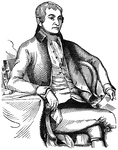
John Jay born December 1745 was an American politician, statesman, revolutionary, diplomat, a Founding Father of the United States. He was President of the Continental Congress from 1778 to 1779 and, from 1789 to 1795, the first Chief Justice of the United States. During and after the American Revolution, he was ambassador to Spain and France. He helped to form American foreign policy and secured favorable peace terms from the British and French with the Jay Treaty. He co-wrote the Federalist Papers with Alexander Hamilton and James Madison. Jay was Governor of New York from 1795 to 1801 and aleading opponent of slavery. His first two attempts to pass emancipation legislation failed in 1777 and 1785, but the third succeeded in 1799. The new law he signed into existence eventually saw the emancipation of all New York slaves before his death.

John Jay

John Jay born December 1745 was an American politician, statesman, revolutionary, diplomat, a Founding…
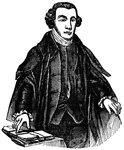
Patrick Henry, born in 1736, was an active figure in the American Revolution, known and remembered for his "Give me Liberty, or give me Death!" speech. He was one of the Founding Fathers of the United States. Along with Samuel Adams and Thomas Paine, he is remembered as one of the most influential and radical advocates of the American Revolution and the republic. He was strong in his denunciations of corruption in government officials and his defense of historic rights June 6, 1799. In 1798 President John Adams nominated Henry special emissary to France, but he had to decline because of failing health. At the urging of Washington was elected to the Virginia House of Delegates as a Federalist. Three months prior to taking his seat in the state legislature, he died of stomach cancer on June 6, 1799, while at Red Hill, his family's large plantation.

Patrick Henry

Patrick Henry, born in 1736, was an active figure in the American Revolution, known and remembered for…
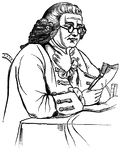
Benjamin Franklin was one of the Founding Fathers of the United States of America. He was also a noted polymath, a leading author and printer, satirist, political theorist, politician, scientist, inventor, civic activist, statesman, and diplomat. In 1751, Franklin and Dr. Thomas Bond obtained a charter from the Pennsylvania legislature to establish a hospital. Pennsylvania Hospital was the first hospital in what was to become the United States of America. In June, 1776, he was appointed a member of the Committee of Five that drafted the Declaration of Independence. Although he was temporarily disabled by gout and unable to attend most meetings of the Committee, Franklin made several small changes to the draft sent to him by Thomas Jefferson. In December, 1776, Franklin was dispatched to France as commissioner for the United States and remained in France until 1785. Franklin retained a lifelong commitment to the Puritan virtues and political values with which he had grown up. Through his civic work and publishing, he succeeded in passing these values into the American culture permanently.

Benjamin Franklin

Benjamin Franklin was one of the Founding Fathers of the United States of America. He was also a noted…
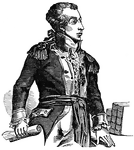
Marquis de la Fayette (or Lafayette), born September 1757 was a French military officer born in the province of Auvergne in south central France. Lafayette was a general in the American Revolutionary War and a leader of the Garde Nationale during the French Revolution. In the American Revolution, Lafayette served in the Continental Army under George Washington. Although wounded during the Battle of Brandywine, he still managed to organize a successful retreat. He served faithfully thourghout the American Revolution. Lafayette was widely commemorated in the U.S. In 1824, the U.S. government named Lafayette Park in his honor. Lafayette College was chartered in Easton, Pennsylvania. Lafayette was honored with a monument in New York City in 1917. Portraits display Washington and Lafayette in the chamber of the U.S. House of Representatives. Numerous towns and cities across the United States were named in his honor.

Gilbert Mottier De LaFayette

Marquis de la Fayette (or Lafayette), born September 1757 was a French military officer born in the…
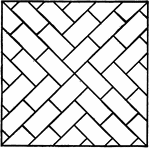
"An exercise in starting and stopping short lines. Draw three-inch square. Draw diagonals with 45-degree triangle. With scale lay off 3/8" spaces along the diagonals, from their intersection. With 45-degree triangle complete figure, finishing one-quarter at a time." —French, 1911

Drawing Street Paving Intersection

"An exercise in starting and stopping short lines. Draw three-inch square. Draw diagonals with 45-degree…
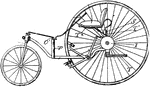
A tricycle is a three wheeled vehicle, while tricycles are often associated with the small three wheeled vehicles used by pre school age children, they are also used by adults for a variety of purposes. in the United States and Canada, adult sized tricycles are used primarily by older persons for recreation, shopping, and exercise.

Three Wheeled Vehicle

A tricycle is a three wheeled vehicle, while tricycles are often associated with the small three wheeled…
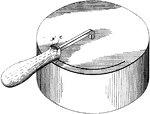
A can opener is a device used to open metal cans. Although preservation of food using tin cans had been practiced since at least 1772 in the Netherlands, the first can openers were patented only in 1855 in England and in 1858 in the United States. Those openers were basically variations of a knife, and the 1855 design continues to be produced. The first opener employing the now familiar sharp rotating wheel, which runs around the can's rim cutting the lid, was invented in 1870 but was difficult to operate. A breakthrough came in 1925 when a second, serrated wheel was added to hold the cutting wheel on the rim of the can. This easy to use design has become one of the most popular can opener models.

Rotating Wheel Can Opening Tool

A can opener is a device used to open metal cans. Although preservation of food using tin cans had been…
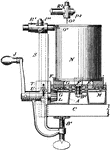
Although preservation of food using tin cans had been practiced since at least 1772 in the Netherlands, the first can openers were patented only in 1855 in England and in 1858 in the United States. Those openers were basically variations of a knife, and the 1855 design continues to be produced.

Rotating Cutting Wheel Tin Can Opener

Although preservation of food using tin cans had been practiced since at least 1772 in the Netherlands,…
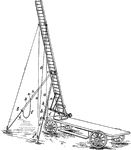
For safety, a rigid ladder should be leaned at an angle of about fifteen degrees to the vertical. In other words, the distance from the foot of the ladder to the wall should be about one quarter of the height of the top of the ladder. At steeper angles, the ladder is at risk of toppling backwards when the climber leans away from it

Four Wheeled Cart Mount for Ariel Ladder

For safety, a rigid ladder should be leaned at an angle of about fifteen degrees to the vertical. In…
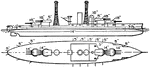
An illustration showing USS Arizona. USS Arizona was a Pennsylvania class battleship, built by U.S. Navy. It was launched in 1915, and served stateside during World War I. The ship sank in Pearl Harbor during World War II.

United States Navy Arizona Battleship

An illustration showing USS Arizona. USS Arizona was a Pennsylvania class battleship, built by U.S.…
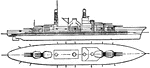
USS Massachusetts commissioned by United States Navy in 1942. The ship was used during the World War II in the Pacific Ocean. The ship has a top speed of 27 knots (31 mph) and 35000 tons.

Massachusetts Battleship United States Navy

USS Massachusetts commissioned by United States Navy in 1942. The ship was used during the World War…
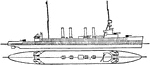
A U.S. Navy Omaha class battlecruiser launched in 1920. The top speed of the cruiser is 35 knots (40 mph). The ship was powered by steam.

United States Navy Omaha Class Battlecruiser

A U.S. Navy Omaha class battlecruiser launched in 1920. The top speed of the cruiser is 35 knots (40…
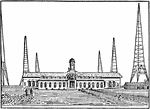
A World War I radio communication at Bordeaux. The United States Army built the radio station for a direct communication line.

French Radio Station at Bordeaux Built by American Army

A World War I radio communication at Bordeaux. The United States Army built the radio station for a…
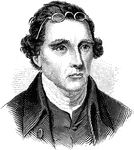
An illustration of Patrick Henry a man who served as the post-colonial Governor of Virginia and was also a prominent figure in the American Revolution. He is known as one of the founding fathers of the United States.

Patrick Henry

An illustration of Patrick Henry a man who served as the post-colonial Governor of Virginia and was…
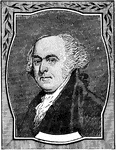
An illustration of John Adams who proposed Washington for Commander-in-Chief of the Continental Army. John Adams was also the second President of the United States and was one of the most influential Found Fathers of the United States.

John Adams

An illustration of John Adams who proposed Washington for Commander-in-Chief of the Continental Army.…
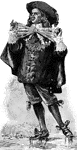
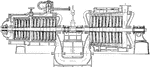
An illustration of King Charles wearing a rather large neck tie.

King Charles

An illustration of King Charles wearing a rather large neck tie.

"The bearings are of the plain ring—oiling type, usually provided with water jackets. The shaft not being unduly long, there is little danger of whipping, and the speeds of rotation not being very high, special precautions are not necessary. Sometimes the turbines are supported by three bearings, the high and intermediate states being separated from the low by a third bearing." —Derr, 1911

DeLaval Steam Electric Generator

"The bearings are of the plain ring—oiling type, usually provided with water jackets. The shaft…
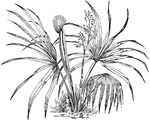
Genus of palm trees including the palmetto of the Southern United States.

Glabra Sabal

Genus of palm trees including the palmetto of the Southern United States.

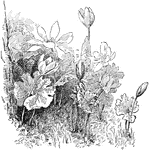
A perennial, herbaceous flowering plant native to eastern North America from Nova Scotia, Canada southward to Florida, United States.

Flowering Sanguinaria

A perennial, herbaceous flowering plant native to eastern North America from Nova Scotia, Canada southward…
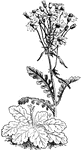
This weed is native to the United States and features yellow flowers.

Senecio Aureus

This weed is native to the United States and features yellow flowers.

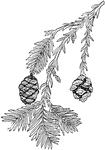
This evergreen is native of the United States, usually flourishes under wet and humid environments.

Sequoia Sempervirens

This evergreen is native of the United States, usually flourishes under wet and humid environments.
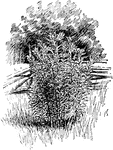
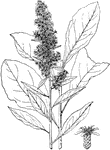
The solidago is a type of flowering plant native to the United States.

Solidago Speciosa

The solidago is a type of flowering plant native to the United States.

Dryer weed from canada and parts of the United States, they bear yellow flowers.

Solidago Nemoralis

Dryer weed from canada and parts of the United States, they bear yellow flowers.

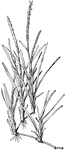
This is a low grass common in southern parts of the United States.

Stenotaphrum Secundatum

This is a low grass common in southern parts of the United States.

Plant belonging to the daisy family, common to eastern parts of the United States.

Vernonia Noveboracensis

Plant belonging to the daisy family, common to eastern parts of the United States.
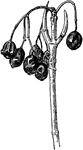
Perennial belonging to the Viburnum, native to central United States.

Viburnum Lentago

Perennial belonging to the Viburnum, native to central United States.

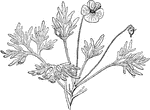
Named "Great Basin Violet," a flowering plant native to western United States.

Viola Beckwithii

Named "Great Basin Violet," a flowering plant native to western United States.

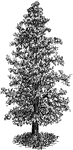
An image of a bald cypress, in pyramidal cultivated form. It is otherwise known as taxodium distichum, and is native to the southeastern United States.

Bald Cypress in Cultivated Form

An image of a bald cypress, in pyramidal cultivated form. It is otherwise known as taxodium distichum,…
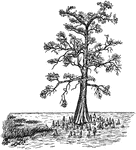
An image of a bald cypress in swamp form, with aerating roots, or knees. It is otherwise known as taxodium distichum, and is native to the southeastern United States.

Bald Cypress in Swamp Form

An image of a bald cypress in swamp form, with aerating roots, or knees. It is otherwise known as taxodium…
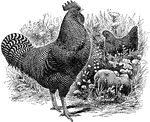
Often called Plymouth Rocks. There are seven varieties: barred, blue, buff, Columbian, partridge, silver-penciled and white. They originated in the United States.

Pair of Barred Plymouth Rocks

Often called Plymouth Rocks. There are seven varieties: barred, blue, buff, Columbian, partridge, silver-penciled…
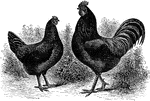
Originated in the United States. It is one of the oldest American chickens, and is critically endangered today. They are excellent for both meat and egg production.

Pair of Black Javas

Originated in the United States. It is one of the oldest American chickens, and is critically endangered…
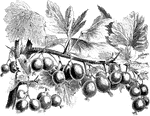
Also known as northern gooseberry. It is slightly smaller in diameter than Ribes grossularia and is typically found in the northwestern United States.

Ribes Oxyacanthoides

Also known as northern gooseberry. It is slightly smaller in diameter than Ribes grossularia and is…
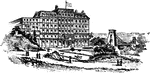
A hotel located in Bristol, United Kingdom.

Clifton Down Hotel

A hotel located in Bristol, United Kingdom.

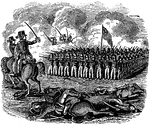
"In close array, this firm united band / Guarded on every point will boldly stand; / Their foes attack them on each side in vain; / By standing, they at last the victory gain."—Barber, 1857

They Conquer Who Endure

"In close array, this firm united band / Guarded on every point will boldly stand; / Their foes attack…
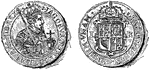
A gold coin of King James I. It was the first coin to bear the name 'Great Britain.'

Gold Coin of James I

A gold coin of King James I. It was the first coin to bear the name 'Great Britain.'
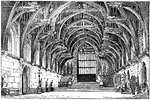
"Next to the Tower and the Abbey, Westminster Hall, adjoining the House of Parliament, is the most historic building in London. The hall was begun by William Rufus in 1097, and was enlarged by his successors. Richard II in 1397 added the great oak roof, which has lasted to this day. Here were held the trials of Strafford and Charles I."—Webster, 1920

Interior of Westminster Hall

"Next to the Tower and the Abbey, Westminster Hall, adjoining the House of Parliament, is the most historic…
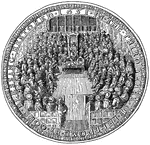
The seal used to symbolize the monarch's approval of important state documents.

Great Seal of England Under the Commonwealth

The seal used to symbolize the monarch's approval of important state documents.
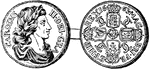
The silver crown coin of Charles II, who was the King of England between 1649 and 1651.

Silver Crown of Charles II

The silver crown coin of Charles II, who was the King of England between 1649 and 1651.
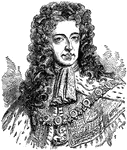
William III of England. He was the King of England between 1689 and 1702.

William III

William III of England. He was the King of England between 1689 and 1702.

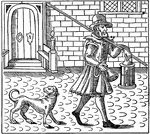
"It was part of the duties of a bellman, or night-watchman, to call out the hours, the state of the weather, and other information as he passed by."—Webster, 1920

A London Bellman

"It was part of the duties of a bellman, or night-watchman, to call out the hours, the state of the…
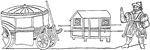
A form of transportation used during 17th century England.

Coach and Sedan Chair

A form of transportation used during 17th century England.

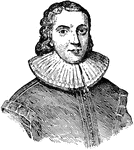
An English poet and author of the epic of Paradise Lost.

John Milton

An English poet and author of the epic of Paradise Lost.

Also refers to John Churchill, the first Duke of Marlborough.

Marlborough

Also refers to John Churchill, the first Duke of Marlborough.