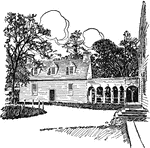
The servant's quarters of George Washington's Mount Vernon plantation in Virginia.

Mount Vernon

The servant's quarters of George Washington's Mount Vernon plantation in Virginia.

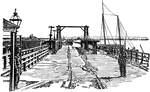
"Long Bridge across the Potomac at Washington, D.C." -Gordy, 1916

Potomac River Long Bridge

"Long Bridge across the Potomac at Washington, D.C." -Gordy, 1916

Johann Gottlieb Rall (ca. 1726 - December 26, 1776 ) was a German colonel in command of Hessian troops in Trenton, New Jersey. By 1776, Rall belonged to the infantry regiment of the 1st Division under General Phillip Leopold von Heister and commanded approximately 1,200 men fighting for Great Britain in the American Revolutionary War. He was at the Battle of Brooklyn at Flatbush, the Battle of White Plains, the Battle of Long Island, and figured prominently in the Battle of Trenton. At the Battle of Trenton, Rall was mortally wounded and taken back to his headquarters where he died.

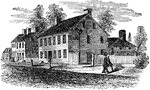
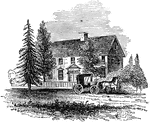
<p>"Rall's head-quarters. This is a frame building standing upon Warren Street, opposite Perry, near the corner of Bank Alley. The buildings on the left are also of ante-Revolutionary origin. This house was a tavern at the time, kept by Stacey Potts, the grandfather of Stacey G. and Joseph C. Potts, Esqrs., of Trenton. In a pane of glass, in the front window on the left of the front door, lower story, may be seen a hole made by a bullet, shot during the battle. Colonel Rall died in the front room in the second story, immediately over this window. It is related that a daughter of Mr. Potts, who was at a neighbor's when the firing commenced, was running toward her father's house, when a musket-ball struck her comb from her head and slightly injured her scalp."—Lossing, 1851

Rall's Headquarters

Johann Gottlieb Rall (ca. 1726 - December 26, 1776 ) was a German colonel in command of Hessian troops…
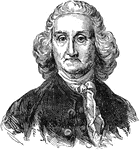
Jonathan Trumbull, Sr. (12 October 1710 – 17 August 1785) was one of the few men who served as governor in both a pre-Revolutionary colony and a post-Revolutionary state. He was a friend and advisor of General Washington throughout the revolutionary period, dedicating the resources of Connecticut to the fight for independence. He was the only colonial governor to continue in office through the American revolution.

Jonathan Trumbull

Jonathan Trumbull, Sr. (12 October 1710 – 17 August 1785) was one of the few men who served as governor…
John Trumbull Birthplace, also known as Governor Jonathan Trumbull House, is a house on Lebanon Green, in Lebanon, Connecticut. The house was constructed by Joseph Trumbull as a wedding gift for his son Jonathan Trumbull, who became governor. Jonathan's son John Trumbull was born in the house June 6, 1756. He would go on to serve as an aide to George Washington in the Revolutionary War and paint four of the eight historical paintings which adorn the United States Capitol rotunda. It was declared a National Historic Landmark in 1965.

Governor Jonathan Trumbull House

John Trumbull Birthplace, also known as Governor Jonathan Trumbull House, is a house on Lebanon Green,…
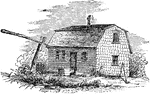
Jonathan Trumbull, Sr. (12 October 1710 &ndash; 17 August 1785) was one of the few men who served as governor in both a pre-Revolutionary colony and a post-Revolutionary state. He was a friend and advisor of General Washington throughout the revolutionary period, dedicating the resources of Connecticut to the fight for independence. He was the only colonial governor to continue in office through the American revolution.

Governor Trumbull's War Office

Jonathan Trumbull, Sr. (12 October 1710 – 17 August 1785) was one of the few men who served as…
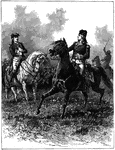
The Battle of Monmouth was an American Revolutionary War battle fought on June 28, 1778 in New Jersey. Here, George Washington is rebuking General Lee at the Battle of Monmouth.

Washington and General Lee

The Battle of Monmouth was an American Revolutionary War battle fought on June 28, 1778 in New Jersey.…

The Liberty Cap large cents of 1793-1796 are the classics of early American copper coinage. They represent the third step in the infant Philadelphia Mint's quest for a permanent cent design.

Liberty Cap Cent

The Liberty Cap large cents of 1793-1796 are the classics of early American copper coinage. They represent…
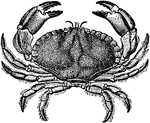
The Dungeness crab is a species of crab that inhabits eelgrass beds and water bottoms from the Aleutian Islands in Alaska to Santa Cruz, California. Its binomial name, Cancer magister, simply means "master crab" in Latin. They measure as much as 25 cm (10 inches) in some areas off the coast of Washington, but typically are under 20 cm (8 inches). They are a popular delicacy, and are the most commercially important crab in the Pacific Northwest, as well as the western states generally.

Dungeness Crab

The Dungeness crab is a species of crab that inhabits eelgrass beds and water bottoms from the Aleutian…
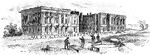
The Burning of Washington took place in 1814, during the Anglo-American War of 1812. British forces occupied Washington, D.C. and set fire to many public buildings. The facilities of the U.S. government, including the White House, were largely destroyed.

Remains of the Capitol After the Fire of 1814

The Burning of Washington took place in 1814, during the Anglo-American War of 1812. British forces…
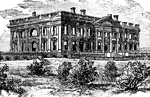
The Burning of Washington took place in 1814, during the Anglo-American War of 1812. British forces occupied Washington, D.C. and set fire to many public buildings. The facilities of the U.S. government, including the White House, were largely destroyed.

Remains of the White House After the Fire of 1814

The Burning of Washington took place in 1814, during the Anglo-American War of 1812. British forces…
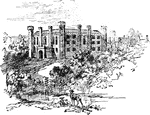
Willian de Wessyngton was a forebear of George Washington, the first President of the United States. Though it was not from Washington, Sunderland, that George Washington's great-grandfather John Washington left for Virginia, but from Essex, Washington Old Hall was the family home of George Washington's ancestors, and the present structure does incorporate small parts of the medieval home in which they lived.

Washington Old Hall

Willian de Wessyngton was a forebear of George Washington, the first President of the United States.…
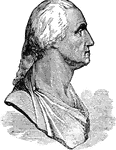
Bust of George Washington by Jean-Antoine Houdon. George Washington (February 22, 1732 — December 14, 1799) served as the first President of the United States of America (1789—1797), and led the Continental Army to victory over the Kingdom of Great Britain in the American Revolutionary War (1775—1783).

Houdon's Bust of Washington

Bust of George Washington by Jean-Antoine Houdon. George Washington (February 22, 1732 — December…
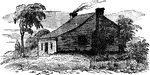
Ferry Farm, also known as George Washington Boyhood Home Site or Ferry Farm Site, is the name of the farm and home at which George Washington spent much of his childhood. In July 2008, archeologists announced that they had found remains of the boyhood home, which had burnt in a fire, including artifacts such as pieces of a tea set probably belonging to George's mother, Mary Ball Washington.

Washington Family Residence

Ferry Farm, also known as George Washington Boyhood Home Site or Ferry Farm Site, is the name of the…
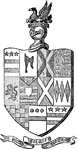
The coat of arms of George Washington, President of the United States of America from 1789 to 1797, were first used to identify the family in the twelfth century, when one of George Washington's ancestors took possession of Washington Old Hall, then in County Durham, in north-east England.

Combined Arms of the Washington Family

The coat of arms of George Washington, President of the United States of America from 1789 to 1797,…
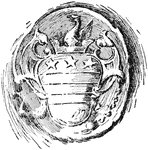
Washington's Seal incorporates the same design which can be found in Washington's Arms. The coat of arms of George Washington, President of the United States of America from 1789 to 1797, were first used to identify the family in the twelfth century, when one of George Washington's ancestors took possession of Washington Old Hall, then in County Durham, in north-east England.

Washington's Seal (From a Letter to Bouquet, 1758)

Washington's Seal incorporates the same design which can be found in Washington's Arms. The coat of…
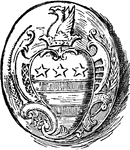
Washington's Private Seal incorporates the same design which can be found in Washington's Arms. The coat of arms of George Washington, President of the United States of America from 1789 to 1797, were first used to identify the family in the twelfth century, when one of George Washington's ancestors took possession of Washington Old Hall, then in County Durham, in north-east England.

Washington's Private Seal, 1783

Washington's Private Seal incorporates the same design which can be found in Washington's Arms. The…
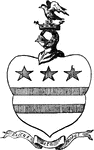
The coat of arms of George Washington, President of the United States of America from 1789 to 1797, were first used to identify the family in the twelfth century, when one of George Washington's ancestors took possession of Washington Old Hall, then in County Durham, in north-east England.

Washington Arms

The coat of arms of George Washington, President of the United States of America from 1789 to 1797,…
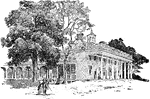
Mount Vernon, located near Alexandria, Virginia, was the plantation home of the first President of the United States, George Washington. The mansion is built of wood in neoclassical Georgian architectural style, and the estate is located on the banks of the Potomac River.

Mount Vernon in Washington's Day

Mount Vernon, located near Alexandria, Virginia, was the plantation home of the first President of the…
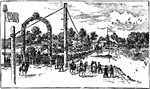
A triumphal arch is a structure in the shape of a monumental archway, in theory built to celebrate a victory in war, actually used to celebrate a ruler. This specific Triumphal Arch was erected near Philadelphia for the reception of General Washington, April 20, 1789.

Triumphal Arch for the Reception of General Washington

A triumphal arch is a structure in the shape of a monumental archway, in theory built to celebrate a…
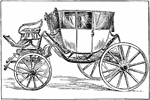
The coach that belonged to the first President of the United States, George Washington. A coach was originally a large, usually closed, four-wheeled carriage with two or more horses harnessed as a team, controlled by a coachman and/or one or more postilions. It had doors in the sides, with generally a front and a back seat inside and, for the driver, a small, usually elevated seat in front called a box, box seat or coach box.

Washington's Coach

The coach that belonged to the first President of the United States, George Washington. A coach was…
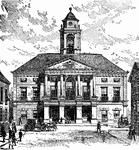
Federal Hall, located at 26 Wall Street in New York City, was the first capitol of the United States of America and the site of George Washington's first inauguration in 1789. It is also the place where the United States Bill of Rights was passed. The original building was demolished in the nineteenth century and replaced by the current structure.

Federal Hall, 1789

Federal Hall, located at 26 Wall Street in New York City, was the first capitol of the United States…
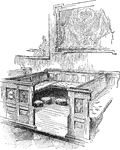
In some churches, pews were installed at the expense of the congregants, and were their personal property; there was no general public seating in the church itself. In these churches, pew deeds recorded title to the pews, and were used to convey them. Pews were originally purchased from the church by their owners under this system, and the purchase price of the pews went to the costs of building the church. Pictured here is George Washington's family pew at St. Paul's Episcopal Church in New York.

Washington's Pew at St. Paul's, New York

In some churches, pews were installed at the expense of the congregants, and were their personal property;…
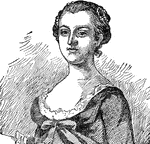
Martha Custis Washington (June 2, 1731 &ndash; May 22, 1802) was the wife of George Washington, the first president of the United States. Although the title was not coined until after her death, Martha Washington is considered to be the first First Lady of the United States. During her lifetime, she was simply known as "Lady Washington."

Martha Custis Washington

Martha Custis Washington (June 2, 1731 – May 22, 1802) was the wife of George Washington, the…
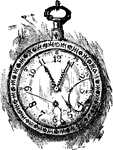
Watch belonging to Martha Custis Washington (June 2, 1731 &ndash; May 22, 1802), the wife of George Washington, the first president of the United States. Although the title was not coined until after her death, Martha Washington is considered to be the first First Lady of the United States. During her lifetime, she was simply known as "Lady Washington."

Martha Washington's Bridal Watch

Watch belonging to Martha Custis Washington (June 2, 1731 – May 22, 1802), the wife of George…
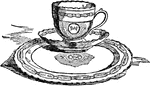
One of many teacups belonging to Mrs. Washington. A teacup is a small cup with a handle, generally a small one that may be grasped with the thumb and one or two fingers.

Martha Washington's Teacup

One of many teacups belonging to Mrs. Washington. A teacup is a small cup with a handle, generally a…
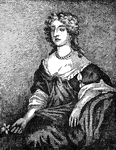
Mary Ball Washington (1708 &ndash; 1789) was the mother of George Washington. Mary Ball met Augustine Washington and they married in 1730. Together, Mary and Augustine had six children.

Mary Washington

Mary Ball Washington (1708 – 1789) was the mother of George Washington. Mary Ball met Augustine…
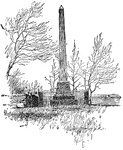
Monument in the memory of Mary Washington at Fredericksburg, VA. Mary Ball Washington (1708 &ndash; 1789) was the mother of George Washington. Mary Ball met Augustine Washington and they married in 1730. Together, Mary and Augustine had six children.

Mary Washington Monument

Monument in the memory of Mary Washington at Fredericksburg, VA. Mary Ball Washington (1708 –…
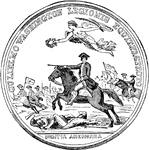
For his valor and victory at Cowpens, Washington received a silver medal awarded by the Continental Congress executed under the direction of Thomas Jefferson. The unique silver medal was designed by French medallic artists Du Pre and De Vivier.

Silver Medal Awarded to William Washington, Front

For his valor and victory at Cowpens, Washington received a silver medal awarded by the Continental…
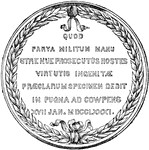
For his valor and victory at Cowpens, Washington received a silver medal awarded by the Continental Congress executed under the direction of Thomas Jefferson. The unique silver medal was designed by French medallic artists Du Pre and De Vivier.

Silver Medal Awarded to William Washington, Back

For his valor and victory at Cowpens, Washington received a silver medal awarded by the Continental…
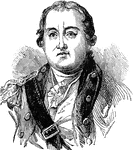
William Washington (February 28, 1752 to March 6, 1810), was a patriotic Southern cavalry officer during the American Revolutionary War, who held a final rank of Brigadier General in the newly created United States after the war.

William Washington

William Washington (February 28, 1752 to March 6, 1810), was a patriotic Southern cavalry officer during…
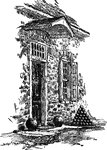
Hasbrouck House served as Washington's headquarters during the Revolutionary War from April 1782 until August 1783. It was chosen for its comparatively safe location north of the strategically important West Point. The 7,000 troops of the Continental Army were encamped near what is today known as Vails Gate, a few miles to the southwest.

Entrance to Washington's Headquarters, Newburgh

Hasbrouck House served as Washington's headquarters during the Revolutionary War from April 1782 until…
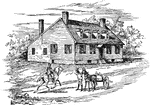
Ferry Farm, also known as George Washington Boyhood Home Site or Ferry Farm Site, is the name of the farm and home at which George Washington spent much of his childhood. In July 2008, archeologists announced that they had found remains of the boyhood home, which had burnt in a fire, including artifacts such as pieces of a tea set probably belonging to George's mother, Mary Ball Washington.

Washington's House in Fredericksburg

Ferry Farm, also known as George Washington Boyhood Home Site or Ferry Farm Site, is the name of the…
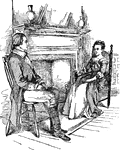
George Washington meeting with the charming widow of Daniel Parke Custis, Mrs. Martha Dandridge Custis. Mrs. Custis was later re-married to George Washington.

Colonel Washington and Mrs. Custis

George Washington meeting with the charming widow of Daniel Parke Custis, Mrs. Martha Dandridge Custis.…
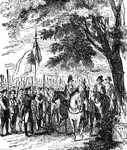
Although he did not explicitly seek the office of commander and even claimed that he was not equal to it, there was no serious competition. Congress created the Continental Army on June 14, 1775; the next day, on the nomination of John Adams of Massachusetts, Washington was appointed Major General and elected by Congress to be Commander-in-chief.

Washington Taking Command of the Army

Although he did not explicitly seek the office of commander and even claimed that he was not equal to…
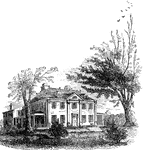
Washington used the home as his headquarters and home while he planned the Siege of Boston between July 1775 and April 1776. During his time there, Washington was visited by John Adams and Abigail Adams, Benedict Arnold, Henry Knox, and Nathaniel Greene. Martha Washington joined her husband in December 1775 and the two stayed in the house until March 1776. On Twelfth Night in January 1776, the couple celebrated their wedding anniversary in the home.

Washington's Headquarters at Cambridge, 1775

Washington used the home as his headquarters and home while he planned the Siege of Boston between July…
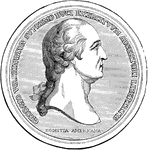
Since the American Revolution, Congress has commissioned gold medals as its highest expression of national appreciation for distinguished achievements and contributions. Each medal honors a particular individual, institution, or event. The medal was first awarded in 1776 by the Second Continental Congress to then-General George Washington during the American Revolutionary War.

Washington's Congressional Gold Medal, Front

Since the American Revolution, Congress has commissioned gold medals as its highest expression of national…
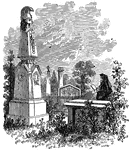
The monument of Alexander Macomb in the Congressional Cemetery in Washington, D.C.

Macomb's Monument

The monument of Alexander Macomb in the Congressional Cemetery in Washington, D.C.
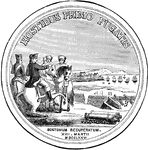
Since the American Revolution, Congress has commissioned gold medals as its highest expression of national appreciation for distinguished achievements and contributions. Each medal honors a particular individual, institution, or event. The medal was first awarded in 1776 by the Second Continental Congress to then-General George Washington during the American Revolutionary War.

Washington's Congressional Gold Medal, Back

Since the American Revolution, Congress has commissioned gold medals as its highest expression of national…
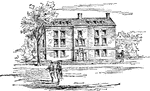
The Morris-Jumel Mansion (also known as the Roger and Mary Philipse Morris House), located in historic Washington Heights, is the oldest house in Manhattan. It served as a headquarters for both sides in the American Revolution. Between September 14 and October 20, 1776, General George Washington used the mansion as his temporary headquarters after he and his army were forced to evacuate Brooklyn Heights following their loss to the British Army under the command of General William Howe in the Battle of Long Island.

Washington's Headquarters at New York

The Morris-Jumel Mansion (also known as the Roger and Mary Philipse Morris House), located in historic…
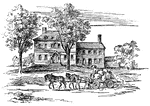
The Ford Mansion is part of the Morristown National Historical Park, and is located on a hilltop in Morristown, New Jersey. The Ford Mansion was the "hard winter" (from December 1779 - May 1780) quarters of George Washington and the Continental Army. That winter remains the coldest on record for New Jersey.

Washington's Headquarters at Morristown

The Ford Mansion is part of the Morristown National Historical Park, and is located on a hilltop in…
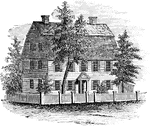
Joseph Webb House is a historic Georgian-style house in Wethersfield, Connecticut that was the site of a five day military conference during the American Revolutionary War. General George Washington came to Wethersfield in order to plan with Rochambeau, the French commander. These plans led to the Siege of Yorktown, the last major battle of the war. Washington, in his words, "lodged...at the house of Joseph Webb", on the May 17, 1781. This house is in the central part of Wethersfield, a few rods south of the Congregational Church.

The Webb House

Joseph Webb House is a historic Georgian-style house in Wethersfield, Connecticut that was the site…
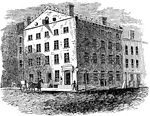
In August of 1775, Americans took possession of cannons from the Battery at the tip of Manhattan and exchanged fire with the HMS Asia (1764). They retaliated by firing a 32-gun broadside on the city, sending a cannon ball through the roof of Fraunces Tavern. When the victorious Americans re-occupied the city, it was Fraunces Tavern that hosted Washington and his officers in a victory banquet. On Dec. 4, 1783, Washington was again at Fraunces Tavern to say farewell to his officers in the Long Room. Saving America from the fate of many republics that turned quickly to military dictatorship, Washington resigned his post and returned to civilian life until chosen first President of the United States.

Fraunces Tavern

In August of 1775, Americans took possession of cannons from the Battery at the tip of Manhattan and…
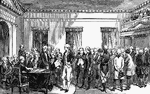
At Fraunces Tavern on December 4, Washington formally bade his officers farewell and on December 23, 1783, he resigned his commission as commander-in-chief, emulating the Roman general Cincinnatus, an exemplar of the republican ideal of citizen leadership who rejected power. During this period, the United States was governed under the Articles of Confederation without a President, the forerunner to the Constitution.

Washington Resigning His Commission

At Fraunces Tavern on December 4, Washington formally bade his officers farewell and on December 23,…
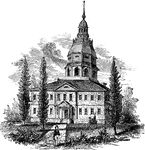
Construction began in 1772 and was not completed until 1779 due to the ongoing Revolutionary War. From November 26, 1783 to June 3, 1784, Annapolis served as the United States capital. The Congress of the Confederation met in the Maryland State House. Subsequently, Annapolis was a candidate to become the new permanent national capital before Washington, D.C. was built.

State House, Annapolis, MD

Construction began in 1772 and was not completed until 1779 due to the ongoing Revolutionary War. From…
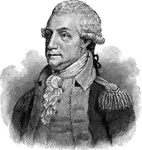
The Electoral College elected Washington unanimously in 1789, and again in the 1792 election; he remains the only president to receive 100% of electoral votes. John Adams was elected vice president. Washington took the oath of office as the first President under the Constitution for the United States of America on April 30, 1789 at Federal Hall in New York City although, at first, he had not wanted the position.

George Washington (1789)

The Electoral College elected Washington unanimously in 1789, and again in the 1792 election; he remains…
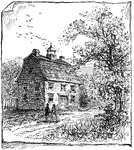
The Battle of Monmouth was an American Revolutionary War battle fought on June 28, 1778 in New Jersey. Washington sent almost one-half of his army as an advance when Clinton made the imminent move out of the Monmouth Courthouse.

Old Monmouth Courthouse

The Battle of Monmouth was an American Revolutionary War battle fought on June 28, 1778 in New Jersey.…
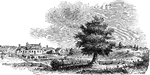
The Battle of Monmouth was an American Revolutionary War battle fought on June 28, 1778 in New Jersey.
Battleground at Monmouth

The Battle of Monmouth was an American Revolutionary War battle fought on June 28, 1778 in New Jersey.

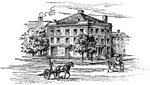
In 1789, George Washington lived on Cherry Street, in a four-story mansion that belonged to Walter Franklin, a wealthy merchant. This house served as the first Executive Mansion of the President of the United States.

George Washington's House on Cherry Street, New York (1789)

In 1789, George Washington lived on Cherry Street, in a four-story mansion that belonged to Walter Franklin,…
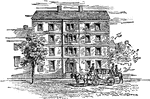
In 1788, he built a magnificent home on Broadway, which in 1790 was leased to become the president's home, occupied by George Washington after the president's previous residence on Pearl proved too small.

George Washington's House on Broadway, New York (1790)

In 1788, he built a magnificent home on Broadway, which in 1790 was leased to become the president's…
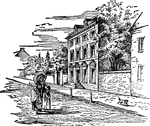
This house, located on the 500 block of Market Street, served as the executive mansion of the United States, while the nation's capital was located in Philadelphia, PA. Two Presidents occupied the house while in office, George Washington from 1790 to 1797, and John Adams, from 1797 to 1800.

The President's House in Philadelphia (1794)

This house, located on the 500 block of Market Street, served as the executive mansion of the United…
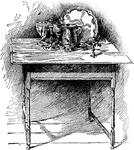
The table at which President George Washington sat to eat his breakfast.

George Washington's Breakfast Table

The table at which President George Washington sat to eat his breakfast.
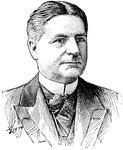
Charles Willis Needham (1848-1935) was the seventh president of George Washington University.

Charles Willis Needham

Charles Willis Needham (1848-1935) was the seventh president of George Washington University.
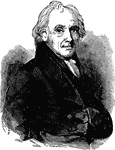
Mason Locke Weems (October 11, 1756 &ndash; May 23, 1825), generally known as Parson Weems, was an American printer and author. He is best known as the source of some of the apocryphal stories about George Washington, including the famous tale of the cherry tree ("I cannot tell a lie, I did it with my little hatchet"). The Life of Washington, Weems' most famous work, contained the story.

Mason Locke Weems

Mason Locke Weems (October 11, 1756 – May 23, 1825), generally known as Parson Weems, was an American…
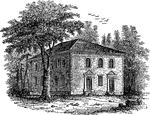
Pohick was the first permanent church in the colony to be established north of the Occoquan River, sometime prior to 1724. Originally called "the Occoquan Church," it was soon referred to as "Pohick Church" because of its proximity to Pohick Creek. George Washington's map of the area locates this long-lost wooden edifice near a site now occupied by Cranford Methodist Church.

Pohick Church

Pohick was the first permanent church in the colony to be established north of the Occoquan River, sometime…
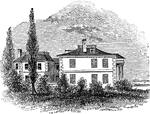
The Morris-Jumel Mansion, located in historic Washington Heights, is the oldest house in Manhattan. It served as a headquarters for both sides in the American Revolution. It was built by Roger Morris in 1765 and reflects the Palladian style of architecture. When the Revolutionary War began in 1776, Morris, who was a Loyalist, and his wife returned to England.

Morris-Jumel Mansion

The Morris-Jumel Mansion, located in historic Washington Heights, is the oldest house in Manhattan.…
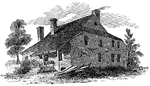
The headquarters of George Washington at Newburg during the Revolutionary War.

Washington's Headquarters at Newburg

The headquarters of George Washington at Newburg during the Revolutionary War.
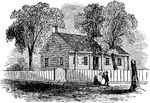
The Jacob Purdy House was used as General George Washington's headquarters in 1778 and possibly in 1776 during the Battle of White Plains of the American Revolutionary War.

Jacob Purdy House

The Jacob Purdy House was used as General George Washington's headquarters in 1778 and possibly in 1776…
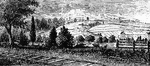
While Washington was inspecting the terrain, seeing where it was best to station his troops, he ran into several light horseman and told him that the British were advancing. Washington rode back to camp to prepare his men. He quickly stationed a couple hundred Continentals and a couple of artillery pieces onto Chatterton Hill, to support the militia. The skirmishers, who had the job of slowing the British advance, retired soon after Washington reinforced Chatterton Hill.

Chatterton's Hill, From the Railway Station

While Washington was inspecting the terrain, seeing where it was best to station his troops, he ran…
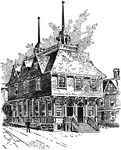
The Old State House is a historic legislative building located at the intersection of Washington and State Streets in Boston, Massachusetts, USA.

The Boston Old State House

The Old State House is a historic legislative building located at the intersection of Washington and…