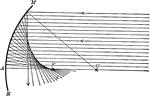
"The spherical aberration of a concave mirror is the deviation of some of the reflected light from the focus, as shown It arises from the curvature of the mirror, and causes an indistinctness or blurring of the image." -Avery 1895

Spherical Aberration of a Concave Mirror

"The spherical aberration of a concave mirror is the deviation of some of the reflected light from the…
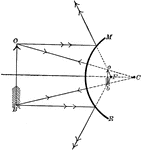
"A convex mirror is generally a part of the other surface of a spherical shell. It increases the divergence, or decreases the convergence of light that falls upon it. The foci are virtual; the principal focus is midway between the center of the mirror and the center of curvature. The foci may be located and the images determined by processes closely similar to those used for concave mirrors, as illustrated." -Avery 1895

Convex Mirror

"A convex mirror is generally a part of the other surface of a spherical shell. It increases the divergence,…
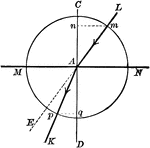
"LA represents a ray of light propagated in air, falling obliquely upon the surface of the water at A, and deviated by the water from AE to AK." -Avery 1895

Refraction of Light Between Air and Water

"LA represents a ray of light propagated in air, falling obliquely upon the surface of the water at…
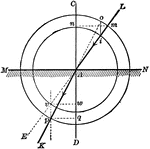
"If the ray passes in the opposite direction, i.e., from water into air, the process is the reverse of that just indicated. Let KA represent the incident ray." -Avery 1895

Refraction of Light Between Water and Air

"If the ray passes in the opposite direction, i.e., from water into air, the process is the reverse…
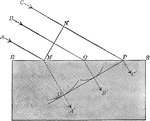
"Thus, when erher waves that constitute light are transmitted through glass, they are hindered by the molecules of the glass, and impart some of their motion to those molecules' i.e., a part of the light is absorbed. When a beam of light, as represented by ABC moves forward in the air, the wave-front, MN, continues parallel to itself and moves forward in a straight line. As the wave front advances, A strikes the glass first, and is retarted, the retardation of B and C later change the direction of the rays." -Avery 1895

Explanation of Refraction

"Thus, when erher waves that constitute light are transmitted through glass, they are hindered by the…
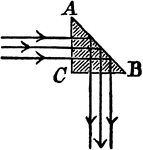
"Cathetal prisms readily yield the phenomena of total reflection as shown, and are often used when light is to be turned through a right angle." -Avery 1895

Cathetal Prism

"Cathetal prisms readily yield the phenomena of total reflection as shown, and are often used when light…
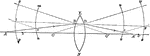
"...let LN represent a glass biconvex lens, with centres of curvature at C and C', and AB, the incident ray." -Avery 1895

Refraction of Light through Bi Convex Lens

"...let LN represent a glass biconvex lens, with centres of curvature at C and C', and AB, the incident…
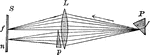
"The prism will deflect the red and orange, and form a reddish colored image at n. The violet, indigo, blue, green and yellow light, not caught by the prism, will unite at f to form a greenish image. When the prism is removed, the reddish light that fell at n, and the greenish light that fell at f, unite to form white light." -Avery 1895

Refraction of Complimentary Colors

"The prism will deflect the red and orange, and form a reddish colored image at n. The violet, indigo,…
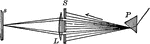
"A prism is used to disperse ordinary light, and slits are cut in paper S to only allow yellow and blue light to pass. These two simple colors will be blended by the lens, forming a light that is nearly white. The effect of mingling any two colors may be determined in this way." -Avery 1895

Color Spectrum

"A prism is used to disperse ordinary light, and slits are cut in paper S to only allow yellow and blue…
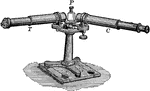
"A spectroscope is an instrument used ot produce a spectrum of the light form any source, and for its study." -Avery 1895

Spectroscope

"A spectroscope is an instrument used ot produce a spectrum of the light form any source, and for its…

"Throw a sunbeam through a very small opening in the shutter of a darkened room. Receive the beam upon a convex lens of short focal length, placing a pieve of red glass between the aperture and the lens. Place and opaque screen with a sharp edge beyond the focal distance of the lens, as at a, so as to cut off the lower part of the cone of homogeneous light, and project the upper part thereof upon a screen at b." -Avery 1895

Diffraction

"Throw a sunbeam through a very small opening in the shutter of a darkened room. Receive the beam upon…
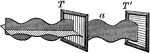
"The effect of holding polarizing lenses at right angles to each other." -Avery 1895

Polarization of Light

"The effect of holding polarizing lenses at right angles to each other." -Avery 1895
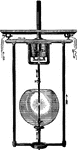
"The arc lamp is essentially a device for automatically separating the carbons when the current is turned on, for 'feeding' the carbons together as they are burned away at their tips, and, in some cases, for short-circuiting the lamp in case of irregularity or accident." -Avery 1895

Arc Lamp

"The arc lamp is essentially a device for automatically separating the carbons when the current is turned…
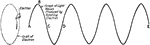
"Showing diagrammatically one explanation of the production of light waves by revolving electrons." —Croft 1917

Light Waves Explanation

"Showing diagrammatically one explanation of the production of light waves by revolving electrons."…
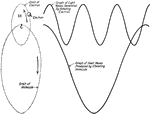
"Diagram indicating one explanation which has been advanced for light and heat waves generated by the movement of an electron around its orbit in a molecule and by the simultaneous movement of the molecule." —Croft 1917

Light Waves

"Diagram indicating one explanation which has been advanced for light and heat waves generated by the…
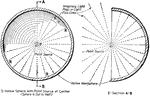
"The radiation of light, or the intensity of light is inversely proportional to the square of the distance from the light source." —Croft 1917

Light Intensity

"The radiation of light, or the intensity of light is inversely proportional to the square of the distance…
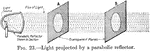
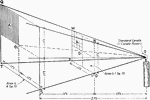
"Light projected by a parabolic reflector." —Croft 1917

Parabolic Reflector

"Light projected by a parabolic reflector." —Croft 1917

"Another illustration of how luminous density varies inversely as the square of the distance." —Croft 1917

Light Intensity Versus Distance

"Another illustration of how luminous density varies inversely as the square of the distance." —Croft…
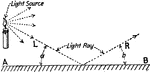
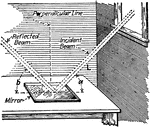
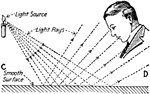
"Reflection of light from a smooth surface." —Croft 1917

Reflection of Light from a Smooth Surface

"Reflection of light from a smooth surface." —Croft 1917

"Angle of incidence equals angle of reflection." —Croft 1917

Reflection of Light

"Angle of incidence equals angle of reflection." —Croft 1917

"Reflection of light form a smooth surface." —Croft 1917

Reflection of Light from a Smooth Surface

"Reflection of light form a smooth surface." —Croft 1917

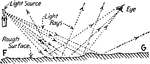
"Reflection of light from a broken surface." —Croft 1917

Reflection of Light from a Broken Surface

"Reflection of light from a broken surface." —Croft 1917

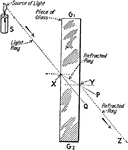
"Illustrating refraction of light from a source through glass, and the appropriate angles of refraction." —Croft 1917

Refraction of Light through Glass

"Illustrating refraction of light from a source through glass, and the appropriate angles of refraction."…
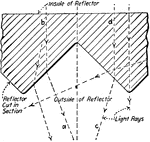
"Cross-section of prismatic reflector, showing how light rays are refracted and dispersed." —Croft 1917

Prismatic Reflector

"Cross-section of prismatic reflector, showing how light rays are refracted and dispersed." —Croft…
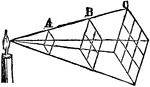
"A card placed at point A receives normal light. At point B the card receives four times as much light, but only at 1/4 intensity. At point C nine times the area covered, but only 1/9 the intensity." —Quackenbos 1859

Light Intensity at Different Distances

"A card placed at point A receives normal light. At point B the card receives four times as much light,…
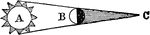
"Since A is producing light and larger than object B, the shadow of B continuously shrinks to a single point at C." —Quackenbos 1859

Diminish Shadow

"Since A is producing light and larger than object B, the shadow of B continuously shrinks to a single…
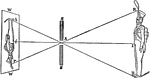
"Slit A is a very small opening. The light coming from the soldier on the right shines through the slit in straight lines making the image of the soldier inverted on wall W." —Quackenbos 1859

Inverted Image

"Slit A is a very small opening. The light coming from the soldier on the right shines through the slit…
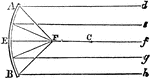
"Parallel rays of light strike the concave mirror. The rays converge at the focus, F, which is halfway between the mirror surface and the center of the sphere that the mirror would form if it were a full sphere." —Quackenbos 1859

Reflection from Concave Mirrors

"Parallel rays of light strike the concave mirror. The rays converge at the focus, F, which is halfway…
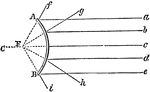
"Parallel rays strike the convex mirror, reflect, and diverge as if they had originated from a virtual focus inside the mirror. Focus F is located between the surface of the mirror and the mirror's center if it were a full body sphere." —Quackenbos 1859

Reflection by Convex Mirrors

"Parallel rays strike the convex mirror, reflect, and diverge as if they had originated from a virtual…
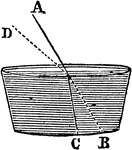
"Since air is a rarer medium and water is denser, as ray A passes into the water, it is refracted to C. Also note that as ray B leaves the water, it is refracted to D as it enters the air." —Quackenbos 1859

Refraction Between Mediums

"Since air is a rarer medium and water is denser, as ray A passes into the water, it is refracted to…
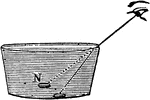
"If the coin were to be observed in an empty pan and then watched as the pan was filled with water, the image of the coin would be refracted to position N." —Quackenbos 1859

Refraction as seen by the Human Eye

"If the coin were to be observed in an empty pan and then watched as the pan was filled with water,…
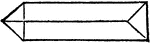
"A prism is a piece of glass, having for its sides three plane surfaces and for its ends two equal and parallel triangles." —Quackenbos 1859

Prism

"A prism is a piece of glass, having for its sides three plane surfaces and for its ends two equal and…
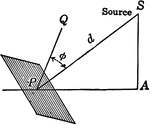
Illustration modeling the illumination on a surface when the surface is not perpendicular to hte rays of light from a source of light.

Illumination of a Surface When the Surface is not Perpendicular to the Source

Illustration modeling the illumination on a surface when the surface is not perpendicular to hte rays…
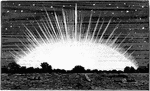
"The general appearance of the aurora is that of an arch of white light rising from the horizon, like the morning down, from which reddish streamers radiate upward, appearing and disappearing in rapid succession, in a series extending along the rim of the arch from one extremity to the other, often with an undulatory motion, the arch continually rising till the streamers sometimes reach the zenith." -Atkinson 1903

Aurora Borealis

"The general appearance of the aurora is that of an arch of white light rising from the horizon, like…
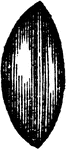
Lens of the eye. The rays of light are brought nearer together by the lenses of the eye, just as they are by the lenses of the telescope.

Lens of the Eye

Lens of the eye. The rays of light are brought nearer together by the lenses of the eye, just as they…
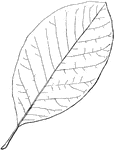
Leaves - simple, alternate, edge entire. Outline - long oval. Apex - pointed. Base - pointed. Leaf - five to ten inches long, thin, dark green above; green beneath and slightly downy; growing along the branch and not simply in a cluster at its end. Bark - dark and rough. Flowers - three to six inches across, bluish or yellowish-white, abundant and fragrant. May, June. Fruit - in a cylinder-shaped bunch, two to three inches long, and somewhat resembling a small cucumber. Found - in rich woods from Western New York to southern Illinois and southward, and in cultivation. Its finest growth is in the southern Alleghany Mountains.  General Information - A tree sixty to ninety feet high, with a straight trunk and rich foliage. The wood is durable, soft, and light. Used for cabinet-work, for flooring, for pump-logs, and water-troughs. As in other magnolias the juice is bitter and aromatic. From "magnol," the name of a botanist of the seventeenth century.

Genus Magnolia, L. (Magnolia)

Leaves - simple, alternate, edge entire. Outline - long oval. Apex - pointed. Base - pointed. Leaf -…
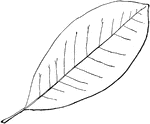
Leaves - Simple, alternate, edge entire. Outline - long oval or slightly reverse egg-shape. Apex, slightly blunt-pointed. Base, pointed. Leaf -about three to six inches long, thick and smooth; dark green and polished above; white below; the middle rib green and distinct; the side ribs slight and indistinct. Bark - of trunk, smoothish, light gray, aromatic and bitter. Flowers - large (two to three inches wide), white, at the ends of the branches, very fragrant. June, July. Fruit - bright red berries, at first in small cone-like clusters, then hanging by slender threads. September.  Found - in swampy ground, from Massachusetts southward, usually near the coast. <p>General Information - A small tree (often a bush) four to twenty-five feet high, or higher southward, where its leaves are evergreen. All parts of the tree (and it is the same with the other magnolias) have an intensely bitter, aromatic juice, which is stimulating and tonic. From "magnol," the name of a botanist of the seventeenth century.

Genus Magnolia, L. (Magnolia)

Leaves - Simple, alternate, edge entire. Outline - long oval or slightly reverse egg-shape. Apex, slightly…
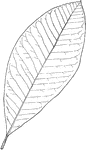
Leaves - Simple, alternate, edge entire. Outline - long oval or slightly reverse egg-shape. Apex, short, sharp-pointed. Base, pointed. Leaf - twelve to thirty-six inches long, six to eight inches wide; rather dark green above; lighter beneath; silky when young, but soon smooth; growing in clusters at the ends of the branches. Bark - smoothish and light. Flowers - seven to eight inches across, at the ends of the branches, white, and fragrant. May, June. Fruit - in a cylinder-shaped bunch, four to five inches long, and rose-colored as it ripens. Found - in Southeastern Pennsylvania and southward along the Alleghany Mountains, and in cultivation. <p>General Information - A tree twenty to thirty feet high, with irregular branches, and light, soft wood. As in other magnolias the juice is bitter and fragrant. From "magnol," the name of a botanist of the seventeenth century.

Genus Magnolia, L. (Magnolia)

Leaves - Simple, alternate, edge entire. Outline - long oval or slightly reverse egg-shape. Apex, short,…
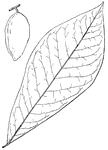
Leaves - simple; alternate; edge entire. Outline - long, reverse egg-shape. Apex - pointed, in small leaves, sometimes rounded. Base - taper-pointed or slightly rounded. Leaf - five to ten inches long, thin, rusty downy with young, soon becoming smooth and polished. Bark - slivery-gray, smooth and polished; young shoots downy. Flowers - one and a half inches wide; dark to light, in drooping clusters, appearing with the leaves. March, April. Fruit - about three inches long by one and a half inches thick, egg-shape, yellow, about ten-seeded, fragrant, sweet, and edible. October. Found - from Western New York to Southern Iowa and southward. General Information - A small tree of unpleasant odor when bruised, ten to twenty feet high (or often only a bush) and densely clothed with its long leaves.<p>General Information - A small tree of unpleasant odor when bruised, ten to twenty feet high (or often only a bush) and densely clothed with its long leaves.

Genus Asimina, Adans (Papaw)

Leaves - simple; alternate; edge entire. Outline - long, reverse egg-shape. Apex - pointed, in small…
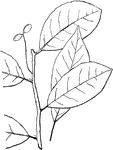
Leaves - simple; alternate; edge entire. Outline - oval or reverse egg-shape. Apex - pointed. Base - pointed. Leaf/Stem - slightly hairy when young. Leaf - two to five inches long; usually about half as broad; dark green and very shining above, especially when old; light green and shining below; thick, tough, and firm. Middle rib slightly hairy when young; side ribs rather indistinct and curved. Bark - grayish and often broken into short sections. Fertile Flowers - small, in clusters of three to eight on slender stems. April, May. Fruit - nearly one half inch long; bluish-black when ripe; egg-shape or oval; acid and rather bitter until "frosted." Stone - oval, somewhat pointed at each end, slightly flattened, and with three or four blunt ridges on each side. September. Found - from Southern Maine to Michigan, and southward to Florida and Texas. General Information - A tree twenty to forty feet high (larger southward), with flat, horizontal branches. The wood, even in short lengths, is very difficult of cleavage, and so is well fitted for beetles, hubs of wheels, pulleys, etc. Its leaves are the first to ripen in the fall, changing (sometimes as early as August) to a bright crimson. In the South, opossums climb the tree in search of its fruit and are immortalized in stories.

Genus Nyssa, L. (Sour Gum)

Leaves - simple; alternate; edge entire. Outline - oval or reverse egg-shape. Apex - pointed. Base -…
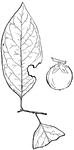
Leaves - simple; alternate, edge entire. Outline - long oval or long egg-shape. Apex - pointed. Base - pointed or rounded. Leaf - three to five inches long, thickish; dark and smooth, usually shining, above; below dull, with ribs curved and irregular and minutely downy. On the upper surface the ribs are quite indistinct, except as the lea is held toward the light when they appear almost transparent. In the same position the left is seen also to be edged with a slight delicate fringe (appearing in the dried leaf like a line of yellow light). Bark - of trunk dark and rough. Flowers - greenish-yellow and small, at the base of the leaf-stems. June. Fruit - about one inch in diameter, rounded, nearly stemless, orange-red when ripe, with about eight large flat seeds. After frost it is of very pleasant flavor, before, exceedingly "puckery." Found - from Connecticut southward to Florida and westward to Southeastern Iowa. General Information - A tree twenty to sixty feet high; sometimes, at the South, more than one hundred feet high. The wood is hard and close-grained; the bark tonic and astringent. From two Greek words meaning fruit of Jove.

Genus Diospyros, L. (Persimmon)

Leaves - simple; alternate, edge entire. Outline - long oval or long egg-shape. Apex - pointed. Base…
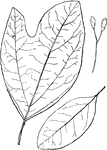
Leaves - simple; alternate; edge entire or lobed. Outline - when the edge is entire usually oval or egg-shape; when lobed usually broader and reverse egg-shape. Apex - of the leaf or of the lobes rounded or slightly blunt-pointed. Base - pointed or wedge-shape. Leaf - variable in size, dark, thin, smooth; rather shining above; the lobes, when resent, two or three in number and usually more or less bulging, with the hollows always rounded. Bark - obliquely and curiously furrowed and broken, gray without, reddish within; young twigs yellowish. Flowers - greenish-yellow, in clusters. May, June. Fruit - oval, one-seeded, blue, with a reddish, club shaped stem; pungent. Found - from Southwestern Vermont, southward and westward.  General Information - a tree fifteen to fifty feet high with light and soft wood. All parts of the tree have a pleasant, spicy taste and fragrance. From the bark of the roots a powerful aromatic stimulant is obtained.

Genus Sassafras, Nees. (Sassafras)

Leaves - simple; alternate; edge entire or lobed. Outline - when the edge is entire usually oval or…
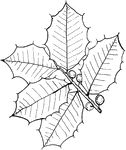
Leaves - simple; alternate; edge with remote, very sharp spine-like teeth, with rounded spaces between. Outline - oval. Apex and Base - pointed. Leaf - about two inches long; dark polished green above; below rather yellowish-green; thick and stiff; smooth throughout; ribs very indistinct below. Bark - light gray and smooth. Fruit - a nearly round, bright-red berry, the size of a pea. It ripens in September and continues upon the branches into the winter. Found - from Massachusetts southward near the coast to Florida, and from Southern Indiana southwest, and southward to the Gulf. General Information - The use of holly and other evergreens in religious ceremonies dates from pagan times. "Trummying of the temples with floures, boughes, and garlondes, was taken of the heathen people, whiche decked their idols and houses with suche array.: Early church councils made rules and restrictions concerning the practice - e.g., in France Christians were forbidden "to decke up their houses with lawrell, yvie, and green gouches in the Christmas season," for "Hedera est gratissima Baccho." (The ivy is most acceptable to Bacchus.)

Genus Ilex, L. (Holly)

Leaves - simple; alternate; edge with remote, very sharp spine-like teeth, with rounded spaces between.…
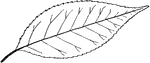
Leaves - simple; alternate; edge with remote, not evergreen; egg-shape or long oval, rather thin with edge finely toothed,  Outline - oval. Apex - taper-pointed. Leaf - about two inches long; dark polished green above; below rather yellowish-green; thick and stiff; smooth throughout; ribs very indistinct below. Bark - light gray and smooth. Fruit - a nearly round, bright-red berry, the size of a pea. It ripens in September and continues upon the branches into the winter. Found - in damp woods in the Catskill and Tahonic Mountains, and in Cattaraugus County, New York; through Pennsylvania as far east as Northampton County, and southward along the Alleghanies.General Information - This is usually regarded as a shrub, "but it not seldom attains the size and exhibits the port of a small tree" -(T. C. Porter).

Genus Ilex, L. (Holly)

Leaves - simple; alternate; edge with remote, not evergreen; egg-shape or long oval, rather thin with…
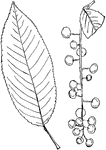
Leaves - simple; alternate; edge toothed (with the points of the teeth so incurved as to appear blunt), and often finely "crinkled." Outline - usually long oval or long egg-shape. Apex - pointed. Base - rounded or slightly pointed. Leaf/Stem - usually with two to five tooth-like glands near the base of the leaf. Leaf - two to five inches long; thickish; polished, and of a deep shining green above; beneath, lighter and smooth, with the middle rib sometimes downy toward the base. In the autumn the leaves turn to orange and later to pale yellow. Bark - of old trunks, blackish and rough; of young trunks and on the larger branches, reddish or purplish brown; marked with scattered lines; on young shoots, at first green or olive brown, gradually becoming darker, and sprinkled (sic) with small orange dots. Flowers - white, with short stems, closely set in a long, cylinder-shaped cluster. May, June. Fruit - about one and a quarter inches in diameter; with short stems (one and a quarter to one and a third inches ) hanging in long, close clusters from the ends of the twigs. It is nearly black when ripe, and of a pleasant flavor though somewhat bitter; it is eagerly eaten by birds. August. Found - very widely distributed north, south, and west. It reaches its finest growth on the western slopes of the Alleghany Mountains. General Information - A tree fifty to eighty feet high. The wood is light and hard, of a brown or reddish tinge, becoming darker with exposure, and of very great value in cabinet work and interior finish. It is now becoming scarce, so that stained birch is often used as a substitute. The bitter aromatic bark is used as a valuable tonic; "cherry brandy" is made from the fruit.

Genus Prunus L. (Cherry, Plum)

Leaves - simple; alternate; edge toothed (with the points of the teeth so incurved as to appear blunt),…
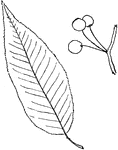
Leaves - simple; alternate, or alternate in pairs; edge finely and sharply toothed. Outline - narrow egg-shape. Apex - taper-pointed. Base - rounded or slightly pointed. Leaf/Stem - grooved above. Leaf - two to six inches long, shining and smooth and of about the same shade of green on both sides. Bark - reddish-brown and smooth, with swollen, rusty-colored dots, and usually stripping, like that of the garden cherry, around the trunk. Flowers - white, on stems about one inch or more in length, in nearly stemless clusters. May. Fruit - the size of a large pea, light red, on long stems (about three fourths to one inch long), sour, in clusters of two to five at the sides of the branches, and usually from the base of the leaf-stems; seldom abundant. July. Found - Common in all northern forests. In Northern New England it quickly occupies burned-out pine regions. General Information - A slender tree, usually twenty to twenty-five feet high, of no value as timber.

Genus Prunus L. (Cherry, Plum)

Leaves - simple; alternate, or alternate in pairs; edge finely and sharply toothed. Outline - narrow…
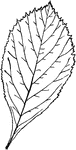
Leaves - simple; alternate; edge sharply and unequally toothed (sometimes with quite deep and sharp cuts, almost forming small lobes. Outline - oval or reverse egg-shape Apex - slightly pointed Base - tapering in a hollow curve and along the sides of the leaf-stem to a point Leaf/Stem - bordered by the leaf, to its base Leaf - about three to five inches long, one and a half to three inches wide; upper surface smoothish, and furrowed above the ribs; under surface downy at least when young; rather thick; permanently downy on the ribs. Thorns - one to two inches long Bark - of trunk, smooth and gray. New twigs, light greenish-brown Flowers - often one inch across; white eight to twelve in a cluster; at the ends of the branches; fragrant. May, June. Fruit - about one half inch in diameter, round or pear-shaped; orange-red or crimson; edible. October. Found - through the Atlantic forests to Western Florida, and from Eastern Texas far westward. Common. General Information - A thickly branching tree (or often a shrub) eight to twenty feet high; the most widely distributed of the American Thorns. It varies greatly in size, and in the style of its fruit and leaves. From a Greek word meaning strength.

Genus Crataegus, L. (Thorn)

Leaves - simple; alternate; edge sharply and unequally toothed (sometimes with quite deep and sharp…
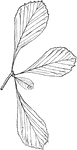
Leaves - simple; alternate; edge unevenly sharp-toothed above the middle; sometimes, toward the apex deeply cut. Outline - reverse egg-shape. Apex - usually slightly pointed. Base - strongly wedge-shape, tapering from above the middle of the leaf and along the leaf-stem to a point. Leaf/Stem - one half to one inch long, slender, and winged by a tapering leaf. Leaf - one and a half to two and a half inches long; about as wide; light green; rather thick; downy when young; when mature, smooth and dull, or sometimes hairy below, especially of the ribs. Ribs, very straight below; above, marked by deep furrows. Thorns - one to two inches long, stout and curved, or often wanting. Bark - rough. Flowers - white; eight to fifteen in somewhat leafy bunches. May. Fruit - about one half inch in diameter, or more; usually dull red or yellow, with whitish dots; round; somewhat edible. September.Found - from New Brunswick and Vermont southward and westward. General Information - A thick, wide spreading tree, twelve to twenty-five feet high. From a Greek word meaning strength.

Genus Crataegus, L. (Thorn)

Leaves - simple; alternate; edge unevenly sharp-toothed above the middle; sometimes, toward the apex…
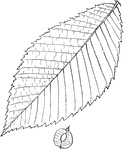
Leaves - simple; alternate; edge sharply and doubly toothed. Outline - oval or long egg-shape. Apex - taper-pointed. Base - slightly heart-shaped or rounded. Leaf/Stem - about one eighth inch long, stout and rough. Buds - hairy. Leaf - four to seven inches long, three to four inches wide. The upper surface is rough both ways, and very rough downwards, almost like a fine file. The under surface is slightly rough. Ribs - beneath are prominent and straight, and hairy in their angles. Bark - of the larger branches, brownish; branchlets, light-gray and very rough, becoming grayish-purple. The inner bark is very gummy and "slippery." Seeds - flat, round, winged, but not fringed. Last of May. Found - along the lower St. Lawrence to Ontario, and from Western New England westward and southward; in woods and along streams. General Information - A tree thirty to forty feet high. Its wood is hard and strong, but splits easily when dry. Though otherwise inferior, for posts it is superior to white elm. Its inner bark is sold by druggists as "slippery elm," and is nutritious and medicinal. Its name of red elm is due to the reddish-brown tinge of its large rounded and hairy buds in the spring.

Genus Ulmus, L. (Elm)

Leaves - simple; alternate; edge sharply and doubly toothed. Outline - oval or long egg-shape. Apex…
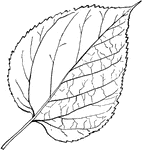
Leaves - simple; alternate; edge coarsely and somewhat irregularly toothed; or, at times, unequally and very variously two- to three-lobed. Outline - egg shape. Apex - long pointed (when there are side lobes their ends may be rounded). Base - heart-shaped, and more or less one-sided. Leaf - three to seven inches long, rather thin, rough above and downy below, sometimes becoming very smooth. The ribs are very distinct, and whitish below. Bark - grayish, and much broken. Berries - about the size and shape of small blackberries. When ripe they are very dark purple (nearly black), juicy, and sweet. July. Found - from Western New England, westward and southward. General Information - A tree fifteen to twenty-five feet high; in the Middle and Eastern States much larger. It is most common and reaches its finest growth along the lower Ohio and Mississippi rivers. Its wood is valuable, light, and soft, but very durable in contact with the ground. The White Mulberry (M. alba) is sometimes found around old houses and in fields. It was introduced from China, and was formerly cultivated as food for silk-worms. Its leaves resemble those of the Red Mulberry in shape, but are smooth and shining.

Genus Morus, L. (Mulberry)

Leaves - simple; alternate; edge coarsely and somewhat irregularly toothed; or, at times, unequally…
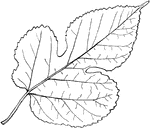
Leaves - simple; alternate; edge irregularly sharp-toothed, or, at times unequally and very variously two- to three-lobed. Outline - very nearly that of the Red Mulberry broad egg-shape. Apex - taper-pointed (when there are side lobes their ends also pointed). Base - rounded or slightly pointed, rarely, in the small leaves, slightly heart-shaped. Leaf/Stem - rough. Leaf - usually about five inches long, sometimes nine inches; thick, rough above, very velvety-rough. The main ribs are very distinct, and are thickly netted with smaller ones. Bark - light and smoothish. Flowers - in long aments and balls. Fruit - not edible. General Information - An introduced tree, common around houses or escaped from cultivation. A low-branching, large-headed shade tree of medium size, introduced from Japan. In Japan and China the bark of the Paper Mulberry is made into paper, whence the name.

Genus Broussonetia, L'Her.

Leaves - simple; alternate; edge irregularly sharp-toothed, or, at times unequally and very variously…
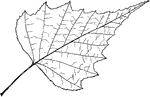
Leaves - simple; alternate (often alternate in pairs); edge unequally sharp-toothed, with the base entire. Outline - triangular. Apex - taper-pointed. Base - variable, more or less squared, sometimes slightly hollowed, rounded or pointed. Leaf/Stem - long and slender, about three quarters of an inch or more in length. Leaf - one and three quarters to three inches long. Smooth and shining on both sides. Bark - The outer bark of the mature trunk is chalky-white and thin, but not, like the bark of the Paper-birch, easily separable into layers. Usually it is marked with blackish dots and lines. Often the branchlets and twigs are blackish, and in very young trees the bark may be light reddish-brown, and marked with white dots. Found - on poor soil, from Delaware and Pennsylvania northward (mostly toward the coast), and in ornamental cultivation. It springs up abundantly over burned and abandoned lands. General Information - A slender, short-lived tree, twenty to thirty feet high, with white, soft wood, not durable; used largely in making spools, shoe pegs, etc., and for fuel. A still more graceful cultivated species is the European Weeping Birch (B. pendula). Its branches are very drooping, with more slender leaves, and a spray that is exceedingly light and delicate, especially in early spring.

Genus Betula, L. (Birch)

Leaves - simple; alternate (often alternate in pairs); edge unequally sharp-toothed, with the base entire.…
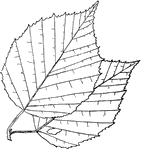
Leaves - simple; alternate; edge sharply and unequally double-toothed. Outline - egg-shaped. Apex - pointed. Base - rounded, slightly heart-shaped, or, rarely, wedge-shaped. Leaf/Stem - downy. Leaf - two to three inches long; dark green and smooth above; beneath, dull, and with the ribs somewhat hairy, especially in their angles. Bark - of trunk very tough and durable; thick; snow-white on the outside; easily removed from the wood, and then itself very separable into paper-like sheets. The inner sheets are of a reddish tinge. Found - in the mountains of Northern Pennsylvania, New England, and far northward, farther than any other non-evergreen tree of America, excepting the aspen.    General Information - A tree, forty to seventy feet high. The wood is light, hard, and very close-grained, but decays rapidly when exposed - more rapidly than the bark, which often remains as a shell long after the wood within has disappeared. It is very largely used in making spools, pegs, shoe-lasts, in turnery, for wood-pulp, and for fuel. The waterproof bark is much used by Indians and trappers for their canoes. "Give me of your bark, O Birch-Tree! Of your yellow bark, O Birch-Tree! Growing by the rushing river, Tall and stately in the valley! I a light canoe will build me, That shall float upon the river, Like a yellow leaf in autumn, Like a yellow water-lily. 'Lay aside your cloak, O Birch-Tree! Lay aside your white-skin wrapper, For the summer time is coming, And the sun is warm in the heaven, And you need no white-skin wrapper!'" Hiawatha

Genus Betula, L. (Birch)

Leaves - simple; alternate; edge sharply and unequally double-toothed. Outline - egg-shaped. Apex -…
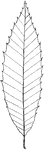
Leaves - simple; alternate; edge sharp-toothed with the teeth bristle-pointed and the hollows between rounded. Outline - very narrow oval. Apex - taper-pointed. Base - taper-pointed. Leaf - four to eight inches long, two to three inches wide; smooth above and below; with straight ribs terminating in the bristle-teeth. Bark - of trunk grayish and in young trees very smooth. Fruit - with large bristly husks. Usually there are two or three nuts pressed closely in each cell, and therefore flat on one or both sides. The nut, though smaller, is sweeter and more delicate than in the European variety, the "Spanish Chestnut." Found - from Southern Maine to Delaware and Southern Indiana; southward along the Alleghany Mountains and west to Middle Kentucky and Tennessee. Its finest growth is on the western slopes of the southern Alleghany Mountains. General Information - A tree fifty to eight feet high or more, with light, soft wood, largely used in cabinet-work, for railway ties, posts. etc. Genus Castanea, L. from the name of a town in Thessaly.

Genus Castanea, L. (Chestnut)

Leaves - simple; alternate; edge sharp-toothed with the teeth bristle-pointed and the hollows between…
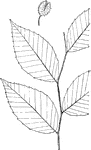
Leaves - simple; alternate; edge sharp-toothed, with small and remote teeth. Outline - oval or egg-shape. Apex - taper-pointed. Base - rounded. Leaf - three to six inches long, about half as wide; a very "finished" leaf; when young, fringed with soft white hairs; becoming smooth and polished; with distinct and straight unbranched side-ribs, ending in the teeth of the edge. The dead, bleached leaves often cling thickly to the branches throughout the winter. Bark - of the trunk, light gray, smooth, and unbroken. Fruit - a small four-celled prickly burr, splitting half-way to the base when ripe, and with two sweet, three-sided nuts in each shell.Found - in rich woods, Nova Scotia to Florida and westward, with it finest growth on the "bluffs" of the lower Mississippi basin. General Information - Large stately trees, with spreading branches and a delicate spray, fifty to eighty feet high. The wood is hard and very close-grained, and is used largely in the making of chairs, handles, plan-stocks, shoe-lasts, and for fuel. When the tree is not crowded, it sends out its nearly horizontal or drooping branches as low as from ten to thirty feet above the ground. Lumber-men make the distinction of "red Beech" and "White Beech," claiming that the former is harder, with a redder and thicker heart-wood.  Among woodsmen and the Indians, the Beech is said to be a favorite refuge in thunder-storms. They claim that it is scarcely ever struck by lightning. Lumber-men claim a difference in the quality of trees which retain their leaves and those which shed them. "Said a neighbor to me one day: 'You might 'a knowed that beech would split hard with all the dry leaves on it,' -- and it did. That was the first I'd ever heard of the sign, but I've never known it fail since."

Genus Fagus, L. (Beech)

Leaves - simple; alternate; edge sharp-toothed, with small and remote teeth. Outline - oval or egg-shape.…
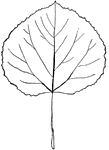
Leaves - simple; alternate; edge sharp-toothed, with rounded hollows between. Outline - rounded. Apex - short, sharp-pointed. Base - slightly heart-shaped. Leaf/Stem - slender and very much flattened sidewise. Leaf - two to two and a half inches wide, and usually about one half inch shorter than wide; dark green; smooth on both sides when mature, with a slight down on the edge. Ribs distinct above and below and whitish. Bark - of trunk, greenish-white and smooth, often with blotches of very dark brown, especially under the ends of the branches. The bark is exceedingly bitter. Found - from Northern Kentucky and the mountains of Pennsylvania northward to Hudson Bay and Newfoundland, northwest to the Arctic Ocean, and along the Rocky Mountain slopes. It is the most widely distributed of North American Trees.  General Information - A tree twenty to fifty feet high, with white, soft wood that is largely used in place of rags in making coarse paper. The tremulousness of its foliage, which the slightest breeze stirs, is due to the thinness of the sidewise-flattened leaf-stems. Tradition accounts differently for the motion of the leaves. It says that the wood of the aspen tree was taken for the Saviour's cross, and that, ever since, the tree has shivered. Another tradition claims that, when Christ went by on his way to Calvary, all the trees sympathized and mourned, excepting the aspen; but when he died, there fell upon the aspen a sudden horror of remorse, and such a fearful trembling as has never passed away. In describing the occupations of the fifty maidens in the hall of the "gorgeous palace" of King Alcinous, Homer says: "...some wove the web, Or twirled the spindle, sitting, with a quick, Light motion like the aspen's glancing leaves."

Genus Populus, L. (Aspen, Poplar)

Leaves - simple; alternate; edge sharp-toothed, with rounded hollows between. Outline - rounded. Apex…
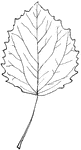
Leaves - simple; alternate; edge large-toothed, with the hollows rounded. Outline - wide egg-shape. Apex - sharp-pointed. Base - squared, or slightly rounded. Leaf/Stem - long and slender, and flattened sidewise. Leaf - three to five inches long, smooth on both sides when mature; white, and covered thickly with silky wool when young. Ribs, whitish and distinct above. Bark - of the trunk, smooth, and of a soft, light greenish-gray; when old, becoming somewhat cracked. On the young branches the bark is dark. Found - in Nova Scotia and New Brunswick, through the Northern States, along the Alleghany Mountains to North Carolina, and west to Wisconsin and Iowa. Rare at the South. common at the North. General Information - A tree forth to eight feet high, with open, crooked branches. Large quantities of the soft, white wood are ground into pulp for making paper. "In both this and the P. tremuloides, Michx., the leaves of young sprouts are often differently shaped and toothed, and much enlarged." -- (Porter.) Poplar wood, like other soft woods, is not usually esteemed for durability' but an old couplet, said to have been found inscribed on a poplar plank, teaches differently: "Though 'heart of Oak' be e'er so stout, Keep me dry, and I'll see him out."

Genus Populus, L. (Aspen, Poplar)

Leaves - simple; alternate; edge large-toothed, with the hollows rounded. Outline - wide egg-shape.…
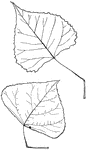
Leaves - simple; alternate; edge somewhat irregularly toothed. Outline - broad egg-shape (approaching triangular-shape). Apex - long, taper-pointed. Base - squared, slightly hollowed, or slightly pointed. Leaf/Stem - long and slender and much compressed sidewise. Leaf - two to three and a half inches long (much larger on young shoots); length and width nearly the same; smooth; ribs distinct and whitish on both sides, irregular, and branching. Bark - of trunk, light "granite-gray," smooth on young trunks, becoming somewhat rough with age, and with rounded up-and-down furrows. New and vigorous shoots are green, and marked with short white or brownish lines. Seeds - covered with a white, cotton-like fibre. Found - from Western New England southward to Western Florida, westward to the Rocky Mountains. The common "cottonwood" of the West, bordering all streams flowing east from the Rocky Mountains. General Information - A tree eighty to one hundred feet high. The very light and soft wood is largely used in making paper pulp, for light boxes, and for fuel. Experiments have been made in separating and weaving the cottony fibre of the poplar seeds. It can be manufactured into cloth, but not in paying quantity and quality.

Genus Populus, L. (Aspen, Poplar)

Leaves - simple; alternate; edge somewhat irregularly toothed. Outline - broad egg-shape (approaching…
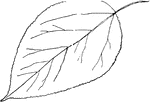
Leaves - simple; alternate; edge finely and rather sharply toothed. Outline - egg-shape. Apex - taper-pointed. Base - rounded. Leaf/Stem - nearly smooth, the lower half rounded, the upper part only slightly flattened. Leaf/Bud - in the spring is large and yellow, and covered with a fragrant gum (as, to some extent, are the buds of most of the poplars). Leaf - four to six inches long; when young, yellowish above, becoming bright green; whitish, and "net-veined" below; smooth. Found - in Northern New England, Central Michigan, and Minnesota, and far northward. General Information - A tree sixty to seventy feet high, with very light and soft wood.

Genus Populus, L. (Aspen, Poplar)

Leaves - simple; alternate; edge finely and rather sharply toothed. Outline - egg-shape. Apex - taper-pointed.…
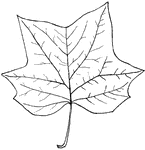
Leaves - simple; alternate; edge lobed (lobes entire). Outline - rounded. Apex - cut almost squarely across, with a shallow hollow, giving a square look to the upper half of the leaf. Base - usually heart-shape. Leaf - three to five inches long and wide; very smooth; with four to six lobes (two lobes at the summit; at the sides two, or two large and two small). Bark - of trunk, dark ash-color and slightly rough. Flowers - four to six inches across, greenish-yellow, marked within with orange, somewhat tulip-like, fragrant solitary. May, June. Found - from Southwestern Vermont to Michigan, southward and westward. Its finest growth is in the valley of the lower Wabash River and along the western slopes of the Alleghany Mountains. General Information - Among the largest and most valuable of the North American Trees. It is usually seventy to one hundred feet high, often much higher, with a straight, clear trunk, that divides rather abruptly at the summit into coarse and straggling branches. The wood is light and soft, straight grained, and easily worked, with the heart wood light yellow or brown, and the thin sap wood nearly white. It is very widely and variously used - for construction, for interior finish, for shingles, in boat-building, for the panels of carriages, especially in the making of wooden pumps and wooden ware of different kings. I asked a carpenter: "Hope, is n't it the tulip wood (which you call poplar*) that the carriage-makers use for their panels?" "Yes, and the reason is, because it shapes so easily. If you take a panel and wet one side, and hold the other side to a hot stove-pipe, the piece will just hub the pipe. It's the best wood there is for panelling." "Of all the trees of North America with deciduous leaves, the tulip tree, next to the buttonwood, attains the amplest dimensions, while the perfect straightness and uniform diameter of its trunk for upwards of forty feet, the more regular disposition of its branches, and the greater richness of its foliage, give it a decided superiority over the buttonwood and entitle it to be considered as one of the most magnificent vegetables of the temperate zone." - Michaux. *The name should be dropped. The tree is not a poplar. The tulip tree was very highly esteemed by the ancients; so much so that in some of their festivals they are said to have honored it by pouring over its roots libations of wine.

Genus Liriodendron, L. (Tulip Tree)

Leaves - simple; alternate; edge lobed (lobes entire). Outline - rounded. Apex - cut almost squarely…