Girl with a book and sea life around her.

Girl

Girl with a book and sea life around her.

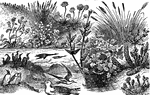
1. Sea-plantain. 2. Sea-pink 3. Sea-reed, 4. Sea Rocket, 5. Sea Campion, 6. Sea-holly 7. Sea-spurge 8. Stone-pop

Types of Seashore Life

1. Sea-plantain. 2. Sea-pink 3. Sea-reed, 4. Sea Rocket, 5. Sea Campion, 6. Sea-holly 7. Sea-spurge…
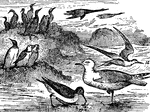
9. Cormorant, 10. Guillemot, 11. Puffin, 12. Sanderling, 13. Herring Gull, 14. Tern.

Types of Seashore Life

9. Cormorant, 10. Guillemot, 11. Puffin, 12. Sanderling, 13. Herring Gull, 14. Tern.
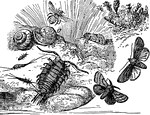
16. Andrena cineraria, 17. Helix virgata, 18. Pod-lover moth, 19. Anurida maritima, 20. Machillis maritima, 21. Sea-slater, 22. Shore wainscot moth, 23. Ground lackey moth.

Types of Seashore Life

16. Andrena cineraria, 17. Helix virgata, 18. Pod-lover moth, 19. Anurida maritima, 20. Machillis maritima,…
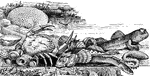
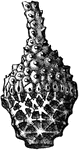
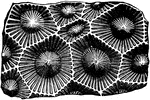
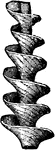
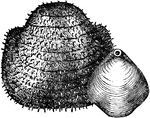
24. Various corals, 25. Razor-shell, 26. Cockle, 27. Various winkels, 28. Shore crab, 29. Father lasher, 30. Periophthalamus, 31. Lobworm, 32. Gunnel

Types of Seashore Life

24. Various corals, 25. Razor-shell, 26. Cockle, 27. Various winkels, 28. Shore crab, 29. Father lasher,…
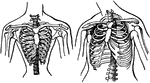
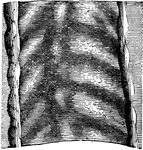
On the right is a normal sized chest and on the left is chest as it is in one that has been girt round tightly all her life, so as to make her waist very small. The ribs are brought very near together, so that they could hold only very small lungs. Health and vigor cannot exist with such small breathing machinery and are sacrificed for the sake of a small waist.

Abnormal Chest

On the right is a normal sized chest and on the left is chest as it is in one that has been girt round…
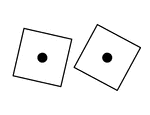

Pair of thrown dice showing two ones.

Dice Pair, 1-1

Pair of thrown dice showing two ones.

War token with union shield and "ONE COUNTRY" obverse and snake and "BEWARE" reverse. These little mementoes of the War of the Rebellion represent the small currency chiefly in use during that period. They were all privately issued, and the Government did not interfere. Merchants displayed their cards on them (often with appropriate characteristic devices), and freely used them in their business. Others partook of the general type, were supplied in suitable quantities to the purchaser, and were "current everywhere." They continued in circulation until about 1867 when their use was prohibited by law.

War Token, 1865

War token with union shield and "ONE COUNTRY" obverse and snake and "BEWARE" reverse. These little mementoes…
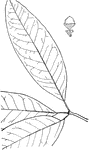
Leaves - simple; alternate; edge entire. Outline - long and narrow. Apex - pointed and bristle-tipped. Base - pointed. Leaf - three to six inches long; one to two inches wide; smooth and shining above; somewhat downy beneath; thick and stiff. Bark - smooth and unbroken. Acorns - small, nearly stemless. Cup - shallow. Nuts - rounded; about one half inch in diameter; bitter. October. Found - in Lehigh County, Pennsylvania (Porter), westward to Southeastern Iowa, and southward. Most common west of the Alleghany Mountains.  General Information - A tree thirty to fifty feet high, with poor wood, that is used at the West for shingles and clapboards.  Note: Of the nine hybrids that have been recognized, most are outside of our limits or entirely local. Mention need be made only of tow: Q. heterophylla, Michaux ("Bartram's Oak"). Staten Island and New Jersey to Delaware and North Carolina; Q. Rudkini, Britt., New Jersey. Quercus, possible from a Celtic word meaning to inquire, because it was among the oaks that the Druids oftenest practised their rites.   The Oak "Live thy Life, Young and old, Like yon oak, Bright in spring, Living gold; Summer-rich, Then; and then Autumn-changed, Sober-hued Gold again. All his leaves fall'n at length, Look, he stands, Trunk and bough, Naked strength.: Alfred (Lord) Tennyson, 1889.

Genus Quercus, L. (Oak)

Leaves - simple; alternate; edge entire. Outline - long and narrow. Apex - pointed and bristle-tipped.…
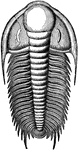
The trilobite was an early animal on earth during the Primordial Period.

Trilobite

The trilobite was an early animal on earth during the Primordial Period.

A track of the early life form, the trilobite.

Trilobite Track

A track of the early life form, the trilobite.

A mollusk radiate from the Paleozoic time, Stictopora acuta.

Mollusk Radiate

A mollusk radiate from the Paleozoic time, Stictopora acuta.

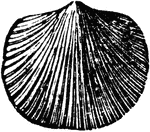
A mollusk radiate from the Paleozoic time, Orthis testudinaria.

Orthis Mollusk

A mollusk radiate from the Paleozoic time, Orthis testudinaria.

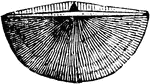
A mollusk radiate from the Paleozoic time, Leptaena sericea.

Leptaena Mollusk

A mollusk radiate from the Paleozoic time, Leptaena sericea.

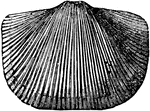
A mollusk radiate from the Paleozoic time, Orthis occidentalis.

Orthis Mollusk

A mollusk radiate from the Paleozoic time, Orthis occidentalis.

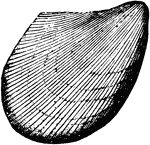
A mollusk radiate from the Paleozoic time, Ambonychia bellistriata.

Ambonychia Mollusk

A mollusk radiate from the Paleozoic time, Ambonychia bellistriata.

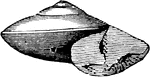
A mollusk radiate from the Paleozoic time, Raphistoma lenticularis.

Raphistoma Mollusk

A mollusk radiate from the Paleozoic time, Raphistoma lenticularis.

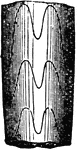
A mollusk radiate from the Paleozoic time, Orthoceras junceum.

Mollusk Radiate

A mollusk radiate from the Paleozoic time, Orthoceras junceum.

An articulate radiate from the Paleozoic time, Orthoceras junceum.

Orthoceras Articulate

An articulate radiate from the Paleozoic time, Orthoceras junceum.

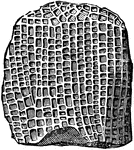
A radiate from the Paleozoic time, Favosites Niagarensis of the Niagara group.

Favosites Radiate

A radiate from the Paleozoic time, Favosites Niagarensis of the Niagara group.

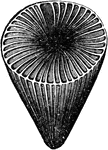
A radiate from the Paleozoic time, Zaphrentis bilateralis of the Clinton group

Zaphrentis Radiate

A radiate from the Paleozoic time, Zaphrentis bilateralis of the Clinton group

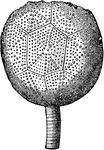
A radiate from the Paleozoic time, Caryocrinus ornatus.

Caryocrinus Radiate

A radiate from the Paleozoic time, Caryocrinus ornatus.

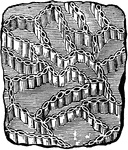
A radiate from the Paleozoic time, Halysites catenulata.

Halysites Radiate

A radiate from the Paleozoic time, Halysites catenulata.

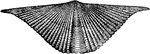
A mollusk radiate from the Paleozoic time, Pentamerus oblongus, a brachiopod from the Clinton group.
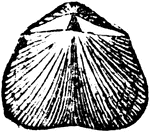
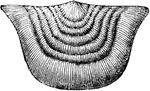
Pentamerus Brachiopod

A mollusk radiate from the Paleozoic time, Pentamerus oblongus, a brachiopod from the Clinton group.
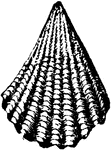
A mollusk radiate from the Paleozoic time, Orthis varica of the Niagara group.

Orthis Mollusk

A mollusk radiate from the Paleozoic time, Orthis varica of the Niagara group.

A mollusk radiate from the Paleozoic time, Strophomena rhomboidalis

Strophomena Mollusk

A mollusk radiate from the Paleozoic time, Strophomena rhomboidalis

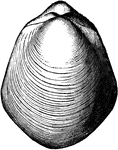
A mollusk radiate from the Paleozoic time, Rhynchotreta cuneata from the United States and Great Britain.
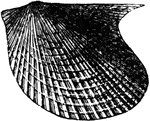
Rhynchotreta Mollusk

A mollusk radiate from the Paleozoic time, Rhynchotreta cuneata from the United States and Great Britain.

A mollusk radiate from the Paleozoic time, Pterinea emacerata from the Niagara group.

Pterinea Mollusk

A mollusk radiate from the Paleozoic time, Pterinea emacerata from the Niagara group.
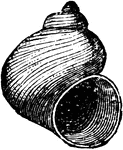
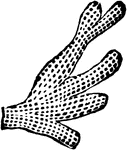
A mollusk radiate from the Paleozoic time, Cyclonema cancellata from the Clinton group.

Cyclonema Mollusk

A mollusk radiate from the Paleozoic time, Cyclonema cancellata from the Clinton group.
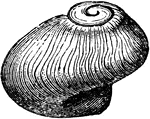
A mollusk radiate from the Paleozoic time, Platyceras angulatum from the Niagara group.

Platyceras Mollusk

A mollusk radiate from the Paleozoic time, Platyceras angulatum from the Niagara group.
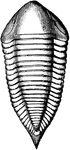
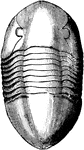
An articulate radiate from the Paleozoic time, Homalonotus delphinocephalus.

Articulate Radiate

An articulate radiate from the Paleozoic time, Homalonotus delphinocephalus.

An ancient mollusk from the Paleozoic time, Spirifer mucronatus.

Sprifer Mollusk

An ancient mollusk from the Paleozoic time, Spirifer mucronatus.

An ancient mollusk from the Paleozoic time, Goniatites Marcellensis from the Hamilton group.

Goniatites Mollusk Fossil

An ancient mollusk from the Paleozoic time, Goniatites Marcellensis from the Hamilton group.
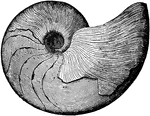
An ancient mollusk from the Paleozoic time, Goniatites Marcellensis from the Hamilton group.

Goniatites Mollusk

An ancient mollusk from the Paleozoic time, Goniatites Marcellensis from the Hamilton group.
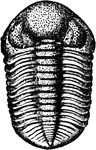
An ancient articulate from the Paleozoic time, Pacops bufo from the Hamilton group.

Pacops Articulate

An ancient articulate from the Paleozoic time, Pacops bufo from the Hamilton group.
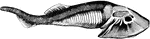
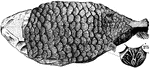
Ganoids were ancient fish from the Paleozoic time. The image is of the Cephalaspis Lyellii.

Ganoid

Ganoids were ancient fish from the Paleozoic time. The image is of the Cephalaspis Lyellii.

Ganoids were ancient fish from the Paleozoic time. The image is of the Holoptychius.

Ganoid

Ganoids were ancient fish from the Paleozoic time. The image is of the Holoptychius.

An ancient radiate from the Carboniferous Age, the Zeacrinus elegans.

Zeacrinus Radiate

An ancient radiate from the Carboniferous Age, the Zeacrinus elegans.

An ancient radiate from the Carboniferous Age, the Actinocrinus proboscidialis.

Actinocrinus Radiate

An ancient radiate from the Carboniferous Age, the Actinocrinus proboscidialis.
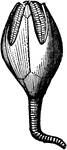
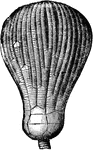
An ancient radiate from the Carboniferous Age, the Pentremites pyriformis.

Pentremites Radiate

An ancient radiate from the Carboniferous Age, the Pentremites pyriformis.

An ancient radiate from the Carboniferous Age, the Lithostrotion Canadense.

Lithostrotion Radiate

An ancient radiate from the Carboniferous Age, the Lithostrotion Canadense.

An ancient mollusk from the Carboniferous Age, the Archimedes reversa.

Archimedes Mollusk

An ancient mollusk from the Carboniferous Age, the Archimedes reversa.

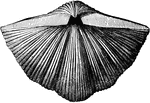
Two ancient mollusks from the Carboniferous Age, the Productus Nebrascensis and the Athyris subtilita.

Ancient Mollusks

Two ancient mollusks from the Carboniferous Age, the Productus Nebrascensis and the Athyris subtilita.
An ancient mollusk from the Carboniferous Age, the Spirifer cameratus.

Spirifer Mollusk

An ancient mollusk from the Carboniferous Age, the Spirifer cameratus.

A leaf of the Zamia, a tree from the Mesozoic time.

Zamia Leaf

A leaf of the Zamia, a tree from the Mesozoic time.

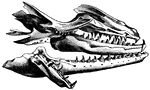
The jaw bones of the Mosasaurus, a great snake-like reptile of the Cretaceous Period.

Mosasaurus Jaw

The jaw bones of the Mosasaurus, a great snake-like reptile of the Cretaceous Period.
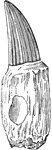
A tooth of the Mosasaurus, a great snake-like reptile of the Cretaceous Period.
Mosasaurus Toot

A tooth of the Mosasaurus, a great snake-like reptile of the Cretaceous Period.
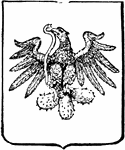
The Coat of Arms of Mexico.

Mexican Coat of Arms

The Coat of Arms of Mexico.

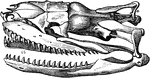
"Skull of Boa constrictor. a, quadrate bone; b, b, halves of lower jaw." -Cooper, 1887

Boa Constrictor Skull

"Skull of Boa constrictor. a, quadrate bone; b, b, halves of lower jaw." -Cooper, 1887
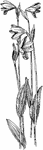
Of the orchid family (Orchidaceae), the snake mouth or Pogonia ophioglossoides.

Snake Mouth

Of the orchid family (Orchidaceae), the snake mouth or Pogonia ophioglossoides.

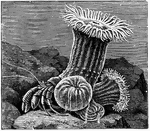
"Sea anemones on back of hermit crab." -Thomson, 1916

Anemone

"Sea anemones on back of hermit crab." -Thomson, 1916

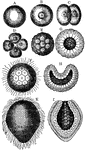
"Life history of a coral, Monoxenia darwinii. A, B, Ovum. C, Division into two. D, four-cell stage. E, Blastula. F, Free-swimming blastula with cilia. G, Section of blastula. H, Beginning of invagination. I, Section of completed gastrula, showing ectoderm, and archenteron. K, Free-swimming ciliiated gastrula." -Thomson, 1916

Coral Stages

"Life history of a coral, Monoxenia darwinii. A, B, Ovum. C, Division into two. D, four-cell stage.…

"Life history of Monocystis. 1. Young Gregarine lying within a sperm mother cell of earthworm. 2. Association of two Gregarines within a cyst, ready to form gametes. 3. Numerous spore-cases (sp.c., pseudonavicellae) within a cyst. 4. A spore-case with eight spores (sp.) and a residual core (rb)." -Thomson, 1916

Monocystis

"Life history of Monocystis. 1. Young Gregarine lying within a sperm mother cell of earthworm. 2. Association…
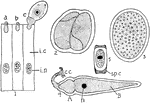
"Life history of Gregarina. 1. Young forms (a, b, c) emerging from intestinal cells (i.c.); i.n., nucleus of intestinal cell. 2. Two forms conjugating (G. blattarum). 3. Spore formation within a cyst. 4. Adult with deciduous head-cap (c.c.), and a cuticular partition dividing the cell into an anterior part (A) and a posterior part (B); n., the nucleus. 5. A spore within its spore-case (sp.c.)." -Thomson, 1916

Gregarina

"Life history of Gregarina. 1. Young forms (a, b, c) emerging from intestinal cells (i.c.); i.n., nucleus…
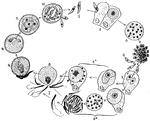
"Life history of Coccidium. 1. Sporozoite; 2. Sporozoite entering a cell and becoming a trophozoite; 3-4. Schizont, forming merozoites; 5. Merozoites entering another cell; 6a. Merozoite forming macrogamete; 6b. Merozoite forming microgametes; 7. Free microgamete; 8-9. Fertilisation of macrogamete by microgamete; 10. Zygote within oocyst; 11. Formation of spores within oocyst; 12. Spores forming sporozoites." -Thomson, 1916

Coccidium

"Life history of Coccidium. 1. Sporozoite; 2. Sporozoite entering a cell and becoming a trophozoite;…
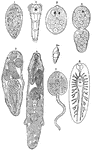
"Life history of liver fluke. 1. Developing embryo in egg-case; 2. free-swimming ciliated embryo; 3. sporocyst; 3a. shell of Limnaus truncatulus; 4. division of sporocyst; 5. sporocyst with rediae forming within it; 6. redia with more rediae forming within it; 7. tailed cercaria; 8. young fluke." -Thomson, 1916

Liver Fluke Stages

"Life history of liver fluke. 1. Developing embryo in egg-case; 2. free-swimming ciliated embryo; 3.…
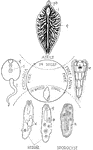
"Diagram of life cycle of liver fluke." -Thomson, 1916

Liver Fluke Life Cycle

"Diagram of life cycle of liver fluke." -Thomson, 1916

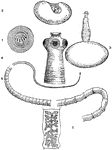
"Life history of Taenia solium. 1. Six-hooked embryo in egg-case; 2. proscolex or bladder-worm stage, with invaginated head; 3. bladder-worm with evaginated head; 4. enlarged head of adult, showing suckers and hooks; 5. general view of the tape-worm, from small head and thin neck to the rip joints; 6. a rip joint or proglottis with branched uterus; all other organs are now lost." -Thomson, 1916

Pork Tapeworm

"Life history of Taenia solium. 1. Six-hooked embryo in egg-case; 2. proscolex or bladder-worm stage,…
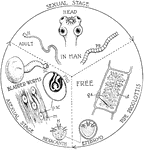
"Diagram of life history of Taenia solium." -Thomson, 1916

Pork Tapeworm

"Diagram of life history of Taenia solium." -Thomson, 1916

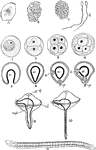
"Development of Polygordius. a., Mother sperm cell; b., c., sperm morulae; d., spermatosoa. 1. Ovum with large nucleus; 2. two-cell stage; 3. four-cell stage; 4. blastosphere; 5. gastrula; ac., archenteron; 6. closure of gastrula mouth or blastopore; 7. formation of stomodaeum (st.), and proctodaeum (pr.), which invaginate to meet archenteron (ac.); 8. complete gut formed; 9. elongation of larva; ap. sp., posterior segments; 11. form of adult Polygordius." -Thomson, 1916

Polygordius

"Development of Polygordius. a., Mother sperm cell; b., c., sperm morulae; d., spermatosoa. 1. Ovum…