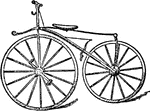
Boneshaker is a name used from about 1869 up to the present time, to refer to the first type of true bicycle with pedals, which was called "velocipede" (from the Latin for "fast foot") by its manufacturers. "Boneshaker" refers to the extremely uncomfortable ride, which was caused by the stiff wrought-iron frame and wooden wheels surrounded by tires made of iron.

Boneshaker Bicycle

Boneshaker is a name used from about 1869 up to the present time, to refer to the first type of true…
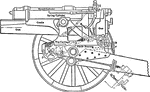
A howitzer is a type of artillery piece that is characterized by a relatively short barrel and the use of comparatively small explosive charges to propel projectiles at trajectories with a steep angle of descent. In the taxonomies of artillery pieces used by European (and European-style) armies in the 18th, 19th, and 20th centuries, the howitzer stood between the "gun" (which was characterized by a longer barrel, larger propelling charges, smaller shells, higher velocities and flatter trajectories) and the "mortar" (which has the ability to fire projectiles at even higher angles of ascent and descent).

Howitzer

A howitzer is a type of artillery piece that is characterized by a relatively short barrel and the use…
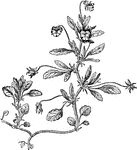
Heartsease (Viola tricolor) is a common European wild flower, growing as an annual or short-lived perennial. It has been introduced into North America, where it has spread widely, and is known as the Johnny Jump Up (though this name is also applied to similar species such as the Yellow Pansy). It is the progenitor of the cultivated Pansy, and is therefore sometimes called Wild Pansy; before the cultivated Pansies were developed, "Pansy" was an alternative name for the wild form.

Heartsease

Heartsease (Viola tricolor) is a common European wild flower, growing as an annual or short-lived perennial.…
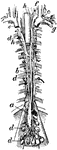
"Human Thoracic Duct and Azygous Veins. a, receptacle of the chyle; b, trunk of the thoracic duct, opening at c into root of left innominate vein at junction of f, left jugular, and g, left subclavian vein; e, right innominate vein; d, d, d, several thoracic and lumbar lymphatic glands; h, h, a short portion of the esophagus. Two azygous veins run parallel with and on each side of the duct, until the left crosses behind the duct to join the right. The structures represented rest nearly upon the back-bone." -Whitney, 1911

Thoracic Duct

"Human Thoracic Duct and Azygous Veins. a, receptacle of the chyle; b, trunk of the thoracic duct, opening…
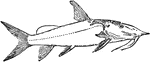
Upside-down catfish, Synodontis nigriventris, is a species of catfish. It's particularly noteworthy because of its habit of swimming upside down most of the time. Upside-down catfish originate from the Central Congo basin of Africa.

Upside-down Catfish

Upside-down catfish, Synodontis nigriventris, is a species of catfish. It's particularly noteworthy…
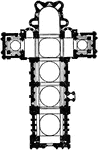
An illustration of the floor plan of Angouleme Cathedral. A first cathedral was built on the site a primitive, pre-Christian sanctuary, in the 4th century AD. The edifice was destroyed when the town was taken by Clovis after the Battle of Vouillé (507). Another cathedral was consecrated in 560, but this was also set on fire by the Vikings/Normans some two centuries later. A third cathedral was then constructed under bishop Grimoard, abbot of Saint-Pierre de Brantôme. The new church was consecrated in 1017. However, at the beginning of the 12th century the citizens started to consider it too small for to the wealth of the county. The designer was bishop Gerard II, one of the most important French figures of the time, who was a professor, Papal legate for four popes and also a notable artist. Works began about 1110 and finished in 1128.

Angouleme Cathedral

An illustration of the floor plan of Angouleme Cathedral. A first cathedral was built on the site a…
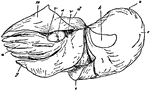
An illustration of a female nautilus without the shell. "c, points to the concave margin of the mantle-skirt leading into the sub-pallial chamber; g, the mid-foot or siphon; k, the superficial origin of its retractor muscles closely applied to the shell and serving to hold the animal in tis place; l, the sipjuncular pedicle of the visceral hump broken off short; v,v, the superior and inferior ophthalmic tentacles." (Britannica, 1910)

Female Nautilus without Shell

An illustration of a female nautilus without the shell. "c, points to the concave margin of the mantle-skirt…
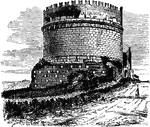
"The usual form of independent monumental tombs was a ponderous tower-shaped block, sometimes square, and sometimes round, with a quadrangular substructure; as, for instance, the tomb of Cæcilia Metella at Rome, which belongs to the time of Julius Cæsar, and which was used in the Middle Ages as a fortress, with battlements added to it.

Tomb of Cæcilia Metella

"The usual form of independent monumental tombs was a ponderous tower-shaped block, sometimes square,…
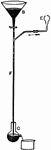
The Sprengel pump is a vacuum pump invented by Hanover-born chemist Hermann Sprengel in 1865 while he was working in London. The pump could be run continuously and without any supervision to achieve the lowest vacuum achievable at that time.

Sprengel Pump

The Sprengel pump is a vacuum pump invented by Hanover-born chemist Hermann Sprengel in 1865 while he…
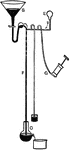
The Sprengel pump is a vacuum pump invented by Hanover-born chemist Hermann Sprengel in 1865 while he was working in London. The pump could be run continuously and without any supervision to achieve the lowest vacuum achievable at that time.

Sprengel Pump

The Sprengel pump is a vacuum pump invented by Hanover-born chemist Hermann Sprengel in 1865 while he…
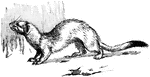
The ermine (Mustela erminea) is a small mammal in the Mustelidae family of weasels.

Ermine

The ermine (Mustela erminea) is a small mammal in the Mustelidae family of weasels.

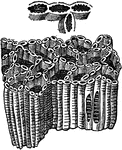
The chain coral. This is an important index fossil of the Silurian, and an important limestone builder as well.

Chain Coral

The chain coral. This is an important index fossil of the Silurian, and an important limestone builder…
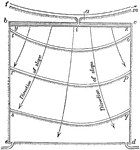
One way to spread water over a hillside field, "f m is the main ditch and the slope of the hill as shown by the arrows; t o, r p, and s q are small ditches or plow furrows cut on a level line around the face of the hill. The water is let into the field by the short ditch at i, and is then spread over the space b c t o by means of a marginal ditch y z, from which it is made to flow in small streams and in a regular manner over the space between it and the lower ditch t o." -Department of Agriculture

Irrigation by Furrows

One way to spread water over a hillside field, "f m is the main ditch and the slope of the hill as shown…
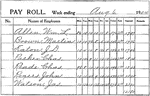
An accountant's sheet of payroll with employee names, hours per day, and pay rate. "Wages are usually calculated on the basis of 8 or 10 hours to a day. In finding the amount due, in order to avoid fractions, it is best to find the total time in hours, multiply by the rate per day and then divide by 8 or 10, carrying decimals to three places." -Moore, 1907

Pay Roll

An accountant's sheet of payroll with employee names, hours per day, and pay rate. "Wages are usually…

"A promissory note, or a note, is a written promise on the part of one person to pay another certain sum of money on demand or at a certain specified future time." -Moore, 1907

Promissory Note

"A promissory note, or a note, is a written promise on the part of one person to pay another certain…
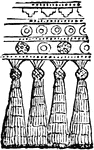
"Assyrian Fringes, from ancient bas-reliefs. Fringe: an ornamental bordering formed of short lengths of thread." -Whitney, 1911

Assyrian Fringe

"Assyrian Fringes, from ancient bas-reliefs. Fringe: an ornamental bordering formed of short lengths…
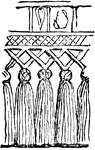
"Assyrian Fringes, from ancient bas-reliefs. Fringe: an ornamental bordering formed of short lengths of thread." -Whitney, 1911

Assyrian Fringe

"Assyrian Fringes, from ancient bas-reliefs. Fringe: an ornamental bordering formed of short lengths…
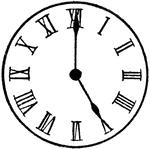
An illustration of a Roman Numeral clock showing five o'clock (5:00).

Clock 5:00

An illustration of a Roman Numeral clock showing five o'clock (5:00).

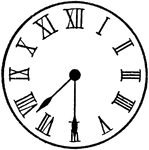
An illustration of a Roman Numeral clock showing 7:30.

Clock 7:30

An illustration of a Roman Numeral clock showing 7:30.

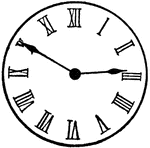
An illustration of a Roman Numeral clock showing 2:50.

Clock 2:50

An illustration of a Roman Numeral clock showing 2:50.

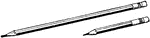
An illustration of two pencils, one long and one short.

Long & Short Pencils

An illustration of two pencils, one long and one short.

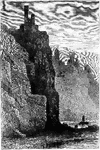
One of four standing medieval castles in Neckarsteinach, also known as "Vier Burgeneck" because of its four standing medieval castles, is a town in the Kreis Bergstraße, in Hesse, Germany.  The town was originally called Steinach, when it received city rights in 1377 it was renamed Neckarsteinach. The Knights of Steinach, lived in the local castle at the time. Two of the castles are still occupied by residents, and the two others are in ruins.

Castle of Neckarsteinach

One of four standing medieval castles in Neckarsteinach, also known as "Vier Burgeneck" because of its…
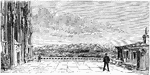
Strasbourg is a city in France. It is located near the German border and at one time was a part of the German Empire. The platform resides on the lower tower and can be reached by three hundred and sixty steps. Two watchmen are constantly on duty to give notice of fire in the city. As proof that one of them is always awake they are forced to ring the great bell every fifteen minutes.

Platform of Strassburg Cathedral

Strasbourg is a city in France. It is located near the German border and at one time was a part of the…
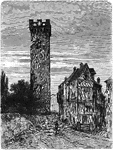
Located in Heilbronn, a city in the north of Baden-Wirttemburg, Germany, is the tower of an old fortress , formerly the donjon-keep. The tower received its name from the fact that a celebrated warrior, Goetz von Berlichingen, was confined there for a short time. Goetz von Berlichingen was elected leader of the peasants who revolted in 1526. During one of his battles his left hand was cut off by a grape-shot. He had a skilful armorer to make him a hand of steel which enabled him to continue his warrior life. His iron hand is still preserved in the little town of Jaxthausen, near Berlichingen.

Tower of Goetz

Located in Heilbronn, a city in the north of Baden-Wirttemburg, Germany, is the tower of an old fortress…
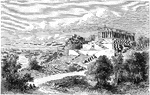
Walhalla, or German Temple of Fame and Honor is a neo-classical hall of fame located on the Danube River 10 km east of Regensburg, in Bavaria, Germany. The exterior is a close imitation of the Parthenon (a temple of the Greek goddess Athena), and is constructed of gray marble. It was the idea of 20-year-old Crown Prince Ludwig I of Bavaria in 1807, at a time when the German states were defeated and occupied by Napoleon. It was meant as a place for the commemoration of great figures and events in ethnic German history, at the time covering 1,800 years, beginning with the Battle of the Teutoburg Forest (AD 9). Whereas the Valhalla of Norse mythology was home to those gloriously slain in battle, Ludwig's Walhalla was intended not only for warriors but also for scientists, writers, clerics and specifically also for women.

Exterior of Walhalla

Walhalla, or German Temple of Fame and Honor is a neo-classical hall of fame located on the Danube River…
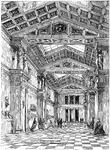
Walhalla, or German Temple of Fame and Honor is a neo-classical hall of fame located on the Danube River 10 km east of Regensburg, in Bavaria, Germany. It was the idea of 20-year-old Crown Prince Ludwig I of Bavaria in 1807, at a time when the German states were defeated and occupied by Napoleon. It was meant as a place for the commemoration of great figures and events in ethnic German history, at the time covering 1,800 years, beginning with the Battle of the Teutoburg Forest (9 AD). Whereas the Valhalla of Norse mythology was home to those gloriously slain in battle, Ludwig's Walhalla was intended not only for warriors but also for scientists, writers, clerics and specifically also for women. The walls are lined with marble, and the ceiling is very richly gilded and decorated. The busts that are placed in rows along the walls are, as far as possible, likenesses of celebrated Germans deemed worthy of a place in the Temple of Fame.

Interior of Walhalla

Walhalla, or German Temple of Fame and Honor is a neo-classical hall of fame located on the Danube River…
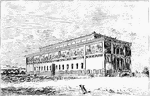
The Alte Pinakothek (Old Pinakothek) is an art museum situated in the Kunstareal in Munich, Germany. It is one of the oldest galleries of the world housing one of the most famous art museums for the old masters. The name (old Pinakothek) alludes to the time period covered by the art — the Neue Pinakothek covers 19th century art and the recently opened Pinakothek der Moderne exhibits modern art, all galleries are part of Munich's "Kunstareal" (the "art area").

Pinacothek

The Alte Pinakothek (Old Pinakothek) is an art museum situated in the Kunstareal in Munich, Germany.…
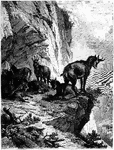
The chamois (Rupicapra rupicapra) is a goat-like animal, living at moderately high altitudes and are adapted to living in steep, rugged, rocky terrain. A fully grown chamois reaches a height of about 2½ feet and weighs about 110 pounds. Males and females have short horns which are slightly curled in the posterior direction. In summer, the fur has a rich brown colour which turns to a light grey in winter. Distinct characteristics are a white face with pronounced black infraorbital stripes, a white rump and a black dorsal stripe. Chamois can reach an age of up to 20 years. Female chamois and their young live in herds; adult males tend to live solitarily for most of the year. During the rut (late November/early December in Europe, May in New Zealand), males engage in fierce battles for the attention of unbred females. An impregnated female undergoes a gestation period of 20 weeks, after which a single kid is born. The kid is fully grown by three years of age.

Chamois

The chamois (Rupicapra rupicapra) is a goat-like animal, living at moderately high altitudes and are…
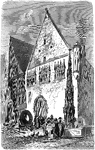
Hotel De Ville was constructed about 1370 in the second half of the fourteenth century. Frescos at one time decorated it façade, some traces still visible in the latter part of the nineteenth century. The hotel is also referred to as the town hall, and is of Gothic architecture. In front of the Town Hall can be seen the beautiful fountain known as the Fischkasten (fish-tank) designed by Jörg Syrlin the Elder, 1482.

Hotel De Ville

Hotel De Ville was constructed about 1370 in the second half of the fourteenth century. Frescos at one…
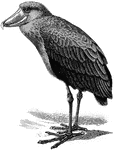
"Balaeniceps rex, the Shoebill, of the White Nile, has a short crest, and is brownish-grey with blackish wings, tail, and feet the bill being yellow with dusky mottlings." A. H. Evans, 1900

Shoebill

"Balaeniceps rex, the Shoebill, of the White Nile, has a short crest, and is brownish-grey with blackish…
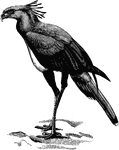
"Standing some four feet high on very long legs, this bird (Secretary Bird) gives the impression of a Heron or Crane, and is a striking object on its native plains. The short strong beak is greatly arched, and is not toothed, the neck is elongated, the body comparatively small, and the metatarsus boldly scutellated all around, the short straight toes with their blunt claws being joined anteriorly by small membranes The ample wings have eleven pointed primaries and seventeen secondaries. the graduated tail of twelve rectrices has the two obtuse median feathers drooping and much prolonged. Down is evenly distributed over the adults, and an after-shaft is present. The general colour is bluish-grey, with black wing-quills, lower back and vent; the loose pendent crest on the occiput and nape contains ten plumes in pairs, the longer being black and the shorter grey with black ends; the tail grey, subterminally barred with black and tipped with white, which sometimes shews on the short close flank-feathers. The long cere, naked sides of the face, and feet are yellow, the irides hazel. The sexes are similar." A. H. Evans

Secretary Bird

"Standing some four feet high on very long legs, this bird (Secretary Bird) gives the impression of…
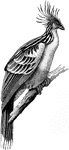
"The Hoatzin (Opisthocomus cristatus) is curious and highly specialized. "The body is long and thin, the bill is strong with basal serrations on the maxilla; bristles surround the gape, and the eye-lids have distinct lashes- a rare fact among birds. The reticulated metatarsi are fairly stout; the toes are long; the hallux being unusually developed and the claws slightly curved. The short rounded wings have ten primaries and nine secondaries. The plumage in both sexes is olive above with white markings, and dull rufous below; the long loose crest and the tip of the tail are yellowish, and patch of bare bluish-black skin surrounds the eyes." A. H. Evans, 1900

Hoatzin

"The Hoatzin (Opisthocomus cristatus) is curious and highly specialized. "The body is long and thin,…
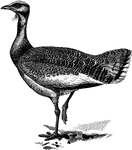
"The Otis Tarda, the Great Bustard, which, as a native only became extinct in Norfolk about 1838, used to extend from East Lothian to Dorset, bit is now merely an occasional visitor to Britain. The upper parts are mottled with rufous, buff, and blackish-brown, the head is blue-grey, with long white bristles at the base of the mandible, the lower surface is white, relieved in the male by a tawny gorget for a short time during the breeding season. The primaries are black, most of the secondaries and wing-coverts white. Some other Bustards seem to have similar vernal change of plumage. The female is smaller and has no bristles." A. H. Evans, 1900

Great Bustard

"The Otis Tarda, the Great Bustard, which, as a native only became extinct in Norfolk about 1838, used…
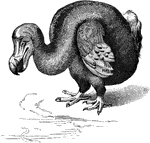
"The Dodo, ...was an immense Pigeon-like bird bigger than a Turkey, with an aborted keel to the sternum and the wings also aborted. The coracoid and scapula met at an obtuse angle, as in many other flightless species. The huge blackish bill terminated in a large horny hook, the cheeks were partly bare, the short yellow legs were stout, scaly, and feathered on the upper portion; the plumage was dark ash- coloured, with whitish breast and tail, yellowish-white wings, and black tips to their coverts. The short rectrices formed a curled tuft, and the first four primaries were directed backwards." A. H. Evans, 1900

Dodo

"The Dodo, ...was an immense Pigeon-like bird bigger than a Turkey, with an aborted keel to the sternum…
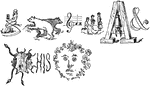
"Time bears for youth a muffled bell, And hides his face in flowers." -Trowbridge, 1866

Time Rebus

"Time bears for youth a muffled bell, And hides his face in flowers." -Trowbridge, 1866

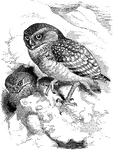
"Speotyto cunicularia, the Burrowing Owl, a comparatively long-legged and short -winged bird with incomplete facial discs and unfeathered toes, is umber-brown varied with yellowish and white, the lower parts becoming lighter." A. H. Evans

Two Burrowing Owls by the Mountains

"Speotyto cunicularia, the Burrowing Owl, a comparatively long-legged and short -winged bird with incomplete…
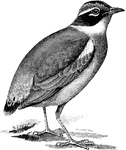
"Pitta brachyura, the Indian Pitta, has plumage that exhibits vivid scarlet, blue, and green tints, in addition to yellow, purple, black, brown, and white. They are stout, strong-billed form, with short rounded wings and tail, the long metatarsus being more or less scutellated all round; the primaries number ten- the secondaries eight, the rectrices twelve." A. H. Evans, 1900

Indian Pitta

"Pitta brachyura, the Indian Pitta, has plumage that exhibits vivid scarlet, blue, and green tints,…
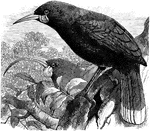
"Heteralocha acutirostris, the New Zealand Huia, the female has a remarkably long, curved bill, that of the male being short, stout, and nearly straight, The plumage is greenish-black, with a white-tipped tail; the bill is whitish, the feet are blue-grey, the large rictal wattles orange." A. H. Evans, 1900

Huia

"Heteralocha acutirostris, the New Zealand Huia, the female has a remarkably long, curved bill, that…
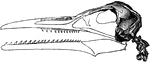
"Ichthyornis victor and I. dispar, ...were small forms of about the size of a Partridge, with the habits and appearance, it is presumed, of Terns or Gulls. The head was extremely large in proportion to the remainder of the skeleton; the beak was long and pointed, with entirely separate rami to the mandible; the sharp teeth, fixed regularly in distinct sockets, were inclined backwards, and occupied the whole of the lower and at least the posterior half of the upper jaw; the keel of the sternum was large and broad; the dorsal and cervico-dorsal vertebrae were biconcave. the quadrate articulated to the skull by one knob,... the metatarsus was short and the whole foot small; a furcula was probably present; the wings were well developed, indicating great powers of flight; while the tail was comparatively short, and ended in a pygostyle." A. H. Evans, 1900

Skeleton Head of a Ichthyornis

"Ichthyornis victor and I. dispar, ...were small forms of about the size of a Partridge, with the habits…

"Then Herod, when he saw that he was mocked of the wise men, was exceeding wroth, and sent forth, and slew all the children that were in Bethlehem, and in all the coasts thereof, from two years old and under, according to the time which he had diligently enquired of the wise men." Matthew 2:16 KJV

Killing the Male Children under the Age of Two

"Then Herod, when he saw that he was mocked of the wise men, was exceeding wroth, and sent forth, and…
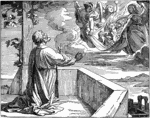
"On the morrow, as they went on their journey, and drew nigh unto the city, Peter went up upon the housetop to pray about the sixth hour: And he became very hungry, and would have eaten: but while they made ready, he fell into a trance, And saw heaven opened, and a certain vessel descending unto him, as it had been a great sheet knit at the four corners, and let down to the earth: Wherein were all manner of fourfooted beasts of the earth, and wild beasts, and creeping things, and fowls of the air. And there came a voice to him, Rise, Peter; kill, and eat. But Peter said, Not so, Lord; for I have never eaten any thing that is common or unclean. And the voice spake unto him again the second time, What God hath cleansed, that call not thou common." Acts 10:9-15 KJV

Peter's Vision on the Housetop

"On the morrow, as they went on their journey, and drew nigh unto the city, Peter went up upon the housetop…
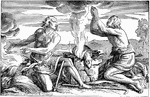
"And in process of time it came to pass, that Cain brought of the fruit of the ground an offering unto the LORD. And Abel, he also brought of the firstlings of his flock and of the fat thereof." Genesis 4:3-4 KJV

Cain and Abel Making an Offering to the Lord

"And in process of time it came to pass, that Cain brought of the fruit of the ground an offering unto…
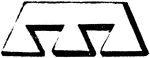
"The Heir, or first son, the LABEL. The differences used by armorists at the present time are nine in number. They not only distinguish the sons of one family, but also denote the subordinate degrees in each house." -Hall, 1862

Label Difference

"The Heir, or first son, the LABEL. The differences used by armorists at the present time are nine in…
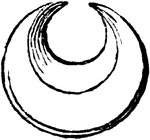
"Second Son, the CRESCENT. The differences used by armorists at the present time are nine in number. They not only distinguish the sons of one family, but also denote the subordinate degrees in each house." -Hall, 1862

Crescent Difference

"Second Son, the CRESCENT. The differences used by armorists at the present time are nine in number.…

"Third Son, the MULLET. The differences used by armorists at the present time are nine in number. They not only distinguish the sons of one family, but also denote the subordinate degrees in each house." -Hall, 1862

Mullet Difference

"Third Son, the MULLET. The differences used by armorists at the present time are nine in number. They…
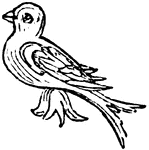
"Fourth Son, the MARTLET. The differences used by armorists at the present time are nine in number. They not only distinguish the sons of one family, but also denote the subordinate degrees in each house." -Hall, 1862

Martlet Difference

"Fourth Son, the MARTLET. The differences used by armorists at the present time are nine in number.…
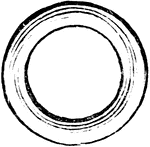
"Fifth Son, the ANNULET. The differences used by armorists at the present time are nine in number. They not only distinguish the sons of one family, but also denote the subordinate degrees in each house." -Hall, 1862

Annulet Difference

"Fifth Son, the ANNULET. The differences used by armorists at the present time are nine in number. They…
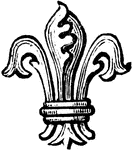
"Sixth Son, the FLEUR-DE-LIS. The differences used by armorists at the present time are nine in number. They not only distinguish the sons of one family, but also denote the subordinate degrees in each house." -Hall, 1862

Fleur-De-Lis Difference

"Sixth Son, the FLEUR-DE-LIS. The differences used by armorists at the present time are nine in number.…

"Seventh Son, the ROSE. The differences used by armorists at the present time are nine in number. They not only distinguish the sons of one family, but also denote the subordinate degrees in each house." -Hall, 1862

Rose Difference

"Seventh Son, the ROSE. The differences used by armorists at the present time are nine in number. They…

"Eighth Son, the CROSS MOLINE. The differences used by armorists at the present time are nine in number. They not only distinguish the sons of one family, but also denote the subordinate degrees in each house." -Hall, 1862

Cross Moline

"Eighth Son, the CROSS MOLINE. The differences used by armorists at the present time are nine in number.…

"Ninth Son, the DOUBLE QUATREFOIL. The differences used by armorists at the present time are nine in number. They not only distinguish the sons of one family, but also denote the subordinate degrees in each house." -Hall, 1862

Double Quatrefoil

"Ninth Son, the DOUBLE QUATREFOIL. The differences used by armorists at the present time are nine in…
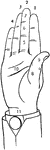
1) The first or index finger. 2) The second or middle finger. 3) The third finger. 4) The fourth finger. 5) The finger's first or lower phalanx. 8) The thumb's second or breath phalanx. 9) The thumb's terminal or voice phalanx. 10) The Palm. 11) The wrist.

Explanatory Diagram

1) The first or index finger. 2) The second or middle finger. 3) The third finger. 4) The fourth finger.…
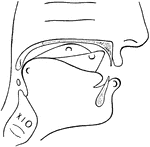
Physiological Bases of the Visible Speech Symbols - Consonants. In representing the consonant a peculiar and exclusive mode of accenting ... the important ... parts of the hand is resorted to, so that, when the different ways of accentuation are understood, the class to which a given position belongs may be readily determined. The modes of accentuation adopted, impart to the various manual positions something more than mere arbitrary class distinction. A hint at the physiological differences between consonants, vowels, and glides also is given, when the positions that represent them are viewed from the index-finger side of the hand ..., according to the rules in this Manual. <p>Consonant positions are distinguished by having the breath phalanx of the thumb close to the plane of the palm and the accented fingers straightened. When the voice phalanx of the thumb is accented, it is never held in contact with an accented finger’s second, or with its terminal, phalanx. The Shut and Nasal positions under this class are the only positions which fail to have accented fingers. In reading a Consonant position we begin at the index-finger side of the hand and treat as accented the nearest straightened finger, and also all other straightened fingers which are directly or indirectly in contact therewith; and as unaccented, all fingers which are closed, and also all straightened fingers which are out of contact with an accented finger. There are fifty-two Consonant positions.

Physiological Bases of the Visible Speech Symbols for Consonants

Physiological Bases of the Visible Speech Symbols - Consonants. In representing the consonant a peculiar…
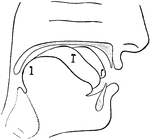
Physiological Bases of the Visible Speech Symbols - Vowels. In representing the vowel classification of sounds, a peculiar and exclusive mode of accenting ... the important ... parts of the hand is resorted to, so that, when the different ways of accentuation are understood, the class to which a given position belongs may be readily determined. The modes of accentuation adopted, impart to the various manual positions something more than mere arbitrary class distinction. A hint at the physiological differences between consonants, vowels, and glides also is given, when the positions that represent them are viewed from the index-finger side of the hand ..., according to the rules in this Manual. <p>Vowel positions are distinguished by always having the voice phalanx of the thumb accented and in contact with the terminal phalanx of the accented finger. This kind of accent is the strongest which can be given a finger, and so always takes precedence. Two modes of accentuation may not co-exist. The Vowel position are thirty-six in number.

Physiological Bases of the Visible Speech Symbols for Vowels

Physiological Bases of the Visible Speech Symbols - Vowels. In representing the vowel classification…
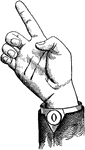
Consonants have a closed or narrowly expanded adjustment of the vocal organs, so that in their production some part of the throat or mouth obstructs, squeezes, or divides the breath. &hellip;in representing consonants the hand suggests a narrow adjustment of the organs, by having the prominent or accented fingers straightened and the second phalanx of the thumb close to the plane of the palm. <p> Non-Vocal Consonant positions have the voice phalanx of the thumb bent at right angles to the breath phalanx, or unaccented. Primary Consonant positions have only the first finger accented. Throat Consonant positions differ from those of the Back in having the index and center fingers separated.

Non-Vocal Primary Throat Consonant

Consonants have a closed or narrowly expanded adjustment of the vocal organs, so that in their production…
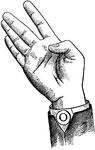
Consonants have a closed or narrowly expanded adjustment of the vocal organs, so that in their production some part of the throat or mouth obstructs, squeezes, or divides the breath. &hellip;in representing consonants the hand suggests a narrow adjustment of the organs, by having the prominent or accented fingers straightened and the second phalanx of the thumb close to the plane of the palm. <p> Non-Vocal Consonant positions have the voice phalanx of the thumb bent at right angles to the breath phalanx, or unaccented. Primary Consonant positions have only the first finger accented. Throat Consonant positions differ from those of the Back in having the index and center fingers separated.

Non-Vocal Primary Throat Consonant

Consonants have a closed or narrowly expanded adjustment of the vocal organs, so that in their production…
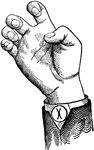
Consonants have a closed or narrowly expanded adjustment of the vocal organs, so that in their production some part of the throat or mouth obstructs, squeezes, or divides the breath. &hellip;in representing consonants the hand suggests a narrow adjustment of the organs, by having the prominent or accented fingers straightened and the second phalanx of the thumb close to the plane of the palm. <p> Non-Vocal Consonant positions have the voice phalanx of the thumb bent at right angles to the breath phalanx, or unaccented. Shut Consonant positions do not have any of the fingers accented. Throat Consonant positions differ from those of the Back in having the index and center fingers separated.

Non-Vocal Shut Throat Consonant

Consonants have a closed or narrowly expanded adjustment of the vocal organs, so that in their production…
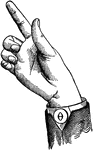
Consonants have a closed or narrowly expanded adjustment of the vocal organs, so that in their production some part of the throat or mouth obstructs, squeezes, or divides the breath. &hellip;in representing consonants the hand suggests a narrow adjustment of the organs, by having the prominent or accented fingers straightened and the second phalanx of the thumb close to the plane of the palm. <p> Vocalized Consonant positions have the voice phalanx of the thumb accented; that is, brought in line with the breath phalanx; this constitutes the only difference between the Vocalized and analogous Non-Vocal Consonant positions. Primary Consonant positions have only the first finger accented. Throat Consonant positions differ from those of the Back in having the index and center fingers separated.

Vocalized Primary Throat Consonant

Consonants have a closed or narrowly expanded adjustment of the vocal organs, so that in their production…

Glides are only transitional sounds. They are intermediate to Consonants and Vowels, combining the characteristics of certain central-aperture consonants with the wide or expanded quality of vowels, but differing from vowels in not having a fixed configuration. ...in representing glides the peculiarities of consonants and vowels are blended: the accented fingers, by being straightened, contribute a consonant characteristic; while the second phalanx of the thumb, by being held at an angle to the plane of the palm, imparts to the glide positions the wide, without giving them the firm, quality of vowel positions. <p> Breath-Glide - A transitional aspiration, of organic quality corresponding to that of the adjoining elements [a soft effect of the Consonants, back primary; top primary; Point primary; Lip primary; etc.]. Although this glide has no fixed abiding place, and is of a somewhat variable organic formation, in its effect it is very closely allied to the Throat consonant aspirate, and is therefore represented with a posterior position of the palm and a separation of the index and center fingers, which are characteristic features of Throat positions. This is the only Non-Vocal glide, and hence is the only one in the representation of which the voice phalanx is unaccented.

Breath-Glide

Glides are only transitional sounds. They are intermediate to Consonants and Vowels, combining the characteristics…
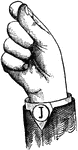
Vowels have a wide, firm, and free channel, whereby the breath is modified without friction or sibilation. &hellip; in representing vowels the hand suggests a wide and firm channel, by having the accented finger bent and its terminal phalanx brought firmly in contact with the terminal phalanx of the thumb. <p> Vowel positions are distinguished by always having the voice phalanx of the thumb accented and in contact with the terminal phalanx of the accented finger. This kind of accent is the strongest which can be given a finger, and so always takes precedence. Two modes of accentuation may not co-exist. Back Vowels have the palm in the posterior position. In Primary Vowel positions the accented voice phalanx of the thumb and the terminal phalanx of the accented finger overlap. None of the unaccented fingers are straightened. Low Vowels have the first or index finger accented.

Normal Aperture Back Primary Low Vowel

Vowels have a wide, firm, and free channel, whereby the breath is modified without friction or sibilation.…