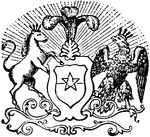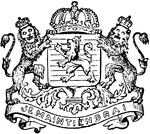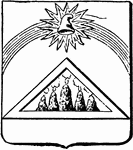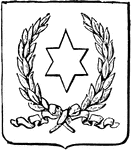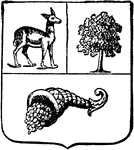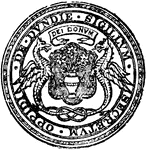
"A royal and parliamentary burgh and seaport, situated on the east coast of Scotland, in the county of Forfar, on the north bank of the Firth of Tay, twelve miles from the confluence of that estuary with the German Ocean. It is the third town in Scotland as regards to population, and the second in commercial importance." — Encyclopedia Britannica, 1893

Dundee

"A royal and parliamentary burgh and seaport, situated on the east coast of Scotland, in the county…

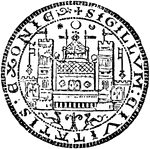
The seal for the civil corporation of Durham and Framwellgate.

Corporation Seal

The seal for the civil corporation of Durham and Framwellgate.

"Corporation Seal." &mdash Encyclopedia Britannica, 1893

Corporation Seal

"Corporation Seal." &mdash Encyclopedia Britannica, 1893

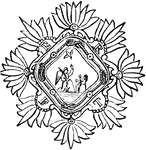
"Star of the order of the Thistle." — Chambers' Encyclopedia, 1875

Order of the Thistle

"Star of the order of the Thistle." — Chambers' Encyclopedia, 1875

"The religious Order of the Heavenly Annunciation, or of the Nuns of the Annunciation of Mary, was instituted by Victoria Fornare at Genoa in 1682, after the rule of St. Augustine. All the convents of the order in France, Germany, and the Netherlands have disappeared since the French Revolution. Some still exist in Italy." — Chambers' Encyclopedia, 1875

Order of the Annunciation

"The religious Order of the Heavenly Annunciation, or of the Nuns of the Annunciation of Mary, was instituted…
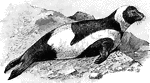
A seal which has many bands of white around black.

Ribbon Seal

A seal which has many bands of white around black.

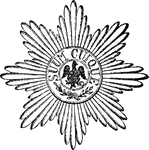
"Star of the Order of the Black Eagle." — Chambers' Encyclopedia, 1875

Black Eagle

"Star of the Order of the Black Eagle." — Chambers' Encyclopedia, 1875

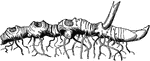
Rootstock of Solomon's Seal, with the bottom of the stalk of the season, and the bud for the next year's growth.

Solomon's Seal

Rootstock of Solomon's Seal, with the bottom of the stalk of the season, and the bud for the next year's…
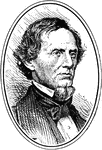
(1808-1889) President of the Confederate States of America. US Senator from Mississippi

Jefferson Davis

(1808-1889) President of the Confederate States of America. US Senator from Mississippi
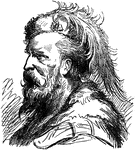
La Salle, a famous French adventurer who navigated the Mississippi down to the Gulf of Mexico.

La Salle

La Salle, a famous French adventurer who navigated the Mississippi down to the Gulf of Mexico.

Jefferson Davis, a senator from Mississippi who was elected president of the Confederate States of America. , US Senator from Mississippi.

Jefferson Davis

Jefferson Davis, a senator from Mississippi who was elected president of the Confederate States of America.…
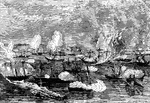
Depiction of the battle on the Mississippi between Confederate and Union forces at Forts Jackson and St. Philip.

Passage of Forts Jackson and St. Phillip

Depiction of the battle on the Mississippi between Confederate and Union forces at Forts Jackson and…
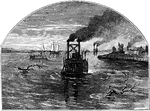
The Mississippi Valley lies between the predominant and secondary mountain-systems. It is over 300,000 square miles in area, and includes some of the most fertile land in the country.

Scene of Mississippi

The Mississippi Valley lies between the predominant and secondary mountain-systems. It is over 300,000…
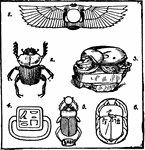
The ancient Egyptians regarded the scarab as a symbol of immortality. 1. Stone scarab with wings, 2. The sacred beetle (<em>Scarabaeus sacer</em>), 3. Scarab from the British Museum, 4. Scarab seal from the tomb of Maket, 5, 6. Scarabs from monuments.

Egyptian scarabs

The ancient Egyptians regarded the scarab as a symbol of immortality. 1. Stone scarab with wings, 2.…
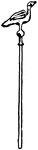
A sceptre from the seal of Edward the Confessor.

Sceptre of Edward the Confessor

A sceptre from the seal of Edward the Confessor.

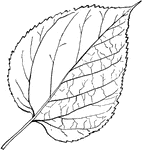
Leaves - simple; alternate; edge sharp-toothed, but entire at the base. Outline - obliquely egg-shaped, very one-sided. Apex - taper-pointed. Base - usually somewhat heart-shaped, or slightly pointed or rounded. Leaf - two to three inches long, one to two inches wide; rough. Bark - of the trunk, rough; sometimes much crumpled. Fruit - about the size of a pea; solitary; drooping from the bases of the leaf-stems, on stems once or twice as long as the leaf-stems; rounded; pulp thin, sweet, and edible; purplish red; ripe in September. Found - from the valley of the St. Lawrence westward and southward. General Information - A tree fifteen to thirty feet high (but much larger at the South), most common, and reaching its finest growth in the basin of the Mississippi. It is very variable in size and in the shape and texture of its leaves. Variety crassifolia is sometimes found, in which the leaves are thicker and usually toothed all around. Hackberry is an ancient name for lotus.

Genus Celtis, L. (Hackberry)

Leaves - simple; alternate; edge sharp-toothed, but entire at the base. Outline - obliquely egg-shaped,…
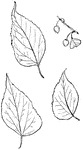
Leaves - simple; alternate; edge coarsely and somewhat irregularly toothed; or, at times, unequally and very variously two- to three-lobed. Outline - egg shape. Apex - long pointed (when there are side lobes their ends may be rounded). Base - heart-shaped, and more or less one-sided. Leaf - three to seven inches long, rather thin, rough above and downy below, sometimes becoming very smooth. The ribs are very distinct, and whitish below. Bark - grayish, and much broken. Berries - about the size and shape of small blackberries. When ripe they are very dark purple (nearly black), juicy, and sweet. July. Found - from Western New England, westward and southward. General Information - A tree fifteen to twenty-five feet high; in the Middle and Eastern States much larger. It is most common and reaches its finest growth along the lower Ohio and Mississippi rivers. Its wood is valuable, light, and soft, but very durable in contact with the ground. The White Mulberry (M. alba) is sometimes found around old houses and in fields. It was introduced from China, and was formerly cultivated as food for silk-worms. Its leaves resemble those of the Red Mulberry in shape, but are smooth and shining.

Genus Morus, L. (Mulberry)

Leaves - simple; alternate; edge coarsely and somewhat irregularly toothed; or, at times, unequally…
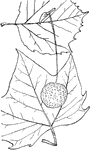
Leaves - simple; alternate; edge variable, either coarse-toothed or somewhat lobed; with the teeth or lobes sharp, and the hollows between them rounded. Outline - rounded. Apex - pointed. Base - more or less heart-shaped, squared, or rounded. Leaf/Stem - downy when young, smoothish when old; and covering the leaf-bud with its swollen base. Leaf - three and a half to eight inches wide, and usually broader than long; downy beneath when young, becoming smooth. Bark - the thin outer bark peels off each year in hard and brittle strips, leaving the branches and parts of the trunk with a mottled, whitish, polished-looking surface. Flowers - small, in compact, round balls (about one inch in diameter) like round buttons, which dry and harden, and cling to the branches by their slender stems (three to four inches long), and swing like little bells during a good part of the winter. Found - from Southern Main, southward and westward, in rich, moist soil, oftenest along streams. Its finest growth is in the bottom lands of the Mississippi and Ohio rivers. General Information - The largest of the trees of the Atlantic forests, commonly sixty to eighty feet high; along the western rivers often eighty to one hundred and thirty feet high, sometimes more, with a circumference of forty to fifty feet. A tree in Eaton, N. J., is one of the largest in the Sate. It is eighty-five feel high. At a point eight fee from the ground its circumference is fourteen feet three inches. The largest trunks are usually hollow.  The wood is hard and compact, difficult to split and work, of a reddish-brown color within. Its principle use is in the making of tobacco boxes. There is a fine and somewhat noted group of these trees on the grounds of James Know, in Knoxboro, N. Y. In old times they formed a favorite camping place for the Indians in their trading expeditions. They all measure not far from three feet in diameter. The name "sycamore," though a common one, should be dropped - it belongs to another and very different tree. From a Greek word meaning broad, in reference to the breadth of the buttonwood's shade or of its leaf.

Genus Platanus, L. (Buttonwood)

Leaves - simple; alternate; edge variable, either coarse-toothed or somewhat lobed; with the teeth or…
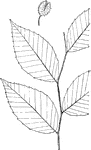
Leaves - simple; alternate; edge sharp-toothed, with small and remote teeth. Outline - oval or egg-shape. Apex - taper-pointed. Base - rounded. Leaf - three to six inches long, about half as wide; a very "finished" leaf; when young, fringed with soft white hairs; becoming smooth and polished; with distinct and straight unbranched side-ribs, ending in the teeth of the edge. The dead, bleached leaves often cling thickly to the branches throughout the winter. Bark - of the trunk, light gray, smooth, and unbroken. Fruit - a small four-celled prickly burr, splitting half-way to the base when ripe, and with two sweet, three-sided nuts in each shell.Found - in rich woods, Nova Scotia to Florida and westward, with it finest growth on the "bluffs" of the lower Mississippi basin. General Information - Large stately trees, with spreading branches and a delicate spray, fifty to eighty feet high. The wood is hard and very close-grained, and is used largely in the making of chairs, handles, plan-stocks, shoe-lasts, and for fuel. When the tree is not crowded, it sends out its nearly horizontal or drooping branches as low as from ten to thirty feet above the ground. Lumber-men make the distinction of "red Beech" and "White Beech," claiming that the former is harder, with a redder and thicker heart-wood.  Among woodsmen and the Indians, the Beech is said to be a favorite refuge in thunder-storms. They claim that it is scarcely ever struck by lightning. Lumber-men claim a difference in the quality of trees which retain their leaves and those which shed them. "Said a neighbor to me one day: 'You might 'a knowed that beech would split hard with all the dry leaves on it,' -- and it did. That was the first I'd ever heard of the sign, but I've never known it fail since."

Genus Fagus, L. (Beech)

Leaves - simple; alternate; edge sharp-toothed, with small and remote teeth. Outline - oval or egg-shape.…
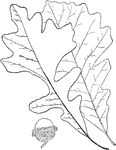
Leaves - simple; alternate; lobed (the edge of the lobes entire, or of the larger ones sometimes wavy). Outline - reverse egg-shape. Apex - of the lobes, rounded. Base - wedge-shape. Leaf - six to fifteen inches long (the longest of the oak-leaves); smooth above, downy beneath; the lobes usually long and rather irregular, the middle ones longest and often extending nearly to the middle rib. Bark - of the young branches always marked with corky wings or ridges. Acorns - large, with short stems. Cup - two thirds to two inches across, roughly covered with pointed scales, and heavily fringed around the nut. Nut - very large (one to one and a half inches long); broad egg-shape; one half to two thirds or often wholly enclosed by the cup. Found - along the coast of Maine southward as far as the Penobscot, in Western New England, in Western New York, in Pennsylvania, and thence westward to the foot-hills of the Rocky Mountains of Montana, and from Central Nebraska and Kansas southwest to the Indian Territory and Texas. It is found farther west and northwest than any other oak of the Atlantic forests. In the prairie region it forms a principal growth of the "Oak Openings." General Information - One of the most valuable and widely distributed oaks in North America, growing sixty to eighty feet in height, or more, with hard, tough wood resembling that of the White Oak. "The most interesting thing about this tree, perhaps is its power, quite unknown in the other White Oaks, of adapting itself to very different climatic conditions, which enables it to live in the humid climate of Maine and Vermont, to flourish in the somewhat drier climate of the Mississippi Valley, and to exist (still farther west) in the driest and most exposed region in habited by any of the Eastern America Oaks." - Sargent. Q. m. olivaformis is a variety found only in a few districts (near Albany and in Pennsylvania), having narrower and rather more deeply lobed leaves. Quercus, possible from a Celtic word meaning to inquire, because it was among the oaks that the Druids oftenest practised their rites.

Genus Quercus, L. (Oak)

Leaves - simple; alternate; lobed (the edge of the lobes entire, or of the larger ones sometimes wavy).…
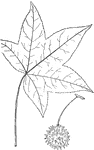
Leaves - simple; alternate; edge deeply lobed (lobes finely and sharply toothed throughout). Outline - rounded. The lobes are five to seven, radiating from the base. Apex - of the lobes, pointed. Base - of the leaf heart-shape. Leaf - three to seven inches in diameter, smooth and shining with a pleasant odor when bruised. Ribs tufted at their angles. Bark - gray; usually strongly winged with corky ridges along the branchlets. In the South, a spicy gum, from which the tree takes its name, oozes from the bark. Fruit - small woody pods are collected into a round ball. These usually contain a few good seeds and a large number of others that resemble saw-dust. September. Found - from Connecticut to Illinois, and southward. It reaches its finest growth and is very common in the bottom lands of the Mississippi basin. General Information - A fine tree sixty to seventy feel high, or southward one hundred feet and more. The wood is valuable, and would be better appreciated except for the difficulty of seasoning it. It is sometimes used as a substitute for Black Walnut, Its gum is used medicinally.

Genus Liquidamber, L. (Sweet Bum)

Leaves - simple; alternate; edge deeply lobed (lobes finely and sharply toothed throughout). Outline…
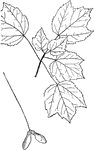
Leaves - simple; opposite; edge lobed, with the lobes irregularly sharp-toothed and notched. Outline - roundish, with three to five lobes (the lowest pair, if present, the smallest); and with the hollows between the lobes pointed and usually extending less than half-way to the base of the leaf. Apex - of the lobes, pointed. Base - heart-shaped (or sometimes rounded.) Leaf/Stem - long and round. Leaf - (very variable in size and in the toothing and shape of its lobes); whitish beneath. Bark - smoothish; gray, becoming dark and rough with age. Flowers - rich crimson, on short stems in drooping clusters. March, April. Fruit - bright red, smooth, with stems two to three inches long. The wings are about one inch long. At first they approach each other, but afterward are somewhat spreading. September.Found - widely distributed in swamps and along streams especially in all wet forests eastward from the Mississippi to the Atlantic, and from Southern Canada to Florida and Texas. General Information - A tree thirty to sixty feet high, with wood of considerable value, especially when it shows a "curly grain." It is one of the very earliest trees to blossom in the spring, and to show its autumn coloring in the fall.

Genus Acer, L. (Maple)

Leaves - simple; opposite; edge lobed, with the lobes irregularly sharp-toothed and notched. Outline…
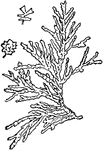
Leaves - simple; indeterminate in position because of their smallness and closeness. They are scale-like, somewhat egg-shape, overlapping each other, and closely pressed in four rows up and down the very flat branchlets. Each leaf has at its centre a raised gland, easily distinguished if held between the eye and the light. Bark - fibrous. The "spray" (formed from the flat branchlets) is itself flat and very delicate and of a dull green. Cones - about one fourth of an inch in diameter, round, variously placed, compact, purplish as they ripen; opening when ripe toward the centre line (i. e., not toward its base). Scales - fleshy, shield-shaped and apparently fastened near their centres, with the edge several-pointed, and with a sharp point or knob in the centre. Seeds - usually four to eight under each scale, oval, with wide wings at the sides. Found - in deep, cold swamps (filling them densely and exclusively), from Southern Maine along the coast to Florida, and along the Gulf coast to Mississippi. General Information - A tapering evergreen tree, thirty to seventy feet high, with light and durable wood, largely used in boat-building, for wooden-ware, shingles, etc.

Genus Chamaecyparis, Spach. (White Cedar)

Leaves - simple; indeterminate in position because of their smallness and closeness. They are scale-like,…
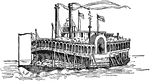
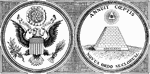
Mississippi River Steamer

Steamer

Mississippi River Steamer

The seal of the United States.

United States Seal

The seal of the United States.

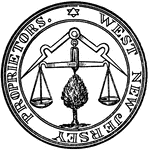
The seal of the western part of the New Jersey colony.

Seal of West Jersey

The seal of the western part of the New Jersey colony.

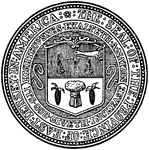
The seal of the eastern part of the New Jersey colony.

Seal of East Jersey

The seal of the eastern part of the New Jersey colony.

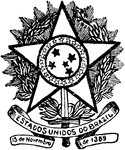
The coat of arms of Brazil.

Brazilian Coat of Arms

The coat of arms of Brazil.

The coat of arms of Chile.

Chilean Coat of Arms

The coat of arms of Chile.

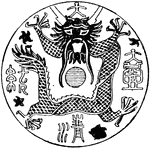
The coat of arms of China.

Chinese Coat of Arms

The coat of arms of China.

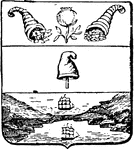
The coat of arms of Colombia.

Colombian Coat of Arms

The coat of arms of Colombia.

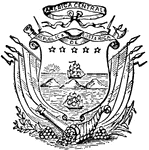
The coat of arms of Costa Rica.

Costa Rican Coat of Arms

The coat of arms of Costa Rica.

The coat of arms of Dominican Republic.

Dominican Republic Coat of Arms

The coat of arms of Dominican Republic.

The Coat of Arms of Ecuador.

Ecuador Coat of Arms

The Coat of Arms of Ecuador.

The Coat of Arms of Egypt.

Egyptian Coat of Arms

The Coat of Arms of Egypt.

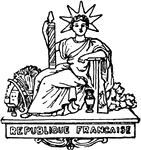
The Coat of Arms of France.

French Coat of Arms

The Coat of Arms of France.

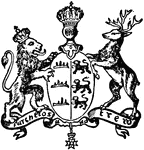
The Coat of Arms of Wurtemberg.

Wurtemberg Coat of Arms

The Coat of Arms of Wurtemberg.

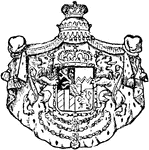
The Coat of Arms of Bavaria.

Bavarian Coat of Arms

The Coat of Arms of Bavaria.

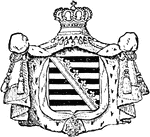
The Coat of Arms of Saxony.

Saxony Coat of Arms

The Coat of Arms of Saxony.

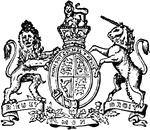
The Coat of Arms of Great Britain.

Great Britain Coat of Arms

The Coat of Arms of Great Britain.

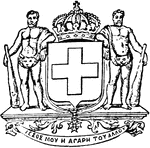
The Coat of Arms of Greece.

Greek Coat of Arms

The Coat of Arms of Greece.

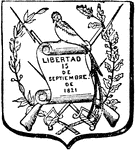
The Coat of Arms of Guatemala.

Guatemalan Coat of Arms

The Coat of Arms of Guatemala.

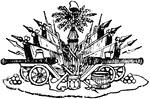
The Coat of Arms of Haiti.

Haitian Coat of Arms

The Coat of Arms of Haiti.

The Coat of Arms of Honduras.

Honduran Coat of Arms

The Coat of Arms of Honduras.

The seal of the Seminole Nation.

Seminole Seal

The seal of the Seminole Nation.

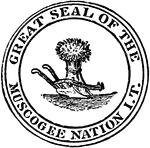
The seal of the Muscogee Nation.

Muscogee Seal

The seal of the Muscogee Nation.

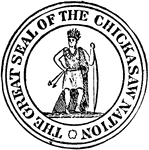
The seal of the Chickasaw Nation.

Chickasaw Seal

The seal of the Chickasaw Nation.

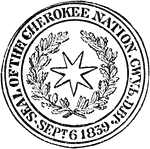
The seal of the Cherokee Nation.

Cherokee Seal

The seal of the Cherokee Nation.

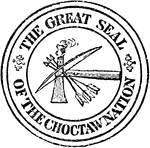
The seal of the Choctaw Nation.

Choctaw Seal

The seal of the Choctaw Nation.

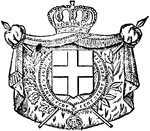
The Coat of Arms of Italy.

Italian Coat of Arms

The Coat of Arms of Italy.

The Coat of Arms of Mexico.

Mexican Coat of Arms

The Coat of Arms of Mexico.

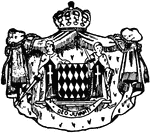
The Coat of Arms of Monaco.

Monaco Coat of Arms

The Coat of Arms of Monaco.

The Coat of Arms of the Netherlands.

Netherlands Coat of Arms

The Coat of Arms of the Netherlands.

The Coat of Arms of Nicaragua.

Nicaraguan Coat of Arms

The Coat of Arms of Nicaragua.

The Coat of Arms of Paraguay.

Paraguay Coat of Arms

The Coat of Arms of Paraguay.

The Coat of Arms of Peru.

Peruvian Coat of Arms

The Coat of Arms of Peru.

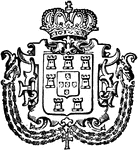
The Coat of Arms of Portugal.

Portuguese Coat of Arms

The Coat of Arms of Portugal.

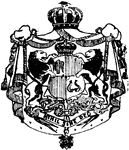
The Coat of Arms of Romania.

Romanian Coat of Arms

The Coat of Arms of Romania.

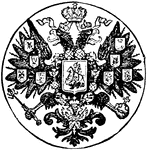
The Coat of Arms of Russia.

Russian Coat of Arms

The Coat of Arms of Russia.

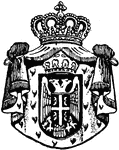
The Coat of Arms of Serbia.

Serbian Coat of Arms

The Coat of Arms of Serbia.