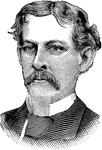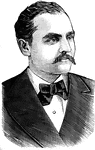
Comstock served in the Civil War and created the New York Society for the Suppression of Vice. He is also famous for the Comstock law and the term <em>comstockery</em> meaning censorship because of perceived obscenity or immorality.

Anthony Comstock

Comstock served in the Civil War and created the New York Society for the Suppression of Vice. He is…

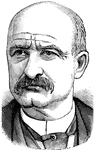
Pulitzer was a journalist and purchased the <em>New York World</em>. The Pulitzer Prizes were first given out in 1917.

Joseph Pulitzer

Pulitzer was a journalist and purchased the New York World. The Pulitzer Prizes were first…
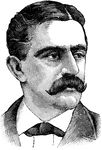
Fairchild was Attorney General of New York and U.S. Secretary of the Treasury. Fairchild also was president of Atlanta and Charlotte Air Line Railroad and director of the Erie and Pittsburgh Railroad.

Charles Stebbins Fairchild

Fairchild was Attorney General of New York and U.S. Secretary of the Treasury. Fairchild also was president…
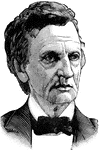
(1818-1901) US Secretary of State, US Attorney General and Senator from New York.

William Maxwell Evarts

(1818-1901) US Secretary of State, US Attorney General and Senator from New York.
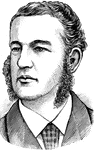
Known as the Commodore Vanderbilt and director of the Long Island Rail Road.

Cornelius Vanderbilt

Known as the Commodore Vanderbilt and director of the Long Island Rail Road.

Son of the founder of the New York "Herald" and became proprietor when his father died.

James Gordon Bennett

Son of the founder of the New York "Herald" and became proprietor when his father died.
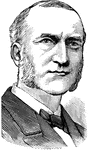
President of the New York Central railroad.

Chauncey M. Depew

President of the New York Central railroad.

Superintendent of the New Jersey Southern railroad and New York and Long Branch railroad.

Rufus Blodgett

Superintendent of the New Jersey Southern railroad and New York and Long Branch railroad.

Prof. Adler was a Jewish intellectual who founded the Society for Ethical Culture in New York City.
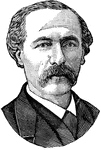
Felix Adler

Prof. Adler was a Jewish intellectual who founded the Society for Ethical Culture in New York City.
Journalist and correspondent of the New York <em>Tribune</em> and the St. Louis <em>Democrat</em>.

James Redpath

Journalist and correspondent of the New York Tribune and the St. Louis Democrat.

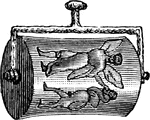
"A Cylinder Seal" &mdash; Morey, 1903

Cylinder Seal

"A Cylinder Seal" — Morey, 1903

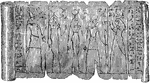
"Papyrus, from the Collection of the New York Historical Society." — Quackenbos, 1882

Papyrus

"Papyrus, from the Collection of the New York Historical Society." — Quackenbos, 1882

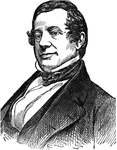
"This distinguished American author was born in the city of New York, April 3, 1783." &mdash;The Popular Cyclopedia, 1888

Washington Irving

"This distinguished American author was born in the city of New York, April 3, 1783." —The Popular…
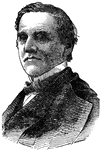
Samuel Jones Tilden (February 9, 1814 – August 4, 1886) was the 25th Governor of New York and the Democratic candidate for the U.S. Presidency in the disputed election of 1876, winning a popular vote majority, but ultimately being denied victory by the electoral college.

Samuel J. Tilden

Samuel Jones Tilden (February 9, 1814 – August 4, 1886) was the 25th Governor of New York and the…
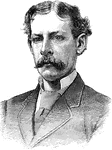
James Gordon Bennett Jr. was publisher of <em>New York Herald</em> newspaper.

James Gordon Bennett

James Gordon Bennett Jr. was publisher of New York Herald newspaper.

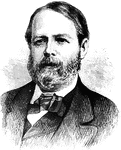
George Jones was publisher of <em>New York Times</em> newspaper.

George Jones

George Jones was publisher of New York Times newspaper.

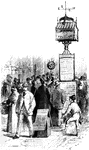
The Express Bulletin in New York City.

Express Bulletin

The Express Bulletin in New York City.

A recessed balcony, W. H. Vanderbilt's House, Fifth Avenue. Herter Brothers, Architects.

Recessed Balcony

A recessed balcony, W. H. Vanderbilt's House, Fifth Avenue. Herter Brothers, Architects.
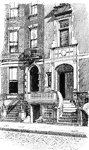
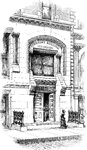
Doorways on Madison Avenue. G. E. Harney, and McKim, Mead, and White, Archiects.

Doorways

Doorways on Madison Avenue. G. E. Harney, and McKim, Mead, and White, Archiects.

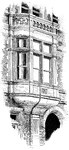
An oriel is a bay window that projects from an upper floor of a building. This example is from a house on Fifty-Fourth Street in New York. C. C. Haight, Architect.

Oriel

An oriel is a bay window that projects from an upper floor of a building. This example is from a house…
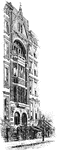
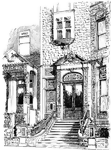
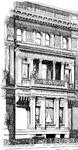
House in Fifty-Sixth Street, New York. Bruce Price, Architect.

House

House in Fifty-Sixth Street, New York. Bruce Price, Architect.

Doorway at Fifth Avenue and Sixty-Seventh Street in New York. Lamb and Rich, Architects.

Fifth Avenue

Doorway at Fifth Avenue and Sixty-Seventh Street in New York. Lamb and Rich, Architects.
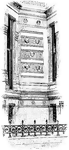
From ex-governor Tilden's House. Calvert Vaux, Architect.

Tilden's House

From ex-governor Tilden's House. Calvert Vaux, Architect.

Doorway of Guernsey Building, Broadway, New York City. R. M. Hunt, Architect

Guernsey Building

Doorway of Guernsey Building, Broadway, New York City. R. M. Hunt, Architect

Post Building in New York. George B. Post, Architect.

Post Building

Post Building in New York. George B. Post, Architect.

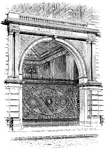
Gateway of Mills Building in New York. George B. Post, Architect.

Mills Building

Gateway of Mills Building in New York. George B. Post, Architect.

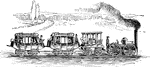
A railroad train in New York State, 1831.

Railroad Train

A railroad train in New York State, 1831.

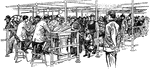
Immigrants arriving at Ellis Island, New York.

Ellis Island

Immigrants arriving at Ellis Island, New York.

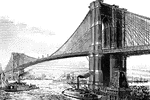
The East River suspension bridge of New York City.

East River

The East River suspension bridge of New York City.

A famous author who produced works such as <em>History of the Ciry of New York</em> and was the editor of the <em>Magazine of American History.</em>

Martha Lamb

A famous author who produced works such as History of the Ciry of New York and was the editor…
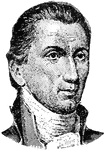
The fifth president of the United States, born in Westmoreland county, Virginia, April 28, 1758; died in New York City, July 4, 1831.

James Monroe

The fifth president of the United States, born in Westmoreland county, Virginia, April 28, 1758; died…
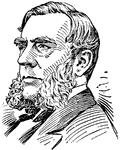
A statesman born in Washington, Mass., Feb. 8, 1811; died in New York city, Feb. 14, 1883.

Edwin Morgan

A statesman born in Washington, Mass., Feb. 8, 1811; died in New York city, Feb. 14, 1883.

An artist and an inventor, born in Charlestown, Mass., April 27, 1791; died in New York City, April 2, 1872.

Samuel Morse

An artist and an inventor, born in Charlestown, Mass., April 27, 1791; died in New York City, April…
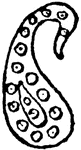
"Also known as the cone, the palm leaf, the river loop, the crown jewel, the seal, the almond, the feather, the boquet, and the flame. There is a vast difference of opinion as to the origin and meaning of this motif. Some authorities claim it was intended for the fir cone, which served as an emblem of immortality and was revered by the ancients; some say it was intended for the palm leaf, which has been handed down by the Greeks as a symbol of victory; others say it was intended to represent a loop which the river Indus makes on a vast plain in upper Cashmere as seen from the Mosque. By some it is said to represent the crown jewels or chief ornament in the old Iranian crown, which is a composite jewel of pear shape. Tradition tells us that the signing of documents in such a manner was a custom well known in the East. This design has also been called the almond, the feather, the bouquet, and the flame on account of its fancied resemblance to these objects. We have selected the name "pear" because the image it conveys is more clearly recognized by the western mind. It is that which its shape most suggests. The Pear design is common in many kinds of rugs, especially in those of Persia and Kurdistan, but it varies greatly in varieties of form and size. The large size is usually employed in the Caucasus and Southern Persia, while the small size is used more frequently in Central and Western Persia. In the Saraband, Shiraz, Herat, Khorasan, and Senna, it frequently covers the whole field. In the two former alternate rows usually have the stems of the pears turned in opposite directions, while in the three latter the stems are usually turned in the same direction."

Pear Design

"Also known as the cone, the palm leaf, the river loop, the crown jewel, the seal, the almond, the feather,…
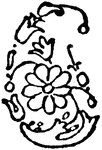
"Also known as the cone, the palm leaf, the river loop, the crown jewel, the seal, the almond, the feather, the boquet, and the flame. There is a vast difference of opinion as to the origin and meaning of this motif. Some authorities claim it was intended for the fir cone, which served as an emblem of immortality and was revered by the ancients; some say it was intended for the palm leaf, which has been handed down by the Greeks as a symbol of victory; others say it was intended to represent a loop which the river Indus makes on a vast plain in upper Cashmere as seen from the Mosque. By some it is said to represent the crown jewels or chief ornament in the old Iranian crown, which is a composite jewel of pear shape. Tradition tells us that the signing of documents in such a manner was a custom well known in the East. This design has also been called the almond, the feather, the bouquet, and the flame on account of its fancied resemblance to these objects. We have selected the name "pear" because the image it conveys is more clearly recognized by the western mind. It is that which its shape most suggests. The Pear design is common in many kinds of rugs, especially in those of Persia and Kurdistan, but it varies greatly in varieties of form and size. The large size is usually employed in the Caucasus and Southern Persia, while the small size is used more frequently in Central and Western Persia. In the Saraband, Shiraz, Herat, Khorasan, and Senna, it frequently covers the whole field. In the two former alternate rows usually have the stems of the pears turned in opposite directions, while in the three latter the stems are usually turned in the same direction."

Pear Design

"Also known as the cone, the palm leaf, the river loop, the crown jewel, the seal, the almond, the feather,…
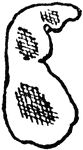
"Also known as the cone, the palm leaf, the river loop, the crown jewel, the seal, the almond, the feather, the boquet, and the flame. There is a vast difference of opinion as to the origin and meaning of this motif. Some authorities claim it was intended for the fir cone, which served as an emblem of immortality and was revered by the ancients; some say it was intended for the palm leaf, which has been handed down by the Greeks as a symbol of victory; others say it was intended to represent a loop which the river Indus makes on a vast plain in upper Cashmere as seen from the Mosque. By some it is said to represent the crown jewels or chief ornament in the old Iranian crown, which is a composite jewel of pear shape. Tradition tells us that the signing of documents in such a manner was a custom well known in the East. This design has also been called the almond, the feather, the bouquet, and the flame on account of its fancied resemblance to these objects. We have selected the name "pear" because the image it conveys is more clearly recognized by the western mind. It is that which its shape most suggests. The Pear design is common in many kinds of rugs, especially in those of Persia and Kurdistan, but it varies greatly in varieties of form and size. The large size is usually employed in the Caucasus and Southern Persia, while the small size is used more frequently in Central and Western Persia. In the Saraband, Shiraz, Herat, Khorasan, and Senna, it frequently covers the whole field. In the two former alternate rows usually have the stems of the pears turned in opposite directions, while in the three latter the stems are usually turned in the same direction."

Pear Design

"Also known as the cone, the palm leaf, the river loop, the crown jewel, the seal, the almond, the feather,…

"Also known as the cone, the palm leaf, the river loop, the crown jewel, the seal, the almond, the feather, the boquet, and the flame. There is a vast difference of opinion as to the origin and meaning of this motif. Some authorities claim it was intended for the fir cone, which served as an emblem of immortality and was revered by the ancients; some say it was intended for the palm leaf, which has been handed down by the Greeks as a symbol of victory; others say it was intended to represent a loop which the river Indus makes on a vast plain in upper Cashmere as seen from the Mosque. By some it is said to represent the crown jewels or chief ornament in the old Iranian crown, which is a composite jewel of pear shape. Tradition tells us that the signing of documents in such a manner was a custom well known in the East. This design has also been called the almond, the feather, the bouquet, and the flame on account of its fancied resemblance to these objects. We have selected the name "pear" because the image it conveys is more clearly recognized by the western mind. It is that which its shape most suggests. The Pear design is common in many kinds of rugs, especially in those of Persia and Kurdistan, but it varies greatly in varieties of form and size. The large size is usually employed in the Caucasus and Southern Persia, while the small size is used more frequently in Central and Western Persia. In the Saraband, Shiraz, Herat, Khorasan, and Senna, it frequently covers the whole field. In the two former alternate rows usually have the stems of the pears turned in opposite directions, while in the three latter the stems are usually turned in the same direction."

Pear Design

"Also known as the cone, the palm leaf, the river loop, the crown jewel, the seal, the almond, the feather,…
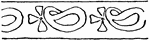
"Also known as the cone, the palm leaf, the river loop, the crown jewel, the seal, the almond, the feather, the boquet, and the flame. There is a vast difference of opinion as to the origin and meaning of this motif. Some authorities claim it was intended for the fir cone, which served as an emblem of immortality and was revered by the ancients; some say it was intended for the palm leaf, which has been handed down by the Greeks as a symbol of victory; others say it was intended to represent a loop which the river Indus makes on a vast plain in upper Cashmere as seen from the Mosque. By some it is said to represent the crown jewels or chief ornament in the old Iranian crown, which is a composite jewel of pear shape. Tradition tells us that the signing of documents in such a manner was a custom well known in the East. This design has also been called the almond, the feather, the bouquet, and the flame on account of its fancied resemblance to these objects. We have selected the name "pear" because the image it conveys is more clearly recognized by the western mind. It is that which its shape most suggests. The Pear design is common in many kinds of rugs, especially in those of Persia and Kurdistan, but it varies greatly in varieties of form and size. The large size is usually employed in the Caucasus and Southern Persia, while the small size is used more frequently in Central and Western Persia. In the Saraband, Shiraz, Herat, Khorasan, and Senna, it frequently covers the whole field. In the two former alternate rows usually have the stems of the pears turned in opposite directions, while in the three latter the stems are usually turned in the same direction."

Pear Design

"Also known as the cone, the palm leaf, the river loop, the crown jewel, the seal, the almond, the feather,…
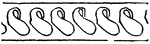
"Also known as the cone, the palm leaf, the river loop, the crown jewel, the seal, the almond, the feather, the boquet, and the flame. There is a vast difference of opinion as to the origin and meaning of this motif. Some authorities claim it was intended for the fir cone, which served as an emblem of immortality and was revered by the ancients; some say it was intended for the palm leaf, which has been handed down by the Greeks as a symbol of victory; others say it was intended to represent a loop which the river Indus makes on a vast plain in upper Cashmere as seen from the Mosque. By some it is said to represent the crown jewels or chief ornament in the old Iranian crown, which is a composite jewel of pear shape. Tradition tells us that the signing of documents in such a manner was a custom well known in the East. This design has also been called the almond, the feather, the bouquet, and the flame on account of its fancied resemblance to these objects. We have selected the name "pear" because the image it conveys is more clearly recognized by the western mind. It is that which its shape most suggests. The Pear design is common in many kinds of rugs, especially in those of Persia and Kurdistan, but it varies greatly in varieties of form and size. The large size is usually employed in the Caucasus and Southern Persia, while the small size is used more frequently in Central and Western Persia. In the Saraband, Shiraz, Herat, Khorasan, and Senna, it frequently covers the whole field. In the two former alternate rows usually have the stems of the pears turned in opposite directions, while in the three latter the stems are usually turned in the same direction."

Pear Design

"Also known as the cone, the palm leaf, the river loop, the crown jewel, the seal, the almond, the feather,…
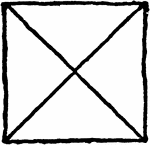
Built on the right angle triangle and, like the Signet of David, it is found in many of the Turkish and Caucasian fabrics and to it scores of patterns may be traced.

Solomon's Seal

Built on the right angle triangle and, like the Signet of David, it is found in many of the Turkish…
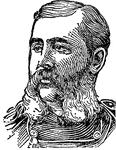
A soldier born in Frederick City, Maryland, March 25, 1838. After graduating at Rochester University, New York, in 1858, he was admitted to practice law in New York, but in 1862 entered the United States army, remaining with the 140th regiment to the close of the war.

Elwell Otis

A soldier born in Frederick City, Maryland, March 25, 1838. After graduating at Rochester University,…

An American clergyman and social reformer, born in Framingham, Massachusetts. Although scholarly and reserved, he preached two sermons in 1892 in which he attacked the political corruption of New York City government. Backed by the evidence he collected, his statements led to both the exposure of Tammany Hall and to subsequent social and political reforms.

Charles Parkhurst

An American clergyman and social reformer, born in Framingham, Massachusetts. Although scholarly and…
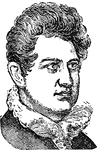
Actor and dramatist, born in New York City, June 9, 1792; died in Tunis, April 10, 1852. He was employed in a New York counting-house at an early age. While there, he edited the "Thespian Mirror."

John Howard Payne

Actor and dramatist, born in New York City, June 9, 1792; died in Tunis, April 10, 1852. He was employed…
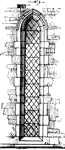
"The cathedrals of Salisbury, Chichester, Lincoln, and York, Beverley Minster, and Westminster Abbey, contain specimens of Early English windows." &mdash;D'Anvers, 1895

Early English window

"The cathedrals of Salisbury, Chichester, Lincoln, and York, Beverley Minster, and Westminster Abbey,…
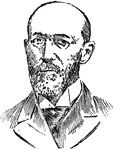
A three term U.S. Senator from New York in the years 1887 and 1897-1909.

Thomas Platt

A three term U.S. Senator from New York in the years 1887 and 1897-1909.

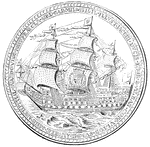
"Medal struck in honour of James Duke of York. By Thomas Simon." &mdash;D'Anvers, 1895

Medal

"Medal struck in honour of James Duke of York. By Thomas Simon." —D'Anvers, 1895

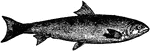
The common name of a class of food fishes belonging to the genus salmo. They are common to both salt fresh waters, and are particularly abundant in the North Atlantic. There are a number of well-known species, all of which are among the most important marketable fishes, but those of the North Atlantic are most widely distributed, ranging north of New york in North America and north of Spain in Europe.

Salmon

The common name of a class of food fishes belonging to the genus salmo. They are common to both salt…
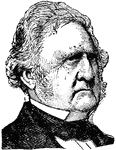
A distinguished general, born in Petersburg, Virginia, June 13, 1786; died at West Point, New York, May 29, 1866.

Winfield Scott

A distinguished general, born in Petersburg, Virginia, June 13, 1786; died at West Point, New York,…
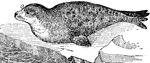
The general name of certain genera of carnivorous mammals, havin feet adapted for swimming, and being able to live both in and out of water.

Seal

The general name of certain genera of carnivorous mammals, havin feet adapted for swimming, and being…
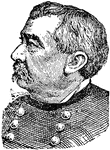
Eminent military leader, born in Albany, New York, March 6, 1831; died at Nonquitt, Mass., Aug. 5, 1888. His parents came from Ireland and settled in Albany a short time before his birth, but soon after removed to Ohio, where he attended the public schools.

Philip Sheridan

Eminent military leader, born in Albany, New York, March 6, 1831; died at Nonquitt, Mass., Aug. 5, 1888.…
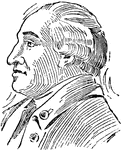
An eminent general, born in Magdeburg, Germany, Nov. 15, 1730; died at Steubenville, near Utica, New York, Nov. 28, 1794.

Frederick Steuben

An eminent general, born in Magdeburg, Germany, Nov. 15, 1730; died at Steubenville, near Utica, New…
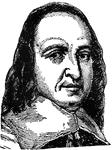
A director-general of the New Netherlands, born in Holland in 1602; died in New York City in 1682.
Peter Stuyvesant

A director-general of the New Netherlands, born in Holland in 1602; died in New York City in 1682.

An American politician. He served in the United States House of Representatives from Minnesota as a Republican and from New York as a Democrat. Towne also served in the United States Senate from Minnosota as a Democrat.

Charles Towne

An American politician. He served in the United States House of Representatives from Minnesota as a…

A popular American author born in Ogden, New York to Windor Stone Trowbridge and Rebecca Willey. His papers are located at the Houghton Library at Harvard University.

John Trowbridge

A popular American author born in Ogden, New York to Windor Stone Trowbridge and Rebecca Willey. His…
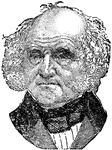
The eighth president of the United States, born in Kinderhook, New York, Dec. 5, 1782; died there July 24, 1862.

Martin Van Buren

The eighth president of the United States, born in Kinderhook, New York, Dec. 5, 1782; died there July…
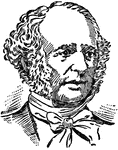
A capitalist and philanthropist, born near Stapleton, Staten Island, New York, May 27, 1794; died in New York City, Jan. 4, 1877.

Cornelius Vanderbilt

A capitalist and philanthropist, born near Stapleton, Staten Island, New York, May 27, 1794; died in…
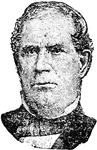
Journalist, born in Cairo, New York, Nov. 15, 1797; died in New York City, Nov. 22, 1882.

Thurlow Weed

Journalist, born in Cairo, New York, Nov. 15, 1797; died in New York City, Nov. 22, 1882.
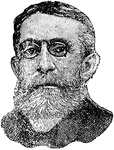
An educator and diplomatist, born in Homer, New York, Nov. 7, 1832.

Andrew Dickson White

An educator and diplomatist, born in Homer, New York, Nov. 7, 1832.

A poet, born in West Hills, Long Island, New York, May 31, 1819; died in Camden, New Jersey, March 25, 1892.

Walt Whitman

A poet, born in West Hills, Long Island, New York, May 31, 1819; died in Camden, New Jersey, March 25,…
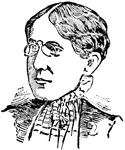
A lecturer and reformer, born in Churchville, New York, Sept. 28, 1839; died in New York City, Feb. 18, 1898.

Frances Willard

A lecturer and reformer, born in Churchville, New York, Sept. 28, 1839; died in New York City, Feb.…