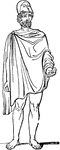
"The English cloak, though commonly adopted as the translation of these terms, conveys no accurate conception of the form, material, or use of that which they denoted. The article designated by them was always a rectangular piece of cloth, exactly, or at least nearly square. It was indeed used in the very form in which it was taken from the loom, being made entirely by the weaver, without any aid from the tailor except to repair the injuries which it sustained by time. Whatever additional richness and beauty it received from the art of the dyer, was bestowed upon it before its materials were woven into cloth or even spun into thread. Most commonly it was used without having undergone any process of this kind. The raw material, such as wool, flax, or cotton, was manufactured in its natural state, and hence pallia were commonly white, although from the same cause brown, drab, and gray, were also prevailing colours." — Smith, 1873

Palium

"The English cloak, though commonly adopted as the translation of these terms, conveys no accurate conception…
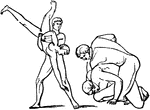
"An athletic game, in which all the powers of the fighter were called into action. The pancratium was one of the games or gymnastic contests which were exhibited at all the great festivals of Greece; it consisted of boxing and wrestling, and was reckoned to be one of the heavy or hard exercises, on account of the violent exertions it required, and for this reason it was not much practised in the gymnasia. In Homer we find neither the game nor the name of the pancratium mentioned, and as it was not introduced at the Olympic games until Ol. 33, we may presume that the game, though it may have existed long before in a rude state, was not brought to any degree of perfection until a short time before that event. The name of the combatants was Pancratiastae, or Pammachi. They fought naked, and had their bodies anointed and covered with sand, by which they were enabled to take hold of one another. When the contest began, each of the fighters might commence by boxing or by wrestling, accordingly as he thought he should be more successful in the one than in the other. The victory was not decided until one of the parties was killed, or lifted up a finger, thereby declaring that he was unable to continue the contest either from pain or fatigue." — Smith, 1873

Pancratium

"An athletic game, in which all the powers of the fighter were called into action. The pancratium was…
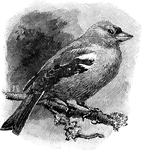
A common European bird whose pleasant short and often repeated song is haerd fro early spring to the middle of summer.

Chaffinch

A common European bird whose pleasant short and often repeated song is haerd fro early spring to the…
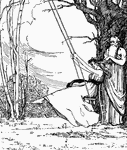
Scene from the story, "In Time's Swing."

Time's Swing

Scene from the story, "In Time's Swing."

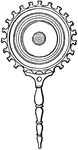
"Speculum, a mirror, a looking-glass. The looking-glasses of the ancients were usually made of metal, at first of a composition of tin and copper, but afterwards more frequently of silver. The ancients seem to have had glass mirrors also like ours, consisting of a glass plate covered at the back with a thin leaf of metal. They were manufactured as early as the time of Pliny at the celebrated glass-houses at Sidon, but they must have been inferior to those of metal, since they never came into general use, and are never mentioned by ancient writers among costly pieces of furniture, whereas metal mirrors frequently are. Looking-glasses were generally small, and such as could by carried in the hand. Instead of their being fixed so as to be hung against the wall or to stand upon the table or floor, they were generally held by female slaves before their mistresses when dressing. The general form of looking-glasses is shown in the following wood-cut." — Smith, 1873

Speculum

"Speculum, a mirror, a looking-glass. The looking-glasses of the ancients were usually made of metal,…
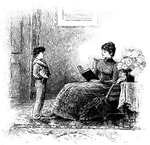
A mother reading to her son

Story Time

A mother reading to her son

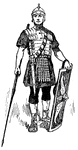
Roman soldier with short trousers.

Trousers

Roman soldier with short trousers.

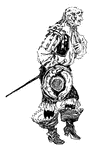
What a Cavalier wore. The name Cavalier originally related to political and social attitudes and behaviour, of which clothing was a very small part, it has subsequently become strongly identified with the fashionable clothing of the court at the time for supporters of King Charles I and his son Charles II during the English Civil War, the Interregnum, and the Restoration (1642 – c. 1679).

Cavalier

What a Cavalier wore. The name Cavalier originally related to political and social attitudes and behaviour,…
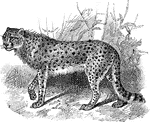
A hunting leopard. Has a short mane crest of hairs passing from the back of he head to the sholders. A very fast runner.

Cheetah

A hunting leopard. Has a short mane crest of hairs passing from the back of he head to the sholders.…
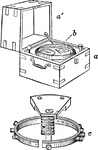
An instrument that measures time in a precise manner.

Chronometer

An instrument that measures time in a precise manner.

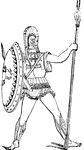
"The early Greeks used a very short sword, as may be seen from the preceding cut. The ancient Homeric sword had generally a straight, two-edged blade, rather broad, and nearly of equal width from hilt to point." — Anthon, 1891

Greek soldier

"The early Greeks used a very short sword, as may be seen from the preceding cut. The ancient Homeric…
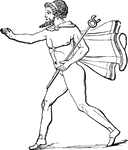
"Mercury, with his caduceus, summons the souls of the departed from Orcus, or the low world, as in the case of Protesilaus, for example, who obtained permission from Pluto and Proserpina to visit for a short period the regions of light." — Anthon, 1891

Mercury with caduceus

"Mercury, with his caduceus, summons the souls of the departed from Orcus, or the low world, as in the…
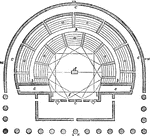
"Theatrum, a theatre. The Athenians before the time of Aeschylus had only a wooden scaffolding on which their dramas were performed. Such a wooden theatre was only erected for the time of the Dionysiac festivals, and was afterwards pulled down. The first drama that Aeschylus brought upon the stage was performed upon such a wooden scaffold, and it is recorded as a singular and ominous coincidence that on that occasion (500 b.c.) the scaffolding broke down. To prevent the recurrence of such an accident, the building of a stone theatre was forthwith commenced on the south-eastern descent of the Acropolis, in the Lenaea; for it should be observed, that throughout Greece theatres were always built upon eminences, or on the sloping side of a hill." &mdash Smith; 1873

Theatrum

"Theatrum, a theatre. The Athenians before the time of Aeschylus had only a wooden scaffolding on which…
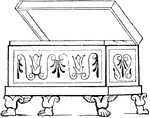
"In makin Aeneas burn incense, Virgil follows the custom of his own time rather than historical verity." — Anthon, 1891

Ancient censer

"In makin Aeneas burn incense, Virgil follows the custom of his own time rather than historical verity."…
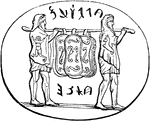
"According to the ancient authorities, it was made of bronze, and its form was oval, but with the two sides receding inward with an even curvature, and so as to make it broader at the ends than in the middle. The original ancile was said to have fallen from the skies in the time of Numa. To secure its preservation, Numa ordered eleven other shields to be made exactly like it. These twelve <em>ancilia</em> were kept in the temple of Mars Gradivus, and were taken from it only once a year, on the kalends of March. The feast of the god was then observed during several days; when the Salii, or priests of Mars, twelve in number, carried the sacred shields about the city, singing songs in praise of Mars, Numa, and Mamurius Veturius, who made the eleven. They at the same time performed a dance, in which they struck the shield with rods, so as to keep time with their voices and with the movements of the dance." &mdash; Anthon, 1891

Ancilia

"According to the ancient authorities, it was made of bronze, and its form was oval, but with the two…
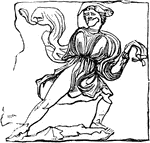
"Tunica, an under-garment. Greek. The chiton was the only kind of under-garment, worn by the Greeks. Of this there were two kinds, the Dorian and Ionian. The Dorian chiton, as worn by males, was a short woollen shirt, without sleeves; the Ionian was a long linen garment, with sleeves. The former seems to have been originally worn throughout the whole Greece; the latter was brought over to Greece by the Ionians of Asia. The Ionic chiton was commonly worn at Athens by men during the Persian wars, but it appears to have entirely gone out of fashion for the male sex about the time of Pericles, from which time the Dorian chiton was the under-garment universally adopted by men through the whole of Greece." &mdash; Smith; 1873

Tunica

"Tunica, an under-garment. Greek. The chiton was the only kind of under-garment, worn by the Greeks.…
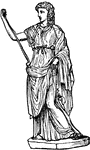
"Tunica, an under-garment. Greek. The chiton was the only kind of under-garment, worn by the Greeks. Of this there were two kinds, the Dorian and Ionian. The Dorian chiton, as worn by males, was a short woollen shirt, without sleeves; the Ionian was a long linen garment, with sleeves. The former seems to have been originally worn throughout the whole Greece; the latter was brought over to Greece by the Ionians of Asia. The Ionic chiton was commonly worn at Athens by men during the Persian wars, but it appears to have entirely gone out of fashion for the male sex about the time of Pericles, from which time the Dorian chiton was the under-garment universally adopted by men through the whole of Greece." &mdash; Smith; 1873

Tunica

"Tunica, an under-garment. Greek. The chiton was the only kind of under-garment, worn by the Greeks.…
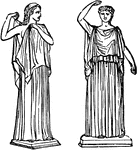
"Tunica, an under-garment. Greek. The chiton was the only kind of under-garment, worn by the Greeks. Of this there were two kinds, the Dorian and Ionian. The Dorian chiton, as worn by males, was a short woollen shirt, without sleeves; the Ionian was a long linen garment, with sleeves. The former seems to have been originally worn throughout the whole Greece; the latter was brought over to Greece by the Ionians of Asia. The Ionic chiton was commonly worn at Athens by men during the Persian wars, but it appears to have entirely gone out of fashion for the male sex about the time of Pericles, from which time the Dorian chiton was the under-garment universally adopted by men through the whole of Greece." &mdash; Smith; 1873

Tunica

"Tunica, an under-garment. Greek. The chiton was the only kind of under-garment, worn by the Greeks.…
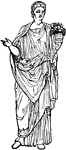
"Tunica, an under-garment. Roman. The Tunica of the Romans, like the Greek chiton, was a woollen under garment, over which the toga was worn. It was the Indumentum of Indulus, as opposed to the Amictus, the general term for the toga, pallium, or any other outer garment. The Romans are said to have had no other clothing originally but the toga; and when the tunic was first introduced, it was merely a short garment without sleeves, and was called Colobrium. It was considered a mark of effeminacy for men to wear tunics with long sleeves and reaching the feet." &mdash; Smith; 1873

Tunica

"Tunica, an under-garment. Roman. The Tunica of the Romans, like the Greek chiton, was a woollen under…
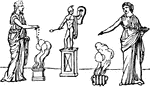
"Turibulum, a censer. The Greeks and Romans, when they sacrificed, commonly took a little frankincense out of the acerra, and let it fall upon the flaming altar. More rarely they used a censer, by means of which they burned the incense in greater profusion, and which was in fact a small moveable grate or foculus. he following wood-cut, taken from an ancient painting, shows the performance of both of these acts at the same time." &mdash Smith; 1873

Turibulum

"Turibulum, a censer. The Greeks and Romans, when they sacrificed, commonly took a little frankincense…
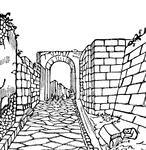
"Via, a public road. It was not until the period of the long protracted Samnite wars that the necessity was felt of securing a safe communication between the city and the legions; and then for the first time we hear of those famous paved roads, which, in after ages, connected Rome with her most distant provinces, constituting the most lasting of all her works. The excellence of the principles upon which they were constructed is sufficiently attested by their extraordinary durability, many specimens being found in the country around Rome which have been used without being repaired for more than a thousand years." &mdash; Smith; 1873

Via

"Via, a public road. It was not until the period of the long protracted Samnite wars that the necessity…
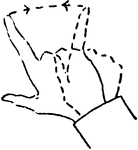
"To add 50 yards describe a short horizontal line with forefinger." &mdash; Moss, 1914

Hand signal

"To add 50 yards describe a short horizontal line with forefinger." — Moss, 1914

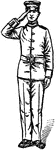
"Raise the right hand smartly till the tip of the forefinger touches the lower part of the headdress above the right eye, thumb and fingers extended and joined, palm to the left, forearm inclined at about 45 degrees, hand and wrist straight; at the same time look toward the person saluted." &mdash; Moss, 1914

Salute

"Raise the right hand smartly till the tip of the forefinger touches the lower part of the headdress…
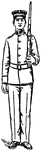
"Carry the piece with the right hand and place it on the left shoulder, barrel up, trigger guard in the hollow of the shoulder, at the same time grasp the butt with the left hand, heel between first and second fingeres, thumb and fingers closed on the stock." — Moss, 1914

Left Shoulder, Arms

"Carry the piece with the right hand and place it on the left shoulder, barrel up, trigger guard in…
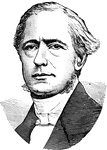
Developed Pitman Shorthand and was vice-president of the Vegetarian Society.

Isaac Pitman

Developed Pitman Shorthand and was vice-president of the Vegetarian Society.

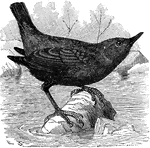
A bird that spends most of its time in the water. It has a thick body; very short tail of 12 rectrices and short rounded wings consisting of 10 primaries.

American Dipper

A bird that spends most of its time in the water. It has a thick body; very short tail of 12 rectrices…
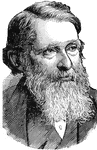
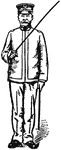
Famous author and poet.

John Ruskin

Famous author and poet.

"In marching in double time the saber is carried diagonally across the breast, edge to the front; the left hand steadies the scabbard." — Moss, 1914

Marching with Saber

"In marching in double time the saber is carried diagonally across the breast, edge to the front; the…
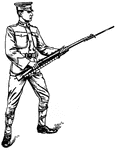
"At the second command sake the position of guard; at the same time throw the rifle smartly to the front, grasp the rifle with the left hand just below the lower band, fingers between the stock and gun sling, barrel turned slightly to the left, the right hand grasping the small of the stock about 6 inches in front of the right hip, elbows free from the body, bayonet point at the height of the chin." — Moss, 1914

Bayonet Guard

"At the second command sake the position of guard; at the same time throw the rifle smartly to the front,…
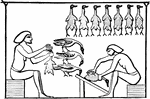
"The Egyptian shops exhibited many curious scenes. Poulters suspended geese and other birds from a pole in front of the shop, which, at the same time, supported an awning to shade them from the sun." — Goodrich, 1844

Egyptian Shop

"The Egyptian shops exhibited many curious scenes. Poulters suspended geese and other birds from a pole…
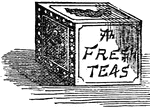
The leaves of a shrub or small tree, a native of China and Japan; usually shipped in boxes.

Tea

The leaves of a shrub or small tree, a native of China and Japan; usually shipped in boxes.

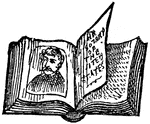
One side of a leaf of a book or manuscript.

Page

One side of a leaf of a book or manuscript.

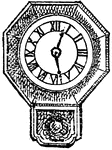
An instrument or machine for measuring time.

Clock

An instrument or machine for measuring time.

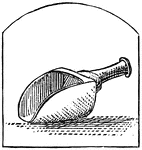
A short-handled vessel generally used in weighing sugar, coffee, etc.

Scoop

A short-handled vessel generally used in weighing sugar, coffee, etc.

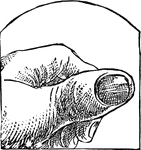
The short, thick, finger of the human hand, or the corresponding member of animals.

Thumb

The short, thick, finger of the human hand, or the corresponding member of animals.

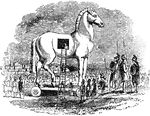
"According to the poets, it was by stratagem that this famous city was at last overcome. They tell us that the Greeks constructed a wooden horse of prodigious size, and in the body of which they concealed a number of armed men, and then retired towards the sea-shore to induce the enemy to believe that the besiegers had given up the enterprise, and were about to return home. Deceived by this maneuver, the Trojans brought the gigantic horse into the city, and the men who had been concealed within it, stealing out in the night time, unbarred the gates and admitted the Grecian army within the walls." — Goodrich, 1844

Trojan horse

"According to the poets, it was by stratagem that this famous city was at last overcome. They tell us…
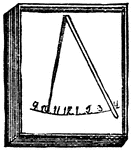
An instrument for showing the time of day from the shadow of a style on a graduated surface.

Dial

An instrument for showing the time of day from the shadow of a style on a graduated surface.

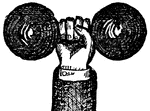
Two spheres of iron or other heavy material, connected by a short bar for a handle; used as a weight for swinging in the hands.

Dumb-bells

Two spheres of iron or other heavy material, connected by a short bar for a handle; used as a weight…
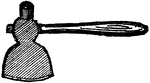
A small axe with a short handle, to be used with one hand.

Hatchet

A small axe with a short handle, to be used with one hand.

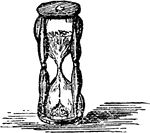
An instrument for measuring time, especially the interval of an hour, by the running of sand out of a glass vessel.

Hour-glass

An instrument for measuring time, especially the interval of an hour, by the running of sand out of…
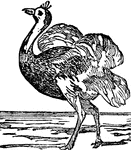
A large bird, nearly ten feet high, having a long neck, stout long legs, with only two toes, and short wings, with long soft plumes, in the place of feathers. It is remarkable for its speed, and swallowing bits of metal or stone.

Ostrich

A large bird, nearly ten feet high, having a long neck, stout long legs, with only two toes, and short…
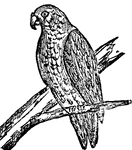
A climbing bird of brilliant color, having a fleshy tongue, and a short, hooked bill toothed above.
Parrot

A climbing bird of brilliant color, having a fleshy tongue, and a short, hooked bill toothed above.

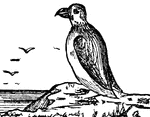
A marine diving bird, allied to the auk, and having a short, thick beak like that of the parrot.

Puffin

A marine diving bird, allied to the auk, and having a short, thick beak like that of the parrot.
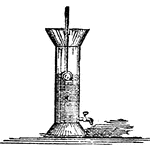
An instrument for measuring the quantity of rain that falls at any given place in a given time.

Rain-gauge

An instrument for measuring the quantity of rain that falls at any given place in a given time.
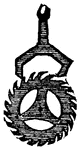
The contrivance in a time-piece which connects the wheel-work with the pendulum or the balance, giving to the latter the impulse by which it is kept in vibration.

Escapement

The contrivance in a time-piece which connects the wheel-work with the pendulum or the balance, giving…
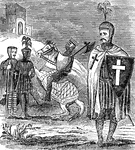
"The chivalry of the gothic nations began in the woods of Germany. No youth was then permitted to assume arms, at that time the geat privilege of the noble and the free, at his own pleasure. It was made a social rank, to which it was necessary that the aspiring candidates should be elected in the public councils of their rude commonwealth; and the emulated distinction was then solemnly conferred by the prince, or a kinsman, giving them a javelin and a shield. In these customs we see the origin of knighthood." &mdash; Goodrich, 1844

Chivalry and knight-errantry

"The chivalry of the gothic nations began in the woods of Germany. No youth was then permitted to assume…
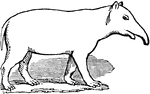
"The <em>Palaeotherium magnum</em> was of the size of a horse, but thicker and more clumsy; its head was massive, and its legs and tail were short. It resembled a large tapir, but differed somewhat as to the teeth, and had one toe less on the fore-feet. Its height was probably from four to five feet; about equal, it is said, to that of the rhinoceros of Java. It was, no doubt, furnished with a short proboscis or trunk." &mdash; Goodrich, 1844

Palaeotherium magnum

"The Palaeotherium magnum was of the size of a horse, but thicker and more clumsy; its head…
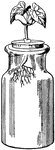
"The bean with its roots in unboiled water will grow for a considerable time, as long as the mineral matter in the water will provide it with food materials. The roots of the plant in the boiled water will quickly die and the whole plant will then wither, because the roots no longer send the water up to the leaves." — Ritchie, 1918

Bean Plant in Jar

"The bean with its roots in unboiled water will grow for a considerable time, as long as the mineral…
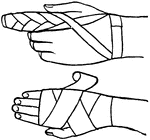
A hand with the index finger wrapped in a bandage.

Bandaged hand

A hand with the index finger wrapped in a bandage.

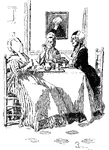
Ladies drinking tea

Tea Time

Ladies drinking tea

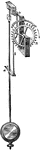
"A pendulum has a strong tendency to maintain its plane of oscillation, a fact that has been used in the experimental demonstration of the earth upon its axis. The chief function of the wheel-work of a clock is to register the number of vibrations of the pendulum. If the clock gains time, the pendulum is lengthened by lowering the bob, if it loses time, the pendulum is shortened by raising the bob." &mdash; Avery, 1895

Pendulum

"A pendulum has a strong tendency to maintain its plane of oscillation, a fact that has been used in…
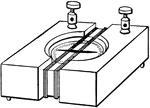
"Secure the two ends of the wire by double-pointed tacks. Place a small pocket compass upon the block thus wound, and turn the block until the coils of wire are parallel to the needle when the circuit is open. Then pass a current through the coil. The deflection of the needle is much stronger than before, although, owing to the weakening of the cell, the deflection falls off after a time." &mdash; Avery, 1895

Galvanoscope

"Secure the two ends of the wire by double-pointed tacks. Place a small pocket compass upon the block…
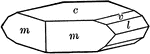
"Orthorhombic. Crystals commonly tabular parallel to basal plane, showing also short prisms and low brachydomes." &mdash; Ford, 1912

Marcasite

"Orthorhombic. Crystals commonly tabular parallel to basal plane, showing also short prisms and low…
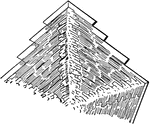
"Orthorhombic. Crystals commonly tabular parallel to basal plane, showing also short prisms and low brachydomes. The brachydomes usually striated parallel to the brachy-axis. Often twinned, given coxcomb and spear-shaped groups." &mdash; Ford, 1912

Marcasite

"Orthorhombic. Crystals commonly tabular parallel to basal plane, showing also short prisms and low…
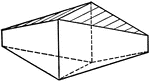
"Orthohombric. Usually in tabular diamond-shaped crystals, formed by a short prism terminated by low brachydomes. The brachydomes are usually striated parallel to the brachy-axis." &mdash; Ford, 1912

Arsenopyrite

"Orthohombric. Usually in tabular diamond-shaped crystals, formed by a short prism terminated by low…
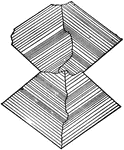
"Orthohombric. Usually in tabular diamond-shaped crystals, formed by a short prism terminated by low brachydomes. The brachydomes are usually striated parallel to the brachy-axis. Twinned at times, giving stellate groups; the different individuals of the twin groups being distinguished from each other by the direction of the striations upon them." &mdash; Ford, 1912

Arsenopyrite

"Orthohombric. Usually in tabular diamond-shaped crystals, formed by a short prism terminated by low…
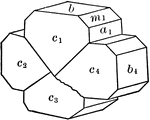
"Orthohombric. Crystals usually short prismatic to tabular. Sometimes quite complex with many prism, pyramid and dome faces. Frequently twinned, giving tabular crystals with recurring reentrant angles in the prism zone." &mdash; Ford, 1912

Bournonite

"Orthohombric. Crystals usually short prismatic to tabular. Sometimes quite complex with many prism,…
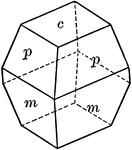
"Monoclinic. Crystals varied in habit. Often with prominent basal plane which is steeply inclined and which in combination with short prism and pyramid faces gives a thin wedge-shaped crystal." &mdash; Ford, 1912

Titanite

"Monoclinic. Crystals varied in habit. Often with prominent basal plane which is steeply inclined and…
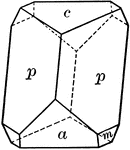
"Monoclinic. Crystals varied in habit. Often with prominent basal plane which is steeply inclined and which in combination with short prism and pyramid faces gives a thin wedge-shaped crystal." &mdash; Ford, 1912

Titanite

"Monoclinic. Crystals varied in habit. Often with prominent basal plane which is steeply inclined and…
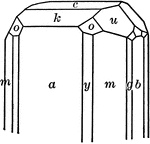
"Orthohombic. Habit of crystals is short prismatic; often in square prisms because of prominent development of the vertical pinacoids. Terminated by basal plane, pyramids and domes; frequently complex." &mdash; Ford, 1912

Columbite

"Orthohombic. Habit of crystals is short prismatic; often in square prisms because of prominent development…