This ClipArt gallery offers 279 images of the Roman Empire including culture, people, everyday life, coats of arms, and more.

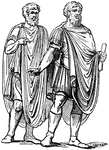
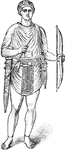
A cloak chiefly worn by soldiers, and thus opposed to the toga, the garb of peace. The abolla was used by by the lower classes at Rome, and consequently by the philosophers who affected severity of manners and life.

Abolla

A cloak chiefly worn by soldiers, and thus opposed to the toga, the garb of peace. The abolla was used…
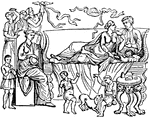
"The act of reclining at meals. The Greeks and Romans were accustomed, in later times, to recline at their meals; but this practice could not have been od great antiquity in Greece, since Homer always describes persons as sitting at their meals; and Isidore of Seville, an ancient grammarian, also attributes the same custom to the ancient Romans. Even in the time of the early Roman emperors, children in families of the highest rank used to sit together, while their fathers and elders reclined on couches at the upper part of the room. Roman ladies continued the practice of sitting at table, even after the recumbent position had become common with the other sex. It appears to have been considered more decent, and more agreeable to the severity and purity of ancient manners for women to sit, more especially if many persons were present. But, on the other hand, we find cases of women reclining, where there was conceived to be nothing bold or indelicate in their posture. Such is the case in the following woodcut, which seems intended to represent a scene of matrimonial felicity. The husband and wife recline on a sofa; their two sons are in front of them; and several females and a boy are performing a piece of music for the entertainment of the married pair." — Smith, 1873

Accubatio

"The act of reclining at meals. The Greeks and Romans were accustomed, in later times, to recline at…
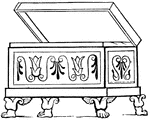
"The incense-box or censer used in sacrifices. The acerra was also a small moveable alter placed before the dead, on which perfumes were burnt. The use of the accerrae at funerals was forbidden by a law of the Twelve Tables as an unnecessary expense." — Smith, 1873

Acerra

"The incense-box or censer used in sacrifices. The acerra was also a small moveable alter placed before…
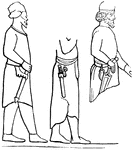
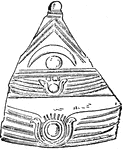
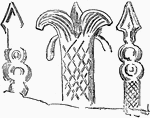
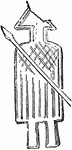
"A Persian sword, whence Horace speaks of the <em>Medus acinaces.</em> The acinaces was a short and straight weapon; and thus differed from the Roman <em>sica,</em> which was curved. It was worn on the right side of the body, whereas the Greeks and Romans usually had their swords suspended on the left side. The form of the acinaces, with the mode of wearing it, is illustrated by the by the following Persepolitan figures." &mdash; Smith, 1873

Acinaces

"A Persian sword, whence Horace speaks of the Medus acinaces. The acinaces was a short and…
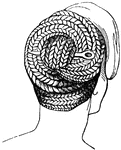
"A needle, a pin. Pins were made not only of metal, but also of wood, bone, and ivory. They were used for the same purposes as with us, and also in dressing the hair. The mode of platting the hair, and then fastening it with a pin or needle, is shown in the annexed figure of the female head. This fashion has been continued to our own times by the females of Italy." &mdash; Smith, 1873

Acus

"A needle, a pin. Pins were made not only of metal, but also of wood, bone, and ivory. They were used…
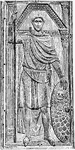
Flavius Aetius (396-454) was a Roman general of the closing period of the Western Roman Empire.

Flavius Aetius

Flavius Aetius (396-454) was a Roman general of the closing period of the Western Roman Empire.

"In order that [Alaric's] body might be saved from the gaze of the vulgar and the rage of his foes, he gave direction that it should be buried in the bed of the river Busentinus."&mdash;Ridpath, 1885

The Burial of Alaric in the Bed of the Busentinus

"In order that [Alaric's] body might be saved from the gaze of the vulgar and the rage of his foes,…
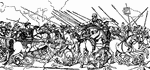
Alexander defeating the Persians.

Alexander

Alexander defeating the Persians.

Hannibal and his army crossing the Alps.

Hannibal and his Army Crossing the Alps

Hannibal and his army crossing the Alps.

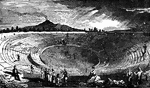
View of the amphitheatre at Pompeii.

Amphitheatre

View of the amphitheatre at Pompeii.

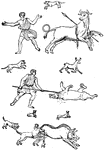
Bas-relief of early amusements at the amphitheatre.

Amphitheatrical Amusements

Bas-relief of early amusements at the amphitheatre.

"Ancilia carried by Salii. The sacred shield carried by the Salii, and made of bronze. The original ancile was found, according to tradition, in the palace of Numa; and, as no numan hand has brought it there, it was concluded that it had been sent from heaven. At the same time, the haruspices declared that the Roman state would endure so long as this shield remained in Rome. To secure its preservation in the city, Numa ordered eleven other shields, exactly like it, to be made by the armourer, Mamurius Veturius, and twelve ancilia. They were kept in the temple of that divinity, on the Palatine mount, and were taken from it only once a year, on the calends of March. The feast of the god was then observed during several daysl when the Salaii carried their shields about the city, singing songs in praise of Mars, Numa, and Mamurius Veturius, and at the same time performing a dance, which probably in some degree resembled our morris with rods, so as to keep time with their voices, and with the movements of their dance. The preceding cut shows one of these rods, as represented on the tomb of pontifex salius, or chief of the Salii" &mdash; Smith, 1873

Ancile

"Ancilia carried by Salii. The sacred shield carried by the Salii, and made of bronze. The original…
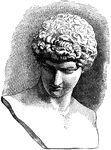
"It was during Hadrian's sojourn in this country that his favorite, the beautiful Birthynian named Antinous, cast himself for his master's sake into the Nile, and was drowned. t appears that the oracle at Besa had informed the Emperor that impending calamity could be averted only by the self-sacrifice of the one whom he most loved. Antinous believed himself to be designated as the offering, and accordingly gave his life to the river."&mdash;Ridpath, 1885

Antinous

"It was during Hadrian's sojourn in this country that his favorite, the beautiful Birthynian named Antinous,…
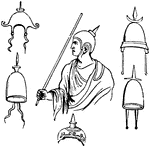
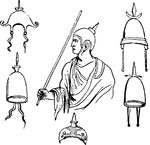
"A cap worn by the flamines and salii at Rome. The essential part of the apex, to which alone the name properly belonged, was a pointed piece of olive-wood, the base of which was surrounded with a lock of wool. This was worn on the top of the head, and was held there either by fillets only, or, as was more commonly the case, by the aid of a cap which fitted the head, and was also fastened by means of two strings or bands." &mdash; Smith, 1873

Apex

"A cap worn by the flamines and salii at Rome. The essential part of the apex, to which alone the name…
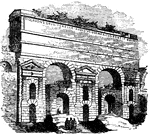
"Aquila." &mdash; Greenough, 1899

Aquila

"Aquila." — Greenough, 1899

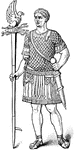
An Aquilifer was the Roman soldier in charge of carrying the standard for his unit.

Aquilifer

An Aquilifer was the Roman soldier in charge of carrying the standard for his unit.

"Archer." &mdash; Greenough, 1899

Archer

"Archer." — Greenough, 1899

"Homer describes in various passages an entire suit of armour, and we observe that it consisted of the same portions which were used by the Greek soldiers ever after. Moreover, the order of putting them on is always the same. The heavy-armed warrior, having already a tunic around his body, and preparing for combat, puts on-1. his greaves; 2. his cuirass; 3. his sword, hung on the left side of his body by means of a belt which passed over the right shoulder; 4. the large round shield, supported in the same manner; 5. his helmet; 6. he took his spear." &mdash; Smith, 1873

Arma

"Homer describes in various passages an entire suit of armour, and we observe that it consisted of the…
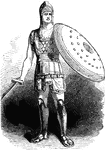
"The Municipal Arms of Rome." &mdash; Young, 1901

Arms of Rome

"The Municipal Arms of Rome." — Young, 1901

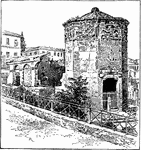
"The town clock of Athens in the Hellenistic Age." -Breasted, 1914

Athenian Town Clock

"The town clock of Athens in the Hellenistic Age." -Breasted, 1914

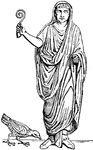
"Among the anceient Romans, a functionary whose duty it was to observe and to interpret, according to traditional rules, the auspices, or reputed natural signs concerning future events."-Whitney, 1902.

Auger

"Among the anceient Romans, a functionary whose duty it was to observe and to interpret, according to…
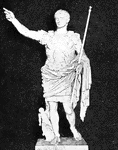
"Augustus ruled for about forty-two yeras, that is, from 27 B.C. to 14 A.D., and this period is known in history as the Golden Age of Latin Literature."&mdash;Colby, 1899

Augustus

"Augustus ruled for about forty-two yeras, that is, from 27 B.C. to 14 A.D., and this period is known…
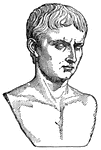
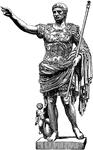
Augustus, born Gaius Octavius Thurinus, was adopted by his great-uncle Julius Caesar in 44 BC, and between then and 27 BC was officially named Gaius Julius Caesar. After 27 BC, he was named Gaius Julius Caesar Augustus. Because of the various names he bore, it is common to call him Octavius when refering to events between 63 and 44 BC, Octavian (or Octavianus) when refering to events between 44 and 27 BC, and Augustus when refering to events after 27 BC.

Sculpture of Augustus

Augustus, born Gaius Octavius Thurinus, was adopted by his great-uncle Julius Caesar in 44 BC, and between…
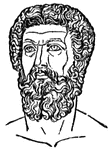
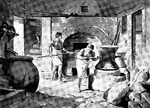
A Roman bakery

Bakery

A Roman bakery

This antique Roman balance from Pompeii has one pan that hangs from a rod.

Antique Roman balance from Pompeii

This antique Roman balance from Pompeii has one pan that hangs from a rod.
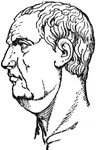
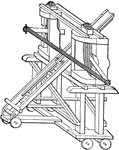
The Ballista is a device for throwing large darts very accurately. The Roman Ballistas threw stones instead of darts.

Ballista

The Ballista is a device for throwing large darts very accurately. The Roman Ballistas threw stones…
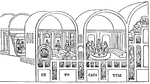
"Balneum or balineum signifies, in its primary sense, a bath or bathing vessel, such as most Romans possessed in their own houses; and from that it came to mean the chamber which contained the bath. When the baths of private individuals became more sumptuous, and comprised many rooms, the plural balnea or balinea was adopted, which still, in correct language, had reference only to the baths of private persons. Balneae and balineae, which have no singular number, were the public baths. But this accuracy of diction is neglected by many of the subsequent writers. This image is Fresco from the Thermae of Titus." &mdash; Smith, 1873

Balneum

"Balneum or balineum signifies, in its primary sense, a bath or bathing vessel, such as most Romans…
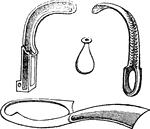
"Balneum or balineum signifies, in its primary sense, a bath or bathing vessel, such as most Romans possessed in their own houses; and from that it came to mean the chamber which contained the bath. When the baths of private individuals became more sumptuous, and comprised many rooms, the plural balnea or balinea was adopted, which still, in correct language, had reference only to the baths of private persons. Balneae and balineae, which have no singular number, were the public baths. But this accuracy of diction is neglected by many of the subsequent writers. This image shows the strigiles and guttus that the Romans used to scrape off perspiration." &mdash; Smith, 1873

Balneum

"Balneum or balineum signifies, in its primary sense, a bath or bathing vessel, such as most Romans…
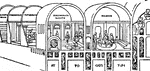
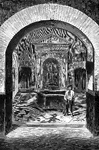
Interior of bath in ancient Rome.

Bath

Interior of bath in ancient Rome.

An ancient bath-room (as discovered).

Bath-Room

An ancient bath-room (as discovered).

"In the Brave Days of Old." &mdash;Bulfinch, 1897

Roman battle

"In the Brave Days of Old." —Bulfinch, 1897

Roman standard Bearer

Bearer

Roman standard Bearer

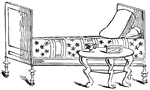
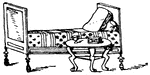
Bed and table at Pompeii (from wall painting).

Bed and Table

Bed and table at Pompeii (from wall painting).

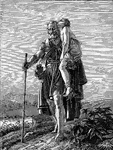
Belsarius was ordered to have his eyes put out, and was reduced to a homeless beggar.

Blind Belsarius

Belsarius was ordered to have his eyes put out, and was reduced to a homeless beggar.
A Roman skin bottle from specimens at Pompeii and Herculaneum

Skin Bottles

A Roman skin bottle from specimens at Pompeii and Herculaneum

A Roman skin bottle from specimens at Pompeii and Herculaneum

Skin Bottles

A Roman skin bottle from specimens at Pompeii and Herculaneum

A Roman skin bottle from specimens at Pompeii and Herculaneum

Skin Bottles

A Roman skin bottle from specimens at Pompeii and Herculaneum

A Roman skin bottle from specimens at Pompeii and Herculaneum

Skin Bottles

A Roman skin bottle from specimens at Pompeii and Herculaneum

Gold breastpins discovered at Pompeii.

Breastpins

Gold breastpins discovered at Pompeii.

"After a successful summer campaign, [Caesar] made his way to the coast and cross over into Britain. He then withdrew into his winter-quarters in Gaul, but in the following year returned into the island, defeated the British Celts under their king Cassivellaunus, and reduced the country to a dependency, compelling the Britons to pay tribute and give hostages."

Landing of the Romans in Britain

"After a successful summer campaign, [Caesar] made his way to the coast and cross over into Britain.…

Decorations placed on the helmets of the Roman soldiers.

Bronze Helmet Ornament

Decorations placed on the helmets of the Roman soldiers.

Brooches of gold found at Pompeii.

Brooches

Brooches of gold found at Pompeii.

Roman bucranes and festoon.

Bucranes and Festoon

Roman bucranes and festoon.

"Soldiers Building Cam, with Guards." &mdash; Greenough, 1899

Building Camp

"Soldiers Building Cam, with Guards." — Greenough, 1899

"Constantine, the first Christian emperor, removed the capital of the world-empire from Rome to Byzantium, henceforth to be called Constantinople. Though the court, with all its splendor and power, was thus transferred to a city where Greek was the vernacular, the change did not retard, but rather hastened, the decline of literature." &mdash; The Delphian Society, 1913

Byzantine court

"Constantine, the first Christian emperor, removed the capital of the world-empire from Rome to Byzantium,…

"The staff or mace carried by heralds and ambassadors in time of war. This name is also given to the staff with which Hermes or Mercury is usually represented, as is shown in he following figure of that god. From caduceus was formed the word cadu ceator, which signified a person sent to treaty of peace. The persons of the caduceatores were considered sacred." &mdash; Smith, 1873

Caduceus

"The staff or mace carried by heralds and ambassadors in time of war. This name is also given to the…

"All histories of England commence with the invasion of Julius Caesar, the earliest event in that quarter of which we have any authentic account. The Island of Britain was an unknown region to the Romans, and nearly so to the rest of mankind, at the period when Caesar's conquests had reduced the greater part of Gaul to the Roman government. Britain, lying within sight of the northern shores of Gaul, attracted his notice, and he began to meditate schemes of conquest." &mdash; Goodrich, 1844

Caesar in England

"All histories of England commence with the invasion of Julius Caesar, the earliest event in that quarter…

"The Death of Caesar. Naturaly such extraordinary success made him enemies, and though the city seemed in the main to be contented with his rule, it was easy for his ill-wishers to play on the passions of the people by pointing out that he had aimed at the complete overthrow of the constitution and the establishment of a tyranny. It was said that he intended to assume the title of king. Several times a crown was publicly offered to him and he refused it; but his refusal was thought to proceed merely from his perception of the displeasure of the people. A plot was formed against him, and the Ides (15th day) of March, 44 B.C., was fixed upon for his assassination. The rumors of the intended murder got abroad and Caesar was warned of the plot, but he took no notice of these warnings. On the appointed day he was surrounded in the Senate by the conspirators and killed. Among the assassins was one of whom Caesar had always regarded as his especial friend. This was Brutus, and it is said that Caesar, when he recognized him among his assailants, ceased to offer resistance, and exclaiming, 'Thou too, Brutus!' allowed himself to be slain."&mdash;Colby, 1899

Caesar's Death

"The Death of Caesar. Naturaly such extraordinary success made him enemies, and though the city seemed…

Julius Caesar riding on a horse.

Julius Caesar

Julius Caesar riding on a horse.

Julius Caesar heard that a little way off there was a country nobody knew anything about, except that the people were very fierce and savage, and that a sort of pearl was found in the shells of mussels which lived in the rivers. He could not bear that there should be any place that his own people, the Romans, did not know and subdue. So he commanded the ships to be prepared, and he and his soldiers embarked, watching the white cliffs in the other side of the sea grow higher and higher as he came nearer and nearer.

Julius Caesar

Julius Caesar heard that a little way off there was a country nobody knew anything about, except that…

An image depicting Julius Caesar, a Roman general and statesman. He was a key component to the shift of the Roman Republic into the Roman Empire. He emerged as the unrivaled leader of the Roman world in 49 BC.

Julius Caesar

An image depicting Julius Caesar, a Roman general and statesman. He was a key component to the shift…

"Caliga." &mdash; Greenough, 1899

Caliga

"Caliga." — Greenough, 1899

Cameo, a term applied to gems of different colors sculptured in relief. The art of engraving on gems boasts of high antiquity, having been practised with various degrees of success by the Egyptians, Greeks, and Romans.

Cameo

Cameo, a term applied to gems of different colors sculptured in relief. The art of engraving on gems…

"Sacrifice in Camp. Military Band." &mdash; Greenough, 1899

Camp Sacrifice

"Sacrifice in Camp. Military Band." — Greenough, 1899

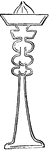
"Originally a candlestick, but afterwards the name of a stand for supporting lamps, in which signification most commonly occurs. The candelara of this kind were usually made to stand upon the ground, and were of a considerable height. The most common kind were made of wood; but those which have been found in Herculaneum and Pompeii are mostly of bronze. sometimes they were made of the more precious metals, and even of jewels. The candelbra did not always stand upon the ground, but were also placed upon the table. Such candelabra usually consisted of pillars, from the capitals of which several lamps hung down, or of trees, from whose branches lamps also were suspended. the preceding cut represents a very elegant candelabrum of this kind, found in Pompeii." &mdash; Smith, 1873;

Candelabrum

"Originally a candlestick, but afterwards the name of a stand for supporting lamps, in which signification…

Candelabrum

Candelabrum

Candelabrum

Candelabrum on a triangular pedistal in Vatican Museum.

Candelabrum

Candelabrum on a triangular pedistal in Vatican Museum.

"A robe worn by the Medes and Persians over their trowsers and other garments. It had wide sleeves, and was made of woollen cloth, which was either purple or of some other splendid colour. In the Persepolitan sculptres, from which the annexed figures are taken, nearly all the principal personages wear it." &mdash; Smith, 1873;

Candys

"A robe worn by the Medes and Persians over their trowsers and other garments. It had wide sleeves,…

The Capitoline Hill is a Roman hill between the Forum and the Campus Martius. The Cloaca Maxima was one of the world's earliest sewage systems. "The Capitoline and Cloaca Maxima. A restoration." -Allen, 1890

Capitoline and Cloaca Maxima

The Capitoline Hill is a Roman hill between the Forum and the Campus Martius. The Cloaca Maxima was…

"A box for holding books among the Romans. These boxes were of cylindrical form. There does not appear to have been any difference between the capsa and scrinium, except that the latter word was usually applied to those boxes which held a considerable number of rolls. The slaves who had the charge of these book-chests were called capsarii, and also custodes scriniorum; and te slaves who carried in a capsa behind their young masters the books of the sons of respectable Romans, when they went to school, were called by the same name." &mdash; Smith, 1873;

Capsa

"A box for holding books among the Romans. These boxes were of cylindrical form. There does not appear…