An illustration of two adult quail and six baby quail.

Group of Adult & Baby Quail

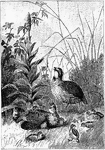
An illustration of two adult quail and six baby quail.

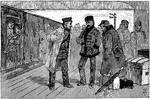
An illustration of a group of men waiting at a train station.

Group of Men Waiting at Train Station

An illustration of a group of men waiting at a train station.

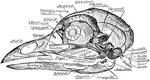
"Fig. 62 Skull of common fowl, enlarged. from nature by Dr. R.W. Shufeldt, U.S.A. The names of bones and some other parts are printed, requiring no explanation; but observe the following points: The distinction of none of the bones composing the brain-case (the upper back expanded part) can be found in a mature skull. The brain is contained between the occipital, sphenoidals, squamosals, parietals and part of frontal; the ethmoidals belong to the same group of cranial bones proper. All other bones, excepting the three otic ear-bones, are bones of the face and jaws. The lower jaw, of five bones, is drawn detached; it articulates by the black surface marked articular with the prominence just above- the quadratic bone. Observe that from this quadrate a series of bones quadrato-jugal, jugal, maxillary-makes a slender rod running to the premaxillary; this is the zygoma, or jugal bar. Observe from the quadrate also another series, composed of pterygoid and palatine bones, to the premaxillary; this is the pterygo-palatine bar; it slides along a median fixed axis of the skull, the rostrum, which bears the loose vomer at its end. The under mandible, quadrate, pterygoid, and vomer are the only movable bones of this skull. But when the quadrate rocks back and forth, as it does by its upper joint, its lower end pulls and pushes upon the upper mandible, by means of the jugal and pterygo-palatine bars, setting the whole scaffolding of the upper jaw in motion. This motion hinges upon the elasticity of the bones of the forehead, at the thin place just where the reference-lines from the words "lacrymal" and "mesethmoid" cross each other. The dark oval space behind the quadrate is the external orifice of the ear; the parts in it to which the three reference-lines go are diagrammatic, not actual representations; thus, the quadrate articulates with a large pro-otic as well as with the squamosal. The great excavation at the middle of the figure, containing the cirlet of the unshaded bones, is the left orbital cavity, orbit, or socket of the eye. The mesethmoid includes most of the background of this cavity, shaded diagonally. The upper one of the two processes of bone extending into it from behind is post-frontal or sphenotic process; the under one (just over the quadrate) is the squamosal process. A bone not shown, the presphenoid, lies just in front of the oval black space over the end of basisphenoid. This black oval is the optic foramen, through which the nerve of sight passes from the brain-cavity to the eye. The black dot a little behind the optic foramen is the orifice of exit of a part of the trifacial nerve. The black mark under the letters "on" of the word "frontal" is the olfactory foramen, where the nerve of smell emerges from the brain-box to go to the nose. The nasal cavity is the black space behind nasal and covered by that bone, and in the oval blank before it. The parts of the beak covered by horn are only premaxillary, nasal, and dentary. The condyle articulates with the first cervical vertebra; just above it, not shown, is the foramen magnum, or great hole through which the spinal medulla, or main nervous cord, passes from the spinal column. The basioccipital is hidden, excepting its condyle; so is much of the basisphenoid. The prolongation forward of the basisphenoid, marked "rostrum," and bearing the vomer at its end, is the parasphenoid, as far as its thickened under border is concerned. Between the fore end of the pterygoid and the basisphenoidal rostrum, is the site of the basipterygoid process, by which the bones concerned articulate by smooth facets; further forward, the palatines ride freely upon the parasphenoidal rostrum. In any passerine bird , the vomer would be thick in front, and forked behind, riding like the palatine upon the rostrum. The palatine seems to run into the maxillary in this view; but it continues on to premaxillary. The maxillo-palatine is an important bone which cannot be seen in the figure because it extends horizontally into the paper from the maxillary about where the reference life "maxillary" goes to that bone. The general line from the condyle to the end of the vomer is the cranial axis, basis cranii, or base of the cranium. This skull is widest across the post-frontal; next most so across the bulge of the jugal bar." Elliot Coues, 1884

Skull of a Common Fowl

"Fig. 62 Skull of common fowl, enlarged. from nature by Dr. R.W. Shufeldt, U.S.A. The names of bones…
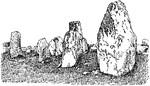
A menhir is a large upright standing stone. Menhirs may be found singly as monoliths, or as part of a group of similar stones. Their size can vary considerably; but their shape is generally uneven and squared, often tapering towards the top. Menhirs are widely distributed across Europe, Africa, and Asia, but are most numerous in Western Europe; in particular in Ireland, Great Britain and Brittany.

Group of Menhirs

A menhir is a large upright standing stone. Menhirs may be found singly as monoliths, or as part of…
"Scops. Little Horned Owls. Screech Owls. Like the miniature Bubo in form (all our species under a foot long). Skull and ear-parts symmetrical; latter small, simply elliptical, with rudimentry operculum; facial disc moderately developed; plumicorns evident; nostrils at edge of cere, which is not inflated, and shorter than the rest of the culmen. Wings rounded, but long, about twice the length of the short rounded tail, about to the end which they fold; in our species the 4th and 5th primaries longest, the 1st quite short; 3 or 4 outer primaries sinuate or emarginate on inner webs. Tarsus feathered (in our species), but toes only partly bristly (in the S. asio group) or quite naked (as in S. Flammeola). Plumage dichromatic in some cases; i.e. some individuals of the same species normally mottled gray, while others are reddish, the two phases very distinct when fully developed, but shading insensibly into each other, and entirely independent of age, season, or sex. In normal plumage, a white or whitish scapular stripe; lower parts with lengthwise blotches or shaft-lines and crosswise bars or waves of blackish or dark colors; upper parts with black or blackish shaft-lines on a finely-dappled brown or gray ground (more or less obliterated in the red phase); facial disc black-bordered nearly all around; wing-quills spotted or marbled on outer webs, barred on inner webs. Tail with light and dark bars. A large and nearly cosmopolitan genus, especially rich in tropical species; but only two are known to inhabit N. Am. one of them running into several local races very difficult to characterize satisfactorily." Elliot Coues, 1884

Screech Owls

"Scops. Little Horned Owls. Screech Owls. Like the miniature Bubo in form (all our species under a foot…
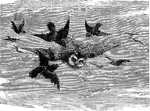
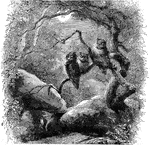
An adult owl being mobbed by a group of smaller birds. Mobbing occurs when smaller birds, in fear, will swarm in an attack other birds.

The Mobbing of an Owl

An adult owl being mobbed by a group of smaller birds. Mobbing occurs when smaller birds, in fear, will…
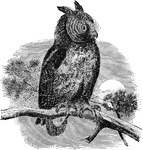
Scops. Little Horned Owls. Screech Owls. Like the miniature Bubo in form (all our species under a foot long). Skull and ear-parts symmetrical; latter small, simply elliptical, with rudimentry operculum; facial disc moderately developed; plumicorns evident; nostrils at edge of cere, which is not inflated, and shorter than the rest of the culmen. Wings rounded, but long, about twice the length of the short rounded tail, about to the end which they fold; in our species the 4th and 5th primaries longest, the 1st quite short; 3 or 4 outer primaries sinuate or emarginate on inner webs. Tarsus feathered (in our species), but toes only partly bristly (in the S. asio group) or quite naked (as in S. Flammeola). Plumage dichromatic in some cases; i.e. some individuals of the same species normally mottled gray, while others are reddish, the two phases very distinct when fully developed, but shading insensibly into each other, and entirely independent of age, season, or sex. In normal plumage, a white or whitish scapular stripe; lower parts with lengthwise blotches or shaft-lines and crosswise bars or waves of blackish or dark colors; upper parts with black or blackish shaft-lines on a finely-dappled brown or gray ground (more or less obliterated in the red phase); facial disc black-bordered nearly all around; wing-quills spotted or marbled on outer webs, barred on inner webs. Tail with light and dark bars. A large and nearly cosmopolitan genus, especially rich in tropical species; but only two are known to inhabit N. Am. one of them running into several local races very difficult to characterize satisfactorily." Elliot Coues, 1884

Screech Owl

Scops. Little Horned Owls. Screech Owls. Like the miniature Bubo in form (all our species under a foot…
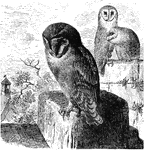
"Aluco flammeus pratincola. Barn Owl. above, including upper surfaces of wings and tail, tawny, fulvous, or orange-brown delicately clouded or marbled with ashy and white, and dotted with blackish, sometimes also with white; suck marking resolved, or tending to resolve, into four or five bars of dark mottling on the wings and tail. below, including lining of wings, varying from pure white to tawny, ochrey, or fulvous, but usually paler than the upper parts and dotted with small but distinct blackish specks. Face varying from white to fulvous or purplish-brown, in some shades as if stained with claret, usually quite dark or even black. About the eyes, and the border of the disc, dark brown. Thus extremely variable in tone of coloration, but the pattern more constant, while the generic characters render the bird unmistakable. Nestlings are covered with fluffy white down." Elliot Coues, 1884

Barn Owls

"Aluco flammeus pratincola. Barn Owl. above, including upper surfaces of wings and tail, tawny, fulvous,…
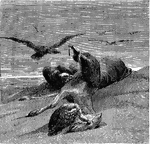
A group of vultures, three on the ground, eat their prey. Several vultures are approaching those already on the ground.

Vultures

A group of vultures, three on the ground, eat their prey. Several vultures are approaching those already…

"The third class of timber buildings which has to be described is the so-called Swiss-Cottage style [shown here]. This class belongs exclusively to the country in contradistinction to the town. It is only lately that its application has been extended to other purposes, as for example, (and in combination with framed half-timbered construction) to railway stations, &c."

Group of Swiss Houses

"The third class of timber buildings which has to be described is the so-called Swiss-Cottage style…
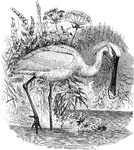
"European Spoonbill. Platalea leucorodia. Bill long, flat, remarkably widened, rounded, and spoon-shaped at the end. Birds of this group are known at a glance, by the singularity of the bill; they closely resemble the foregoing in structure and habit, being simply spoon-billed Ibises. The trachea is peculiarly convoluted within the thorax." Elliot Coues, 1884

European Spoonbill

"European Spoonbill. Platalea leucorodia. Bill long, flat, remarkably widened, rounded, and spoon-shaped…
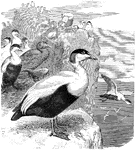
"Somateria mollissima. European Eider Duck. Bill with lateral frontal process extending on each side of the forehead, between the short pointed extension of the feathers on the culmen and the much greater extension of those on the sides of the bill, which reach to below the nostril, about opposite those on the chin. The general upper outline of the bill nearly straight, and the frontal processes narrow, acute, and nearly parallel. Adult male: Plumage almost entirely black and white. Top of head glossy blue-black, including eyes, and forking behind to receive the white of the hind-head. Occiput more or less washed with sea-green. Neck all around, fore breast, most of the back, most of the wing-coverts above and below, the curly tertials, and sides of rump, white, on the breast tinged with pale creamy-brown." Elliot Coues, 1884

Eider Ducks

"Somateria mollissima. European Eider Duck. Bill with lateral frontal process extending on each side…

"The buildings which have been constructed in these various styles differ essentially from those which have been carried out in the same styles in other countries. In churches and other buildings erected in the Gothic style this difference mainly consists in deficiency of strongly marked architectural keeping, for both main and subordinate features are generally irregular. In most cases the whole group is highly unsymmetrical, and the tower is at one corner, by which a picturesque effect is aimed at [shown here]. The material and the mode of construction are generally left visible, and it is endeavoured to utilize them as ornament; and this not only externally but also in the interior, where the beams and rafters of the roof are often left quite bare; they are even thus exposed where their appearance is not in keeping with the destination of the buildings."

Memorial Church in Scotland

"The buildings which have been constructed in these various styles differ essentially from those which…
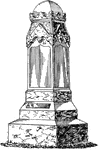
A monument is a type of structure either explicitly created to commemorate a person or important event or which has become important to a social group as part of their remembrance of past events.

Explicit Monument

A monument is a type of structure either explicitly created to commemorate a person or important event…
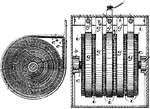
A rechargeable battery also known as a storage battery is a group of one or more secondary cells. Rechargeable batteries use electrochemical reactions that are electrically reversible. Rechargeable batteries can offer economic and environmental benefits compared to disposable batteries.

Storage Battery

A rechargeable battery also known as a storage battery is a group of one or more secondary cells. Rechargeable…
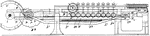
This machine is used for multiplication, and division purposes. Multiplication is the mathematical operation of scaling one number by another. It is one of the four basic operations in elementary arithmetic. Conceptually, division describes two distinct but related settings. Partitioning involves taking a set of size a and forming b groups that are equal in size. The size of each group formed, c, is the quotient of a and b. Quantitate division involves taking a set of size a and forming groups of size b. The number of groups of this size that can be formed, c, is the quotient of a and b

Multiplying or Dividing Machine

This machine is used for multiplication, and division purposes. Multiplication is the mathematical operation…
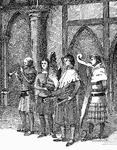
A group of musicians playing at Nursted Court entertaining the nobles. The musicians, from left to right, are playing a shawm, Portative (hand organ), vielle, and harp.

Musicians at Nursted Court

A group of musicians playing at Nursted Court entertaining the nobles. The musicians, from left to right,…
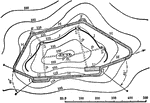
"On the height 130 is an armoured battery P B, containing four 6 in. howitzers in cupolas, with an observation post in a small cupola in the centre. A passage runs along the backs of the cupolas and ammunition rooms, and two barrack rooms are provided at the ends, with other small rooms as offices in the centre." — Encyclopaedia Britannica, 1922

Austrian Design Group Fortification

"On the height 130 is an armoured battery P B, containing four 6 in. howitzers in cupolas, with an observation…
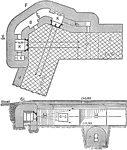
"The Austrian counterscarp casement is constructionally simple. Under the counterscarp wall, on the further side of the ditch, facing the salient angle of the of the work, a chamber is formed with embrasures for rifle, machine gun or light artillery fire along the two adjacent ditch lengths." — Encyclopaedia Britannica, 1922

Austrian Fort Counterscarp Casement

"The Austrian counterscarp casement is constructionally simple. Under the counterscarp wall, on the…
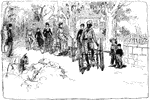
An illustration of a group of people riding tricycles down the street with other people and children watching.

People Riding Tricycles

An illustration of a group of people riding tricycles down the street with other people and children…
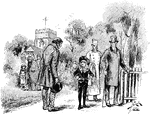
An illustration of a group of people surrounding a man talking to a young boy in front of a building.
Man and Boy Talking

An illustration of a group of people surrounding a man talking to a young boy in front of a building.

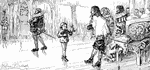
An illustration of a young boy in a room full of royal looking men. The boy is walking towards one of the men, holding an object out to one of the men that looks like a key.

Boy in a Group of Men

An illustration of a young boy in a room full of royal looking men. The boy is walking towards one of…
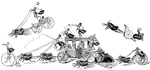
An illustration of a group of fleas doing various activities seen in a circus. Some fleas are pulling a carriage with fleas inside, some are riding bicycles, and some look like they are racing each other.

Flea Circus

An illustration of a group of fleas doing various activities seen in a circus. Some fleas are pulling…
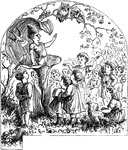
An illustration of a little man standing inside of a Jack-in-the-Pulpit plant. The man seems to be a fairy tale figure and he is talking to a group of children.

Jack-in-the-Pulpit

An illustration of a little man standing inside of a Jack-in-the-Pulpit plant. The man seems to be a…
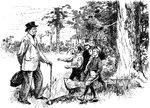
A well dressed mail man carrying mail in a large black bag. A group of young boys is coming to greet him.

Mail Man and Young Boys

A well dressed mail man carrying mail in a large black bag. A group of young boys is coming to greet…
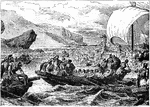
A large group of travelers in boats sailing on to the discovery of Lebanon.

Phoenician Fleet on a Voyage of Discovery

A large group of travelers in boats sailing on to the discovery of Lebanon.
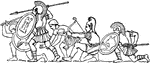
"A group of Greek soldiers, drawn from sculptured figures in the temple pediment."—Gordy, 1912

Greek Soldiers

"A group of Greek soldiers, drawn from sculptured figures in the temple pediment."—Gordy, 1912
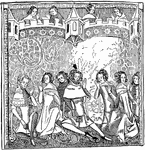
A group in the manor house, during feudalist Europe.

Tapestry

A group in the manor house, during feudalist Europe.

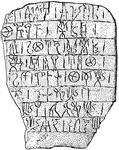
"A large tablet with linear script found in the palace at Gnossus, Crete. There are eight lines of writing with a total of about twenty words. Notice the upright lines which appear to mark the termination of each group of signs."—Webster, 1913

Cretan Writing

"A large tablet with linear script found in the palace at Gnossus, Crete. There are eight lines of writing…
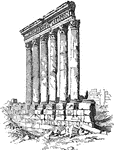
"The ruins at Balbec in Syria lie amidst desolate mountains, forty miles from the sea. They consist of a group of shattered temples crowning the ancient acropolis. Six massive columns nearly one hundred feet high, supporting a marble frieze, are all that remains of the majestic Temple of the Sun."—Webster, 1913

Temple of the Sun

"The ruins at Balbec in Syria lie amidst desolate mountains, forty miles from the sea. They consist…
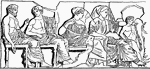
"The chief gods, in striking contrast with the monstrous divinities of the Oriental mythologies, had been molded by the fine Hellenic imagination into human forms of surpassing beauty and grace."—Myers, 1904

Group of Gods and Goddesses

"The chief gods, in striking contrast with the monstrous divinities of the Oriental mythologies, had…
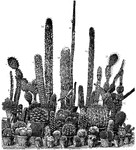
There are sixteen types of cacti pictures. Those varieties include opuntia, cereus, opuntia streptacantha, cereus candicans, mammillaris, cereus peruvianus monstrosus, echinocereus electracanthus, mammillaria, echinopsis formosa, echinocactus visnaga, cereus peruvianus var, opuntia candelabriformis, cereus strictus, pilocereus senilis, cereus tweedii, and cereus chilensis.

Group of Cacti

There are sixteen types of cacti pictures. Those varieties include opuntia, cereus, opuntia streptacantha,…
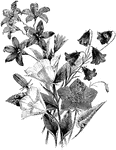
Campanulas flowers are blue or white. The varieties picture are lactiflora, rotundifolia Hostii, carpathic turbinata, and carpathica alba.

Group of Campanulas

Campanulas flowers are blue or white. The varieties picture are lactiflora, rotundifolia Hostii, carpathic…
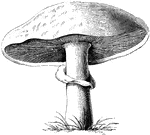
Common mushroom is the common name of agaricus campestris. Mushroom is the popular name given to a group of fungi.

Common Mushroom

Common mushroom is the common name of agaricus campestris. Mushroom is the popular name given to a group…
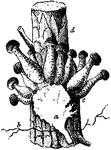
Pictured is a group of young spore bearers of agaricus melleus. The mushrooms can be found growing between the wood and the bark in black, string like or flattened bands.

Agaricus Melleus

Pictured is a group of young spore bearers of agaricus melleus. The mushrooms can be found growing between…
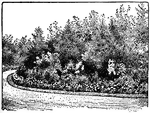
Pictured are annuals filling the formal space between a drive and a tree group. Annuals are plants that bloom in the open the same year the seeds are sown and that do not live over winter.

Annual Plants in Landscaping

Pictured are annuals filling the formal space between a drive and a tree group. Annuals are plants that…
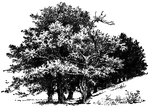
Pictured is a group of old sugar maples with irregular and broken heads.

Old Sugar Maples

Pictured is a group of old sugar maples with irregular and broken heads.

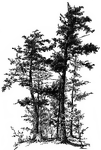
Illustrated is a group of surviving hemlock spruces.

Hemlock Spruce

Illustrated is a group of surviving hemlock spruces.

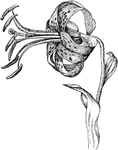
Illustrated is a form of lily. It belongs to the turban or Turk's cap group, lilium superbum.

Lilium Superbum

Illustrated is a form of lily. It belongs to the turban or Turk's cap group, lilium superbum.
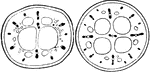
The left is a transverse section of a petiole of the castalia group. The right is transverse section of a penduncle of the castalia group.

Castalia Petiole and Peduncle

The left is a transverse section of a petiole of the castalia group. The right is transverse section…
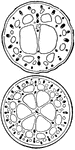
The left is a transverse section of a petiole of the lotos group. The right is a transverse section of a peduncle of the lotos group.

Lotos Petiole and Peduncle

The left is a transverse section of a petiole of the lotos group. The right is a transverse section…
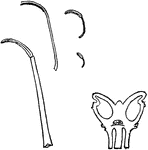
Pictured are stamens and the vertical section of an ovary from a flower of the anecphya group.

Anecphya Group

Pictured are stamens and the vertical section of an ovary from a flower of the anecphya group.
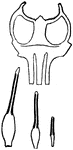
Pictured are the stamens of a vertical cross section of an ovary from a flower of the <i>brachyceras</i> group.

Brachyceras Group

Pictured are the stamens of a vertical cross section of an ovary from a flower of the brachyceras group.
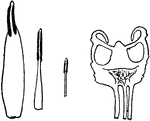
Pictured are the stamens and a vertical section of the ovary of a flower of the castalia group.

Castalia Group

Pictured are the stamens and a vertical section of the ovary of a flower of the castalia group.
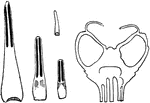
Pictured are the stamens and a vertical section of the ovary of a flower of the lotos group.

Lotos Group

Pictured are the stamens and a vertical section of the ovary of a flower of the lotos group.
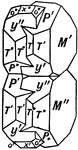
This figure shows an example of Compound Twinning, where two orthoclase twins are twinned in parallel to their basal pinacoid. Compound Twins are produced by the presence of two or more twinning laws in the same group.

Compound Twinning

This figure shows an example of Compound Twinning, where two orthoclase twins are twinned in parallel…
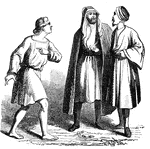
Examples of medieval attire.

Garments

Examples of medieval attire.

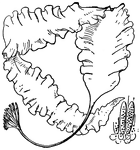
Laminaria saccharina belongs to the group Laminariæ, a group of algæ belonging to  the Phæosporeæ, a subdivision of the Phæosphyceæ, or brown seaweeds. The propagative cells are always swarm-spores of similar form and size; and these are produced in unilocular sporangia. The thallus has a stalk, often of considerable thickness, which is attached below to rocks or other substratum by means of rootlike growth, and ends above in a flat lamina, which may be divided or undivided.

Laminaria Saccharina

Laminaria saccharina belongs to the group Laminariæ, a group of algæ belonging to the Phæosporeæ,…
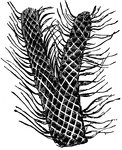
This illustration shows a portion of Lepidodendron. Lepidodendron is the generic name of a large and important group of plants  which flourished principally in the Carboniferous period. The outer surface of the bark is marked by lozenge-shaped, scale-like markings, the leaf-cushions. These are arranged in dense spirals, which wind around the stems. Often, the narrow and pointed leaves are found, still adherent; they may also carry cones <i>(lepidostrobi)</i>, which in form somewhat resemble those of the fir. The branches usually fork repeatedly, and were implanted on a massive stem which had a similar external sculpture. Some of these stems have been seen in the roofs of coal workings with a length of a hundred feet. Their roots are generally known as stigmaria. The Lepidodendra belonged to the Lycopodiaceæ, and have their nearest representatives in the diminutive club-mosses, which they resemble even in their superficial characters.

Portion of Lepidodendron

This illustration shows a portion of Lepidodendron. Lepidodendron is the generic name of a large and…
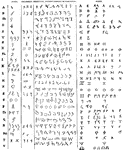
Leading alphabet of antiquity.  Included is Punic (Western Semitic from Carthage, North Africa - now extinct), Pelasgian (a form of Greek), Phoenician (Northern Semitic language), Ancient Hebraic or Samaritan (an ancient group closely related to Semitics), and Greek.

Alphabet of Antiquity

Leading alphabet of antiquity. Included is Punic (Western Semitic from Carthage, North Africa - now…
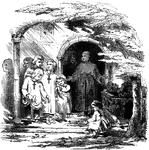
A church scene with the priest standing in the doorway with a group of children in robes.

Church Scene

A church scene with the priest standing in the doorway with a group of children in robes.
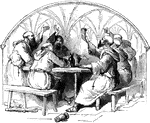
A group of monks sit on backless benches around a table in a vaulted room.

Monks at a Table

A group of monks sit on backless benches around a table in a vaulted room.

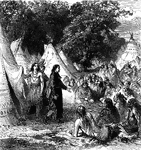
A missionary in a long black robe addresses a group of seated Native Americans. The setting is a collection of Plains Indian teepees, although the surroundings are forested.

Missionary Addressing Native Americans

A missionary in a long black robe addresses a group of seated Native Americans. The setting is a collection…
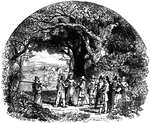
A scene of New England colonists talking with several Native Americans in a wooded glen. In the background is a group of Plains Indian teepees, which would be out of place for the presumed New England setting, but consistent with popular imagination.

Colonists Interacting with Native Americans

A scene of New England colonists talking with several Native Americans in a wooded glen. In the background…
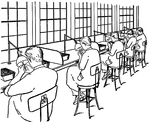
Group of workers inspecting small parts under lamps. They are seated on high stools with backs.

Bench Inspectors

Group of workers inspecting small parts under lamps. They are seated on high stools with backs.
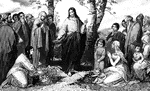
"And why are ye anxious concerning raiment? Consider the lilies of the field, how they grow; they toil not, neither do they spin: yet I say unto you, that even Solomon in all his glory was not arrayed like one of these. But if God doth so clothe the grass of the field, which to-day is, and to-morrow is cast into the oven, shall he not much more clothe you, O ye of little faith?" Matthew 6:28-30 ASV
<p>Christ preaching and gesturing toward lilies at his feet. He is surrounded by a group of followers.

Jesus Preaching, Consider the Lilies of the Field

"And why are ye anxious concerning raiment? Consider the lilies of the field, how they grow; they toil…
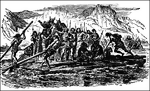
A group of Franks, mainly men with a couple of women and children, cross the Rhine River on a wooden raft. Two men strain at the large oars on the front and another can be seen working an oar in the back. Several men have spears and two are pointing into the distance in front of them. Another raft can be seen just behind them (right), while a third is shown far away in the distance. Large cliffs rise in the background. The Romans were resettling the Franks near to their borders so they could be controlled.

Franks Crossing the Rhine to Establish Themselves on the West Bank as Allies of Rome

A group of Franks, mainly men with a couple of women and children, cross the Rhine River on a wooden…
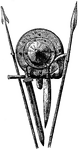
A collection of weapons used by the Germanic tribe called the Franks. These are all of their most typically used weapons: a shield, a spear or Germanic spear, a Frankish spear or angon (this is similar to a short javelin), a sword, a knife, and a short axe for battling in close quarters. All of the weapons are standing vertically, except for the short axe, which lies horizontally, underneath the shield. The shield appears to be three-tiered.

Frankish Weapons, Including a Shield, Germanic Spear, Angon, Sword, Knife, and Short Axe

A collection of weapons used by the Germanic tribe called the Franks. These are all of their most typically…
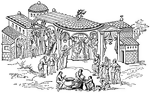
Illustration of an Anglo-Saxon manor house or noble's house from 11th century England. There are several porticoes and entrances to the house. People huddle in the entryways, some have shields and spears. An animal head with antlers is at the pinnacle of one roof. The lord and lady are giving alms to several poor people in the courtyard. There is a line of men with canes, a group filling large pottery jars, and a line of people reaching for alms.

Anglo-Saxon Manor House, Circa 11th Century

Illustration of an Anglo-Saxon manor house or noble's house from 11th century England. There are several…
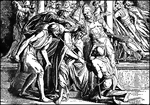
"And they stripped him, and put on him a scarlet robe. And they platted a crown of thorns and put it upon his head, and a reed in his right hand; and they kneeled down before him, and mocked him, saying, Hail, King of the Jews! And they spat upon him, and took the reed and smote him on the head." Matthew 27:28-30 ASV
<p>Illustration of Jesus being scourged and beaten by the soldiers. They are placing a crown of thorns on his head. They have put a robe on him and a reed in his hands. One soldier is knelt mockingly at Jesus' feet, another soldier holds a multi-strap, leather whip. A group of people and soldiers can be seen in the background.

Jesus Scourged, Mocked, and Crowned with Thorns

"And they stripped him, and put on him a scarlet robe. And they platted a crown of thorns and put it…