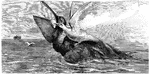
An illustration of a brown pelican with a fish in it's mouth and a sea gull resting on his back. The brown pelican is the smallest of the eight species of pelican, although it is a large bird in nearly every other regard. It lives strictly on coasts from Washington and Virginia south to northern Chile and the mouth of the Amazon River, as well as the island of Saut d'Eau in Trinidad and Tobago. Some immature birds may stray to inland freshwater lakes. After nesting, North American birds move in flocks further north along the coasts, returning to warmer waters for winter. Their young are hatched in broods of about 3, and eat around 150 lbs. of fish in the 8-10 month period they are cared for. Gulls (often informally Seagulls) are birds in the family Laridae. They are typically medium to large birds, usually gray or white, often with black markings on the head or wings. They typically have harsh wailing or squawking calls. They have stout, longish bills, and webbed feet.

Brown Pelican and Sea Gull

An illustration of a brown pelican with a fish in it's mouth and a sea gull resting on his back. The…
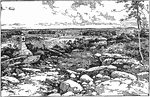
Little Round Top is the smaller of two rocky hills south of Gettysburg, Pennsylvania. It was the site of an unsuccessful assault by Confederate troops against the Union left flank on July 2, 1863, the second day of the Battle of Gettysburg.

Battleground of Little Round Top

Little Round Top is the smaller of two rocky hills south of Gettysburg, Pennsylvania. It was the site…
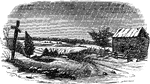
The Battle of Guilford Court House was a battle fought on March 15, 1781 inside the present-day city of Greensboro, North Carolina, during the American Revolutionary War.

The Battlefield of Guilford

The Battle of Guilford Court House was a battle fought on March 15, 1781 inside the present-day city…

Wade Hampton III (March 28, 1818 - April 11, 1902) was a Confederate cavalry leader during the American Civil War and afterwards a politician from South Carolina, serving as its governor and as a U.S. Senator.

Wade Hampton III

Wade Hampton III (March 28, 1818 - April 11, 1902) was a Confederate cavalry leader during the American…


The house of Cornelius Harnett in North Carolina.

Harnett's House

The house of Cornelius Harnett in North Carolina.

The town of Harper's Ferry, where an important Civil War battle was fought in 1862.

View of Harper's Ferry, 1862, Looking South

The town of Harper's Ferry, where an important Civil War battle was fought in 1862.

The seal of Harvard University in Massachusetts.

Seal of Harvard

The seal of Harvard University in Massachusetts.

Lambeth Palace is the official London residence of the Archbishop of Canterbury. It is located in Lambeth, on the south bank of the River Thames a short distance upstream of the Palace of Westminster on the opposite shore. It was acquired by the archbishopric around 1200.

Lambeth Palace, 1867

Lambeth Palace is the official London residence of the Archbishop of Canterbury. It is located in Lambeth,…
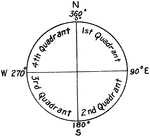
The four cardinal directions or cardinal points are north, south, east, and west.

Cardinal Directions

The four cardinal directions or cardinal points are north, south, east, and west.
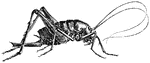
Parktown prawn is the familiar term South Africans use for Libanasidus vittatus, a monotypic king cricket species found in South Africa, belonging to the Anostostomatidae family. It is not considered a true cricket. Adults are usually around 4 to 5 centimeters in length, with an antennae of 2 cm. Parktown is an affluent suburb in Johannesburg, where these crickets are commonly found, hence the name.

Partown Prawn

Parktown prawn is the familiar term South Africans use for Libanasidus vittatus, a monotypic king cricket…
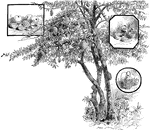
An illustration of a Calabash tree and ways to utilize the shell of the fruit it produces. Crescentia (Calabash tree, huingo, krabasi, or kalebas) is a genus of six species of flowering plants in the family Bignoniaceae, native to southern Florida, the Caribbean, southern Mexico, Central America and northern South America. The species are small trees growing to 10 m tall, and producing large spherical fruits up to half a meter in diameter.

Calabash Tree

An illustration of a Calabash tree and ways to utilize the shell of the fruit it produces. Crescentia…
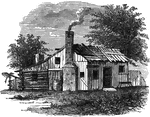
The birthplace of Andrew Jackson, President of the United States.

Birthplace of Andrew Jackson

The birthplace of Andrew Jackson, President of the United States.

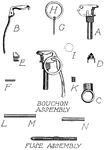
<p>A: Bouchon<br>B: Lever<br>C: Bouchon Seal<br>D: Striker<br>E: Spring<br>F: Hinge Pin<br>G: Split Pin<br>H: Split Pin Ring<br>I: Moisture Cap<br>K: Primer<br>L: Priming Powder<br>M: Fuse<br>N: Detonator</p>

Grenade Parts

A: Bouchon B: Lever C: Bouchon Seal D: Striker E: Spring F: Hinge Pin G: Split Pin H: Split Pin Ring…

A cotton press yard of the Cotton Centennial in the 1884 World's Fair in New Orleans, Louisiana.

Cotton Centennial

A cotton press yard of the Cotton Centennial in the 1884 World's Fair in New Orleans, Louisiana.

State buildings in Atlanta, Georgia after the American Civil War.

Atlanta, Georgia State Buildings

State buildings in Atlanta, Georgia after the American Civil War.

Thomas Jefferson's seal with the motto: "Rebellion to tyrants is obedience to God."

Jefferson's Seal

Thomas Jefferson's seal with the motto: "Rebellion to tyrants is obedience to God."
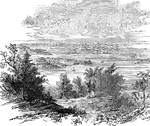
The crossing between Lakes George and Champlain had been used by natives for thousands of years. The town was located on the direct route, utilizing rivers and two long lakes, between New York City to the south and the French settlement of Montreal to the north. The town was the setting for historic battles and maneuvers during both the French and Indian War and the American Revolution. The site of Fort Ticonderoga marked the location of an important portage between Lake George and Lake Champlain.

Ticonderoga and the Lake, from Mount Defiance

The crossing between Lakes George and Champlain had been used by natives for thousands of years. The…

The seal of the War Office of the United States of America. The term "War Office" used during the Revolution, and for many years afterward, was associated with the Headquarters of the Army.

United States of America War Office

The seal of the War Office of the United States of America. The term "War Office" used during the Revolution,…

Monument to Johann von Robaii, Baron de Kalb a German soldier and volunteer who served as a major general in the Continental Army during the American Revolutionary War.

Baron de Kalb's Monument

Monument to Johann von Robaii, Baron de Kalb a German soldier and volunteer who served as a major general…
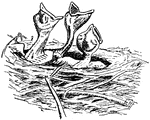
The American Robin, Turdus migratorius, is a migratory songbird of the thrush family. It is named after the European Robin because of the male's bright red breast, though the two species are not related. The American Robin is widely distributed throughout North America, wintering south of Canada from Florida to central Mexico and along the Pacific Coast. It is the state bird of Connecticut, Michigan and Wisconsin. It has seven subspecies, but only T. m. confinis in the southwest is particularly distinctive, with pale gray-brown underparts.

Young American Robins

The American Robin, Turdus migratorius, is a migratory songbird of the thrush family. It is named after…
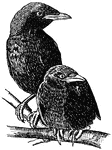
The true crows are large passerine birds that comprise the genus Corvus in the family Corvidae. Ranging in size from the relatively small pigeon-sized jackdaws (Eurasian and Daurian) to the Common Raven of the Holarctic region and Thick-billed Raven of the highlands of Ethiopia, the 40 or so members of this genus occur on all temperate continents (except South America) and several offshore and oceanic islands (including Hawaii).

Crows

The true crows are large passerine birds that comprise the genus Corvus in the family Corvidae. Ranging…
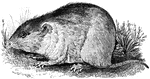
The Meadow Vole (Microtus pennsylvanicus), sometimes called the Field Mouse or Meadow Mouse, is a small North American vole found across Canada, Alaska and the northern United States. Its range extends further south along the Atlantic coast. One subspecies, the Florida Salt Marsh Vole, is found in Florida, and is classified as endangered. The Meadow Vole is active year-round, usually at night. It also digs underground burrows where it stores food for the winter and females give birth to their young. Although these animals tend to live close together, they are aggressive towards one other. This is particularly evident in males during the breeding season. It can cause damage to fruit trees, garden plants and commercial grain crops.

Field Mouse

The Meadow Vole (Microtus pennsylvanicus), sometimes called the Field Mouse or Meadow Mouse, is a small…
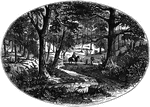
The Battle of Kings Mountain, October 7, 1780, was an important Patriot victory in the Southern campaign of the American Revolutionary War.

View at King's Mountain Battleground

The Battle of Kings Mountain, October 7, 1780, was an important Patriot victory in the Southern campaign…
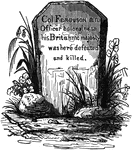
The Battle of Kings Mountain, October 7, 1780, was an important Patriot victory in the Southern campaign of the American Revolutionary War.

Monument on King's Mountain

The Battle of Kings Mountain, October 7, 1780, was an important Patriot victory in the Southern campaign…

Henry Laurens (March 6, 1724 &ndash; December 8, 1792) was an American merchant and rice planter from South Carolina who became a political leader during the Revolutionary War.

Henry Laurens

Henry Laurens (March 6, 1724 – December 8, 1792) was an American merchant and rice planter from…
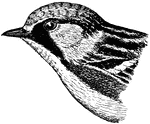
The Chestnut-sided Warbler, Dendroica pensylvanica, is a New World warbler. They breed in eastern North America and in southern Canada westwards to the Canadian Prairies. They also breed in the Great Lakes region and in the eastern USA. These birds are migratory, wintering in Central America south to northern Colombia, and they are very rare vagrants to western Europe.

Chestnut-sided Warbler

The Chestnut-sided Warbler, Dendroica pensylvanica, is a New World warbler. They breed in eastern North…
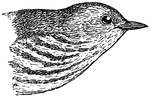
The Yellow Warbler (Dendroica petechia) is a New World warbler. It is the most widespread Dendroica species, breeding in almost the whole of North America and down to northern South America.

Yellow Warbler

The Yellow Warbler (Dendroica petechia) is a New World warbler. It is the most widespread Dendroica…
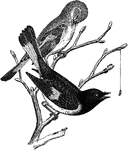
The American Redstart, Setophaga ruticilla, is a New World warbler. They breed in North America, across southern Canada and the eastern USA. These birds are migratory, wintering in Central America, the West Indies, and northern South America. They are very rare vagrants to western Europe. This species is unrelated to the Old World redstarts. This species derives its name from the male's red tail, start being an old word for tail.

American Redstart

The American Redstart, Setophaga ruticilla, is a New World warbler. They breed in North America, across…
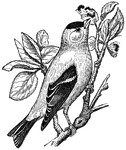
The American Goldfinch (Carduelis tristis), also known as the Eastern Goldfinch and Wild Canary, is a North American bird in the finch family. It is migratory, ranging from southern Canada to North Carolina during the breeding season, and from just south of the Canadian border to Mexico during the winter. The only finch in its subfamily which undergoes a complete molt, the American Goldfinch displays sexual dimorphism in its coloration; the male is a vibrant yellow in the summer and an olive color during the winter months, while the female is a dull yellow-brown shade which brightens only slightly during the summer. The male displays brightly colored plumage during the breeding season to attract a mate.

American Goldfinch

The American Goldfinch (Carduelis tristis), also known as the Eastern Goldfinch and Wild Canary, is…
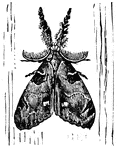
Tussock Moths, Lymantriidae or Liparidae, are a family of moths with about 350 known genera and over 2,500 known species found all over the world, in every continent except Antarctica. They are particularly concentrated in sub-Saharan Africa, India, Southeast Asia and South America; one estimate lists 258 species in Madagascar alone (Schaefer, 1989). Apart from oceanic islands, notable places that do not host Lymantriids include New Zealand, the Antilles, and New Caledonia.

Tussock Moth

Tussock Moths, Lymantriidae or Liparidae, are a family of moths with about 350 known genera and over…
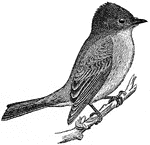
The genus Sayornis is a small group of medium-sized insect-eating birds in the Tyrant flycatcher family Tyrranidae native to North and South America.

Phoebe

The genus Sayornis is a small group of medium-sized insect-eating birds in the Tyrant flycatcher family…

The seal and signature of William Tryon. Tryon was the royal governor North Carolina and New York. The history of Tryon's administration is a record of folly, extortion, and crime, and he gained the name of "The Wolf of North Carolina." He was governor of New York when the Revolutionary War broke out, and he was the last governor of that province appointed by the crown.

Seal and Signature of Tryon

The seal and signature of William Tryon. Tryon was the royal governor North Carolina and New York. The…
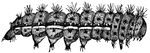
An illustration of a Io moth caterpillar. The io moth (Automeris io) is a very colorful North American moth in the Saturniidae family. It ranges from the southeast corner of Manitoba and in the southern extremes of Ontario, Quebec, and New Brunswick in Canada, and in the US it is found from North Dakota, South Dakota, Nebraska, Colorado, New Mexico, Texas, Utah, east of those states and down to the southern end of Florida.

Io Moth Caterpillar

An illustration of a Io moth caterpillar. The io moth (Automeris io) is a very colorful North American…
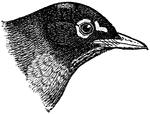
The American Robin, Turdus migratorius, is a migratory songbird of the thrush family. It is named after the European Robin because of the male's bright red breast, though the two species are not related. The American Robin is widely distributed throughout North America, wintering south of Canada from Florida to central Mexico and along the Pacific Coast. It is the state bird of Connecticut, Michigan and Wisconsin. It has seven subspecies, but only T. m. confinis in the southwest is particularly distinctive, with pale gray-brown underparts.

American Robin

The American Robin, Turdus migratorius, is a migratory songbird of the thrush family. It is named after…
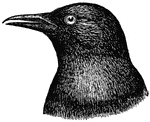
The true crows are large passerine birds that comprise the genus Corvus in the family Corvidae. Ranging in size from the relatively small pigeon-sized jackdaws (Eurasian and Daurian) to the Common Raven of the Holarctic region and Thick-billed Raven of the highlands of Ethiopia, the 40 or so members of this genus occur on all temperate continents (except South America) and several offshore and oceanic islands (including Hawaii). In the United States, the word "crow" is used to refer to the American Crow.

Crow

The true crows are large passerine birds that comprise the genus Corvus in the family Corvidae. Ranging…
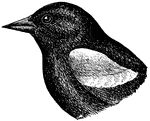
The Red-winged Blackbird (Agelaius phoeniceus) is a passerine bird of the family Icteridae found in most of North and much of Central America. It breeds from Alaska and Newfoundland south to Florida, the Gulf of Mexico, Mexico and Guatemala, with isolated populations in western El Salvador, northwestern Honduras and northwestern Costa Rica. It may winter as far north as Pennsylvania and British Columbia, but northern populations are generally migratory, moving south to Mexico and the southern United States. The Red-winged Blackbird is sexually dimorphic; the male has all black with a red shoulder and yellow wing bar, while the female is a nondescript dark brown. Seeds and insects make up the bulk of the Red-winged Blackbird's diet.

Red-winged Blackbird

The Red-winged Blackbird (Agelaius phoeniceus) is a passerine bird of the family Icteridae found in…
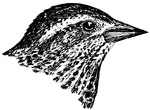
The Red-winged Blackbird (Agelaius phoeniceus) is a passerine bird of the family Icteridae found in most of North and much of Central America. It breeds from Alaska and Newfoundland south to Florida, the Gulf of Mexico, Mexico and Guatemala, with isolated populations in western El Salvador, northwestern Honduras and northwestern Costa Rica. It may winter as far north as Pennsylvania and British Columbia, but northern populations are generally migratory, moving south to Mexico and the southern United States. The Red-winged Blackbird is sexually dimorphic; the male has all black with a red shoulder and yellow wing bar, while the female is a nondescript dark brown. Seeds and insects make up the bulk of the Red-winged Blackbird's diet.

Red-winged Blackbird (Female)

The Red-winged Blackbird (Agelaius phoeniceus) is a passerine bird of the family Icteridae found in…
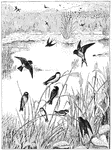
The Sand Martin (Riparia riparia) is a migratory passerine bird in the swallow family. This species was first described by Linnaeus in his Systema naturae in 1758 as Hirundo riparia.Riparia means "of the riverbank", and is derived from the Latin ripa, a riverbank. It has a wide range in summer, embracing practically the whole of Europe and the Mediterranean countries, part of northern Asia and also North America, where it is called Bank Swallow. It winters in eastern and southern Africa, South America and South Asia (where it is called the Collared Sand Martin).

Swallow Roost

The Sand Martin (Riparia riparia) is a migratory passerine bird in the swallow family. This species…
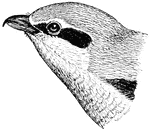
The Great Grey Shrike (Lanius excubitor) is a member of the shrike family. The Great Grey Shrike breeds in northern Europe and Asia, and in North America in northern Canada and Alaska (where it known as the Northern Shrike). It is migratory and winters further south in those continents, too, for example, Great Britain and the northern USA. Wintering birds usually arrive in October and November. As a rule they are then solitary, and when several arrive simultaneously they speedily spread out, each establishing its hunting territory and reducing competition with others.

Great Grey Shrike

The Great Grey Shrike (Lanius excubitor) is a member of the shrike family. The Great Grey Shrike breeds…
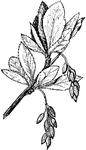
Berberis (B&eacute;r-be-ris, barberry, pepperidge bush) a genus of about 450-500 species of deciduous and evergreen shrubs from 1-5 m tall with thorny shoots, native to the temperate and subtropical regions of Europe, Asia, Africa, North America and South America. They are closely related to the genus Mahonia, which is included within Berberis by some botanists.

Barberry

Berberis (Bér-be-ris, barberry, pepperidge bush) a genus of about 450-500 species of deciduous…
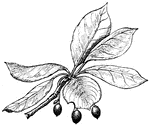
The tupelos, or pepperidge tree, genus Nyssa, are a small genus of about 9 to 11 species of trees with alternate, simple leaves. Most are highly tolerant of wet soils and flooding, some needing to grow in such environments. Five of the species are native to eastern North America from the extreme south of Canada south to eastern Mexico; the others to east and south Asia from China south to Malaysia and west to the Himalaya. A related genus, Davidia, the Dove tree, occurs in China.

Tupelp

The tupelos, or pepperidge tree, genus Nyssa, are a small genus of about 9 to 11 species of trees with…
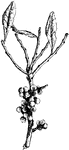
Myrica is a genus of about 35-50 species of small trees and shrubs in the family Myricaceae, order Fagales. The genus has a wide distribution, including Africa, Asia, Europe, North America and South America, and missing only from Australasia. Some botanists split the genus into two genera on the basis of the catkin and fruit structure, restricting Myrica to a few species, and treating the others in Morella.

Myrica

Myrica is a genus of about 35-50 species of small trees and shrubs in the family Myricaceae, order Fagales.…
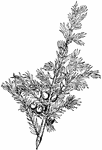
Junipers are coniferous plants in the genus Juniperus of the cypress family Cupressaceae. Depending on taxonomic viewpoint, there are between 50-67 species of juniper, widely distributed throughout the northern hemisphere, from the Arctic, south to tropical Africa in the Old World, and to the mountains of Central America. Junipers vary in size and shape from tall trees, 20-40 m tall, to columnar or low spreading shrubs with long trailing branches. They are evergreen with needle-like and/or scale-like leaves. They can be either monoecious or dioecious

Juniper

Junipers are coniferous plants in the genus Juniperus of the cypress family Cupressaceae. Depending…
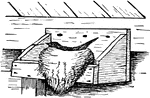
An illustration of a Phoebe's nest in a box. The genus Sayornis is a small group of medium-sized insect-eating birds in the Tyrant flycatcher family Tyrranidae native to North and South America. They prefer semi-open or open areas. These birds wait on a perch and then catch insects in flight, also sometimes picking them up from the ground. Their nest is an open cup sometimes placed on man-made structures. They often slowly lower and raise their tails while perched.

Phoebe's Nest

An illustration of a Phoebe's nest in a box. The genus Sayornis is a small group of medium-sized insect-eating…
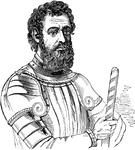
Giovanni da Verrazzano (c. 1485 – c. 1528) was an Italian explorer of North America, in the service of the French crown. He is renowned as the first European to explore the Atlantic coast of North America between South Carolina and Newfoundland, including New York Harbor and Narragansett Bay, in 1524.

Giovanni da Verrazzano

Giovanni da Verrazzano (c. 1485 – c. 1528) was an Italian explorer of North America, in the service…
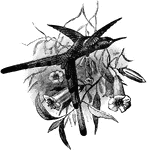
A species of hummingbird, the Red-Tailed Comet (Sappho sparganura) is native to South America.

Red-Tailed Comet

A species of hummingbird, the Red-Tailed Comet (Sappho sparganura) is native to South America.
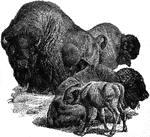
The American Bison (Bison bison) is a bovine mammal, also commonly known as the American buffalo. 'Buffalo' is something of a misnomer for this animal as it is only distantly related to either of the two "true buffaloes", the water buffalo and the African Buffalo. The bison once inhabited the Grasslands of the United States and Asia in massive herds, ranging from the Great Slave Lake in Canada's far north to Mexico in the south, and from eastern Oregon almost to the Atlantic Ocean, taking its subspecies into account. Its two subspecies are the Plains Bison (Bison bison bison), distinguished by its smaller size and more rounded hump, and the Wood Bison (Bison bison athabascae), distinguished by its larger size and taller square hump. Wood Bison are one of the largest species of cattle in the world, surpassed in size only by the massive Asian gaur and Wild Asian Water Buffalo, both of which are found mainly in India and Southeast Asia.

North American Bison

The American Bison (Bison bison) is a bovine mammal, also commonly known as the American buffalo. 'Buffalo'…
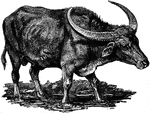
The Domestic Water Buffalo or Domestic Asian Water buffalo (Bubalus bubalis) is abundant in Asia, and widely used in South America, southern Europe and elsewhere. It is a large ungulate and a member of the bovine subfamily. There are established feral populations in northern Australia but the dwindling true wild populations are thought to survive in India, Nepal, Bhutan and Thailand. All the domestic varieties and breeds descend from one common ancestor, the wild Asian water buffalo, which is now an endangered species.

Domestic Water Buffalo

The Domestic Water Buffalo or Domestic Asian Water buffalo (Bubalus bubalis) is abundant in Asia, and…
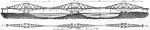
The Forth Bridge is a cantilever railway bridge over the Firth of Forth in the east of Scotland, to the east of the Forth Road Bridge, and 14 km (9 miles) west of central Edinburgh. It is often called the Forth Rail Bridge or Forth Railway Bridge to distinguish it from the Forth Road Bridge, but should correctly be referred to as the Forth Bridge. The bridge connects Scotland's capital Edinburgh with the Kingdom of Fife, and acts as a major artery connecting the north-east and south-east of the country. Described as "the one internationally recognised Scottish landmark", it may be nominated by the British government as a UNESCO World Heritage Site. The bridge and its associated railway infrastructure is owned by Network Rail Infrastructure Limited.

Forth Bridge

The Forth Bridge is a cantilever railway bridge over the Firth of Forth in the east of Scotland, to…
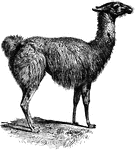
The guanaco (Lama guanicoe) is a camelid animal native to South America that stands between 107 and 122 centimeters (3.5 and 4 feet) at the shoulder and weighs about 90 kg (200 lb). The colour varies very little, ranging from a light brown to dark cinnamon and shading to white underneath. Guanacos have grey faces and small straight ears. They are extremely striking with their large, alert brown eyes, streamlined form, and energetic pace. They are particularly ideal for keeping in large groups in open parklands.

Guanaco

The guanaco (Lama guanicoe) is a camelid animal native to South America that stands between 107 and…
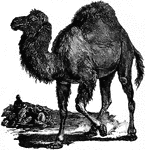
The Dromedary camel (Camelus dromedarius) is a large even-toed ungulate. It is often referred to as the one-humped camel, Arabian camel, or simply as the "dromedary". Its native range is unclear, but it was probably the Arabian Peninsula. The domesticated form occurs widely in northern Africa and the Middle East; the world's only population of dromedaries exhibiting wild behaviour is an introduced feral population in Australia. The dromedary camel is arguably the best-known member of the camel family. Other members of the camel family include the llama and the alpaca in South America. The Dromedary has one hump on its back, in contrast to the Bactrian camel which has two. A good mnemonic for remembering which way around these terms apply is this: "Bactrian" begins with "B", and "Dromedary" begins with "D"; "B" on its side has two humps, whilst "D" on its side has only one hump.

Dromedary

The Dromedary camel (Camelus dromedarius) is a large even-toed ungulate. It is often referred to as…
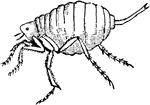
The chigoe flea (Tunga penetrans) is a parasitic arthropod found in tropical climates, especially South America and the West Indies. At 1 mm long, the chigoe flea is the smallest known flea. Breeding female chigoes burrow into exposed skin and lay eggs, causing intense irritation. After this point, the skin lesion looks like a 5 to 10 mm white spot with a central black dot, which are the flea's exposed hind legs, respiratory spiracles and reproductive organs.

Chigoe Flea (Male)

The chigoe flea (Tunga penetrans) is a parasitic arthropod found in tropical climates, especially South…
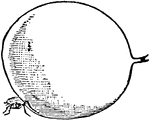
The chigoe flea (Tunga penetrans) is a parasitic arthropod found in tropical climates, especially South America and the West Indies. At 1 mm long, the chigoe flea is the smallest known flea. Breeding female chigoes burrow into exposed skin and lay eggs, causing intense irritation. After this point, the skin lesion looks like a 5 to 10 mm white spot with a central black dot, which are the flea's exposed hind legs, respiratory spiracles and reproductive organs.

Chigoe Flea (Female)

The chigoe flea (Tunga penetrans) is a parasitic arthropod found in tropical climates, especially South…
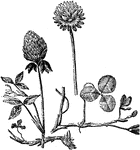
An illustration of white clover (left) and red clover (right). Clover (Trifolium), or trefoil, is a genus of about 300 species of plants in the pea family Fabaceae. The genus has a cosmopolitan distribution; the highest diversity is found in the temperate Northern Hemisphere, but many species also occur in South America and Africa, including at high altitudes on mountains in the tropics. They are small annual, biennial, or short-lived perennial herbaceous plants. The leaves are trifoliate (rarely 5- or 7-foliate), with stipules adnate to the leaf-stalk, and heads or dense spikes of small red, purple, white, or yellow flowers; the small, few-seeded pods are enclosed in the calyx

Clover

An illustration of white clover (left) and red clover (right). Clover (Trifolium), or trefoil, is a…
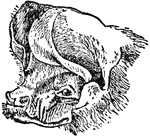
The Big Free-tailed Bat (Nyctinomops macrotis) is a bat species found in South, North and Central America.
Head of Free-tailed Bat

The Big Free-tailed Bat (Nyctinomops macrotis) is a bat species found in South, North and Central America.

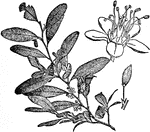
Coca is a plant in the family Erythroxylaceae, native to north-western South America. The plant plays a significant role in traditional Andean culture. Coca leaves contain cocaine alkaloids, a basis for the drug cocaine, which is a powerful stimulant. Coca should not be confused with the similarly named South American cocoa bean from which chocolate is made. The plant resembles a blackthorn bush, and grows to a height of 2&ndash;3 m (7&ndash;10 ft). The branches are straight, and the leaves, which have a green tint, are thin, opaque, oval, and taper at the extremities. A marked characteristic of the leaf is an areolated portion bounded by two longitudinal curved lines, one line on each side of the midrib, and more conspicuous on the under face of the leaf. The flowers are small, and disposed in little clusters on short stalks; the corolla is composed of five yellowish-white petals, the anthers are heart-shaped, and the pistil consists of three carpels united to form a three-chambered ovary. The flowers mature into red berries.

Coca Flower

Coca is a plant in the family Erythroxylaceae, native to north-western South America. The plant plays…

Coca is a plant in the family Erythroxylaceae, native to north-western South America. The plant plays a significant role in traditional Andean culture. Coca leaves contain cocaine alkaloids, a basis for the drug cocaine, which is a powerful stimulant. The flowers mature into red berries.

Coca Fruit

Coca is a plant in the family Erythroxylaceae, native to north-western South America. The plant plays…
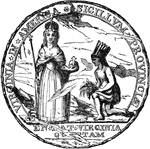
The Colonial Seal of Virginia. An Indian kneels before a prominent royal figure.

Colonial Seal of Virginia

The Colonial Seal of Virginia. An Indian kneels before a prominent royal figure.

In 1776 the Board of War and Ordnance was created for issuing supplies to troops in the field, and the first Ordnance magazine was established at Carlisle, Pennsylvania the following year. An armory and arsenal at Springfield, Massachusetts (1777-1968) was also established along with later armories such as Harpers Ferry, West Virginia (1799-1861), and Watertown, Massachusetts (1816-1968).

Seal of the Board of War and Ordnance

In 1776 the Board of War and Ordnance was created for issuing supplies to troops in the field, and the…
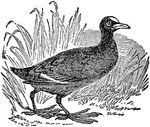
Coots , are medium-sized water birds which are members of the rail family Rallidae. They constitute the genus Fulica. Coots have predominantly black plumage, and, unlike many of the rails, they are usually easy to see, often swimming in open water. They are close relatives of the moorhen. The greatest species variety is in South America, and it is likely that the genus originated there. They are common in Europe and North America.

Coot

Coots , are medium-sized water birds which are members of the rail family Rallidae. They constitute…