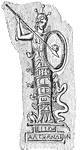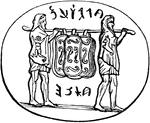
"Ancilia carried by Salii. The sacred shield carried by the Salii, and made of bronze. The original ancile was found, according to tradition, in the palace of Numa; and, as no numan hand has brought it there, it was concluded that it had been sent from heaven. At the same time, the haruspices declared that the Roman state would endure so long as this shield remained in Rome. To secure its preservation in the city, Numa ordered eleven other shields, exactly like it, to be made by the armourer, Mamurius Veturius, and twelve ancilia. They were kept in the temple of that divinity, on the Palatine mount, and were taken from it only once a year, on the calends of March. The feast of the god was then observed during several daysl when the Salaii carried their shields about the city, singing songs in praise of Mars, Numa, and Mamurius Veturius, and at the same time performing a dance, which probably in some degree resembled our morris with rods, so as to keep time with their voices, and with the movements of their dance. The preceding cut shows one of these rods, as represented on the tomb of pontifex salius, or chief of the Salii" — Smith, 1873

Ancile

"Ancilia carried by Salii. The sacred shield carried by the Salii, and made of bronze. The original…
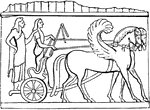
"The rim or border of anything, especially of a shield or chariot. The trim of the large round shield of the ancient Greeks, was thinner than the part which it enclosed: but on the other hand, the antyx of a chariot must have been thicker than the body to which it gave both form and strength. In front of the chariot the antyx was often raised above the body, into the form of a curvature, which served the purpose of a hook to hang the reins upon." — Smith, 1873

Antyx

"The rim or border of anything, especially of a shield or chariot. The trim of the large round shield…
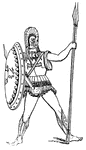
"Homer describes in various passages an entire suit of armour, and we observe that it consisted of the same portions which were used by the Greek soldiers ever after. Moreover, the order of putting them on is always the same. The heavy-armed warrior, having already a tunic around his body, and preparing for combat, puts on-1. his greaves; 2. his cuirass; 3. his sword, hung on the left side of his body by means of a belt which passed over the right shoulder; 4. the large round shield, supported in the same manner; 5. his helmet; 6. he took his spear." — Smith, 1873

Arma

"Homer describes in various passages an entire suit of armour, and we observe that it consisted of the…
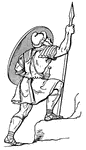
"Homer describes in various passages an entire suit of armour, and we observe that it consisted of the same portions which were used by the Greek soldiers ever after. Moreover, the order of putting them on is always the same. The heavy-armed warrior, having already a tunic around his body, and preparing for combat, puts on-1. his greaves; 2. his cuirass; 3. his sword, hung on the left side of his body by means of a belt which passed over the right shoulder; 4. the large round shield, supported in the same manner; 5. his helmet; 6. he took his spear." — Smith, 1873

Arma

"Homer describes in various passages an entire suit of armour, and we observe that it consisted of the…
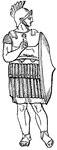
"The large shield worn by the Greeks and Romans, which was originally of the circular form, and is said to have been first used by Proetus and Acrisius or Argos, and therefore is called clipeus Argolicus, and likened to the sun. But the clipeus is often represented in Roman sculpture of an oblong oval, which makes the distinction between the common buckler and that of Argos." — Smith, 1873

Clipeus

"The large shield worn by the Greeks and Romans, which was originally of the circular form, and is said…
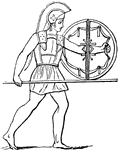
"The large shield worn by the Greeks and Romans, which was originally of the circular form, and is said to have been first used by Proetus and Acrisius or Argos, and therefore is called clipeus Argolicus, and likened to the sun. But the clipeus is often represented in Roman sculpture of an oblong oval, which makes the distinction between the common buckler and that of Argos." — Smith, 1873

Clipeus

"The large shield worn by the Greeks and Romans, which was originally of the circular form, and is said…
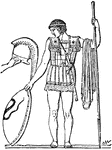
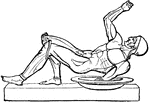
"After the fall of Athens Sparta stood without a rival in Greece." — Smith, 1882

Greek warriot

"After the fall of Athens Sparta stood without a rival in Greece." — Smith, 1882

Man waring Ocreae, or greaves. (From the Aeginetan Marbles)

Aeginetan Marbles

Man waring Ocreae, or greaves. (From the Aeginetan Marbles)

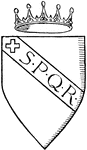
"The Municipal Arms of Rome." — Young, 1901

Arms of Rome

"The Municipal Arms of Rome." — Young, 1901

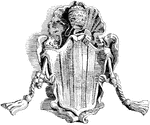
"Arms of Benedict XIV (Lambertini)." — Young, 1901

Benedict XIV

"Arms of Benedict XIV (Lambertini)." — Young, 1901

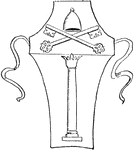
"Arms of Martin V." — Young, 1901

Arms of Martin V

"Arms of Martin V." — Young, 1901

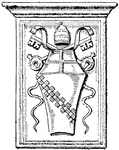
"Arms of Innocent VIII. (Cibo)" — Young, 1901

Innocent VIII

"Arms of Innocent VIII. (Cibo)" — Young, 1901

"Arms of Alexander VI. (Borgia)" — Young, 1901

Alexander VI

"Arms of Alexander VI. (Borgia)" — Young, 1901

"Arms of Urban VIII. (Barberini)" — Young, 1901

Urban VIII

"Arms of Urban VIII. (Barberini)" — Young, 1901

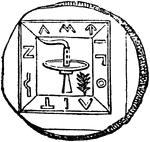
"Lampadedromia, torch-race, and often simply, Lampas, was a game common throughout Greece. At Athens we know of five celebrations of this game: one to Prometheus at the Prometheia, a second to Minerva at the Panametheia, a third to Vulcan at the Hephaesteia, a fourth to Pan, and a fifth to the Thracian Diana or Bendis. The three former are of unknown antiquity; the fourth was introduced soon after the battle of Marathon; the last in the time of Socrates. The race was usually run on foot, horses being first used in the time of Socrates: sometimes also at night. The preparation for it was a principal branch of the Gymnasiarchia, so much so indeed in later times, that Lampadarchia, seems to have been pretty much equivalent to the Gymnasiarchia. The gymnasiarch had to provide the lampas, which was a candlestick with a kind of shield set at the bottom of the socket, so as to shelter the flame of the candle; as is seen in the following woodcut, taken from a coin, He had also to provide for the training of the runners, which was of no slight consequence, for the race was evidently a severe one, with other expenses, which on the whole were very heave, so that Isaeus classes this office with the choregia and trierarchia, and reckons that it had cost him 12 minae." — Smith, 1873

Lampadephoria

"Lampadedromia, torch-race, and often simply, Lampas, was a game common throughout Greece. At Athens…

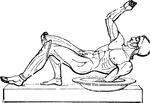
"A greave, a leggin. A pair of greaves was one of the six articles of armour which formed the complete equipment of a Greek warrior, and likewise of a Roman soldier as fixed by Servius Tullius. They were made of various metals, with a lining probably of leather, felt, or cloth. Their form is shown in the accompanying cut. The figure is that of a fallen warrior, and is consequence of the bending of the knees, the greaves are seen to project a little above them. This statue also shows the ankle-rings, which were used to fasten the greaves immediately above the feet. The woodcut that follows shows the interior of a bronze shield, and a pair of bronze greaves found in the tomb of an Etruscan Museum. The greaves are made right and left." — Smith, 1873

Ocrea

"A greave, a leggin. A pair of greaves was one of the six articles of armour which formed the complete…
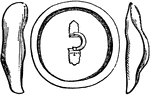
"A greave, a leggin. A pair of greaves was one of the six articles of armour which formed the complete equipment of a Greek warrior, and likewise of a Roman soldier as fixed by Servius Tullius. They were made of various metals, with a lining probably of leather, felt, or cloth. Their form is shown in the accompanying cut. The figure is that of a fallen warrior, and is consequence of the bending of the knees, the greaves are seen to project a little above them. This statue also shows the ankle-rings, which were used to fasten the greaves immediately above the feet. The woodcut that follows shows the interior of a bronze shield, and a pair of bronze greaves found in the tomb of an Etruscan Museum. The greaves are made right and left." — Smith, 1873

Ocrea

"A greave, a leggin. A pair of greaves was one of the six articles of armour which formed the complete…
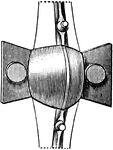
Iron Shield Boss off of a shield used in the Gallic War.

Gallic Iron Shield Boss

Iron Shield Boss off of a shield used in the Gallic War.

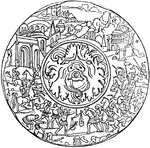
"A round shield, three feet in diameter, carried by the celites in the Roman army. Though small, compared with the Clipeus, it was so strongly made as to be a very effectual protection. This was probably owing to the use of iron in its framework. The parma was also worn by the cavalry. We find the term parma often applied to the target (Cetra), which was also a small round shield, and therefore very similar to the parma. The preceding cut represents a votive parma, embossed and gilt, representing onits border, as is supposed the taking of Rome by the Gauls under Brennus, and its recovery by Camillus." — Smith, 1873

Parma

"A round shield, three feet in diameter, carried by the celites in the Roman army. Though small, compared…
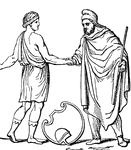
"A small shield, Iphicrates, observing that the ancient Clipeus was cumbrous and inconvenient, introduced among the Greeks a much smaller and lighter shield, from which those who bore it took the name of peltastae. It consisted principally of a frame of wood or wicker-work, covered with skin or leather. An elegant form of the pelta is exhibited in the preceting cut, representing Penthesilea, Queen of the Amazons, in the act of offering aid to Priam." — Smith, 1873

Pelta

"A small shield, Iphicrates, observing that the ancient Clipeus was cumbrous and inconvenient, introduced…
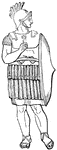
"The following cut represents a Roman clypeus, from the column of Trajan. The projection in the centre was called the <em>umbo</em>, or boss, and sometimes a spike or other prominent excrescence, was placed upon this." — Anthon, 1891

Roman Clypeus

"The following cut represents a Roman clypeus, from the column of Trajan. The projection in the centre…
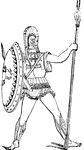
"The early Greeks used a very short sword, as may be seen from the preceding cut. The ancient Homeric sword had generally a straight, two-edged blade, rather broad, and nearly of equal width from hilt to point." &mdash; Anthon, 1891

Greek soldier

"The early Greeks used a very short sword, as may be seen from the preceding cut. The ancient Homeric…
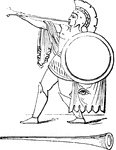
"There appears to have been no essential difference in form between Greek and Roman or Tyrrhenian trumpets. Both were long, straight, bronze tubes, gradually increasing in diameter, and terminating in a bell-shaped aperture." &mdash; Anthon, 1891

Roman trumpet

"There appears to have been no essential difference in form between Greek and Roman or Tyrrhenian trumpets.…
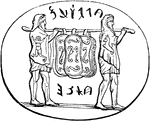
"According to the ancient authorities, it was made of bronze, and its form was oval, but with the two sides receding inward with an even curvature, and so as to make it broader at the ends than in the middle. The original ancile was said to have fallen from the skies in the time of Numa. To secure its preservation, Numa ordered eleven other shields to be made exactly like it. These twelve <em>ancilia</em> were kept in the temple of Mars Gradivus, and were taken from it only once a year, on the kalends of March. The feast of the god was then observed during several days; when the Salii, or priests of Mars, twelve in number, carried the sacred shields about the city, singing songs in praise of Mars, Numa, and Mamurius Veturius, who made the eleven. They at the same time performed a dance, in which they struck the shield with rods, so as to keep time with their voices and with the movements of the dance." &mdash; Anthon, 1891

Ancilia

"According to the ancient authorities, it was made of bronze, and its form was oval, but with the two…
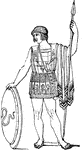
An ancient Greek soldier.

Greek soldier

An ancient Greek soldier.

"Figure of a fallen warrior, represented among the sculptures now at Munich, belonging to the temple in Aegina. In consequence of the bending of the knees, the greaves are seen to project a little above them. The statue also shows very distinctly the ankle-rings." &mdash; Anthon, 1891

Fallen soldier

"Figure of a fallen warrior, represented among the sculptures now at Munich, belonging to the temple…
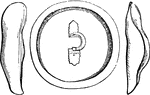
"Represents the interior view of a bronze shield and a pair of greaves. These greaves are made right and left." &mdash; Anthon, 1891

Greaves and shield

"Represents the interior view of a bronze shield and a pair of greaves. These greaves are made right…
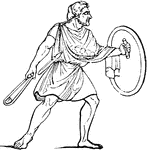
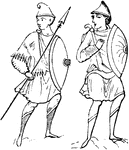
Greek soldier with sling.

Sling

Greek soldier with sling.

"This was a small round shield, made of the hide ofa quadruped." &mdash; Anthon, 1891

Targe

"This was a small round shield, made of the hide ofa quadruped." — Anthon, 1891

"A breastplate covered with metal in the form of scales, not used to support the shield, as was done with the more ancient aegis, but extending equally on both sides, from shoulder to shoulder." &mdash; Anthon, 1891

Aegis

"A breastplate covered with metal in the form of scales, not used to support the shield, as was done…
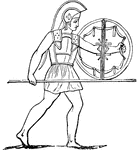
"In the Homeric times, the Greeks used a belt for the sword, and another for the shield. These passed over the shoulders and crossed upon the breast. The shield-belt lay over the other, and was the larger and broader of the two. This mode of carrying the shield was subsequently laid aside, on account of its inconvenience. The later method is shown." &mdash; Anthon, 1891

Greek with shield

"In the Homeric times, the Greeks used a belt for the sword, and another for the shield. These passed…
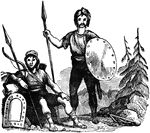
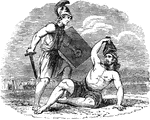
A pair of ancient Scythian warriors.

Ancient Scythians

A pair of ancient Scythian warriors.

"Determined to save his own country at the expense of his own life, Codrus disguised himself in a peasant's dress, entered the Peloponnesian camp, and provoked a quarrel with a soldier, by whom he was killed." &mdash; Goodrich, 1844

Codrus slain

"Determined to save his own country at the expense of his own life, Codrus disguised himself in a peasant's…
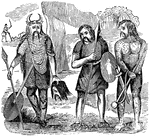
"They had some rude notions of sculpture, and made images out of clay, which they hardened in the fire. They excelled at wicker-work, and their baskets were sent to Rome, where they were very much admired." &mdash; Goodrich, 1844

Old Britons

"They had some rude notions of sculpture, and made images out of clay, which they hardened in the fire.…
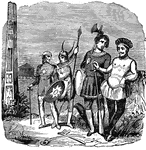
"In the eleventh century, the Anglo-Saxons, originally the fiercest nation of the North of Europe, had become changed into a submissive and unwarlike people by the combine influences of luxury, a great landed aristocracy, and a richly endowed hierarchy." &mdash; Goodrich, 1844

Saxons

"In the eleventh century, the Anglo-Saxons, originally the fiercest nation of the North of Europe, had…
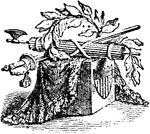
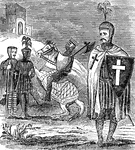
A sword and axe resting on a square block.

Sword and axe

A sword and axe resting on a square block.

"The chivalry of the gothic nations began in the woods of Germany. No youth was then permitted to assume arms, at that time the geat privilege of the noble and the free, at his own pleasure. It was made a social rank, to which it was necessary that the aspiring candidates should be elected in the public councils of their rude commonwealth; and the emulated distinction was then solemnly conferred by the prince, or a kinsman, giving them a javelin and a shield. In these customs we see the origin of knighthood." &mdash; Goodrich, 1844

Chivalry and knight-errantry

"The chivalry of the gothic nations began in the woods of Germany. No youth was then permitted to assume…
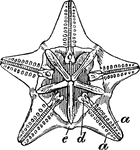
A family of irregular sea urchins, flattened into a discoidal or shield like shape, with a mouth central and furnished with a masticatory apparatus.

Clypeastrid

A family of irregular sea urchins, flattened into a discoidal or shield like shape, with a mouth central…
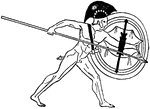

A large circular shield with a convex outer and concave inner surface.

Clypeus

A large circular shield with a convex outer and concave inner surface.

A doodad.

Doodad

A doodad.

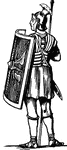
A Roman soldier.

Roman soldier

A Roman soldier.

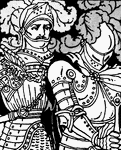
A scene from the story, <em>The Knights of the Silver Shield</em>.

The Knights of the Silver Shield

A scene from the story, The Knights of the Silver Shield.

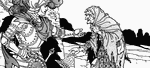
A scene from the story, <em>The Knights of the Silver Shield</em>.

The Knights of the Silver Shield

A scene from the story, The Knights of the Silver Shield.

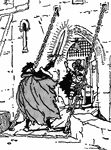
A scene from the story, <em>The Knights of the Silver Shield</em>.

The Knights of the Silver Shield

A scene from the story, The Knights of the Silver Shield.

"The Palladium." &mdash;Bulfinch, 1897

The Palladium

"The Palladium." —Bulfinch, 1897

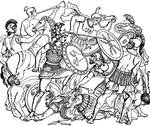
"In the Brave Days of Old." &mdash;Bulfinch, 1897

Roman battle

"In the Brave Days of Old." —Bulfinch, 1897

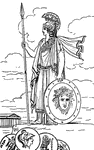
"Minerva." &mdash;Bulfinch, 1897

Minerva

"Minerva." —Bulfinch, 1897

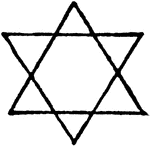
An emblem seen the world over in decoration, especially in synagogues. It is common in the Caucasian and Turkoman products, especially in the form of the elongated eight-pointed star. This eight-pointed star in the centre of an octagon is said to have represented the Deity of the ancient Medes. In all probability the six-pointed star was an adaptation of the Shield of David. It is supposed to have been symbolic of divinity. To it may be traced scores of Turkish patterns.

Star Designs

An emblem seen the world over in decoration, especially in synagogues. It is common in the Caucasian…
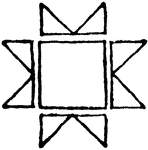
An emblem seen the world over in decoration, especially in synagogues. It is common in the Caucasian and Turkoman products, especially in the form of the elongated eight-pointed star. This eight-pointed star in the centre of an octagon is said to have represented the Deity of the ancient Medes. In all probability the six-pointed star was an adaptation of the Shield of David. It is supposed to have been symbolic of divinity. To it may be traced scores of Turkish patterns.

Star Designs

An emblem seen the world over in decoration, especially in synagogues. It is common in the Caucasian…
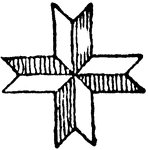
An emblem seen the world over in decoration, especially in synagogues. It is common in the Caucasian and Turkoman products, especially in the form of the elongated eight-pointed star. This eight-pointed star in the centre of an octagon is said to have represented the Deity of the ancient Medes. In all probability the six-pointed star was an adaptation of the Shield of David. It is supposed to have been symbolic of divinity. To it may be traced scores of Turkish patterns.

Star Designs

An emblem seen the world over in decoration, especially in synagogues. It is common in the Caucasian…

"The western pediment of the Temple of Aegina." &mdash;D'Anvers, 1895

Temple of Aegina

"The western pediment of the Temple of Aegina." —D'Anvers, 1895

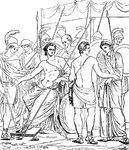
"The Parting of Achilles and Briseis. (Supposed to be from a Greek Painting.)" &mdash;D'Anvers, 1895

The Parting of Achilles and Briseis

"The Parting of Achilles and Briseis. (Supposed to be from a Greek Painting.)" —D'Anvers, 1895
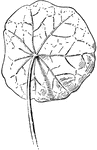
A shield-shaped that is with the stalk attached somewhere within the circumference of the leaf or other organ.

Peltate

A shield-shaped that is with the stalk attached somewhere within the circumference of the leaf or other…
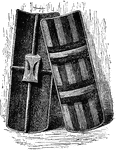
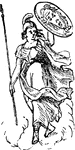
Shields used by the peoples of the ancient Congo.

Congo Shields

Shields used by the peoples of the ancient Congo.

The shield of Jupiter, which had been fashioned by Hephaestus. When Jupiter was angry he waved and shook the shield making a soung like that of a tempest, by which nations were overawed.

Aegis

The shield of Jupiter, which had been fashioned by Hephaestus. When Jupiter was angry he waved and shook…
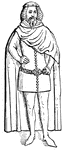
"Lionel, Duke of Clarence, who also wears his mantle; and a younder brother not now to be identified to consequence of his shield of arms having long been lost." — Encyclopedia Britannica, 1893 <p>Lionel of Antwerp, 1st Duke of Clarence, jure uxoris 4th Earl of Ulster and 5th Baron of Connaught, KG (Norman French: Leonell Duc de Clarence; 29 November 1338 – 7 October 1368) was the third son, but the second son to survive infancy, of Edward III of England and Philippa of Hainault.

Duke of Clarence

"Lionel, Duke of Clarence, who also wears his mantle; and a younder brother not now to be identified…
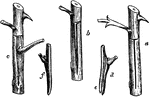
"The simplest and most generally practised form of budding is that called Shield budding or T-budding. The operator should be provided with a budding-knife in which the cutting edge of the blade is rounded off at the point, and which has a thin ivory or bone handle, for raising the bark of the stock. A horizonal incision is made in the bark quite down to the wood, and from this a perpendicular slit is drawn downwards to the extent of perhaps an inch, so that the slit has a resemblance to the letter T, as at a. A bud is then cut by a clean incision from the tree intended to be propagated, having a portion of the wood attached to it, and so that the whole may be an inch and a half long, as at d." &mdash; Encyclopedia Britannica, 1893

Shield-Budding

"The simplest and most generally practised form of budding is that called Shield budding or T-budding.…
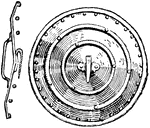
A buckler, or small round shield.

Rondache

A buckler, or small round shield.

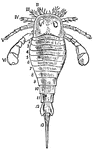
"Eurypterus Fischeri, Eichwald. Silurian of Rootzikil. Restoration after Schmidt. The dorsal aspect is presented showing the prosomatic shield with paired compound eyes and the prosomatic appendages II. to IV. The small first pair of appendages is concealed from view by the carapace. 1 to 12 are the somites of the opisthosoma; 13, the post-anal spine." &mdash; The Encyclopedia Britannica, 1910

Eurypterus Fischeri

"Eurypterus Fischeri, Eichwald. Silurian of Rootzikil. Restoration after Schmidt. The dorsal aspect…
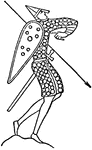
A heavily armored man with a sword, shield and spear.

Man with Spear

A heavily armored man with a sword, shield and spear.