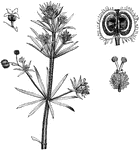
"Galium Aparine; 1. a flower; 2. a young fruit without the corolla; 3. a perpendicular section of a ripe fruit." -Lindley, 1853

Cleavers

"Galium Aparine; 1. a flower; 2. a young fruit without the corolla; 3. a perpendicular section of a…
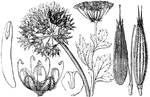
"Athamanta cervariaefolia. 1. a separate flower, with hairy petals; 2. a petal by itself; 3. a ripe fruit with the two carpels or mericarps separating from the double carpopod or axis; 4. a seed deprived of its integuments, and divided vertically, so as to show the position of the embryo." -Lindley, 1853

Athamantha

"Athamanta cervariaefolia. 1. a separate flower, with hairy petals; 2. a petal by itself; 3. a ripe…
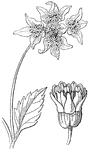
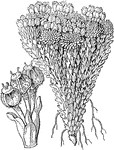
Flowers of Leucolaena rotundifolia, from the Apiaceae family.

Leucolaena

Flowers of Leucolaena rotundifolia, from the Apiaceae family.

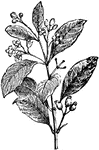
The flowers of Bolax glebaria, a flowering plant in the Apiaceae family.

Bolax

The flowers of Bolax glebaria, a flowering plant in the Apiaceae family.

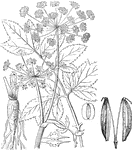
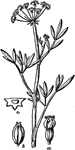
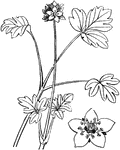
The flowers of Archangelica officinalis, or the Garden Angelica, a flowering plant in the Apiaceae family.
Garden Angelica

The flowers of Archangelica officinalis, or the Garden Angelica, a flowering plant in the Apiaceae family.

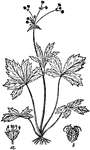
The flower and plant of the moschatel or Adoxa moschatellina, a flowering plant in the Adoxaceae family.
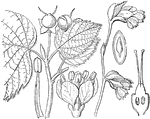
Moschatel

The flower and plant of the moschatel or Adoxa moschatellina, a flowering plant in the Adoxaceae family.

"Corylopsis. 1. flowers; 2. branch in fruit; 3. a flower separate; 4. a stamen; 5. a perpendicular section of the ovary; 6. a section of a seed removed from the capsule and placed with the hilum downwards." -Lindley, 1853

Winter Hazel

"Corylopsis. 1. flowers; 2. branch in fruit; 3. a flower separate; 4. a stamen; 5. a perpendicular section…
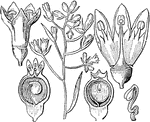
"Thesium pratense. 1. a flower; 2. the same laid open; 3. half an unripe fruit; 4. placenta and pair of ovules; 5. half the ripe fruit and seed." -Lindley, 1853

Thesium

"Thesium pratense. 1. a flower; 2. the same laid open; 3. half an unripe fruit; 4. placenta and pair…
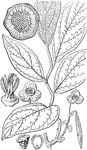
"Bragantia Blumei. 1. a section of its wood; 2. one of its flowers; 3. a seed; 4. the same divided perpendicularly; 5. anthers and stigma of Asarum." -Lindley, 1853

Bragantia

"Bragantia Blumei. 1. a section of its wood; 2. one of its flowers; 3. a seed; 4. the same divided perpendicularly;…
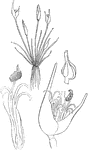
"Centrolepis fascicularis. 1. A head of flowers; 2. a single flower separated; 3. an ovary with the style cut off." -Lindley, 1853

Centrolepis

"Centrolepis fascicularis. 1. A head of flowers; 2. a single flower separated; 3. an ovary with the…
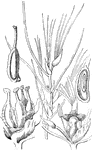
"Zannichellia palustris. 1. A flower; 2. a cluster of ripe ovaries; 3. an ovary opened to exhibit the ovule; 4. a vertical section of a seed, showing the folded up embryo." -Lindley, 1853

Potamogetonaceae

"Zannichellia palustris. 1. A flower; 2. a cluster of ripe ovaries; 3. an ovary opened to exhibit the…
"Blancoa canescens. 1. a flower and ovary of Conostyles aemula opened." -Lindley, 1853

Red Bugle

"Blancoa canescens. 1. a flower and ovary of Conostyles aemula opened." -Lindley, 1853

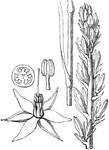
"Haemodorum spicatum. 1. A flower spread open; 2. a cross section of the ovary; 3. an anther." -Lindley, 1853

Mardja

"Haemodorum spicatum. 1. A flower spread open; 2. a cross section of the ovary; 3. an anther." -Lindley,…
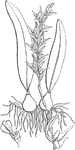
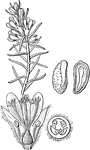
Ione bicolor, a species in the Orchid family.

Ione

Ione bicolor, a species in the Orchid family.

"Turnera genistoides. 1. a flower cut open; 2. a section of the ovary; 3. a seed; 4. a section of it." -Lindley, 1853

Turnera

"Turnera genistoides. 1. a flower cut open; 2. a section of the ovary; 3. a seed; 4. a section of it."…


A decorative divider with flowers and cherubs lighting a torch.

Cherubs and Torch

A decorative divider with flowers and cherubs lighting a torch.

A decorative divider with vines, flowers, and curls.

Vine Divider

A decorative divider with vines, flowers, and curls.

A framed decorative letter T with flowers and vines.

T, Floral Initial

A framed decorative letter T with flowers and vines.

A decorative tailpiece with a rising sun behind leaves and flowers.

Floral Tailpiece

A decorative tailpiece with a rising sun behind leaves and flowers.

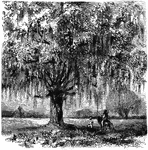
An illustration of a large oak tree. Oaks have spirally arranged leaves, with a lobed margin in many species; some have serrated leaves or entire leaves with a smooth margin. The flowers are catkins, produced in spring. The fruit is a nut called an acorn, borne in a cup-like structure known as a cupule; each acorn contains one seed (rarely two or three) and takes 6–18 months to mature, depending on species.

Oak

An illustration of a large oak tree. Oaks have spirally arranged leaves, with a lobed margin in many…

Anne Vallayer-Coster (1744-1818) was an eighteenth-century French painter. Known as a prodigy artist at a young age, she achieved fame and recognition very early in her career, being admitted to the Royal Academy in 1770, at the age of twenty-six. Despite the negative reputation that still-life painting had at this time, Vallayer-Coster's highly developed skills, especially in the depiction of flowers, soon generated a great deal of attention from collectors and other artists. Her "precocious talent and the rave reviews" earned her the attention of the court, where Marie-Antoinette took a particular interest in Vallayer-Coster's paintings.

Anne Vallayer-Coster

Anne Vallayer-Coster (1744-1818) was an eighteenth-century French painter. Known as a prodigy artist…
A decorative divider containing several birds and flowers.

Divider

A decorative divider containing several birds and flowers.

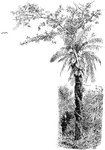
An illustration of a Judas tree wrapped around a palm tree. Cercis siliquastrum, commonly known as Judas Tree, is a small deciduous tree from Southern Europe and Western Asia which is noted for its prolific display of deep-pink flowers in spring.

Judas Tree

An illustration of a Judas tree wrapped around a palm tree. Cercis siliquastrum, commonly known as Judas…
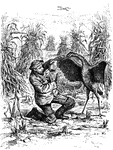
An illustration of a man crouched down guarding his face from a crane attacking him.

Man Attacked by Crane

An illustration of a man crouched down guarding his face from a crane attacking him.
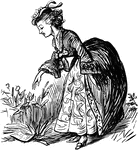
An illustration of a young woman bending down to pick a flower.

Woman Picking Flowers

An illustration of a young woman bending down to pick a flower.

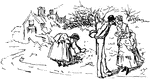
An illustration of a couple talking on a country road while another woman picks flowers.

Couple Talking

An illustration of a couple talking on a country road while another woman picks flowers.

An illustration of a man giving a woman a bouquet of flowers.

Man Giving Woman Flowers

An illustration of a man giving a woman a bouquet of flowers.

"Branch with flowers of Salvadora persica. (a), a female flower; (b), the fruit." -Whitney, 1911

Toothbrush Tree

"Branch with flowers of Salvadora persica. (a), a female flower; (b), the fruit." -Whitney, 1911
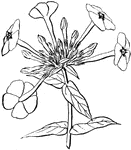
"Flowers of Phlox drummondii showing salver-shaped corolla." -Whitney, 1911

Annual Phlox

"Flowers of Phlox drummondii showing salver-shaped corolla." -Whitney, 1911

"Branch with Inflorescence of Elder (Sambucus Canadensis). (a), part of the inflorescence; (b), fruits." -Whitney, 1911

American Elderberry

"Branch with Inflorescence of Elder (Sambucus Canadensis). (a), part of the inflorescence; (b), fruits."…

"Upper part of stem with the inflorescence of Samphire (Crithmum maritimum). (a), a flower; (b), the fruit; (c), transverse section of one of the fruitlets." -Whitney, 1911

Rock Samphire

"Upper part of stem with the inflorescence of Samphire (Crithmum maritimum). (a), a flower; (b), the…

Santalum album is a small tropical tree cultivated for its fragrant oil and medicinal uses.

Indian Sandalwood

Santalum album is a small tropical tree cultivated for its fragrant oil and medicinal uses.

"Flowering plant of sanicle (Sanicula marilandica). (a), a male flower; (b), the fruit." -Whitney, 1911
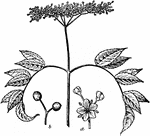
Maryland Black Snakeroot

"Flowering plant of sanicle (Sanicula marilandica). (a), a male flower; (b), the fruit." -Whitney, 1911
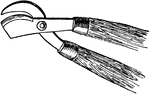
The florist and gardener use scissors with a curved blade for pruning, and a delicate pair for gathering flowers, and large shears, called pruning shears, for trimming hedge plants.

Pruning Shears

The florist and gardener use scissors with a curved blade for pruning, and a delicate pair for gathering…
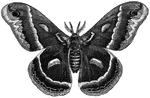
The cecropia moth is one of the largest moths found in North America. It is a member of the Saturniidae family, or giant silk moths. Females with a wingspan of 130 mm or more have been documented. It is found as far west as the Rocky Mountains and north into the maritime provinces of Canada. The larvae of these moths are most commonly found on Maple trees, but they have been known to feed on Wild Cherry and Birch trees among many others.

Cecropia Moth

The cecropia moth is one of the largest moths found in North America. It is a member of the Saturniidae…
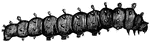
An illustration of the larva of a ceropia moth. The cecropia moth is one of the largest moths found in North America. It is a member of the Saturniidae family, or giant silk moths. Females with a wingspan of 130 mm or more have been documented. It is found as far west as the Rocky Mountains and north into the maritime provinces of Canada. The larvae of these moths are most commonly found on Maple trees, but they have been known to feed on Wild Cherry and Birch trees among many others.

Larva of Cecropia Moth

An illustration of the larva of a ceropia moth. The cecropia moth is one of the largest moths found…
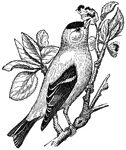
The American Goldfinch (Carduelis tristis), also known as the Eastern Goldfinch and Wild Canary, is a North American bird in the finch family. It is migratory, ranging from southern Canada to North Carolina during the breeding season, and from just south of the Canadian border to Mexico during the winter. The only finch in its subfamily which undergoes a complete molt, the American Goldfinch displays sexual dimorphism in its coloration; the male is a vibrant yellow in the summer and an olive color during the winter months, while the female is a dull yellow-brown shade which brightens only slightly during the summer. The male displays brightly colored plumage during the breeding season to attract a mate.

American Goldfinch

The American Goldfinch (Carduelis tristis), also known as the Eastern Goldfinch and Wild Canary, is…

Smilax is a genus of about 300-350 species, found in the tropics and subtropics worldwide. In China for example about 80 are found (39 of which are endemic), while there are 20 in North America north of Mexico[1]. They are climbing flowering plants, many of which are woody and/or thorny, in the monocotyledon family Smilacaceae, native throughout the tropical and warm temperate regions of the world. Common names include catbriers, greenbriers, prickly-ivys and smilaxes. "Sarsaparilla" (also zarzaparrilla, sarsparilla) is a name used specifically for the Jamaican S. regelii as well as a catch-all term in particular for American species. Occasionally, the non-woody species such as the Smooth Herbaceous Greenbrier (S. herbacea) are separated as genus Nemexia; they are commonly known by the rather ambiguous name "carrion flowers"

Smilax

Smilax is a genus of about 300-350 species, found in the tropics and subtropics worldwide. In China…
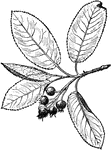
Amelanchier, also known as shadbush, serviceberry, sarvisberry, juneberry, Saskatoon, shadblow, shadwood, sugarplum, and wild-plum, is a genus of about 20 species of shrubs and small deciduous trees in the Rosaceae (Rose family). The genus is native to temperate regions of the Northern Hemisphere, growing primarily in early successional habitats. It is most diverse taxonomically in North America, especially in the northern United States and southern Canada, and is native to every state of the United States except Hawaii. Two species also occur in Asia, and one in Europe. These plants are valued horticulturally, and their fruits are important to wildlife.

Amelanchier

Amelanchier, also known as shadbush, serviceberry, sarvisberry, juneberry, Saskatoon, shadblow, shadwood,…
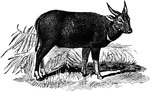
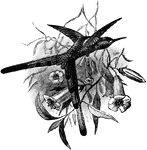
The anoa or sapiutan is a bovine native to Indonesia.

Anoa

The anoa or sapiutan is a bovine native to Indonesia.

A species of hummingbird, the Red-Tailed Comet (Sappho sparganura) is native to South America.

Red-Tailed Comet

A species of hummingbird, the Red-Tailed Comet (Sappho sparganura) is native to South America.
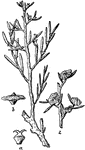
"Greasewood (Sarcobatus vermiculatus). 1, with female flowers; 2, branch with fruits; a, a female flower; b, the fruit." -Whitney, 1911

Greasewood

"Greasewood (Sarcobatus vermiculatus). 1, with female flowers; 2, branch with fruits; a, a female flower;…
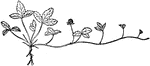
The stem of the mock strawberry (Duchesnea indica), a flowering plant that gets its name from its fruit's resemblance to the strawberry.

Mock Strawberry

The stem of the mock strawberry (Duchesnea indica), a flowering plant that gets its name from its fruit's…
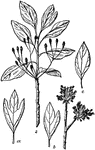
"Sassafras (Sassafras sassafras). 1. Branch with fruits. 2. Branch with sterile flowers. a, b, c, different forms of leaves." -Whitney, 1911

Sassafras

"Sassafras (Sassafras sassafras). 1. Branch with fruits. 2. Branch with sterile flowers. a, b, c, different…
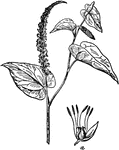
"Flowering branch of Lizardtail (Saururus cernuus). a, flower." -Whitney, 1911

Lizard's Tail

"Flowering branch of Lizardtail (Saururus cernuus). a, flower." -Whitney, 1911

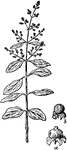
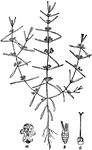
The Summer Savory (Satureja hortensis) is a flowering plant of the Lamiaceae family. The image shows its: a, corolla; b, calyx; and c, pistil.

Summer Savory

The Summer Savory (Satureja hortensis) is a flowering plant of the Lamiaceae family. The image shows…
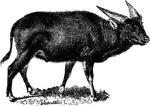
Anoa are a subgenus of buffalo comprising two species native to Indonesia: the Mountain Anoa (Bubalus quarlesi) and the Lowland Anoa (Bubalus depressicornis). Both live in undisturbed forest, and are essentially miniature water buffalo, are similar in appearance to a deer, weighing 150–300 kg (330–660 lb). They live in deep rainforests.

Anoa

Anoa are a subgenus of buffalo comprising two species native to Indonesia: the Mountain Anoa (Bubalus…
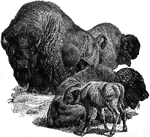
The American Bison (Bison bison) is a bovine mammal, also commonly known as the American buffalo. 'Buffalo' is something of a misnomer for this animal as it is only distantly related to either of the two "true buffaloes", the water buffalo and the African Buffalo. The bison once inhabited the Grasslands of the United States and Asia in massive herds, ranging from the Great Slave Lake in Canada's far north to Mexico in the south, and from eastern Oregon almost to the Atlantic Ocean, taking its subspecies into account. Its two subspecies are the Plains Bison (Bison bison bison), distinguished by its smaller size and more rounded hump, and the Wood Bison (Bison bison athabascae), distinguished by its larger size and taller square hump. Wood Bison are one of the largest species of cattle in the world, surpassed in size only by the massive Asian gaur and Wild Asian Water Buffalo, both of which are found mainly in India and Southeast Asia.

North American Bison

The American Bison (Bison bison) is a bovine mammal, also commonly known as the American buffalo. 'Buffalo'…
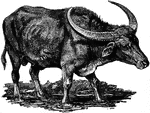
The Domestic Water Buffalo or Domestic Asian Water buffalo (Bubalus bubalis) is abundant in Asia, and widely used in South America, southern Europe and elsewhere. It is a large ungulate and a member of the bovine subfamily. There are established feral populations in northern Australia but the dwindling true wild populations are thought to survive in India, Nepal, Bhutan and Thailand. All the domestic varieties and breeds descend from one common ancestor, the wild Asian water buffalo, which is now an endangered species.

Domestic Water Buffalo

The Domestic Water Buffalo or Domestic Asian Water buffalo (Bubalus bubalis) is abundant in Asia, and…
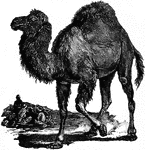
The Dromedary camel (Camelus dromedarius) is a large even-toed ungulate. It is often referred to as the one-humped camel, Arabian camel, or simply as the "dromedary". Its native range is unclear, but it was probably the Arabian Peninsula. The domesticated form occurs widely in northern Africa and the Middle East; the world's only population of dromedaries exhibiting wild behaviour is an introduced feral population in Australia. The dromedary camel is arguably the best-known member of the camel family. Other members of the camel family include the llama and the alpaca in South America. The Dromedary has one hump on its back, in contrast to the Bactrian camel which has two. A good mnemonic for remembering which way around these terms apply is this: "Bactrian" begins with "B", and "Dromedary" begins with "D"; "B" on its side has two humps, whilst "D" on its side has only one hump.

Dromedary

The Dromedary camel (Camelus dromedarius) is a large even-toed ungulate. It is often referred to as…
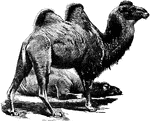
The Bactrian Camel (Camelus bactrianus) is a large even-toed ungulate native to the steppes of north eastern Asia. It is one of the two surviving species of camel. The Bactrian Camel has two humps on its back, in contrast to the single-humped Dromedary Camel. Nearly all of the estimated 1.4 million Bactrian Camels alive today are domesticated, but in October 2002 the estimated 950 remaining in the wild in northwest China and Mongolia were placed on the critically endangered species list.

Bactrian Camel

The Bactrian Camel (Camelus bactrianus) is a large even-toed ungulate native to the steppes of north…
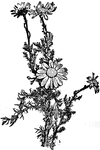
The name Chamomile or Camomile means "earth-apple", because of the applelike scent of the plant. It can refer to any of several distinct species in the sunflower family (Asteraceae): The Chamomile flower is most often consumed in the form of a bitter herb tea infusion. Taken internally, the infusion's effects include calming of the digestive tract, and easing of the spasms of irritable bowel syndrome, nocturnal cramps and period pains. It's a relaxant and sedative, so it is often taken against insomnia or anxiety. The infusion can be used externally to reduce minor skin irritation because of its mild antiseptic effect and it lightens the hair. Ingestion of the dried flowers has an emetic effect. See Matricaria recutita for more complete details.

Chamomile

The name Chamomile or Camomile means "earth-apple", because of the applelike scent of the plant. It…
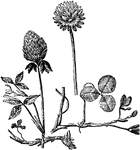
An illustration of white clover (left) and red clover (right). Clover (Trifolium), or trefoil, is a genus of about 300 species of plants in the pea family Fabaceae. The genus has a cosmopolitan distribution; the highest diversity is found in the temperate Northern Hemisphere, but many species also occur in South America and Africa, including at high altitudes on mountains in the tropics. They are small annual, biennial, or short-lived perennial herbaceous plants. The leaves are trifoliate (rarely 5- or 7-foliate), with stipules adnate to the leaf-stalk, and heads or dense spikes of small red, purple, white, or yellow flowers; the small, few-seeded pods are enclosed in the calyx

Clover

An illustration of white clover (left) and red clover (right). Clover (Trifolium), or trefoil, is a…
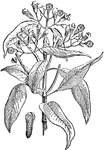
Cloves (Syzygium aromaticum, syn. Eugenia aromaticum or Eugenia caryophyllata) are the aromatic dried flower buds of a tree in the family Myrtaceae. Cloves are native to Indonesia and used as a spice in cuisine all over the world. The name derives from French clou, a nail, as the buds vaguely resemble small irregular nails in shape. Cloves are harvested primarily in Indonesia, Madagascar, and Zanzibar, ; it is also grown in India called Lavang , Pakistan, and Sri Lanka. The clove tree is an evergreen which grows to a height ranging from 10-20 m, having large oval leaves and crimson flowers in numerous groups of terminal clusters. The flower buds are at first of a pale color and gradually become green, after which they develop into a bright red, when they are ready for collecting. Cloves are harvested when 1.5-2 cm long, and consist of a long calyx, terminating in four spreading sepals, and four unopened petals which form a small ball in the centre.

Clove Plant and Seed

Cloves (Syzygium aromaticum, syn. Eugenia aromaticum or Eugenia caryophyllata) are the aromatic dried…
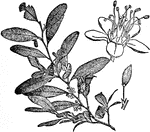
Coca is a plant in the family Erythroxylaceae, native to north-western South America. The plant plays a significant role in traditional Andean culture. Coca leaves contain cocaine alkaloids, a basis for the drug cocaine, which is a powerful stimulant. Coca should not be confused with the similarly named South American cocoa bean from which chocolate is made. The plant resembles a blackthorn bush, and grows to a height of 2–3 m (7–10 ft). The branches are straight, and the leaves, which have a green tint, are thin, opaque, oval, and taper at the extremities. A marked characteristic of the leaf is an areolated portion bounded by two longitudinal curved lines, one line on each side of the midrib, and more conspicuous on the under face of the leaf. The flowers are small, and disposed in little clusters on short stalks; the corolla is composed of five yellowish-white petals, the anthers are heart-shaped, and the pistil consists of three carpels united to form a three-chambered ovary. The flowers mature into red berries.

Coca Flower

Coca is a plant in the family Erythroxylaceae, native to north-western South America. The plant plays…

Coca is a plant in the family Erythroxylaceae, native to north-western South America. The plant plays a significant role in traditional Andean culture. Coca leaves contain cocaine alkaloids, a basis for the drug cocaine, which is a powerful stimulant. The flowers mature into red berries.

Coca Fruit

Coca is a plant in the family Erythroxylaceae, native to north-western South America. The plant plays…
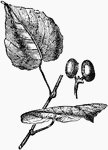
An illustration of an anamirta cocculus leaf. Anamirta cocculus is an Southeast Asian and Indian climbing plant. Its fruit, Cocculus indicus, is the source of picrotoxin, a poisonous alkaloid with stimulant properties. The plant is large-stemmed (up to 10cm in diameter); the bark is "corky gray" with white wood. The "small, yellowish-white, sweet-scented" flowers vary between 6 to 10 centimeters across; the fruit produced is a drupe, "about 1 cm in diameter when dry".

Anamirta cocculus

An illustration of an anamirta cocculus leaf. Anamirta cocculus is an Southeast Asian and Indian climbing…
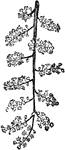
An illustration of an anamirta cocculus branch with flowers. Anamirta cocculus is an Southeast Asian and Indian climbing plant. Its fruit, Cocculus indicus, is the source of picrotoxin, a poisonous alkaloid with stimulant properties. The plant is large-stemmed (up to 10cm in diameter); the bark is "corky gray" with white wood. The "small, yellowish-white, sweet-scented" flowers vary between 6 to 10 centimeters across; the fruit produced is a drupe, "about 1 cm in diameter when dry".

Anamirta cocculus Flowers

An illustration of an anamirta cocculus branch with flowers. Anamirta cocculus is an Southeast Asian…
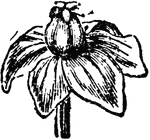
An illustration of an anamirta cocculus female flower. Anamirta cocculus is an Southeast Asian and Indian climbing plant. Its fruit, Cocculus indicus, is the source of picrotoxin, a poisonous alkaloid with stimulant properties. The plant is large-stemmed (up to 10cm in diameter); the bark is "corky gray" with white wood. The "small, yellowish-white, sweet-scented" flowers vary between 6 to 10 centimeters across; the fruit produced is a drupe, "about 1 cm in diameter when dry".

Anamirta cocculus Flower (Female)

An illustration of an anamirta cocculus female flower. Anamirta cocculus is an Southeast Asian and Indian…

An illustration of an anamirta cocculus fruit. Anamirta cocculus is an Southeast Asian and Indian climbing plant. Its fruit, Cocculus indicus, is the source of picrotoxin, a poisonous alkaloid with stimulant properties. The plant is large-stemmed (up to 10cm in diameter); the bark is "corky gray" with white wood. The "small, yellowish-white, sweet-scented" flowers vary between 6 to 10 centimeters across; the fruit produced is a drupe, "about 1 cm in diameter when dry".

Anamirta cocculus Flower (Female)

An illustration of an anamirta cocculus fruit. Anamirta cocculus is an Southeast Asian and Indian climbing…