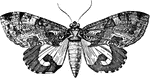
"The Noctuina form an eceedingly large group of nocturnal moths, although even here there are a few exceptional instances of day-flying species. They are distinguished by their stout bodies and narrow forewings, under which when reposing they conceal the inferior and in many cases more brightly-colored pair. The majority of the species are small and dull in their colors, while a few are among the largest of known insects." — Encyclopedia Britanica; 1893

Noctuina

"The Noctuina form an eceedingly large group of nocturnal moths, although even here there are a few…
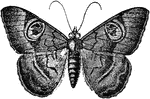
"The Noctuina form an eceedingly large group of nocturnal moths, although even here there are a few exceptional instances of day-flying species. They are distinguished by their stout bodies and narrow forewings, under which when reposing they conceal the inferior and in many cases more brightly-colored pair. The majority of the species are small and dull in their colors, while a few are among the largest of known insects." — Encyclopedia Britanica; 1893

Noctuina

"The Noctuina form an eceedingly large group of nocturnal moths, although even here there are a few…
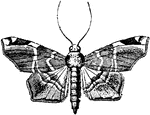
"The Pyralidina are a group of small moths readily distinguished by their long slender bodies and large forewings. One of these, Pyralis vitis, is very destructive to vines, and another, Pyralis farinalis, feeds upon meal and flour. The Galleridae, a family of Pyralidine moths, deposit their eggs in the hives of bees, where the caterpillars, enclosed in silken cases, devour the wax; but the Hydrocampidae, which also belong to this section, are probably the most wonderful of all Lepidopterous insects, their larva being aquatic, living and feeding in the water, and many of them beathing by gills similar to those of caddisworms." — Encyclopedia Britanica; 1893

Pyralidina

"The Pyralidina are a group of small moths readily distinguished by their long slender bodies and large…
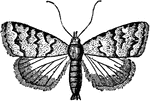
"The Pyralidina are a group of small moths readily distinguished by their long slender bodies and large forewings. One of these, Pyralis vitis, is very destructive to vines, and another, Pyralis farinalis, feeds upon meal and flour. The Galleridae, a family of Pyralidine moths, deposit their eggs in the hives of bees, where the caterpillars, enclosed in silken cases, devour the wax; but the Hydrocampidae, which also belong to this section, are probably the most wonderful of all Lepidopterous insects, their larva being aquatic, living and feeding in the water, and many of them beathing by gills similar to those of caddisworms." — Encyclopedia Britanica; 1893

Pyralidina

"The Pyralidina are a group of small moths readily distinguished by their long slender bodies and large…
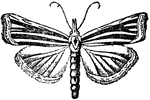
"The Pyralidina are a group of small moths readily distinguished by their long slender bodies and large forewings. One of these, Pyralis vitis, is very destructive to vines, and another, Pyralis farinalis, feeds upon meal and flour. The Galleridae, a family of Pyralidine moths, deposit their eggs in the hives of bees, where the caterpillars, enclosed in silken cases, devour the wax; but the Hydrocampidae, which also belong to this section, are probably the most wonderful of all Lepidopterous insects, their larva being aquatic, living and feeding in the water, and many of them beathing by gills similar to those of caddisworms." — Encyclopedia Britanica; 1893

Pyralidina

"The Pyralidina are a group of small moths readily distinguished by their long slender bodies and large…
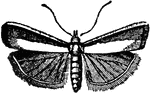
"The Pyralidina are a group of small moths readily distinguished by their long slender bodies and large forewings. One of these, Pyralis vitis, is very destructive to vines, and another, Pyralis farinalis, feeds upon meal and flour. The Galleridae, a family of Pyralidine moths, deposit their eggs in the hives of bees, where the caterpillars, enclosed in silken cases, devour the wax; but the Hydrocampidae, which also belong to this section, are probably the most wonderful of all Lepidopterous insects, their larva being aquatic, living and feeding in the water, and many of them beathing by gills similar to those of caddisworms." — Encyclopedia Britanica; 1893

Pyralidina

"The Pyralidina are a group of small moths readily distinguished by their long slender bodies and large…
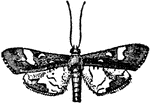
"The Pyralidina are a group of small moths readily distinguished by their long slender bodies and large forewings. One of these, Pyralis vitis, is very destructive to vines, and another, Pyralis farinalis, feeds upon meal and flour. The Galleridae, a family of Pyralidine moths, deposit their eggs in the hives of bees, where the caterpillars, enclosed in silken cases, devour the wax; but the Hydrocampidae, which also belong to this section, are probably the most wonderful of all Lepidopterous insects, their larva being aquatic, living and feeding in the water, and many of them beathing by gills similar to those of caddisworms." — Encyclopedia Britanica; 1893

Pyralidina

"The Pyralidina are a group of small moths readily distinguished by their long slender bodies and large…
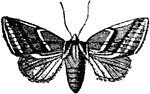
"The Tortricina include a great number of small moths exceedingly injurious to orchard and other trees. They are known as "leaf-rollers" from the habit which most of their larva have of rolling up the leaves on which they feed, and thus forming a shelter for themselves. The Green Tortrix occurs in the larva state on the oak, to which it often does great injurt by stripping the trees of their leaves in the month of June. Throughout Southern Europe the vine is liable to the ravages of another species, Aenectra pillariana, while few of our fruit trees are exempt from the occasional attacks of some species or other of the Carpocapsidae, the fruit-eating family of this group." — Encyclopedia Britanica; 1893

Tortricina

"The Tortricina include a great number of small moths exceedingly injurious to orchard and other trees.…
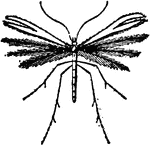
"The insects of the group Pterophorina, are remarkable from the peculiar conformation of their wings. Each of these organs is split longitudinally into several branches, all of them delicately fringed. In the genus Pterophora the fore wings are divided into two, and the hind wings into three branches; while in Orneodes each wing is split into six, and these when the insect is at rest are folded together after the manner of a fan." — Encyclopedia Britanica; 1893

Plume Moth

"The insects of the group Pterophorina, are remarkable from the peculiar conformation of their wings.…
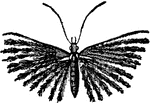
"The insects of the group Pterophorina, are remarkable from the peculiar conformation of their wings. Each of these organs is split longitudinally into several branches, all of them delicately fringed. In the genus Pterophora the fore wings are divided into two, and the hind wings into three branches; while in Orneodes each wing is split into six, and these when the insect is at rest are folded together after the manner of a fan." — Encyclopedia Britanica; 1893

Plume Moth

"The insects of the group Pterophorina, are remarkable from the peculiar conformation of their wings.…
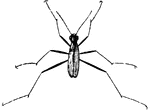
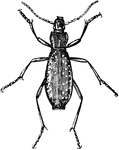
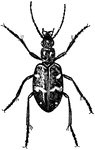
A group of beetles known for being predators. They have bulging eyes and slender legs.

Tiger Beetle

A group of beetles known for being predators. They have bulging eyes and slender legs.

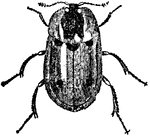
One of the largest group of beetles, mostly having shiny, black bodies.

Ground Beetle

One of the largest group of beetles, mostly having shiny, black bodies.

A group of beetles known for being preditors. They have bulging eyes and slender legs.

Wood Tiger Beetle

A group of beetles known for being preditors. They have bulging eyes and slender legs.
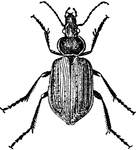
One of the largest group of beetles, mostly having shiny, black bodies.

Ground Beetle

One of the largest group of beetles, mostly having shiny, black bodies.

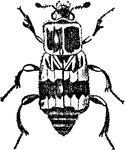
A group of carnivorous beetles that mainly feed on snails.

Carrion Beetle

A group of carnivorous beetles that mainly feed on snails.

A group of carnivorous beetles that mainly feed on snails.

Carrion Beetle

A group of carnivorous beetles that mainly feed on snails.

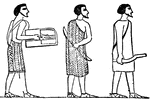
"Among the figures painted in the very ancient tomb at Beni Hassan, in Egypt, occurs a group of figures from which the annexed woodcut has been drawn, conjectured to represent the arrival of Joseph's brethren when they went to purchase corn in the land of the Pharaohs." — Encyclopedia Britannica, 1893

Beni Hassan

"Among the figures painted in the very ancient tomb at Beni Hassan, in Egypt, occurs a group of figures…
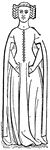
"The effigies of the two royal sisters speak for themselves as expressive and authoritative typical illustrations of the female dress of their era in its simplest and most characteristic forms, as the entire group in which they appear attests the dignified simplicity which the artists of the Middle Ages, with such excellent taste, have shown that they held to be appropriate for the costume, in itself always accurate and historically true." — Encyclopedia Britannica, 1893

Daughter of Edward III

"The effigies of the two royal sisters speak for themselves as expressive and authoritative typical…
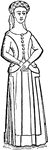
"The effigies of the two royal sisters speak for themselves as expressive and authoritative typical illustrations of the female dress of their era in its simplest and most characteristic forms, as the entire group in which they appear attests the dignified simplicity which the artists of the Middle Ages, with such excellent taste, have shown that they held to be appropriate for the costume, in itself always accurate and historically true." — Encyclopedia Britannica, 1893

Daughter of Edward III

"The effigies of the two royal sisters speak for themselves as expressive and authoritative typical…
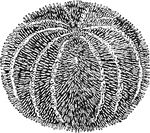
"A common European type of the group is the species Psammechinus esculentus. In certain forms the test is perforated by slit-like apertures." — Encyclopedia Britannica, 1893

Psammechinus esculentus

"A common European type of the group is the species Psammechinus esculentus. In certain forms the test…
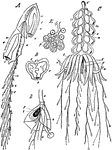
"Floating colonies of Siphonophora. A, Diphyes campanulata. B, A group of appendages from the stem of the same Diphyes. C, Physophora hydrostatica. D, Seperate nectocalyx of the same. E, Cluster of female sporosacs (aborted medusae) of Agalma sarsii. a, stem or axis of the colony; a', pneumatocyst (air-bladder); m, nectocalyx; c, sub-umbrellar cavity of nectocalyx; v, radiating canals of the umbrella of the nectocalyx; o, orifice formed by the margin of the umbrella; t, hydrophyilia in B, dactylozooids in C; n, stomach; i, tentacles; g, sporosacs." — Encyclopedia Britannica, 1893

Siphonophora

"Floating colonies of Siphonophora. A, Diphyes campanulata. B, A group of appendages from the stem of…
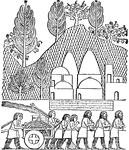
"Bas-relief of group of buildings at Kuyunjik. (After Layard.)" — The Encyclopedia Britannica, 1910

Bas-relief

"Bas-relief of group of buildings at Kuyunjik. (After Layard.)" — The Encyclopedia Britannica,…
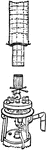
"Coal-gas was first used as a lighthouse illuminant at Salvore, near Trieste, in 1817. For many years it has been used in the harbour lights of Great Britain when in the neighborhood of gas-works. Mr. J. R. Wigham has designed a compound or crecus burner consisting of a group of twenty-eight vertical tubes, each carrying an ordinary double fish-tail burner, and the ignited gases issuing from all these jets unite into one large flame." —The Encyclopedia Britannica, 1910

Coal-gas

"Coal-gas was first used as a lighthouse illuminant at Salvore, near Trieste, in 1817. For many years…
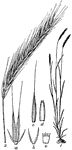
A grass grown for its grain and forage. It is part of the wheat group and is closely related to barley and wheat.

Rye

A grass grown for its grain and forage. It is part of the wheat group and is closely related to barley…
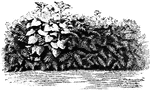
A group of ailanthus and sunflowers

Ailanthus and Sunflowers

A group of ailanthus and sunflowers

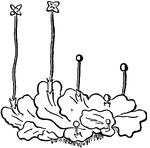
Group of plants bearing mature sporogonia

Pellia Epiphylla

Group of plants bearing mature sporogonia

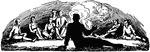
A group around a camp fire

Camping

A group around a camp fire

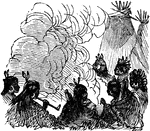
A group of Native American men in council.

Council

A group of Native American men in council.

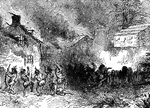
A group of Native Americans attacking a European settlement.

Native American Attack

A group of Native Americans attacking a European settlement.

A group of South American natives.

Aruaca'nians

A group of South American natives.

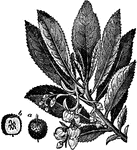
A group of trees or shrubs native to North America and Europe.

Ar'butus

A group of trees or shrubs native to North America and Europe.

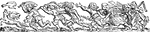
This banner contains images of people with tools and weapons chasing after a duck and fox with an animal in its mouth.

Banner

This banner contains images of people with tools and weapons chasing after a duck and fox with an animal…
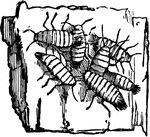
Woolly apple-louse, Schizoneura lanigera: showing a group of specimens on bark.

Apple Louse

Woolly apple-louse, Schizoneura lanigera: showing a group of specimens on bark.

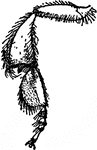
Hind leg of Melipona, peculiar group of spines at apex of tibia.

Bee Leg

Hind leg of Melipona, peculiar group of spines at apex of tibia.

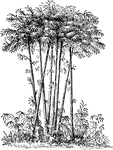
Bamboos are a group of woody perennial evergreen plants in the true grass family Poaceae and occur from Northeast Asia.

Bamboo

Bamboos are a group of woody perennial evergreen plants in the true grass family Poaceae and occur from…
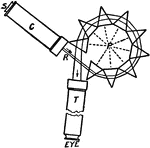
"C. Collimator; P, center of group of prisms; T, telescope; s, slit through which the ray of light enters, R, ray on its progress through prisms to telescope."—Finley, 1917

Spectroscope

"C. Collimator; P, center of group of prisms; T, telescope; s, slit through which the ray of light enters,…


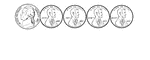
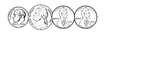
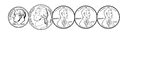
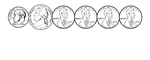
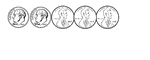
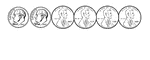
Groups of change with totals from 1 to 100 cents using the least amount of coins.

1 Cent

Groups of change with totals from 1 to 100 cents using the least amount of coins.

Groups of change with totals from 1 to 100 cents using the least amount of coins.

2 Cents

Groups of change with totals from 1 to 100 cents using the least amount of coins.

Groups of change with totals from 1 to 100 cents using the least amount of coins.

3 Cents

Groups of change with totals from 1 to 100 cents using the least amount of coins.

Groups of change with totals from 1 to 100 cents using the least amount of coins.

4 Cents

Groups of change with totals from 1 to 100 cents using the least amount of coins.

Groups of change with totals from 1 to 100 cents using the least amount of coins.

5 Cents

Groups of change with totals from 1 to 100 cents using the least amount of coins.

Groups of change with totals from 1 to 100 cents using the least amount of coins.

6 Cents

Groups of change with totals from 1 to 100 cents using the least amount of coins.

Groups of change with totals from 1 to 100 cents using the least amount of coins.

7 Cents

Groups of change with totals from 1 to 100 cents using the least amount of coins.

Groups of change with totals from 1 to 100 cents using the least amount of coins.

8 Cents

Groups of change with totals from 1 to 100 cents using the least amount of coins.

Groups of change with totals from 1 to 100 cents using the least amount of coins.

9 Cents

Groups of change with totals from 1 to 100 cents using the least amount of coins.

Groups of change with totals from 1 to 100 cents using the least amount of coins.

10 Cents

Groups of change with totals from 1 to 100 cents using the least amount of coins.

Groups of change with totals from 1 to 100 cents using the least amount of coins.

11 Cents

Groups of change with totals from 1 to 100 cents using the least amount of coins.

Groups of change with totals from 1 to 100 cents using the least amount of coins.

12 Cents

Groups of change with totals from 1 to 100 cents using the least amount of coins.

Groups of change with totals from 1 to 100 cents using the least amount of coins.

13 Cents

Groups of change with totals from 1 to 100 cents using the least amount of coins.

Groups of change with totals from 1 to 100 cents using the least amount of coins.

14 Cents

Groups of change with totals from 1 to 100 cents using the least amount of coins.

Groups of change with totals from 1 to 100 cents using the least amount of coins.

15 Cents

Groups of change with totals from 1 to 100 cents using the least amount of coins.

Groups of change with totals from 1 to 100 cents using the least amount of coins.

16 Cents

Groups of change with totals from 1 to 100 cents using the least amount of coins.

Groups of change with totals from 1 to 100 cents using the least amount of coins.

17 Cents

Groups of change with totals from 1 to 100 cents using the least amount of coins.

Groups of change with totals from 1 to 100 cents using the least amount of coins.

18 Cents

Groups of change with totals from 1 to 100 cents using the least amount of coins.

Groups of change with totals from 1 to 100 cents using the least amount of coins.

19 Cents

Groups of change with totals from 1 to 100 cents using the least amount of coins.

Groups of change with totals from 1 to 100 cents using the least amount of coins.

20 Cents

Groups of change with totals from 1 to 100 cents using the least amount of coins.

Groups of change with totals from 1 to 100 cents using the least amount of coins.

21 Cents

Groups of change with totals from 1 to 100 cents using the least amount of coins.

Groups of change with totals from 1 to 100 cents using the least amount of coins.

22 Cents

Groups of change with totals from 1 to 100 cents using the least amount of coins.

Groups of change with totals from 1 to 100 cents using the least amount of coins.

23 Cents

Groups of change with totals from 1 to 100 cents using the least amount of coins.

Groups of change with totals from 1 to 100 cents using the least amount of coins.

24 Cents

Groups of change with totals from 1 to 100 cents using the least amount of coins.