"Fresnel's Revolving Light. —In this form of revolving light the central burner is surrounded by annular lenses L, and a compound arrangement of inclined trapezoidal lenses L' and plane silvered mirrors M. The inclined lenses fit closely to each other and form a pyramidal dome, and the light, intercepted by them, is sent upwards in inclined beams until, falling upon the plane mirrors M, it is sent outwards in horizontal parallelized beams. All these optical agents are made to revolve round the central lamp, and the sailor receives a full flash when the axis of one of the emerging beams passes his eye, and as soon as it passes him he is in darkness until the next beam comes round." —The Encyclopedia Britannica, 1910

Fresnels Revolving Light

"Fresnel's Revolving Light. —In this form of revolving light the central burner is surrounded by annular…
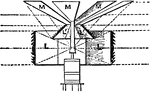
"Fresnel's Revolving Light. —In this form of revolving light the central burner is surrounded by annular lenses L, and a compound arrangement of inclined trapezoidal lenses L' and plane silvered mirrors M. The inclined lenses fit closely to each other and form a pyramidal dome, and the light, intercepted by them, is sent upwards in inclined beams until, falling upon the plane mirrors M, it is sent outwards in horizontal parallelized beams. All these optical agents are made to revolve round the central lamp, and the sailor receives a full flash when the axis of one of the emerging beams passes his eye, and as soon as it passes him he is in darkness until the next beam comes round." —The Encyclopedia Britannica, 1910

Fresnels Revolving Light

"Fresnel's Revolving Light. —In this form of revolving light the central burner is surrounded by annular…
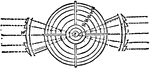
"Fresnel's Revolving Light. —In this form of revolving light the central burner is surrounded by annular lenses L, and a compound arrangement of inclined trapezoidal lenses L' and plane silvered mirrors M. The inclined lenses fit closely to each other and form a pyramidal dome, and the light, intercepted by them, is sent upwards in inclined beams until, falling upon the plane mirrors M, it is sent outwards in horizontal parallelized beams. All these optical agents are made to revolve round the central lamp, and the sailor receives a full flash when the axis of one of the emerging beams passes his eye, and as soon as it passes him he is in darkness until the next beam comes round." —The Encyclopedia Britannica, 1910

Fresnels Revolving Light

"Fresnel's Revolving Light. —In this form of revolving light the central burner is surrounded by annular…
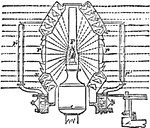
"Fresnel's Revolving Light. —In this form of revolving light the central burner is surrounded by annular lenses L, and a compound arrangement of inclined trapezoidal lenses L' and plane silvered mirrors M. The inclined lenses fit closely to each other and form a pyramidal dome, and the light, intercepted by them, is sent upwards in inclined beams until, falling upon the plane mirrors M, it is sent outwards in horizontal parallelized beams. All these optical agents are made to revolve round the central lamp, and the sailor receives a full flash when the axis of one of the emerging beams passes his eye, and as soon as it passes him he is in darkness until the next beam comes round." —The Encyclopedia Britannica, 1910

Fresnels Revolving Light

"Fresnel's Revolving Light. —In this form of revolving light the central burner is surrounded by annular…
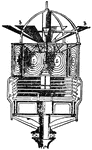
"In 1835 Mr. Stevenson, in a report to the Northern Lighthouse Board, proposed to add fixed reflecting prisms p below the lenses of Fresnel's revolving light, and he communicated this proposal to M. L. Fresnel, who approved of his suggestion, and assisted in carrying out the design in 1843. This combination added, however, but little to the power of the flash, and produced both a periodically flashing and constantly fixed light; but it must be remembered that the prism for fixed lights was the only kind of reflecting prism then known." —The Encyclopedia Britannica, 1910

Stevensons Revolving Light

"In 1835 Mr. Stevenson, in a report to the Northern Lighthouse Board, proposed to add fixed reflecting…
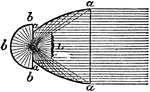
"Catadioptric Holophote.—Part of the anterior hemisphere of rays is intercepted and at once parallelized by the lens L, whose principal focus (i.e., for parallel rays) is in the center of the flame, while the remainder is intercepted and made parallel by the paraboloid a, and thus the double agents in Fresnel's design are dispensed with. The rays of the posterior hemisphere are reflected by the spherical mirror b back again through the foxus, whence passing onwards one portion of them falls on the lens and the rest on the paraboloid, so as finally to emerge in union with and parallel to the front rays." —The Encyclopedia Britannica, 1910

Catadioptric Holophote

"Catadioptric Holophote.—Part of the anterior hemisphere of rays is intercepted and at once parallelized…
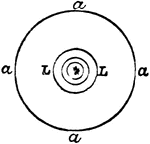
"Catadioptric Holophote.—Part of the anterior hemisphere of rays is intercepted and at once parallelized by the lens L, whose principal focus (i.e., for parallel rays) is in the center of the flame, while the remainder is intercepted and made parallel by the paraboloid a, and thus the double agents in Fresnel's design are dispensed with. The rays of the posterior hemisphere are reflected by the spherical mirror b back again through the foxus, whence passing onwards one portion of them falls on the lens and the rest on the paraboloid, so as finally to emerge in union with and parallel to the front rays." —The Encyclopedia Britannica, 1910

Catadioptric Holophote

"Catadioptric Holophote.—Part of the anterior hemisphere of rays is intercepted and at once parallelized…
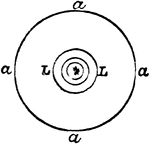
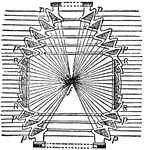
"Holophotal Catadioptric Apparatus Revolving round a Central Flame." —The Encyclopedia Britannica, 1910

Holophotal Catadioptric

"Holophotal Catadioptric Apparatus Revolving round a Central Flame." —The Encyclopedia Britannica,…
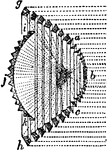
"Perfect Form of Dioptric Holophote for an Oil Flame.—By combining the back prisms ga, hc just described with a semi-holophote abc subtending 180 degrees and a portion of the dioptric spherical mirror ijk, no light is lost on the burner, and all the rays are parallelized, so that this apparatus, being all of glass, is both geometrically and physically perfect." —The Encyclopedia Britannica, 1910

Dioptric Holophote

"Perfect Form of Dioptric Holophote for an Oil Flame.—By combining the back prisms ga, hc just described…
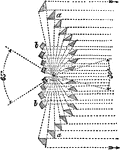
"Professor Swan's Designs.—Among several ingenious arrangements and new forms of agents proposed by Professor Swan is the mode of sending rays from prisms through interstices left between other prisms placed in front, and also a form of agent which he termed the triesoptric prism, in which the rays would undergo two refractions and three reflexions. a are the front and b the triesoptric prisms. The two upper and lower prisms a are constructed of flint glass of high refractive power. It will be observed from the drawing that this ingenious arrangement is nevertheless open to objection, for cones of light of 30 degrees in front and of 65 degrees at the back are lost through the interstices." —The Encyclopedia Britannica, 1910

Swans Designs

"Professor Swan's Designs.—Among several ingenious arrangements and new forms of agents proposed by…
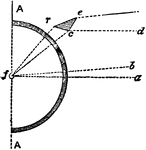
"Condensing Straight Prisms.—These, either by reflexion or refraction or both, cause a ray fr proceeding in any compass bearing from a fixed light apparatus AA to emerge in the direction, e.g., parallel to the corresponding ray fb, which proceeds in the same compass bearing from another part of the apparatus and so of any other ray fc which is bent parallel to the ray fa." —The Encyclopedia Britannica, 1910

Straight Prisms

"Condensing Straight Prisms.—These, either by reflexion or refraction or both, cause a ray fr…
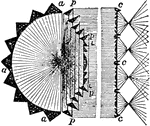
"Fixed Conensing Light for a Single Sector, 1850.—The holophote Light pLp throws its whole light on straight condensing prisms c, each of which distributes the rays over the required sector." —The Encyclopedia Britannica, 1910

Condensing Light

"Fixed Conensing Light for a Single Sector, 1850.—The holophote Light pLp throws its whole light on…
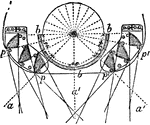
"Condensing Quadrant.—The fixed apparatus bbb, with spherical mirror behind, throws its rays directly through the angle of 90 degrees afa', while the supplementary rays falling on the straight condensing prisms p, p, p', p' are sent out parallel to the corresponding rays in the unobstructed central quadrant of the main apparatus. The whole light will therefore be condensed equally over 90 degrees." —The Encyclopedia Britannica, 1910

Condensing Quadrant

"Condensing Quadrant.—The fixed apparatus bbb, with spherical mirror behind, throws its rays directly…
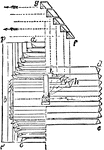
"Condensing Octant.—The central fixed apparatus bb with spherical mirror dd throws its rays directly over the angle of 45 degrees pgp, while the supplemental rays fall upon the straight condensing prisms p, each of which spreads the incident rays parallel to the corresponding rays in the central angle pgp. In this way the whole of the front hemisphere of rays is parallelized in the vertical plane and spread equally over the 45 degree in azimuth." —The Encyclopedia Britannica, 1910

Condensing Octant

"Condensing Octant.—The central fixed apparatus bb with spherical mirror dd throws its rays directly…
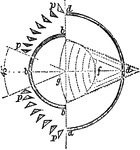
"Condensing Octant.—The central fixed apparatus bb with spherical mirror dd throws its rays directly over the angle of 45 degrees pgp, while the supplemental rays fall upon the straight condensing prisms p, each of which spreads the incident rays parallel to the corresponding rays in the central angle pgp. In this way the whole of the front hemisphere of rays is parallelized in the vertical plane and spread equally over the 45 degree in azimuth." —The Encyclopedia Britannica, 1910

Condensing Octant

"Condensing Octant.—The central fixed apparatus bb with spherical mirror dd throws its rays directly…
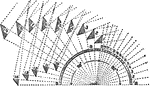
"Condensing Twin Prism Light.—Part of the Lamiash light in the Firth of Clyde. Its action will be easily understood by the numbers shown on the diagram." —The Encyclopedia Britannica, 1910

Twin Prism

"Condensing Twin Prism Light.—Part of the Lamiash light in the Firth of Clyde. Its action will…
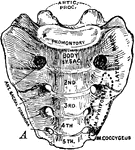
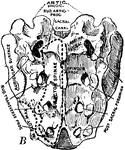
A large triangular bone as the base of the spine. Resides between the two hip bones.

Human Sacrum

A large triangular bone as the base of the spine. Resides between the two hip bones.

A large triangular bone as the base of the spine. Resides in between the two hip bones.

Human Sacrum

A large triangular bone as the base of the spine. Resides in between the two hip bones.
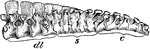
A large triangular bone as the base of the spine. Resides inbetween the two hip bones.

Bird Sacrum

A large triangular bone as the base of the spine. Resides inbetween the two hip bones.

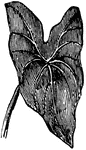
A leaf shaped like a triangle.

Sagittate Leaf

A leaf shaped like a triangle.

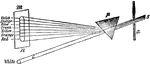
"Solar Spectrum.—If a ray, proceeding from the sun, be admitted into a darkened chamber, through an aperture in the window shutter, and allowed to pass through a triangular shaped piece of glass, called a prism, the light will be decomposed, and instead of a spot of white, there will be seen, on the opposite wall, a most brilliant display of colors, including all those seen in the rainbow." —Comstock, 1850

Solar Spectrum

"Solar Spectrum.—If a ray, proceeding from the sun, be admitted into a darkened chamber, through…
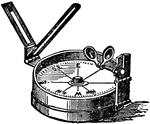
"At sea the declination is generally observed by means of an azimuth compass invented by Kater. It consists of a magnet with a graduated compass card attached to it. At the side of the instrument opposite the eye there is a frame which projects upwards from the plane of the instrument in a nearly vertical direction, and this frame contains a wide rectangular slit cut into two parts by a wire extending lengthwise. The eye-piece is opposite this frame, and the observer is supposed to point the instrument in such a manner that the wire above mentioned shall bisect the sun's visible disk. There is a totally reflecting glass prism which throws into the eye-piece an image of the scale of the graduated card, so that the observer, having first bisected the sun's disk by the wire, must next read the division of the scale which is in the middle of the field of view." —The Encyclopedia Britannica, 1903

Azimuth Compass

"At sea the declination is generally observed by means of an azimuth compass invented by Kater. It consists…
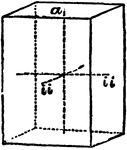
"If the base is a square and the prism stands erect—that is, if its sides or lateral planes, as they are called, are perpendicular to the base—the form is termed a right square prism." —The Encyclopedia Britannica, 1903

Primitive Crystal

"If the base is a square and the prism stands erect—that is, if its sides or lateral planes, as…
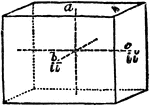
"When the base is a rectangle instead of a square, the form is a right rectangular prism." —The Encyclopedia Britannica, 1903

Primitive Crystal

"When the base is a rectangle instead of a square, the form is a right rectangular prism." —The…
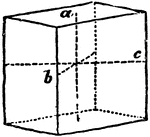
"When the base is a rhombus, and the prism stands erect, the form is a right rhombic prism." —The Encyclopedia Britannica, 1903

Primitive Crystal

"When the base is a rhombus, and the prism stands erect, the form is a right rhombic prism." —The…
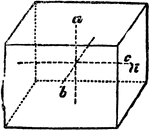
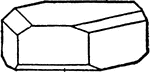
"When the base is a rhomboid, and the prism stands erect, it is only the opposite laeral faces that can be equal. The form is called a right rhomboidal prism." —The Encyclopedia Britannica, 1903

Primitive Crystal

"When the base is a rhomboid, and the prism stands erect, it is only the opposite laeral faces that…
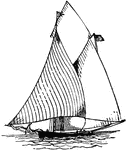
A triangular sail made of light canvas, used only in light winds and on yachts, set between the foretop mast head and the end of the jib boom.

Balloon Jib

A triangular sail made of light canvas, used only in light winds and on yachts, set between the foretop…
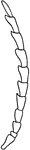
A <em>serrate</em> or saw toothed antenna has the joints more or less triangular in shape and so fitted the one margin resembles the toothed edge of a saw.

Serrate Antenna

A serrate or saw toothed antenna has the joints more or less triangular in shape and so fitted…
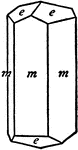
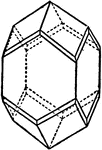
A prism and rhombohedron calcite crystal

Calcite

A prism and rhombohedron calcite crystal

A basal pinacoid, prism, and rhoombohedron calcite crystal

Calcite

A basal pinacoid, prism, and rhoombohedron calcite crystal

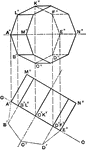
Three dimensional to two dimensional representation of an octagonal prism

Octagonal Prism Orthagonal Projection

Three dimensional to two dimensional representation of an octagonal prism
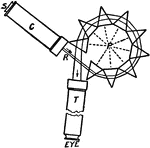
"C. Collimator; P, center of group of prisms; T, telescope; s, slit through which the ray of light enters, R, ray on its progress through prisms to telescope."&mdash;Finley, 1917

Spectroscope

"C. Collimator; P, center of group of prisms; T, telescope; s, slit through which the ray of light enters,…
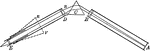
"The light to be studied is admitted through a narrow slit (A) in the end of a tube, in such a way that it will fall in parallel rays on a prism (C) with its edges parallel to the slit. When the beam emerges from the prism, the different colors are separated and the spectrum is viewed through lenses (E) placed at the end of another tube." -Brownlee 1907

Diagrammatic Representation of Spectroscope

"The light to be studied is admitted through a narrow slit (A) in the end of a tube, in such a way that…
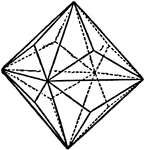
"This solid is bounded by twenty-four isosceles triangles, and may be considered as an octahedron with a low triangular pyramid on each of its faces." -The Encyclopedia Britannica 1910

Triakis-octahedron

"This solid is bounded by twenty-four isosceles triangles, and may be considered as an octahedron with…
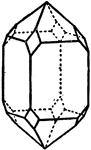
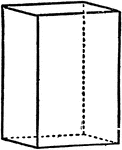
Combination of holohedral tetragonal forms.

Combination of Tetragonal Prism and Basal Pinacoid

Combination of holohedral tetragonal forms.

Rectangular prism/solid.

Rectangular Prism

Rectangular prism/solid.

"...a combination of a bipyramid of the first order with a ditetragonal bipyramid and the prism of the second order." -The Encyclopedia Britannica 1910

Combination of a bipyramid and prism

"...a combination of a bipyramid of the first order with a ditetragonal bipyramid and the prism of the…
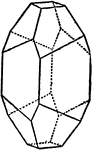
"...a combination of tetragonal prism of the first order with a tetragonal bipyramid of the third order and the basal pinacoid." -The Encyclopedia Britannica 1910

Crystal of Fergusonite

"...a combination of tetragonal prism of the first order with a tetragonal bipyramid of the third order…
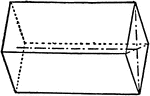
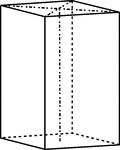
"This consists of four faces parallel to the brachy axis." -The Encyclopedia Britannica 1910

Macro-prism and Brachy-pinacoid

"This consists of four faces parallel to the brachy axis." -The Encyclopedia Britannica 1910
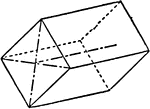
"This consists of four faces perpendicular to the vertical axis." -The Encyclopedia Britannica 1910
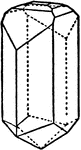
Brachy-prism and Macro-pinacoid

"This consists of four faces perpendicular to the vertical axis." -The Encyclopedia Britannica 1910

Holohedral orthorhombic combination

Prism and Basal Pinacoid

Holohedral orthorhombic combination

"...a combination of the brachy-pinacoid and a prism, with the pedion, two brachy-domes and two marco-domes at the upper end, and a pyramid at the lower end." -The Encyclopedia Britannica 1910

Crystal of Hemmorphite

"...a combination of the brachy-pinacoid and a prism, with the pedion, two brachy-domes and two marco-domes…
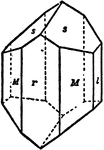
"...represents a crystal of augite bounded by th clino-pinacoid, the ortho-pinacoid, a prism, and a hemi-pyramid." -The Encyclopedia Britannica 1910

Crystal of Augite

"...represents a crystal of augite bounded by th clino-pinacoid, the ortho-pinacoid, a prism, and a…
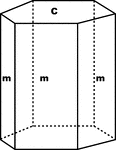
"...shows a combination of a hexagonal prism (m) with the basal pinacoid (c)." -The Encyclopedia Britannica 1910

Hexagonal Prism and Basal Pinacoid

"...shows a combination of a hexagonal prism (m) with the basal pinacoid (c)." -The Encyclopedia Britannica…
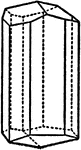
"...represents a crystal of tourmaline wit the trigonal prism, hexagonal prism, and a trigonal pyramid at each end." -The Encyclopedia Britannica 1910

Crystal of Tourmaline

"...represents a crystal of tourmaline wit the trigonal prism, hexagonal prism, and a trigonal pyramid…
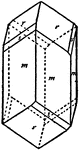
"...represents a crystal of dioptase with the fundamental rhombohedron (r) and the hexagonal prism of the second order (m) combined with the rhombohedron (s)." -The Encyclopedia Britannica 1910

Crystal of Dioptase

"...represents a crystal of dioptase with the fundamental rhombohedron (r) and the hexagonal prism of…
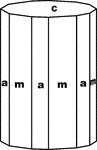
"Hexagonal prism of the first order, consisting of six faces also parallel to the hexad axis, but perpendicular to the other set of three vertical planes of symmetry." -The Encyclopedia Britannica 1910

Hexagonal Prism of the First Order

"Hexagonal prism of the first order, consisting of six faces also parallel to the hexad axis, but perpendicular…
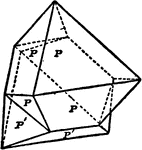
"An octahedron twinned on an octahedral face has the two portions symmetrical with repsect to a plane parallel to this face (the large triangular face in this figure)." -The Encyclopedia Britannica 1910

Spinel-twin

"An octahedron twinned on an octahedral face has the two portions symmetrical with repsect to a plane…
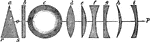
"a, prism; b, plane glass; c, spherical lens; d, double-convex; e, plano-convex, f, double-concave; g, plano-concave; h, meniscus; i, concavo-convex lenses." -Comstock 1850

Lenses of Various Forms

"a, prism; b, plane glass; c, spherical lens; d, double-convex; e, plano-convex, f, double-concave;…
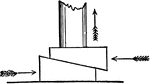
"A wedge is a triangular prism of hard material, fitted to be driven between objects that are to be separated, or into anything that is to be split." -Avery 1895

Wedge

"A wedge is a triangular prism of hard material, fitted to be driven between objects that are to be…
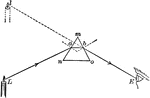
"A prism is a transparent body with two refraction surfaces that lie in intersecting planes. The angle formed by these planes is called the refracting angle." -Avery 1895

Prism

"A prism is a transparent body with two refraction surfaces that lie in intersecting planes. The angle…
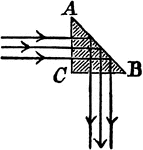
"Cathetal prisms readily yield the phenomena of total reflection as shown, and are often used when light is to be turned through a right angle." -Avery 1895

Cathetal Prism

"Cathetal prisms readily yield the phenomena of total reflection as shown, and are often used when light…
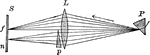
"The prism will deflect the red and orange, and form a reddish colored image at n. The violet, indigo, blue, green and yellow light, not caught by the prism, will unite at f to form a greenish image. When the prism is removed, the reddish light that fell at n, and the greenish light that fell at f, unite to form white light." -Avery 1895

Refraction of Complimentary Colors

"The prism will deflect the red and orange, and form a reddish colored image at n. The violet, indigo,…
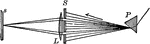
"A prism is used to disperse ordinary light, and slits are cut in paper S to only allow yellow and blue light to pass. These two simple colors will be blended by the lens, forming a light that is nearly white. The effect of mingling any two colors may be determined in this way." -Avery 1895

Color Spectrum

"A prism is used to disperse ordinary light, and slits are cut in paper S to only allow yellow and blue…
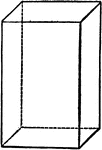
"A parallelopipedon is a prism whose bases (ends) are parallelograms." &mdash;Hallock 1905

Parallelopipedon

"A parallelopipedon is a prism whose bases (ends) are parallelograms." —Hallock 1905
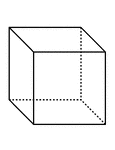
"A cube is a prism whose faces are ends are squares. All the faces of a cube are equal." &mdash;Hallock 1905

Cube

"A cube is a prism whose faces are ends are squares. All the faces of a cube are equal." —Hallock…
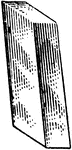
"An allotrope of sulphur, when heated to 115 degrees Celcius, will cool to be yellowish-brown, needle-shaped crystals, derived from an oblique prism." &mdash;Hallock 1905

Sulphur

"An allotrope of sulphur, when heated to 115 degrees Celcius, will cool to be yellowish-brown, needle-shaped…
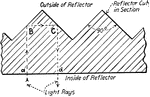
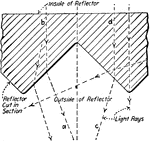
"Enlarged view of prism of prismatic reflector." &mdash;Croft 1917

Prismatic Reflector

"Enlarged view of prism of prismatic reflector." —Croft 1917

"Cross-section of prismatic reflector, showing how light rays are refracted and dispersed." &mdash;Croft 1917

Prismatic Reflector

"Cross-section of prismatic reflector, showing how light rays are refracted and dispersed." —Croft…
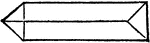
"A prism is a piece of glass, having for its sides three plane surfaces and for its ends two equal and parallel triangles." &mdash;Quackenbos 1859

Prism

"A prism is a piece of glass, having for its sides three plane surfaces and for its ends two equal and…