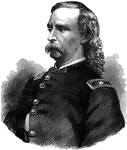
"General George A. Custer, born in New Rumley, Harrison County, Ohio, December 5th, 1839, died in Montana, June 25th, 1876, was graduated at the United States Military Academy in June 1861, and reported for duty at Washington; was assigned to duty as lieutenant in the Fifth Cavalry, and participated, on the day of his arrival at the front, in the first battle of Bull Run. For daring gallantry in a skirmish at Aldie, and in the action at Brandy Station, as well as in the closing operations of the Rappahannock campaign, he was appointed brigadier general of volunteers. General custer, with his entire command, was slain by the Sioux indians in the battle of Little Big Horn, in Montana, June 25th, 1876." — Frank Leslie, 1896

George Custer

"General George A. Custer, born in New Rumley, Harrison County, Ohio, December 5th, 1839, died in Montana,…

"General Lorenzo Thomas, born in Newcastle, Del., October 26th, 1804, died in Washington, D. C., March 2nd, 1875, was graduated from the United States Military Academy in 1823; served in the Florida and Mexican Wars, and received the brevet of lieutenant colonel for gallantry at Monterey. On the 7th of May, 1861, he was brevetted brigadier general, and made adjutant general of the army on August 3rd, with the full rank of brigadier general. He served until 1863, when he was intrusted for two years with the organization of [African American] troops in the Southern States. He was brevetted major general, United States Army, on March 13th, 1865. He was retired in 1869." — Frank Leslie, 1896

Lorenzo Thomas

"General Lorenzo Thomas, born in Newcastle, Del., October 26th, 1804, died in Washington, D. C., March…
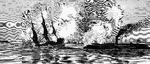
"First naval battle in Hampton Roads between the Confederate iron-plated steamers <em>Merrimac, Yorktown</em>, and <em>Jamestown</em>, and the Federal wooden sailing frigates <em>Cumberland</em> and <em>Congress</em>- sinking of the <em>Cumberland</em> by a blow from the <em>Merrimac</em>, March 8th, 1862- sketched by our special artist. About noon on the 8th, a suspicious-looking vessel, looking like a submerged house, with the roof only above water, was discovered, moving down from Norfolk, by the channel in front of Sewall's Point batteries. There was nothing protruding above the water but a flagstaff flying the Confederate flag and a short smokestack. She moved along slowly, and turned into the channel leading to Newport News, and steamed direct for the wooden sailing frigates <em>Cumberland</em> and <em>Congress</em>, which were lying at the mouth of James River. As soon as she came within range of the <em>Cumberland</em>, the latter opened on her with her heavy guns; but the balls struck and glanced off without effect. In the meantime, as the <em>Merrimac</em> was approaching the two frigates on one side, the Confederate ironclad steamers <em>Yorktown</em> and <em>Jamestown</em> came down James River, and engaged the frigates on the other side. The batteries at Newport News also opened on the <em>Yorktown</em> and <em>Jamestown</em>, and did all in their power to assist the <em>Cumberland</em> and <em>Congress</em>, which, being sailing vessels, were at the mercy of the approaching steamers. The <em>Merrimac</em>, in the meantime, kept steadily on her course, and slowly approached the <em>Cumberland</em>, when she and the <em>Congress</em>, at a distance of one hundred yards, rained full broadsides on the ironclad monters without effect. After receiving the first broadside of the two frigates, she ran on to the <em>Cumberland</em>, striking her about midship, and literally laying open her bow, left her to sink, while she engaged the <em>Congress</em>, which lay about a quarter of a mile distant. The <em>Congress</em>, having no regular crew on board of her, and seeing the hopelessness of resisting the ironclad steamer, at once struck her colors." &mdash; Frank Leslie, 1896

First naval battle

"First naval battle in Hampton Roads between the Confederate iron-plated steamers Merrimac, Yorktown,…
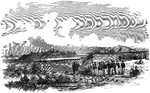
"General view of Forts Hatters and Clark, N. C., captured on the 29th of August, 1861, by the Federal naval and military forces, under command of Commodore Stringham and Major General Butler. Articles of stipulation were signed on the flagship by Commodore Stringham and General Butler on the part of the United States, and by Commodore Barron, Colonel Martin and Major Andrews on the Confederate side, and the swords of the latter delivered up. The two forts remained in possession of the Federal troops, Fort Hatteras under command of Colonel Weber, and Fort Clark under that of Colonel Hawkins. The enemy's loss in killed was 15, and wounded 42; on the Federal side not a single man was either killed or wounded." — Frank Leslie, 1896

Fort Hatteras

"General view of Forts Hatters and Clark, N. C., captured on the 29th of August, 1861, by the Federal…
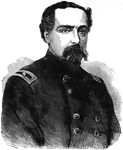
"General Edward Ferrero was born in Granada, Spain, January 18th, 1831. His parents were Italian, and he was brought to the United States when an infant. At the beginning of the war he was lieutenant colonel of the Eleventh New York Militia Regiment. In 1861 he raised the fifty-first New York Regiment, called the "Shepard Rifles," and led a brigade in Burnside's expedition to Roanoke Island, where his regiment took the first fortified redoubt captured in the war. He was in the battles of South Moutain and Antietam, and for his bravery in the latter engagement was appointed brigadier general, September 19th, 1862. He served with distinction at Fredericksburg, Vicksburg and the siege of Petersburg. He was brevetted a major general, December 2nd, 1864, and mustered out in 1865." &mdash; Frank Leslie, 1896

Edward Ferrero

"General Edward Ferrero was born in Granada, Spain, January 18th, 1831. His parents were Italian, and…
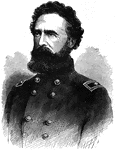
"General George Sykes, born in Dover, Del., October 9th, 1822, died in Brownsville, Texas, February 9th, 1880, was graduated from the United States Military Academy in 1842, and assigned to the Third Infantry; served in the Florida and Mexican Wars, and was brevetted captain for gallantry at Contreras, Churubusco and the capture of the city of Mexico. He became major of the Fourteenth Infantry, May 14th, 1861; was at the battle of Bull Run, and then commanded the regular infantry at Washington till March, 1862. He took part in the Peninsula campign, receiving the brevet of colonel for gallantry at Gaines's Mill and in the succeeding operations of the Army of the Potomac. At the close of the war he was brevetted major general for gallant services in the field." &mdash; Frank Leslie, 1896

George Sykes

"General George Sykes, born in Dover, Del., October 9th, 1822, died in Brownsville, Texas, February…
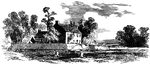
"Fort built around the officer's quarters of the First Minnesota Regiment, Colonel Sully, near Fair Oaks, VA. The peculiarities of the States and nationalities as were represented in the Federal Army developed themselves in a variety of ways. At Fortress Monroe the German regiments erected bowers in which they quaffed their lager and smoked, while their regimental bands played airs which led them back by the ear to Das Vaterland; and the Garibaldi Guard made their tents as much like Swiss cottages as possible. The First Minnesota Regiment, Colonel A. Sully, little dreaming how soon they would have to abandon their handiwork to the enemy, erected a fort around the commodious farm house near Fair Oaks, which, after the battle of Seven Pines, May 31st, 1862, had been given to their captains and lieutenants for their quarters. The appearance was so strange that an officer of General McClellan's staff made a sketch and sent it to us." &mdash; Frank Leslie, 1896

First Minnesota Regiment

"Fort built around the officer's quarters of the First Minnesota Regiment, Colonel Sully, near Fair…
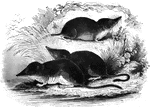
"Is about the size of a rat.. Their legs are of equal length, and terminate into five toes, which are armed with small claws, usually free, thugh not fequently united by a swimming membrane. Their nose is more or less produced, and the tail is elongated, usually tapering, covered with scales." &mdash;Goodrich, 1885

Shrews

"Is about the size of a rat.. Their legs are of equal length, and terminate into five toes, which are…
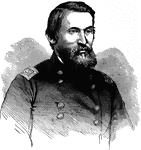
"General Crook, born near Dayton, O., September 8th, 1828, died in Chicago, Ill., March 21st, 1890, was graduated at the United States Military Academy in 1852, and was on duty with the Fourth Infantry in California in 1852-'61. He had risen to a captaincy, when, at the beginning of the Civil War, he returned to the East and became colonel of the Thirty-sixth Ohio Infantry. He afterward served in the Western Virginia campaign, in command of the Third Provisional Brigade, from May 1st to August 15th, 1862, and was wounded in the action at Lewisburg. He served in Tennessee in 1863, and on July 1st he was transferred to the command of the Second Cavalry Division. After various actions, ending in the battle of Chickamauga, he pursued Wheeler's Confederate cavalry and defeated it. He entered upon the command of the Kanawha District, in Western Virginia, in February, 1864; made constant raids and was in numerous actions. He took part in Sheridan's Shenandoah campaign, and received the brevet of brigadier general and major general in the United States Army, March 13th, 1865. General Crook had command of the cavalry of the Army of the Potomac from March 26th to April 9th, during which time he was engaged at Dinwiddie Courthouse, Sailor's Creek and Farmville, till the surrender at Appomattox." &mdash;Leslie, 1896

General George Crook

"General Crook, born near Dayton, O., September 8th, 1828, died in Chicago, Ill., March 21st, 1890,…
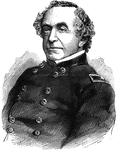
"General Totten, born in New Haven, Conn., August 23rd, 1788, died in Washington, D. C., April 23rd, 1864. Was graduated from the United States Military Academy in 1805, and promoted second lieutenant in the corps of engineers. After the beginning of the Civil War he had charge of the engineer bureau in Washington. When the corps of engineers and that of topographical engineers were consolidated, in 1863, he was made brigadier general on March 3rd; and for his long, faithful and eminent services was brevetted major general, April 21st, 1864." &mdash;Leslie, 1896

General Joseph G. Totten

"General Totten, born in New Haven, Conn., August 23rd, 1788, died in Washington, D. C., April 23rd,…
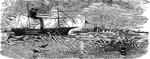
"Shelling of the batteries at Galveston by the United States war steamer <em>South Carolina</em>, on Monday afternoon, August 5th, 1861." —Leslie, 1896

Galveston

"Shelling of the batteries at Galveston by the United States war steamer South Carolina, on…
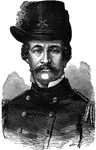
"General Hunter, born in Washington, D. C., July 21st, 1802, died there, February 2nd, 1886, was graduated at the United States Military Academy in 1822; appointed second lieutenant in the Fifth Infantry; promoted first lieutenant in 1828, and became a captain in the First Dragoons in 1833. He resigned his commission in 1836, and engaged in business in Chicago. He re-entered the military service as a paymaster, with the rank of major, in March, 1842. On May 14th, 1861, he was appointed colonel of the Sixth United States Cavalry, and three days later was commissioned brigadier general of volunteers. He commanded the main column of McDowell's army in the Manassas campaign, and was severely wounded at Bull Run, July 21st, 1861. He was made a major general of volunteers, August 13th, 1861; served under General Fremont in Missouri, and on November 2nd succeeded him in the command of the Western Department. In March, 1862, General Hunter was transferred to the Department of the South, with headquarters at Port Royal, S. C. In May, 1864, he was placed in command of the Department of West Virginia. He defeated considerable force at Piedmont on June 5th. He was brevetted major general, United States Army, march 13th, 1865, and mustered out of the volunteer service in January, 1866." &mdash;Leslie, 1896

General David Hunter

"General Hunter, born in Washington, D. C., July 21st, 1802, died there, February 2nd, 1886, was graduated…
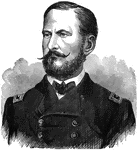
"General Pleasonton, born in Washington, D. C., June 7th, 1824, was graduated at the United States Military Academy in 1844; served in the Mexican War, and was brevetted first lieutenant for gallant and meritorious conduct in the battles of Palo Alto and Resaca de la Palma; was commissioned first lieutenant in 1849, and captain in 1855; commanded his regiment in its march from Utah to Washington in 1861; was commissioned major of the Second Cavalry in 1862; served through the Virginia Peninsula campaign; became brigadier general of volunteers in July of that year, and commanded the division of cavalry of the Army of the Potomac that followed Lee's invading army into Maryland. He was engaged at Boonesborough, South Mountain, Antietam and the subsequent pursuit; engaged the enemy at Fredericksburg, and staid the further advance of the enemy at Chancellorsville. He received the brevet of lieutenant colonel for Antietam in 1862; was promoted major general of volunteers in June, 1863, participating in the numerous actions that preceded the battle of Gettysburg. In March, 1865, he was made major general, United States Army, for services throughout the Civil War." &mdash;Leslie, 1896

General Alfred Pleasonton

"General Pleasonton, born in Washington, D. C., June 7th, 1824, was graduated at the United States Military…
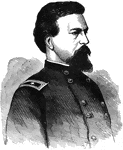
"General Webb, born in New York city, February 15th, 1835, was graduated from the United States Military Academy in 1855, and assigned to the artillery. He served in Florida, Minnesota, and for three years as assistant professor at West Point. He was present at Bull Run and in defenses of Washington until 1862, when he participated in the battles of the Peninsula campaign of the Army of the Potomac, and as chief of staff of the Fifth Corps during the Maryland and Rappahannock campaigns till June 23rd, 1863. He was then commissioned brigadier general of volunteers, and placed in command of a brigade of the Second Corps, serving with great credit at the battle of Gettysburg. He was made major general, United States Army, for gallant and meritorious services in the campaign terminating with the surrender of the insurgent army under General Lee." —Leslie, 1896

General Alexander S. Webb

"General Webb, born in New York city, February 15th, 1835, was graduated from the United States Military…
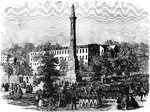
"Review of Confederate troops on their march to Virginia, in front of the Pulaski Monument, Monument Square, Savannah, Ga., August 7th, 1861. The Pulaski Monument is situated in Johnson or Monument Square. It is a fine Doric obelisk of marble, 53 feet in height. The base of the pedestal is 10 feet 4 inches by 6 feet 8 inches, and its elevation is about 12 feet. The corner stone was laid by Lafayette during his visit to the United States in 1825. The needle which surmounts the pedestal is 37 feet high. Another and very elegant structure has also been erected to the memory of this gallant foreigner in Chippewa Square. Pulaski was killed in the attack made by the allied American and French armies in 1779, when the British held possession of Savannah." —Leslie, 1896

Pulaski Monument

"Review of Confederate troops on their march to Virginia, in front of the Pulaski Monument, Monument…
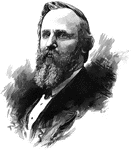
"General Hayes was the nineteenth President of the United States, born in Delaware, O., October 4th, 1822; died in Fremont, O., January 7th, 1893. Hayes was governor of Ohio three times and was a general in the Civil War." —Leslie, 1896

General Rutherford B. Hayes

"General Hayes was the nineteenth President of the United States, born in Delaware, O., October 4th,…
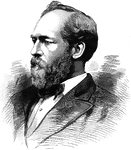
"General James A. Garfield was the twentieth President of the United States, born in Orange, Cuyahoga County, O., November 19th, 1831, died in Elberon, N. J., September 19th, 1881. General Garfield was involved in the Civil War and was inaugurated President of the United States in 1881, and was shot by a disappointed office seeker (Guiteau), July 2nd, the same year." &mdash;Leslie, 1896

General James A. Garfield

"General James A. Garfield was the twentieth President of the United States, born in Orange, Cuyahoga…
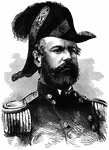
"General Porter, born at Portsmouth, N. H., June 13th, 1822, was graduated from the United States Military Academy in 1845, and assigned to the Fourth Artillery, in which he became second lieutenant, June 18th, 1846. He served in the Mexican War, was commissioned first lieutenant on May 29th, and received the brevet of captain, September 8th, 1847, for services at Molino del Rey, and that of major for Chapultepec. On May 14th, 1861, he became colonel of the Fifteenth Infantry, and on May 17th, 1861, he was made brigadier general of volunteers, and assigned to duty in Washington. In 1862 he participated in the Virginia Peninsula campaign, at Yorktown, Gaines's Mill and Malvern Hill, and received the brevet of brigadier general in the regular army for gallant conduct at the battle of Chickahominy, Va., June 27th, 1862. On November 27th, 1862, General Porter was arraigned before a court-martial in Washington, charged with disobeying orders at the second battle of Bull Run, and on January 21st, 1863, he was cashiered. A bill for his relief was signed by President Cleveland, and he was restored to the United States Army as colonel, August 7th, 1886." &mdash;Leslie, 1896

General Fitzjohn Porter

"General Porter, born at Portsmouth, N. H., June 13th, 1822, was graduated from the United States Military…
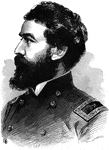
"General Brannan, born in the District of Columbia in 1819, was graduated from the United States Military Academy in 1841, and stationed at Plattsburg, N. Y., in 1841-'42. During the Mexican War he was first lieutenant in the First Artillery. He took part in the battles of Vera Cruz, Cerro Gordo, La Hoya, Contreras and Churubusco, and for gallant and meritorious conduct was brevetted captain on August 28th, 1847. During the next fourteen years he performed much arduous service on the frontier, and from 1856 till 1858 took a gallant part in the campaign against the Seminoles. On September 28th, 1861, he was promoted to be brigadier general of volunteers, serving in the far South until January 24th, 1863. On October 10th, 1863, he became chief of artillery of the Department of the Cumberland, and held that position till June 25th, 1865. On March 13th, 1865, he was brevetted brigadier general in the regular army for his part in the capture of Atlanta, and major general for gallant and meritorious services during the war." &mdash;Leslie, 1896

General John M. Brannan

"General Brannan, born in the District of Columbia in 1819, was graduated from the United States Military…
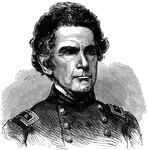
"General Mitchel, born at Morganfield, Union County, Ky., August 28th, 1809, died at Hilton Head, S. C., October 30th, 1862, was graduated from the United States Military Academy in 1829. Immediately after his graduation he was made assistant professor of mathematics at the Military Academy, which position he held for two years, when he was assigned to duty at Fort Marion, St. Augustine, Fla. He soon resigned and moved to Cincinnati, where he commenced the study of law and was admitted to the bar. In 1861 he entered the Civil War in the cause of the Union, and was placed in command of a division of General Buell's army. He served with the Army of the Ohio during the campaigns of Tennessee and Northern Alabama, and reached the brevet title of major general of volunteers, April 11th, 1862. Afterward he was placed in command of the Department of the South at Hilton Hed, S. C., where he was fatally stricken with yellow fever in the prime of his career." &mdash;Leslie, 1896

General Ormsby MacKnight Mitchel

"General Mitchel, born at Morganfield, Union County, Ky., August 28th, 1809, died at Hilton Head, S.…
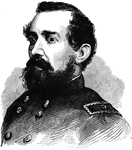
"General Reno, born in Wheeling, W. Va., June 20th, 1823, died on South Mountain, Md., September 14th, 1862, was graduated from the United States Military Academy in 1846, and at once promoted brevet second lieutenant of ordinance. He served in the Mexican War, taking part in the battles of Cerro Gordo, Contreras, Churubusco, and Chapultepec, and in the siege of Vera Cruz he was commissioned second lieutenant, March 3rd, 1847; brevetted first lieutenant, April 18th, for gallant conduct in the first-named engagement, and captain, September 13th, for bravery at Chapultepec, where he was severely wounded. In the Civil War he was commissioned brigadier general, November 12th, 1861, and major general of volunteers, July 18th, 1862; led a brigade under General Burnside in the taking of Roanoke Island, N. C., February 8th, 1862; was engaged under General Pope at Manassas and Chantilly, Va. At Turner's Gap in South Mountain, Md., he repelled the Confederates under Lee, and after being in action all day he was killed in the evening of September 14th, 1862." &mdash;Leslie, 1896

General Jesse L. Reno

"General Reno, born in Wheeling, W. Va., June 20th, 1823, died on South Mountain, Md., September 14th,…
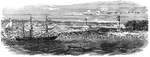
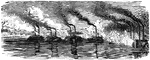
"The United States gunboat <em>Mohawk</em> chasing the Confederate steamer <em>Spray</em> into the St. Mark's River." &mdash;Leslie, 1896

Mohawk

"The United States gunboat Mohawk chasing the Confederate steamer Spray into the St.…

"Bombardment of Fort Henry, Tennessee River, Tenn., by the Mississippi Flotilla, Flag Officer Foote, February 6th, 1862. Flag Officer Foote's official report- United States Flagship Cincinatti, off Fort Henry, Tennessee River, February 6th, 1862: 'The gunboats under my command- the <em>Essex</em>, Commander Porter; the <em>Carondelet</em>, Commander Walker; the <em>Cincinnati</em>, Commander Stembel; the <em>St. Louis</em>, Lieutenant Commanding Paulding; the <em>Conestoga</em>, Lieutenant Commanding Phelps; the <em>Taylor</em>, Lieutenant Commanding Gwin; and the <em>Lexington</em>, Lieutenant Commanding Shirk. After a severe and rapid fire of one hour and a quarter, have captured Fort Henry and have taken General Lloyd Tilghman and his staff as prisoners. The surrender to the gunboats was unconditional, as we kept an open fire upon the enemy until their flag was struck. In half an hour after the surrender I handed the fort and the prisoners over to General Grant, commanding the army, on his arrival at the fort in force. The <em>Essex</em> had a shot in her boiler, after fighting most effectually for two thirds of the action, and was obliged to drop down the river. She, with the other gunboats, officers and men, fought with the greatest gallantry. The <em>Cincinnati</em> received thirty-one shots and had one man killed and eight wounded, two seriously. The fort, with twenty guns and seventeen mortars, was defended by General Tilghman with the most determined gallantry.'" —Leslie, 1896

Bombardment of Fort Henry

"Bombardment of Fort Henry, Tennessee River, Tenn., by the Mississippi Flotilla, Flag Officer Foote,…
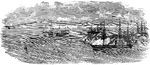
"Ship Island, near the mouth of the Mississippi- United States war steamer "Mississippi" firing on a Confederate steamer." —Leslie, 1896

Ship Island

"Ship Island, near the mouth of the Mississippi- United States war steamer "Mississippi" firing on a…
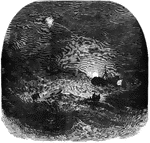
"Loss of the <em>Monitor</em>- gallant attempt of the officers and crew of the United States steamer <em>Rhode Island</em>, to rescue the crew of the <em>Monitor</em>, off Cape Hatteras, at midnight, December 30th 1862. The closing day of 1862 will always be a dark one in our history, for just on the threshold of its birth the pet monster of our ironclads went down off Hatteras, with our flag flying on its tower, and in the midst of a furious storm. Its sudden and unlooked-for fate recalled to every mind that memorable Sunday in March when it signalized its advent to war by driving back to its Norfolk retreat the terrible <em>Merrimac</em>." &mdash;Leslie, 1896

Monitor

"Loss of the Monitor- gallant attempt of the officers and crew of the United States steamer…
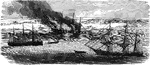
"A detachment of United States sailors from the gunboats <em>Albatross</em> and <em>Gemsbok</em> burning the contraband vessel <em>York</em>. Mouth of Rogue's inlet, near Beaufort, N. C., January 23rd, 1862." —Leslie, 1896

Burning of York

"A detachment of United States sailors from the gunboats Albatross and Gemsbok burning…
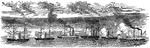
"Engagement between the United States gunboats, commanded by Commodore Davis, and the Confederate Mosquito Fleet, under Commodore Tatnall, near Fort Pulaski, Savannah River, January 28th, 1862. Our artist described this spirited sketch as follows: 'On Monday night Lieutenant Barnes was dispatched in the <em>Ottawa's</em> gig to scout up the creek and report. Passing the piles with ease, he pulled silently up the stream with muffled oars, and with no opposition succeeded in reaching the mouth of the creek where it enters the Savannah River. He came upon the fleet of Tatnall lying there, and approached near enough to see the watch on deck. As he was too near them in case they discovered him, and as he had accomplished the object of reconnoisance, he returned and reported the facts to Captain Davis. On Tuesday forenoon Tatnall's fleet was again discovered standing down the Savannah. We beat to quarters, and when the flagship had got within range we opened on her with an eleven-inch gun from the <em>Ottawa</em>. The signal for action having been given, the gunboats opened fire. The Confederates returned a few shots, which fell short. The engagement lasted nearly two hours, during which time the Confederate Flagship was struck three times, seriously damaging her. One eleven-inch shell struck her on her wheelhouse, and so much disabled her as to compel the commander to signal for assistance, and one steamer turned round and went to her aid. The other three steamed down toward Fort Pulaski faster than they ever went before.'" &mdash;Leslie, 1896

Gunboat engagement

"Engagement between the United States gunboats, commanded by Commodore Davis, and the Confederate Mosquito…
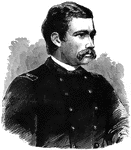
"General Bayard, born in Seneca Falls, N. Y., December 18th 1835, died December 14th, 1862, was graduated from the United States Military Academy in 1856. He was assigned to the First Cavalry. Four years were passed in frontier and garrison duty. He was severely wounded in a fight with the Kiowa Indians. In 1861 he was promoted to first lieutenant in Third Cavalry; captain, Fourth Cavalry, August 20th; and was granted leave of absence to become colonel of the First Pennsylvania Cavalry Volunteers, September 14th, 1861. He became brigadier general of volunteers, April 28th, 1862, and served in the arduous campaigns of the Shenandoah, Northern Virginia, and on the Rappahannock, distinguishing himself by the dash and bravery of his reconnoissances. He was mortally wounded at Fredericksburg, December 13th, 1862, and died the following day. He was buried with military honors at Princeton, N. J." &mdash;Leslie, 1896

General George D. Bayard

"General Bayard, born in Seneca Falls, N. Y., December 18th 1835, died December 14th, 1862, was graduated…
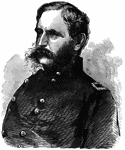
"General Augur, born in New York in 1821, was graduated from the United States Military Academy in 1843. During the Mexican War he served as aid-de-camp to General Hopping, and after his death to General Caleb Cushing. He was promoted captain, August 1st, 1852, and served with distinction in a campaign against the Indians in Oregon in 1856. On May 14th, 1861, he was appointed major in the Thirteenth Infantry, and was for a time commandant of cadets at West Point. In November of that year he was commissioned a brigadier general of volunteers, and joined McDowell's corps. In July, 1862, he was assigned to a division under Banks, and in the battle of Cedar Mountain was severely wounded. He was promoted major general of volunteers, August 9th, 1862, and in November joined his corps and took part in the Louisiana campaign. He was breveted brigadier-general in the United States Army, March 13th, 1865, receiving on the same date the brevet of major-general for services in the field during the rebellion." &mdash;Leslie, 1896

General Christopher C. Augur

"General Augur, born in New York in 1821, was graduated from the United States Military Academy in 1843.…
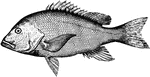
"The Florida or Pensacola red snapper is it is commercially known, because that city is headquarters for the snapper fleet which produces nearly half the red snappers sold in the United States, is among the State's noted food dishes."

Red Snapper

"The Florida or Pensacola red snapper is it is commercially known, because that city is headquarters…
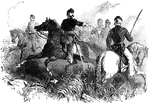
"Major General Burnside assuming command of the Army of the Potomac- issuing orders to his staff. 'Headquarters, Army of the Potomac, November 10th, 1862. In accordance with General Orders, No. 182, issued by the President of the United States, I hereby assume command of the Army of the Potomac. Patriotism, and the exercise of my every energy in the direction of this army, aided by the full and hearty co-operation of its officers and men, will I hope, under the blessing of God, insure its success. Having been a sharer of the privations, and a witness of the bravery of the old Army of the Potomac in the Maryland campaign, and fully identified with them in their feelings of respect and esteem for General McClellan, entertained through a long and most friendly association with him, I feel that it is not as a stranger I assume command. To the Ninth Army Corps, so long and intimately associated with me, I need say nothing; our histories are identical. With diffidence for myself, but with a proud confidence in the unswerving loyalty and determination of the gallant army now intrusted to my care, I accept its control, with the steadfast assurance that the just cause must prevail. A. E. Burnside, Major General Commanding.' Our illustration represents the general issuing orders to his staff immediately after assuming command." &mdash; Frank Leslie, 1896

General Burnside

"Major General Burnside assuming command of the Army of the Potomac- issuing orders to his staff. 'Headquarters,…
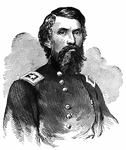
"General Buford, born in Kentucky in 1825, died in Washington, D. C., December 16th, 1863, was graduated at the United States Military Academy in 1848; was appointed brevet second lieutenant in the First Dragoons, and served on the plains until the Civil War began. He was made a major in the inspector general's corps on November 12th, 1861. On June 6th, 1862, he was attached to the staff of General Pope in the Army of Virginia; and on July 27th he was made a brigadier general, and assigned to the command of a brigade of cavalry under General Hooker in the Northern Virginia campaign. He engaged in the skirmish at Madison Courthouse; the passage of the Rapidan in pursuit of Jackson's force; Kelly's Ford, Thoroughfare Gap, and Manassas, where he was wounded. He commanded the cavalry division of the Army of the Potomac in the Pennsylvania campaign, and at Gettysburg he began the attack on the enemy before the arrival of Reynolds, on July 1st, 1863. His last sickness was the result of toil and exposure. His commission as major general reached him on the day of his death."&mdash; Frank Leslie, 1896

General John Buford

"General Buford, born in Kentucky in 1825, died in Washington, D. C., December 16th, 1863, was graduated…
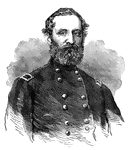
"General Morgan, born in Washington County, Pa., September 20th, 1820, died at Old Point Comfort, Va., July 26th, 1893. At the beginning of the War with Mexico he was made colonel of the Second Ohio Volunteers, and he was subsequently appointed colonel of the Fifteenth United States Infantry, which he led with ability under General Scott, receiving for his gallantry at Contreras and Churubusco, where he was severely wounded, the thanks of the Ohio Legislature and the brevet of brigadier general. On November 21st, 1861, he was made brigadier general of volunteers. In March, 1862, he assumed the command of the Seventh Division of the Army of the Ohio, with which he was ordered to occupy Cumberland Gap, in Southern Kentucky, then held by the Confederates. He forced the enemy to retire on June 18th, 1862. He also served in the Valley of the Kanawha and at Vicksburgh, and was afterward assigned to the Thirteenth Army Corps, and commanded at the capture of Fort Hindman, Ark. Owing to failing health he resigned in June, 1863."&mdash; Frank Leslie, 1896

General George W. Morgan

"General Morgan, born in Washington County, Pa., September 20th, 1820, died at Old Point Comfort, Va.,…

"General Foster, born in Whitefield, N. H., May 27th, 1823, died in Nashua, H. H., September 2nd, 1874, was graduated at the United States Military Academy in 1846, assigned to the Engineer Corps, and served in the Mexican War under General Scott. He received the brevets of first lieutenant and captain for gallantry. At the beginning of the Civil War he was stationed at Charleston, S. C., and safely removed the garrison of Fort Moultrie to Fort Sumter during the night, December 26th-27th, 1860. He was made brigadier general of volunteers October 23rd, 1861, commanded a brigade in Burnside's North Carolina expedition, and received the brevet of lieutenant colonel for his services at Roanoke Island. While in command of the Department of North Carolina, in 1862-'3, he conducted several important expeditions. In 1865 he was brevetted brigadier general in the regular army for gallant services in the capture of Savannah, Ga., and major general for services in the field during the rebellion."&mdash; Frank Leslie, 1896

General John G. Foster

"General Foster, born in Whitefield, N. H., May 27th, 1823, died in Nashua, H. H., September 2nd, 1874,…
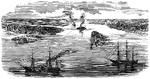
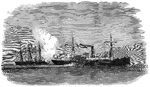
"Naval action between the United States war steamer <em>Mississippi</em> and the Confederate iron-cased floating battery ram and other steamers, off the mouth of the Pass A L'outre, New Orleans, January 1st, 1862."— Frank Leslie, 1896

Naval Battle

"Naval action between the United States war steamer Mississippi and the Confederate iron-cased…
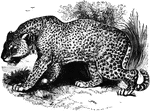
"The Leopard, <em>Felis leopardus</em>, is about half the size of the tiger, being two feet high and four long, and is distinguished alike for the elegance of its form, the grace of its movements, and the beauty of its skin. The latter is of a pale yellow color, marked with small tawny spots, united in circular or quadrangular groups, these groups bein arranged nearly in rows, and covering the whole body." &mdash; S. G. Goodrich, 1885

Leopard

"The Leopard, Felis leopardus, is about half the size of the tiger, being two feet high and…
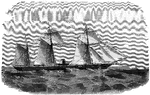
"The Confederate privateer steamer <em>Alabama</em> (290). Captain Raphael Semmes. Our illustration of the <em>Alabama</em> was taken from a photograph while she was at Liverpool, where she was facetiously termed the Emperor of China's yacht. The <em>Alabama</em> was built at Birkenhead; she was about 1,200 tons burden, with draught of about 14 feet; her engines built by Laird & Sons, of Birkenhead, 1862. She was a wooden vessel propelled by a screw, copper bottom, about 210 feet long, rather narrow, painted black outside and drab inside; had a round stern, billethead, very little sheer, flushed deck fore and aft; a bridge forward of the smokestack; carried two large black boats on cranes amidships forward of the main rigging; two black quarter boats between the main and mizzen masts, one small black boat over the stern on cranes; the square spars on a gallows between the bridge and foremast showed above the rail. She carried three long 32-pounders on a side, and was pierced for two more amidships; had a 100-pound rifled pivot gun forward of the bridge, and a 68-pound pivot on the main track; had tracks laid forward for a pivot bow gun, and tracks aft for a pivot stern chaser; her guns were of the Blakely pattern, and were manufactured by Wesley & Preston, Liverpool, 1862. She took her armament and crew and most of her officers on board near Terceira. Wester Islands, from an English vessel. Her commander was Raphael Semmes."&mdash; Frank Leslie, 1896

Steamer Alabama

"The Confederate privateer steamer Alabama (290). Captain Raphael Semmes. Our illustration…
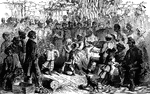
"Extempore musical and terpischorean entertainment at the United States arsenal, Baton Rouge, La., under the patronage of the Forty-First Massachusetts, the one hundred and Thirty-First New York and the Twenty-Fifth Connecticut Volunteers- contraband children dancing the breakdown. If anything were necessary to show the sensuous nature of music, it would be found in the eagerness with which the contraband race pursued it. The Federals, with that love of fun which ever distinguishes the brave soldier off duty, got up, a few evenings after their arrival at Baton Rouge, an extempore musical and terpsichorean entertainment, in which the darky element was largely and loudly represented. The hall was one of the extensive rooms in the United States Arsenal building, and prominent among the promoters were the Forty-first Massachusetts, One Hundred and Thirty-first New York and the Twenty-fifth Cennecticut Volunteers. One of the features was a breakdown, which was dance, or rather jumped, with great vigor by a couple of contraband juveniles."— Frank Leslie, 1896

Civil War Musical Entertainment

"Extempore musical and terpischorean entertainment at the United States arsenal, Baton Rouge, La., under…
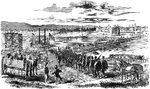
"Federal Volunteers crossing from Cincinnati to Covington on a bridge of coal boats, constructed for the occasion, on their way to defend Kentucky from the Confederates under General Kirby Smith, September 5th, 1862. The Confederate army under command of General Kirby Smith was variously estimated from 15,000 to 30,000 men. They were poorly clad, but well armed, and considering their organization were tolerably well disciplined. Their officers were bitter desperadoes, and they united in their expressed determination to pillage Cincinnati, against which city they pretended to have some terrible grudge to settle. General Kirby Smith, the Confederate commander, was much trusted by his troops, and was a cool and daring leader. Our sketch represents the Federal volunteers crossing from Cincinnati to Covington to defend Kentucky."— Frank Leslie, 1896

Federals Crossing

"Federal Volunteers crossing from Cincinnati to Covington on a bridge of coal boats, constructed for…
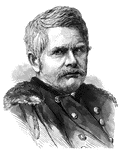
"General Ord, born in Cumberland, Md., October 18th, 1818, died in Havana, Cuba, July 22nd, 1883, was graduated from the United States Military Academy in 1839, and assigned to the Third Artillery. He served with distinction in the Florida and Mexican Wars and during the war for the Union. The battle of Dranesville, in 1861, was won under his leadership, and he was severely wounded at the battle of Hatchie and at the assault on Fort Harrison. Having been several times promoted for gallant and meritous conduct, he became commander of the Department of Virginia and North Carolina in 1865, and led the Army of the James in the victorious engagements that ended the war. In March, 1865, he received the brevet of major general in the regular army, and he subsequently held successive command of the Departments of Arkansas, California, Texas and the Platte."&mdash; Frank Leslie, 1896

General Edward O. C. Ord

"General Ord, born in Cumberland, Md., October 18th, 1818, died in Havana, Cuba, July 22nd, 1883, was…
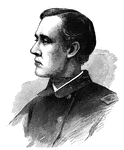
"General Sharpe, born in Kingston, N. Y., February 26th, 1828, was graduated at Rutgers in 1847; studied law at Yale College; was admitted to the bar in 1854, and practiced until he entered the army in 1861 as captain in the Twentieth New York Infantry. He became colonel of the One Hundred and Twentieth New York Infantry in 1862, and took part in all the battles of the Army of the Potomac. He served upon the staffs of Generals Hooker, Meade and Grant, and was brevetted brigadier general in 1864 and major general in 1865. He was attached to the United States Legation at Vienna in 1851, and was a special agent of the State Department in Europe in 1867. In 1870-'73 he was United States Marshal for the Southern District of New York, and took the census that demonstrated the great election frauds of 1868 in New York city, which led to the enforcement of the Federal election laws for the first time in 1871."&mdash; Frank Leslie, 1896

General George H. Sharpe

"General Sharpe, born in Kingston, N. Y., February 26th, 1828, was graduated at Rutgers in 1847; studied…
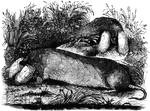
"Is of a reddish-brown color above, and dark-brown below; the body, which is stout and cylindrical, is seven to eight inches long, the tail two and a quarter. The cheek pouches, one on each side, open externally, so that food can be taken out and carried round to the mouth." &mdash; S. G. Goodrich, 1885

Pouched Rat

"Is of a reddish-brown color above, and dark-brown below; the body, which is stout and cylindrical,…
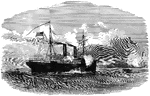
"The <em>Quaker City</em>, one of the Potomac Flotilla, engaging Confederate dragoons in Lynn Haven Bay, near Cape Henry, Va. The <em>Quaker City</em>, Commander Carr, one of the United States Flotilla of the Potomac, while cruising in Lynn Haven Bay, near Cape Henry, picked up a man named Lynch, a refugee from Norfolk, who represented that the master plumber of the Norfolk Navy Yard was ashore and wished to be taken off. An armed boatd which was sent for the purpose was fired upon when near the shore, mortally wounding James Lloyd, a seaman of Charlestown, Mass. A few 32-pound shells dispersed the Confederates." &mdash; Frank Leslie, 1896

Quaker City

"The Quaker City, one of the Potomac Flotilla, engaging Confederate dragoons in Lynn Haven…
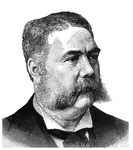
"General Arthur, twenty-first President of the United States, born in Fairfield, Franklin County, Vt., October 5th, 1830; died in New York City, November 18th, 1896."&mdash; Frank Leslie, 1896

General Chester A. Arthur

"General Arthur, twenty-first President of the United States, born in Fairfield, Franklin County, Vt.,…
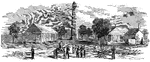
"Tybee Island, Savannah River, Ga.- Views of the lighthouse and barracks- destruction of the lighthouse by the Confederates. Among the numerous structures erected by the United States on the long line of the stormy Atlantic coast for the benefit of the commerce of the world and the safety of the mariners of all nations, none were finer or more useful than the lighthouse on Tybee Island, at the mouth of the Savannah River, familiarly known to sailors as Tybee Light. It was a fixed light, one hundred and eight feet high, and could be seen at a distance of twelve miles. In common with all the other lights on the Confederate coast, it was extinguished by the Georgians soon after the secession of their State. The day after the Federal fleet made its appearance off the mouth of the Savannah River, the Confederates set fire to the interior of the lighthouse, which was burnt, and the costly reflectors destroyed. A similar vandalic measure was resorted to by the Confederates of Charleston, when the Stone Fleet appeared off that harbor. They blew up the celebrated 'Charleston Light.'"— Frank Leslie, 1896

Tybee Island

"Tybee Island, Savannah River, Ga.- Views of the lighthouse and barracks- destruction of the lighthouse…
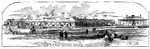
"United States General Hospital, Hilton Head, S. C., exterior. The United States General Hospital at Hilton Head, S. C., was built very strongly of wood, and really had somewhat of an architectural appearance. It was about four hundred feet long, and had excellent accommodation for about five hundred patients. On the right hand of the hospital is the chief doctor's residence. Hilton Head, which is a very beautiful, fertile spot, was owned principally by General Drayton, who cultivated there that celebrated cotton known as Sea Island. The woods, which principally consist of orange, palmetto, pine and dwarf oaks, commence at about a mile from the sea. "— Frank Leslie, 1896

General Hospital Exterior

"United States General Hospital, Hilton Head, S. C., exterior. The United States General Hospital at…
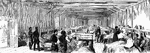
"United States General Hospital, Hilton Head, S. C., interior. The United States General Hospital at Hilton Head, S. C., was built very strongly of wood, and really had somewhat of an architectural appearance. It was about four hundred feet long, and had excellent accommodation for about five hundred patients. On the right hand of the hospital is the chief doctor's residence. We also publish a view of one of the wards, taken shortly after the battle of James Island, where so many Federals fell- either killed or wounded. Hilton Head, which is a very beautiful, fertile spot, was owned principally by General Drayton, who cultivated there that celebrated cotton known as Sea island. The woods, which principally consist of orange, palmetto, pine and dwarf oaks, commence at about a mile from the sea."— Frank Leslie, 1896

General Hospital Interior

"United States General Hospital, Hilton Head, S. C., interior. The United States General Hospital at…
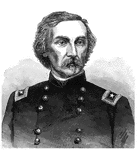
"General Warren, born in Cold Spring, N. Y., January 8th, 1830, died in Newport, R. I., August 8th, 1882, was graduated from the United States Military Academy in 1850, and assigned to the Topographical Engineers as brevet second lieutenant. At the beginning of the Civil War he entered active service as lieutenant colonel of the Fifth New York Volunteers, of which regiment he became colonel on August 31st, 1861. His regiment was ordered to Fortress Monroe, and he took part in the battle of Big Bethel. During the remainder of the year he was stationed at Baltimore, where he constructed the fort on Federal Hill. In the spring of 1862 he joined the Army of the Potomac, serving in the Peninsular campaign and at Yorktown. He was given a brigade in the Fifth Army Corps in May, with which he covered the extreme right of the army and took part in the capture of Hanover Courthouse, the pursuit of Confederate cavalry under Stuart, the battle of Gaines's Mill, the affair at Malvern Hill and subsequent battle, and the skirmish at Harrison's Landing. His brigade was then sent to re-enforce General Pope, and he participated in the battle of Manassas, was engaged at Antietam and the battle of Fredericksburg. On September 26th, 1862, he was appointed brigadier general of volunteers for his services at Gaines's Mill. On March 3rd, 1863, he was appointed chief of engineers of the Army of the Potomac, and during the Chancellorsville campaign he took part in the action on Orange Pike, the storming of Marye's Heights and the battle of Salem. He continued as chief of engineers under Meade, and was engaged at Gettysburg, where he seized Little Round Top. On August 11th, 1863, he was made major general of volunteers. He participated in the battles of the Wilderness campaign and those around Petersburg. He received the successive brevets in the United States Army up to major general."&mdash; Frank Leslie, 1896

General Gouverneur K. Warren

"General Warren, born in Cold Spring, N. Y., January 8th, 1830, died in Newport, R. I., August 8th,…
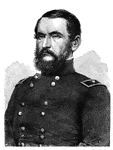
"General Peck, born at Manlius, N. Y., January 4th, 1821, died at Syracuse, n. Y., April 28th, 1978, was graduated from the United States Military Academy in 1843, and commissioned a brevet second lieutenant of artillery. Served in the Mexican War, and distinguished himself at the battles of Palo Alto, Resaca de la Palma, Contreras and Churubusco. On August 9th, 1861, he was made a brigadier general, and at the time of the Virginia Peninsula campaign, in April and May, 1862, was given the command of a brigade in the Fourth Corps under General Couch. He was appointed a major general in July, 1862, and afterward commanded at Suffolk, Va. He stormed Hill's Point, capturing it, and thus ending the siege. Here he was severely wounded. He was mustered out of the service August 24th, 1865."&mdash; Frank Leslie, 1896

General John James Peck

"General Peck, born at Manlius, N. Y., January 4th, 1821, died at Syracuse, n. Y., April 28th, 1978,…
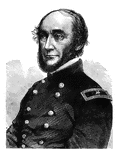
"General Cullum, born in New York city, February 25th, 1809, died in New York city, February 28th, 1892, was graduated from the United States Military Academy in 1833, and brevetted a second lieutenant in the Engineer Corps. During the Mexican War he rendered valuable services as superintending engineer for devising and constructing sapper, miner and pontoon trains. In 1861 he was appointed chief engineer of the Department of the Missouri, with the rank of brigadier general of volunteers, and made chief of staff to General Halleck. The latter position he continued to hold after Halleck was made general in chief, and accompanied him in his Southwestern campaigns, and afterward to headquarters in Washington, D. C., until 1864, when he became superintendent of the United States Military Academy."&mdash; Frank Leslie, 1896

General George W. Cullum

"General Cullum, born in New York city, February 25th, 1809, died in New York city, February 28th, 1892,…
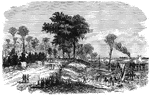
"Lake Providence, La., headquarters of General McPherson and the Federal division under his command. Our artist wrote: 'The Seventeenth Army Corps, under General McPherson, have been exceedingly fortunate in being ordered to Lake Providence, La. Their tents are pitched in pleasant places. I have not seen a position anywhere along the Mississippi River, or anywhere else, which offers such inducements for any army 'to stay awhile' as the banks of this beautiful lake. There is a little town on the landing, which is only fit for, and therefore only occupied by, negro quarters and sutler shops. The lake is immediately back of the village, and not more than a quarter of a mile from the river. Immense cotton fields stretch away on both sides of it, and beautiful residences, surrounded by elaborate gardens full of Southern shrubbery, adorn its banks.'"— Frank Leslie, 1896

Lake Providence

"Lake Providence, La., headquarters of General McPherson and the Federal division under his command.…
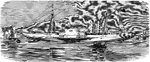
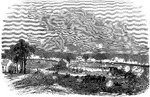
"The anglo-Confederate steamer <em>Anglia</em>, captured off Bull's Bay, twenty-five miles north of Charleston, S. C., by the United States gunboats <em>Restless</em> and <em>Flag</em>, Sunday, October 19th, 1862."&mdash; Frank Leslie, 1896

Anglia

"The anglo-Confederate steamer Anglia, captured off Bull's Bay, twenty-five miles north of…

"Battle of Chancellorsville, Va., Friday, May 1st, 1863. We give a fine sketch of the point where the memorable battle of Chancellorsville began. It was at the junction of the Gordonsville Plank Road, the Old Turnpike, and the road from Ely's and United States stores. The first fighting took place here on Friday, May 1st, and on Saturday the Eleventh Corps was routed, and the enemy repulsed by consummate generalship and the most resolute bravery of the Federal troops. Here, too, on Sunday the enemy made an attack with such overhwhelming force as to force the Federal army back to the second line. Few spots possess greater interest than this scene of fearful battle."— Frank Leslie, 1896

Battle of Chancellorsville

"Battle of Chancellorsville, Va., Friday, May 1st, 1863. We give a fine sketch of the point where the…
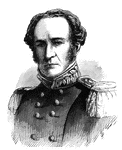
"General Stoneman, born in Busti, Chautauqua County, N. Y., August 8th, 1822, was graduated from the United States Military Academy in 1846, and entered the First Dragoons. In February, 1861, while in command of Fort Brown, Texas, he refused to obey the order of his superior, General Twiggs, for the surrender of the government property to the Secessionists, evacuated the fort and went to New York by steamer. He became major of the First Cavalry, May 9th, 1861, and served in Western virginia till August 13th, when he was appointed brigadier general of volunteers and chief of cavalry of the Army of the Potomac. He served during the Virginia Peninsular campaign of 1862. He was appointed major general, November 29th, 1862. He was engaged in the Atlanta campaign from May to July, 1864; was captured at Clinton, Ga., July 31st, and held a captive till October 27th. He became colonel of the Twenty-first Infantry, July 28th, 1866, and was brevetted colonel, brigadier and major-general for gallant conduct."&mdash; Frank Leslie, 1896

General George Stoneman

"General Stoneman, born in Busti, Chautauqua County, N. Y., August 8th, 1822, was graduated from the…
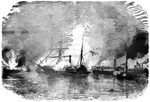
"Daring and desperate attack- surprise and capture of the United States gunboat <em>Harriet Lane</em> by the Confederates under General Magruder, and destruction of the flagship <em>Westfield</em>, in Galveston Harbor, Tex., January 1st, 1863. About two o'clock in the morning of January 1st, 1863, the Federal gunboats were attacked by five Confederate steamers, protected by double rows of bales of cotton, and loaded with troops armed with rifles, muskets, etc. The <em>Harriet Lane</em> was captured by boarding, after about all her officers, including Captain Wainwright and Lieutenant Commander Lee, and a crew of 130, all told, had been killed by muskettry from the Confederate steamers. The gunboats <em>Clifton</em> and <em>Owasco</em> were engaged and escaped, the former losing no men and but one wounded. The <em>Owasco</em> lost one killed and fifteen wounded. Two barks, loaded with coal, fell into the hands of the Confederates. The <em>Westfield</em> (flagship, Commodore Renshaw) was not engaged, being ashore in another channel. Her crew were transferred to transports, and Commodore Renshaw, fearing she would fall into the hands of the Confederates, blew her up. By some mismanagement or accident the exploion took place before a boat containing Commodore Renshaw, First Lieutenant Zimmerman and the boat's crew got away, and they were blown up with the ship. The Confederate force was estimated at 5,000, under the command of General Magruder. The Federal land force, under the command of Colonel Burrill, of Masschusetts, did not exceed 300, the residue not having disembarked at the time of the fight. The Federal loss was 160 killed and 200 taken prisoners. The navy suffered the most. The Confederate loss was much greater, as the Federal guns were firing grape and canister continually in their midst."&mdash; Frank Leslie, 1896

Harriet Lane

"Daring and desperate attack- surprise and capture of the United States gunboat Harriet Lane

"Capture of the United States mail steamer <em>Ariel</em>, Captain Jones, off the east end of Cuba, by the pirate <em>Alabama</em> ('290'), Captain Semmes, December 7th, 1862. Report of the first officer of the <em>Ariel</em>: 'On the 7th of December, at 1:30 P.M., when rounding Cape Maysi, the eastern point of Cuba, we saw a vessel about four miles to the westward, close under the high land, bark-rigged and under canvas. As there was nothing in her appearance indicating her to be a steamer, her smokepipe being down, no suspicions were aroused until in a short time we saw she had furled her sails, raised her smokestack, and was rapidly nearing us under steam, the American flag flying at her peak. Such was her speed in comparison to ours that in about half an hour she had come up within half a mile of us, when she fired a lee gun, hauled down the American ensign and ran up the Confederate flag. No attention was paid to the summons, and the <em>Ariel</em> was pushed to her utmost speed. She then sailed across our wake, took a position on our port quarter, about four hundred yards distant, and fired two guns almost simultaneously, one shot passing over the hurricane deck, and the other hitting the foremast and cutting it half away. A body of United States marines, consisting of 126 men, passengers on board the <em>Ariel</em>, had been drawn up and armed, but the officers in command deemed it worse than folly to resist, as we could plainly see they were training a full broadside to bear upon us, and Captain Jones gave orders to stop the ship and haul down the ensign.'"— Frank Leslie, 1896

Ariel

"Capture of the United States mail steamer Ariel, Captain Jones, off the east end of Cuba,…

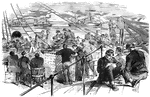
"The Banks Expedition- scene on the hurricane deck of the United States transport <em>North Star</em>- the soldiers of the Forty-first Massachusetts Regiment writing home to their friends, upon their arrival at ship island, Gulf of Mexico. We publish a sketch taken on the evening of the arrival of the Forty-first Massachusetts Regiment at Ship Island. The thoughts of the dear ones at home were uppermost in every soldier's mind, and in a very short time the hurricane deck of the steamer <em>North Star</em> was occupied by a regiment of letterwriters, all hard at work in the service of Cadmus. It is only those separated from all they hold dear who can realize the luxury of that invention which wafts a sigh from Indus to the Pole."&mdash; Frank Leslie, 1896

Banks Expedition

"The Banks Expedition- scene on the hurricane deck of the United States transport North Star-…
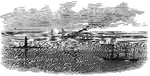
"Capture of the British steamer <em>Anne</em> laden with arms and munition of war for the Confederates, by the United States gunboat <em>Kanawha</em>, acting master partridge, from under the guns of Fort Morgan, Mobile, June 29th, 1862."&mdash; Frank Leslie, 1896

Anne

"Capture of the British steamer Anne laden with arms and munition of war for the Confederates,…
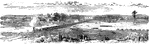
"Commissariat Depot of the United States Army of the Rappahannock at Manassas, Va. Our sketch shows the Federal Commissariat Depot at Manassas before the second battle of Bull Run, when Jackson by a forced march of sixty miles in thirty-five hours had at his mercy all of General Pope's most important supplies and munitions of war, and which Stuart, with a strong force of troops under Colonel Trimble, took possession of, or destroyed, on the night of August 26th, 1862. Manassas is situated on the Virginia Midland and Great Southern Railroad, thirty-three miles west southwest of Washington, and twenty-seven miles west of Alexandria. It is the junction and last terminus of the Manassas division of the same road."— Frank Leslie, 1896

Commissariat Depot

"Commissariat Depot of the United States Army of the Rappahannock at Manassas, Va. Our sketch shows…

"The Plantation Police, or Patrol, was an institution peculiar to the Slave States. It was a semi-military organization, raised and supported by the planters, but recognized by the old State authorities. Their principal duty was to visit the various plantations and patrol the roads at night, arresting all [African Americans] and others not having proper passes. The war, the President's proclomation, and the actual possession of most of the State of Louisiana by the Federal authorities, rendered these patrols doubly rigorous. Some of the [African Americans] submitted reluctantly. The [African American] in the foreground is a speciman of this class. He seems to yield to the superior force of a tottering power, satisfied that his day is at hand; others show the obsequious, submissive stamp- the [African American] satisfied with his lot if he is clothed and fed."— Frank Leslie, 1896

Plantation Police

"The Plantation Police, or Patrol, was an institution peculiar to the Slave States. It was a semi-military…