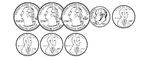
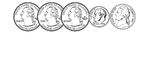
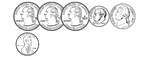
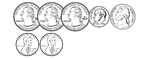
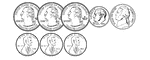
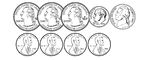
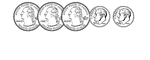
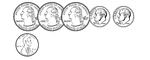
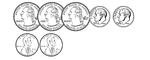
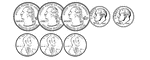
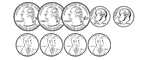

Groups of change with totals from 1 to 100 cents using the least amount of coins.

85 Cents

Groups of change with totals from 1 to 100 cents using the least amount of coins.

Groups of change with totals from 1 to 100 cents using the least amount of coins.

86 Cents

Groups of change with totals from 1 to 100 cents using the least amount of coins.

Groups of change with totals from 1 to 100 cents using the least amount of coins.

87 Cents

Groups of change with totals from 1 to 100 cents using the least amount of coins.

Groups of change with totals from 1 to 100 cents using the least amount of coins.

88 Cents

Groups of change with totals from 1 to 100 cents using the least amount of coins.

Groups of change with totals from 1 to 100 cents using the least amount of coins.

89 Cents

Groups of change with totals from 1 to 100 cents using the least amount of coins.

Groups of change with totals from 1 to 100 cents using the least amount of coins.

90 Cents

Groups of change with totals from 1 to 100 cents using the least amount of coins.

Groups of change with totals from 1 to 100 cents using the least amount of coins.

91 Cents

Groups of change with totals from 1 to 100 cents using the least amount of coins.

Groups of change with totals from 1 to 100 cents using the least amount of coins.

92 Cents

Groups of change with totals from 1 to 100 cents using the least amount of coins.

Groups of change with totals from 1 to 100 cents using the least amount of coins.

93 Cents

Groups of change with totals from 1 to 100 cents using the least amount of coins.

Groups of change with totals from 1 to 100 cents using the least amount of coins.

94 Cents

Groups of change with totals from 1 to 100 cents using the least amount of coins.

Groups of change with totals from 1 to 100 cents using the least amount of coins.

95 Cents

Groups of change with totals from 1 to 100 cents using the least amount of coins.

Groups of change with totals from 1 to 100 cents using the least amount of coins.

96 Cents

Groups of change with totals from 1 to 100 cents using the least amount of coins.

Groups of change with totals from 1 to 100 cents using the least amount of coins.

97 Cents

Groups of change with totals from 1 to 100 cents using the least amount of coins.

Groups of change with totals from 1 to 100 cents using the least amount of coins.

98 Cents

Groups of change with totals from 1 to 100 cents using the least amount of coins.

Groups of change with totals from 1 to 100 cents using the least amount of coins.

99 Cents

Groups of change with totals from 1 to 100 cents using the least amount of coins.

Groups of change with totals from 1 to 100 cents using the least amount of coins.

100 Cents

Groups of change with totals from 1 to 100 cents using the least amount of coins.

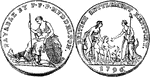
Kentucky Issue (unknown) Kentucky State coin from 1796. Obverse has a seated female with a staff and shield and is inscribed around the figure PAYABLE BY P.P.P. MYDDLETON. Reverse shows a group of 4 figures in a field. The inscription which surrounds the image - BRITISH SETTLEMENT KENTUCKY 1796

Silver Kentucky Issue Coin, 1796

Kentucky Issue (unknown) Kentucky State coin from 1796. Obverse has a seated female with a staff and…
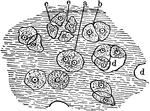
A thin slice of cartilage, magnified, to how the cells embedded in the homogenous matrix. Labels: a, cell in which the nucleus has divided; b, a cell in which division is just complete; c, e, a group of four cells resulting from further division of a pair like b; the new cells have formed some matrix between them, separating them from another; d, d, cavities in the matrix from which cells have dropped out during the preparation of the specimen.

Cartilage Tissue Cells

A thin slice of cartilage, magnified, to how the cells embedded in the homogenous matrix. Labels: a,…
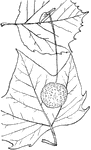
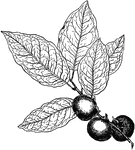
Leaves - simple; alternate; edge variable, either coarse-toothed or somewhat lobed; with the teeth or lobes sharp, and the hollows between them rounded. Outline - rounded. Apex - pointed. Base - more or less heart-shaped, squared, or rounded. Leaf/Stem - downy when young, smoothish when old; and covering the leaf-bud with its swollen base. Leaf - three and a half to eight inches wide, and usually broader than long; downy beneath when young, becoming smooth. Bark - the thin outer bark peels off each year in hard and brittle strips, leaving the branches and parts of the trunk with a mottled, whitish, polished-looking surface. Flowers - small, in compact, round balls (about one inch in diameter) like round buttons, which dry and harden, and cling to the branches by their slender stems (three to four inches long), and swing like little bells during a good part of the winter. Found - from Southern Main, southward and westward, in rich, moist soil, oftenest along streams. Its finest growth is in the bottom lands of the Mississippi and Ohio rivers. General Information - The largest of the trees of the Atlantic forests, commonly sixty to eighty feet high; along the western rivers often eighty to one hundred and thirty feet high, sometimes more, with a circumference of forty to fifty feet. A tree in Eaton, N. J., is one of the largest in the Sate. It is eighty-five feel high. At a point eight fee from the ground its circumference is fourteen feet three inches. The largest trunks are usually hollow.  The wood is hard and compact, difficult to split and work, of a reddish-brown color within. Its principle use is in the making of tobacco boxes. There is a fine and somewhat noted group of these trees on the grounds of James Know, in Knoxboro, N. Y. In old times they formed a favorite camping place for the Indians in their trading expeditions. They all measure not far from three feet in diameter. The name "sycamore," though a common one, should be dropped - it belongs to another and very different tree. From a Greek word meaning broad, in reference to the breadth of the buttonwood's shade or of its leaf.

Genus Platanus, L. (Buttonwood)

Leaves - simple; alternate; edge variable, either coarse-toothed or somewhat lobed; with the teeth or…
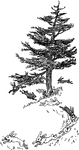
A group of rabbits hopping around a large pine tree.

Rabbits Hopping

A group of rabbits hopping around a large pine tree.

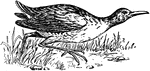
"Group of birds related to the coots and gallinules." -Foster, 1921

Rail

"Group of birds related to the coots and gallinules." -Foster, 1921

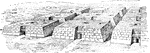
"Restoration of a group of tombs of the nobles in the Pyramid Age." -Breasted, 1914

Tombs

"Restoration of a group of tombs of the nobles in the Pyramid Age." -Breasted, 1914

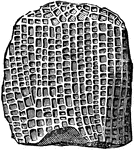
A radiate from the Paleozoic time, Favosites Niagarensis of the Niagara group.

Favosites Radiate

A radiate from the Paleozoic time, Favosites Niagarensis of the Niagara group.

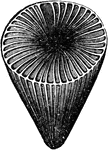
A radiate from the Paleozoic time, Zaphrentis bilateralis of the Clinton group

Zaphrentis Radiate

A radiate from the Paleozoic time, Zaphrentis bilateralis of the Clinton group

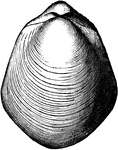
A mollusk radiate from the Paleozoic time, Pentamerus oblongus, a brachiopod from the Clinton group.
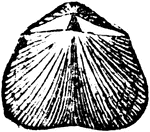
Pentamerus Brachiopod

A mollusk radiate from the Paleozoic time, Pentamerus oblongus, a brachiopod from the Clinton group.

A mollusk radiate from the Paleozoic time, Orthis varica of the Niagara group.

Orthis Mollusk

A mollusk radiate from the Paleozoic time, Orthis varica of the Niagara group.

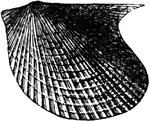
A mollusk radiate from the Paleozoic time, Pterinea emacerata from the Niagara group.

Pterinea Mollusk

A mollusk radiate from the Paleozoic time, Pterinea emacerata from the Niagara group.
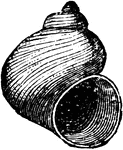
A mollusk radiate from the Paleozoic time, Cyclonema cancellata from the Clinton group.

Cyclonema Mollusk

A mollusk radiate from the Paleozoic time, Cyclonema cancellata from the Clinton group.
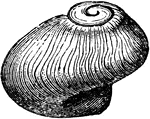
A mollusk radiate from the Paleozoic time, Platyceras angulatum from the Niagara group.

Platyceras Mollusk

A mollusk radiate from the Paleozoic time, Platyceras angulatum from the Niagara group.
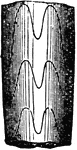
An ancient mollusk from the Paleozoic time, Goniatites Marcellensis from the Hamilton group.

Goniatites Mollusk Fossil

An ancient mollusk from the Paleozoic time, Goniatites Marcellensis from the Hamilton group.
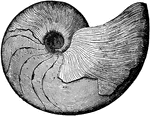
An ancient mollusk from the Paleozoic time, Goniatites Marcellensis from the Hamilton group.

Goniatites Mollusk

An ancient mollusk from the Paleozoic time, Goniatites Marcellensis from the Hamilton group.
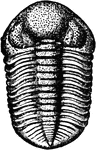
An ancient articulate from the Paleozoic time, Pacops bufo from the Hamilton group.

Pacops Articulate

An ancient articulate from the Paleozoic time, Pacops bufo from the Hamilton group.
A group of daisy-like flowers.

Flowers

A group of daisy-like flowers.

"Leaves and fruit of the common persimmon." -University Society, 1920

Persimmon

"Leaves and fruit of the common persimmon." -University Society, 1920

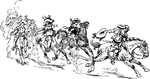
A cavalcade riding after a lady on a horse.

Cavalcade

A cavalcade riding after a lady on a horse.

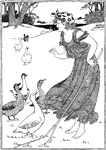
A girl outside with the geese. Story Problem: The girl is feeding 4 geese. 3 more geese join the group. How many geese will the girl be feeding now?

Girl and Geese

A girl outside with the geese. Story Problem: The girl is feeding 4 geese. 3 more geese join the group.…
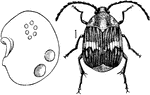
"Spermophagus pectoralis: weevil at right; Mexican bean at left showing: below, holes made by beetle in egress: above, a group of eggs." -Department of Agriculture

Lentil Weevil

"Spermophagus pectoralis: weevil at right; Mexican bean at left showing: below, holes made by beetle…
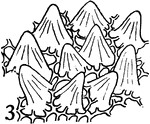
"Group of cells from petal of Viola tricolor." -Stevens, 1916

Plant Epidermis

"Group of cells from petal of Viola tricolor." -Stevens, 1916

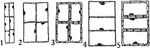
Stages in the development of the elements of the xylem. "D, steps in the formation of wood parenchyma from cambial or procambial cells. 1, group of cambial or procambial cells; 2, the same enlarged in all dimensions; 3, the same with walls thickened and pitted; 4 and 5 show the same stages as 2 and 3, but here the cells have enlarged radially or tangentially more than they have vertically. The walls of these cells are apt to become lignified, but the cells are longer lived than the wood fibers." -Stevens, 1916

Xylem Development 4

Stages in the development of the elements of the xylem. "D, steps in the formation of wood parenchyma…
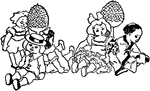
Illustration of a group of toys. It can be used to write mathematics story problems involving addition, subtraction, and counting.

Group of Toys

Illustration of a group of toys. It can be used to write mathematics story problems involving addition,…
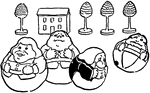
Illustration of a group of toys. It can be used to write mathematics story problems involving addition, subtraction, and counting.

Group of Toys

Illustration of a group of toys. It can be used to write mathematics story problems involving addition,…
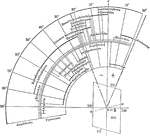
"Maximum extinction angles in the Pyroxene and Amphibole groups. Solid lines indicate extinction angles from c to c; broken lines from c to a. The extinction angle in an amphibole is generally less than 23 degrees; in a pyroxene it is generally greater. " -Johannsen, 1908

Extinction Angles

"Maximum extinction angles in the Pyroxene and Amphibole groups. Solid lines indicate extinction angles…
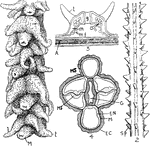
"Structure of Antipatharians. 1. A group of polyps--M. mouth; t., tentacles. 2. Axis without polyps and coenenchyma, covered with spines (Sp.). 3. Vertical section of polyp--A., axis; t., tentacle; g., gullet; m., mesentery; o., ovary; m.f., mesenteric filaments. 4. Cross section of a polyp--EC., ectoderm; M., mesogloea; EN., endoderm; G., gullet; MS., mesenteries." -Thomson, 1916

Antipatharians

"Structure of Antipatharians. 1. A group of polyps--M. mouth; t., tentacles. 2. Axis without polyps…
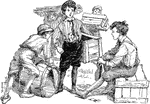
A group of boys moving wooden boxes and barrels.

Boys with Boxes

A group of boys moving wooden boxes and barrels.

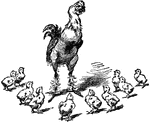
A rooster talks to a group of chicks.

Rooster and Chicks

A rooster talks to a group of chicks.

An illustration of 1 stick that can be used when teaching counting, grouping, and place value.

1 Stick

An illustration of 1 stick that can be used when teaching counting, grouping, and place value.
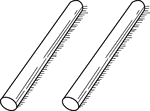
An illustration of 2 sticks that can be used when teaching counting, grouping, and place value.

2 Sticks

An illustration of 2 sticks that can be used when teaching counting, grouping, and place value.
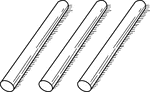
An illustration of 3 sticks that can be used when teaching counting, grouping, and place value.

3 Sticks

An illustration of 3 sticks that can be used when teaching counting, grouping, and place value.
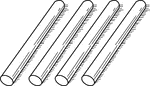
An illustration of 4 sticks that can be used when teaching counting, grouping, and place value.

4 Sticks

An illustration of 4 sticks that can be used when teaching counting, grouping, and place value.
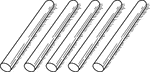
An illustration of 5 sticks that can be used when teaching counting, grouping, and place value.

5 Sticks

An illustration of 5 sticks that can be used when teaching counting, grouping, and place value.
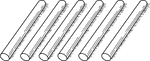
An illustration of 6 sticks that can be used when teaching counting, grouping, and place value.

6 Sticks

An illustration of 6 sticks that can be used when teaching counting, grouping, and place value.
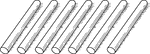
An illustration of 7 sticks that can be used when teaching counting, grouping, and place value.

7 Sticks

An illustration of 7 sticks that can be used when teaching counting, grouping, and place value.
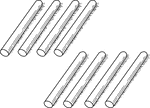
An illustration of 8 sticks that can be used when teaching counting, grouping, and place value.

8 Sticks

An illustration of 8 sticks that can be used when teaching counting, grouping, and place value.
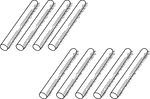
An illustration of 9 sticks that can be used when teaching counting, grouping, and place value.

9 Sticks

An illustration of 9 sticks that can be used when teaching counting, grouping, and place value.
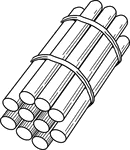
An illustration of a bundle of 10 sticks that can be used when teaching counting, grouping, and place value.

10 Sticks

An illustration of a bundle of 10 sticks that can be used when teaching counting, grouping, and place…
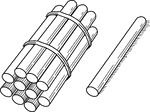
An illustration of a bundle of 11 sticks bundled in tens that can be used when teaching counting, grouping, and place value.

11 Sticks

An illustration of a bundle of 11 sticks bundled in tens that can be used when teaching counting, grouping,…
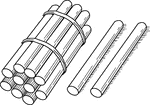
An illustration of a bundle of 12 sticks bundled in tens that can be used when teaching counting, grouping, and place value.

12 Sticks

An illustration of a bundle of 12 sticks bundled in tens that can be used when teaching counting, grouping,…
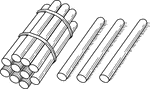
An illustration of a bundle of 13 sticks bundled in tens that can be used when teaching counting, grouping, and place value.

13 Sticks

An illustration of a bundle of 13 sticks bundled in tens that can be used when teaching counting, grouping,…
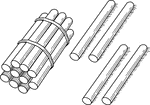
An illustration of a bundle of 14 sticks bundled in tens that can be used when teaching counting, grouping, and place value.

14 Sticks

An illustration of a bundle of 14 sticks bundled in tens that can be used when teaching counting, grouping,…
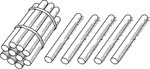
An illustration of a bundle of 15 sticks bundled in tens that can be used when teaching counting, grouping, and place value.

15 Sticks

An illustration of a bundle of 15 sticks bundled in tens that can be used when teaching counting, grouping,…