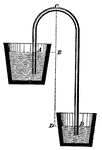
"The action of the siphon illustrates the effect of atmospheric pressure. It is simply a bent tube having unequal branches, open at both ends, and is used to convey a liquid from a higher point to a lower, over an intermediate point higher than either." — Hallock, 1905

Siphon

"The action of the siphon illustrates the effect of atmospheric pressure. It is simply a bent tube having…
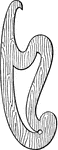
"Curves other than arcs of circles are drawn with the pencil or ruling pen by means of curved or irregular-shaped rulers, called irregular curves. A series of points is first determined through which the curved line is to pass. The line is then drawn through these points by using such parts of the irregular curve as will pass through several of the points at once, the curve being shifted from time to time as required." — Hallock, 1905

Irregular Curves

"Curves other than arcs of circles are drawn with the pencil or ruling pen by means of curved or irregular-shaped…
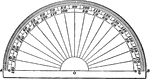
"The outer edge is a semicircle, with center at 0, and is divided into 360 parts. Each division is one-half of one degree, and, for convenience, the degrees are numbered from 0 to 180 from both A and B." — Hallock, 1905

Protractor

"The outer edge is a semicircle, with center at 0, and is divided into 360 parts. Each division is one-half…
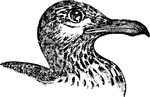
"A long-winged water-bird with webbed feet, inhabiting all parts of the world. The group to which gulls belong embraces also the terns, and these two kinds of birds are closely related." — Beach, 1909

Great Black Backed Gull

"A long-winged water-bird with webbed feet, inhabiting all parts of the world. The group to which gulls…
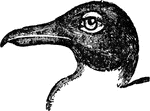
"A long-winged water-bird with webbed feet, inhabiting all parts of the world. The group to which gulls belong embraces also the terns, and these two kinds of birds are closely related." — Beach, 1909

Black-headed Gull

"A long-winged water-bird with webbed feet, inhabiting all parts of the world. The group to which gulls…
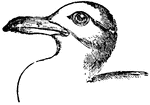
"A long-winged water-bird with webbed feet, inhabiting all parts of the world. The group to which gulls belong embraces also the terns, and these two kinds of birds are closely related." — Beach, 1909

Killiwake Gull

"A long-winged water-bird with webbed feet, inhabiting all parts of the world. The group to which gulls…
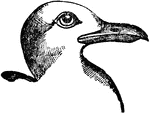
"A long-winged water-bird with webbed feet, inhabiting all parts of the world. The group to which gulls belong embraces also the terns, and these two kinds of birds are closely related." — Beach, 1909

Small Black-Backed Gull

"A long-winged water-bird with webbed feet, inhabiting all parts of the world. The group to which gulls…
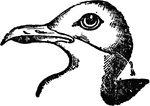
"A long-winged water-bird with webbed feet, inhabiting all parts of the world. The group to which gulls belong embraces also the terns, and these two kinds of birds are closely related." — Beach, 1909

Herring Gull

"A long-winged water-bird with webbed feet, inhabiting all parts of the world. The group to which gulls…
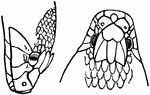
"In popular language, the name of all those large serpents which kill their prey by entwining themselves around it, and constricting it in their coils; but by zoologists of the present day, limited as the name of a genus to a very small portion of their number, all of which are natives of the warm parts of America." — Chambers, 1881

Boa

"In popular language, the name of all those large serpents which kill their prey by entwining themselves…
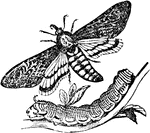
"A species of Hawk-moth or lepidopterous insect of the family Sphingidae, not uncommon in some parts of England and of the continent of Europe, and very widely distributed over the world, being found in Africa, the Mauritius, and the East Indies. It measures almost five inches from tip to tip of the extended wings; is of a dark color, the body yellow with black markings, the thorax with pale markings which have some resemblance to a skull, and from which it derives its name." — Chambers, 1881

Death's Head Moth

"A species of Hawk-moth or lepidopterous insect of the family Sphingidae, not uncommon in some parts…
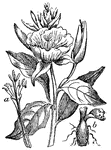
"Evening Primrose: a, flower divested of calyx and corolla, to show the parts or fructification; b, tuberous root." — Chambers, 1881

Evening Primrose

"Evening Primrose: a, flower divested of calyx and corolla, to show the parts or fructification; b,…
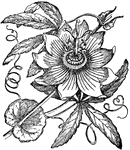
"A genus of plants almost exclusively native to the warm parts of America, and belonging to the natural order Passifloaceae; an order of exogenous plants, of which more than 200 species are known, mostly climbers, having tendrils which spring from the axils of the leaves, herbaceous or half shrubby, natives of tropical and subtropical countries, but rare in Asia and Africa." — Chambers, 1881

Passionflower

"A genus of plants almost exclusively native to the warm parts of America, and belonging to the natural…
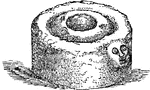
"A primitive mill for grinding corn, the stone of which was turned by the hand before the invention of windmills or water-mills. It is a contrivance of great antiquity, and so well adapted for the wants of a primitive people, that we find it perpetuated to the present day in remote districts of Ireland, and some parts of the Western Islands of Scotland." — Chambers, 1881

Quern

"A primitive mill for grinding corn, the stone of which was turned by the hand before the invention…
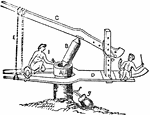
"The Chinapatam Sugar-mill consists of a mortar made by cutting down some hard-wood tree to within 2 or 3 feet of the ground, and hollowing the top of the portion left standing in the ground into the form of a mortar, A. A small hole is then bored obliquely through from the bottom of the cavity to the outside, and a pipe, f, conveys the juice into a jar, g. B is a cylindrical piece of wood, sharpened at each end, to act as a pestle, which is kept in its place with sufficient pressure by the lever C and the ropes at E. Two men are required: one at I has a basket supplied with small lengths of freshly-cut cane, which he places, two or three at a time, in the mortar, and when necessary, removes the crushed ones; the other man sits on the other end of the train, balancing it, and at the same time drives oxen which are attached to the end of the beam D, and keep the movable parts of the mill constantly turning round." — Chambers, 1881

Chinapatam Sugar-mill

"The Chinapatam Sugar-mill consists of a mortar made by cutting down some hard-wood tree to within 2…
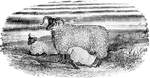
"They are accordingly found on the mountainour parts of Yorkshire, Lancashire, Cumberland, and Westmoreland; over the whole of the Lammermuir range, the upper part of Lanarkshire, and generally over the Highlands of Scotland. Both male and female of this breed have horns, which in the former are very large and spirally twisted. The face and legs are black or specked with black, with an occasional tendency to this color on the fleece; but there is nothing of the brown or russet color which distinguishes the down breeds." — Encyclopedia Britanica, 1893

Black-Faced Heath Sheep

"They are accordingly found on the mountainour parts of Yorkshire, Lancashire, Cumberland, and Westmoreland;…
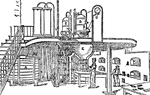
"The Danglish apparatus consists of the following parts: 1st, a generator A, in which carbonic acid is evolved from chalk by sulphuric or hydrochloric acid; 2nd, a gas-holder, in which the carbonic acid is stored for use after being purified in passing through water; 3rd, an air pump, for pumping carbonic acid from the gas-holder, and forcing it into the water vessel and mixer; 4th, another air-pump, for withdrawing atmospheric air from the mixer before the aerated water is admitted; 5th, a water vessel B, a strong cylinder of copper capable of withstanding a pressure of 100 lbs on the square inch, and of sufficient size to contain water for a full charge of the mixer; attached to this water vessel there are a gauge-glass C, and a pressure gauge D, for indicating the pressure of gas as it is pumped in; 6th, the mixer E, a globular vessel of cast-iron, capable of bearing high pressure, through the center of which an axle runs, fitted with iron kneating arms extending to the circumference of the vessel." — Encyclopedia Britanica, 1893

Danglish Apparatus

"The Danglish apparatus consists of the following parts: 1st, a generator A, in which carbonic acid…
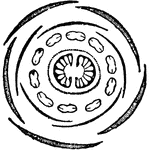
"Diagram of the flower of Saxifrage (Saxifraga tridactylites). The calyx and corolla consist of five parts, the stamens are ten in two rows, while the pistil has only two parts developed. The flower is, neertheless, called symmetrical, although the outer whorls are pentamerous, and the central one dimerous." — Encyclopedia Britanica, 1893

Saxifrage

"Diagram of the flower of Saxifrage (Saxifraga tridactylites). The calyx and corolla consist of five…
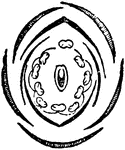
"Diagram of flower of Sweet-pea (Lathyrus), showing five parts of the calyx, of which two are superior, one inferior, and two lateral; five parts of the corolla, of which one is superior, two inferior, and two lateral; ten stamens in two rows; one carpel, in consequence of four being undeveloped." — Encyclopedia Britanica, 1893

Sweet-pea

"Diagram of flower of Sweet-pea (Lathyrus), showing five parts of the calyx, of which two are superior,…
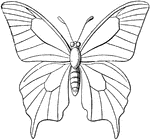
An outline of a butterfly labeling the different parts of the wings.

Butterfly Outline

An outline of a butterfly labeling the different parts of the wings.

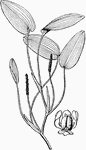
An aquatic herb found in numerous parts in both hemispheres. Usually found floating or wholly imersed in ponds and ditches.

Pondweed

An aquatic herb found in numerous parts in both hemispheres. Usually found floating or wholly imersed…
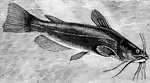
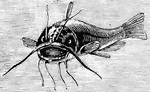
A type of fish with swollen or inflated parts.

Horn Pout

A type of fish with swollen or inflated parts.

A type of fish with swollen or inflated parts.

Horn Pout

A type of fish with swollen or inflated parts.

A small insectivorous migratory bird of the eastern parts of the United States.

Prairie Warbler

A small insectivorous migratory bird of the eastern parts of the United States.

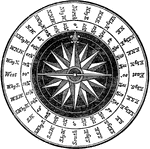
"Three principal parts, the card, the needle on its lower suface, and the case. The whole is enclosed in the compass-box, or binnacle. the term compass is said to have been applied to the instrument because the card involves or compasses the whole plane of the horizon, or because the needle indicates the whole circle of possible variations of direction. The surface of the card is divided by radiating lines into 32 parts, each containing 11 degrees." — Encyclopedia Britannica, 1893

Compass Card

"Three principal parts, the card, the needle on its lower suface, and the case. The whole is enclosed…
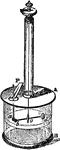
"ABCD is a cylinder of glass 1 foot in diameter and 1 foot high. This cylinder is closed by a glass lid pierced centrically by two openings, each about 20 lines wide. Into the middle opening is cemented a glass tube 2 feet high, to the upper end of which is fitted a torsion head; the separate parts of the head are shown larger at the side of the figure. H is a collar cemented to the glass tube; MO a metal disc, divided on the edge into 360 degrees; this disc is fastened to a tube N, which slips into the collar H. K is a button whose neck turns easily in a hole in MO; to the lower part of the button is fastened a small clamp, which seizes the wire of the balance. I is an arm with a small projecting piece which slips over the edge of the disc MO." — Encyclopedia Britannica, 1893

Torsion Balance

"ABCD is a cylinder of glass 1 foot in diameter and 1 foot high. This cylinder is closed by a glass…
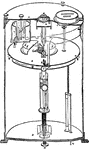
"Thomson's absolute electrometer is an adaptation of the attracted disc principle for absolute determinations. We give merely an indication of its different parts, referring to Thomson a paper for details." — Encyclopedia Britannica, 1893

Absolute Electrometer

"Thomson's absolute electrometer is an adaptation of the attracted disc principle for absolute determinations.…
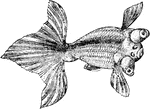
"In China and the warmer parts of Japan a fish extremely similar to the Crucian carp of Europe is of very common occurrence in ponds and other still waters. In the wild state its colors do not differ from those of a Crucian carp, and like that fish it is tenacious of life and easily domesticated. Albinos seem to be rather common and as in other fishes, the color of most of these albinos is a bright orange or golden yellow; occasionally even this shade of color is lost, the fish being more or less pure white or silvery." — Encyclopedia Britannica, 1893

Goldfish

"In China and the warmer parts of Japan a fish extremely similar to the Crucian carp of Europe is of…
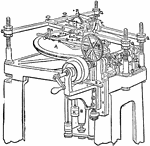
"The plate A is 46 inches in diameter, and is composed of gun metal. These were put on by original graduation, mainly on the plan of Edward Troughton. One very great improvement in this engine is that the axis B is tubular, as seen at C. The object of this hollow is to receive the axis of the circle to be divided, so that it can be fixed flat to the plate by the clamps E, without having first to be detached from the axis and other parts to which it has already been carefully fitted. This obviates the necessity for resetting, which can hardly be done without some error. D is the tangent screw, and F the flame carrying it, which turns on carefully polished steel pivots. The screw is pressed against the edge of the plate by a spiral spring acting under the lever G, and by screwing the lever down the screw can be altogether removed from contact with the plate." — Encyclopedia Britannica, 1893

Dividing Engine

"The plate A is 46 inches in diameter, and is composed of gun metal. These were put on by original graduation,…
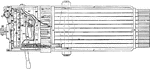
"Nordenfelt Machine Gun. 1-10, parts of frame; 11, breech plug; 12, striker; 13, extractor; 14, cartridge receiver; 15-18, 23-31, lock and trigger parts; 19-22, locking action; 32-35, loading action; 36-39, cartridge receiver; 40, cover; 41-44, parts of hand-lever; 45-49, traversing action; 50-55, elevating and trailing action; 56, 56, hopper and slide." — Encyclopedia Britannica, 1893

Machine Gun

"Nordenfelt Machine Gun. 1-10, parts of frame; 11, breech plug; 12, striker; 13, extractor; 14, cartridge…
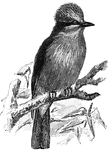
In the males, they have a full globular crest, and the hole under parts flaming red, the back, wings, and tail a dusky brown.

Vermilion Flycatcher

In the males, they have a full globular crest, and the hole under parts flaming red, the back, wings,…
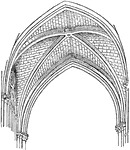
A ceiling vault divided into four parts.

Quadripartite Vault

A ceiling vault divided into four parts.

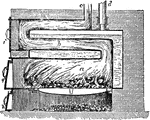
"The fire is made under the principal arch a; the flame and smoke return through the flue b, and then turn back over the top of the boiler to the outlet c, which can be placed at whatever point is in each case most convenient. The other parts referred to are d, flow pipe; e, return pipes, f, soot-door for cleaning flues, g, furnace door." — Encyclopedia Britannica, 1893

Saddle Boiler

"The fire is made under the principal arch a; the flame and smoke return through the flue b, and then…
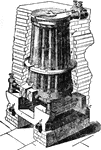
"The Duplex is made in two equal parts, each being capable of being worked alone. Each section consists of a semicircle of upright tubes forming the boiler proper, fitted with the diaphragm a, horizontal pipes forming the furnace f, a flow pipe b and a return pipe c, and an outlet d for removing sedimentary deposits from the interior." — Encyclopedia Britannica, 1893

Duplex Tubular Boiler

"The Duplex is made in two equal parts, each being capable of being worked alone. Each section consists…
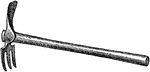
"The pickfork or Canterbury hoe is a very useful tool for breaking up the surface soil, the three-pronged end being used for the looser parts, and the mattock end for breaking clods, or when the surface has become much consolidated." — Encyclopedia Britannica, 1893

Pickfork

"The pickfork or Canterbury hoe is a very useful tool for breaking up the surface soil, the three-pronged…

A quadrilateral plane figure having four right angles and its opposite sides equal in length. The adjacent sides are unequal.

Rectangle

A quadrilateral plane figure having four right angles and its opposite sides equal in length. The adjacent…
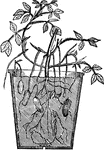
"A genus of plants of the natural order Leguminosae, sub-order Papilionaceae, natives of the warm parts of America, of which, until recently, the only known species was the A. hypogaea, sometimes called the underground kidney-bean, and more frequently the ground-nut. It also receives the names of earth-nut, American earth-nut, and mandubi." — Chambers' Encyclopedia, 1875

Arachis

"A genus of plants of the natural order Leguminosae, sub-order Papilionaceae, natives of the warm parts…
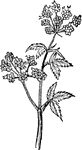
"A plant of the natural order Umbelliefrae, a native of the elevated table-lands in the neighborhood of Santa Fe de Bogota and Caracas, and of regions of similar climate in other parts of Tropical America. It is much cultivated in its native country for its roots, which are used as an esculent. The root divides into a number of parts, which resemble cows' horns or large carrots. When boiled, they are firm and tender, with a flavor not so strong as that of a parsnip." — Chambers' Encyclopedia, 1875

Arracacha

"A plant of the natural order Umbelliefrae, a native of the elevated table-lands in the neighborhood…
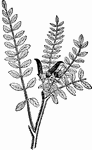
"A genus of plans of the natural order Leguminosae, sub-order Papilionaceae. The pod is more or less perfectly 2-celled. The leaves are pinnate, with a terminal leaflet. the species are numerous, natives chiefly of the temperate and colder parts of the Old World, shrubby, and often spiny, or unarmed and herbaceous." — Chambers' Encyclopedia, 1875

Astragalus

"A genus of plans of the natural order Leguminosae, sub-order Papilionaceae. The pod is more or less…
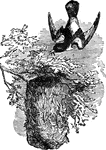
"A very beautiful American, bird, found in all parts of the United States, and as far north as 55 degrees N. lat., but migrating to tropical or subtropical regions in winter." — Chambers' Encyclopedia, 1875

Oriole

"A very beautiful American, bird, found in all parts of the United States, and as far north as 55 degrees…
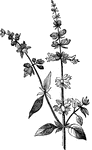
"A genus of plants of the natural order Labiatae. The species are all natives of the tropics, or of the warmer temperate parts of the world, and are generally characterized by a pleasant aromatic smell and taste." — Chambers' Encyclopedia, 1875

Basil

"A genus of plants of the natural order Labiatae. The species are all natives of the tropics, or of…
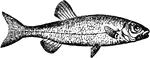
"A fish of the family Cyprinidae, of the same genus with the roach, dace, bleak and minnow. The color is bluish-black on the upper parts, passing in to silvey white on the belly; the cheeks and gill-covers rich golden yellow. The chub rarely attains a weight exceeding 5 lbs. It is plentiful in many of the rivers of England, and occurs in some of those of the south-west of Scotland." — Chambers' Encyclopedia, 1875

Chub

"A fish of the family Cyprinidae, of the same genus with the roach, dace, bleak and minnow. The color…
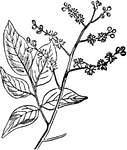
"A valuable medicinal substance, consisting chiefly of a resin (Resin of Copaiva) and a volatile oil (Oil of Copaiva). It flows from incisions made in the stems of trees of the genus Copaifera, trees with pinnate leaves, of the natural order Leguminosae, sub-order Caesalpinisae, natives of the topical parts of America." — Chambers' Encyclopedia, 1875

Copaiva Tree

"A valuable medicinal substance, consisting chiefly of a resin (Resin of Copaiva) and a volatile oil…
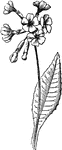
"A common native of pastures in England and many other parts of Europe, although rare in Scotland, a delicate and modest little flower, a universal favorite, both for its beauty and its fragrance. The flowers are small, in an umbel at the top of the scape, the limb of the corolla short and concave." — Chambers' Encyclopedia, 1875

Cowslip

"A common native of pastures in England and many other parts of Europe, although rare in Scotland, a…
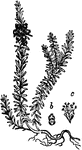
"A small procumbent shrub, of the natural order Empetraceae, a native of the northern parts of the world, abundant in the moors of Scotland and the north of England. The order consists of a few heath-like shrubs, which, however, are regarded as having a botanical affinity to Euphorbiaceae, with small unisexual flowers in the axils of the leaves, the fruit a small berry seated in the persistent calyx. b, fruit cut open; c, flower." — Chambers' Encyclopedia, 1875

Crowberry

"A small procumbent shrub, of the natural order Empetraceae, a native of the northern parts of the world,…
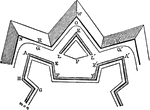
"Curtain, in Fortification, is the portion of rampart or wall between two bastions or two gates. In a regular siege, to batter down the curtain is one of the main operations depended on; and many of the external works constructed by the defenders are intended to frustrate, or at least embarrass, this operation. In the annexed cut, which shows a ground-plan of some of the elements of a regular fortification, FF' is the curtain; HAEF, a bastion. The component parts of the bastion are thus designated: AH and AE, two faces; EF and GH, two flanks; A, the salient; FG, the gorge; and H and E, the shoulders. mn is the rampart; mo, the parapet on the rampart; QPQ', the ditch; NO, the covery-way; RWR', the glacis; KLL', a ravelin." — Chambers' Encyclopedia, 1875

Curtain

"Curtain, in Fortification, is the portion of rampart or wall between two bastions or two gates. In…

"A grass of the same genus with the valuable Ryegrass, an annual, common in the cornfields in England and many parts of Europe. It has no tufts of leaves from the rot, the glumes are as long as the spikelets, or longer, the spikelets contain 5-7 florets which are awned." — Chambers' Encyclopedia, 1875

Darnel

"A grass of the same genus with the valuable Ryegrass, an annual, common in the cornfields in England…
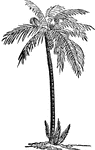
"A genus of palms, the most important species of which is the common Date Palm, the Palm Tree of Scripture, a native of the northern half of Aftica, the south-west of Asia, and some parts of India, and which has also been brought into cultivation in the south of Europe, and might certainly be intruduced with advantage into the south of the United States, and many warm parts of America and Australia." — Chambers' Encyclopedia, 1875

Date Palm

"A genus of palms, the most important species of which is the common Date Palm, the Palm Tree of Scripture,…
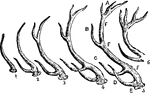
"The annexed cut represents the horns of the stag at different ages. During the first year, there is only a light protuberance; the second year is marked by the brow antler (1); the third year, by the bad antler (2); the fourth, by the tray antler (3); the fifth, by the crockets (4); the sixth, by the beam antler (5), the various parts of which are termed (A) crockets, (B) tray, (C) bay, (D) brow, (E) pearls, (F) the beam of the antler; seventh year (6)." — Chambers' Encyclopedia, 1875

Stag Horns

"The annexed cut represents the horns of the stag at different ages. During the first year, there is…
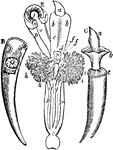
"Dentalium: B, the shell of Dentalium Entalis, broken longitudinally, showing the animal in a contracted state. C, the shell, showing the animal advancing out; a and b, the foot, the lobes of which are developed in the form of a corolla; c, a part of the collar of the mantle. E, the animal, magnified, extricated from the shell, with them antle slit along the dorsal and medial line, detached in part from its posterior insertion, and turned aside so as to show the parts enclosed; a, the extremity of the foot, which closes the aperture j, of the collar lm, of the mantle nop; bb, lobes of the fot; c, the foot itself, presenting a depression or a channel, running its whole length; d, the head; e, the cerebral ganglion; f, f, the two sides of the mouth; g, g, the membranes which support the branchiae; gg, ii, the branchiae; pp, qq, the retractor muscles; s, the muscle of insertion; t, the expanded posterior extremity, in which is situated the vent." — Chambers' Encyclopedia, 1875

Dentalium

"Dentalium: B, the shell of Dentalium Entalis, broken longitudinally, showing the animal in a contracted…
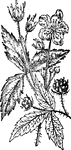
"A plant of the same genus with the Bramble, and very nearly allied to it, but having weaker and more prostrate roundish stems, which take root at the end, their prickles unequal and passing insensibly into hairs, the fruit consisting only of a few (1—5) grains, which, however, are much larger than those of the brambleberry." — Chambers' Encyclopedia, 1875

Dewberry

"A plant of the same genus with the Bramble, and very nearly allied to it, but having weaker and more…
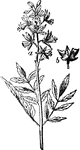
"A genus of plants of the natural order Rutaceae, having a short 5-partite calx, five some-what unequal petals, ten stamens, and five 1—3 seeded follicular capsules cohering at the base." — Chambers' Encyclopedia, 1875

Dittany

"A genus of plants of the natural order Rutaceae, having a short 5-partite calx, five some-what unequal…
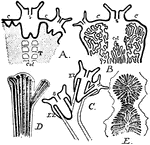
"A, Schematic longitudinal section through a zooid and bud of Stylophora digitata. In A, B, and C the thick black lines represent coenosarc; col, columella; T, tabulae. B, similar section through a single zoooid and bud of Astroides calicularis. C, similar section through three corallites of Lophohelia prolifera. ez, edge-zone. D, Diagram illustration the process of budding by unequal division. E, section through a dividing calicle of Mussa, showing the union of two septa in the plane of division, and the origin of new septa at right angles to them." — The Encyclopedia Britannica, 1910

Stylophora Digitata

"A, Schematic longitudinal section through a zooid and bud of Stylophora digitata. In A, B, and C the…
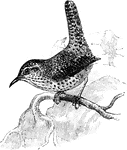
A small bird having grey and brown upper parts with small black and white spots. Pale grey under parts and a brown rump.

Rock Wren

A small bird having grey and brown upper parts with small black and white spots. Pale grey under parts…
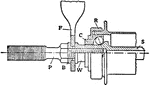
"One end of the cup-adjusting hub, with inward bearings. The cones are formed of one piece with the spindles, and the adjusting cp C is screwed in the end of the hub shell, and locked in position by the screwed locking-ring R. The figure also illustrates a divided spindle for facilitating the removal of the tire for repair when required without disturbing the wheel, bearings, chain or gear-case. The chain side of the hub-spindle, not shown in the figure, is secured to the frame in the usual way; on the left side the spindle S projects very little beyond the adjusting cup. A distance washer W is placed between the end of the spindle S and the fork-end F. A detachable screw-pin, or the footstep, P, passes through the washer W, and is screwed into the end of the spindle S, the hexagod head of the detachable pin drawing all the parts securely together." — The Encyclopedia Britannica, 1910

Cup-adjusting Hub

"One end of the cup-adjusting hub, with inward bearings. The cones are formed of one piece with the…
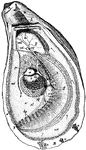
"Anatomy of the Oyster. A. Hinge or anterior umbonal end of the left valve of an adult oyster, upon which the soft parts of the animal are represented as they lie in situ, but with the greater part of the mantle of the right side removed. a u. The auricle of the right side of the heart contracted. B. Posterior or ventral end of the left valve, which in life is usually directed upward more or less, and during the act of feeding and respiration is separated slightly from the margin of its fellow of the opposite side to admit the water for respiration, and which also contains the animal's food in suspension. b m. Body-mass, traversed superficially by the generative ducts g e. b j. The organ of Bojanus, or 'renal' organ, of the right side of the oyster. (The ducts which it sends into the manle are not shown, nor is its connection with the genito-urinary sinus s indicated.)" — Winston's Encyclopedia, 1919

Oyster

"Anatomy of the Oyster. A. Hinge or anterior umbonal end of the left valve of an adult oyster, upon…
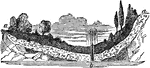
"A sandy stratum, a a, acting as a filter, occupies an inclined position between two other strata impervious to water, such as clay, the water being absorbed by the superficial parts of the strata, as at a a (which may be of very great extent), will penetrate through its whole depth, and, finding no egress below on account of the basin-like form of the stratum, or from its resting at the lower termination upon a compact rock, will accumulate." — Wells, 1857

Sandy Stratum

"A sandy stratum, a a, acting as a filter, occupies an inclined position between two other strata impervious…
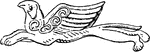
"A griffin having the uppet part of the body of an eagle and the lower parts of a lion, with wings decorated with spirals, are among the more remarkable examples of perforated ornaments for attachment to the clothing." —The Encyclopedia Britannica, 1910

Griffin Pendent

"A griffin having the uppet part of the body of an eagle and the lower parts of a lion, with wings decorated…
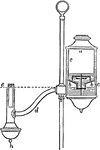
"An example of a form of reading lamp is seen here. The lamp is mounted on a standard on which it can be raised or lowered at will, and fixed by a thumb screw. The oil reservoir is in two parts, the upper ac being an inverted flask which fits into bb, from which the burner is directly fed through the tube d; h is an overflow cup for any oil that escapes at the burner, and it is pierced with air-holes for admitting the current of air to the center tube of the Argand burner. The lamp is filled with oil by withdrawing the flask ac, filling it, and inverting it into its place. The under reservoir bb fills from it to the burner level ee, on a line with the mouth of ac. so soon as that level falls below the mouth of ac, a bubble of air gets access to the upper reservoir, and oil again fills up bb to the level ec, and so on it goes as long as combustion continues and the supply of oil in ac endures." —The Encyclopedia Britannica, 1910

Reading Lamp

"An example of a form of reading lamp is seen here. The lamp is mounted on a standard on which it can…
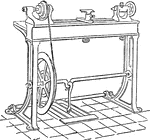
"A modern mechanic's lathe, has very different demands made upon it. For this the greatest possible steadiness in all the working parts is the main desideratum, and it is of great advantage to have the means of obtaining a slow speed, so as to be able to take the heaviest cuts which its strength and the power available to warrant." —The Encyclopedia Britannica, 1910

Mechanic's Lathe

"A modern mechanic's lathe, has very different demands made upon it. For this the greatest possible…
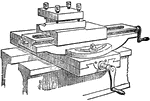
"A slide-rest such as would be used with the lathe in the previous engraving, for which purpose simplicity of construction and steadiness in all its parts are the points chiefly aimed at." —The Encyclopedia Britannica, 1910

Slide-Rest

"A slide-rest such as would be used with the lathe in the previous engraving, for which purpose simplicity…