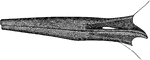
"Haematopus. Oyster-catcher. Bill peculiar - longer than tarsus, twice as long as head, constricted near the base, much compressed, almost like a knife-blade toward end, and truncate, something like a woodpecker's (it is an efficient instrument for prying open shells of bivalve mollusks), hard, straight or or deflected sideways, highly colored. Nasal groove very short, broad, and shallow; grooving of lower mandible slight; interramal space very short, scarcely a third the length of the long ascending gonys. Nostrils remote from the feathers, linear, close to edge of bill." Elliot Coues, 1884

Oyster-catcher Bill

"Haematopus. Oyster-catcher. Bill peculiar - longer than tarsus, twice as long as head, constricted…
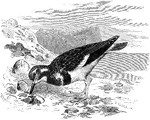
"Strepsilas interpres. Turnstone. Brant Bird. Calico-back. Pied above with black, white, brown, and chestnut-red; below, snowy, with jet breast. Top of head streaked with black and white. Forehead, cheeks, side of head and back of neck, white, with a bar of black coming up from the side of neck to below eye, then coming forward and meeting or tending to meet its fellow over base of bill, enclosing or nearly enclosing a white loral, and another black prolongation on side of neck; lower eye-lid white or not. Lower hind neck, interscapulars and scapulars, pied with black and chestnut; back, rump, and upper tail-coverts, snowy-white, with a large central blackish field on the latter. Tail white, with broad subterminal blackish field, narrowing on the outer feathers and incomplete, widening to usually cut off white tips of central feathers. Wing-coverts and long inner secondaries pied like the scapulars with black and chestnut, the greater coverts broadly white-tipped or mostly white, the short inner secondaries entirely white, the rest acquiring dusky on their ends to increasing extent, with result of a broad oblique white wing-bar. Primaries blackish, the longer ones with large white fields on inner webs, the shorter ones also definitely white on outer webs for a space, the shafts white on the outer webs for a space, the shafts white unless at end; primary coverts white-tipped. Under parts, under wing-coverts, snowy-white, the breast and jugulum jet-black, enclosing a white throat-patch, and sending limbs on sides of head and neck as above said. Bill black; iris black; feet orange." Elliot Coues, 1884

Turnstone

"Strepsilas interpres. Turnstone. Brant Bird. Calico-back. Pied above with black, white, brown, and…
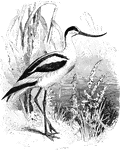
"Recurvirostra. Avocets. Bell slender, more or less recurved, then the upper mandible hooked at the extreme tip; much longer than head, more or less nearly equalling tail and tarsus; flattened on top, without culminal ridge. Wings short (for a wader). Tail very short, square, less than half the wing. Legs exceedingly long and slender; tibiae long-denuded; tarsus nearly twice as long as middle toe and claw; covering of legs skinny. Feet 4-toed; the front toes full-webbed, hind toe short, free. Body remarkably depressed and feathered underneath with thick duck-like plumage; altogether, as in swimming rather than as in wading birds. Altogether, as in swimming rather than as in wading birds. It is a modification like that seen in the lobe-footed phalaropes. Sexes and young alike; winter and summer plumage different." Elliot Coues, 1884

Avocets

"Recurvirostra. Avocets. Bell slender, more or less recurved, then the upper mandible hooked at the…
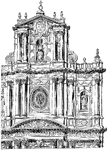
The St-Paul-St-Louis Church is located in Paris on Rue Saint Antoine in the Marais. The church was begun in 1627 and completed in 1641 and is an examaple of Jesuit architecture. It was designed based on the Gesú church in Rome. The letters IHS, as shown on the front of the church, is an abbreviation, the first three letters, of Jesus' name in Greek, ΙΗΣΟΥΣ, translated into English characters."In this style curved lines of the most varied description supersede all straight lines both in ground plans and in designs, whilst the most ordinary and characteristic embellishments are volutes, shellfish, and scrolls; groups of fruit and garlands of flowers, hangings, curtains, etc. [shown here]." "During the time that the license of the Roccoco Style prevailed, the elements of the ancient columnar orders were often misapplied, engaged columns and pilasters were frequently so connected with other side-pilasters which were recessed behind them to the number of one, two, or even three, that the cornices and, in fact, all horizontal mouldings were separately profiled over each column or pilaster [shown here]."

Façade of the Church of St. Paul and St. Louis at Paris

The St-Paul-St-Louis Church is located in Paris on Rue Saint Antoine in the Marais. The church was begun…
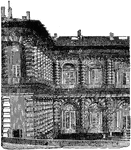
The Palazzo Pitti, in English sometimes called the Pitti Palace, is a vast mainly Renaissance palace in Florence, Italy. It is situated on the south side of the River Arno, a short distance from the Ponte Vecchio. The core of the present palazzo dates from 1458 and was originally the town residence of Luca Pitti, an ambitious Florentine banker.The palace was bought by the Medici family in 1549 and became the chief residence of the ruling families of the Grand Duchy of Tuscany. It grew as a great treasure house as later generations amassed paintings, plates, jewelry and luxurious possessions.In the late 18th century, the palazzo was used as a power base by Napoleon, and later served for a brief period as the principal royal palace of the newly united Italy. The palace and its contents were donated to the Italian people by King Victor Emmanuel III in 1919, and its doors were opened to the public as one of Florence's largest art galleries. Today, it houses several minor collections in addition to those of the Medici family, and is fully open to the public."Columns, pilasters, and mouldings are intermingled and intertwined in a fantastic and meaningless manner, the cornices are often interrupted; the essentially component parts of the architecture are frequently mutilated; for instance, columns and wall-pilasters are executed in rustic work, i. e., formed of extensively projecting hewn stones, yet are furnished with a capital and base as is shown [in this image], which is an illustration taken from the Late Italian Renaissance. For the sake of peculiarity, the various component elements assumed a form diametrically opposed to their original designation; mere decorative and secondary details were raised to the rank of essentials, whilst the real principal forms sank to an entirely subordinate position."

Part of the Back of the Pitti Palace at Florence

The Palazzo Pitti, in English sometimes called the Pitti Palace, is a vast mainly Renaissance palace…
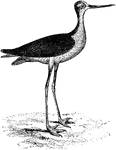
"Himantopus. Stilts. Bill extremely slender, but not flattened, nor turned up, nor hooked; longer than head, rather shorter than tarsus. Wing long and pointed, folding beyond the short and square tail, which is less than half the wing. Legs of unique length and slenderness, the bare part about as long as the wing; tibiae denuded for a great distance; tarsus about twice as long as toes. Feet 3-toes, semipalmate; but the species scarcely swim. Sexes similar; young different." Elliot Coues, 1884

Stilt

"Himantopus. Stilts. Bill extremely slender, but not flattened, nor turned up, nor hooked; longer than…
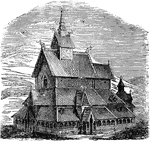
Borgund stave church is a stave church located in Borgund, Lærdal, Norway. It is classified as a triple nave stave church of the so-called Sogn-type. It was probably built in the end of the 12th century, and has not changed structure or had a major reconstruction since that date.The church site shows evidence of a previous building, which can point to an earlier church or perhaps an old pagan temple that had been taken into use as a church. The interior of the church, except for the pulpit and the altarpiece, is mainly free from the post-Reformation decorations seen in most other stave churches. An authentic medieval square-shaped baptismal font made of soapstone is still a part of the interior.Borgund stave church is owned by Fortidsminneforeningen (The Society for the Preservation of Norwegian Ancient Monuments)."The wood buildings of Norway lay claim to a certain monumental and historical importance, partly because they belong to the oldest class of buildings of this description, and partly owing to the purpose for which they were erected, namely, to serve as churches. The case is different as regards the merit of their artistic construction and beauty of shape, in both of which points the standard attained is not a high one, as shown by [this image]. The details principally show traces of the architectural styles prevalent at the time of their erection, viz., the Romanesque and Byzantine, while the main forms must be considered as the result of a severe climate. The perishable nature of the material employed was also naturally prejudicial to any advanced and regular development of architectural skills. From these causes the whole design assumed a pyramidal shape, whilst the climate necessitated mode of construction which is peculiar to the buildings in question. As a projection against its rigours the structures were surrounded by covered passages ornamented externally with those little arcades which are a distinguishing feature of the Romanesque style, whilst the roofs were necessarily very steep in shape on account of the heavy falls of snow, and were covered with wood shingles, tiles, or slates. The form of construction is rather rough, for the corners are generally formed of rude logs, whilst the walls between merely consist of upright boards jointed to one another. Churches of this description are know in Norway by the name of Fascine Churches. Although the construction is thus artless, yet an effort to enrich the whole by individual details and by employment of painted embellishments is frequently to be noticed. This especially effected by means of arabesque-like carvings on the doorways and gables."

Wood Church at Burgund

Borgund stave church is a stave church located in Borgund, Lærdal, Norway. It is classified as…
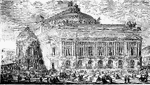
The Palais Garnier, also known as the Opéra de Paris or Opéra Garnier, but more commonly as the Paris Opéra, is a 2,200-seat opera house on the Place de l'Opéra in Paris, France. A grand landmark designed by Charles Garnier in the Neo-Baroque style, it is regarded as one of the architectural masterpieces of its time."The newest and most important building is the new Opera House at Paris," this image "presents an external view.The competition which was announced for the plans for this building brought out at the time the most eminent, artistic, and architectural talent of France, and aroused a very general and lively interest in the result: inasmuch as an architectural chef-d'œuvre was to be produced, such as Paris did not possess before, and one in which the architecture of the present day was to make the utmost possible effect to build a theatre, which in every respect should be worthy of the metropolis of the world, and should thanks to the almost unlimited means at disposal, be the most perfect of its kind."

View of the Opera House in Paris

The Palais Garnier, also known as the Opéra de Paris or Opéra Garnier, but more commonly as the Paris…

"In Belgium the Roman Renaissance was introduced about the same time as in France: but an unmistakable distinction is visible between the two styles. The buildings in Belgium have a certain stamp by which they essentially differ from those of France; in fact, the whole style might be designated as modern Belgian. The peculiarity of the treatment lies mainly in a predilection for that Renaissance which is called the Roccoco style in conjunction with heavy and often very [skillfully] managed; but still the details are for the most part heavier and more robust than those that belong to the best Renaissance style. [This image] shows this peculiarity, but it is somewhat less marked than in many other instances."

View of the Opera House in Paris

"In Belgium the Roman Renaissance was introduced about the same time as in France: but an unmistakable…
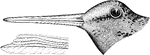
"Philohela. American Woodcock. First three primaries emarginate, attenuate and falcate, abruptly shorter and narrower than the 4th. Wings short and rounded; when folded, the primaries hidden by the coverts and inner quills. Legs short; tibiae feathered to the joint; tarsus shorter than middle toe and claw, scutellate before and behind; toes long and slender, cleft to the base Bill much longer than head, perfectly straight, stout at base, where the ridge rises high, knobbed at end of upper mandible, very deeply grooved nearly all its length, the culmen and line of gonys also furrowed toward end; very soft and sensitive; gape very short and narrow. Head large; neck short; ear under the eye, which is very full, set in back upper corner of the head. Sexes alike; Female largest." Elliot Coues, 1884

American Woodcock Head

"Philohela. American Woodcock. First three primaries emarginate, attenuate and falcate, abruptly shorter…
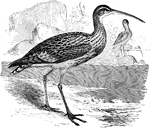
"Numenius arquatus. Eurasian Curlew. European Curlew. Bill of very variably length, always longer than head, probably always exceeding the tarsus, sometimes more than length of entire leg; slender, curved downwards, the tip of the upper mandible knobbed and overhanging the end of the lower; obsoletely grooved nearly to end. Gape of mouth extended beyond base of culmen. Feathers reaching about equally far on sides of each mandible. Wings and tail ordinary; latter barred in color. Legs rather stout; tibia largely denuded below; tarsus much longer than middle toe and claw, scutellate in front only, elsewhere reticulate. Toes short and thick, fattened underneath, broadly margined on sides. Of large and medium stature, and plump form. Coloration variegated; rufous usually prevailing. Sexes alike; changes of plumage not pronounced." Elliot Coues, 1884

Eurasian Curlew

"Numenius arquatus. Eurasian Curlew. European Curlew. Bill of very variably length, always longer than…
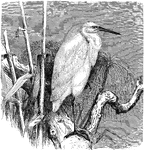
"Garzetta. Small Egret Herons. Color white; and occipital crest, and short recurved train of stiff-shafted loose-webbed feathers in the breeding season; lower neck-feathers lengthened, depending.

European Little White Egret

"Garzetta. Small Egret Herons. Color white; and occipital crest, and short recurved train of stiff-shafted…
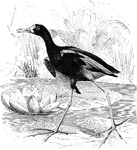
"Parra. Jacanas. Bill plover-like, contracted in continuity, enlarged terminally; with culmen depressed to end of nasal groove, then convex and decurved; outline of mandibular rami about straight to the gonys, which is ascending; commissure about straight to the decurved end. Nasal grooves along the contracted portion of the bill; nostrils small, elliptical, situate in advance of the base of the bill. Angle of mouth with a leaf-like lobe of skin (rudimentary in our species). Forehead with a large leaf-like lobe of skin, with free lateral and posterior edges, adherent centrally and anteriorly where reaching base of upper mandible. A sharp horny spur on bend o wing Primaries 10, not peculiar in structure; outer 3 about equal and longest, overlaid by the inner quills in the closed wing. Tail very short, with soft rectrices concealed be the coverts. Tibia bare below, and with the tarsus scutellate before and behind, the scutella tending to become confluent in a continuous sheath. All the toes, claws included, longer than tarsus; middle toe alone nearly as long as tarsus; outer toe alone about as long as middle, its claw shorter than that of middle toe; inner toe a little shorter than outer, its claw longer; hind toe only about as long as basal joint of middle toe, but its claw much longer than itself; all the claws slender, about straight, very acute." Elliot Coues, 1884

Parra Jacana

"Parra. Jacanas. Bill plover-like, contracted in continuity, enlarged terminally; with culmen depressed…
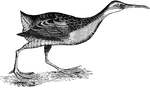
"Rallus longirostris crepitans. Clapper Rail. Salt-water Marsh-hen. Mud-hen. Above, variegated with olive-brown and pale olive-ash, the latter edging the feathers, the variegation dull and blended. Below, pale dull ochrey-brown, whitening on the throat, frequently ashy-shaded on the breast, without decided cinnamon-brown shade. Flanks, axillars, and lining of wings, fuscous-gray, with sharp narrow white bars. Quills and tail plain dark-brown, without chestnut on the coverts. Eyelids and short superciliary line whitish. The general tone is that of a gray bird, without any reddishness." Elliot Coues, 1884

Clapper Rail

"Rallus longirostris crepitans. Clapper Rail. Salt-water Marsh-hen. Mud-hen. Above, variegated with…
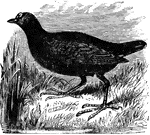
"Gallinula. Gallinules. Water Hens. Mud Hens. Bill not longer than head, stout at base, tapering, compressed, the culmen running directly up on the forehead and expanding into a frontal plate of different shape in different species. Nostrils near middle of bill, linear. Feet large and stout; tibia naked below; tarsus moderately compressed, scutellate; toes very long, the outer longer than the inner, with an evident though slight marginal membrane; claws long, slender, little curved, acute. Wings short and rounded, but ample. Tail very short, of 12 weak feathers, with long ample under coverts, as in Rails. Plumage not rich blue." Elliot Coues, 1884

Gallinule

"Gallinula. Gallinules. Water Hens. Mud Hens. Bill not longer than head, stout at base, tapering, compressed,…
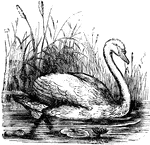
"Cygynus. White Swans. Neck of extreme length. Trachea normally entering sternum. Bill tuberculate or not, the skinny covering in the adults reaching to the eyes; not shorter than head, very high at base, where deeper than wide, broader and flattening toward the rounded end; culminal ridge at base about horizontal, very broad and flat or even excavated, the sides of the bill there nearly vertical. Nostrils near middle of bill, high up. Leg behind centre of equilibrium when the body is horizontal. Tibia bare below. Tarsus shorter than middle toe and claw, entirely reticulate; toes long, with full webs, the anterior reticulate on top for a distance, then scutellate. Hallux small, elevate, with slight lobe. Wings very long and ample. Tail short, rounded or wedged, of twenty or twenty-four feathers. Size large: adults entirely white, with black bill and feet, former usually in part yellow." Elliot Coues, 1884

Mute Swan

"Cygynus. White Swans. Neck of extreme length. Trachea normally entering sternum. Bill tuberculate or…
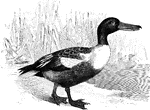
"Spatula clypeata. Shoveller Duck. Broad-bill. Bill blackish; iris orange-red: feet vermilion-red. Head and neck dark glossy green. Lower neck and fore breast pure white. Abdomen purplish-chestnut. Wing-coverts sky-blue; speculum rich green, set between white tips of greater coverts, and black subtips and white tips of secondaries; inner secondaries greenish-black, with long white stripe; long scapulars blue on outer webs, striped with white and greenish-black on inner; short anterior scapulars white. Rump and upper and under tail-coverts black; a white patch on each side at root of tail." Elliot Coues, 1884

Northern Shoveler

"Spatula clypeata. Shoveller Duck. Broad-bill. Bill blackish; iris orange-red: feet vermilion-red. Head…
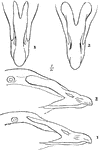
"Somateri mollissima. Somateri dresseri. Common Eider. Bill gibbous at base of upper mandible; outline of culmen variously curved; with long, acute or clubbed, tumid process extending in line with culmen variously curved; with long, acute or clubbed tumid process extending in line with culmen on each side of forehead, divided by extension of feathers on culmen. feathers of side of bill advancing to about under nostrils, far beyond those on culmen. No speculum. Male no black marks on chin. (mollissima - Frontal processes short, narrow, acute, parallel. Smaller.). (dresseri - Frontal processes long, broad, clubbed, divergent. Larger.)." Elliot Coues, 1884

The Bill of an Eider

"Somateri mollissima. Somateri dresseri. Common Eider. Bill gibbous at base of upper mandible; outline…
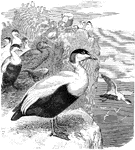
"Somateria mollissima. European Eider Duck. Bill with lateral frontal process extending on each side of the forehead, between the short pointed extension of the feathers on the culmen and the much greater extension of those on the sides of the bill, which reach to below the nostril, about opposite those on the chin. The general upper outline of the bill nearly straight, and the frontal processes narrow, acute, and nearly parallel. Adult male: Plumage almost entirely black and white. Top of head glossy blue-black, including eyes, and forking behind to receive the white of the hind-head. Occiput more or less washed with sea-green. Neck all around, fore breast, most of the back, most of the wing-coverts above and below, the curly tertials, and sides of rump, white, on the breast tinged with pale creamy-brown." Elliot Coues, 1884

Eider Ducks

"Somateria mollissima. European Eider Duck. Bill with lateral frontal process extending on each side…
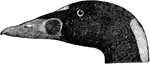
"Oidemia perspicillata trowbridgii. Trowbridge's Surf Duck, With the bill longer, exceeding the head, and o slightly different shape; feathers falling short of nostrils; gape 2.75; white frontal patch small, its posterior border anterior to a line between eyes, instead of reaching or passing beyond this." Elliot Coues, 1884

Trowbridge's Surf Duck

"Oidemia perspicillata trowbridgii. Trowbridge's Surf Duck, With the bill longer, exceeding the head,…
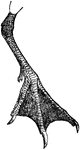
"Sterna fuliginosa. Sooty Tern. feet stout; toes short; with much incised webs; tibia bare .70; tarsus 1.00; middle toe and claw 1.20; outer do. 1.05; inner do. .75; hind do. .30. "Elliot Coues, 1884

Sooty Tern Foot

"Sterna fuliginosa. Sooty Tern. feet stout; toes short; with much incised webs; tibia bare .70; tarsus…
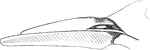
'Rhynchops. Skimmer. Bill hypognathous Among the singular bills of birds that frequently excite our wonder, that of the skimmers as one of the most anomalous. The under mandible is much longer than the upper, compressed like a knife-blade; its end is obtuse; its sides come abruptly together and are completely soldered; the upper edge is as sharp as the under, and fits a groove in the upper mandible; the jawbone, viewed apart, looks like a short-handled pitchfork. The upper mandible in also compressed, but less so, nor is it so obtuse at the end; its substance is nearly hallow, with light cancellated structure, much as in a toucan; it is freely movable by means of an elastic hinge at the forehead." Elliot Coues, 1884

The Bill of a Skimmer

'Rhynchops. Skimmer. Bill hypognathous Among the singular bills of birds that frequently excite our…
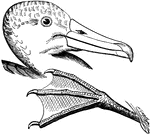
"Diomedea brachyura. Short-tailed Albatross. Bill 5.00 or 6.00 inches long, with long, with moderately concave culmen and prominent hook. Frontal feathers forming almost no reentrance on culmen, running nearly straight around whole base of upper mandible, and extending scarcely farther on sides of under mandible, with hardly any convexity. Tail very short, contained rather more than 3 times in length of wing. Adult plumage white, the head and neck usually washed with shining rusty-yellow; wings and tail dark or blackish, with a wholly indeterminate amount of white on the coverts and inner quills - sometimes nearly all the wing-coverts white excepting a line along the border of the fore-arm - sometimes the white restricted to a small space at the elbow. Bill pale reddish-yellow, drying pale dingy-yellowish; feet flesh-color." Elliot Coues, 1884

Bill and Foot of a Short-tailed Albatross

"Diomedea brachyura. Short-tailed Albatross. Bill 5.00 or 6.00 inches long, with long, with moderately…
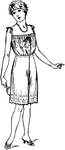
This is an early 20th century lady's undergarment. It is designed in a knee length short style. It has lace material at the top and bottom edges, and a small belt at the waist.

Early 20th Century Lady's Undergarment

This is an early 20th century lady's undergarment. It is designed in a knee length short style. It has…
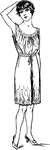
This is an early 20th century lady's undergarment. It is designed in a knee length short style. It has lace material at the top and bottom edges, and a small belt that ties at the waist.

Early 20th Century Lady's Undergarment

This is an early 20th century lady's undergarment. It is designed in a knee length short style. It has…
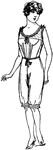
This is an early 20th century lady's undergarment. It is designed in a knee length short style. It has lace trimming at the top and bottom edges, and a small belt at the waist.

Early 20th Century Lady's Undergarment

This is an early 20th century lady's undergarment. It is designed in a knee length short style. It has…
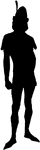
This 1350 Silhouette of man is a black outline that shows the fashion of men during that period. The man is wearing a short sleeve shirt, tight fitting pants, and a pointed hat with a feather.

1350 Silhouette of Man

This 1350 Silhouette of man is a black outline that shows the fashion of men during that period. The…
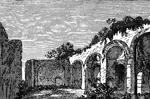
The ruins of the baths of Caracalla were roman public baths built in Rome, Italy between AD 212 and 216, during the reign of the emperor Caracalla. At the time, the baths included marble seats for bathers, a public library, gymnasiums and restaurants.

Ruins of the Baths of Caracalla

The ruins of the baths of Caracalla were roman public baths built in Rome, Italy between AD 212 and…
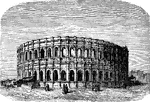
The arena of Nîmes is a Roman amphitheater located in city of Nimes, France. The amphitheater was built around 70 A.D. during the time of Emperor Caesar Augustus. The structure is designed in an enclosed ellipsis.

The Arena of Nîmes

The arena of Nîmes is a Roman amphitheater located in city of Nimes, France. The amphitheater was built…
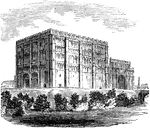
The Norwich Castle was built in 1067 by the order of William the Conquerer, who was King of England at the time. The castle was built to be used as fortification in the city of Norwich, England.

Norwich Castle

The Norwich Castle was built in 1067 by the order of William the Conquerer, who was King of England…
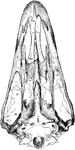
"Dromaeognathous skull of ostrich, nat. size specimen no. 16,629, U.S. Nat Museum, by Dr. R. W. Shufeldt, U.S.A. RR, rostrum, beyond which the ossified nasal septum continues in the axis of the skull to the letters "Pmx." V, the short vomer, borne upon R, uniting laterally with Mxp, the broad maxillo-palatines; Pl, palatines, remote from rostrum, underrunning beyond Mxp, but not to Pmx. Pt, expanded scroll-like pterygoids, atriculating behind with Btp, the strong basipterygoid processes on the body (not rostum) of the sphenoid; they underlap R, but do not articulate there. Pmx, premaxillaries; Mx, maxillaries, whose ends run forward to opposite the letters "Pmx"; jugal; qj, quadrato-jugal; Qu, quadrate. (N.B. This is the most exceptional case of dromaeognathism. Each of the Ratite families - Struthionidae, Rheidae, Casuariidae, Dinornithidae, and Apterygidae, - as well as the Carinate family Tinamidae, offers a special case of such formation, as explained in the text.)." Elliot Coues, 1884

The Skull Structure of an Ostrich

"Dromaeognathous skull of ostrich, nat. size specimen no. 16,629, U.S. Nat Museum, by Dr. R. W. Shufeldt,…
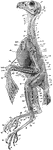
"Muscles of a bird (accipiter nisus), after Carus, Tab. Anat. Comp., 1828, pl. 4.   a, pharynx; b, trachea; e, hyoid bone; d, ear; e, humerous; f, radius; g, ulna; h, radial finger; i, tibia; k, metatarsus; l, hind toe; m, inner toe; n, middle toe; o, outer toe. 1, biventer cervicis, with central tendon 1 a, and upper 1 b, and lower 1 c, belly. 2, complexus. 3, flexor capitis lateralis. 4, flexor longus capitis. 5, extensor magnus cervicis. 6, descendens cervicis. 7, 7, semispinales. 8, flexorsuperior capitis. 9, flexor inferior or longus capitis. 10, 10, intertransversales. 11, levator coccygis. 12, depressor coccygis. 13, cruro-coccygeus (ilio-coccygeus?). 14, pubo-coccygeus. 15 ischio-coccygeus. 16, lateralis quartus (quadratus coccygis, to tail-feathers). 17, obliquus externus abdominis. 18, cucullaris (trapezius). 19, serratus magnus. 20, pectoralis major. 21, a, b, latissimus dorsi. 22, deltoid. 23, suprascapular. 24, coraco-brachialis. 25, biceps brachii. 26, supinatpr longus. 27, anconeus longus (part of "triceps"). 28, anconeus brevis. 29, anconeus brevissimus. 30 a, 30 b, tensor patagii, carpal and radial parts. 31, tensor patagii posterior. 32, extensormetacarpi longus. 33, extensor metacarpi brevis. 34 a, flexor digitorum sublimis. 34 b, flexor digitorum profundus. 34 c, flexor metacarpi radialis. 36, flexor (meta-) carpi ulnaris. 37, glutaeus maximus. 38, adductor femoris primus. 39, sartorius. 40, latissimus femoris. 41, gracilis = ambiens: only its tendon in sight. 42, vastus; 43, iceps cruris. 44, semimembranosus. 46,46,47, gastrocnemius. 48 digastricus (chief opener of the mouth). 49, temporal. 50, long ligament. 51, cutaneous muscle of scalp. 52, masseter. 53, a muscle of the hyoid bone. 54, tibialis anticus. 55, tibialis posticus. 56, extensor hallucis. 57, flexor hallucis. 58, flaxor digitorum profundus or perforans, seen in various places: long and short head, and several tendons. 59, extensor longus digitorum, tendons seen in various places 60, abductor digiti interni. 61,61,61, flexores digitorum perforati. 62, peronaeus. 63, abductor minimi digiti. 64, abductor hallucis." Elliot Coues, 1884

Eurasian Sparrowhawk Muscles

"Muscles of a bird (accipiter nisus), after Carus, Tab. Anat. Comp., 1828, pl. 4. a, pharynx; b, trachea;…
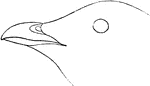
"Alle. Sea Dove. Size small. Bill very short, stout, and obtuse, as well as high at base, the sides of both mandibles turgid, the edge of the upper much infected; culmen very convex; rictus ample, decurved at end; gonys straight, very short, the mandibular rami correspondingly long, and widely divaricated; nasal fossae short, wide, deep, partly, patly feathered. Nostrils sub basal, more nearly circular than in any other genus excepting the next." Elliot Coues, 1884

Sea Dove Bill

"Alle. Sea Dove. Size small. Bill very short, stout, and obtuse, as well as high at base, the sides…
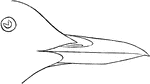
"Uria grylle. Black Guillemots. Bill much shorter than head, about equal to tarsus, straight, rather stout, moderately compressed; culmen at first straight, then decurved; gape straight to near tip; gonys short straight, ascending, about 1/2 as long as culmen. No nick or groove near tip of upper mandible; its tomial edge scarcely inflected. Nasal fossae large and deep, partially filled with feathers which do not entirely cover the nostrils." Elliot Coues, 1884

Black Guillemot Bill

"Uria grylle. Black Guillemots. Bill much shorter than head, about equal to tarsus, straight, rather…
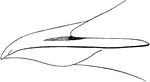
"Lomvia arra. Thick-billed Guillemot. Arrie. Bill short, stout, wide, deep; culmen curved throughout; commissure decurved at end; gonys if anything concave in outline, the angle very protuberant; cutting edges of the upper mandible dilated and denuded toward the base, this bare turgid space flesh-colored in life, drying pale yellowish." Elliot Coues, 1884

Thick-billed Guillemot Bill

"Lomvia arra. Thick-billed Guillemot. Arrie. Bill short, stout, wide, deep; culmen curved throughout;…
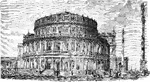
"In Dresden, owing to the method of instruction in the technical schools, as well as to the influence of the buildings, as, for instance, those by Zwinger, and the new theatre by Semper, the Renaissance style is the one preferred by the architects who have been there educated."The Semperoper is the opera house of the Saxon State Opera Dresden (German: Sächsische Staatsoper Dresden) and the concert hall of the Sächsische Staatskapelle Dresden in Dresden, Germany. It was first built in 1841, by architect Gottfried Semper.The building style itself is debated among many, as it has features that appear in the Early Renaissance style, Baroque and even features Corinthian style pillars typical of classical Greece (classical revival). Perhaps the most suitable label for this style would be Eclecticism; where influences from many styles are used- a practice most common during this period.It had to be rebuilt after a fire destroyed it in 1869. The citizenry demanded that Gottfried Semper do the reconstruction, even though he was in exile at the time because of his activities in the May Uprising in Dresden in 1849. So the architect had his son Manfred Semper complete the second opera house with his father's plans. This second one was constructed in Neo-Renaissance style in 1878. During construction, performances were held at the Gewerbehausall, which opened in 1870.The building is considered to be a prime example of "Dresden-Baroque" architecture. It is situated on the Theater Square in central Dresden on the bank of the Elbe River. On top of the portal there is a Panther quadriga with a statue of Dionysos. The interior was created by such famous architects of the time as Johannes Schilling. Monuments on the portal depict famous artists such as Johann Wolfgang von Goethe and Friedrich Schiller, William Shakespeare, Sophocles, Molière and Euripides. The building also features work by Ernst Rietschel and Ernst Julius Hähnel.In the pre-war years, the building premiered many of the works of Richard Strauss.During the last weeks of World War II in 1945 the building was destroyed again - this time by Allied bombing and the subsequent fire storms. Exactly 40 years later, on February 13, 1985 the opera was rebuilt almost the same as it was before the war. It reopened with the same opera that was performed last before the destruction in 1945: Weber's Der Freischütz.During the flood of the Elbe in 2002 the building suffered heavy water damage. With substantial help from around the world, it reopened in December 2002.Today, most operas are accompanied by the Sächsische Staatskapelle Dresden.

Theatre at Dresden

"In Dresden, owing to the method of instruction in the technical schools, as well as to the influence…
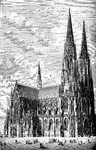
"In this city many individual tendencies are perceptible, but the predominant inclination is toward the Italian Renaissance . The new Opera-House, built by Van der Nüll and Siccardsburg, forms an exception to this rule, the design and forms of which were copied from the Early French Renaissance, with its narrow moulding and flat elliptical arches. On the other hand, the models of the thirteenth and fourteenth centuries are chosen for churches built in the Gothic style. In its richest phase this is seen in the memorial church, built by Ferstel; and in its poorest aspect, and divested of all the ornamental details necessary to produce a good effect, in the Lazaristen Kirche, built by Schmidt, one of the most important representatives of the Gothic style, and at the same time an advocate in word and deed for its reintroduction."The Votivkirche in Vienna, Austria, is one of the most important neo-Gothic religious architectural sites in the world.

Vienna, Memorial Church

"In this city many individual tendencies are perceptible, but the predominant inclination is toward…
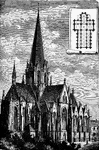
"In this city many individual tendencies are perceptible, but the predominant inclination is toward the Italian Renaissance . The new Opera-House, built by Van der Nüll and Siccardsburg, forms an exception to this rule, the design and forms of which were copied from the Early French Renaissance, with its narrow moulding and flat elliptical arches. On the other hand, the models of the thirteenth and fourteenth centuries are chosen for churches built in the Gothic style. In its richest phase this is seen in the memorial church, built by Ferstel; and in its poorest aspect, and divested of all the ornamental details necessary to produce a good effect, in the Lazaristen Kirche, built by Schmidt, one of the most important representatives of the Gothic style, and at the same time an advocate in word and deed for its reintroduction."The Lazaristenkirche is a Roman Catholic church building in the 7th district of Vienna, Neubau.

Lazarist Church at Vienna

"In this city many individual tendencies are perceptible, but the predominant inclination is toward…
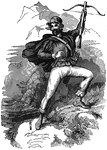
William Tell was known as an expert marksman with the crossbow. At the time, Habsburg emperors were seeking to dominate Uri. Hermann Gessler, the newly appointed Austrian Vogt of Altdorf raised a pole in the village's central square with his hat on top and demanded that all the local townsfolk bow before it. Tell passed without bowing, and was arrested. His punishment, being forced to shoot an apple off the head of his son, Walter, or else both would be executed. Tell had been promised freedom if he shot the apple. Tell split the fruit with a single bolt from his crossbow. When Gessler queried him about the purpose of the second bolt in his quiver, Tell answered that if he had ended up killing his son in that trial, he would have turned the crossbow on Gessler himself. Gessler became enraged at that comment, and had Tell bound and brought to his ship to be taken to his castle at Küssnacht. In a storm on Lake Lucerne, Tell managed to escape. He went to Küssnacht, and when Gessler arrived, Tell shot him. Tell's defiance of Gessler sparked a rebellion leading to the formation of the Swiss Confederation.

William Tell

William Tell was known as an expert marksman with the crossbow. At the time, Habsburg emperors were…
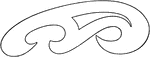
An ellipse French curve, or irregular curve, is used to draw short elliptical radius curves by using points.

Ellipse Curve French Curves

An ellipse French curve, or irregular curve, is used to draw short elliptical radius curves by using…
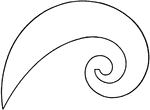
A Logarithmic Spiral French curve, or irregular curve, is used to draw short elliptical radius curves by using points. The log curve is approximately closely shaped to a cycloid and other mathematical curves.

Logarithmic Spiral Curve French Curves

A Logarithmic Spiral French curve, or irregular curve, is used to draw short elliptical radius curves…
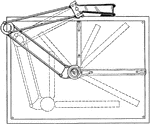
The Universal Drafting Machine is used in a large drafting room. It combines the functions of T-square, triangle, scale, and protractor to save time in machine drawing and civil engineering work.

Universal Drafting Machine

The Universal Drafting Machine is used in a large drafting room. It combines the functions of T-square,…
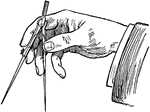
For better control of the divider, hold the divider with the thumb and the index finger on the outside of the legs, and the middle and ring finger inside the leg. The head of the divider should be resting above the second joint of index finger.

Divider Holding Position

For better control of the divider, hold the divider with the thumb and the index finger on the outside…
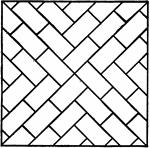
"An exercise in starting and stopping short lines. Draw three-inch square. Draw diagonals with 45-degree triangle. With scale lay off 3/8" spaces along the diagonals, from their intersection. With 45-degree triangle complete figure, finishing one-quarter at a time." —French, 1911

Drawing Street Paving Intersection

"An exercise in starting and stopping short lines. Draw three-inch square. Draw diagonals with 45-degree…

"The upright single-stroke "commercial gothic" letter is a standard for titles, reference letters, etc. In the proportion of width to height the general rule is that the smaller the letters the more extended their width should be. A low extended letter is more legible than a high compressed one and at the same time makes a better appearance." —French, 1911

Upright Single Stroke Capitals

"The upright single-stroke "commercial gothic" letter is a standard for titles, reference letters, etc.…
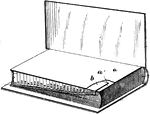
An index is a list of words or phrases and associated points to where useful material relating to that heading can be found in a document. In this traditional back-of-the-book index the headings will include names of people, places and events, and concepts selected by a person as being relevant and of interest to a possible reader of the book.

Index Device for Books

An index is a list of words or phrases and associated points to where useful material relating to that…
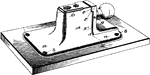
The study experimented with the processing of nuts, and the first step in the process was, of course, cracking the nuts. To do this nuts were placed, one at a time, on stone or an anvil stone and then struck with a smaller hammer stone. As nuts were cracked in this manner a pit developed in the lower stone; the pit deepened as additional nuts were cracked, and this facilitated the cracking process since nuts were held rather stationary in this seat.

Nut Cracking Anvil

The study experimented with the processing of nuts, and the first step in the process was, of course,…
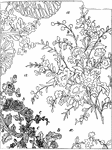
This check is a pattern consisting of crossed horizontal and vertical bands in two or more colors in woven cloth. Checks are traditionally associated with the with Celtic countries, especially Scotland where woven dyed wool was, at one time, a principal cloth. District checks were created as camouflage for moving inconspicuously on the laird's lands.

Manufacture of Figured Fabrics

This check is a pattern consisting of crossed horizontal and vertical bands in two or more colors in…
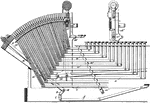
A Linotype machine is a line casting machine used in printing. The machine revolutionized printing and especially newspaper publishing, making it possible for a relatively small number of operators to set type for many pages on a daily basis. The Linotype machine operator enters text on a 90-character keyboard. The machine assembles matrices, which are molds for the letter forms, into a line. The assembled line is then cast as a single piece, called a slug, of type metal in a process known as hot metal typesetting. The matrices are then returned to the type magazine from which they came. The name of the machine comes from the fact that it produces an entire line of metal type at once, hence a line-o-type. This allows much faster typesetting and composition than original hand composition in which operators place down one pre cast metal letter, punctuation mark or space at a time.

Linotype Machine

A Linotype machine is a line casting machine used in printing. The machine revolutionized printing and…
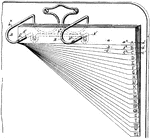
An index is a system used to make finding information easier. In a traditional back-of-the-book index the headings will include names of people, places and events, and concepts selected by a person as being relevant and of interest to a possible reader of the book.

File Index

An index is a system used to make finding information easier. In a traditional back-of-the-book index…
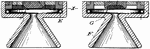
Credit for the invention of the electric telephone is frequently disputed, and new controversies over the issue have arisen from time-to-time. As with other great inventions such as radio, television, light bulb, and computer, there were several inventors who did pioneering experimental work on voice transmission over a wire and improved on each other's ideas.

Telephone Transmitting Device

Credit for the invention of the electric telephone is frequently disputed, and new controversies over…
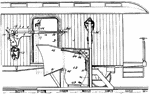
One or more mail pieces are disposed in each holder, such that all of the mail pieces in each holder are to be delivered to the same recipient. The holders are stacked in a predetermined order for a carrier delivery route, and may be banded or otherwise secured together until the time of delivery.

Mail Bag Delivering Machine

One or more mail pieces are disposed in each holder, such that all of the mail pieces in each holder…
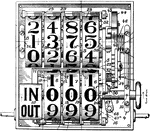
The Ohmer fare register was, in various models, a mechanical device for registering and recording the fares of passengers on streetcars, busses and taxis in the early 20th century. It was invented and improved by members and employees of the Ohmer family of Dayton, Ohio. This latter company employed up to 9,000 people at one time and was a major manufacturer of precision equipment during World War 1.

Ohmer Fare Register

The Ohmer fare register was, in various models, a mechanical device for registering and recording the…
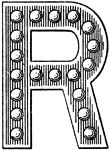
This is a letter sign shaped into the letter R. This sign features 19 small light bulbs for night time illumination.

Letter Sign R

This is a letter sign shaped into the letter R. This sign features 19 small light bulbs for night time…
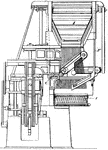
The Linotype machine is a line casting machine that is commonly used in printing. This machine modernized printing in particular the newspaper publishing companies. Linotypes made possible for a relatively small number of operators to set type for many pages on a daily basis.

Early Model Linotype Machine

The Linotype machine is a line casting machine that is commonly used in printing. This machine modernized…
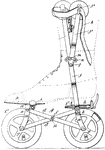
A skating category that lies somewhere between aggressive and recreational skating, free skating, also known as urban skating or free riding, includes many tricks such as jumps, slides, and grinds. The emphasis of free skating is getting from A to B by the fastest possible route, by skating quickly through city streets and negotiating all obstacles. The boots on skates suitable for free skating tend to be more rigid for better leg support, like the aggressive skate, whilst the wheels tend to be rather big, like those found on recreational skates, and the frames short, like those found on hockey skates.

Two Wheeled Cycle Skate

A skating category that lies somewhere between aggressive and recreational skating, free skating, also…
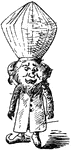
One of the more prominent places people see costumes is in theater, film and on television. In combination with other aspects, theatrical costumes can help actors portray characters' age, gender role, profession, social class, personality, and even information about the historical period/era, geographic location and time of day, as well as the season or weather of the theatrical performance. Often, stylized theatrical costumes can exaggerate some aspect of a character; for example Harlequin and Pantaloon in the Commedia dell'Arte.

Theatrical Costume

One of the more prominent places people see costumes is in theater, film and on television. In combination…
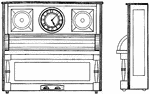
A longcase clock, also tall-case clock, floor clock, or grandfather clock, is a tall, freestanding, weight-driven pendulum clock with the pendulum held inside the tower, or waist of the case. The English clockmaker William Clement is credited with the development of this form in 1670. Most longcase clocks are striking clocks, which means they sound the time on each hour or fraction of an hour.

Long Case Clock

A longcase clock, also tall-case clock, floor clock, or grandfather clock, is a tall, freestanding,…
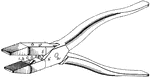
Pliers are a hand tool used to hold objects firmly, or for cutting and bending tough materials such as wire. Generally pliers consist of a pair of metal first class levers joined at a fulcrum positioned closer o one end of the levers, creating short jaws on one side of the fulcrum, and longer handles on the other side.

Cutting Pliers

Pliers are a hand tool used to hold objects firmly, or for cutting and bending tough materials such…
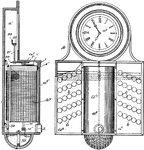
A time clock, sometimes known as a clock card machine or punch clock or time recorder, is a mechanical timepiece used to assist in tracking the hours an employee of a company worked. In regards to mechanical time clocks this was accomplished by inserting a heavy paper card, called a time card, into a slot on the time clock. When the time card hit a contact at the rear of the slot, the machine would print day and time information on the card. This allowed a timekeeper to have an official record of the hours an employee worked to calculate and pay an employee.

Workman's Time Recorder

A time clock, sometimes known as a clock card machine or punch clock or time recorder, is a mechanical…