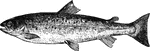
"The salmon two to four feet long, and weighs ten to twelve pounds, though it has been taken of eights andd even a hundred pounds. The form is long and oval, the scales moderately thin, oval, and rather easily detached; the teeth numerous, sharp and incurved; branchial rays twelve, color above blueish-black, tinged with gray; beneath silvery white." — Goodrich, 1859

Salmon

"The salmon two to four feet long, and weighs ten to twelve pounds, though it has been taken of eights…
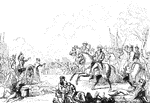
"The field of Monmouth. In the picture here given, the chief is seen most prominently on his white charger, with his general officers. Washington and Green are in front; Knox on the right, upon the most prominent horse; and behind them are Hamilton, Cadwallader, etc. On the left is seen the group of artillery, with 'Captain Molly' at the gun. In the distance is seen a portion of the British army, and Colonel Monckton falling from his horse. On the right, in the foreground, lying by a cannon, is Dickinson, of Virginia; and on the left, by a drum, Bonner, of Pennsylvania. In the center is a wounded rifleman."—Lossing, 1851

Monmouth

"The field of Monmouth. In the picture here given, the chief is seen most prominently on his white charger,…
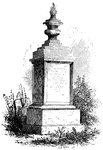
"Woodhull's Monument. This monument stands on the south side of the church. It is of white marble, about eight feet in height. The following is the inscription upon it: 'Sacred to the memory of the Reverend John Woodhull, D.D., who died Nov. 22d, 1824, aged 80 years. An able, faithful, and beloved minister of Jesus Christ. He preached the Gospel 56 years. He was settled first in Leacock, in Pennsylvania, and in 1779 removed to this congregation, which he served as pastor, with great diligence and success, for 45 years. Eminent as an instructor of youth, zealous for the glory of God, fervent and active in the discharge of all public and private duties, the labors of a long life have ended ina large reward.'"—Lossing, 1851

Woodhull's Monument

"Woodhull's Monument. This monument stands on the south side of the church. It is of white marble, about…
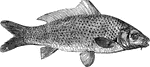
"It is ten to forty inches long, and sometimes attains the weight of a hundred pounds; the general color is rich olive-brown above, yellowish-white beneath." — Goodrich, 1859

Common Carp

"It is ten to forty inches long, and sometimes attains the weight of a hundred pounds; the general color…
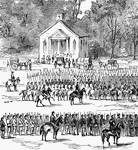
"Battle at Willis Church, Monday, June 30th, 1862- the Federal forces, under General Heintzelman, engaged with the enemy. This desperate battle between the Confederates on one hand and the divisions of General Heintzelman and Franklin on the other was fought on the morning of Monday, June 30th, 1862, at Willis Church, a place midway between the White Oak Swamp Bridge and Turkey Bend, where, later in the day, another fierce fight raged, the week of combat being closed next day by the deadly but drawn battle of Malvern Hill. Our sketch represents the position of part of the Federal army at ten o'clock in the morning, just as the battle was commencing. The baggage train is in the foreground, and the enemy is advancing upon the Federal lines, and covering the advance with a heavy shower of shells. Willis Church is on the left of the illustration, being what most of the Southern places of worship were, mere wooden barns." —Leslie, 1896

Battle at Willis Church

"Battle at Willis Church, Monday, June 30th, 1862- the Federal forces, under General Heintzelman, engaged…
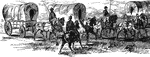
Horses and wagons at the Battle of Willis Church.

Horses and Wagons

Horses and wagons at the Battle of Willis Church.

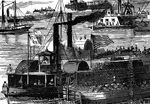
Ships at the burning of the White House.

Ship

Ships at the burning of the White House.

Ships at the burning of the White House.

Ship

Ships at the burning of the White House.

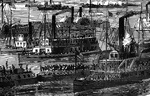
"Burning of the White House- the Federal troops, by command of General McClellan, abandoning their position at the White House, and breaking up the commisariat depot on the Pamunkey River- departure of the Union flortilla for the James River, June 26th, 1862. The Confederate raid of Stuart's cavalry at Garlick's Landing and Tunstall's Station had struck the occupants of the White House Landing with a deep sense of insecurity; and, consequently, when they received orders on Wednesday, June 25th, to prepare for the hasty removal of all the government stores, they set to work with great activity, and by Thursday the greater portion of the heavy stores were embarked on board the numerous transports lying in the river. Unfortunately, through some accident the White house took fire, and the house of Washington's wife was soon destroyed." — Frank Leslie, 1896

Burning of the White House

"Burning of the White House- the Federal troops, by command of General McClellan, abandoning their position…
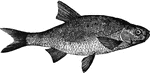
"The Azurine or Blue Roach, <em>L. ceruleus</em>, is a small fish, seldom exceeding a pound in weight; the flesh is firm, and of good flavour." &mdash; Goodrich, 1859

Blue Roach

"The Azurine or Blue Roach, L. ceruleus, is a small fish, seldom exceeding a pound in weight;…

"Siege of Petersburg- the Ninth Corps charging on the enemy's works after the explosion of the mine, July 30th, 1864. Immediately after the explosion of the mine a hundred cannons opened along the Federal front, and at half-past five the Ninth Corps charged, carrying the fort with a part of the line on each side. The Second Division, which was in the centre, advanced and carried the second line a short distance beyond the fort, and rested, holding ground with the utmost determination. It was at the time the [African American] Division, under General White, was pushed forward and ordered to charge and carry the crest of the hill, which would have decided the contest. The troops advanced in good order as far as the first line, where they received a galling fire, which checked them, and although quite a number kept on advancing, the greater number seemed to become utterly demoralized, part taking refuge in the fort, and the remainder running to the rear as fast as possible. They were rallied and again pushed forward, but without success, the greater part of the officers being killed or wounded."&mdash; Frank Leslie, 1896

Siege of Petersburg

"Siege of Petersburg- the Ninth Corps charging on the enemy's works after the explosion of the mine,…
"Siege of Petersburg- the Ninth Corps charging on the enemy's works after the explosion of the mine, July 30th, 1864. Immediately after the explosion of the mine a hundred cannons opened along the Federal front, and at half-past five the Ninth Corps charged, carrying the fort with a part of the line on each side. The Second Division, which was in the centre, advanced and carried the second line a short distance beyond the fort, and rested, holding ground with the utmost determination. It was at the time the [African American] Division, under General White, was pushed forward and ordered to charge and carry the crest of the hill, which would have decided the contest. The troops advanced in good order as far as the first line, where they received a galling fire, which checked them, and although quite a number kept on advancing, the greater number seemed to become utterly demoralized, part taking refuge in the fort, and the remainder running to the rear as fast as possible. They were rallied and again pushed forward, but without success, the greater part of the officers being killed or wounded."&mdash; Frank Leslie, 1896

Siege of Petersburg

"Siege of Petersburg- the Ninth Corps charging on the enemy's works after the explosion of the mine,…

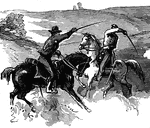
"Desperate skirmish at Old Church, near Tunstall's Station, VA., between a squadron of the Fifth United States Cavalry and Stuart's Confederate Cavalry, June 13th, 1862- death of the Confederate Captain Latane. The Confederate cavalry raid was first to Old Church, where they had a skirmish with a squadron of the Fifth United States Cavalry, who gallantly cut their way through the greatly superior numbers of the enemy, killing a Confederate captain. The Confederates then proceeded to Garlick's Landing, on the Pamunkey River, and only four miles from the White House; thence to Baltimore Crossroads, near New Kent Courthouse, on their way to Richmond, which they reached by crossing the Chickahominy, between Bottom's Bridge and James River."&mdash; Frank Leslie, 1896

Old Church

"Desperate skirmish at Old Church, near Tunstall's Station, VA., between a squadron of the Fifth United…
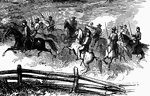
"Desperate skirmish at Old Church, near Tunstall's Station, VA., between a squadron of the Fifth United States Cavalry and Stuart's Confederate Cavalry, June 13th, 1862- death of the Confederate Captain Latane. The Confederate cavalry raid was first to Old Church, where they had a skirmish with a squadron of the Fifth United States Cavalry, who gallantly cut their way through the greatly superior numbers of the enemy, killing a Confederate captain. The Confederates then proceeded to Garlick's Landing, on the Pamunkey River, and only four miles from the White House; thence to Baltimore Crossroads, near New Kent Courthouse, on their way to Richmond, which they reached by crossing the Chickahominy, between Bottom's Bridge and James River."&mdash; Frank Leslie, 1896

Old Church

"Desperate skirmish at Old Church, near Tunstall's Station, VA., between a squadron of the Fifth United…
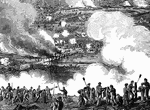
"Battle of White Oak Swamp Bridge, Monday June 30th, 1862- Ayres's, Mott's and Randall's batteries checking the advance of the Confederates. After the battle of Savage's Station the Federals continued on their retreat, and by eight o'clock on the morning of June 30th, 1862, they had crossed White Oak Swamp and Creek, after destroying the bridge over the latter and warding off the repeated attacks to which they were subjected throughout the night. After crossing White Oak Creek the Federals had quickly formed a new line of battle at Willis Church, General Hancock's forces being on the extreme right, while Porter's occupied the left, and Heintzelman's and Sumner's the intervening space. Jackson's advance was checked by the destruction of the bridge, and when he reached the creek, at about noon, he found the approaches well defended by artillery. Jackson opened upon Hancock's troops, and made repeated efforts to rebuild the bridge under cover of his heavy artillery, but he was every time repulsed. While this was going on Longstreet and Hill had come upon a Federal force at a place two miles away, called Frazier's Farm. Here stood Sumner and Hooker, on the extreme right, McCall somewhat in advance toward the centre and Kearny on the extreme left. When Longstreet found this force arrayed against him he waited for re-enforcements to come up, and it was four o'clock when he commenced the attack. McCall's left was first assailed by Kenper's brigade, which was met by the Pennsylvania Reserves under Colonel Simmons, who, after a bitter conflict, drove the Confederates into the woods with a loss of 250 killed and wounded and about 200 prisoners. Fresh troops then enabled the Confederates to drive back the Federals, who in turn lost heavily. Longstreet and Hill now pressed on, and the conflict became a severe one along the entire front. One point, then another, was vainly tried in the determined effort to break the Federal line. At length Wilcox's Alabama Brigade rushed across an open field upon McCall's left, directly against Randall's battery, which centered upon the Confederates a most galling fire. Nothing daunted, they moved on, and finally engaging in a desperate hand-to-hand fight, first captured Cooper's battery, and afterward Randall's battery, which had been doing such terrible execution. A charge was then ordered for the recapture of the guns. The Confederates bravely met the severe attacks that followed. A still more desperate hand-to-hand struggle took place for the possession of the lost batteries, which were finally recaptured. By dark the Confederates had retired into the woods, and the Federals remained on that portion of the field which they had lost earlier in the action. The Federal loss was about 1,800 killed and wounded, whilst that of the Confederates was over 2,000. Colonel Simmons and General Meade were both severely wounded, while General McCall was a made prisoner." —Leslie, 1896

Battle of White Oak Swamp Bridge

"Battle of White Oak Swamp Bridge, Monday June 30th, 1862- Ayres's, Mott's and Randall's batteries checking…
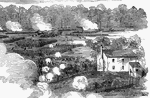
"Battle of White Oak Swamp Bridge, Monday June 30th, 1862- Ayres's, Mott's and Randall's batteries checking the advance of the Confederates. After the battle of Savage's Station the Federals continued on their retreat, and by eight o'clock on the morning of June 30th, 1862, they had crossed White Oak Swamp and Creek, after destroying the bridge over the latter and warding off the repeated attacks to which they were subjected throughout the night. After crossing White Oak Creek the Federals had quickly formed a new line of battle at Willis Church, General Hancock's forces being on the extreme right, while Porter's occupied the left, and Heintzelman's and Sumner's the intervening space. Jackson's advance was checked by the destruction of the bridge, and when he reached the creek, at about noon, he found the approaches well defended by artillery. Jackson opened upon Hancock's troops, and made repeated efforts to rebuild the bridge under cover of his heavy artillery, but he was every time repulsed. While this was going on Longstreet and Hill had come upon a Federal force at a place two miles away, called Frazier's Farm. Here stood Sumner and Hooker, on the extreme right, McCall somewhat in advance toward the centre and Kearny on the extreme left. When Longstreet found this force arrayed against him he waited for re-enforcements to come up, and it was four o'clock when he commenced the attack. McCall's left was first assailed by Kenper's brigade, which was met by the Pennsylvania Reserves under Colonel Simmons, who, after a bitter conflict, drove the Confederates into the woods with a loss of 250 killed and wounded and about 200 prisoners. Fresh troops then enabled the Confederates to drive back the Federals, who in turn lost heavily. Longstreet and Hill now pressed on, and the conflict became a severe one along the entire front. One point, then another, was vainly tried in the determined effort to break the Federal line. At length Wilcox's Alabama Brigade rushed across an open field upon McCall's left, directly against Randall's battery, which centered upon the Confederates a most galling fire. Nothing daunted, they moved on, and finally engaging in a desperate hand-to-hand fight, first captured Cooper's battery, and afterward Randall's battery, which had been doing such terrible execution. A charge was then ordered for the recapture of the guns. The Confederates bravely met the severe attacks that followed. A still more desperate hand-to-hand struggle took place for the possession of the lost batteries, which were finally recaptured. By dark the Confederates had retired into the woods, and the Federals remained on that portion of the field which they had lost earlier in the action. The Federal loss was about 1,800 killed and wounded, whilst that of the Confederates was over 2,000. Colonel Simmons and General Meade were both severely wounded, while General McCall was a made prisoner." —Leslie, 1896

Battle of White Oak Swamp Bridge

"Battle of White Oak Swamp Bridge, Monday June 30th, 1862- Ayres's, Mott's and Randall's batteries checking…
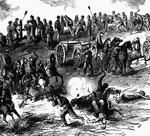
"Battle of White Oak Swamp Bridge, Monday June 30th, 1862- Ayres's, Mott's and Randall's batteries checking the advance of the Confederates. After the battle of Savage's Station the Federals continued on their retreat, and by eight o'clock on the morning of June 30th, 1862, they had crossed White Oak Swamp and Creek, after destroying the bridge over the latter and warding off the repeated attacks to which they were subjected throughout the night. After crossing White Oak Creek the Federals had quickly formed a new line of battle at Willis Church, General Hancock's forces being on the extreme right, while Porter's occupied the left, and Heintzelman's and Sumner's the intervening space. Jackson's advance was checked by the destruction of the bridge, and when he reached the creek, at about noon, he found the approaches well defended by artillery. Jackson opened upon Hancock's troops, and made repeated efforts to rebuild the bridge under cover of his heavy artillery, but he was every time repulsed. While this was going on Longstreet and Hill had come upon a Federal force at a place two miles away, called Frazier's Farm. Here stood Sumner and Hooker, on the extreme right, McCall somewhat in advance toward the centre and Kearny on the extreme left. When Longstreet found this force arrayed against him he waited for re-enforcements to come up, and it was four o'clock when he commenced the attack. McCall's left was first assailed by Kenper's brigade, which was met by the Pennsylvania Reserves under Colonel Simmons, who, after a bitter conflict, drove the Confederates into the woods with a loss of 250 killed and wounded and about 200 prisoners. Fresh troops then enabled the Confederates to drive back the Federals, who in turn lost heavily. Longstreet and Hill now pressed on, and the conflict became a severe one along the entire front. One point, then another, was vainly tried in the determined effort to break the Federal line. At length Wilcox's Alabama Brigade rushed across an open field upon McCall's left, directly against Randall's battery, which centered upon the Confederates a most galling fire. Nothing daunted, they moved on, and finally engaging in a desperate hand-to-hand fight, first captured Cooper's battery, and afterward Randall's battery, which had been doing such terrible execution. A charge was then ordered for the recapture of the guns. The Confederates bravely met the severe attacks that followed. A still more desperate hand-to-hand struggle took place for the possession of the lost batteries, which were finally recaptured. By dark the Confederates had retired into the woods, and the Federals remained on that portion of the field which they had lost earlier in the action. The Federal loss was about 1,800 killed and wounded, whilst that of the Confederates was over 2,000. Colonel Simmons and General Meade were both severely wounded, while General McCall was a made prisoner." —Leslie, 1896

Battle of White Oak Swamp Bridge

"Battle of White Oak Swamp Bridge, Monday June 30th, 1862- Ayres's, Mott's and Randall's batteries checking…
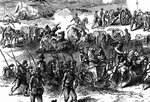
"Battle of White Oak Swamp Bridge, Monday June 30th, 1862- Ayres's, Mott's and Randall's batteries checking the advance of the Confederates. After the battle of Savage's Station the Federals continued on their retreat, and by eight o'clock on the morning of June 30th, 1862, they had crossed White Oak Swamp and Creek, after destroying the bridge over the latter and warding off the repeated attacks to which they were subjected throughout the night. After crossing White Oak Creek the Federals had quickly formed a new line of battle at Willis Church, General Hancock's forces being on the extreme right, while Porter's occupied the left, and Heintzelman's and Sumner's the intervening space. Jackson's advance was checked by the destruction of the bridge, and when he reached the creek, at about noon, he found the approaches well defended by artillery. Jackson opened upon Hancock's troops, and made repeated efforts to rebuild the bridge under cover of his heavy artillery, but he was every time repulsed. While this was going on Longstreet and Hill had come upon a Federal force at a place two miles away, called Frazier's Farm. Here stood Sumner and Hooker, on the extreme right, McCall somewhat in advance toward the centre and Kearny on the extreme left. When Longstreet found this force arrayed against him he waited for re-enforcements to come up, and it was four o'clock when he commenced the attack. McCall's left was first assailed by Kenper's brigade, which was met by the Pennsylvania Reserves under Colonel Simmons, who, after a bitter conflict, drove the Confederates into the woods with a loss of 250 killed and wounded and about 200 prisoners. Fresh troops then enabled the Confederates to drive back the Federals, who in turn lost heavily. Longstreet and Hill now pressed on, and the conflict became a severe one along the entire front. One point, then another, was vainly tried in the determined effort to break the Federal line. At length Wilcox's Alabama Brigade rushed across an open field upon McCall's left, directly against Randall's battery, which centered upon the Confederates a most galling fire. Nothing daunted, they moved on, and finally engaging in a desperate hand-to-hand fight, first captured Cooper's battery, and afterward Randall's battery, which had been doing such terrible execution. A charge was then ordered for the recapture of the guns. The Confederates bravely met the severe attacks that followed. A still more desperate hand-to-hand struggle took place for the possession of the lost batteries, which were finally recaptured. By dark the Confederates had retired into the woods, and the Federals remained on that portion of the field which they had lost earlier in the action. The Federal loss was about 1,800 killed and wounded, whilst that of the Confederates was over 2,000. Colonel Simmons and General Meade were both severely wounded, while General McCall was a made prisoner." —Leslie, 1896

Battle of White Oak Swamp Bridge

"Battle of White Oak Swamp Bridge, Monday June 30th, 1862- Ayres's, Mott's and Randall's batteries checking…
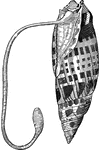
"Noted for a very long proboscis, sometimes twice the length of the shell. The latter is turretted, smooth, white, and spotted with light red." &mdash; Goodrich, 1859

Bishop's mitre shell

"Noted for a very long proboscis, sometimes twice the length of the shell. The latter is turretted,…
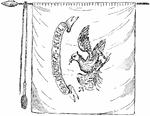
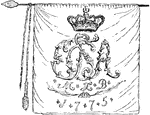
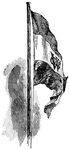
"View of the front of the Hessian Flag"&mdash;Lossing, 1851

Hessian Flag

"View of the front of the Hessian Flag"—Lossing, 1851

"View of the back of the Hessian Flag"&mdash;Lossing, 1851

Hessian Flag

"View of the back of the Hessian Flag"—Lossing, 1851

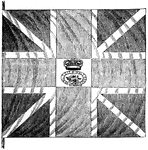
"British flag. This is a representation of one of the flags surrendered at Yorktown, and presented to Washington. I made this sketch of the flag itself, then in the Museum at Alexandria, in Virginia. It belonged to the seventh regiment. The size of the flag is six feet long, and five feet four inches wide. The ground is blue; the central stripe of the cross red; the marginal ones white. In the center is a crown, and beneath it a garter with its inscription, 'Honi soit qui mal y pense,' inclosing a full-blown rose. These are neatly embroidered with silk. The fabric of the flag is heavy twilled silk."&mdash;Lossing, 1851

British Flag

"British flag. This is a representation of one of the flags surrendered at Yorktown, and presented to…
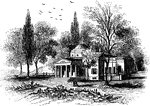
"Monticello, Governor Jefferson's place of retirement. This venerated mansion is yet standing, though somewhat dilapidated and deprived of its former beauty by neglect. The furniture of its distinguished owner is nearly all gone, except a few pictures and mirrors, otherwise the interior of the house is the same as when Jefferson died. It is upon an eminence, with many aspen-trees around it, and commands a view of the Blue Ridge for one hundred and fifty miles on one side, and on the other one of the most beautiful and extensive landscapes in the world. Wirt, writing of the interior arrangements of the house during Mr. Jefferson's life time, records that, in the spacious and lofty hall which opens to the visitor on entering, 'he marks no tawdry and unmeaning ornaments; but before, on the right, on the left, all around, the eye is struck and gratified by objects of science and taste, so classed and arranged as to produce their finest effect."&mdash;Lossing, 1851

Monticello

"Monticello, Governor Jefferson's place of retirement. This venerated mansion is yet standing, though…
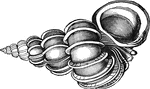
"The shell is mostly white and lustrous; turreted and many-whorled; the animal has a proboscis-like mouth, tentacles close together, long, and pointed, and the eyes near their outer bases." &mdash; Goodrich, 1859

Wentle-trap

"The shell is mostly white and lustrous; turreted and many-whorled; the animal has a proboscis-like…
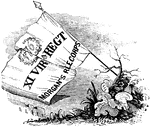
"Flag of Morgan's Rifle Corps."&mdash;Lossing, 1851

Morgan's Flag

"Flag of Morgan's Rifle Corps."—Lossing, 1851

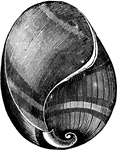
"The <em>B. velum</em> is very elegant, and of a light-brown color; the apex and base are both white, bordered with dark brown bands." &mdash; Goodrich, 1859

Bulla velum

"The B. velum is very elegant, and of a light-brown color; the apex and base are both white,…
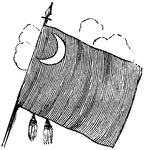
"South Carolina Flag."&mdash;Lossing, 1851

South Carolina Flag

"South Carolina Flag."—Lossing, 1851

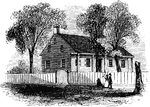
"Washington's head-quarters. The house occupied by Washington while the army was at White Plains is yet standing. It is a frame building, on the east side of the road, about two miles above the village. This view is from the road, looking northeast. When I last visited it (1851), Miss Jemima Miller, a maiden ninety-three yeras of age, and her sister, a few years her junior, were living therein, the home of their childhood. A chair and table, used by the chief, is carefully preserved by the family, and a register for the names of the numerous visitors is kept. This house was in the deep solitude of the forests, among the hills, when Washington was there; now the heights and the plain near by smile with cultivation."—Lossing, 1851

Washington's Head-Quarters

"Washington's head-quarters. The house occupied by Washington while the army was at White Plains is…
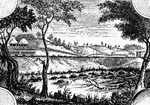
"Place where the British crossed the Bronx. This view is from the southeastern side of the Bronx, a little more than half a mile below the rail-way station at White Plains, looking north. The rail-way bridge is seen on the extreme right. Between that and the barn on the left the British ascended. In the field, seen a little to the left of the telegraph posts, toward the center, and the one on the summit beyond, the hottest of the engagement occurred. The latter is on the land of Mr. Cornelius Horton. In a hollow, near a large hickory-tree, on the southwest side of Chatterton's Hill, are the graves of many of the slain."&mdash;Lossing, 1851

Bronx

"Place where the British crossed the Bronx. This view is from the southeastern side of the Bronx, a…
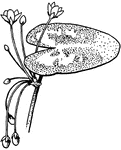
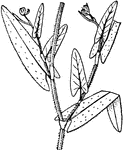
Leaves small, mostly less than 15cm. long, heart-shaped; flowers white and less than 2.5cm across.
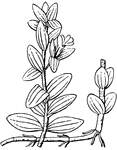
Nymphoides

Leaves small, mostly less than 15cm. long, heart-shaped; flowers white and less than 2.5cm across.
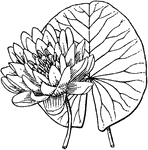
Flowers white; leaf-blade round.

Nymphaea

Flowers white; leaf-blade round.

Plants aromatic when crushed; flowers blue.

Hydrotrida

Plants aromatic when crushed; flowers blue.

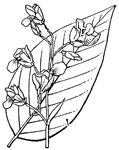
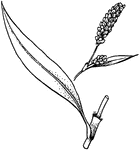
Stems with a sheath just above attachment point of leaf; flowers individually small, white to pink.
Polygonum

Stems with a sheath just above attachment point of leaf; flowers individually small, white to pink.

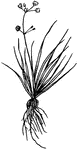
Leaves from base of scape bearing evident white flowers in racemes; roots without crss-constrictions.
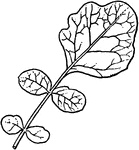
Sagittaria

Leaves from base of scape bearing evident white flowers in racemes; roots without crss-constrictions.
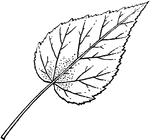
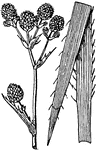
flowers white in dense button-like heads; leaves bristly-margined.

Eryngium

flowers white in dense button-like heads; leaves bristly-margined.

Flowers white.

Nasturtium

Flowers white.

Plant large, over 5dm tall; flowers large, white, pink, or purplish.

Hibiscus

Plant large, over 5dm tall; flowers large, white, pink, or purplish.

Sheaths around stem above each point of leaf-attachment; flowers white to red, not fragrant.

Polygonum

Sheaths around stem above each point of leaf-attachment; flowers white to red, not fragrant.
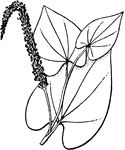
Stems with no sheaths; flowers white, fragrant.

Saururus

Stems with no sheaths; flowers white, fragrant.

Plants white-powdery above; plants extremely large, usually over 1 m.

Thalia

Plants white-powdery above; plants extremely large, usually over 1 m.

Leaves covered with tiny black dots visible with lens; flowers small, white.

Gratiola

Leaves covered with tiny black dots visible with lens; flowers small, white.

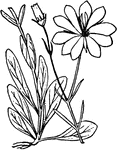
Flowers white, or, if pink, with a yellow or green eye in the center.

Sabatia

Flowers white, or, if pink, with a yellow or green eye in the center.

Flowers small, white, gathered in dense, sessile clusters in the axils of the leaves.

Lycopus

Flowers small, white, gathered in dense, sessile clusters in the axils of the leaves.

"Flag of the Dutch West India Company. When the rights of the company ceased, a new and more powerful company was forced in Holland in 1621, called the West India Company, with full control of New Netherland. It was a trading company like the others, but it was intended also to dispute the Spanish power in America. The Dutch captains, like the English, found a profitable business in capturing Spanish vessels. The West India Company encouraged people to settle on its lands; it explored the North River and the South River, now known as the Delaware; and villages grew up about Fort Orange, and at New Amsterdam, as the Dutch called the settlement on Manhattan Island."—Scudder, 1897

Dutch West India Flag

"Flag of the Dutch West India Company. When the rights of the company ceased, a new and more powerful…
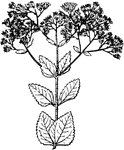
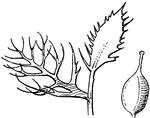
Flowers white or purplish.

Eupatorium

Flowers white or purplish.

Flowers conspicuous, white, 4-petaled.

Neobeckia

Flowers conspicuous, white, 4-petaled.

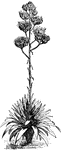
"Century-plant. A large North American genus of plants, of the natural order Amaryllidace&aelig;, chiefly Mexican."-Whitney, 1902

Agave

"Century-plant. A large North American genus of plants, of the natural order Amaryllidaceæ, chiefly…
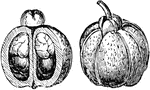
"&hellip;a fleshy fruit containing several large jet-black seeds partly embedded in a white spongy aril.."-Whitney, 1902

Akee fruit

"…a fleshy fruit containing several large jet-black seeds partly embedded in a white spongy aril.."-Whitney,…
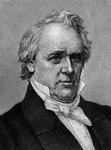
In 1859, John Brown collected a small body of men, white and black, in the mountains of Maryland. He made a sudden attack upon Harper's Ferry, where there was a United States arsenal, which he seized and held for a few hours. The attack was a direct assault upon slavery. Brown had resolved to carry the war into what he regarded as the enemy's country, and he expected to see the slaves flock to his standard. There were few at the North who knew of his purpose; and the country, North and South, was amazed at the act. John Brown was wounded and taken prisoner; some of his associates were killed, and some were taken with him. He was tried by the State of Virginia, sentenced, and hanged. His action was generally condemned by the people, but many declared him a martyr to freedom, and accused slavery of provoking him to the deed. His act, moreover, deepened the feeling of the South that the North was in a hostile attitiude; and public opinion at the South held the North responsible for Brown's movement."—Scudder, 1897

John Brown

In 1859, John Brown collected a small body of men, white and black, in the mountains of Maryland. He…
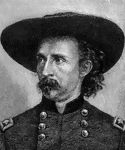
"George Armstrong Custer, a brilliant cavalry officer, was born at New Rumley, Ohio, December 5, 1839. He graduated at West Point, in 1861, and at once engaged in active service, being in the Bull Run battle. Throughout the war, it is said he never lost a gun or a flag, and captured more guns, flags and prisoners than any other officer not commanding an army. After the war he served on the frontier, and it was largely his reports of the fertility and mineral wealth of the Black Hills that stimulated the movement of population in that direction."&mdash;Scudder, 1897

George Armstrong Custer

"George Armstrong Custer, a brilliant cavalry officer, was born at New Rumley, Ohio, December 5, 1839.…
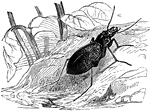
"The Blue Carabus, <em>C. cyaneus</em>, is an inch and a quarter long, the body oval, flat, and above of a brilliant blue." &mdash; Goodrich, 1859

Blue Carabus

"The Blue Carabus, C. cyaneus, is an inch and a quarter long, the body oval, flat, and above…
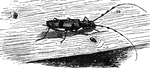
"Is of an ashy-blue color and is a very elegant species." &mdash Goodrich, 1859

Rosalie Beetle

"Is of an ashy-blue color and is a very elegant species." &mdash Goodrich, 1859

"The Sybil Butterfly, <em>P. Sybilla</em>, sometimes called the <em>Mourning Butterfly</em>, is a common European species, flying in the dog-days, the upper part of the wings of a brownish-black, with a white band across the middle; beneath they are of an ashy-blue, with black spots." &mdash; Goodrich, 1859

Sybil Butterfly

"The Sybil Butterfly, P. Sybilla, sometimes called the Mourning Butterfly, is a common…

"The Galatea Butterfly, <em>P. Galatea</em>, A Euoprean species, called <em>The Half-Mourning Butterfly</em>, has the wings slightly denticulated; they are of a brownish-yellow, with the base and extremities black, and spotted with white." &mdash; Goodrich, 1859

Half-Mourning Butterfly

"The Galatea Butterfly, P. Galatea, A Euoprean species, called The Half-Mourning Butterfly,…

"The Peacock-butterfly, <em>V. Io</em>, has the edges of the wings denticulated; above they are of a reddish-fawn, with a large eye-spot on each; those on the superior wings are red, encircled, with mingled black and yellow; those o nthe inferior ones are blue, with a black circle. It is a splendid European species, inhabiting woods, meadows, and gardens in October." &mdash; Goodrich, 1859

Peacock Butterfly

"The Peacock-butterfly, V. Io, has the edges of the wings denticulated; above they are of a…
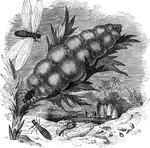
"These animals, often called <em>White Ants</em>, live in vast communities, principally in the hotter regions of the earth, where they do incredible damage by devouring almost every thing that comes in their way." &mdash; Goodrich, 1859

White Ants

"These animals, often called White Ants, live in vast communities, principally in the hotter…
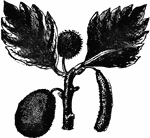
"The breadfruit is a large, globular fruit of a pale-green color, about the size of a child's head, marked on the surface with irregular six-sided depressions, and containing a white and somewhat fibrous pulp, which when ripe becomes juicy and yellow. The tree that produces it grows wild in Tahiti and other islands of the South Seas. it is about 40 feet high, with large and spreading branches, and has large bright green leaves, deeply divided into seven or nine spear-shaped lobes. The eatable part of this fruit lies between the skin and the core, and it is as white as snow and somewhat of the consistence of new bread."&mdash;(Charles Leonard-Stuart, 1911)

Breadfruit

"The breadfruit is a large, globular fruit of a pale-green color, about the size of a child's head,…
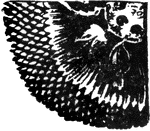
"The breadfruit is a large, globular fruit of a pale-green color, about the size of a child's head, marked on the surface with irregular six-sided depressions, and containing a white and somewhat fibrous pulp, which when ripe becomes juicy and yellow. The tree that produces it grows wild in Tahiti and other islands of the South Seas. it is about 40 feet high, with large and spreading branches, and has large bright green leaves, deeply divided into seven or nine spear-shaped lobes. The eatable part of this fruit lies between the skin and the core, and it is as white as snow and somewhat of the consistence of new bread."&mdash;(Charles Leonard-Stuart, 1911)

Breadfruit Fruit

"The breadfruit is a large, globular fruit of a pale-green color, about the size of a child's head,…
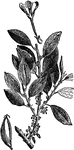
"Cacao, or cocoa, is the chocolate tree, and also the powder and beverage made with it obtained from the fruit of this tree. The tree is 16 to 18 feet high, a native of tropical America, and much cultivated in the tropics of both hemispheres, especially in the West India Islands, Central and South America. Its fruit is contained in pointed, oval, ribbed pods 6 to 10 inches long, each inclosing 50 to 100 seeds in a white, sweetish pulp. The term coca is a corruption of cacao, but is more commonly used in commerce: cocoa nuts, however, are obtained from an entirely different tree."&mdash;(Charles Leonard-Stuart, 1911)

Cacao Plant

"Cacao, or cocoa, is the chocolate tree, and also the powder and beverage made with it obtained from…
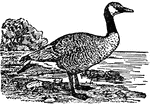
"The Canada Goose is an American wild goose 30 to 35 inches long, brownish above, lighter below, head, neck, bill and feet black, a white patch on the cheek; breeds in the N. of the continent and migrates S. when the frost becomes severe."&mdash;(Charles Leonard-Stuart, 1911)

Canada Goose

"The Canada Goose is an American wild goose 30 to 35 inches long, brownish above, lighter below, head,…