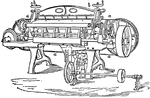
"In this machine the knife or cutter a is an endless band of steel which revolves at considerable speed with its cutting edges close to the sides of a pair of rollers through which the leather is fed and pressed against the knife. The lower of these rollers is made of short segments or rings, each separately capable of yielding to some extent so as to accommodate itself to the inequal thickness of various parts of a hide." —The Encyclopedia Britannica, 1910

Splitting Machine

"In this machine the knife or cutter a is an endless band of steel which revolves at considerable speed…
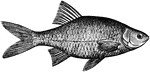
A fish with a red eye. Sometimes refered to as a pest in parts of the world because of its impact on native species.

Rudd

A fish with a red eye. Sometimes refered to as a pest in parts of the world because of its impact on…
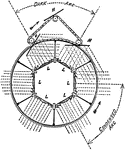
"Plane mirrors M revolve on an endless chain placed outside of the apparatus and alter the direction of the flashes after they pass into the dark arc on the landward side so as to cause the lenses L, L to repeat their flashes over the seaward are which requires strengthening. The condensing spherical mirror and mirror of unequal areas will also be found applicable in cases where the flashes do not require to sweep over the whole horizon." —The Encyclopedia Britannica, 1910

Repeating Light

"Plane mirrors M revolve on an endless chain placed outside of the apparatus and alter the direction…
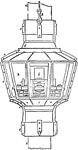
"aa is the mast, b tackle hook, c, c brass flanges for fixing parts of lantern together, e and g weather guards, h plate glass front of lantern, i shutter by which lamps are trimmed, k lamps, l silver reflector. Revolving catoptric apparatus was applied to floating lights in England, and M. Letourneau, in 1851, proposed to employ a number of sets of dioptric apparatus in one lantern." —The Encyclopedia Britannica, 1910

Floating Lights

"aa is the mast, b tackle hook, c, c brass flanges for fixing parts of lantern together, e and g weather…
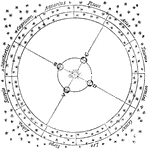
"The twelve signs of the zodiac, together with the Sun, and the Earth revolving around him. When the Earth is at A, the Sun will appear to be just entering the sign Aries, because then, when seen from the Earth, he ranges towards certain stars at the beginning of that constellation. When the Earth is at C, the Sun will appear in the opposite part of the heavens, and therefore in the beginning of Libra. The middle line, dividing the circle of the zodiac into equal parts, is the line of the ecliptic." —Comstock, 1850

Zodiac Signs

"The twelve signs of the zodiac, together with the Sun, and the Earth revolving around him. When the…
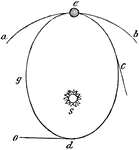
"Elliptical Orbits.—It has been supposed that the Sun's attraction, which constitutes the Earth's gravity, was at all times equal, or that the Earth was at an equal distance from the Sun, in all parts of its orbit." —Comstock, 1850

Planet Motion

"Elliptical Orbits.—It has been supposed that the Sun's attraction, which constitutes the Earth's…
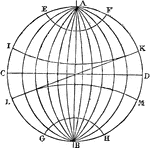
"The Earth, whose diameter is 7,912 miles, is represented by the globe, or sphere. The straight line passing through its center, and about which it turns, is called its axis, and the two extremities of the axis are the poles of the Earth, A being the north pole, and B the south pole. The line C D, crossing the axis, passes quite round the Earth, and divides it into two equal parts. This is called the equinoctial line, or the equator. That part of the Earth situated north of this line, is caled the northern hemisphere, and that part south of it, the southern hemisphere. The small circles E F and G H, surrounding or including the poles, are called the polar circles." —Comstock, 1850

Earth Divisions

"The Earth, whose diameter is 7,912 miles, is represented by the globe, or sphere. The straight line…
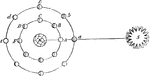
"Let S be the Sun, E the Earth, and A, B, C, D, F, the Moon in different parts of her orbit. Now when the Moon changes, or is in conjunction with the Sun, as at A, her dark side is turned towards the Earth, and she is invisible, as represented at a. The Sun always shines on one half of the Moon, in every direction, as represented at A and B, on the inner circle; but we at the Earth can see only such portions of the enlightened part as are turned towards us. After her change, when she has moved from A to B, a small part of her illuminated side comes in sight, and she appears horned, as at b, and is then called the new Moon. When she arrives at C, severel days afterwards, one half of her disc is visible, and she appears as at c, her appearance being the same in both circles. At this point she is said to be in her first quarter, because she has passed through a quarter of her orbit, and is 90 degrees from the place of her conjunction with the Sun. At D, she shows us still more of her enlightened side, and is then said to appear gibbous as at d. When she comes to F, her whole enlightened side is turned towards the Earth, and she appears in all the spendor of a full Moon." —Comstock, 1850

Moon Phases

"Let S be the Sun, E the Earth, and A, B, C, D, F, the Moon in different parts of her orbit. Now when…
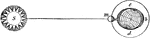
"Let m be the Moon, and E the Earth covered with water. As the Moon passes round the Earth, its solid and fluid parts are equally attracted by her influence according to their densities; but while the solid parts are at liberty to move only as a whole, the water obeys the slightest impulse, and thus tends towards the Moon where her attraction is the strongest. Consequently, the waters are perpetually elevated immediately under the Moon. If, therefore, the Earth stood still, the influence of the Moon's attraction would raise the tides only as she passed round the Earth. But as the Earth turns on her axis every 24 hours, and as the waters nearest the Moon, as at a, are constantly elevated, they will, in the course of 24 hours, move round the whole Earth, and consequently from this cause there will be high water at every place once in 24 hours." —Comstock, 1850

Tides

"Let m be the Moon, and E the Earth covered with water. As the Moon passes round the Earth, its solid…
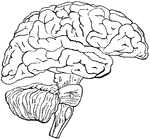
"Diagram illustrating the general relationships of the parts of the brain. A, fore-brain; b, midbrain; B, cerebellum; C, pons Varolii; D, medulla oblongata; B, C, and D together constitute the hind-brain." —Martin, 1917

Brain

"Diagram illustrating the general relationships of the parts of the brain. A, fore-brain; b, midbrain;…
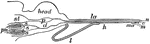
"Diagrammatic vertical section of the head and proboscis of a mosquito. l, labium bent as when the other parts pierce the skin; p, pumping organ; o, hypopharynx through which is a channel for the exit of the secretion of the poison and salivary glands pn and s; d, exit for poison and saliva; m, maxilla; ma, mandible; la, labrum below which is the channel conducting the food from the inlet at n; st, stomach." —Davison, 1906

Proboscis

"Diagrammatic vertical section of the head and proboscis of a mosquito. l, labium bent as when the other…
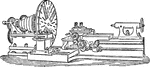
"Break lathes can take in work of considerable length as well as of large diameter,—the treble-geared headstock and all other parts being in their case made of sufficient strength to bear the heavy strains which result from the increased size and weight of the work, a quality in which gap lathes are not unfrequntly deficient." —The Encyclopedia Britannica, 1903

Break Lathe

"Break lathes can take in work of considerable length as well as of large diameter,—the treble-geared…
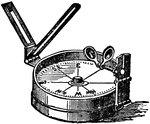
"At sea the declination is generally observed by means of an azimuth compass invented by Kater. It consists of a magnet with a graduated compass card attached to it. At the side of the instrument opposite the eye there is a frame which projects upwards from the plane of the instrument in a nearly vertical direction, and this frame contains a wide rectangular slit cut into two parts by a wire extending lengthwise. The eye-piece is opposite this frame, and the observer is supposed to point the instrument in such a manner that the wire above mentioned shall bisect the sun's visible disk. There is a totally reflecting glass prism which throws into the eye-piece an image of the scale of the graduated card, so that the observer, having first bisected the sun's disk by the wire, must next read the division of the scale which is in the middle of the field of view." —The Encyclopedia Britannica, 1903

Azimuth Compass

"At sea the declination is generally observed by means of an azimuth compass invented by Kater. It consists…
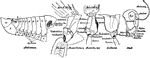
A grasshopper disarticulated and separated into regions, with all the parts named; the segments of the abdomen are numbered and are not alike on the dorsal and ventral surface.

Grasshopper

A grasshopper disarticulated and separated into regions, with all the parts named; the segments of the…
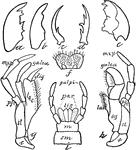
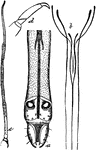
Mouth parts of a mandibulate insect: different types of mandibles at a <em>a</em>, <em>b</em>, <em>c</em>, <em>d</em>, <em>e</em>; <em>f</em>, the labrum-epipharynx; <em>g</em>, <em>h</em>, types of maxillae; the cardo at <em>c</em>; stipes, <em>st</em>; subgalea, <em>sg</em>; galea as marked; palpus bearer, <em>pfr</em>; palpus at <em>mxp</em>; lacinia at <em>lac</em>; and digitus at <em>dig</em>; <em>i</em>, the labium with sub-mentum, <em>sm</em>, mantum, <em>m</em>, ligula, <em>lig</em>, paraglossa, <em>par</em>, and palpi.

Mandibles

Mouth parts of a mandibulate insect: different types of mandibles at a a, b, c,…

Mouth parts of a plant-louse. -<em>a</em>, the jointed beak; <em>b</em>, the lancets, much enlarged; <em>c</em> and <em>d</em> illustrate the feeler and foot.

Mouth Parts of Plant Louse

Mouth parts of a plant-louse. -a, the jointed beak; b, the lancets, much enlarged;…
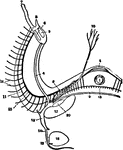
Diagram of nervous system of Crania; from the dorsal side. The nerves running to the dorsal parts are white, with black edges; those running to the ventral parts are solid black.

Brachiopoda

Diagram of nervous system of Crania; from the dorsal side. The nerves running to the dorsal parts are…
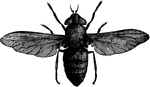
The horse-flies or <em>tabanidae</em>, comprise another set of troublesome creatures, of medium or large size. They have short, broad heads, enormous eyes, and short, though many jointed, feelers. The abdomen is oval, a little flattened, and the body convex and powerful. The mouth parts are well developed, consisting of a series of five sharped-pointed lancets so rigid that they readily pierce the skin and draw blood almost as soon as they touch.

Horse Fly

The horse-flies or tabanidae, comprise another set of troublesome creatures, of medium or large…
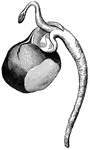
Horse-chestnut in germination; footstalks are formed to the cotyledons, pushing out in their lengthening the growing parts.

Horse Chestnut in Germination

Horse-chestnut in germination; footstalks are formed to the cotyledons, pushing out in their lengthening…
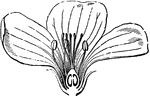
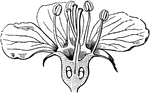
Flax-flower in section; the parts all free,-hypogenous.

Flax-Flower

Flax-flower in section; the parts all free,-hypogenous.

Hawthorn-blossom in section; parts adnate to whole face of ovary. and with each other beyond; another grade of perigynous.

Hawthorn Blossom

Hawthorn-blossom in section; parts adnate to whole face of ovary. and with each other beyond; another…
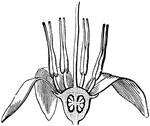
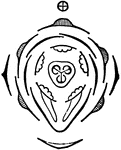
Cranberry-blossom in section; parts epigynous.

Cranberry-Blossom

Cranberry-blossom in section; parts epigynous.

Diagram of Violet-flower; showing the relation of parts to bract and axis.

Violet-Flower

Diagram of Violet-flower; showing the relation of parts to bract and axis.

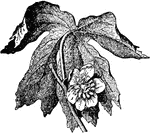
A North American poisonous herb. The plant itself usually has a blossom between two large green fleshy leaves. Parts of it are edible.

Mayapple

A North American poisonous herb. The plant itself usually has a blossom between two large green fleshy…
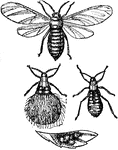
Eriosoma Imbricata. Found very abundantly on birch in Maryland in October. These insects cluster together on the twigs, and have the appearance of many small spots of snow-like wool or down moving up and down by jerks, the hinder parts of the insect being covered with this downy secretion.

Wooly Aphid

Eriosoma Imbricata. Found very abundantly on birch in Maryland in October. These insects cluster together…
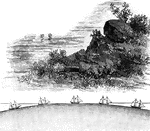
If the earth were flat, as soon as an object appeared on the horizon we would see the upper and lower parts at the same time; but if it were curved, the top parts would first be seen.

Curvature of the Earth's Surface

If the earth were flat, as soon as an object appeared on the horizon we would see the upper and lower…
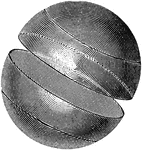
A Great Circle is one which would be formed on the earth's surface by a plane passing through the earth's centre, hence dividing it into two equal parts. All great circles, therefore, divide the earth into two hemispheres.

Great Circle

A Great Circle is one which would be formed on the earth's surface by a plane passing through the earth's…
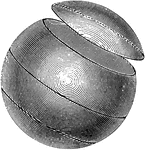
A small circle is one formed by a plane which does not cut the earth into two equal parts. The small circles are the <em>parallels</em>.

Small Circle

A small circle is one formed by a plane which does not cut the earth into two equal parts. The small…
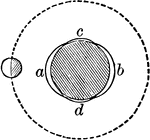
If the earth were uniformly covered with a layer of water, the passage of the moon over any place as at <em>a</em>, would cause the water to lose its globular form, become bulged at <em>a</em>, and <em>b</em>, and flattened at <em>c</em>, and <em>d</em>. In other words, the water would become <em>deeper</em> at <em>a</em>, and <em>b</em>, at the parts of the earth nearest and farthest from the moon and <em>shallower</em> in all places 90 degrees or at right angles to these points.

Lunar Tide

If the earth were uniformly covered with a layer of water, the passage of the moon over any place as…
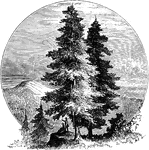
Pines are native to most of the Northern Hemisphere. In North America, they range from Arctic south to Nicaragua and Hispaniola, with the highest diversity in Mexico and California. In Eurasia, they range from Portugal and Scotland east to the Russian Far East, Japan, and the Philippines, and south to northernmost Africa, the Himalaya and Southeast Asia, with one species (Sumatran Pine) just crossing the Equator in Sumatra. Pines are also extensively planted in many parts of the Southern Hemisphere.

Pine Tree

Pines are native to most of the Northern Hemisphere. In North America, they range from Arctic south…
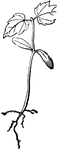

A Red Maple seedling with parts full-grown and bud at apex for further growth.

Maple Seedling

A Red Maple seedling with parts full-grown and bud at apex for further growth.

Diagram of a shoot with its leaves 5-ranked, with a spiral line drawn from the attachment of one leaf to the next, and so only the parts on the side turned from the eye are fainter.

Five-ranked

Diagram of a shoot with its leaves 5-ranked, with a spiral line drawn from the attachment of one leaf…
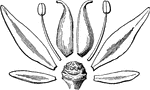
Parts of the same, two of each kind, separated and displayed; the torus or receptacle in the centre; <em>a</em> a sepal; <em>b</em>, a petal; <em>c</em>, a stamen <em>d</em>, a pistil.

Sedum Ternatum

Parts of the same, two of each kind, separated and displayed; the torus or receptacle in the centre;…
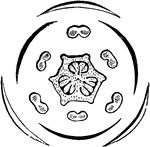
Diagram of flower of Trillium. In this, as in all such diagrams of cross-section of blossoms, the parts of the outer circle represent the calyx; the next, corolla; within, stames (here in two circles of three each, and the cross-section is through the anthers); in the centre, section of three ovaries joined into a compound one of three cells.

Trillium

Diagram of flower of Trillium. In this, as in all such diagrams of cross-section of blossoms, the parts…
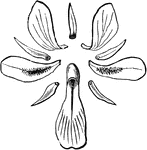
Its calyx and corolla displayed: the five smaller parts are the sepals; the five intervening larger ones are the petals.

Violet

Its calyx and corolla displayed: the five smaller parts are the sepals; the five intervening larger…
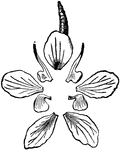
Its calyx and corolla displayed; the five large parts are the sepals; the four smaller, of two shapes, are the petals; the place of the fifth petal is vacant.

Larkspur

Its calyx and corolla displayed; the five large parts are the sepals; the four smaller, of two shapes,…
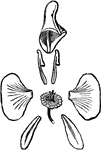
Its parts displayed: five speals, the upper forming the hood; the two lateral alike, broad and flat; the two lower small. The two pieces under the hood represent the corolla, reduced to two odd-shaped petals; in centre the numerous stamens and three pistils.

Monkshood

Its parts displayed: five speals, the upper forming the hood; the two lateral alike, broad and flat;…
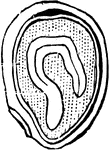
Seed of a Linden or Basswood cut through lengthwise, the parts lettered: <em>a</em>, the hilum or scar; <em>b</em>, the outer coat; <em>c</em>, the inner; <em>d</em>, the alhumen; <em>e</em>, the embryo.

Seed

Seed of a Linden or Basswood cut through lengthwise, the parts lettered: a, the hilum or scar;…
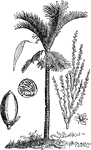
A species of palm which grows in much of the tropical Pacific, Asia, and parts of east Africa.

Betel Nut Palm

A species of palm which grows in much of the tropical Pacific, Asia, and parts of east Africa.
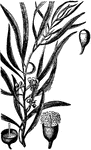
Eucalyptus is dominate in Australia but also found in adjacent parts of New Guinea and Indonesia. Many are known as gum trees.

Eucalyptus

Eucalyptus is dominate in Australia but also found in adjacent parts of New Guinea and Indonesia. Many…
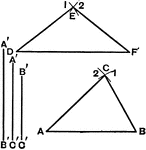
Method to construct a scalene triangle

Construct Scalene Triangle

Method to construct a scalene triangle

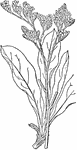
"Sea lavender (<em>statice limonium</em>) is a native British plant, being fairly common in certain parts of the coast."&mdash;Finley, 1917

Sea lavender

"Sea lavender (statice limonium) is a native British plant, being fairly common in certain…
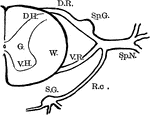
Diagram showing anatomy of the spinal nerve roots and adjacent parts. Labels: G., gray matter of the spinal cord; W., white matter of the same; D.H., dorsal horn of gray matter; V.H., ventral horn of gray matter; D.R., dorsal root of spinal nerve; Sp.G., spinal ganglion; V.R., ventral root of the spinal nerve; Sp. N., spinal nerve; Rc., communicating branch (ramus communicans); S.G., sympathetic ganglion.

Spinal Nerve Roots

Diagram showing anatomy of the spinal nerve roots and adjacent parts. Labels: G., gray matter of the…
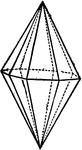
"This is the general form; it is bounded by sixteen scalene triangles, and all the indices are unequal." -The Encyclopedia Britannica 1910

Ditetragonal Bipyramid

"This is the general form; it is bounded by sixteen scalene triangles, and all the indices are unequal."…
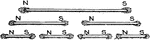
"Effect of breaking a magnet into several parts. If a magnetized needle be broken, each part will be found to be a complete magnet having a N and S pole." -Hawkins, 1917

Separating a magnet

"Effect of breaking a magnet into several parts. If a magnetized needle be broken, each part will be…
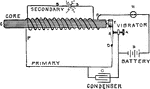
"Diagram of a vibrator coil. The parts are as follows: A, contact screw; B, battery; C, core; D, vibrator terminal; G, condenser; P, primary winding; S, secondary winding; W, switch; Y, vibrator." -Hawkins, 1917

Vibrator Coil

"Diagram of a vibrator coil. The parts are as follows: A, contact screw; B, battery; C, core; D, vibrator…
Subcutaneous areolar tissue from a young rabbit, highly magnified. The white fibers are in wavy bundles, the elastic fibers form an open network. Labels: p, p, vacuolated cells; g, granular cells; c, c, branching lamellar cells; c', a flattened cells, of which only the nucleus and some scattered granules are visible; f, fibrillated cell."If we make a cut through the skin of some part of the body where there is no subcutaneous fat, as in the upper eyelid, and proceed to raise it from the parts lying beneath, we observe that it is loosely connected to them by a soft filmy substance of considerable tenacity and elasticity. This is areolar tissue. It is also found, in like manner, under the serous and mucous membranes, and serves to attach them to the parts which they line or cover. Proceeding further, we find this areolar tissue lying between the muscles, the blood-vessels, and other deep-seated parts; also forming investing sheaths for the muscles, the nerves, the blood-vessels, and other parts. It both connects and insulates entire organs, and, in addition, performs the same office for the finer parts of which these organs are made up. It is thus one of the most general and most extensively distributed of the tissues." &mdash;Kimber, 1907

Subcutaneous Areolar Tissue from a Young Rabbit

Subcutaneous areolar tissue from a young rabbit, highly magnified. The white fibers are in wavy bundles,…

Fibrous tissue, from the longitudinal section of a tendon. "The fibrous tissue is met with in the form of ligaments, connecting the bones together at the joints, and in the form of sinews or tendons, by means of which the muscles are attached to the bones. It also forms fibrous membranes which invest and protect different parts or organs of the body." &mdash;Kimber, 1907

Fibrous Tissue of a Tendon

Fibrous tissue, from the longitudinal section of a tendon. "The fibrous tissue is met with in the form…
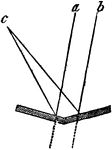
"The incident rays, a and b, being parallel before they reach the reflectors, are thrown off at unequal angles in respect to each other, for b fallson the mirror more obliquely than a, and consequently is thrown off more obliquely in a contraty direction, therefore, then angles of reflection being equal to those of incidence, the two rays meet at c." -Comstock 1850

Plane Inclined Mirrors

"The incident rays, a and b, being parallel before they reach the reflectors, are thrown off at unequal…
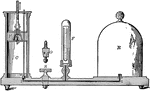
"The air pump is an instrument for removing a gas from a closed vessel, the essential parts are shown." -Avery 1895

Air Pump

"The air pump is an instrument for removing a gas from a closed vessel, the essential parts are shown."…
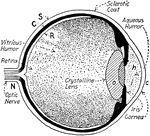
"The human eye-essential parts shown in section." —Croft 1917

Eye

"The human eye-essential parts shown in section." —Croft 1917

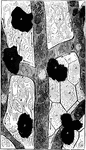
Circulation in frog's foot under a microscope. Labels: A, walls of capillaries; B, tissue of web lying between the capillaries; C, cells of epidermis covering web (these are only shown in the right-hand and lower part of the field; in the other parts of the field the focus of the microscope lies below the epidermis); D, nuclei of these epidermic cells; E, pigment cells contracted, not partially expanded; F, red blood corpuscle (oval in the frog) passing along capillary -- nucleus not visible; G, another corpuscle squeezing its way through a capillary, the canal of which is smaller than its own transverse diameter; H, another bending as it slides round a corner; K, corpuscle in capillary seen through the epidermis; I, white blood corpuscle.

Circulation in a Frog's Foot

Circulation in frog's foot under a microscope. Labels: A, walls of capillaries; B, tissue of web lying…

"When two bodies of equal weight are connected by a rod, the centre of gravity will lie in the middle of that rod. When two bodies of unequal weight are so connected, the centre of gravity will be nearer to the heavier one. These principles are illustrated [here], in which C represents the centre of gravity." &mdash;Quackenbos 1859

Center of Gravity of Rod with Weights

"When two bodies of equal weight are connected by a rod, the centre of gravity will lie in the middle…
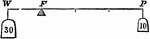
"When bodies of unequal weight are supported by the arms of a lever, they will balance each other whenever the weight of the one multiplied into its distance from the fulcrum." &mdash;Quackenbos 1859

Steelyard

"When bodies of unequal weight are supported by the arms of a lever, they will balance each other whenever…
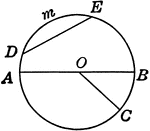
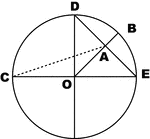
Circle with diameter, radius, arc, chord, and arc.

Circle With Parts

Circle with diameter, radius, arc, chord, and arc.

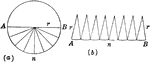
Illustration of circle with parts drawn to show area.

Area of a Circle by parts

Illustration of circle with parts drawn to show area.

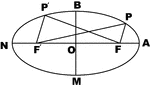
Illustration of ellipse with parts labeled.

Ellipse With Parts Labeled

Illustration of ellipse with parts labeled.

Illustration of circle with arc, chord, diameter  and radius.

Parts of Circle

Illustration of circle with arc, chord, diameter and radius.

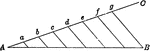
A line which is divided into seven equal parts, shown by construction.

Construction of Dividing Lines

A line which is divided into seven equal parts, shown by construction.
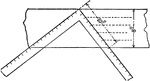
A line which is divided into equal parts, shown by construction and square.

Construction of Dividing Lines

A line which is divided into equal parts, shown by construction and square.