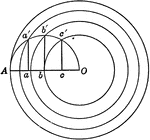
Circle divided into equal parts by concentric circles.

Dividing Circle into Equal Parts by Concentric

Circle divided into equal parts by concentric circles.
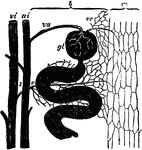
Circulation in the kidney. Labels: ai, small branch of renal artery giving off the branch va, which enters glomerulus, issues as ve, and then breaks up into capillaries, which after surrounding the tubule find their way by v into vi, branch of the renal vein; m, capillaries around tubules in parts of the cortical substance where there are no glomeruli.

Kidney Circulation

Circulation in the kidney. Labels: ai, small branch of renal artery giving off the branch va, which…
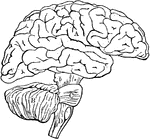
Diagram illustrating the general relationships of the parts of the brain. Labels: A, fore-brain; b, mid-brain; B, cerebellum; C, pons Varolii; D, medulla oblongata; B,c,and D together constitute the hind-brain.

Brain

Diagram illustrating the general relationships of the parts of the brain. Labels: A, fore-brain; b,…
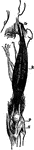
The rectus muscle of the thigh; to show the constituent parts of a muscle. Labels: R, the fleshy belly; to, Tendon of origin; ti, Tendon of insertion; n, Nerve of supply; a, Artery of supply; v, Vein; l, Lymphatic vessel; P, the patella.

Thigh Muscle

The rectus muscle of the thigh; to show the constituent parts of a muscle. Labels: R, the fleshy belly;…
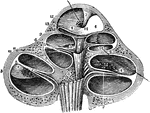
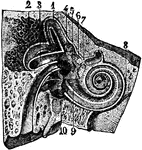
A vertical section of the cochlea, highly magnified, to show the arrangement and connection of its parts.

The Cochlea of the Ear

A vertical section of the cochlea, highly magnified, to show the arrangement and connection of its parts.

An illustration of a straight line with 5 points dividing it into 4 equal parts. Multiple of a given line.

Straight Line With Points Divided Into Equal Parts

An illustration of a straight line with 5 points dividing it into 4 equal parts. Multiple of a given…
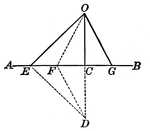
Illustration showing two straight lines drawn from the same point in a perpendicular to a given line, cutting off on the line unequal segments from the foot of the perpendicular, the more remote is the greater.

Lines Drawn From the Same Point in a Perpendicular to a Given line, Cutting Off Segments

Illustration showing two straight lines drawn from the same point in a perpendicular to a given line,…
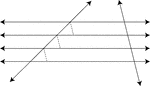
Illustration showing that when three or more parallel lines intercept equal parts on one transversal, they intercept equal parts on every transversal.

Parallel Lines Cut By A Transversal

Illustration showing that when three or more parallel lines intercept equal parts on one transversal,…
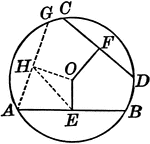
Illustration of a circle with unequal chords, which are unequally distant from the center.

Circle With Unequal Chords

Illustration of a circle with unequal chords, which are unequally distant from the center.
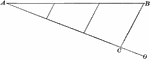
Illustration of the construction used to divide a straight line into a given number of equal parts.
Construction of a Straight Line Divided Into Equal Parts

Illustration of the construction used to divide a straight line into a given number of equal parts.

The vestibule of the ear. It is a central common cavity of communication between the osseous parts of the internal ear.

The Vestibule

The vestibule of the ear. It is a central common cavity of communication between the osseous parts of…
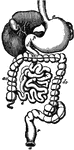
The small intestine, a convoluted, tubular, digestive organ, about 20 ft in length, extending from the pylorus to the ileo-caecal valve, where it terminates in the large intestine. It is connect to the spinal column by the mesenteric portion of the peritoneum, and divided into 3 parts, the duodenum (d), the jejunum, and the ileum (i).

The Small Intestine

The small intestine, a convoluted, tubular, digestive organ, about 20 ft in length, extending from the…
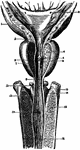
The male urethra, which is the urinary canal from the neck of the bladder to the meatus urinarius; in the male it is chiefly within the penis, is from 8 to 9 inches in length, and is divided into 3 parts: the prostatic, membranous, and spongy portions of the urethra.

The Male Urethra

The male urethra, which is the urinary canal from the neck of the bladder to the meatus urinarius; in…
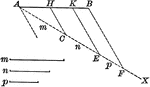
Line divided into proportional parts.

Line Divided Into Parts

Line divided into proportional parts.

A flashcard featuring an illustration of a polygon with four unequal sides

Flashcard of a polygon with four unequal sides

A flashcard featuring an illustration of a polygon with four unequal sides
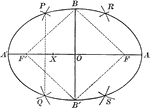
Illustration of an ellipse with foci F' and F, major axis A' to A, minor axis B' to B, and center O.
Ellipse With Parts Labeled

Illustration of an ellipse with foci F' and F, major axis A' to A, minor axis B' to B, and center O.

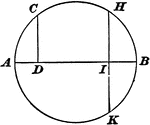
"If from any point on the circumference of a circle, a perpendicular be let fall upon a given diameter, this perpendicular will be a mean proportional between the two parts into which it divides the diameter."

Circle With a Perpendicular Drawn to the Diameter

"If from any point on the circumference of a circle, a perpendicular be let fall upon a given diameter,…
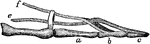
The arrangement of the tendons of a finger. At <em>a b c </em> are the 3 bones of the finger. At <em>f</em> is the tendon that bends the second bone, <em>b</em>. This is divided into two parts, just at its end, where it is fastened to the bone. Through this division the tendon <em>e</em> passes, to go to the last bone, <em>c</em>.

Tendons of a Finger

The arrangement of the tendons of a finger. At a b c are the 3 bones of the finger. At f

Illustration showing succession of golden rectangles that are used to construct the golden spiral. Two quantities are considered to be in the golden ratio if (a+ b)/a = a/b which is represented by the Greek letter phi. Each rectangle shown is subdivided into smaller golden rectangles. The golden spiral is a special type of logarithmic spiral. Each part is similar to smaller and larger parts.

Golden Rectangles

Illustration showing succession of golden rectangles that are used to construct the golden spiral. Two…
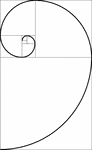
Illustration showing succession of golden rectangles that are used to construct the golden spiral. Two quantities are considered to be in the golden ratio if (a+ b)/a = a/b which is represented by the Greek letter phi. Each rectangle shown is subdivided into smaller golden rectangles. The golden spiral is a special type of logarithmic spiral. Each part is similar to smaller and larger parts.

Golden Rectangles

Illustration showing succession of golden rectangles that are used to construct the golden spiral. Two…
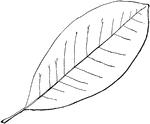
Leaves - Simple, alternate, edge entire. Outline - long oval or slightly reverse egg-shape. Apex, slightly blunt-pointed. Base, pointed. Leaf -about three to six inches long, thick and smooth; dark green and polished above; white below; the middle rib green and distinct; the side ribs slight and indistinct. Bark - of trunk, smoothish, light gray, aromatic and bitter. Flowers - large (two to three inches wide), white, at the ends of the branches, very fragrant. June, July. Fruit - bright red berries, at first in small cone-like clusters, then hanging by slender threads. September.  Found - in swampy ground, from Massachusetts southward, usually near the coast. <p>General Information - A small tree (often a bush) four to twenty-five feet high, or higher southward, where its leaves are evergreen. All parts of the tree (and it is the same with the other magnolias) have an intensely bitter, aromatic juice, which is stimulating and tonic. From "magnol," the name of a botanist of the seventeenth century.

Genus Magnolia, L. (Magnolia)

Leaves - Simple, alternate, edge entire. Outline - long oval or slightly reverse egg-shape. Apex, slightly…
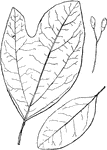
Leaves - simple; alternate; edge entire or lobed. Outline - when the edge is entire usually oval or egg-shape; when lobed usually broader and reverse egg-shape. Apex - of the leaf or of the lobes rounded or slightly blunt-pointed. Base - pointed or wedge-shape. Leaf - variable in size, dark, thin, smooth; rather shining above; the lobes, when resent, two or three in number and usually more or less bulging, with the hollows always rounded. Bark - obliquely and curiously furrowed and broken, gray without, reddish within; young twigs yellowish. Flowers - greenish-yellow, in clusters. May, June. Fruit - oval, one-seeded, blue, with a reddish, club shaped stem; pungent. Found - from Southwestern Vermont, southward and westward.  General Information - a tree fifteen to fifty feet high with light and soft wood. All parts of the tree have a pleasant, spicy taste and fragrance. From the bark of the roots a powerful aromatic stimulant is obtained.

Genus Sassafras, Nees. (Sassafras)

Leaves - simple; alternate; edge entire or lobed. Outline - when the edge is entire usually oval or…
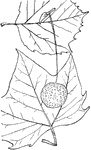
Leaves - simple; alternate; edge variable, either coarse-toothed or somewhat lobed; with the teeth or lobes sharp, and the hollows between them rounded. Outline - rounded. Apex - pointed. Base - more or less heart-shaped, squared, or rounded. Leaf/Stem - downy when young, smoothish when old; and covering the leaf-bud with its swollen base. Leaf - three and a half to eight inches wide, and usually broader than long; downy beneath when young, becoming smooth. Bark - the thin outer bark peels off each year in hard and brittle strips, leaving the branches and parts of the trunk with a mottled, whitish, polished-looking surface. Flowers - small, in compact, round balls (about one inch in diameter) like round buttons, which dry and harden, and cling to the branches by their slender stems (three to four inches long), and swing like little bells during a good part of the winter. Found - from Southern Main, southward and westward, in rich, moist soil, oftenest along streams. Its finest growth is in the bottom lands of the Mississippi and Ohio rivers. General Information - The largest of the trees of the Atlantic forests, commonly sixty to eighty feet high; along the western rivers often eighty to one hundred and thirty feet high, sometimes more, with a circumference of forty to fifty feet. A tree in Eaton, N. J., is one of the largest in the Sate. It is eighty-five feel high. At a point eight fee from the ground its circumference is fourteen feet three inches. The largest trunks are usually hollow.  The wood is hard and compact, difficult to split and work, of a reddish-brown color within. Its principle use is in the making of tobacco boxes. There is a fine and somewhat noted group of these trees on the grounds of James Know, in Knoxboro, N. Y. In old times they formed a favorite camping place for the Indians in their trading expeditions. They all measure not far from three feet in diameter. The name "sycamore," though a common one, should be dropped - it belongs to another and very different tree. From a Greek word meaning broad, in reference to the breadth of the buttonwood's shade or of its leaf.

Genus Platanus, L. (Buttonwood)

Leaves - simple; alternate; edge variable, either coarse-toothed or somewhat lobed; with the teeth or…
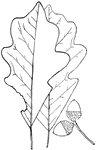
Leaves - simple; alternate; edge quite deeply wavy-toothed. Outline - reverse egg-shape or oval. Apex - blunt-pointed. Base - pointed. Leaf - five to eight inches long; smooth, and rather bright green above; whitish-downy beneath, becoming almost silvery-white; often with a rather deep hollow just below the middle, and usually abruptly spreading above; the teeth unequal, longest toward the middle of the leaf, sometimes almost long enough to be called lobes; mostly rounded at the apex, but sometimes ending in a hard point; the main ribs prominent and rust-colored. Bark - of trunk, grayish-white, dividing into large, flat scales. Acorns - usually in pairs on a stem one and a quarter to three inches long. Cup - rounded, rather thin, rough, with sharp scales; the upper scales bristle-tipped, forming a border, or sometimes a fringe, along the edge; slightly downy within. Nut - one inch or less in length, egg-shape; sweet. October. Found - from Southern Maine and the Upper St. Lawrence to Southeastern Iowa and Western Missouri, south to Delaware and along the Alleghany Mountains to Northern Georgia; along borders of streams and in swamps, in deep, rich soil. Its finest growth is in the region of the Great Lakes. General Information - A tree thirty to sixty feet high or more, with wood similar in value to that of the White Oak. Quercus, possible from a Celtic word meaning to inquire, because it was among the oaks that the Druids oftenest practised their rites.

Genus Quercus, L. (Oak)

Leaves - simple; alternate; edge quite deeply wavy-toothed. Outline - reverse egg-shape or oval. Apex…
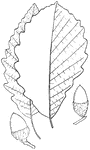
Leaves - simple; alternate; edge coarsely and evenly wavy-toothed. Outline - reverse egg-shape or sometimes oval. Apex - blunt-pointed. Base - rounded or slightly pointed, and often somewhat unequal. Leaf - four to seven inches long, two to four inches wide; smooth above, paler and downy beneath. Teeth - twelve to twenty-six, decreasing evenly and uniformly to the apex. Bark - of trunk, gray; furrowed up and down with continuous and often very deep furrows, with sharp ridges between. Acorns - usually in pairs on a stem about one half of an inch long, or often shorter. Cup - rounded or somewhat top-shaped, with minute scales, or warty. Nut - usually long egg-shape or long oval; one to one and one fourth inches long; brown; about one third covered by the cup; sweet. September, October. Found - from Eastern Massachusetts to New York, southward to Delaware, along the Alleghany Mountains to Alabama and westward to Central Kentucky and Tennessee. General Information - A tree forth to seventy feet in height, with strong, hard wood, largely used in fencing, or railroad ties, etc.; of less value than that of the White Oak. Its bark is very rich in tannin. Quercus, possible from a Celtic word meaning to inquire, because it was among the oaks that the Druids oftenest practised their rites.

Genus Quercus, L. (Oak)

Leaves - simple; alternate; edge coarsely and evenly wavy-toothed. Outline - reverse egg-shape or sometimes…
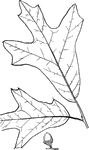
Leaves - simple; alternate; edge lobed (the edges of the lobes mostly entire, but often with one to three teeth toward the ends). Outline - abruptly spreading above the middle. Base - rounded, sometimes slightly unequal. Ends of the lobes and of the few teeth, when present, sharp and bristle-tipped. Leaf - about three to six inches long; dark, dull green, and rough above; below, grayish and downy. Lobes, usually three, sometimes four or five, mostly long and narrow, especially the end one. Bark - of trunk, blackish and deeply grooved. Acorns - nearly stemless. Cup - shallow, somewhat top-shaped. Nut, about one third to one half inch long, rounded, sometimes slightly hollowed at the apex, bitter. October. Found - in sandy soils and barrens, from Long Island southward; in the Northern States, only near the coat and rare. General Information - A tree about twenty to thirty feet high in New Jersey; in the South, seventy to eighty feet; with wood of slight value except for fuel. Quercus, possible from a Celtic word meaning to inquire, because it was among the oaks that the Druids oftenest practised their rites.

Genus Quercus, L. (Oak)

Leaves - simple; alternate; edge lobed (the edges of the lobes mostly entire, but often with one to…
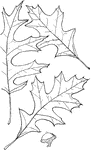
Leaves - simple; alternate; edge lobed (edges of the lobes mostly entire, but notched and toothed towards the ends). Outline - narrow oval or broad oval. Base - from long wedge-shape to squared. Ends of lobes and of the teeth pointed and bristle-tipped. Leaf - three to five inches long; both sides bright green, smooth, and shining; downy in the angles of the ribs below. Lobes - seven to nine, usually seven, with the hollows between them broad and round and usually reaching about three fourths of the way or more to the middle rib. The wide type of leaf closely resembles the leaves of the scarlet oak, but it is smaller and usually the hollows reach nearer to the middle rib. Bark - smoothish (comparatively), inner bark reddish. Acorns - numerous, small, on short stems. Cup - top-shaped, shallow, and nearly smooth. Nut - rounded, one half inch long or less, sometimes broader than long, light brown. October. Found - from the valley of the Connecticut to Central New York, southward to Delaware and the District of Columbia; in Southern Wisconsin and southward; usually along streams and on low, wet land. Most common and reaching its finest growth west of the Alleghany Mountains. General Information - A handsome tree forty to sixty feet high, usually with a pointed top and with light and delicate foliage. The wood is rather coarse and not durable. It takes its name of Pin Oak from the peg-like look of the dead twigs and short branches with which the lower parts of the tree are usually set. Quercus, possible from a Celtic word meaning to inquire, because it was among the oaks that the Druids oftenest practised their rites.

Genus Quercus, L. (Oak)

Leaves - simple; alternate; edge lobed (edges of the lobes mostly entire, but notched and toothed towards…
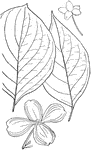
Leaves - simple; opposite; edge entire. Outline - egg-shape, or often broad oval, or reverse egg-shape. Apex - pointed, often taper-pointed. Base - pointed and usually slightly unequal. Leaf/Stem - short (about one half inch). Leaf - three to five inches long; smooth above; pale and nearly smooth beneath; with the whitish ribs very distinct and curved. Bark - of trunk, blackish and rough, with short, broken ridges. The bark, especially of the roots, is very bitter and is used as a tonic. Flowers - The real flowers are greenish-yellow, in a small rounded bunch; but this bunch is surrounded by four large, petal-like leaves, white and often tinged with pink, more than an inch in length, reverse egg-shaped, and ending in a hard, abruptly turned point. The appearance is of a single large flower. The tree blossoms in May before the leaves are fully set. Fruit - The "Flower" is succeeded by a bunch of oval berries that turn bright red as they ripen, making the tree in the autumn, with its richly changing foliage, nearly as attractive as in the spring. Found - in rich woods, from New England to Minnesota, and southward to Florida and Texas. It is very common, especially at the South. General Information - A finely shaped, rather flat-branching tree, usually twelve to thirty feet high, but dwindling, northward, to the dimensions of a shrub; one of the most ornamental of all our native flowering trees. Its character throughout the extent of its range would seem to warrant the recognition of its blossom as the "national flower." Cornus, from a Greek word meaning horn, because of the hardness of the wood.

Flowering Dogwood

Leaves - simple; opposite; edge entire. Outline - egg-shape, or often broad oval, or reverse egg-shape.…
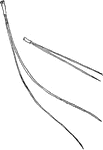
Leaves - simple; indeterminate in position because of their closeness, but arranged along the branches in two-leaved sheathed bunches. Leaf - needle-shape, five to eight inches long; dark, dull, green; rounded and smooth on the outside; on the inside hollowed. Cones - about two to three inches long; rounded at the base; sometimes crowded in large clusters. Scales - not armed with points or knobs. Bark - of the trunk, comparatively smooth and reddish, of a clearer red than that of any other species in the United States. Found - in dry and sandy soil from Newfoundland and the northern shores of the Gulf of St. Lawrence to the Winnipeg River, through the Northern States to Massachusetts, in the mountains of Northern Pennsylvania. Rare in the Eastern States, except in the extreme northern parts of New England. General Information - An evergreen tree fifty to eight feet high, or more, with hard and durable wood, useful for all kinds of construction. It is low-branching and regular in shape. In a note give in confirmation of his estimate of the height of the red pine, Michaux says that when the French in Quebec built the war-ship St. Lawrence, fifty guns, they made its main-mast of this pine.

Genus Pinus, L. (Pine)

Leaves - simple; indeterminate in position because of their closeness, but arranged along the branches…
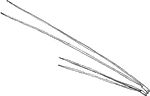
Leaves - simple; indeterminate in position because of their closeness, but arranged along the branches in two-leaved sheathed bunches (On vigorous young shoots the leaves are sometimes clustered in threes, not on the old branches.) Leaf - needle-shape, two and a half to five inches long, usually four to five inches; dark green; slender; rounded on the outer side; on the inner side, hollowed. Cone - about two to three inches long, in old trees scarcely more than one and a half inches long; the smallest of the American Pine cones; surface roughened by the slightly projecting ends of the scales; not growing in large clusters. Scales - tipped with a weak prickle pointing outward.Found - in Staten Island and New Jersey, and southward to Western Florida; through the Gulf States, Arkansas, and parts of Kansas, Missouri, and Illinois. General Information - An evergreen tree forty to eighty feet high, with straight trunk, regular branches, and pyramid-shaped head. The timber is hard and very valuable, second in value (among the Yellow Pines) only to the "Georgia Pine" (P. palustris -" Long-leaved Pine," "Southern Pine").

Genus Pinus, L. (Pine)

Leaves - simple; indeterminate in position because of their closeness, but arranged along the branches…
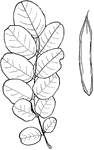
Leaves - compound (odd-feathered; leaflets, eleven to twenty-five); alternate; edge entire. Outline - oval or egg-shape. Apex, rounded. Base - rounded. Stem - of leaf, smooth, and covering the leaf-bud of the next year. Leaflets - very smooth, thin, often slightly tipped with the end of the mid-rib. Bark - of trunk, dark, rough, and very deeply ridged. The smaller branches and young trunks are armed with strong, triangular prickles, but these disappear when the parts are three to four inches thick. Flowers - showy and abundant; in long, loose clusters drooping from the sides of the branchlets; white; and very fragrant. May, June. Fruit - a smooth and rather blunt pod, two to three inches long, one and a half inches wide, four- to six-seeded. Seeds, dark brown. September. Found - Native in the Alleghany Mountains from Pennsylvania (Monroe County - Porter) to Georgia; but now very generally naturalized throughout the United States east of the Rocky Mountains. General Information - A tree usually forty to fifty feet high, sometimes ninety feet, and of rapid growth. Its wood is exceedingly hard and strong, and remarkable durable when in contact with the ground. It is used largely for posts, in ship-building, and in turnery, and it is preferred to all other native wood for tree nails. It is one of the most valuable trees of this or of any country. But is cultivation as a timber tree, which at one time was very general, has nearly ceased in the United State on account of the constant damage done by the grub of the Painted Clytus (Clytus pictus). This troublesome borer not only injures the new growth, but also pierces and detaches large branches, leaving the tree ragged and stunted.

Genus Robinia, L. (Locust)

Leaves - compound (odd-feathered; leaflets, eleven to twenty-five); alternate; edge entire. Outline…
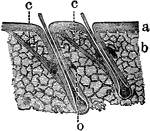
Parts of two hairs embedded in their follicles. Labels: a, the skin, which is seen to dip down and line the follicle; b, the subcutaneous tissue; c, the muscles of the hair follicle, which by their contraction can erect the hair; o, sebaceous gland.

Hairs and their Follicles

Parts of two hairs embedded in their follicles. Labels: a, the skin, which is seen to dip down and line…
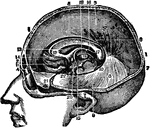
Section of the head showing the greater scythe, the horizontal apophysis of the dura mater between the brain and the cerebellum and other parts under the middle line of the head.

Head, Section of

Section of the head showing the greater scythe, the horizontal apophysis of the dura mater between the…
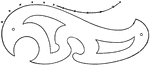
For larger circles beam compasses are used. The two parts called channels which carry the pen and the needle point are clamped to a wooden beam at a distance equal to the radius of the circle. The thumb nut underneath one of the channel pieces makes accurate adjustment possible.

Beam Compasses

For larger circles beam compasses are used. The two parts called channels which carry the pen and the…
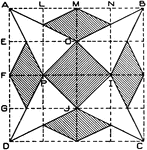
Diamond pattern exercise: Divide A D and A B into 4 equal parts, then draw horizontal lines through E, F, and G and vertical lines through L, M, and N. Draw lines from A and B to the intersection O of lines E and M, and from A and D to the intersection P of lines F and L. Similarly, draw D J, J C, C I, and I B. Also connect the points O, P, J, and I, thus forming a square. The four diamond-shaped areas are formed by drawing lines from the middle points of A D, A B, B C, and D C to the middle points of lines A P, A O, O B, I B, etc.

Diamond Exercise

Diamond pattern exercise: Divide A D and A B into 4 equal parts, then draw horizontal lines through…
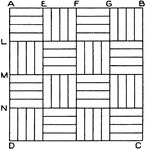
Square pattern exercise: Divide A D and A B into 4 equal parts and draw horizontal and vertical lines. Now divide these dimensions, A L, M N, etc., and E F, G B, etc., into 4 equal parts- each 1/4 inch- and draw light pencil lines with the T-square and triangle.

Square Exercise

Square pattern exercise: Divide A D and A B into 4 equal parts and draw horizontal and vertical lines.…
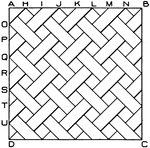
Weave pattern exercise: Divide A D and A B into 8 equal parts, and through the points O, P, Q, H, I, J, etc., draw horizontal and vertical lines. Now draw lines connecting O and H, P and I, Q and J, etc. As these lines form an angle of 45 degrees with the horizontal, a 45-degree triangle may be used. Similarly from each one of the given points on A B and A D, draw lines at an angle of 45 degrees to B C and D C respectively.

Weave Exercise

Weave pattern exercise: Divide A D and A B into 8 equal parts, and through the points O, P, Q, H, I,…
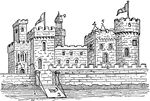
Medieval Castle of the Holy Roman Empire. "1 Moat, 2 Drawbridge, 3 Wicket, 4 Merlons, 5 Embrasures, 6 Rampart, 7 Portcullis, 8 Donjon or Keep, 9 Turret, 10 Escutcheon." -Foster, 1921

Medieval Castle

Medieval Castle of the Holy Roman Empire. "1 Moat, 2 Drawbridge, 3 Wicket, 4 Merlons, 5 Embrasures,…
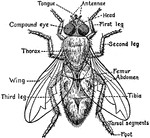
Parts of a fly are labeled

Parts of a Fly

Parts of a fly are labeled

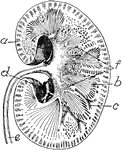
Transverse section of the human kidney: "(a) cortex; (b) medulla; (c) small branch of the renal artery; (d) renal artery; (e) ureter; (f) pelvis." -Foster, 1921

Kidney

Transverse section of the human kidney: "(a) cortex; (b) medulla; (c) small branch of the renal artery;…
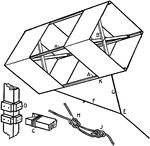
The parts of a box kite: "A, frame, with B, crosspiece; C D, details of joints; F G, bridle; E, string jointed to bridle; H J, knots." -Foster, 1921

Kite

The parts of a box kite: "A, frame, with B, crosspiece; C D, details of joints; F G, bridle; E, string…

A device propelled through water with a ship as its target. "(a) Head; (b) air cylinder; (c) after body; (e) propellers; (f) war nose." -Foster, 1921

Torpedo

A device propelled through water with a ship as its target. "(a) Head; (b) air cylinder; (c) after body;…
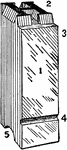
A piece of wood or metal to stamp a letter or character. "(1) the body, (2) the face, (3) the shoulder, (4) the nick and (5) the groove." -Foster, 1921

Type

A piece of wood or metal to stamp a letter or character. "(1) the body, (2) the face, (3) the shoulder,…
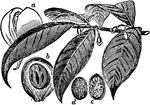
A nutmeg plant and its parts. "a, fruit bursting open; b, the same with one valve removed; c, section of seed; d, seed with the covering removed." -Foster, 1921

Nutmeg

A nutmeg plant and its parts. "a, fruit bursting open; b, the same with one valve removed; c, section…
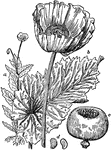
The parts of the opium poppy from which the drug is made from the poppy's juice. "a, whole plant; b, flower and leaf; c, ripe capsule; d, seed and its section, enlarged." -Foster, 1921

Opium poppy

The parts of the opium poppy from which the drug is made from the poppy's juice. "a, whole plant; b,…
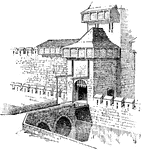
"Fortified gate of a medieval castle...(A) the moat; (B) the drawbridge; (C) the portcullis." -Breasted, 1914

Fortified Gate

"Fortified gate of a medieval castle...(A) the moat; (B) the drawbridge; (C) the portcullis." -Breasted,…
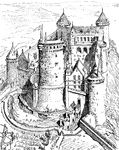
French castle of Coucy-le-Chateau built in the thirteenth century. The parts are: (A) moat, (B) round donjon, (C) inner court, and (D) the residence of the lord.

Coucy le Chateau

French castle of Coucy-le-Chateau built in the thirteenth century. The parts are: (A) moat, (B) round…
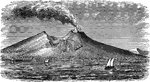
The parts of a volcano illustrated with Mount Vesuvius: "a, the cone; b, summit cinder-cone; c, Somma, part of former outline of crater; d, Hermitage (now Observatory); e, Portici; f, Herculaneum; g, Torre del Greco." -Dana, 1883

Mount Vesuvius

The parts of a volcano illustrated with Mount Vesuvius: "a, the cone; b, summit cinder-cone; c, Somma,…
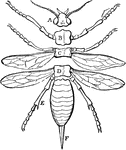
"A, the head; B, C, D, segments of the thorax; E, abdomen; F, ovipositor." -Cooper, 1887

Parts of an Insect

"A, the head; B, C, D, segments of the thorax; E, abdomen; F, ovipositor." -Cooper, 1887
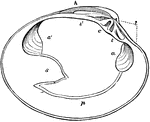
"a, a', impressions of the muscles; p, pallial line; s, bend occupied by the siphon; h, hinge; c, t, t', teeth." -Cooper, 1887

Clamshell

"a, a', impressions of the muscles; p, pallial line; s, bend occupied by the siphon; h, hinge; c, t,…
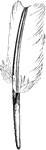
"Parts of a Feather. a, quill; b, shaft; c, vane; d, down." -Cooper, 1887

Feather Parts

"Parts of a Feather. a, quill; b, shaft; c, vane; d, down." -Cooper, 1887

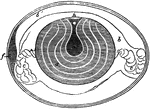
"Section of a Hen's Egg before Incubation. a, yolk, showing concentric layers; a', its semi-fluid center; b, inner dense part of the albumen; b', outer thinner part; c, twisted cords of albumen; h, the white spot, or germ cell." -Cooper, 1887

Egg Parts

"Section of a Hen's Egg before Incubation. a, yolk, showing concentric layers; a', its semi-fluid center;…
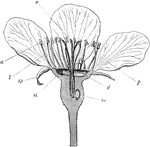
"Enlarged section of a Bartlett pear flower: st, style; sp, sepal; f, filament; a, anther; s, stigma; p, petal; d, disk; ov, ovule." -Department of Agriculture, 1899

Bartlett Pear Flower

"Enlarged section of a Bartlett pear flower: st, style; sp, sepal; f, filament; a, anther; s, stigma;…
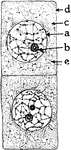
"A, embryonic cells from onion root tip; d, plasmatic membrane; c, cytoplasm; a, nuclear membrane enclosing the thread-like nuclear reticulum; b, nucleolus; e, plastids (black dots scattered about)." -Stevens, 1916

Onion Cells

"A, embryonic cells from onion root tip; d, plasmatic membrane; c, cytoplasm; a, nuclear membrane enclosing…
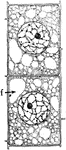
"B, older (onion) cells farther back from the root tip. The cytoplasm is becoming vacuolate; f, vacuole." -Stevens, 1916

Onion Cells

"B, older (onion) cells farther back from the root tip. The cytoplasm is becoming vacuolate; f, vacuole."…
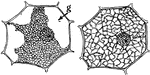
In onion cells: "C, a cell from the epidermis of the mid-rib of Tradescantia zebrina, in its natural condition on the right, and plasmolyzed by salt solution on the left; g, space left by the recedence of the cytoplasm from the wall; the plasma membrane can now be seen as a delicate membrane bounding the shrunken protoplast." -Stevens, 1916

T. Zebrina Cell

In onion cells: "C, a cell from the epidermis of the mid-rib of Tradescantia zebrina, in its natural…
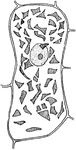
"A, cell from the epidermis of the upper side of the calyx of Tropaeolum majus with crystalline chromoplasts." -Stevens, 1916

T. Majus Cell

"A, cell from the epidermis of the upper side of the calyx of Tropaeolum majus with crystalline chromoplasts."…
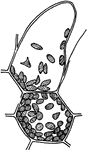
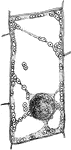
"B, cells from the petal of Lupinus luteus with yellow chromoplasts." -Stevens, 1916

L. Luteus Cell

"B, cells from the petal of Lupinus luteus with yellow chromoplasts." -Stevens, 1916

"C, cell showing numerous chloroplasts scattered through the cytoplasm." -Stevens, 1916

Plant Cell

"C, cell showing numerous chloroplasts scattered through the cytoplasm." -Stevens, 1916

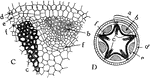
Types of vascular bundles: "C, a portion of the radial type, shown complete in D, where the part outlined at a, corresponds to C. Corresponding parts are lettered the same in both figures; c, xylem; b, phloem; f, cambium ring; e, pericycle; d, endodermis. C and D are from the tap root of Vicia faba." -Stevens, 1916

Radial Vascular Bundle

Types of vascular bundles: "C, a portion of the radial type, shown complete in D, where the part outlined…