


An illustration of a group of men and woman riding on horseback.

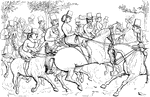
Group on Horseback

An illustration of a group of men and woman riding on horseback.

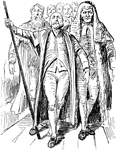
An illustration of a group of Parliament members.

Parliament Members

An illustration of a group of Parliament members.

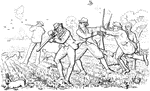
An illustration of a group of men walking through a field holding shotguns.

Group of Men Hunting

An illustration of a group of men walking through a field holding shotguns.

An illustration of a group of men shooting gamefowl.

Group of Men Hunting

An illustration of a group of men shooting gamefowl.

An illustration of a group of men riding on horses.

Men on Horseback

An illustration of a group of men riding on horses.

An illustration of a group of four men leaning up against a fence while smoking.

Men Leaning on Fence

An illustration of a group of four men leaning up against a fence while smoking.
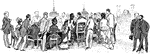
An illustration of a group of people surrounding a casino table.

Casino

An illustration of a group of people surrounding a casino table.

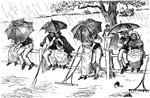
An illustration of a group of men and woman caught in a rain storm sitting on a fence huddled under umbrellas.

Group Caught in Rain

An illustration of a group of men and woman caught in a rain storm sitting on a fence huddled under…
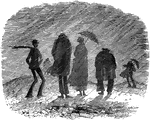

An illustration of a small group walking through a rain storm.

Group Walking through Storm

An illustration of a small group walking through a rain storm.

An illustration of a group of women standing together.

Group of Women

An illustration of a group of women standing together.

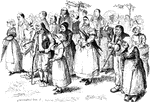
An illustration of a group of townspeople from Sainte-Anne-d'Auray as pictured at their pardon in 1623.
Group of Townspeople

An illustration of a group of townspeople from Sainte-Anne-d'Auray as pictured at their pardon in 1623.
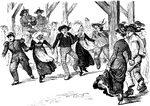
An illustration of a group of men and woman dancing.

Group Dancing

An illustration of a group of men and woman dancing.

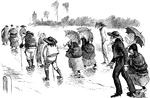
An illustration of a group of men and women walking in a rain storm.

Walking in Rain

An illustration of a group of men and women walking in a rain storm.

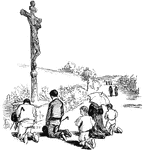
An illustration of a group of people kneeling in front a large cross.

Kneeling in Front of Cross

An illustration of a group of people kneeling in front a large cross.

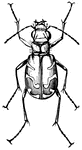
The tiger beetles are a large group of beetles known for their predatory habits. Some tiger beetles can run at a speed of 5 mph. For its size it has been suggested that they are technically the fastest running land animals. This has been featured on "Animal Planet's Most Extreme" show as the number one fastest animal known to man on earth.

Tiger Beetle

The tiger beetles are a large group of beetles known for their predatory habits. Some tiger beetles…
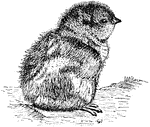
Grouse are a group of birds from the order Galliformes. Often considered a family Tetraonidae, the American Ornithologists' Union and many others include grouse as a subfamily Tetraoninae in the family Phasianidae. Grouse inhabit temperate and subarctic regions of the northern hemisphere, from pine forests to moorland and mountainside. Most species are year-round residents, and do not migrate. These birds feed mainly on vegetation, but also on insects, especially when feeding young. Several of the forest-living species are notable for eating large quantities of conifer needles, which most other vertebrates refuse

Young Grouse

Grouse are a group of birds from the order Galliformes. Often considered a family Tetraonidae, the American…
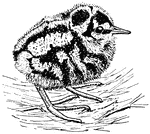
The woodcocks are a group of seven extant very similar wading bird species in the genus Scolopax, characterised by a long slender bill and cryptic brown and blackish plumage. Only two woodcocks are widespread, the others being localised island species. Their closest relatives are the typical snipes of the genus Gallinago (Thomas et al., 2004). These are woodland birds which feed at night or in the evenings, searching for invertebrates in soft ground with their long bills. Unlike in most birds the tip of the upper mandible is flexible. This habit and their unobtrusive plumage makes it difficult to see them when they are resting in the day. The tiny feathers that are located at the first joint of the woodcock's wings are referred to as "pin feathers" and these are much sought after by artists for fine painting work.

Young Woodcock

The woodcocks are a group of seven extant very similar wading bird species in the genus Scolopax, characterised…
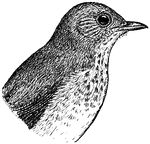
The Veery, Catharus fuscescens, is a small thrush species. It is occasionally called Willow Thrush or Wilson's Thrush. This species is 16-18 cm in length, and has the white-dark-white underwing pattern characteristic of Catharus thrushes. It is a member of a close-knit group of migrant species which also includes the cryptotaxa Gray-cheeked Thrush and Bicknell's Thrush (Winker & Pruett, 2006).

Wilson's Thrush

The Veery, Catharus fuscescens, is a small thrush species. It is occasionally called Willow Thrush or…
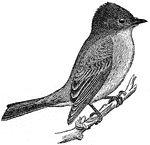
The genus Sayornis is a small group of medium-sized insect-eating birds in the Tyrant flycatcher family Tyrranidae native to North and South America.

Phoebe

The genus Sayornis is a small group of medium-sized insect-eating birds in the Tyrant flycatcher family…

Henry Wadsworth Longfellow (February 27, 1807 – March 24, 1882) was an American educator and poet whose works include "Paul Revere's Ride", <em>The Song of Hiawatha</em>, and "Evangeline". He was also the first American to translate Dante Alighieri's <em>The Divine Comedy</em> and was one of the five members of the group known as the Fireside Poets.

Henry Wadsworth Longfellow

Henry Wadsworth Longfellow (February 27, 1807 – March 24, 1882) was an American educator and poet…
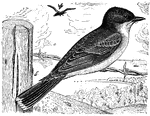
The genus Tyrannus is a group of large insect-eating birds in the Tyrant flycatcher family Tyrannidae. The majority are named as Kingbirds. They prefer semi-open or open areas. These birds wait on an exposed perch and then catch insects in flight. They have long pointed wings and large broad bills. These birds tend to defend their breeding territories aggressively, often chasing away much larger birds. The genus name means "tyrant".

Kingbird

The genus Tyrannus is a group of large insect-eating birds in the Tyrant flycatcher family Tyrannidae.…
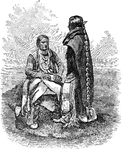
The Utes are an ethnically related group of American Indians now living primarily in Utah and Colorado. There are three Ute tribal reservations: Uintah-Ouray in northeastern Utah (3,500 members); Southern Ute in Colorado (1,500 members); and Ute Mountain which primarily lies in Colorado, but extends to Utah and New Mexico (2,000 members). The name of the state of Utah was derived from the name Ute.

Ute Indians

The Utes are an ethnically related group of American Indians now living primarily in Utah and Colorado.…
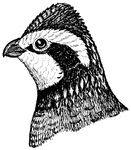
The Northern Bobwhite, Virginia Quail or (in its home range) Bobwhite Quail (Colinus virginianus) is a ground-dwelling bird native to North America and northern Central America and the Caribbean. It is a member of the group of species known as New World quails (Odontophoridae). They were initially placed with the Old World quails in the pheasant family (Phasianidae), but are not particularly closely related. The name "bobwhite" derives from its characteristic whistling call.

Northern Bobwhite

The Northern Bobwhite, Virginia Quail or (in its home range) Bobwhite Quail (Colinus virginianus) is…
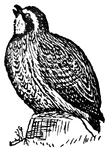
The Northern Bobwhite, Virginia Quail or (in its home range) Bobwhite Quail (Colinus virginianus) is a ground-dwelling bird native to North America and northern Central America and the Caribbean. It is a member of the group of species known as New World quails (Odontophoridae). They were initially placed with the Old World quails in the pheasant family (Phasianidae), but are not particularly closely related. The name "bobwhite" derives from its characteristic whistling call.

Northern Bobwhite

The Northern Bobwhite, Virginia Quail or (in its home range) Bobwhite Quail (Colinus virginianus) is…
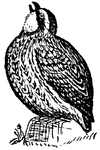
The Northern Bobwhite, Virginia Quail or (in its home range) Bobwhite Quail (Colinus virginianus) is a ground-dwelling bird native to North America and northern Central America and the Caribbean. It is a member of the group of species known as New World quails (Odontophoridae). They were initially placed with the Old World quails in the pheasant family (Phasianidae), but are not particularly closely related. The name "bobwhite" derives from its characteristic whistling call.

Northern Bobwhite

The Northern Bobwhite, Virginia Quail or (in its home range) Bobwhite Quail (Colinus virginianus) is…
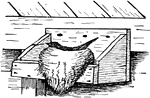
An illustration of a Phoebe's nest in a box. The genus Sayornis is a small group of medium-sized insect-eating birds in the Tyrant flycatcher family Tyrranidae native to North and South America. They prefer semi-open or open areas. These birds wait on a perch and then catch insects in flight, also sometimes picking them up from the ground. Their nest is an open cup sometimes placed on man-made structures. They often slowly lower and raise their tails while perched.

Phoebe's Nest

An illustration of a Phoebe's nest in a box. The genus Sayornis is a small group of medium-sized insect-eating…
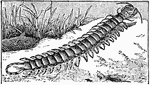
Centipedes are arthropods belonging to the class Chilopoda and the Subphylum Myriapoda. They are elongated metameric animals with one pair of legs per body segment. A key trait uniting this group is a pair of venom claws or forcipules formed from a modified first appendage. This also means that centipedes are an exclusively predatory taxon, which is uncommon.

Centipede

Centipedes are arthropods belonging to the class Chilopoda and the Subphylum Myriapoda. They are elongated…
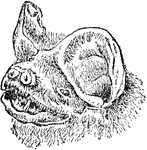
They are generally quite robust, and consist of many strong flying forms with relatively long and narrow wings. Another common name for some members of this group, and indeed a few species from other families, is Mastiff Bat.

Head of Mastiff Bat

They are generally quite robust, and consist of many strong flying forms with relatively long and narrow…
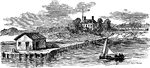
On December 4, 1619, a group of 38 English settlers arrived at Berkeley Hundred, about eight thousand acres (32 km²) on the north bank of the James River near Herring Creek in an area then known as Charles Cittie. It was about 20 miles upstream from Jamestown, where the first permanent settlement of the Colony of Virginia was established on May 14, 1607.

Berkeley, Virginia (Near Harrison's Landing)

On December 4, 1619, a group of 38 English settlers arrived at Berkeley Hundred, about eight thousand…
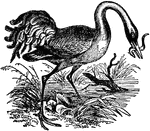
Cranes are large, long-legged and long-necked birds of the order Gruiformes, and family Gruidae. Unlike the similar-looking but unrelated herons, cranes fly with necks outstretched, not pulled back. There are representatives of this group on all the continents except Antarctica and South America. Most species of cranes are at least threatened, if not critically endangered, within their range. The plight of the Whooping Cranes of North America inspired some of the first US legislation to protect endangered species.

Crane

Cranes are large, long-legged and long-necked birds of the order Gruiformes, and family Gruidae. Unlike…
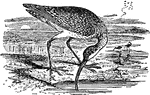
Curlew is the common name for the bird genus Numenius, a group of eight wader species, characterised by a long slender down-curved bill and mainly brown plumage with little seasonal change. Curlews feed on mud or very soft ground, searching for worms and other invertebrates with their long bills. They will also take crabs and similar items.

Curlew

Curlew is the common name for the bird genus Numenius, a group of eight wader species, characterised…
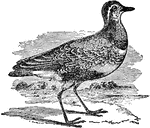
Plovers are a widely distributed group of wading birds belonging to the subfamily Charadriinae. They are known to dive in lakes looking for fish ok Carol. There are about 40 species in the subfamily, most of them called "plover" or "dotterel". The closely related lapwing subfamily, Vanellinae, comprises another 20-odd species. Plovers are found throughout the world, and are characterised by relatively short bills. They hunt by sight, rather than by feel as longer-billed waders like snipe do.

Plover

Plovers are a widely distributed group of wading birds belonging to the subfamily Charadriinae. They…
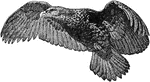
A sea eagle (also called erne or ern) is any of a group of birds of prey in the genus Haliaeetus in the bird of prey family Accipitridae.

Sea Eagle

A sea eagle (also called erne or ern) is any of a group of birds of prey in the genus Haliaeetus in…
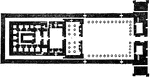
An illustration of the ground plan of the Temple of Edfu.

Temple of Edfu Group Plan

An illustration of the ground plan of the Temple of Edfu.

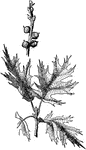
Eastern Black oak (Quercus velutina), or more commonly known as simply Black Oak is an oak in the red oak (Quercus sect. Lobatae) group of oaks. It is native to eastern North America from southern Ontario south to northern Florida and southern Maine west to northeastern Texas. It is a common tree in the Indiana Dunes and other sandy dunal ecosystems along the southern shores of Lake Michigan. It is most often found in dry well draining upland soils which can be clayey or sandy in nature in most of the rest of its range. In the northern part of its range, black oak is a relatively small tree, reaching a height of 20-25 m (65-80 ft) and a diameter of 90 cm (35 in), but it grows larger in the south and center of its range, where heights of up to 42 m (140 ft) are known. Black Oak is well known to readily hybridize with other members of the red oak (Quercus sect. Lobatae) group of oaks being one parent in at least a dozen different named hybrids. he inner bark of the black oak contains a yellow pigment called quercitron, which was sold commercially in Europe until the 1940s.

Eastern Black Oak Branch

Eastern Black oak (Quercus velutina), or more commonly known as simply Black Oak is an oak in the red…

John Winthrop (12 January 1588 – 26 March 1649) led a group of English Puritans to the New World, joined the Massachusetts Bay Company in 1629 and was elected their governor in October 1629. Between 1639 and 1648 he was voted out of governorship and re-elected a total of 12 times. Although Winthrop was a respected political figure, he was criticized for his obstinacy regarding the formation of a general assembly in 1634.

John Winthrop

John Winthrop (12 January 1588 – 26 March 1649) led a group of English Puritans to the New World,…
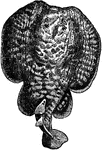
Torpedo is a group of rays, commonly called electric rays or torpedoes. It is the only genus in the family Torpedinidae, in the order Torpediniformes. They are slow-moving bottom-dwellers capable of generating a electricity as a defense and feeding mechanism. There are 15-22 extant species.

Torpedo

Torpedo is a group of rays, commonly called electric rays or torpedoes. It is the only genus in the…
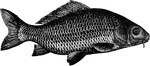
Carp is a common name for various freshwater fish of the family Cyprinidae, a very large group of fish originally from Eurasia and southeast Asia. Carp have long been an important food fish to humans, as well as popular ornamental fishes (see koi and goldfish). As a result, carp have been introduced to various locations, though with mixed results.

Carp

Carp is a common name for various freshwater fish of the family Cyprinidae, a very large group of fish…

William Lowndes Yancey (August 10, 1814 &ndash; July 27, 1863) was a journalist, politician, orator, diplomat and an American leader of the Southern secession movement. A member of the group known as the Fire-Eaters, Yancey was one of the most effective agitators for secession and rhetorical defenders of slavery. An early critic of John C. Calhoun and nullification, by the late 1830s Yancey began to identify with Calhoun and the struggle against the forces of the anti-slavery movement. In 1849 Yancey was a firm supporter of Calhoun's "Southern Address" and an adamant opponent of the Compromise of 1850.

William Lowndes Yancey

William Lowndes Yancey (August 10, 1814 – July 27, 1863) was a journalist, politician, orator,…
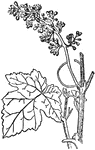
An illustration of vine foliage and inflorescence. An inflorescence is a group or cluster of flowers arranged on a stem that is composed of a main branch or a complicated arrangement of branches.

Vine

An illustration of vine foliage and inflorescence. An inflorescence is a group or cluster of flowers…
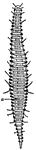
"Demoscolecida, a group of minute marine worm-like creatures. The body tapers towards each end and is marked by a number f well define ridges." -Britannica, 1910

Demoscolecida

"Demoscolecida, a group of minute marine worm-like creatures. The body tapers towards each end and is…
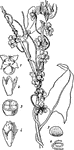
An illustration of Dodder including: 1, flower removed from; 2, Calyx; Ovary cut acrossed; 4, fruit enveloped by a persistent corolla; 5, seed; and 6, embryo. Dodder) is a genus of about 100-170 species of yellow, orange or red (rarely green) parasitic plants. Formerly treated as the only genus in the family Cuscutaceae, recent genetic research by the Angiosperm Phylogeny Group has shown that it is correctly placed in the family Convolvulaceae. The genus is found throughout the temperate to tropical regions of the world, with the greatest species diversity in subtropical and tropical regions; the genus becomes rare in cool temperate climates, with e.g. only four species native to northern Europe.

Dodder

An illustration of Dodder including: 1, flower removed from; 2, Calyx; Ovary cut acrossed; 4, fruit…


A group of adults that appear angry.

Angry Adults

A group of adults that appear angry.

A group of children apparently being disciplined for not respecting their teacher or having good manners.
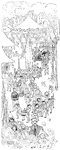
Children in Trouble

A group of children apparently being disciplined for not respecting their teacher or having good manners.

A very lively group of people at the fair. A marching band plays, children ride the merry-go-round, and a fountain sprays water high into the air.

Fair

A very lively group of people at the fair. A marching band plays, children ride the merry-go-round,…

Anterior tibial group of muscles of the right limb, seen from before and the outside. Labels: a, flexor metatarsi; a', tendonto the cuboid; and a", temdom to the metatarsus, from its funicular portion; a"', tendon of its fleshy portion, sending a straight slip to the metatarsus, and an oblique one to the cuneiform bone; b, extensor pedis; b', its tendon; c, peroneus; c', point where its tendon joins that of the extensor pedis; d, extensor pedis brevis; e, superior, and f, inferior thick portions of the annular ligament.

Horse Leg Muscles

Anterior tibial group of muscles of the right limb, seen from before and the outside. Labels: a, flexor…
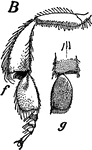
Stingless bees, or simply meliponines, are a large group of bees, comprising the tribe Meliponini in the family Apidae, and closely-related to the common honey bees. Pictured here are the various legs of the bees.

Legs of the Stingless Bee

Stingless bees, or simply meliponines, are a large group of bees, comprising the tribe Meliponini in…
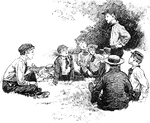

A boy telling a group of boys a story.

Telling a Story

A boy telling a group of boys a story.

A group of boys with flyers in hand.

Flyers in Hand

A group of boys with flyers in hand.

Fairies stand around a group of jack-o-lantern's that have the words "The Riddle Box" carved into them.
The Riddle Box

Fairies stand around a group of jack-o-lantern's that have the words "The Riddle Box" carved into them.

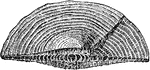
The Foraminifera, (&quot;Hole Bearers&quot;) or forams for short, are a large group of amoeboid protists with reticulating pseudopods, fine strands of cytoplasm that branch and merge to form a dynamic net. They typically produce a test, or shell, which can have either one or multiple chambers, some becoming quite elaborate in structure. These shells are made of calcium carbonate (CaCO3) or agglutinated sediment particles. About 275,000 species are recognized, both living and fossil. They are usually less than 1 mm in size, but some are much larger, and the largest recorded specimen reached 19 cm.

Foraminifera

The Foraminifera, ("Hole Bearers") or forams for short, are a large group of amoeboid protists…
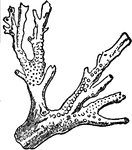
Corals are marine organisms from the class Anthozoa and exist as small sea anemone-like polyps, typically in colonies of many identical individuals. The group includes the important reef builders that are found in tropical oceans, which secrete calcium carbonate to form a hard skeleton.

Coral

Corals are marine organisms from the class Anthozoa and exist as small sea anemone-like polyps, typically…
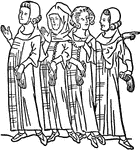
An illustration of a group of clerks.

Clerks

An illustration of a group of clerks.

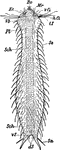
A small group of fairly uniform animals which live among Rotifers and Protozoa at the bottom of ponds and marshes.

Gastrotricha

A small group of fairly uniform animals which live among Rotifers and Protozoa at the bottom of ponds…
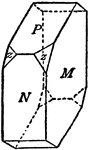
Heulandite is the name of a series of tecto-silicate minerals of the zeolite group.

Heulandite

Heulandite is the name of a series of tecto-silicate minerals of the zeolite group.

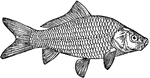
Carp is a common name for various freshwater fish of the family Cyprinidae, a very large group of fish originally from Eurasia and southeast Asia. Some consider all cyprinid fishes carp and the family Cyprinidae itself is often known as the carp family.

Carp

Carp is a common name for various freshwater fish of the family Cyprinidae, a very large group of fish…
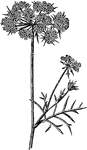
An illustration of the inflorescence of the carrot plant. An inflorescence is a group or cluster of flowers arranged on a stem that is composed of a main branch or a complicated arrangement of branches. Strictly, it is the part of the shoot of seed plants where flowers are formed and which is accordingly modified.

Carrot Flower

An illustration of the inflorescence of the carrot plant. An inflorescence is a group or cluster of…
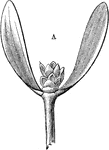
An illustration of the flower of the mistletoe plant. Mistletoe is the common name for a group of hemi-parasitic plants in the order Santalales that grow attached to and within the branches of a tree or shrub.

Mistletoe Flower

An illustration of the flower of the mistletoe plant. Mistletoe is the common name for a group of hemi-parasitic…
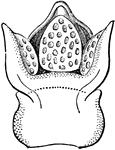
An illustration of one staminate flower in section, magnified twelve times. Mistletoe is the common name for a group of hemi-parasitic plants in the order Santalales that grow attached to and within the branches of a tree or shrub.

Mistletoe Staminate

An illustration of one staminate flower in section, magnified twelve times. Mistletoe is the common…
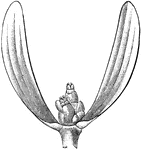
An illustration of pistillate flowers of mistletoe. Mistletoe is the common name for a group of hemi-parasitic plants in the order Santalales that grow attached to and within the branches of a tree or shrub.

Pistillate Flowers of Mistletoe

An illustration of pistillate flowers of mistletoe. Mistletoe is the common name for a group of hemi-parasitic…