This ClipArt gallery offers 124 illustrations of Egyptian architecture, including structures and styles commonly seen and used in Egyptian construction. Illustrations include pyramids, temples, obelisks, columns, and other distinctive elements of Egyptian architecture.

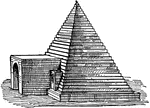
One, structural and pyramidal, is represented by many examples at Abydos, the most venerated of all the burial grounds of Egypt. All of these are built of brick, and are of moderate size and little artistic interest.

Tomb at Abydos

One, structural and pyramidal, is represented by many examples at Abydos, the most venerated of all…
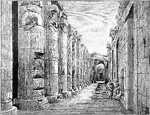
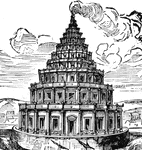
Alexandria, Pharos Island Lighthouse

Pharos Island Lighthouse

Alexandria, Pharos Island Lighthouse

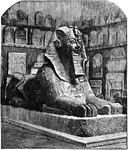
"Androsphinx of Thothmes III."-Whitney, 1902

Androsphinx

"Androsphinx of Thothmes III."-Whitney, 1902

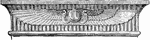
An entablature refers to the superstructure of moldings and bands which lie horizontally above columns, resting on their capitals. Entablatures are major elements of classical architecture, and are commonly divided into the architrave, frieze, and the cornice. The architrave (also called epistyle or door frame) is a moulded or ornamental band framing a rectangular opening. It is the lintel or beam that rests on the capitals of the columns.

Architrave of Entablature over Doorway at the Great Temple at Philæ

An entablature refers to the superstructure of moldings and bands which lie horizontally above columns,…
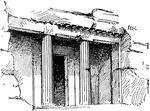
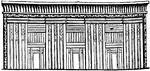
Beni Hasan (also written as Bani Hasan, or also Beni-Hassan) is a village in Middle Egypt about 25 km south of al Minya, on the east bank of the Nile, with remarkable catacombs that have been excavated. During the Middle Kingdom, it was the center of the cult of Pakhet.

Tomb at Beni-Hassan

Beni Hasan (also written as Bani Hasan, or also Beni-Hassan) is a village in Middle Egypt about 25 km…
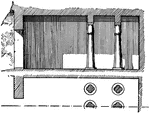
Beni Hasan (also written as Bani Hasan, or also Beni-Hassan) is a village in Middle Egypt about 25 km south of al Minya, on the east bank of the Nile, with remarkable catacombs that have been excavated. During the Middle Kingdom, it was the center of the cult of Pakhet.

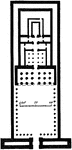
Section and Half-Plan of a Tomb at Beni-Hassan

Beni Hasan (also written as Bani Hasan, or also Beni-Hassan) is a village in Middle Egypt about 25 km…
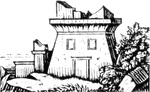
Ancient Egyptian building

Building

Ancient Egyptian building

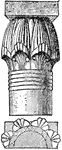
An illustrational of a decorative capital.

Capital

An illustrational of a decorative capital.

An illustration of a decorative capital.

Capital

An illustration of a decorative capital.

"In their private dwellings the Egyptians sometimes used graceful columns and the true arch (both of which forms the Greeks may have learned from them); but for their more important buildings they preferred massive walls and rows of huge, close-set columns, supporting roofs of immense flat slabs of rock." - West, 1904

A Capital from Karnak

"In their private dwellings the Egyptians sometimes used graceful columns and the true arch (both of…
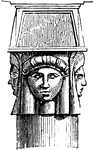
In some temples the pillars have, in lieu of capital, the face of a goddess, probably of Isis, with a drooping sacerdotal hood, and supporting a temple on the head. This face is repeated on four sides of the circular shaft.

Capital in the Temple at Denderah

In some temples the pillars have, in lieu of capital, the face of a goddess, probably of Isis, with…
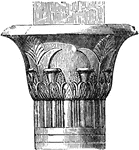
The capitals of the columns display an immense variety. The most beautiful have a crater-like form, and appear like the projecting bell of a flower, with leaves standing out from the surface (here). In other instances the pillars are imitations of a palm tree, and have a smooth slender shaft, a neck-moulding of several rings, and then, without any intermediate architectural division, a capital formed of the graceful leaves of the palm.

Capital in the Temple at Edfu

The capitals of the columns display an immense variety. The most beautiful have a crater-like form,…
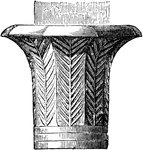
The capitals of the columns display an immense variety. The most beautiful have a crater-like form, and appear like the projecting bell of a flower, with leaves standing out from the surface. In other instances the pillars are imitations of a palm tree, and have a smooth slender shaft, a neck-moulding of several rings, and then, without any intermediate architectural division, a capital formed of the graceful leaves of the palm (here).

Capital in the Temple at Edfu

The capitals of the columns display an immense variety. The most beautiful have a crater-like form,…
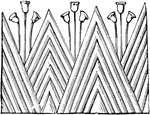
At the lower part of the capital there frequently occurs an ornament of diminishing triangles, resembling the sheath from which the stalk of a plant springs (here). The same ornament often occurs at the base of the shaft, and seems to a certain extent borrowed from the shape of the lower portion of the papyrus plant. Other capitals imitate an unopened bud or seed-pod.

Capital Ornament in the Temple at Edfu

At the lower part of the capital there frequently occurs an ornament of diminishing triangles, resembling…
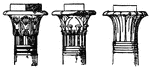
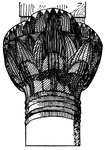
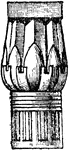
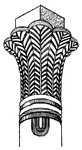
Figures a and b show the bell-shaped (campaniform) capital. Figure c is a palmiform capital.

Capital Types

Figures a and b show the bell-shaped (campaniform) capital. Figure c is a palmiform capital.
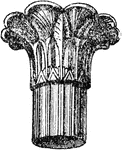
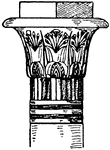
A capital with palm decoration.

Capital with Palm

A capital with palm decoration.

A bell capital with papyrus decoration.

Bell Capital with Papyrus

A bell capital with papyrus decoration.

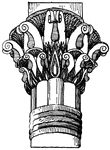
Ptolemaic floral capital from Philae.

Floral Capital

Ptolemaic floral capital from Philae.

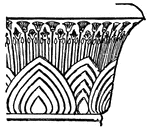
Lobed lotus capital from the Theban Oasis.

Lobed Lotus Capital

Lobed lotus capital from the Theban Oasis.

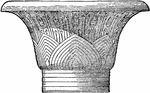
A decorative capital with lotus engraved.

Lotus Capital

A decorative capital with lotus engraved.

Palm capital from the Temple of Edfu.

Palm Capital

Palm capital from the Temple of Edfu.

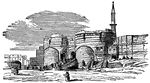
Gateway of the Citadel, Cairo

Citadel, Cairo

Gateway of the Citadel, Cairo

A coffin or tomb of stone; a kind of stone chest, generally more or less ornamented for receiving a dead body. The oldest known sarcophagi are Egyptian, and have been found in certain pyramids.

Egyptian Sarcophagus

A coffin or tomb of stone; a kind of stone chest, generally more or less ornamented for receiving a…
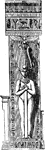
Instead of columns, square piers are not infrequently introduced in the tombs. In structural buildings they only occur in connection with colossal statues; in which case the pier supports the roof, and the statue, while connected with the pier at the back, has its head free, without supporting anything.

Front View of the Colossal Statue on a Pier at the Luxor Temple

Instead of columns, square piers are not infrequently introduced in the tombs. In structural buildings…
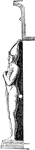
Instead of columns, square piers are not infrequently introduced in the tombs. In structural buildings they only occur in connection with colossal statues; in which case the pier supports the roof, and the statue, while connected with the pier at the back, has its head free, without supporting anything.

Profile of the Colossal Statue on a Pier at the Luxor Temple

Instead of columns, square piers are not infrequently introduced in the tombs. In structural buildings…
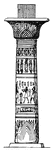
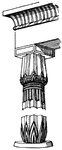
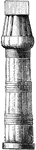
Campaniform column.

Egyptian Column

Campaniform column.

Lotus-bundle column from the Temple of Thomthmes III, Karnak.

Egyptian Column

Lotus-bundle column from the Temple of Thomthmes III, Karnak.

"Columns are largely employed in the architecture of Egyptian temples. They are of various forms." —D'Anvers, 1895

Column

"Columns are largely employed in the architecture of Egyptian temples. They are of various forms." —D'Anvers,…
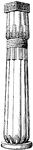
"Columns are largely employed in the architecture of Egyptian temples. They are of various forms." —D'Anvers, 1895

Column

"Columns are largely employed in the architecture of Egyptian temples. They are of various forms." —D'Anvers,…
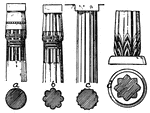
Egyptian columns had shafts of three types: a) circular or cylindrical, b) clustered, c) polygonal or proto-doric. The first two tapered upward and sometimes had a slight swelling at the base (d).

Column Types

Egyptian columns had shafts of three types: a) circular or cylindrical, b) clustered, c) polygonal or…
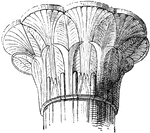
"Many columns have capitals representing palm leaves." —D'Anvers, 1895

Capital of a column

"Many columns have capitals representing palm leaves." —D'Anvers, 1895

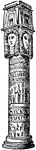
An illustration of a decorative column.

Decorative Column

An illustration of a decorative column.

An illustration of a column with a craving of Hathor. In Egyptian mythology, Hathor (Pronounced Hah-Thor) (Egyptian for house of Horus) was originally a personification of the Milky Way, which was seen as the milk that flowed from the udders of a heavenly cow. Hathor was an ancient goddess, and was worshipped as a cow-deity from at least 2700 BC.

Hathor's Column

An illustration of a column with a craving of Hathor. In Egyptian mythology, Hathor (Pronounced Hah-Thor)…
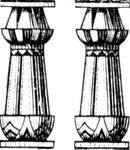
Columns

Columns

Columns

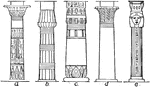
a, campaniform; b, clustered lotus column; c, simple lotus column; d, palm column; e, Hathor-headed column.

Types of Columns

a, campaniform; b, clustered lotus column; c, simple lotus column; d, palm column; e, Hathor-headed…
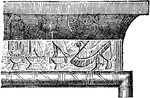
An entablature refers to the superstructure of moldings and bands which lie horizontally above columns, resting on their capitals. Entablatures are major elements of classical architecture, and are commonly divided into the architrave, frieze, and the cornice. The term cornice comes from Italian cornice, meaning "ledge." Cornice molding is generally any horizontal decorative molding which crowns any building or furniture element: the cornice over a door or window, for instance, or the cornice around the edge of a pedestal. A simple cornice may be formed just with a crown molding.

Cornice of Entablature over Doorway at the Great Temple at Philæ

An entablature refers to the superstructure of moldings and bands which lie horizontally above columns,…
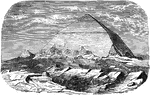
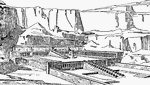
"Temple of Deir-el-Bahri, conjectural restoration by Prof. E. Brune." — The Encyclopedia Britannica, 1910

Deir-el-Bahri

"Temple of Deir-el-Bahri, conjectural restoration by Prof. E. Brune." — The Encyclopedia Britannica,…
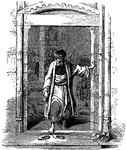
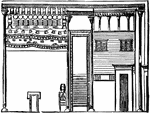
The Temple of Edfu is an ancient Egyptian temple located on the west bank of the Nile in the city of Edfu which was known in Greco-Roman times as Apollonopolis Magna, after the chief god Horus-Apollo. It is the second largest temple in Egypt after Karnak and one of the best preserved. The temple, dedicated to the falcon god Horus, was built in the Ptolemaic period between 237 and 57 BCE.

Temple of Edfu Plan

The Temple of Edfu is an ancient Egyptian temple located on the west bank of the Nile in the city of…
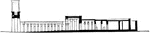
The Temple of Edfu is an ancient Egyptian temple located on the west bank of the Nile in the city of Edfu which was known in Greco-Roman times as Apollonopolis Magna, after the chief god Horus-Apollo. It is the second largest temple in Egypt after Karnak and one of the best preserved. The temple, dedicated to the falcon god Horus, was built in the Ptolemaic period between 237 and 57 BCE.

Temple of Edfu Section

The Temple of Edfu is an ancient Egyptian temple located on the west bank of the Nile in the city of…
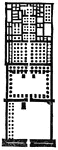
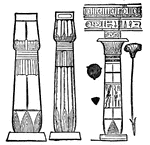
Plan of the Memnonium, at Thebes.

Egypt, Plan of the Memnonium, Thebes

Plan of the Memnonium, at Thebes.

Types of Egyptian Columns.

Egypt, Types of Columns of

Types of Egyptian Columns.

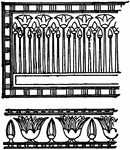
Externally the temples presented only masses of unbroken wall; but these, as well as the pylons, were covered with huge pictures of a historical character. Only in the tombs do we find painted ornament of a purely conventional sort. Rosettes, diaper patterns, spirals, and checkers are to be met with in them; but many of these can be traced to symbolic origins.

Egyptian Floral Ornament Form

Externally the temples presented only masses of unbroken wall; but these, as well as the pylons, were…
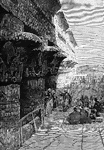
Sleep temples are regarded by some as an early instance of hypnosis over 4000 years ago, under the influence of Imhotep.

Egyptian Temple

Sleep temples are regarded by some as an early instance of hypnosis over 4000 years ago, under the influence…
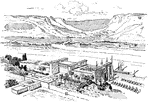
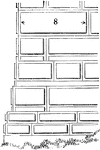
The workmanship of the white marble columns, and of the large squared stones which are joined without cement, shows a cultivated skill.

Elevation of Platform at Pasargadæ

The workmanship of the white marble columns, and of the large squared stones which are joined without…
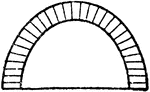
"Upright elliptical arch, sometimes called the egg-shaped arch, employed in Egyptian and Sassanian architecture." — The Encyclopedia Britannica, 1910

Elliptical Arch

"Upright elliptical arch, sometimes called the egg-shaped arch, employed in Egyptian and Sassanian architecture."…
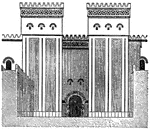
"Facade of the Great Hall of Columns of the Ptolemaic temple at Edfu." — The Encyclopedia Britannica, 1910

Facade

"Facade of the Great Hall of Columns of the Ptolemaic temple at Edfu." — The Encyclopedia Britannica,…
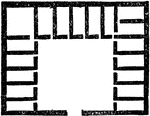
An illustration of a typical floor plan in an Egyptian private dwelling.

Private Dwelling Floor Plan

An illustration of a typical floor plan in an Egyptian private dwelling.
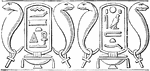
They are generally of smaller dimensions in the interior, so that the walls or columns of the same chamber contain several rows of such representations. Between and over them are often found ornamented bands like friezes, and at the bottom of the walls, as in the case of the columns, are introduced more decorations, representing lotus-plants.

Mural Frieze-like Decoration from the Temple of Esneh

They are generally of smaller dimensions in the interior, so that the walls or columns of the same chamber…
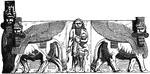
An illustration of sculptures from a gateway at Khorsabad.

Gateway at Khorsabad

An illustration of sculptures from a gateway at Khorsabad.

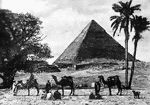
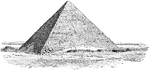
The Great Pyramid at Gizeh

Gizeh Pyramid

The Great Pyramid at Gizeh

An illustration of the Great Hall of Columns at Karnak.

Great Hall of Columns at Karnak

An illustration of the Great Hall of Columns at Karnak.

"Restoration of the Great Hall of Karnak-- largest building of the Egyptian empire." -Breasted, 1914

Great Hall of Karnak

"Restoration of the Great Hall of Karnak-- largest building of the Egyptian empire." -Breasted, 1914

The Great Pyramid of Giza, also called Khufu's Pyramid or the Pyramid of Khufu, and Pyramid of Cheops, is the oldest and largest of the three pyramids in the Giza Necropolis bordering what is now Cairo, Egypt, and is the only remaining member of the Seven Wonders of the Ancient World.

Great Pyramid of Giza

The Great Pyramid of Giza, also called Khufu's Pyramid or the Pyramid of Khufu, and Pyramid of Cheops,…

The Great Pyramid of Giza, also called Khufu's Pyramid or the Pyramid of Khufu, and Pyramid of Cheops, is the oldest and largest of the three pyramids in the Giza Necropolis bordering what is now Cairo, Egypt, and is the only remaining member of the Seven Wonders of the Ancient World. The Great Pyramid is the only pyramid known to contain both ascending and descending passages. There are three known chambers inside the Great Pyramid. These are arranged centrally, on the vertical axis of the pyramid.

Great Pyramid of Giza, Cross Section

The Great Pyramid of Giza, also called Khufu's Pyramid or the Pyramid of Khufu, and Pyramid of Cheops,…

The Grand Gallery features a corbel haloed design and several cut "sockets" spaced at regular intervals along the length of each side of its raised base with a "trench" running along its center length at floor level. What purpose these sockets served is unknown. An antechamber leads from the Grand Gallery to the King's Chamber.

Great Pyramid of Giza, Section of the Grand Gallery

The Grand Gallery features a corbel haloed design and several cut "sockets" spaced at regular…

The King's Chamber is lined with red granite brought from Aswan 935 km (580 miles) to the south, of which the blocks used for the roof are estimated to weigh 50 to 80 tons. Egyptologists believe they were transported on barges down the Nile river.

Great Pyramid of Giza, King's Chamber

The King's Chamber is lined with red granite brought from Aswan 935 km (580 miles) to the south, of…

An section illustration of the Great Pyramid.

Great Pyramid Section

An section illustration of the Great Pyramid.

A: King's Chamber;B: Queen's Chamber;C: Chamber Cut in Rock.

Section of Great Pyramid

A: King's Chamber; B: Queen's Chamber; C: Chamber Cut in Rock.

"Vertical Section of the Great pyramid, looking West showingA. Entrance passage.       B. A later opening.D. First ascending passage. E. Horizontal Passage.F. Queen's chamber.G G. Grand gallery.H. Antechamber.I. Coffer.K. King's chamber.M N. Ventilating chambers.O. Subterranean chamber.P. Well, so-called.R R R. Probable extent to which the native rock is employed to assist the masonry of the building." - West, 1904

Vertical section of the Great Pyramid

"Vertical Section of the Great pyramid, looking West showing A. Entrance passage. B. A later opening. D.…

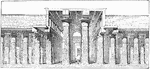
"Section through Hall of Columns, Karnak. a, Clerestory window." — The Encyclopedia Britannica, 1910

Hall of Columns

"Section through Hall of Columns, Karnak. a, Clerestory window." — The Encyclopedia Britannica,…