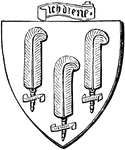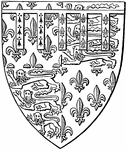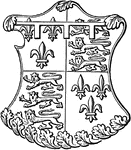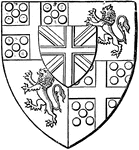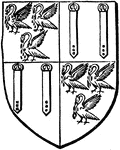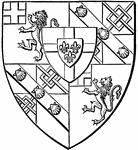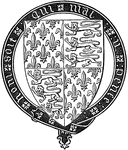
The heraldic shield for the city of Rochester in the United Kingdom.

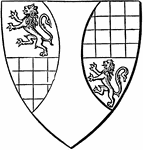
Shield of Rochester

The heraldic shield for the city of Rochester in the United Kingdom.

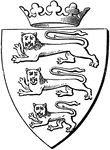
The heraldic shield and crown of Henry III of England.

Crown and Shield of Henry III

The heraldic shield and crown of Henry III of England.

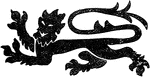
A common charge in heraldry. It generally symbolizes bravery, strength, and royalty.

Heraldic Lion

A common charge in heraldry. It generally symbolizes bravery, strength, and royalty.

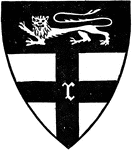
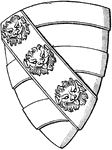
The shield of a knight of the time of Edward II. The lion's face is a common charge in heraldry.

Heraldic Shield with a Lion's Face

The shield of a knight of the time of Edward II. The lion's face is a common charge in heraldry.
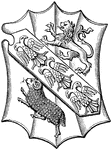
The heraldic shield of Abbot Ramryge.

Shield of Abbot Ramryge

The heraldic shield of Abbot Ramryge.

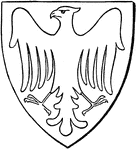
The heraldic charge of the eagle is one of the earliest charges. It holds the same rank that the lion maintains among beasts.

Eagle

The heraldic charge of the eagle is one of the earliest charges. It holds the same rank that the lion…
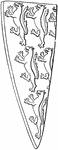
The heraldic shield of William Longspée, the 3rd Earl of Salisbury.

Shield of William Longspée

The heraldic shield of William Longspée, the 3rd Earl of Salisbury.

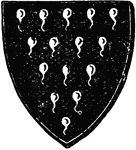
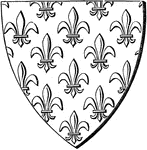
"When several charges appear in one shield, the number in each row is generally indicated - as, 'three, two, and one,' and these must be given in writing, not in figures; but when the numbers exceed six, they produce the appearance of a pattern, and the field so covered is said to be seméee with the charge in question."—Aveling, 1891

Shield Semée

"When several charges appear in one shield, the number in each row is generally indicated - as, 'three,…
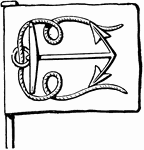
"This charge is borne with a cable, and set fesse-wise, by the British Admiralty; but it is usual to place it in pale, and it depicted without a cable, unless the contrary is specified."—Aveling, 1891

Anchor

"This charge is borne with a cable, and set fesse-wise, by the British Admiralty; but it is usual to…
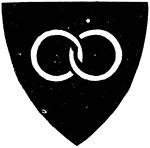
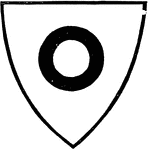
"Two or more annulets interlacing each other."—Aveling, 1891

Annulet Conjoined

"Two or more annulets interlacing each other."—Aveling, 1891

"From annulus, a ring. A mark of difference of the fifth son."—Aveling, 1891

Annulet

"From annulus, a ring. A mark of difference of the fifth son."—Aveling, 1891

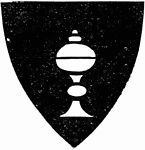
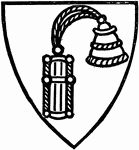
"An egg-shaped, ornamental, covered cup, with a circular pedestal and base."—Aveling, 1891

Covered Cup

"An egg-shaped, ornamental, covered cup, with a circular pedestal and base."—Aveling, 1891
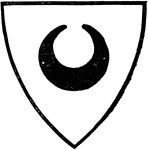
"A half-moon shaped charge, with its horns turned upwards."—Aveling, 1891

Crescent

"A half-moon shaped charge, with its horns turned upwards."—Aveling, 1891

The heraldic shield of the Black Prince, who was father of Richard II of England.

Black Prince

The heraldic shield of the Black Prince, who was father of Richard II of England.

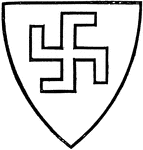
"A description of cross, with the ends or extremities bent at right angles."—Avelin, 1891

Fylot Shield

"A description of cross, with the ends or extremities bent at right angles."—Avelin, 1891
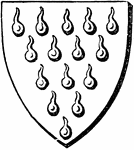
A heraldic field sprinkled with drops of blood.

Guttée du Sang

A heraldic field sprinkled with drops of blood.

"When the drops have their natural position inverted."—Aveling, 1891

Guttée Reversed

"When the drops have their natural position inverted."—Aveling, 1891

An ancient pen and ink holder.

Penner and Inkhorn

An ancient pen and ink holder.

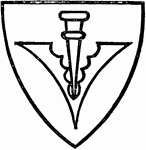
"The barbed head of a spear or arrow, engrailed on the inner side. The point of the spear is placed in base."—Aveling, 1891

Pheon

"The barbed head of a spear or arrow, engrailed on the inner side. The point of the spear is placed…
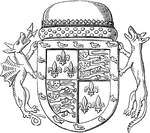
"Shield and supporters of Jaspar Tudor, K.G., Earl of Pembroke in 1452 and in 1485 Duke of Bedford; second son of Queen Catherine and Owen Tudor."—Aveling, 1891

Shield of Jaspar Tudor

"Shield and supporters of Jaspar Tudor, K.G., Earl of Pembroke in 1452 and in 1485 Duke of Bedford;…
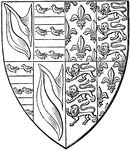
"Shield of John de Hastings, K.G., Earl of Pembroke, Quatering De Hastings and De Valence, and impaling France ancient and England quarterly."—Aveling, 1891

Shield of John de Hastings

"Shield of John de Hastings, K.G., Earl of Pembroke, Quatering De Hastings and De Valence, and impaling…
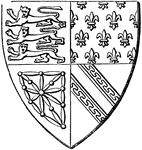
"Quartered shield of arms borne by Isabella, Queen of Edward II."—Aveling, 1891

Shield of Queen Isabella

"Quartered shield of arms borne by Isabella, Queen of Edward II."—Aveling, 1891
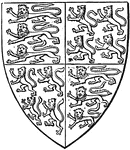
The heraldic shield of Philippa of Hainault, the Queen consort of Edward III of England.

Shield of Queen Philippa

The heraldic shield of Philippa of Hainault, the Queen consort of Edward III of England.
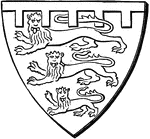
The heraldic shield of King Edward I of England, reigning from 1272 to 1307.

Shield of Edward I

The heraldic shield of King Edward I of England, reigning from 1272 to 1307.

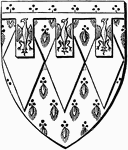
The heraldic shield of Sir Edward de Montague.

Shield of Sir Edward de Montague

The heraldic shield of Sir Edward de Montague.

The heraldic charge borne by the eldest son in a family.

The Label

The heraldic charge borne by the eldest son in a family.

The heraldic charge borne by the second eldest son in a family.

The Crescent

The heraldic charge borne by the second eldest son in a family.

The heraldic charge borne by the third eldest son in a family.

The Mullet

The heraldic charge borne by the third eldest son in a family.

The heraldic charge borne by the fourth eldest son in a family.

The Martlet

The heraldic charge borne by the fourth eldest son in a family.

The heraldic charge borne by the fifth eldest son in a family.

The Annulet

The heraldic charge borne by the fifth eldest son in a family.

The heraldic charge borne by the sixth eldest son in a family.

The Fleur-de-lis

The heraldic charge borne by the sixth eldest son in a family.

The heraldic charge borne by the seventh eldest son in a family.

The Rose

The heraldic charge borne by the seventh eldest son in a family.

The heraldic charge borne by the eighth eldest son in a family.

The Cross Moline

The heraldic charge borne by the eighth eldest son in a family.

The heraldic charge borne by the ninth eldest son in a family.

The Double Quatrefoil

The heraldic charge borne by the ninth eldest son in a family.

The heraldic shield of Ralph de Arundel.

Shield of Ralph de Arundel

The heraldic shield of Ralph de Arundel.

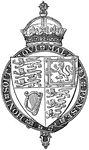
The heraldic shield of Her Majesty Queen Victoria.

Shield of Queen Victoria

The heraldic shield of Her Majesty Queen Victoria.

The heraldic shield of Henry Plantagenet of Bolingbroke, 1399.

Shield of Henry Plantagenet

The heraldic shield of Henry Plantagenet of Bolingbroke, 1399.

The heraldic shield of Henry V, Prince of Wales.

Shield of Henry V

The heraldic shield of Henry V, Prince of Wales.

The coat of arms of Arthur Wellesley, the Duke of Wellington.

Arms of Duke of Wellington

The coat of arms of Arthur Wellesley, the Duke of Wellington.

The heraldic shield of the British Howard family, after its augmentation.

Augmented Shield of Howard

The heraldic shield of the British Howard family, after its augmentation.

The heraldic shield of the family of Pelham, after its augmentation.

Shield of Pelham

The heraldic shield of the family of Pelham, after its augmentation.

The heraldic coat of arms of Spencer Churchill, Duke of Marlborough.

Arms of Spencer Churchill

The heraldic coat of arms of Spencer Churchill, Duke of Marlborough.

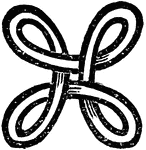
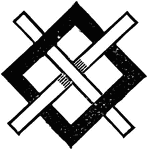
A knot used in heraldic designs.

Bowen Knot

A knot used in heraldic designs.

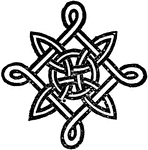
An elegant interlaced cord used in heraldry.

Lacy Knot

An elegant interlaced cord used in heraldry.

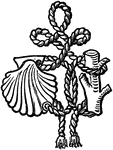
A decorative knot used in heraldry.

Dacre Knot

A decorative knot used in heraldry.

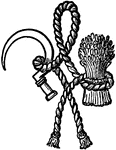
The Harrington knot used in heraldry.

Harrington Knot

The Harrington knot used in heraldry.

The Hungerford knot is commonly seen in heraldry.

Hungerford Knot

The Hungerford knot is commonly seen in heraldry.

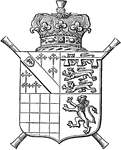
The coat of arms of the Duke of Norfolk.

Arms of the Duke of Norfolk

The coat of arms of the Duke of Norfolk.

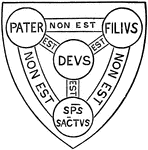
The heraldic shield used to represent the Holy Trinity.

Symbol of the Holy Trinity

The heraldic shield used to represent the Holy Trinity.

The heraldic shield of King Edward III of England.
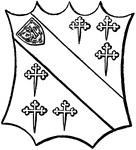
Shield of Edward III

The heraldic shield of King Edward III of England.

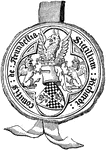
"The Seal of Richard, Earl of Arundel, bears his achievement of arms. The supporters, crest, helm, etc., are as conspicuously drawn as the shield. The crest is large in proportion to the shield; it was usually thus represented in the compositions of the fourteenth and fifteenth centuries."—Aveling, 1891

Seal of Richard, Earl of Arundel

"The Seal of Richard, Earl of Arundel, bears his achievement of arms. The supporters, crest, helm, etc.,…
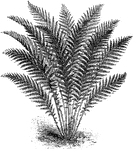
The common name of aspidium is shield fern. The common name of the aculeatum variety is the hard shield fern. The hard shield fern has dark green fronds which are one to three feet long.

Aspidium Aculeatum

The common name of aspidium is shield fern. The common name of the aculeatum variety is the hard shield…
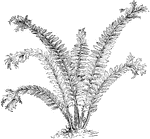
Aspidium angulare is commonly known as the soft shield fern. Grandiceps is a narrow fronded variety. This fern has a broad, tasselled head.

Aspidium Angulare Grandiceps

Aspidium angulare is commonly known as the soft shield fern. Grandiceps is a narrow fronded variety.…
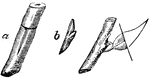
In shield-budding the bark should first have two incisions, a length wise incision one inch long, and an incision around the bark (figures a and b). The bud should then be prepared by removing half the leaf.

Shield Budding

In shield-budding the bark should first have two incisions, a length wise incision one inch long, and…
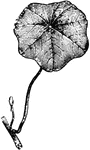
Peltate leaves are target shaped or shield like. Pictured is a peltate leaf of Indian cress.

Peltate Leaf of Indian Cress

Peltate leaves are target shaped or shield like. Pictured is a peltate leaf of Indian cress.
A banner, featuring two cherubs, torches, and a shield.

Pictorial Banner

A banner, featuring two cherubs, torches, and a shield.

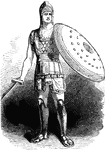
The image of a Roman legionnaire. He is equipped with a dense breastplate, a helm, a large round shield, greaves, and a short sword.

Arms and Armor

The image of a Roman legionnaire. He is equipped with a dense breastplate, a helm, a large round shield,…
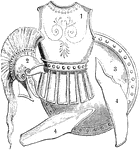
An array of miscellaneous ancient armors. The image depicts (1) a cuirass, often referred to as a coat of mail, (2) a helmet, (3) the shield, and (4), the greaves.

Arms and Armor

An array of miscellaneous ancient armors. The image depicts (1) a cuirass, often referred to as a coat…
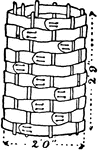
A gabion is an open cylinder made of brushwood, canvas, wire-netting, or iron bands used in fortification. Filled with loose earth, gabions are placed on end, in tiers, to form a wall behind which earth can be piled. They are usually constructed on location and made up of whatever materials are on hand.

Gabion

A gabion is an open cylinder made of brushwood, canvas, wire-netting, or iron bands used in fortification.…
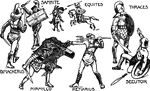
This illustration shows various types of gladiators, each type with with his specific weapons attributed to him.
Gladiators were swordsmen whose profession was to fight for the public amusement. Gladiators are said to have been borrowed by Rome from the Etruscans. They were first exhibited in Rome in 246 BC, primarily at funerals, but afterwards at festivals, particularly those celebrated by the aediles and other magistrates. More than ten thousand were shown at Trajan's triumph over the Dacians. They were either free-born citizens, usually of a low class, who fought for hire, or captives, slaves, or malefactors, and were kept in schools, where they were carefully trained. Chief varieties were Andabatae, who wore helmets with no openings for the eyes, so that their blindfold movements provoked the spectators' mirth; Mirmillones, who used Gallic weapons, sword and shield; Retiarii, who carried a net and a three-pronged lance -- the net to entangle their opponents; and Thraces, who, like the Thracians, used a short sword and a round buckler. 
When a gladiator was severely wounded and defeated, the people cried out 'Habet' (He has it), and he lowered his arms; then, if the spectators wished his life to be spared, they turned their thumbs down; but it they desired his death, they turned them up. These combats were often attended by great cruelty and callousness on the part of the spectators; sometimes they were fights à outrance, none being spared alive. Discharged gladiators were presented with a rudis, or wooden sword, and hence were called rudiarii. Gladiatorial combats were disliked by the Greeks, and practically never took place in Greek cities.

Gladiators

This illustration shows various types of gladiators, each type with with his specific weapons attributed…