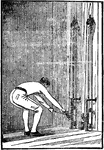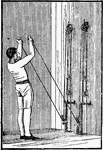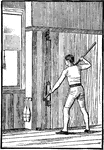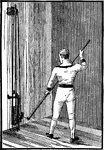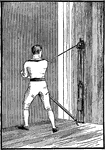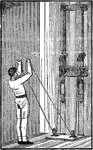
A man exercising with chest weights. In this position, he has bent over and now straightens his body with his hands over his head.

Chest Weights

A man exercising with chest weights. In this position, he has bent over and now straightens his body…
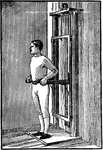
A man exercising with the traveling parallels. This device is used for upper body exercises.

Traveling Parallels

A man exercising with the traveling parallels. This device is used for upper body exercises.
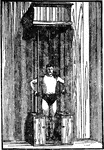
A man exercising with the lifting machine. This device is used for leg exercises.

Lifting Machine

A man exercising with the lifting machine. This device is used for leg exercises.

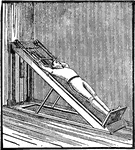
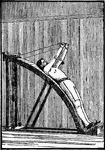
A man exercising with the long inclined plane, used for the upper body.

Long Inclined Plane

A man exercising with the long inclined plane, used for the upper body.

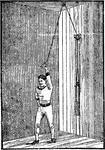
A man exercising with the giant pulley, used for chest and arms.

Giant Pulley

A man exercising with the giant pulley, used for chest and arms.

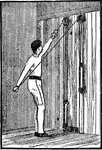
A man exercising with the high pulleys used for chest and arms.

High Pulleys

A man exercising with the high pulleys used for chest and arms.

A man exercising with the low pulleys used for chest and arms.

Low Pulleys

A man exercising with the low pulleys used for chest and arms.

A man exercising with the low pulleys used for chest and arms.

Low Pulleys

A man exercising with the low pulleys used for chest and arms.

A man exercising with the quarter circle used for chest and arms.

Quarter Circle

A man exercising with the quarter circle used for chest and arms.

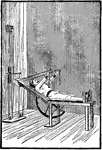
A man exercising with the folding table for the upper body.

Folding Table

A man exercising with the folding table for the upper body.

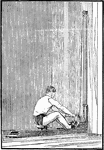
A man exercising with the rowing machine.

Rowing Machine

A man exercising with the rowing machine.

A man exercising with the paddling machine, high attachment.

Paddling Machine

A man exercising with the paddling machine, high attachment.

A man exercising with the paddling machine, low attachment.

Paddling Machine

A man exercising with the paddling machine, low attachment.

A man exercising with the sculling machine, used for the upper body.

Sculling Machine

A man exercising with the sculling machine, used for the upper body.

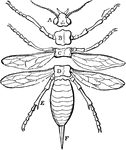
"A, the head; B, C, D, segments of the thorax; E, abdomen; F, ovipositor." -Cooper, 1887

Parts of an Insect

"A, the head; B, C, D, segments of the thorax; E, abdomen; F, ovipositor." -Cooper, 1887
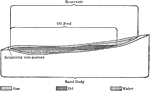
"A reservoir in the geological sense is that portion of a sand-body or other rock in place, with pores of sufficient number and size as to be capable of holding and yielding a commercial quantity of oil or gas if they are present. It includes the whole porous volume whether it contains water, oil or gas." -Johnson, 1916

Reservoir

"A reservoir in the geological sense is that portion of a sand-body or other rock in place, with pores…
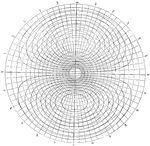
The diagram shows cotidal lines projected for a larger body of water.

Diurnal Cotidal Lines

The diagram shows cotidal lines projected for a larger body of water.

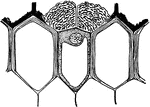
"Showing at f the felty body covering the passage way through the exodermis of the aerial root of Sobralia macrantha." -Stevens, 1916

S. Macrantha Aerial Root

"Showing at f the felty body covering the passage way through the exodermis of the aerial root of Sobralia…
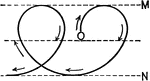
The image "shows the path of a body starting northward from any point O in the northern hemisphere and moving without friction. As it reaches higher latitudes, the deflection is more rapid and it turns to the east and south." -Dryer, 1901

Wind Movement

The image "shows the path of a body starting northward from any point O in the northern hemisphere and…
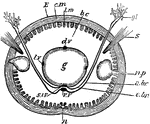
"Cross-section of Arenicola. E., Epidermis; c.m., circular muscles; l.m., longitudinal muscles; b.c., body cavity; gl., gill; s., setae; n.p., nephridial pore; a.br., afferent branchial; e.br., efferent branchial; n., ventral nerve-cord, with blood vessels above; d.v., dorsal vessel; l.v., lateral vessel; s.i.v., sub-intestinal vessels; v.v., ventral vessel; g., gut." -Thomson, 1916

Arenicola

"Cross-section of Arenicola. E., Epidermis; c.m., circular muscles; l.m., longitudinal muscles; b.c.,…
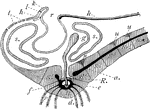
"Diagrammatic vertical section through disc and base of one of the arms of Antedon rosacea. The section is inter-radial on the left, radial on the right. t., Ciliated openings in body wall; h., sub-epithelial ambulacral nerve; l., water-vascular canal; k., tentacle; r., mouth; s., intestine; g., central plexus, with "chambered organ" at its base; f., coelom; R1.-R3., radial plates; Br., brachial plates; u., muscle; a., axial nerve-cord; d., central capsule; C.D., centro-dorsal plate; p., cirri; e., nerve branches from central capsule to cirri." -Thomson, 1916

A. Rosacea Arm

"Diagrammatic vertical section through disc and base of one of the arms of Antedon rosacea. The section…
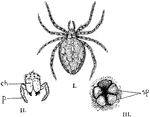
"Garden spider. I., Female garden spider; II., end view of head of the same showing the simple eyes, the poison fangs (ch.), and the pedipalps (p.); III., posterior end of body showing two pairs of spinnerets (sp.), with anus above." -Thomson, 1916

Garden Spider

"Garden spider. I., Female garden spider; II., end view of head of the same showing the simple eyes,…
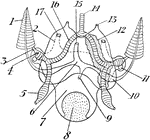
"Diagram of circulatory and excretory systems in a Decapod-like Sepia. 1, Gill; 2, renal sac; 3, afferent branchial vessel; 4, branchial heart; 5, abdominal vein; 6, heart; 7, viscero-pericardial sac (body cavity); 8, genital organ; 9, posterior aorta; 10, "auricle"; 11, glandular appendix of branchial heart; 12, renal appendices of branchial vein; 13, external aperure of kidney; 14, vena cava; 15, anterior aorta; 16, bifurcation of vena cava; 17, reno-pericardial aperture." -Thomson, 1916

Cuttlefish Circulatory and Excretory Systems

"Diagram of circulatory and excretory systems in a Decapod-like Sepia. 1, Gill; 2, renal sac; 3, afferent…
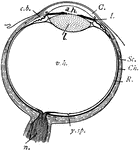
"Diagram of the eye. C., Cornea; a.h., aqueous humour; c.b., ciliary body; l., lens; I., iris; Sc., sclerotic; Ch., choroid; R., retina; v.h., vitreous humour; y.sp., yellow spot; n., optic nerve." -Thomson, 1916

Eye

"Diagram of the eye. C., Cornea; a.h., aqueous humour; c.b., ciliary body; l., lens; I., iris; Sc.,…
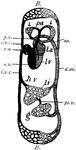
"Diagram of circulation. r.a., Right auricle receiving superior vena cava (s.v.c.) and inferior vena cava (i.v.c.); r.v., right ventricle; p.a., pulmonary artery to lungs (L.); p.v., right pulmonary vein; l.a., left auricle; l.v., left ventricle; ao., aortic arch; d.ao., dorsal aorta giving off arteries to liver (ii.), to gut (g.), to body (B.); po.v., portal veins; h.v., hepatic vein." -Thomson, 1916

Circulation

"Diagram of circulation. r.a., Right auricle receiving superior vena cava (s.v.c.) and inferior vena…
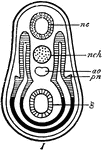
"Development of excretory system of vertebrate. The primitive segments are not separated off from the lateral plate, and the pronephros (pn.) is seen arising from the lower part of the primitive segment.n.c., nerve cord; nch., notochord; pn., pronephros; g., gut; p.s., primitive segment; mes., mesonephric tubule; pn.d., pronephric duct; b.c., body cavity; ao., aorta; siv., sub-intestinal vein, with vessel to the aorta." -Thomson, 1916

Excretory System Stage 1

"Development of excretory system of vertebrate. The primitive segments are not separated off from the…
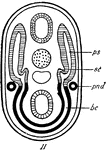
"Development of excretory system of vertebrate. The pronephros is completely separated off from the primitive segment and lateral plate.n.c., nerve cord; nch., notochord; pn., pronephros; g., gut; p.s., primitive segment; mes., mesonephric tubule; pn.d., pronephric duct; b.c., body cavity; ao., aorta; siv., sub-intestinal vein, with vessel to the aorta." -Thomson, 1916

Excretory System Stage 2

"Development of excretory system of vertebrate. The pronephros is completely separated off from the…
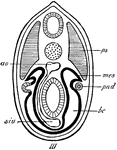
"The origin of the mesonephric tubules is seen. They arise from the upper part of the lateral plate, which is now completely separated from the primitive segment, and curving round the pronephric duct come to open into it.n.c., nerve cord; nch., notochord; pn., pronephros; g., gut; p.s., primitive segment; mes., mesonephric tubule; pn.d., pronephric duct; b.c., body cavity; ao., aorta; siv., sub-intestinal vein, with vessel to the aorta." -Thomson, 1916

Excretory System Stage 3

"The origin of the mesonephric tubules is seen. They arise from the upper part of the lateral plate,…
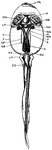
"Dissection of tadpole. DL., Lower lip; H., ventricle of heart; DE., oesophagus; NA., head kidney; A., aorta; K., kidney; KU., ureter; DO., cloaca; LH., hind-limb; KV., opening of ureter into cloaca; GR., genital ridge; GF., fatty body; LF., fore-limb; OG., gills; a, epidermis; b, dermis." -Thomson, 1916

Tadpole Dissection

"Dissection of tadpole. DL., Lower lip; H., ventricle of heart; DE., oesophagus; NA., head kidney; A.,…
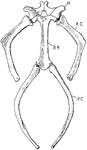
"Hyoid apparatus of a Chelonian. BH., Body of the hyoid (basihyal); H., representing another part of the hyoid arch; A.C., anterior cornu, representing the first branchial arch; P.C., posterior cornu, representing the second branchial arch." -Thomson, 1916

Turtle Hyoid

"Hyoid apparatus of a Chelonian. BH., Body of the hyoid (basihyal); H., representing another part of…
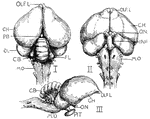
"Brain of pigeon (I. dorsal, II. ventral, III. lateral aspects). OLF.L., Olfactory lobes; C.H., cerebral hemispheres; PB., pineal body; OL., optic lobes; CB., cerebellum; FL., flocculus or lateral extension of cerebellum; M.O., medulla oblongata; PIT., pituitary body at end of infundibulum (INF.); O.N., optic nerves crossing in the chiasma." -Thomson, 1916

Pigeon Brain

"Brain of pigeon (I. dorsal, II. ventral, III. lateral aspects). OLF.L., Olfactory lobes; C.H., cerebral…
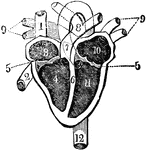
View of the heart with its several chambers exposed and the vessels in connection with them. Labels: 1, the superior vena cava. 2, the inferior vena cava. 3. the chamber called the auricle. 4. the right ventricle. 5. the line marking the passage between the two chambers, and the points of attachment of one margin of the valve. 6. the septum between the two ventricles. 7. the pulmonary artery, arising from the right ventricle, and dividing at 8 into right and left, of the corresponding lungs. 9. the four pulmonary veins, bringing the blood from the lungs into 10, the left auricle. 11. the left ventricle. 12. the aorta, arising from the left ventricle, and passing down behind the heart, to distribute blood to every part of the system. Thus the blood moves in a double circle, one from the heart to the body, and from the body back to the heart, called the systemic circle; the other, from the heart to the lung, and from the lung back to the heart, called the pulmonic circle.

Heart and its Chambers

View of the heart with its several chambers exposed and the vessels in connection with them. Labels:…
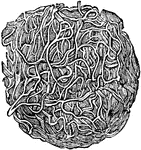
A portion of fibrin, showing its fibrous structure and netlike arrangement of its fibers. In a short time after the blood is taken from the body it separates into two portions, by a process called coagulation or clot; the white substance which forms the upper part of the clot is called fibrin, and the red mass under it, the red particles. The fibrin is the material from which all solids of the body are formed.

Blood Clotting Fibers

A portion of fibrin, showing its fibrous structure and netlike arrangement of its fibers. In a short…
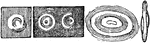
A particle of human blood as it appears when transparent and floating. 2. the same, seen as illuminated. 3. the same, one half illuminated. 4. a particle of frog's blood floating. 5. the same, seen edgewise. All these objects are magnified 500 diameters.

Blood Particle

A particle of human blood as it appears when transparent and floating. 2. the same, seen as illuminated.…
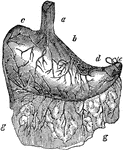
The human stomach. Labels: a, the esophagus or gullet; b, the cardiac portion; c, the left extremity; d, the small extremity; e, the pylorus tied; g,g, the omentum or caul, which is attached to the outside of the stomach, and falls over the intestines like a curtain.

Stomach

The human stomach. Labels: a, the esophagus or gullet; b, the cardiac portion; c, the left extremity;…
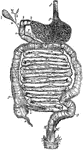
The digestive system. This figure represents the whole tract of the intestinal canal, not exactly in its natural position, but spread out so as to show the relative proportions; f, the esophagus; g, cardia; h, pylorus; i, i, the duodenum, about twelve fingers; breadth in length; k, hepatic duct; l, gall bladder; m, cystic duct; n, ductus communis, formed by the union of both; o, the opening of this duct into the duodenum; p, pancreatic duct; q, its opening into the duodenum; r, jejunum; s, ilium; these constitute the small intestines, and are about 26 feet in length, or five times the length of the body; t, termination of ilium in the coecum; , u, superior fold of valve of colon; v, inferior do. ; w, coecum; x, vermiform process; y, y, colon; z, rectum. The coecum, colon, and rectum, form the large intestines, and are about 6 feet in length; the coecum being about 4 inches long, and the same in diameter. The arrows show the direction which the food takes in digestion.

Stomach

The digestive system. This figure represents the whole tract of the intestinal canal, not exactly in…
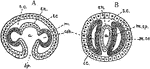
"Mesoderm formed by pouches from entoderm after gastrulation. A and B, early and later stages in formation of mesoderm and coelom. a, primitive gut; bp., blastopore; coe, body cavity, formed from pockets of the archenteron; ec., ectoderm; en., entoderm; m., mesoderm; m.so, body-wall mesoderm; m.sp., visceral mesoderm; s.c., segmentation cavity." -Galloway, 1915

Mesoderm Forming

"Mesoderm formed by pouches from entoderm after gastrulation. A and B, early and later stages in formation…
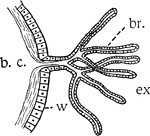
"Diagram illustrating gills or branchiae. b.c., cavity in which the body fluids circulate; br., branchial filaments which are merely much thinned out-pocketings of the body wall (w); ex, the external medium–water–in which the oxygen is dissolved." -Galloway, 1915

Gills or Branchiae

"Diagram illustrating gills or branchiae. b.c., cavity in which the body fluids circulate; br., branchial…
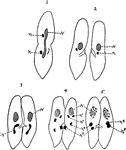
"Paramecium. I, transverse fission; 2-5, stages in conjugation. The meganucleus gradually disintegrates during the process and the micronucleus by two successive divisions forms four micronuclei. Two of these disintegrate. One of the remaining micronuclei (n3) in each animal passes into the other Paramecium and unites with the stationary micronucleus (n4), thus fertilizing it. Later a new meganucleus is formed in each animal by the division of this body. Nucleus n3 is often smaller than n4 and may represent the male element." -Galloway, 1915

Paramecium Division

"Paramecium. I, transverse fission; 2-5, stages in conjugation. The meganucleus gradually disintegrates…
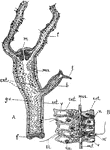
"A, Longitudinal section through the body of Hydra (diagrammatic). B, small portion of the wall more highly magnified. b, bud; ect., ectoderm; ent., entoderm; f, foot; fl., flagellum; g.v., gastro-vascular cavity; m., mouth; mes., mesenchyma (non-cellular); m.f., muscular processes of the ectodermal cells; n, nettling cells; n', same, exploded; nu., nucleus; t, tentacle; v, vacuole." -Galloway, 1915

Hydra

"A, Longitudinal section through the body of Hydra (diagrammatic). B, small portion of the wall more…
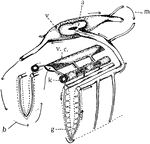
"Diagram showing the heart and general course of the circulation in the lamellibranchs. Only a short section is shown. a, auricle (right), with slit to ventricle; b, the body (region of spaces, lacunae, capillaries; v, the ventricle from which arteries pass forward and their capillaries; m, the mantle and capillaries; v, ventricle from which arteries pass forward and backward; v.c., "vena cava," in which the blood collects on returning from the tissues of the body." -Galloway, 1915

Bivalve Circulation

"Diagram showing the heart and general course of the circulation in the lamellibranchs. Only a short…
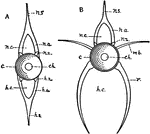
"Diagram of vertebrae of a bony fish. A, caudal; B, trunk. c, centrum or body of the vertebra; ch., the notochord; h.a., haemal arch; h.c., haemal canal; h.s., haemal spine; h.z., haemal zygapophysis, or articulating facet; m.b., inter-muscular bone; n.a., neural arch; n.c., neural canal; n.s., neural spine; n.z., neural zygapophysis; r, rib." -Galloway, 1915

Fish Vertebrae

"Diagram of vertebrae of a bony fish. A, caudal; B, trunk. c, centrum or body of the vertebra; ch.,…
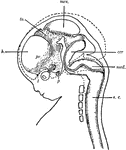
"Diagram of head and brain of human foetus six weeks old (heavy boundaries). The dotted line indicates the outline of the brain of a foetus three months old. Note thee great growth of the hemisphere (h). cer, cerebellum; med, medulla oblongata; mes, mesencephalon; p, pituitary body; pr, prosencephalon; s.c., spinal cord; th, thalamencephalon; 1, olfactory nerve; 2, optic nerve." -Galloway, 1915

Human Fetus

"Diagram of head and brain of human foetus six weeks old (heavy boundaries). The dotted line indicates…
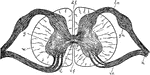
"Diagram of a cross-section of the spinal cord through the roots of spinal nerves. c, central canal; d.f., dorsal fissure; d.r., dorsal root of spinal nerve arising from the dorsal horn of the gray matter (g); gn., ganglion on the dorsal root; n, spinal nerve; v.f., ventral fissure; v.r., ventral root of the spinal nerve, arising from the ventral horn of the gray matter; w., white matter." -Galloway, 1915

Spinal Cord

"Diagram of a cross-section of the spinal cord through the roots of spinal nerves. c, central canal;…
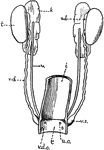
"Diagram of the urino-genital organs of a male Bird. ad., adrenal body; c, cloaca; i, intestine; k, kidney; t, testis; u, ureter; u.o., opening of ureter into the cloaca; v.d., vas deferens; v.d.o., opening of the vas deferens; v.s., vesicula seminalis." -Galloway, 1915

Male Bird Genital Organs

"Diagram of the urino-genital organs of a male Bird. ad., adrenal body; c, cloaca; i, intestine; k,…
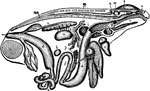
"General view of the viscera of a male frog, from the right side. a, stomach; b, urinary bladder; c, small intestine; cl, cloacal aperture; d, large intestine; e, liver; f, bile duct; g, gall bladder; h, spleen; i, lung; k, larynx; l, fat body; m, testis; n, ureter; o, kidney; p, pancreas; s, cerebral hemisphere; sp, spinal cord; t, tongue; u, auricle; ur, urostyle; v, ventricle; v.s, vesicula seminalis; w, optic lobe; x, cerebellum; y, Eustachian recess; z, nasal sac." -Parker, 1900

Frog Viscera

"General view of the viscera of a male frog, from the right side. a, stomach; b, urinary bladder; c,…
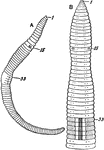
"Lumbricus agricola. A, entire specimen, lateral view; B, ventral view of anterior portion of the body, magnified. 1, 15, 33, first, fifteenth, and thirty-third segments. The black dots represent the setae." -Parker, 1900

Lumbricus Agricola

"Lumbricus agricola. A, entire specimen, lateral view; B, ventral view of anterior portion of the body,…
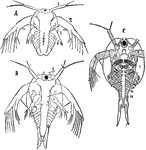
"Three stages in the development of Apus. fs, frontal sensory organ; L, digestive gland; s, carapace; 1-4, cephalic appendages; I-XIII, body segments and appendages." -Parker, 1900

Apus Stages

"Three stages in the development of Apus. fs, frontal sensory organ; L, digestive gland; s, carapace;…
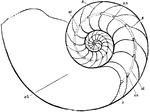
"Section of the shell of Nautilus pompilius, showing the septa (s, s), the septal necks (s. n., s. n.), the siphuncle (si, represented by dotted lines), and the large body-chamber (ch)." -Parker, 1900

Chambered Nautilus

"Section of the shell of Nautilus pompilius, showing the septa (s, s), the septal necks (s. n., s. n.),…
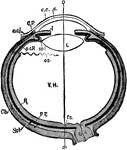
"Diagrammatic horizontal section of the eye of man. c, cornea; ch. choroid (dotted); C. P, ciliary processes; e. c, epithelium of cornea; e. cj, conjunctiva; f. c, yellow spot; I, iris; L, lens; ON, optic nerve; OS, ora serrata; o-x, optic axis; p. c. R, anterior non-visual portion of retina; P. E, pigmented epithelium (black); R, retina; sp. l, suspensory ligament; Scl, sclerotic; V. H, vitreous body." -Parker, 1900

Human Eye

"Diagrammatic horizontal section of the eye of man. c, cornea; ch. choroid (dotted); C. P, ciliary processes;…
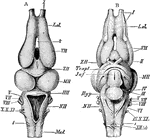
"Rana esculenta. The brain. A, from above; B, from below. ch. opt, optic chiasma; HH, cerebellum; Hyp, pituitary body; Inf, infundibulum; L. ol, olfactory lobe; Med, spinal cord; MH, mid-brain; NH, medulla oblongata; Th. opt, optic thalamus; Tr. opt, optic tract; VH, cerebral hemisphere; ZH, diencephalon; I-X, cerebral nerves; XII. (1), hypoglossal (first spinal) nerve." -Parker, 1900

Edible Frog Brain

"Rana esculenta. The brain. A, from above; B, from below. ch. opt, optic chiasma; HH, cerebellum; Hyp,…
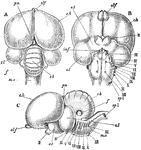
"Columba livia. The brain; A, from above; B, from below; C, from the left side. cb, cerebellum; c. h, cerebral hemispheres; f, flocculus; inf, infundibulum; m. o, medulla oblongata; o. l, optic lobes; o. t, optic tracts; pn, pineal body; II-XIII, cerebral nerves; sp. 1, first spinal nerve." -Parker, 1900

Rock Pigeon Brain

"Columba livia. The brain; A, from above; B, from below; C, from the left side. cb, cerebellum; c. h,…
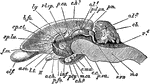
"Lepus cuniculus. Longitudinal vertical sectioin of the brain. cb, cerebellum, showing arbor vitae; c. c, crus cerebri; ch1, parencephalon; ch2, temporal lobe; c. ma, corpus mammillare; f. m, foramen of Monro; inf, infundibulum; ly, lyra; m. o, medulla oblongata; o. ch, optic chiasma; olf, olfactory lobe; pty, pituitary body; vl. ip, velum interpositum; v. vn, valve of Vieussens; II, optic nerve." -Parker, 1900

Rabbit Brain

"Lepus cuniculus. Longitudinal vertical sectioin of the brain. cb, cerebellum, showing arbor vitae;…
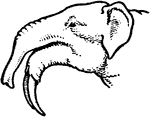
A full body picture of a long-jawed mastodon during the time period of Miocene.

Long-jawed Mastodon

A full body picture of a long-jawed mastodon during the time period of Miocene.

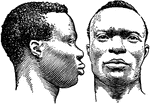
in early development of race, the Negro type were found in Africa.

Early Races, Negro

in early development of race, the Negro type were found in Africa.

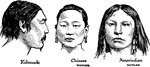
in early development of race, the Mongolian type consistent of Kalmucks, Chinese, and Amerindians.
Early Races, Mongolian

in early development of race, the Mongolian type consistent of Kalmucks, Chinese, and Amerindians.

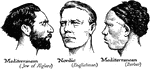
in early development of race, the Caucasian type consisted of Mediterranean men (Jews of Algiers), Mediterranean woman (Berber) and Nordics (Englishmen).

Early Races, Caucasian

in early development of race, the Caucasian type consisted of Mediterranean men (Jews of Algiers), Mediterranean…
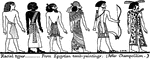
Early developments of racial types, a tomb paint from an Egyptian tomb.

Racial Types From Egyptian Paintings

Early developments of racial types, a tomb paint from an Egyptian tomb.
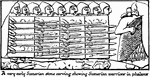
Perhaps the earliest people to form real cities in the western region of the world, were a people of mysterious origin called Sumerians. This drawing is a very early Sumerian stone carving showing Sumerian warriors in phalanx.

Stone Carvings of Sumerian Warriors

Perhaps the earliest people to form real cities in the western region of the world, were a people of…
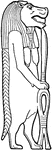
An early figure of the Egyptian hippopotamus goddess.

Egyptian Hippopotamus Goddess

An early figure of the Egyptian hippopotamus goddess.