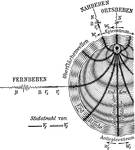
Diagrammatic representation of the propagation of the earthquake waves and their record by the seismograph in different parts of the earth.

Earthquake Waves

Diagrammatic representation of the propagation of the earthquake waves and their record by the seismograph…
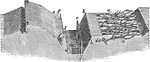
"Section of Fortified Wall. (Interior on the left; exterior on the right.) a, a, is the abatis; b, b, the counterscarp; c, c, the palisade; d, d, the scarp; f, f, the fraise; f, e, g, g, the parapet; h, the banquette; and i, g, the breast-height." -Whitney, 1911

Section of Fortified Wall

"Section of Fortified Wall. (Interior on the left; exterior on the right.) a, a, is the abatis; b, b,…
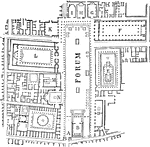
"Forum of Pompeii. A, principal entrance; B, a Corinthian temple; C, the public prison (carcer publicus); D is supposed to have been a horreum, or public granary; E, temple of Venus, the guardian goddess of the city; F, basilica; G, H, I, the curiae, or civil and commercial tribunals; K, a rectangular building which may have served the purpose of a shop for money-changers; L, a portico terminating in an apsis; M, temple of Mercury or Quirinus; N, a building with a large semicircular tribune, which probably constituted the residence of the priests called Augustales." -Whitney, 1911

Forum of Pompeii

"Forum of Pompeii. A, principal entrance; B, a Corinthian temple; C, the public prison (carcer publicus);…
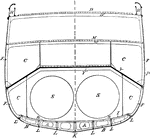
"Frame of Iron Ship. A, double bottom; B, bracket frame; C, coal-bunkers; D, upper or spar deck; D', upper- or or spar-deck beam; F, main frame; H, hammock-berthing; I, inner bottom plating; K, keel; L, longitudinals; M, main deck; M', main-deck beam; P, outside plating; R, reverse frame; S, boilers; Y, protective deck; Y', protective-deck beam." -Whitney, 1911

Frame of Iron Ship

"Frame of Iron Ship. A, double bottom; B, bracket frame; C, coal-bunkers; D, upper or spar deck; D',…
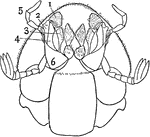
"Under Surface of Head of Tumble-bug (Copris carolina), about four times natural size. 1, galea; 2, palpifer; 3, lacinia; 4, subgalea; 5, maxillary palp; 6, stipes." -Whitney, 1911

Ventral View of Dung Beetle

"Under Surface of Head of Tumble-bug (Copris carolina), about four times natural size. 1, galea; 2,…
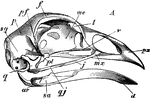
"Typical Skull of Common Fowl (Galliformes). A, side view: sa, surangular bone of mandible; ar, articular of mandible; d, dentary; f, frontal; j, jugal; l, lacrymal; me, mesethmoid; mx, maxillary; p, parietal; pf, postfrontal process; pt, pterygoid; px, premaxillary; q, quadrate; qj, quadratojugal; sq, squamosal; v, vomer." -Whitney, 1911

Skull of Common Fowl

"Typical Skull of Common Fowl (Galliformes). A, side view: sa, surangular bone of mandible; ar, articular…
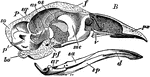
"Typical Skull of Common Fowl (Galliformes). B, vertical longitudinal section: sa, surangular bone of mandible; ar, articular of mandible; d, dentary; f, frontal; me, mesethmoid; p, parietal; pf, postfrontal process; px, premaxillary; sq, squamosal; v, vomer; as, alisphenoid; bo, basioccipital; so, supraoccipital; os, orbitosphenoid; p', prootic; pf, pituitary fossa; sp, splenial bone." -Whitney, 1911

Skull of Common Fowl

"Typical Skull of Common Fowl (Galliformes). B, vertical longitudinal section: sa, surangular bone of…
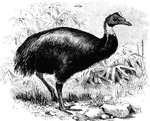
One-wattled Cassowary "...Casuarius uniappendiculatus, of Salawatti and the adjoining parts of New Guinea, has the head, throat, and nape blue, the lower portion of the neck and the median pear-shaped caruncle yellow, the casque dusky olive, and the longitudinal naked space towards the sides of the neck flesh-coloured with a yellow margin." - A. H. Evans, 1900

One-wattled Cassowary

One-wattled Cassowary "...Casuarius uniappendiculatus, of Salawatti and the adjoining parts of New Guinea,…
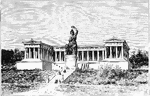
The Statue of Bavaria is a bronze-cast statue of a female figure representing Bavaria's "secular patron saint", the Tellus (Mater) Bavarica. It is also called the goddess of the land of Bavaria. The statue was built at the foundry of J.B. Stiglmair from 1844 until 1850, mainly by Stiglmair's nephew Ferdinand Von Miller. Since the Bavaria is one of the biggest bronze sculptures in the world, it had to be built out of four big parts and several smaller ones.

Statue of Bavaria

The Statue of Bavaria is a bronze-cast statue of a female figure representing Bavaria's "secular patron…
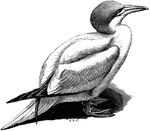
"The Gannet (S. bassana) has slate-grey wing-quills, purplish-grey bill, reddish feet and naked parts." A. H. Evans, 1900 Additionally, these birds have white plumage and blue eyes.

Gannet

"The Gannet (S. bassana) has slate-grey wing-quills, purplish-grey bill, reddish feet and naked parts."…
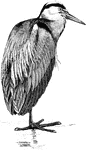
"The most typical forms of Ardea (Common Heron) are large slaty-coloured birds, varied by black, rufous, and white, the head being commonly darker and lower parts striped; while two slender occipital plumes are, in most cases, developed in the nuptial period, and the scapular and jugular feathers are elongated, though not decomposed." A. H. Evans, 1900

Common Heron

"The most typical forms of Ardea (Common Heron) are large slaty-coloured birds, varied by black, rufous,…
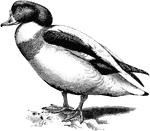
Tadorna cornuta, the Sheld-Drake or Bargander, ...shews a white collar on the lower neck followed by a broad chestnut band; blackish outer scapulars, remiges, and the tip of a tail; a patch of chestnut on the inner secondaries, a green speculum, and a brown line down the under parts, the remaining portions being white." A. H. Evans, 1900

Shelduck

Tadorna cornuta, the Sheld-Drake or Bargander, ...shews a white collar on the lower neck followed by…
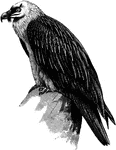
"Gypa&eumltus barbatus, the magnificent L&emumlmmergeier, is greyish-black with white streaks, and has a white crown, cheeks with a black band bifurcating at the eye to meet above, and pale tawny lanceolate plumage on the neck and lower parts. Dense black bristles cover the nostrils and lores, and the black tuft, which gives the name of "Bearded Vulture", projects below the mandible. The sclerotic membrane is crimson. The young are chiefly brown and buff." A. H. Evans, 1900

L&emumlmmergeier

"Gypaëtus barbatus, the magnificent L&emumlmmergeier, is greyish-black with white streaks, and has…
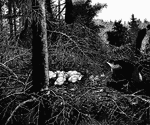
"Accipiter nisus, the Sparrow-Hawk, which breeds throughout Europe, North Africa, Asia north of the Himalayas; extending further south in winter, but represented in South Africa. It is bluish-grey above, with white mottling on the nape and rufous cheeks, the white-tipped tail exhibiting from three to five bands, and the buffish-white under parts red-brown bars. A. H. Evans. This picture shows two adult Sparrow-hawk in a large flat nest of twigs with five young Sparrow-Hawk by a tall tree." A. H. Evans, 1900

Two Sparrow Hawk in a Large Flat Nest of Twigs with Five Young Sparrow-Hawk Beside a Tree Trunk

"Accipiter nisus, the Sparrow-Hawk, which breeds throughout Europe, North Africa, Asia north of the…
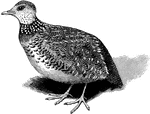
Pedionomus torquatus differs in structure from Turnix by the presence of a small hind-toe. The lax upper plumage is, in the female, reddish-brown with black barring and buff margins to the feathers, the lower parts being pale buff marked with black. A broad white collar spotted with black surrounds the neck, while a rust-coloured nape and chest distinguish the above sex from the male, where the collar is brown and brown." A. H. Evans, 1900

Plain Wanderer

Pedionomus torquatus differs in structure from Turnix by the presence of a small hind-toe. The lax upper…
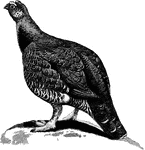
"Lagopus scoticus, the Red Grouse or Muirfowl, the only bird entirely confined to our islands, differs from its congeners in never becoming white in the winter. It varies considerably in coloration, but is usually considered a local form of the Willow Grouse (L. albus) of the north of Europe, Asia, and America. The male in both summer and winter is more or less, chestnut-brown above, with black markings and a reddish head; the lower parts are similar, but are usually spotted with white. In Autumn the brown of the upper parts becomes buff, and the lower surface is barred with buff and black." A. H. Evans, 1900

Red Grouse

"Lagopus scoticus, the Red Grouse or Muirfowl, the only bird entirely confined to our islands, differs…
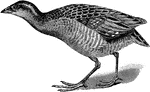
The Crex pratensis, Land-Rail, or Cork Crake, is mostly brown with the upper parts spotted, a blue-green head and neck, chestnut wings, and flanks streaked with a reddish colour. "The Land-Rail extends from most of Europe to the North of Central Asia, wintering in Africa, and occurring accidentally in North America, or even Greenland and Australia." A. H. Evans, 1900

Land-Rail

The Crex pratensis, Land-Rail, or Cork Crake, is mostly brown with the upper parts spotted, a blue-green…
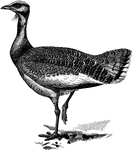
"The Otis Tarda, the Great Bustard, which, as a native only became extinct in Norfolk about 1838, used to extend from East Lothian to Dorset, bit is now merely an occasional visitor to Britain. The upper parts are mottled with rufous, buff, and blackish-brown, the head is blue-grey, with long white bristles at the base of the mandible, the lower surface is white, relieved in the male by a tawny gorget for a short time during the breeding season. The primaries are black, most of the secondaries and wing-coverts white. Some other Bustards seem to have similar vernal change of plumage. The female is smaller and has no bristles." A. H. Evans, 1900

Great Bustard

"The Otis Tarda, the Great Bustard, which, as a native only became extinct in Norfolk about 1838, used…
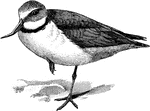
Anarhynchus frontalis, the Wry-bill of New Zealand, is grey, with a black gorget and whitish lower parts; the habits are as in Aegialitis, but the laterally-twisted bill enables the bird to pick up insects from around stones with the greatest ease." A. H. Evans, 1900

Wry-bill

Anarhynchus frontalis, the Wry-bill of New Zealand, is grey, with a black gorget and whitish lower parts;…
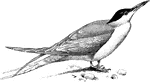
Sterna fluviatilis, the Common Tern, occupying the coasts and inland waters of Europe, temperate Asia, and temperate America-chiefly on the eastern side in the last case- and migrating to South Africa, India, Ceylon, and Brazil, has red feet, and bill with horn-coloured tip, the lower parts being vinaceous grey." A. H. Evans, 1900

Common Tern

Sterna fluviatilis, the Common Tern, occupying the coasts and inland waters of Europe, temperate Asia,…
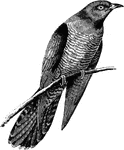
"Cuculus canorus the familiar Cuckoo of Britain and nearly all the Old World, is greyish-brown above and on the throat, the lower parts being white barred with dusky, and the wings and tail shewing a few white markings. A chestnut-brown or "hepatic" phase is sometimes met with. The young are brown mottled with white on the nape."

Cuckoo

"Cuculus canorus the familiar Cuckoo of Britain and nearly all the Old World, is greyish-brown above…
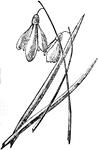
Epigaea repens (Mayflower or Trailing Arbutus) is a low, spreading shrub in the Ericaceae family. It is found from Newfoundland to Florida, west to Kentucky and the Northwest Territory. It can also be found in parts of Central Europe and Western Africa.

Mayflower

Epigaea repens (Mayflower or Trailing Arbutus) is a low, spreading shrub in the Ericaceae family. It…

Epigaea repens (Mayflower or Trailing Arbutus) is a low, spreading shrub in the Ericaceae family. It is found from Newfoundland to Florida, west to Kentucky and the Northwest Territory. It can also be found in parts of Central Europe and Western Africa.

Mayflower

Epigaea repens (Mayflower or Trailing Arbutus) is a low, spreading shrub in the Ericaceae family. It…
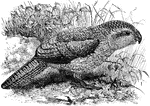
"Stringops habroptilus, the Kakapo or Tarapo of New Zealand has sap-green upper parts, with yellow middles to the feathers and transverse brown markings; yellower lower surface; and browner cheeks, remiges, and rectrices. The soft plumage, the disc of feathers round the eye, and the nocturnal habits have given this bird the name Owl-Parrot." A. H. Evans, 1900

Kakapo

"Stringops habroptilus, the Kakapo or Tarapo of New Zealand has sap-green upper parts, with yellow middles…
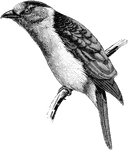
"Leptosoma discolor, the Kiromobo or Vorondreo of Madagascar, and the Comoro Islands, which has a big crested head; a long, slightly hooked bill, overhung at the base by recurved loral feathers; linear nostrils, places far forward and covered by a partly reversible outer toe. The wings are moderate, having ten primaries and twelve secondaries; the long, square tail has twelve feathers; the tongue is tapering, horney and channeled; a large aftershaft is present is present, and there is a considerable powder-down patch on each side of the rump. The head is grey, glossed with copper and green, the neck duller; the upper parts are shining green and coppery-red, the under parts grey with white abdomen. The slightly larger female is reddish-brown above, with buff markings and only dull gloss; the head is chiefly lack, the lower surface fawn-coloured spotted with black." A. H. Evans, 1900

Kirombo

"Leptosoma discolor, the Kiromobo or Vorondreo of Madagascar, and the Comoro Islands, which has a big…
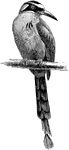
"Momotus brasiliensis, the Motmot, from Guiana to Northern Brazil, is somewhat similar in colour (to the Eumomota superciliaris), but has little red on the back; the head is cobalt-blue with black on the crown and sides; the under parts are green with rufous tinge. the long throat-feathers are black with light blue edges." A. H. Evans, 1900

Motmot

"Momotus brasiliensis, the Motmot, from Guiana to Northern Brazil, is somewhat similar in colour (to…
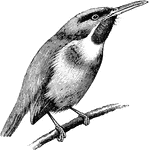
"Todus viridis, Tody, has coloration that is green, with a red throat, yellowish-white or pinkish under parts, and yellow, green, or pink feathers on the flanks. The bill is dull red. The T. viritis inhabits Jamaica. A. H. Evans

Tody

"Todus viridis, Tody, has coloration that is green, with a red throat, yellowish-white or pinkish under…
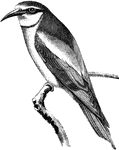
"Merops Apiaster, the Bee-eater, has ruddy-brown head, neck, upper back, and broad alar bar, buff lower back, green wings and tail with black tips to the long median rectrices, light blue upper tail-coverts, pale green and white forehead, black ear-coverts, and bright yellow throat, divided from the greenish-blue under parts by a black band." A. H. Evans, 1900

Bee Eater

"Merops Apiaster, the Bee-eater, has ruddy-brown head, neck, upper back, and broad alar bar, buff lower…
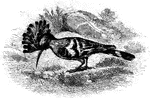
"Upupa epops, not unfrequently visits Britain, where it has nested on several occasions; it breeds from Southern Scandinavia to Northern Africa and the Atlantic Islands, migrating a little further south; while it extends through most of Asia and reaches Japan. The fine erectile crest, the head, neck, and lower parts are cinnamon-coloured; the remaining plumage is black, varied with buff and white; a band of the latter crosses the tail; and head plumes are tipped with black and white." A. H. Evans

Hoopoe

"Upupa epops, not unfrequently visits Britain, where it has nested on several occasions; it breeds from…
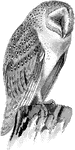
Strix flammea, the nocturnal White Screech-, or Barn Owl, is orange-buff above, with brown, grey and white markings, but is white below and on the complete facial discs. The dark grey phase has white parts tinged with orange and a few distinct blackish spots beneath. The legs are entirely, and the toes partially, covered with bristly feathers." A. H. Evens, 1900

Screech Owl

Strix flammea, the nocturnal White Screech-, or Barn Owl, is orange-buff above, with brown, grey and…
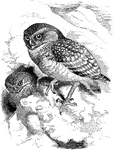
"Speotyto cunicularia, the Burrowing Owl, a comparatively long-legged and short -winged bird with incomplete facial discs and unfeathered toes, is umber-brown varied with yellowish and white, the lower parts becoming lighter." A. H. Evans

Two Burrowing Owls by the Mountains

"Speotyto cunicularia, the Burrowing Owl, a comparatively long-legged and short -winged bird with incomplete…
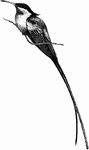
"Aithurus polytmus, the Long-tailed Hummingbird, peculiar to Jamaica, the two tail-feathers next to the outer pair are immensely elongated, and, after crossing one another, bend outwards in a curve; the lateral rectrices are bluish-black, as is the head with its divided crest; all the outer parts being luminous green, and the bill red with black tip. The female is chiefly green above and white below, with brownish brown." A. H. Evans, 1900

Long Tailed Hummingbird

"Aithurus polytmus, the Long-tailed Hummingbird, peculiar to Jamaica, the two tail-feathers next to…
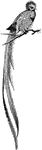
"Pharomacrus mocinno, the Quezal of the higher districts of Guatemala to Veragua, is brilliant iridescent green above, tinged with blue on the far extended tail-coverts; the throat is green, the under parts are gorgeous crimson, the remiges and the six median rectrices are black, the remainder chiefly white." A. H. Evans, 1900

Quezal

"Pharomacrus mocinno, the Quezal of the higher districts of Guatemala to Veragua, is brilliant iridescent…
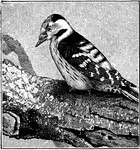
"Dendrocopus minor, or Lesser Spotted Woodpecker, are the British representatives, The colours in this genus are black and white in varied proportions, with crimsons on the head and often on the lower parts; a small amount of buff and brown being not uncommonly added." A. H. Evans, 1900

Lesser Spotted Woodpecker

"Dendrocopus minor, or Lesser Spotted Woodpecker, are the British representatives, The colours in this…
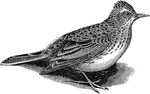
"Alauda arvensis, the Sky-Lark, breed in Britain. The normal coloration is light-brown with darker longitudinal streaks, the under parts being whitish and frequently spotted anteriorly." A. H. Evans, 1900

Skylark

"Alauda arvensis, the Sky-Lark, breed in Britain. The normal coloration is light-brown with darker longitudinal…
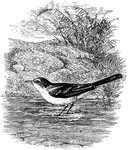
"Motacilla raii, the Yellow Wagtails, are generally black and white, grey and white, grey with a yellow breast (or even head), greenish with yellow lower parts and greyish or black heads, or almost entirely yelowish." A. H. Evans, 1900

Yellow Wagtail

"Motacilla raii, the Yellow Wagtails, are generally black and white, grey and white, grey with a yellow…
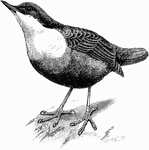
"Cinclus aquaticus, Dippers, the colour above is normally greyish-black or brown; the lower parts are similar or white, commonly with a black belly, while a chestnut band crosses the breast in the British. The sexes are alike, but the young are spotted. Both plumage and down are close and nearly impervious to water." A. H. Evans, 1900

Dipper

"Cinclus aquaticus, Dippers, the colour above is normally greyish-black or brown; the lower parts are…
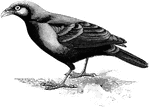
"Ptilorhynchus violaceus, the Satin Bower-bird, is purplish-black, with much feathered culmen. Female Paridise-birds generally have brown upper parts with lighter markings, though they are occasionally blacker. The hen of the Ptilorhynchus exhibits grey-green and brown tints." A. H. Evans, 1900

Satin Bower-bird

"Ptilorhynchus violaceus, the Satin Bower-bird, is purplish-black, with much feathered culmen. Female…
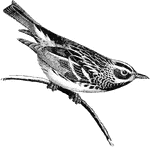
"Mniotilta varia, the Black and White Warbler, The general coloration is olive-green, grey, or slaty-blue, with yellow or rarely orange under parts; chestnut marks, white wing-bands, and the like, occasionally relieving plumage. The head is particularly dark and streaky. Mniotilta, exhibits black and white stripes." A. H. Evans, 1900

Black and White Warbler

"Mniotilta varia, the Black and White Warbler, The general coloration is olive-green, grey, or slaty-blue,…
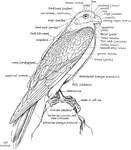
"The annexed figure explains the nomenclature of most of the outward of a Bird, but some further explanations may be given." A. H. Evans, 1900

A Labeled Diagram of a Falcon to Show the Nomenclature of the External Parts

"The annexed figure explains the nomenclature of most of the outward of a Bird, but some further explanations…
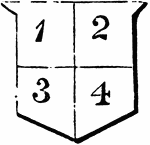
"QUARTERED PER CROSS—The shield is divided into four parts, called quarters, by an horizontal and perpendicular line, crossing each other in the centre of the field, each of which is numbered." -Hall, 1862

Quartered Per Cross

"QUARTERED PER CROSS—The shield is divided into four parts, called quarters, by an horizontal…
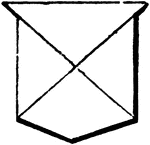
"QUARTERED PER SALTIER, which is made by two diagonal lines, dexter and sinister, crossing each other in the centre of the field." -Hall, 1862

Quartered Per Saltier

"QUARTERED PER SALTIER, which is made by two diagonal lines, dexter and sinister, crossing each other…
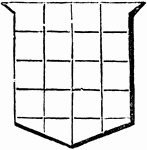
"The Escutcheon is sometimes divided into a great number of parts, in order to place in it the arms of several families to which one is allied; this is called a genealogical achievement. The compartments are called QUARTERINGS." -Hall, 1862

Quarterings

"The Escutcheon is sometimes divided into a great number of parts, in order to place in it the arms…
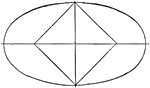
Diagram of an ellipse that can used to illustrate the different parts. Segment MN is the major axis, segment CD is the conjugate (minor) axis, and point O is the center of the ellipse. Both foci are also labeled in the illustration.

Parts of Ellipse

Diagram of an ellipse that can used to illustrate the different parts. Segment MN is the major axis,…
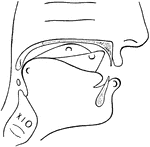
Physiological Bases of the Visible Speech Symbols - Consonants. In representing the consonant a peculiar and exclusive mode of accenting ... the important ... parts of the hand is resorted to, so that, when the different ways of accentuation are understood, the class to which a given position belongs may be readily determined. The modes of accentuation adopted, impart to the various manual positions something more than mere arbitrary class distinction. A hint at the physiological differences between consonants, vowels, and glides also is given, when the positions that represent them are viewed from the index-finger side of the hand ..., according to the rules in this Manual. <p>Consonant positions are distinguished by having the breath phalanx of the thumb close to the plane of the palm and the accented fingers straightened. When the voice phalanx of the thumb is accented, it is never held in contact with an accented finger’s second, or with its terminal, phalanx. The Shut and Nasal positions under this class are the only positions which fail to have accented fingers. In reading a Consonant position we begin at the index-finger side of the hand and treat as accented the nearest straightened finger, and also all other straightened fingers which are directly or indirectly in contact therewith; and as unaccented, all fingers which are closed, and also all straightened fingers which are out of contact with an accented finger. There are fifty-two Consonant positions.

Physiological Bases of the Visible Speech Symbols for Consonants

Physiological Bases of the Visible Speech Symbols - Consonants. In representing the consonant a peculiar…
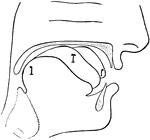
Physiological Bases of the Visible Speech Symbols - Vowels. In representing the vowel classification of sounds, a peculiar and exclusive mode of accenting ... the important ... parts of the hand is resorted to, so that, when the different ways of accentuation are understood, the class to which a given position belongs may be readily determined. The modes of accentuation adopted, impart to the various manual positions something more than mere arbitrary class distinction. A hint at the physiological differences between consonants, vowels, and glides also is given, when the positions that represent them are viewed from the index-finger side of the hand ..., according to the rules in this Manual. <p>Vowel positions are distinguished by always having the voice phalanx of the thumb accented and in contact with the terminal phalanx of the accented finger. This kind of accent is the strongest which can be given a finger, and so always takes precedence. Two modes of accentuation may not co-exist. The Vowel position are thirty-six in number.

Physiological Bases of the Visible Speech Symbols for Vowels

Physiological Bases of the Visible Speech Symbols - Vowels. In representing the vowel classification…
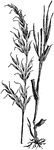
Tall Meadow Oat Grass (Arrhenatherum avenaceum), or Tall Oat Grass is the avena elatior of Linnaeus. It has open panicled spikelets. The grass is two-flowered, the lower flower staminate, bearing a long bent awn below the middle of the back. The leaves are flat, acute and roughish on both sides. The panicle leans slightly to one side and the glumes are very unequal. The stems grow from two to three feet high with a perennial fibrous root that is sometimes bulbous. It is distinguished from other grasses by having two florets, the lower one having a long awn rising from a little above the base of the base of the outer palea. The grass flowers from May to July.

Tall Meadow Oat Grass

Tall Meadow Oat Grass (Arrhenatherum avenaceum), or Tall Oat Grass is the avena elatior of Linnaeus.…
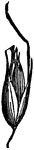
Tall Meadow Oat Grass (Arrhenatherum avenaceum), or Tall Oat Grass is the avena elatior of Linnaeus. It has open panicled spikelets. The grass is two-flowered, the lower flower staminate, bearing a long bent awn below the middle of the back. The leaves are flat, acute and roughish on both sides. The panicle leans slightly to one side and the glumes are very unequal. The stems grow from two to three feet high with a perennial fibrous root that is sometimes bulbous. It is distinguished from other grasses by having two florets, the lower one having a long awn rising from a little above the base of the base of the outer palea. The grass flowers from May to July. A magnified spikelet is shown here.

Tall Meadow Oat Grass

Tall Meadow Oat Grass (Arrhenatherum avenaceum), or Tall Oat Grass is the avena elatior of Linnaeus.…
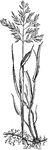
It is a common native grass species in parts of northern Europe and is a hardy pasture grass. It is native to Europe

Meadow Soft Grass

It is a common native grass species in parts of northern Europe and is a hardy pasture grass. It is…

Wheat (Triticum vulgare) is an annual herbaceous plant. The seed is oblong, or a compressed oval, surrounded by scales or chaff, which are easily removed. The side of the kernal or fruit which is next to the rachis in growing is marked by a deep groove separating the mealy parts in the middle . On the other side of the kernal a small oval is seen. The oval is the seat of the embryo, or place where the germ of the new plant is to take its start. The grain is composed to a great extent of starch, with a large percentage of gluten and other nitrogen bodies. Shown is a variation of winter wheat.

Wheat

Wheat (Triticum vulgare) is an annual herbaceous plant. The seed is oblong, or a compressed oval, surrounded…

Wheat (Triticum vulgare) is an annual herbaceous plant. The seed is oblong, or a compressed oval, surrounded by scales or chaff, which are easily removed. The side of the kernal or fruit which is next to the rachis in growing is marked by a deep groove separating the mealy parts in the middle. On the other side of the kernal a small oval is seen. The oval is the seat of the embryo, or place where the germ of the new plant is to take its start. The grain is composed to a great extent of starch, with a large percentage of gluten and other nitrogen bodies. Shown is a variation of winter wheat.

Wheat

Wheat (Triticum vulgare) is an annual herbaceous plant. The seed is oblong, or a compressed oval, surrounded…

Wheat (Triticum spelta) is an annual herbaceous plant. The seed is oblong, or a compressed oval, surrounded by scales or chaff, which are easily removed. The side of the kernal or fruit which is next to the rachis in growing is marked by a deep groove separating the mealy parts in the middle. On the other side of the kernal a small oval is seen. The oval is the seat of the embryo, or place where the germ of the new plant is to take its start. The grain is composed to a great extent of starch, with a large percentage of gluten and other nitrogen bodies. Shown is a sample of spelta wheat.

Wheat

Wheat (Triticum spelta) is an annual herbaceous plant. The seed is oblong, or a compressed oval, surrounded…

Wheat (Triticum spelta) is an annual herbaceous plant. The seed is oblong, or a compressed oval, surrounded by scales or chaff, which are easily removed. The side of the kernal or fruit which is next to the rachis in growing is marked by a deep groove separating the mealy parts in the middle. On the other side of the kernal a small oval is seen. The oval is the seat of the embryo, or place where the germ of the new plant is to take its start. The grain is composed to a great extent of starch, with a large percentage of gluten and other nitrogen bodies. Shown is a sample of a summer variety.

Wheat

Wheat (Triticum spelta) is an annual herbaceous plant. The seed is oblong, or a compressed oval, surrounded…
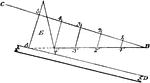
Illustration used to show how to divide a line into any number of equal parts by construction.

Construction Used to Divide a Line Into Equal Parts

Illustration used to show how to divide a line into any number of equal parts by construction.
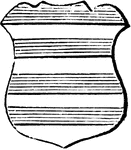
"Barry of eight pieces, azure and argent. BARRY. A field divided transversely into several equal parts, and consisting of two different tinctures interchangeably disposed." -Hall, 1862

Barry Ordinary

"Barry of eight pieces, azure and argent. BARRY. A field divided transversely into several equal parts,…
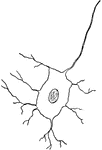
Animal nerve cells are specialized cells called neurons. Figure 1C is a nerve cell with parts of its fiber.

Nerve Cell

Animal nerve cells are specialized cells called neurons. Figure 1C is a nerve cell with parts of its…
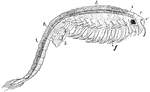
The class of crustacea is divided into two sub-classes, Entomostraca and Malacostraca. The first, Entomostraca, contains the fairy-shrimps (Branchipus). A simple Crustacean, the fairy shrimp body is distinctly separated into head, thorax, and abdomen. This diagram shows parts of the fairy-shimp, (b) brood-pouch, (e,e') compound and simple eyes, (f) paddle-shaped feet, (h) tubular heart, and (i) intestine.

Fairy-shrimp

The class of crustacea is divided into two sub-classes, Entomostraca and Malacostraca. The first, Entomostraca,…
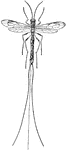
Ichneumon flies are solitary insects, and most are parasitoids&mdash;the larvae feeding on or in another insect which finally dies. As with all hymenopterans, ichneumons are closely related to ants and bees. The female finds a host and lays an egg on, near, or inside the host's body. Upon hatching, the larval ichneumon feeds either externally or internally, killing the host when they themselves are ready to pupate. The large ichneumon fly (Thakessa), with long flexable ovipositor. The various parts of ths ovipositor are spread aapart in the figure; naturally they lie together to form a single piercing organ.

Ichneumon Fly

Ichneumon flies are solitary insects, and most are parasitoids—the larvae feeding on or in another…
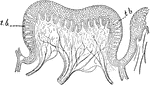
The sense of taste enables us to test in some degree the chemical constitution of substances we take into the mouth as food. These organs are located in the mouth or on the mouth parts. This example shows a vertical section of large papilla on the tongue of a calf detailing the taste buds

Sense of Taste

The sense of taste enables us to test in some degree the chemical constitution of substances we take…
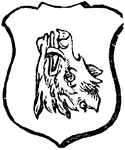
"Argent, a boar's head erect, and erased. ERECT. This is said of any animal or parts of animals, naturally horizontal, being placed in a perpendicular direction." -Hall, 1862

Boar's Head Erect

"Argent, a boar's head erect, and erased. ERECT. This is said of any animal or parts of animals, naturally…