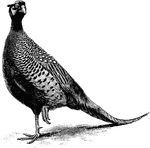
"Phasianus colchicus, Pheasant, ...has a white collar and slaty lower back with dark green barring; while the former has the rump feathers buff, with black mottlings and purplish-red tips. The females, hardly separable from one another, lack the red face-wattles, the long ear-tufts, and the pair of spurs of a male." A. H. Evans, 1900

Pheasant

"Phasianus colchicus, Pheasant, ...has a white collar and slaty lower back with dark green barring;…
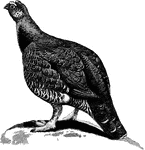
"Lagopus scoticus, the Red Grouse or Muirfowl, the only bird entirely confined to our islands, differs from its congeners in never becoming white in the winter. It varies considerably in coloration, but is usually considered a local form of the Willow Grouse (L. albus) of the north of Europe, Asia, and America. The male in both summer and winter is more or less, chestnut-brown above, with black markings and a reddish head; the lower parts are similar, but are usually spotted with white. In Autumn the brown of the upper parts becomes buff, and the lower surface is barred with buff and black." A. H. Evans, 1900

Red Grouse

"Lagopus scoticus, the Red Grouse or Muirfowl, the only bird entirely confined to our islands, differs…
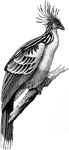
"The Hoatzin (Opisthocomus cristatus) is curious and highly specialized. "The body is long and thin, the bill is strong with basal serrations on the maxilla; bristles surround the gape, and the eye-lids have distinct lashes- a rare fact among birds. The reticulated metatarsi are fairly stout; the toes are long; the hallux being unusually developed and the claws slightly curved. The short rounded wings have ten primaries and nine secondaries. The plumage in both sexes is olive above with white markings, and dull rufous below; the long loose crest and the tip of the tail are yellowish, and patch of bare bluish-black skin surrounds the eyes." A. H. Evans, 1900

Hoatzin

"The Hoatzin (Opisthocomus cristatus) is curious and highly specialized. "The body is long and thin,…
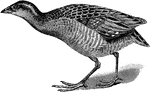
The Crex pratensis, Land-Rail, or Cork Crake, is mostly brown with the upper parts spotted, a blue-green head and neck, chestnut wings, and flanks streaked with a reddish colour. "The Land-Rail extends from most of Europe to the North of Central Asia, wintering in Africa, and occurring accidentally in North America, or even Greenland and Australia." A. H. Evans, 1900

Land-Rail

The Crex pratensis, Land-Rail, or Cork Crake, is mostly brown with the upper parts spotted, a blue-green…
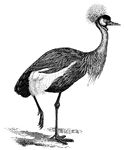
"Balearica pavonina, the "Crowned" Crane of the Northern Ethiopian Region, is greenish-black above and dark grey below, most of the feathers being lanceolate (shaped like a lance); the neck is delicate grey all around, the secondaries are chestnut-the inner being somewhat decomposed; white and yellow shew on the wing coverts; a spreading tuft of twisted yellow and white bristles with black tips surmounts the occiput, while the sides of the face are bare-white above and pink below, and the throat is covered with black down. There is a very small throat-wattle in this form." A. H. Evans, 1900

Crowned Crane

"Balearica pavonina, the "Crowned" Crane of the Northern Ethiopian Region, is greenish-black above and…
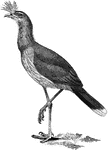
"Cariama cristata, the Seriem&aacute, or Crested Screamer, extending from Pernambuco to Paraguay and Matto Grosso, is ochreous-grey above with zig-zag umber markings, and whitish below with brown stripes. Vertical feathers on the lores form a conspicuous crest, while those of the neck and throat are long and loose; interrupted white bands cross the remiges, and the bases and tips of the lateral rectrices. The iris is yellow, the beak and feet are red, the naked orbits greenish. The female is yellower, and exhibits less crest." A. H. Evans, 1900

Seriemá

"Cariama cristata, the Seriemá, or Crested Screamer, extending from Pernambuco to Paraguay and…
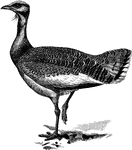
"The Otis Tarda, the Great Bustard, which, as a native only became extinct in Norfolk about 1838, used to extend from East Lothian to Dorset, bit is now merely an occasional visitor to Britain. The upper parts are mottled with rufous, buff, and blackish-brown, the head is blue-grey, with long white bristles at the base of the mandible, the lower surface is white, relieved in the male by a tawny gorget for a short time during the breeding season. The primaries are black, most of the secondaries and wing-coverts white. Some other Bustards seem to have similar vernal change of plumage. The female is smaller and has no bristles." A. H. Evans, 1900

Great Bustard

"The Otis Tarda, the Great Bustard, which, as a native only became extinct in Norfolk about 1838, used…
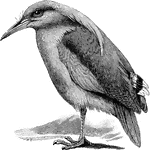
"Rhinochetus jubatus, the Kuga ... has powder-down patches that are profusely distributed over the whole body, except toward the remiges and rectrices. The plumage is slaty-grey, with indistinct dark bars on the wings and tail; while the former expanded rufous and white bands appear, varied by black markings; while a long, erectile whitish-grey crest adorns the occiput and nape. The bill and feet are orange and red." A. H. Evans, 1900

Kagu

"Rhinochetus jubatus, the Kuga ... has powder-down patches that are profusely distributed over the whole…
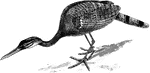
"Eurypyga helias, Sun-Bittern, has a black head, with a white stripe above and under each eye, and a white throat: the remaining plumage "being variegated with black, brown, chestnut, bay, buff, grey, and white-so mottled, speckled, and belted either in wave-like or zigzag forms, as somewhat to resemble certain moths. The bay colour forms two conspicuous patches on each wing, and also an antepenultimate bar on the tail, behind which is a subterminal band of black. The irides are red; the bill isgreenish-olive; and the legs are pale yellow." A. H. Evans, 1900

Sun-Bittern

"Eurypyga helias, Sun-Bittern, has a black head, with a white stripe above and under each eye, and a…
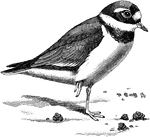
"Aegialitis hiaticola, the Ringed Plover, Sand-Lark, or Stone-runner, mistakenly called the "Ring-Dotterel" which is common on the British coasts and even inland, extends from Smith's Sound eastward to Bering Strait, and migrates to South Africa, North India, or accidentally, Australia. It breeds as far south as the Atlantic Islands, North Africa, and Turkestan. The plumage is light brown, with white forehead, post-ocular streak, upper neck, alar bar, outer rectrices, and under surface; the crown, lores, cheeks, and a collar-broader in front-being black. The young lack the black crown." A. H. Evans, 1900

Ringed Plover

"Aegialitis hiaticola, the Ringed Plover, Sand-Lark, or Stone-runner, mistakenly called the "Ring-Dotterel"…
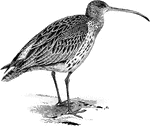
"Numenius arquata, the Curlew or Whaup, breeds freely on the moorlands of Britain; and extends throughout Northern Europe and Asia to Lake Baikal. The plumage is pale brown with darker streaks, the rump, tail, and axillaries being white, and the two latter barred with brown; the belly is white, the breast nearly in winter." A. H. Evans, 1900

Curlew

"Numenius arquata, the Curlew or Whaup, breeds freely on the moorlands of Britain; and extends throughout…
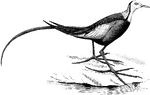
"Hydrophasianus chirurgus, the Indian Jacana, of most of the Indian Region, is Bronzy-brown above and purplish-black below, with no fleshy outgrowths, but a large sharp spur. The head is white in front, with an intervening black lateral stripe; the wings are mainly white, with curious filamentous appendages to the attenuated blackish outer primaries; the four median feathers of dark brown tail are enormously elongated and decurved. The winter and immature plumage is almost entirely bronzy-brown, with white under surface crossed by a black gorget; but the young have a rufous head." A. H. Evans, 1900

Indian Jacana

"Hydrophasianus chirurgus, the Indian Jacana, of most of the Indian Region, is Bronzy-brown above and…
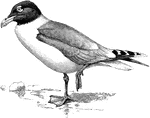
"Larus ichthyaetus, the Great Black-headed Gull, ranging from the Black Sea and the Levant to Tibet, and wintering in Southern Asia, has the bill almost orange." A. H. Evans, 1900. The adults have a black hood, grey wings and back, and white wing tips.

Great Black-Headed Gull

"Larus ichthyaetus, the Great Black-headed Gull, ranging from the Black Sea and the Levant to Tibet,…
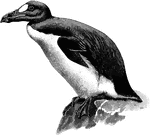
"This species (Alca impennis or Great Auk), extirpated chiefly by the persecution of fisherman, but subsequently by collectors, resembles a flightless Razorbill, though double the size; it had no white stripes on the head or bill, but shewed a large white patch before each eye. A. impennis, the extinct Great Auk or Garefowl, inhabited the North Atlantic, chiefly in the neighborhood of Ice A. H. Evans, 1900

Great Auk

"This species (Alca impennis or Great Auk), extirpated chiefly by the persecution of fisherman, but…
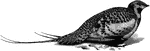
"Syrrhaptes paradoxus, Sand-Ground, are true desert birds, affording excellent instances of protective coloration in their buff or brownish tints, slightly varied with grey, black, orange, and white." A. H. Evans, 1900

Pallas's Sand Grouse

"Syrrhaptes paradoxus, Sand-Ground, are true desert birds, affording excellent instances of protective…
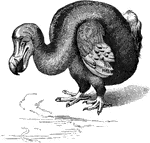
"The Dodo, ...was an immense Pigeon-like bird bigger than a Turkey, with an aborted keel to the sternum and the wings also aborted. The coracoid and scapula met at an obtuse angle, as in many other flightless species. The huge blackish bill terminated in a large horny hook, the cheeks were partly bare, the short yellow legs were stout, scaly, and feathered on the upper portion; the plumage was dark ash- coloured, with whitish breast and tail, yellowish-white wings, and black tips to their coverts. The short rectrices formed a curled tuft, and the first four primaries were directed backwards." A. H. Evans, 1900

Dodo

"The Dodo, ...was an immense Pigeon-like bird bigger than a Turkey, with an aborted keel to the sternum…
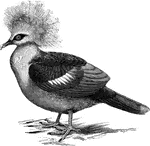
"Goura coronata, the Crowned Pigeon, discovered by Dampier in 1699, is bluish-slate -coloured, with darker wings, and some black on the chin and side of the head; a broad chestnut band crossing the back, one of white shewing conspicuously on the wing, and one of grey terminating the tail." A. H. Evans, 1900

Crowned Pigeon

"Goura coronata, the Crowned Pigeon, discovered by Dampier in 1699, is bluish-slate -coloured, with…
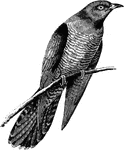
"Cuculus canorus the familiar Cuckoo of Britain and nearly all the Old World, is greyish-brown above and on the throat, the lower parts being white barred with dusky, and the wings and tail shewing a few white markings. A chestnut-brown or "hepatic" phase is sometimes met with. The young are brown mottled with white on the nape."

Cuckoo

"Cuculus canorus the familiar Cuckoo of Britain and nearly all the Old World, is greyish-brown above…
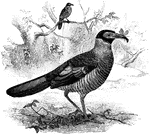
"The plumage is brownish, with white margins to the feathers and a purple tinge on the rufous-mottled head, neck, and breast; the back is greener, the tail more lilac, the abdomen white, the bare orbits blue and red. With its long stout legs this species covers the ground very quickly, running with outstretched neck, elevated crest, slightly expanded wings, and jerking tail, or springing into trees and taking brief flights." A. H. Evans, 1900

Two Radiated Ground Cuckoo, One with an Insect in its Mouth, the Other in a Tree Branch in a wooded Area

"The plumage is brownish, with white margins to the feathers and a purple tinge on the rufous-mottled…
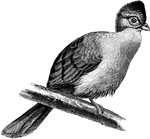
"The Gallirex chlorochlyamys, Green-mantled Turaco, has a general coloration of metallic blue and green or greyish-brown, usually varied with crimson, ...all have erectile crests of different sizes. The bill is red, yellowish, or black, the feet are black. The sexes are alike, the younger are duller. The red feathers yield a peculiar pigment, containing copper, called Turacin, which is reducible to a powder; this is so soluble that the colour is washed away during the rain or in a bath, though regained subsequently." A. H. Evans, 1900

Green-Mantled Turaco Sitting on a Tree Limb

"The Gallirex chlorochlyamys, Green-mantled Turaco, has a general coloration of metallic blue and green…
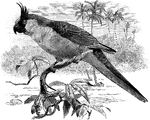
The Nymphicus uvaeesis, Uvaean Parakeet, has a dark coloured face, black beak, green plumage and crest, a yellowish underside, and blue patches on the wings and tail.

Uvaean Parakeet

The Nymphicus uvaeesis, Uvaean Parakeet, has a dark coloured face, black beak, green plumage and crest,…
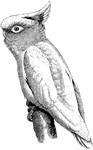
"Cacatuo leadbeateri, Leadbeater's Cockatoo, has a red crest banded with yellow and tipped with white, and rosy tinge on the head and lower surface." A. H. Evans, 1900

Leadbeater's Cockatoo Sitting on a Tree Branch

"Cacatuo leadbeateri, Leadbeater's Cockatoo, has a red crest banded with yellow and tipped with white,…
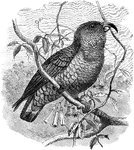
"Nestor notabilis, the Kea of the south island of New Zealand, has olive-green plumage with blackish margins; the wings and tail are varied with blue and yellow, the latter having a brown subterminal band; the rump and under wing-coverts are scarlet. The female is duller."

A Kea Sitting a Tree Branch

"Nestor notabilis, the Kea of the south island of New Zealand, has olive-green plumage with blackish…
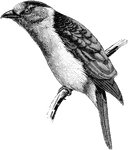
"Leptosoma discolor, the Kiromobo or Vorondreo of Madagascar, and the Comoro Islands, which has a big crested head; a long, slightly hooked bill, overhung at the base by recurved loral feathers; linear nostrils, places far forward and covered by a partly reversible outer toe. The wings are moderate, having ten primaries and twelve secondaries; the long, square tail has twelve feathers; the tongue is tapering, horney and channeled; a large aftershaft is present is present, and there is a considerable powder-down patch on each side of the rump. The head is grey, glossed with copper and green, the neck duller; the upper parts are shining green and coppery-red, the under parts grey with white abdomen. The slightly larger female is reddish-brown above, with buff markings and only dull gloss; the head is chiefly lack, the lower surface fawn-coloured spotted with black." A. H. Evans, 1900

Kirombo

"Leptosoma discolor, the Kiromobo or Vorondreo of Madagascar, and the Comoro Islands, which has a big…
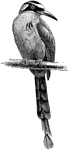
"Momotus brasiliensis, the Motmot, from Guiana to Northern Brazil, is somewhat similar in colour (to the Eumomota superciliaris), but has little red on the back; the head is cobalt-blue with black on the crown and sides; the under parts are green with rufous tinge. the long throat-feathers are black with light blue edges." A. H. Evans, 1900

Motmot

"Momotus brasiliensis, the Motmot, from Guiana to Northern Brazil, is somewhat similar in colour (to…
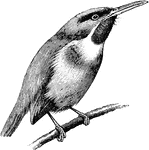
"Todus viridis, Tody, has coloration that is green, with a red throat, yellowish-white or pinkish under parts, and yellow, green, or pink feathers on the flanks. The bill is dull red. The T. viritis inhabits Jamaica. A. H. Evans

Tody

"Todus viridis, Tody, has coloration that is green, with a red throat, yellowish-white or pinkish under…
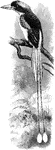
"Tanysiptera, the Racquet-tailed Kingfisher or "Paradise Kingfisher", the sexes may be similar or dissimilar, even in the same genus; the young are like their parents, or somewhat duller. The colours of the Family are most variable, a combination of blue, green, and chestnut being frequent, while almost uniform red, or black and white, are not uncommon; the beak may be black, red, yellow, or parti-coloured.' A. H. Evans, 1900

Racquet-Tailed Kingfisher

"Tanysiptera, the Racquet-tailed Kingfisher or "Paradise Kingfisher", the sexes may be similar or dissimilar,…
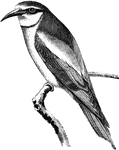
"Merops Apiaster, the Bee-eater, has ruddy-brown head, neck, upper back, and broad alar bar, buff lower back, green wings and tail with black tips to the long median rectrices, light blue upper tail-coverts, pale green and white forehead, black ear-coverts, and bright yellow throat, divided from the greenish-blue under parts by a black band." A. H. Evans, 1900

Bee Eater

"Merops Apiaster, the Bee-eater, has ruddy-brown head, neck, upper back, and broad alar bar, buff lower…
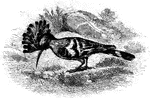
"Upupa epops, not unfrequently visits Britain, where it has nested on several occasions; it breeds from Southern Scandinavia to Northern Africa and the Atlantic Islands, migrating a little further south; while it extends through most of Asia and reaches Japan. The fine erectile crest, the head, neck, and lower parts are cinnamon-coloured; the remaining plumage is black, varied with buff and white; a band of the latter crosses the tail; and head plumes are tipped with black and white." A. H. Evans

Hoopoe

"Upupa epops, not unfrequently visits Britain, where it has nested on several occasions; it breeds from…
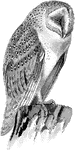
Strix flammea, the nocturnal White Screech-, or Barn Owl, is orange-buff above, with brown, grey and white markings, but is white below and on the complete facial discs. The dark grey phase has white parts tinged with orange and a few distinct blackish spots beneath. The legs are entirely, and the toes partially, covered with bristly feathers." A. H. Evens, 1900

Screech Owl

Strix flammea, the nocturnal White Screech-, or Barn Owl, is orange-buff above, with brown, grey and…
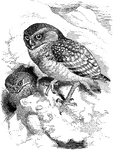
"Speotyto cunicularia, the Burrowing Owl, a comparatively long-legged and short -winged bird with incomplete facial discs and unfeathered toes, is umber-brown varied with yellowish and white, the lower parts becoming lighter." A. H. Evans

Two Burrowing Owls by the Mountains

"Speotyto cunicularia, the Burrowing Owl, a comparatively long-legged and short -winged bird with incomplete…
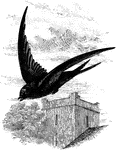
"The coloration of the twenty or more species of Cypselus is sooty-black or mouse-brown, frequently exhibiting a metallic gloss, while the collar, rump, abdomen, or edges of the feathers may be white. A forked tail is not uncommon. The common Swift, or Deviling of Britain, is found through Europe, North Africa, and Asia, southwards t the Himalayas, migrating to South Africa, Madagascar, and Southern Asia." A. H. Evans, 1900

Common Swift Flying Through the Air by a Structure and a Tree with its Mouth Open

"The coloration of the twenty or more species of Cypselus is sooty-black or mouse-brown, frequently…
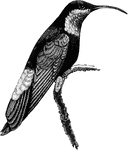
"The Eulampis jugularis, or Hummingbird, has brilliant coloration almost defies description, the most exquisite metallic or jewel-like hues glorifying a background of green, blue, or brown; while crests, ear-tufts, neck-frills, and pendent beards ending in points or forks, add to the effect." A. H. Evans, 1900

Hummingbird

"The Eulampis jugularis, or Hummingbird, has brilliant coloration almost defies description, the most…
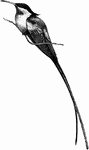
"Aithurus polytmus, the Long-tailed Hummingbird, peculiar to Jamaica, the two tail-feathers next to the outer pair are immensely elongated, and, after crossing one another, bend outwards in a curve; the lateral rectrices are bluish-black, as is the head with its divided crest; all the outer parts being luminous green, and the bill red with black tip. The female is chiefly green above and white below, with brownish brown." A. H. Evans, 1900

Long Tailed Hummingbird

"Aithurus polytmus, the Long-tailed Hummingbird, peculiar to Jamaica, the two tail-feathers next to…
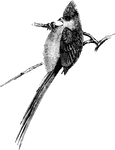
"Colius capensis, or Cape Coly, has two stripes of black on the back enclosing one of white, the bare skin surrounding the eye is scarlet and bluish-grey everywhere else. The legs are red in life fading to buff after death." A. H. Evans, 1900

Cape Coly

"Colius capensis, or Cape Coly, has two stripes of black on the back enclosing one of white, the bare…
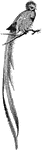
"Pharomacrus mocinno, the Quezal of the higher districts of Guatemala to Veragua, is brilliant iridescent green above, tinged with blue on the far extended tail-coverts; the throat is green, the under parts are gorgeous crimson, the remiges and the six median rectrices are black, the remainder chiefly white." A. H. Evans, 1900

Quezal

"Pharomacrus mocinno, the Quezal of the higher districts of Guatemala to Veragua, is brilliant iridescent…
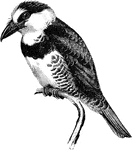
"Bucco hyperrhynchus, or Puff-bird, is blue-black, with a white under surface crossed by a broad black band, and a white forehead and nape, with a large bill." A. H. Evans

Puff-bird

"Bucco hyperrhynchus, or Puff-bird, is blue-black, with a white under surface crossed by a broad black…
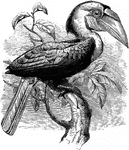
The Rytidoceros undulatus, Plait-billed Hornbill, or Wreathed Hornbill, has black wings, belly, and back. The male has a buff colored head with red plumes from the nape, a naked yellow gular pouch that has a black stripe. The female has a black head and neck with a blue gular pouch. The feet are black, the bill yellow, the the iris red.

Plait-billed Hornbill

The Rytidoceros undulatus, Plait-billed Hornbill, or Wreathed Hornbill, has black wings, belly, and…
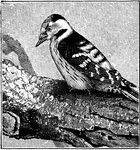
"Dendrocopus minor, or Lesser Spotted Woodpecker, are the British representatives, The colours in this genus are black and white in varied proportions, with crimsons on the head and often on the lower parts; a small amount of buff and brown being not uncommonly added." A. H. Evans, 1900

Lesser Spotted Woodpecker

"Dendrocopus minor, or Lesser Spotted Woodpecker, are the British representatives, The colours in this…
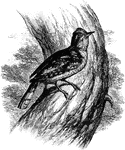
"Iynx torquilla, the Cuckoo's-mate or Snake-bird, is fairly common in England, and extends thence to Japan, Kordofan, and Senegal. The Wryneck may be distinguished from the typical Woodpeckers by their soft tails without spiny shafts, and naked nostrils with a partial covering. The plumage shews a particular mixture of black , brown, grey, and white, somewhat similar to the Nightjar." A. H. Evans, 1900

A Wryneck Sitting on a Tree

"Iynx torquilla, the Cuckoo's-mate or Snake-bird, is fairly common in England, and extends thence to…
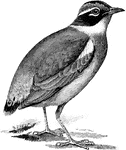
"Pitta brachyura, the Indian Pitta, has plumage that exhibits vivid scarlet, blue, and green tints, in addition to yellow, purple, black, brown, and white. They are stout, strong-billed form, with short rounded wings and tail, the long metatarsus being more or less scutellated all round; the primaries number ten- the secondaries eight, the rectrices twelve." A. H. Evans, 1900

Indian Pitta

"Pitta brachyura, the Indian Pitta, has plumage that exhibits vivid scarlet, blue, and green tints,…
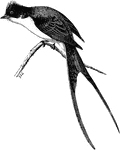
"Milvulus tyrannus, Scissor-tail, normally exhibits olive, grey, yellow, or white in varying proportions." A. H. Evans, 1900

Scissor-tail

"Milvulus tyrannus, Scissor-tail, normally exhibits olive, grey, yellow, or white in varying proportions."…
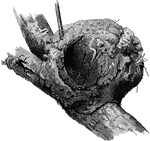
"The curious nest is placed in exposed situations on branches, in forks of trees or shrubs, on posts, rocks, or house-roofs; it has thick walls, almost unbreakable when dry, of clayey mud and dung mixed with a little hair or dry grass, a lining of same materials underlying the three to five white eggs." A. H. Evans, 1900

The Nest of an Oven-bird

"The curious nest is placed in exposed situations on branches, in forks of trees or shrubs, on posts,…
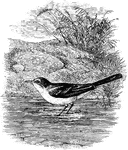
"Motacilla raii, the Yellow Wagtails, are generally black and white, grey and white, grey with a yellow breast (or even head), greenish with yellow lower parts and greyish or black heads, or almost entirely yelowish." A. H. Evans, 1900

Yellow Wagtail

"Motacilla raii, the Yellow Wagtails, are generally black and white, grey and white, grey with a yellow…
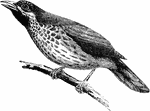
"Timelia maculata, the Babbling Thrush, sexes are commonly alike, the plain rufous coloration being often relieved by black, white, and grey." A. H. Evans, 1900

Babbling Thrush

"Timelia maculata, the Babbling Thrush, sexes are commonly alike, the plain rufous coloration being…
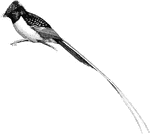
"Terpsiphone paradisi, Paradise Flycatchers, have fine crests, shorter in the female; while fleshy wattles, round or above the eye, of scarlet, blue, or yellow, are found. The bill is sometimes reddish or blue, and the inside of the mouth green or yellowish, as in certain Birds of Paradise. The female is rich bay above, with similar head, but grey cheeks and throat. In other species the males are said to be maroon, cinnamon, chestnut, blue-grey, or glossy-black above." A. H. Evans, 1900

Paradise Flycatcher

"Terpsiphone paradisi, Paradise Flycatchers, have fine crests, shorter in the female; while fleshy wattles,…
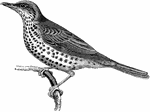
"Turdus viscivorus, Mistletoe Thrush, the coloration is ordinarily plain black or brown, more or less varied with grey, white, rufous, or chestnut, occasionally in the form of a collar; many Thrushes, moreover, exhibit the characteristic white breast spotted with brown. The bill if frequently orange or yellow." A. H. Evans

Mistletoe Thrush

"Turdus viscivorus, Mistletoe Thrush, the coloration is ordinarily plain black or brown, more or less…
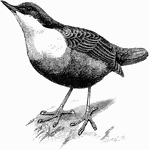
"Cinclus aquaticus, Dippers, the colour above is normally greyish-black or brown; the lower parts are similar or white, commonly with a black belly, while a chestnut band crosses the breast in the British. The sexes are alike, but the young are spotted. Both plumage and down are close and nearly impervious to water." A. H. Evans, 1900

Dipper

"Cinclus aquaticus, Dippers, the colour above is normally greyish-black or brown; the lower parts are…
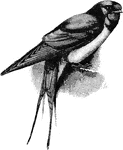
"Hirundo rustica, the Swallow, is metallic black, with a variable amount of chestnut or rufous on the head, rump, or lower surface; the last of these regions exhibiting much white or having a black pectoral band, while streaky markings are not uncommon." A. H. Evans

Swallow

"Hirundo rustica, the Swallow, is metallic black, with a variable amount of chestnut or rufous on the…
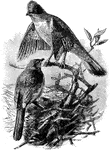
"Hypocolius ampelinus, Grey "Coly-Shrike", the plumage is soft, with characteristically stiff shafts on the lower back; the nostrils are nearly concealed by the feathers; the rictal bristles are feeble. The unusual coloration is either bluish-grey with a certain amount of black and white, or chiefly black and white. The black has generally a purplish or a greenish gloss; while barring occurs occasionally in the cocks, and much more commonly in the hens, where the tints are duller, the grey lighter, and the hue in some cases brown or even rufous. A. H. Evans, 1900

Two Grey "Coly-Shrike" Birds Sitting on Tree Branches

"Hypocolius ampelinus, Grey "Coly-Shrike", the plumage is soft, with characteristically stiff shafts…
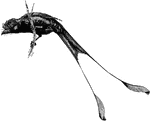
"Dissemurus paradiseus, the Drongo, both sexes are typically black, with metallic gloss of blue, purple, or green, though a few are greyer or browner, or have a little white below. The variable bill is usually large and more or less curved, with a hooked tip, a notched maxilla, and fairly strong rictal bristles. The bill and feet are black; eyes red, white, or brown." A. H. Evans, 1900

Drongo

"Dissemurus paradiseus, the Drongo, both sexes are typically black, with metallic gloss of blue, purple,…
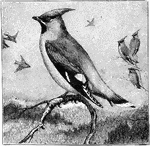
"Both sexes of our irregular winter-visitor the Waxwing (Ampelis garrulus) are silky greyish-brown, with blackish wigs, and tail relieved by yellow and white; a black forehead, eye-stripe, and throat; chestnut under tail-coverts and basil margin of the erectile crest; and, in the adults, flattened wax-like tips to the shafts of the secondaries or even rectrices. The young are streaked below." A. H. Evans, 1900

One Waxwing Sitting on a Branch in the Forefront with Three Waxwings Sitting on Branches and Four Flying Around in the Background

"Both sexes of our irregular winter-visitor the Waxwing (Ampelis garrulus) are silky greyish-brown,…
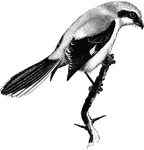
"The Lanius excubitor, Great Grey Shrike, lax plumage is either black, grey, and white, or is varied with rich red-brown. The young are browner, and are often transversely barred below..." A. H. Evans, 1900

Great Grey Shrike

"The Lanius excubitor, Great Grey Shrike, lax plumage is either black, grey, and white, or is varied…
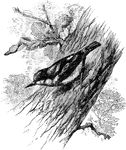
"The colours in Sitta caesia, (Nuthatch) which ranges over nearly all the Palaearctic and Indian Regions, and throughout North America to Mexico, are slaty-blue and rusty-red of various shades, relieved by black and white; the slaty tints shewing chiefly above, often in combination with black or brown cap." A. H. Evans, 1900

Nuthatch

"The colours in Sitta caesia, (Nuthatch) which ranges over nearly all the Palaearctic and Indian Regions,…
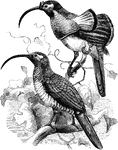
"Drepanornis albertisi, D'Albertis' Bird of Paradise, is rufous-brown, with green throat and ante-ocular region, white belly and dusky breast; the sides of the last exhibit dark-edged bronzy plumes, which can be expanded like a fan, succeeded by long grey decomposed feathers with lilac margins; and small bluish tufts surmount the bare orbits and post-ocular region." A. H. Evans, 1900

D'Albertis' Bird of Paradise

"Drepanornis albertisi, D'Albertis' Bird of Paradise, is rufous-brown, with green throat and ante-ocular…
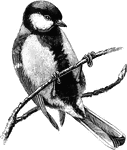
"Parus major, the Great Titmouse, are olive, brown, or grey, varied with black, white, chestnut, or buff, as in our Crested Tit. The sexes are very similar, the young often yellower." A. H. Evans, 1900

Great Titmouse

"Parus major, the Great Titmouse, are olive, brown, or grey, varied with black, white, chestnut, or…
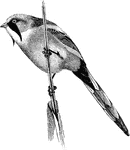
"Panurus biarmicus, the "Bearded Tit" or "Reed-Pheasant" plumage is orange-brown above, with grey crown and a black streak from the lores down the cheeks, where the feathers are elongated and point backwards; the wings are varied with black and white; the throat is greyish, the breast pinkish; the abdomen coloured like the back; the under tail-coverts are black, the bill is yellow. The hen has a buff head, while she lacks the black "moustache" and under tail-coverts." A. H. Evans, 1900

Reed Pheasant

"Panurus biarmicus, the "Bearded Tit" or "Reed-Pheasant" plumage is orange-brown above, with grey crown…
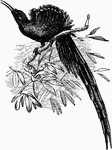
"Falcinellus speciosus, Long-tailed Bird of Paradise, is black with rainbow-like reflections; the broad plumes of the sides of the upper breast being banded with metallic blue and green, and having wide tips which open upwards into a fan; while the long pointed flank-feathers compose similarly coloured tufts." A. H. Evans

Long-tailed Bird of Paradise

"Falcinellus speciosus, Long-tailed Bird of Paradise, is black with rainbow-like reflections; the broad…
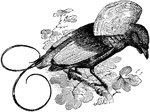
"Diphyllodes magnifica, Magnificent Bird of Paradise, has a brown head and under surface, green throat and breast-shield, orange-brown back surmounted by a double cape of straw-yellow upon red-brown, and long, curved steel-blue head, with two lines of brown feathers crossing each other at right angles, and for its blue feet." A. H. Evans, 1900

Magnificent Bird of Paradise

"Diphyllodes magnifica, Magnificent Bird of Paradise, has a brown head and under surface, green throat…
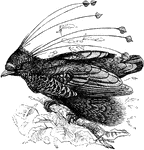
"Parotia sexpennis, the Six-wired Bird of Paradise, is bronzy- and purplish-black, having scale-like golden throat- and breast-feathers with green and blue reflections. A satiny white patch crosses the forehead; the occiput is green, blue, and purple, having two lateral tufts, from each of which spring three wires terminating in small black discs; while large, soft, erectile masses of black adorn each side of the body." A. H. Evans, 1900

Six-wired Bird of Paradise

"Parotia sexpennis, the Six-wired Bird of Paradise, is bronzy- and purplish-black, having scale-like…