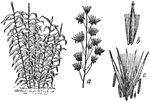
"Bamboo-reed (Arundo donax). a, panicle; b, flowering scale, clothed with silky hairs; c, spikelet." -Whitney, 1911

Giant Reed

"Bamboo-reed (Arundo donax). a, panicle; b, flowering scale, clothed with silky hairs; c, spikelet."…
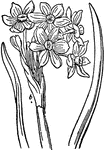
Narcissus is the botanic name for a genus of mainly hardy, mostly spring-flowering, bulbs in the Amaryllis family native to Europe, North Africa, and Asia. There are also several Narcissus species that bloom in the autumn. Though Hortus Third cites 26 wild species, Daffodils for North American Gardens cites between 50 and 100 excluding species variants and wild hybrids. Through taxonomic and genetic research, it is speculated that over time this number will likely continue to be refined. Daffodil is a common English name, sometimes used now for all varieties, and is the chief common name of horticultural prevalence used by the American Daffodil Society The range of forms in cultivation has been heavily modified and extended, with new variations available from specialists almost every year.

Narcissus

Narcissus is the botanic name for a genus of mainly hardy, mostly spring-flowering, bulbs in the Amaryllis…
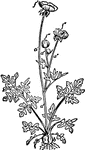
Ranunculus bulbosus, commonly known as St Anthony's turnip or bulbous buttercup, is a perennial weed of the Buttercup Family. It has attractive yellow flowers, and deeply divided, three-lobed long-petioled basal leaves. Bulbous buttercup is known to form tufts.

Bulbous Buttercup

Ranunculus bulbosus, commonly known as St Anthony's turnip or bulbous buttercup, is a perennial weed…
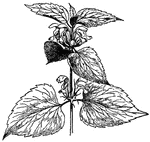
Lamium album (White Deadnettle) is a flowering plant in the family Lamiaceae, native throughout Europe and western Asia, growing in a variety of habitats from open grassland to woodland, generally on moist, fertile soils. It is a herbaceous perennial plant growing to 50-100 cm tall, with green, four-angled stems. The leaves are 3-8 cm long and 2-5 cm broad, triangular with a rounded base, softly hairy, and with a serrated margin and a petiole up to 5 cm long; they appear superficially similar to those of the Stinging nettle Urtica dioica but do not sting, hence the common name "dead nettle". The flowers are white, produced in whorls ('verticillasters') on the upper part of the stem, the individual flowers 1.5-2.5 cm long

Lamium Album

Lamium album (White Deadnettle) is a flowering plant in the family Lamiaceae, native throughout Europe…
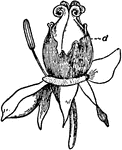
Paeonia) is the only genus in the flowering plant family Paeoniaceae. They are native to Asia, southern Europe and western North America. Most are herbaceous perennial plants 0.5–1.5 metres tall, but some are woody shrubs up to 1.5–3 metres tall. They have compound, deeply lobed leaves, and large, often fragrant flowers, ranging from red to white or yellow, in late spring and early summer. In the past, the peonies were often classified in the family Ranunculaceae, alongside Hellebores and Anemones.

Peony Bud

Paeonia) is the only genus in the flowering plant family Paeoniaceae. They are native to Asia, southern…
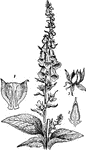
An illustration of: 1, Coralla cut open showing the four stamens; 2, Unripe fruit (lengthwise); 3, ripe capsule split open; and the foxglove plant. Digitalis is a genus of about 20 species of herbaceous perennials, shrubs, and biennials that are commonly called foxgloves. The genus was traditionally placed in the figwort family Scrophulariaceae, but upon review of phylogenetic research, it has now been placed in the much enlarged family Plantaginaceae. The genus is native to Europe, western and central Asia, and northwestern Africa. The scientific name means "finger-like" and refers to the ease with which a flower of Digitalis purpurea can be fitted over a human fingertip. The flowers are produced on a tall spike, are tubular, and vary in colour with species, from purple to pink, white, and yellow. The best-known species is the Common Foxglove, Digitalis purpurea. It is a biennial, often grown as an ornamental plant due to its showy flowers, that range in colour from purples through to whites, with variable marks and spotting. The first year of growth produces only the long, basal leaves. In the second year, the erect leafy stem 0.5-2.5 m tall develops.

Foxglove

An illustration of: 1, Coralla cut open showing the four stamens; 2, Unripe fruit (lengthwise); 3, ripe…

Sedum is the large stonecrop genus of the Crassulaceae, representing about 400 species of leaf succulents, found throughout the northern hemisphere, varying from annual and creeping herbs to shrubs. The plants have water-storing leaves. The flowers usually have five petals, seldom four or six. There are typically twice as many stamens as petals.

Sedum

Sedum is the large stonecrop genus of the Crassulaceae, representing about 400 species of leaf succulents,…
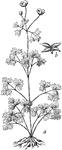
The plant and fruit of the False Rue Anemone (Isopyrum biternatum). It is a flowering plant in the Ranunculaceae family of buttercups.

False Rue Anemone

The plant and fruit of the False Rue Anemone (Isopyrum biternatum). It is a flowering plant in the Ranunculaceae…
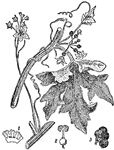
Bryony is the common name for any of twelve species in the genus Bryonia. These are perennial, tendril-climbing, dioecious herbs with palmately lobed leaves and flowers in axillary clusters. The fruit is a smooth, globular berry.

Bryony

Bryony is the common name for any of twelve species in the genus Bryonia. These are perennial, tendril-climbing,…
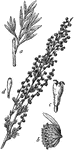
"Pasture Sage-brush (Artemisia frigida). a, leaf; b, flower-head; c, fertile flower; d, marginal flower." -Whitney, 1911

Sagebrush

"Pasture Sage-brush (Artemisia frigida). a, leaf; b, flower-head; c, fertile flower; d, marginal flower."…
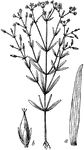
"Canadian St.-John's-wort (Hypericum Canadense). a, leaf; b, seed-capsule." -Whitney, 1911

Canadian St. John's Wort

"Canadian St.-John's-wort (Hypericum Canadense). a, leaf; b, seed-capsule." -Whitney, 1911
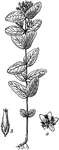
"Marsh St.-John's-wort (Triadenum Virginicum). a, flower; b, seed-capsule." -Whitney, 1911

Marsh St. John's Wort

"Marsh St.-John's-wort (Triadenum Virginicum). a, flower; b, seed-capsule." -Whitney, 1911
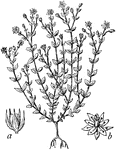
"Thyme-leaved Sandwort (Arenaria serpyllifolia). a, capsule surrounded by the scarious calyx; b, expanded flower." -Whitney, 1911

Thyme-Leaved Sandwort

"Thyme-leaved Sandwort (Arenaria serpyllifolia). a, capsule surrounded by the scarious calyx; b, expanded…
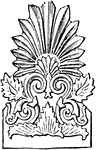
On the apex and two lower angles of the pediment were introduced acroteria, sometimes ornaments of flowers and tendrils, and sometimes statues of gods or animals. These were placed on small pedestals, and offered an æsthetic contrast to the sliding effect which would otherwise have been produced by the oblique lines of the pediment.

Façade Tile from the Temple of Diana at Ephesus

On the apex and two lower angles of the pediment were introduced acroteria, sometimes ornaments of flowers…
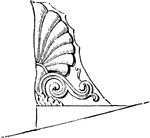
On the apex and two lower angles of the pediment were introduced acroteria, sometimes ornaments of flowers and tendrils, and sometimes statues of gods or animals. These were placed on small pedestals, and offered an æsthetic contrast to the sliding effect which would otherwise have been produced by the oblique lines of the pediment.

Acroteria, or Roof-Pedestal, from the Temple of Theseus at Athens

On the apex and two lower angles of the pediment were introduced acroteria, sometimes ornaments of flowers…
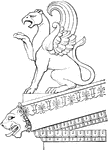
On the apex and two lower angles of the pediment were introduced acroteria, sometimes ornaments of flowers and tendrils, and sometimes statues of gods or animals. These were placed on small pedestals, and offered an æsthetic contrast to the sliding effect which would otherwise have been produced by the oblique lines of the pediment.

Acroteria from the Temple of Minerva at Ægina

On the apex and two lower angles of the pediment were introduced acroteria, sometimes ornaments of flowers…
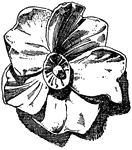
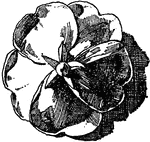
The Wild Rose is used as an ornament design in flat and relief forms.

Wild Rose

The Wild Rose is used as an ornament design in flat and relief forms.

The Wild Rose is used as an ornament design in flat and relief forms.

Wild Rose

The Wild Rose is used as an ornament design in flat and relief forms.

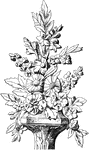
The Louis XVI Bouquet is a carving.

Louis XVI Bouquet

The Louis XVI Bouquet is a carving.

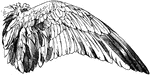
Wild Goose Wing.

Wild Goose Wing

Wild Goose Wing.

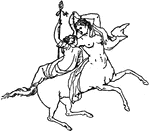
The Centaurs and Bacchantes comes from mural paintings found in ancient Pompeii, Rome. It is imaginary wild monsters with the fore part of a man and the hinder of a horse.

Centuars and Bacchantes

The Centaurs and Bacchantes comes from mural paintings found in ancient Pompeii, Rome. It is imaginary…
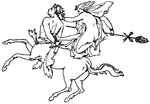
The two Centaurs and Bacchantes comes from mural paintings found in ancient Pompeii, Rome. It is imaginary wild monsters with the fore part of a man and the hinder of a horse.

Multiple Centuars and Bacchantes

The two Centaurs and Bacchantes comes from mural paintings found in ancient Pompeii, Rome. It is imaginary…
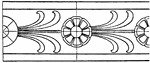
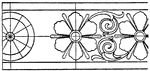
The antique rosette band is pattern of small flowers.

Antique Rosette Band

The antique rosette band is pattern of small flowers.

The antique rosette band is pattern of small flowers.

Antique Rosette Band

The antique rosette band is pattern of small flowers.

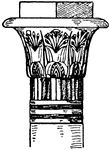
The Egyptian capital is the upper termination of the column with opened papyrus flowers. It is found in Kom-Ombo an agricultural town in Egypt.

Egyptian Capital

The Egyptian capital is the upper termination of the column with opened papyrus flowers. It is found…
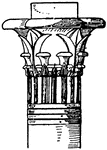
The Egyptian capital is the upper termination of the column with opened papyrus flowers. It is found in Philae an island on the Nile river in Egypt.

Egyptian Capital

The Egyptian capital is the upper termination of the column with opened papyrus flowers. It is found…
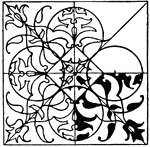
The Renaissance square panel is a motif of flowers.

Renaissance Square Panel

The Renaissance square panel is a motif of flowers.

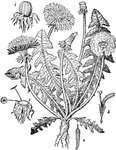
Taraxacum is a large genus of flowering plants in the family Asteraceae. They are native to Europe, North America and Asia and two species, T. officinale and T. erythrospermum, are found as weeds worldwide. The common name Dandelion is given to members of the genus and like other members of the Asteraceae family, they have very small flowers collected together into a composite flower head. Each single flower in a head is called a floret. Many Taraxacum species produce seeds asexually by apomixis, where the seeds are produced without pollination, resulting in offspring that are genetically identical to the parent plant.

Dandelion

Taraxacum is a large genus of flowering plants in the family Asteraceae. They are native to Europe,…
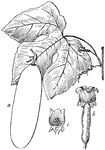
"Sicana odorifera. a, fruit; b, female flower; c, male flower." -Whitney, 1911

Cassabanana

"Sicana odorifera. a, fruit; b, female flower; c, male flower." -Whitney, 1911

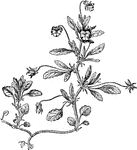
Heartsease (Viola tricolor) is a common European wild flower, growing as an annual or short-lived perennial. It has been introduced into North America, where it has spread widely, and is known as the Johnny Jump Up (though this name is also applied to similar species such as the Yellow Pansy). It is the progenitor of the cultivated Pansy, and is therefore sometimes called Wild Pansy; before the cultivated Pansies were developed, "Pansy" was an alternative name for the wild form.

Heartsease

Heartsease (Viola tricolor) is a common European wild flower, growing as an annual or short-lived perennial.…
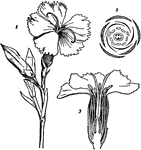
Dianthus is a genus of about 300 species of flowering plants in the family Caryophyllaceae, native mainly to Europe and Asia, with a few species extending south to north Africa, and one species (D. repens) in arctic North America. The species are mostly perennial herbs, a few are annual or biennial, and some are low subshrubs with woody basal stems. The leaves are opposite, simple, mostly linear and often strongly glaucous grey-green to blue-green. The flowers have five petals, typically with a frilled or pinked margin, and are (in almost all species) pale to dark pink. One species, D. knappii, has yellow flowers with a purple center.

Dianthus

Dianthus is a genus of about 300 species of flowering plants in the family Caryophyllaceae, native mainly…
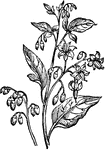
The Bittersweet (Solanum dulcamara) is a perennial vine in the Solanaceae family of nightshades.

Bittersweet

The Bittersweet (Solanum dulcamara) is a perennial vine in the Solanaceae family of nightshades.
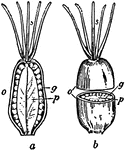
An illustration of various parts of the cashew tree. "1, Branch, bearing flowers and fruit. The fruit stales are enlarged in pear like for bearing the nut (the true fruit) at their apex; 2, Flower expanded; Stamen and pistil, with the calyx; 4, Stamen separated; 5, Nut constituting the fruit; 6, Nut opened longitudinally; 7, Seed seprated from the nut; 8, Cotyledons opened to show the radicle a, and the plumule." (Britannica, 1910)

Cashew Tree

An illustration of various parts of the cashew tree. "1, Branch, bearing flowers and fruit. The fruit…
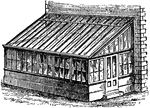
A lean-to plant house which is associated with the growth of ornamental plant and flowers.

Plant House

A lean-to plant house which is associated with the growth of ornamental plant and flowers.
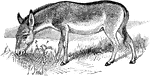
The Khulan or Dziggetai (Equus hemionus hemionus) is an onager, a horse species larger than a donkey.
Khulan

The Khulan or Dziggetai (Equus hemionus hemionus) is an onager, a horse species larger than a donkey.

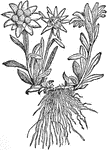
Edelweiss (Leontopodium alpinum) is a European mountain flower of the Asteraceae or daisy family.

Edelweiss

Edelweiss (Leontopodium alpinum) is a European mountain flower of the Asteraceae or daisy family.
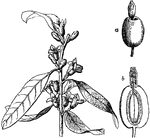
"Flowering Branch of Oleaster (Elaeagnus angustifolia). a, fruit; b, section of same." -Whitney, 1911
Oleaster

"Flowering Branch of Oleaster (Elaeagnus angustifolia). a, fruit; b, section of same." -Whitney, 1911

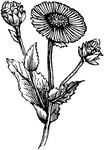
The Elecampane (Inula helenium) is a flowering plant in the Asteraceae family of daisies.

elecampane

The Elecampane (Inula helenium) is a flowering plant in the Asteraceae family of daisies.
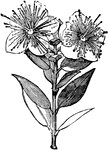
The Myrtle (Myrtus) is a genus of one or two species of flowering plants in the family Myrtaceae, native to southern Europe and north Africa. They are evergreen shrubs or small trees, growing to 5 m tall. The leaves are entire, 3-5 cm long, with a fragrant essential oil. The star-like flowers have five petals and sepals, and numerous stamens. Petals are usually white. The fruits are globose blue-black berries containing several seeds. The flowers are pollinated by insects, and the seeds dispersed by birds that feed on the berries.

Myrtle

The Myrtle (Myrtus) is a genus of one or two species of flowering plants in the family Myrtaceae, native…
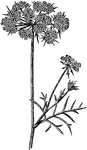
An illustration of the inflorescence of the carrot plant. An inflorescence is a group or cluster of flowers arranged on a stem that is composed of a main branch or a complicated arrangement of branches. Strictly, it is the part of the shoot of seed plants where flowers are formed and which is accordingly modified.

Carrot Flower

An illustration of the inflorescence of the carrot plant. An inflorescence is a group or cluster of…
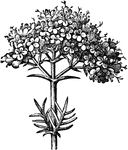
Valerian is a hardy perennial flowering plant, with heads of sweetly scented pink or white flowers. The flowers are in bloom in the northern hemisphere from June to September. Valerian was used as a perfume in the sixteenth century.

Valerian Inflorescence

Valerian is a hardy perennial flowering plant, with heads of sweetly scented pink or white flowers.…
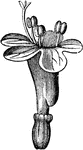
Valerian is a hardy perennial flowering plant, with heads of sweetly scented pink or white flowers. The flowers are in bloom in the northern hemisphere from June to September. Valerian was used as a perfume in the sixteenth century.

Valerian Flower

Valerian is a hardy perennial flowering plant, with heads of sweetly scented pink or white flowers.…
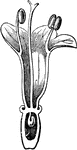
An illustration of a longitudinal sectional view of the valerian flower. Valerian is a hardy perennial flowering plant, with heads of sweetly scented pink or white flowers. The flowers are in bloom in the northern hemisphere from June to September. Valerian was used as a perfume in the sixteenth century.

Valerian Flower (Longitudinal Section)

An illustration of a longitudinal sectional view of the valerian flower. Valerian is a hardy perennial…
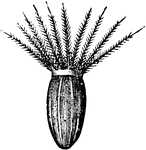
An illustration of the valerian seed with attached pappus. In a composite flower, Pappus is the part of individual disk and ray flowers that surrounds the base, in the same manner as the calyx does in a non-compound flower. The pappus may be like bristles or tiny hairs, teeth, or scales, and is usually too small to see without magnification. Valerian is a hardy perennial flowering plant, with heads of sweetly scented pink or white flowers. The flowers are in bloom in the northern hemisphere from June to September. Valerian was used as a perfume in the sixteenth century.

Valerian Seed with Pappus

An illustration of the valerian seed with attached pappus. In a composite flower, Pappus is the part…
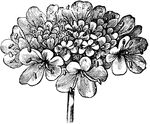
An illustration of the inflorescence of the field scabious. Knautia arvensis, commonly known as Field Scabious, is a species in the genus Knautia. It is a perennial plant that grows between 25 and 100 cm. It prefers grassy places and dry soils, avoiding heavy soils, and flowers between July and September. The flowered head is flatter than similar species Devils bit scabious and Small Scabious. There are 4 stamens in each flower, and 1 notched long stigma. The fruit is nut like, cylindrical and hairy, 5-6mm in size. It has a tap root. The stem has long stiff hairs angled downwards. There are no stipules. The leaves form a basal rosette, are paired on the stem, the lowest typically 300mm long, spear shaped, whereas the upper are smaller.

Inflorescence of Field Scabious

An illustration of the inflorescence of the field scabious. Knautia arvensis, commonly known as Field…
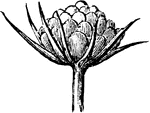
An illustration of the young inflorescence of the field scabious. Knautia arvensis, commonly known as Field Scabious, is a species in the genus Knautia. It is a perennial plant that grows between 25 and 100 cm. It prefers grassy places and dry soils, avoiding heavy soils, and flowers between July and September. The flowered head is flatter than similar species Devils bit scabious and Small Scabious. There are 4 stamens in each flower, and 1 notched long stigma. The fruit is nut like, cylindrical and hairy, 5-6mm in size. It has a tap root. The stem has long stiff hairs angled downwards. There are no stipules. The leaves form a basal rosette, are paired on the stem, the lowest typically 300mm long, spear shaped, whereas the upper are smaller.

Young Inflorescence of Field Scabious

An illustration of the young inflorescence of the field scabious. Knautia arvensis, commonly known as…
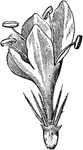
An illustration of a ray-floret of the field scabious. Knautia arvensis, commonly known as Field Scabious, is a species in the genus Knautia. It is a perennial plant that grows between 25 and 100 cm. It prefers grassy places and dry soils, avoiding heavy soils, and flowers between July and September. The flowered head is flatter than similar species Devils bit scabious and Small Scabious. There are 4 stamens in each flower, and 1 notched long stigma. The fruit is nut like, cylindrical and hairy, 5-6mm in size. It has a tap root. The stem has long stiff hairs angled downwards. There are no stipules. The leaves form a basal rosette, are paired on the stem, the lowest typically 300mm long, spear shaped, whereas the upper are smaller.

Ray-floret of Field Scabious

An illustration of a ray-floret of the field scabious. Knautia arvensis, commonly known as Field Scabious,…
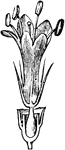
An illustration of a ray-floret of the field scabious. Knautia arvensis, commonly known as Field Scabious, is a species in the genus Knautia. It is a perennial plant that grows between 25 and 100 cm. It prefers grassy places and dry soils, avoiding heavy soils, and flowers between July and September. The flowered head is flatter than similar species Devils bit scabious and Small Scabious. There are 4 stamens in each flower, and 1 notched long stigma. The fruit is nut like, cylindrical and hairy, 5-6mm in size. It has a tap root. The stem has long stiff hairs angled downwards. There are no stipules. The leaves form a basal rosette, are paired on the stem, the lowest typically 300mm long, spear shaped, whereas the upper are smaller.

Ray-floret of Field Scabious

An illustration of a ray-floret of the field scabious. Knautia arvensis, commonly known as Field Scabious,…
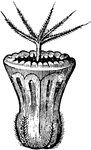
An illustration of the seed of the field scabious. Knautia arvensis, commonly known as Field Scabious, is a species in the genus Knautia. It is a perennial plant that grows between 25 and 100 cm. It prefers grassy places and dry soils, avoiding heavy soils, and flowers between July and September. The flowered head is flatter than similar species Devils bit scabious and Small Scabious. There are 4 stamens in each flower, and 1 notched long stigma. The fruit is nut like, cylindrical and hairy, 5-6mm in size. It has a tap root. The stem has long stiff hairs angled downwards. There are no stipules. The leaves form a basal rosette, are paired on the stem, the lowest typically 300mm long, spear shaped, whereas the upper are smaller.

Seed of Field Scabious

An illustration of the seed of the field scabious. Knautia arvensis, commonly known as Field Scabious,…
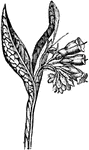
Comfrey (also comphrey) is an important herb in organic gardening, having many medicinal and fertilizer uses. Comfrey (Symphytum officinale L.) is a perennial herb of the family Boraginaceae with a black, turnip-like root and large, hairy broad leaves that bears small bell-shaped white, cream, purple or pink flowers. It is native to Europe, growing in damp, grassy places, and is widespread throughout the British Isles on river banks and ditches.

Comfrey

Comfrey (also comphrey) is an important herb in organic gardening, having many medicinal and fertilizer…
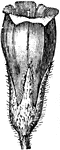
Comfrey (also comphrey) is an important herb in organic gardening, having many medicinal and fertilizer uses. Comfrey (Symphytum officinale L.) is a perennial herb of the family Boraginaceae with a black, turnip-like root and large, hairy broad leaves that bears small bell-shaped white, cream, purple or pink flowers. It is native to Europe, growing in damp, grassy places, and is widespread throughout the British Isles on river banks and ditches.

Comfrey Flower

Comfrey (also comphrey) is an important herb in organic gardening, having many medicinal and fertilizer…
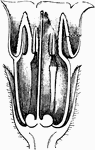
Comfrey (also comphrey) is an important herb in organic gardening, having many medicinal and fertilizer uses. Comfrey (Symphytum officinale L.) is a perennial herb of the family Boraginaceae with a black, turnip-like root and large, hairy broad leaves that bears small bell-shaped white, cream, purple or pink flowers. It is native to Europe, growing in damp, grassy places, and is widespread throughout the British Isles on river banks and ditches.

Comfrey (Longitudinal Section)

Comfrey (also comphrey) is an important herb in organic gardening, having many medicinal and fertilizer…
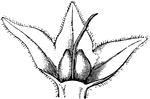
Comfrey (also comphrey) is an important herb in organic gardening, having many medicinal and fertilizer uses. Comfrey (Symphytum officinale L.) is a perennial herb of the family Boraginaceae with a black, turnip-like root and large, hairy broad leaves that bears small bell-shaped white, cream, purple or pink flowers. It is native to Europe, growing in damp, grassy places, and is widespread throughout the British Isles on river banks and ditches.

Sepal and Fruit of Comfrey

Comfrey (also comphrey) is an important herb in organic gardening, having many medicinal and fertilizer…
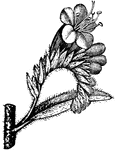
Echium vulgare (Viper's Bugloss) is a species of Echium native to most of Europe, and western and central Asia. It is a biennial or monocarpic perennial plant growing to 30-80 cm tall, with rough, hairy, lanceolate leaves. The flowers start pink and turn vivid blue and are 15-20 mm in a branched spike, with all the stamens protruding. Stamens remain red and stand out against the blue flowers. It flowers between May and September. It is found in dry, bare and waste places.

Viper's Bugloss Inflorescence

Echium vulgare (Viper's Bugloss) is a species of Echium native to most of Europe, and western and central…
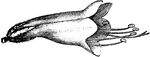
Echium vulgare (Viper's Bugloss) is a species of Echium native to most of Europe, and western and central Asia. It is a biennial or monocarpic perennial plant growing to 30-80 cm tall, with rough, hairy, lanceolate leaves. The flowers start pink and turn vivid blue and are 15-20 mm in a branched spike, with all the stamens protruding. Stamens remain red and stand out against the blue flowers. It flowers between May and September. It is found in dry, bare and waste places.

Viper's Bugloss Flower

Echium vulgare (Viper's Bugloss) is a species of Echium native to most of Europe, and western and central…
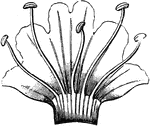
Echium vulgare (Viper's Bugloss) is a species of Echium native to most of Europe, and western and central Asia. It is a biennial or monocarpic perennial plant growing to 30-80 cm tall, with rough, hairy, lanceolate leaves. The flowers start pink and turn vivid blue and are 15-20 mm in a branched spike, with all the stamens protruding. Stamens remain red and stand out against the blue flowers. It flowers between May and September. It is found in dry, bare and waste places.

Viper's Bugloss Corolla and Stamens

Echium vulgare (Viper's Bugloss) is a species of Echium native to most of Europe, and western and central…
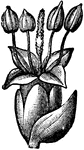
An illustration of a plantain plant flower and bract. In botany, a bract is a modified or specialized leaf. Bracts are ordinarily associated with reproductive structures (subtending flowers, inflorescence axes, or cone scales). They are ordinarily reduced in size relative to foliage leaves, or of a different color or texture from foliage leaves, or both.

Plantain Flower and Bract

An illustration of a plantain plant flower and bract. In botany, a bract is a modified or specialized…
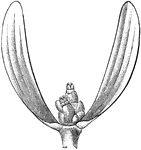
An illustration of pistillate flowers of mistletoe. Mistletoe is the common name for a group of hemi-parasitic plants in the order Santalales that grow attached to and within the branches of a tree or shrub.

Pistillate Flowers of Mistletoe

An illustration of pistillate flowers of mistletoe. Mistletoe is the common name for a group of hemi-parasitic…
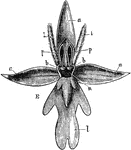
Fly orchid (Ophrys insectifera) is a plant of the family Orchidaceae, a native of the British Isles and Europe favouring sites with alkaline soil. The name arises because it resembles a fly, being totally dependent on flies and bees for pollination. However this is fairly unsuccessful as they seldom visit the flower and it forms seed only infrequently. The plants use scent to attract male flies, which pollinate the flowers as they attempt to mate with the flower. The scent released by the flowers mimic female fly sexual pheromones.

Fly Orchid

Fly orchid (Ophrys insectifera) is a plant of the family Orchidaceae, a native of the British Isles…

"In architecture, a sculptured ornament in imitation of a garland or festoon of fruits, leaves, or flowers, or of other objects, suspended between two points." -Whitney, 1911

Encarpus

"In architecture, a sculptured ornament in imitation of a garland or festoon of fruits, leaves, or flowers,…