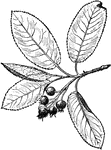
Amelanchier, also known as shadbush, serviceberry, sarvisberry, juneberry, Saskatoon, shadblow, shadwood, sugarplum, and wild-plum, is a genus of about 20 species of shrubs and small deciduous trees in the Rosaceae (Rose family). The genus is native to temperate regions of the Northern Hemisphere, growing primarily in early successional habitats. It is most diverse taxonomically in North America, especially in the northern United States and southern Canada, and is native to every state of the United States except Hawaii. Two species also occur in Asia, and one in Europe. These plants are valued horticulturally, and their fruits are important to wildlife.

Amelanchier

Amelanchier, also known as shadbush, serviceberry, sarvisberry, juneberry, Saskatoon, shadblow, shadwood,…
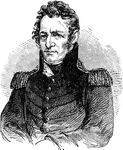
Solomon Van Vechten Van Rensselaer (August 6, 1774 – April 23, 1852) was an United States Representative from the state of New York, a lieutenant colonel during the War of 1812, and a postmaster. He was the son of Jeremiah Van Rensselaer and nephew of Killian Van Rensselaer, who were also Representatives.

Solomon Van Rensselaer

Solomon Van Vechten Van Rensselaer (August 6, 1774 – April 23, 1852) was an United States Representative…
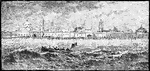
The Battle of Veracruz was a 20-day siege of the key Mexican seaport of Veracruz, during the Mexican-American War. Lasting from March 9 to March 29, 1847, it began with the first large-scale amphibious assault conducted by United States military forces, and ended with the surrender and occupation of the city. U.S. forces then marched inland to Mexico City.

Vera Cruz during the Mexican War

The Battle of Veracruz was a 20-day siege of the key Mexican seaport of Veracruz, during the Mexican-American…
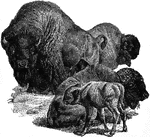
The American Bison (Bison bison) is a bovine mammal, also commonly known as the American buffalo. 'Buffalo' is something of a misnomer for this animal as it is only distantly related to either of the two "true buffaloes", the water buffalo and the African Buffalo. The bison once inhabited the Grasslands of the United States and Asia in massive herds, ranging from the Great Slave Lake in Canada's far north to Mexico in the south, and from eastern Oregon almost to the Atlantic Ocean, taking its subspecies into account. Its two subspecies are the Plains Bison (Bison bison bison), distinguished by its smaller size and more rounded hump, and the Wood Bison (Bison bison athabascae), distinguished by its larger size and taller square hump. Wood Bison are one of the largest species of cattle in the world, surpassed in size only by the massive Asian gaur and Wild Asian Water Buffalo, both of which are found mainly in India and Southeast Asia.

North American Bison

The American Bison (Bison bison) is a bovine mammal, also commonly known as the American buffalo. 'Buffalo'…
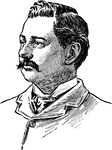
Seth Low (January 18, 1850 - September 17, 1916), born in Brooklyn, New York, was an American educator and political figure who served as mayor of Brooklyn, as President of Columbia University, as diplomatic representative of the United States, and as Mayor of New York City.

Seth Low

Seth Low (January 18, 1850 - September 17, 1916), born in Brooklyn, New York, was an American educator…
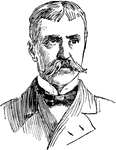
William Ludlow was an officer in the Corps of Engineers and a major general in the United States Army who served in the Civil War and led a scientific expedition examining the natural wonders of Yellowstone National Park.

William Ludlow

William Ludlow was an officer in the Corps of Engineers and a major general in the United States Army…
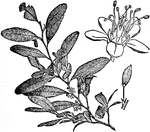
Coca is a plant in the family Erythroxylaceae, native to north-western South America. The plant plays a significant role in traditional Andean culture. Coca leaves contain cocaine alkaloids, a basis for the drug cocaine, which is a powerful stimulant. Coca should not be confused with the similarly named South American cocoa bean from which chocolate is made. The plant resembles a blackthorn bush, and grows to a height of 2–3 m (7–10 ft). The branches are straight, and the leaves, which have a green tint, are thin, opaque, oval, and taper at the extremities. A marked characteristic of the leaf is an areolated portion bounded by two longitudinal curved lines, one line on each side of the midrib, and more conspicuous on the under face of the leaf. The flowers are small, and disposed in little clusters on short stalks; the corolla is composed of five yellowish-white petals, the anthers are heart-shaped, and the pistil consists of three carpels united to form a three-chambered ovary. The flowers mature into red berries.

Coca Flower

Coca is a plant in the family Erythroxylaceae, native to north-western South America. The plant plays…
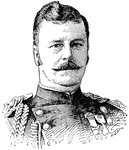
Lieutenant General Arthur MacArthur, Jr. (June 2, 1845–September 5, 1912), was a United States Army General.

Arthur MacArthur

Lieutenant General Arthur MacArthur, Jr. (June 2, 1845–September 5, 1912), was a United States…
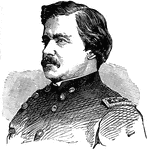
Alexander McDowell McCook (April 22, 1831 – June 12, 1903) was a career United States Army officer and a Union general in the American Civil War.

Alexander McDowell McCook

Alexander McDowell McCook (April 22, 1831 – June 12, 1903) was a career United States Army officer…
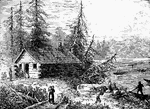
During this early period Virginia's population grew with the introduction of settlers and servants into the burgeoning plantation economy. Land from the Native Americans was appropriated by force and treaty, including the Treaty of 1677, which made the signatory tribes tributary states. In 1619 the House of Burgesses was established as the colony's elected governance, and African servants were first introduced, with slavery being codified in 1661.

Early Settlers

During this early period Virginia's population grew with the introduction of settlers and servants into…
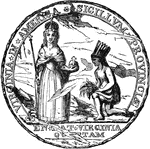
The Colonial Seal of Virginia. An Indian kneels before a prominent royal figure.

Colonial Seal of Virginia

The Colonial Seal of Virginia. An Indian kneels before a prominent royal figure.
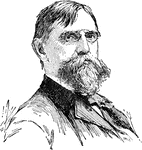
Benjamin Franklin "Bluff" Wade (October 27, 1800 – March 2, 1878) was a U.S. lawyer and United States Senator from Ohio. In the Senate, he was associated with the Radical Republicans of that time. Wade, along with other politicians, witnessed the defeat of the Union Army at the First Battle of Bull Run. There, he was almost captured by the Confederate Army. Wade, along with most other Radical Republicans, was highly critical of President Andrew Johnson (who became President after Lincoln's assassination).

Benjamin Franklin Wade

Benjamin Franklin "Bluff" Wade (October 27, 1800 – March 2, 1878) was a U.S. lawyer and United States…
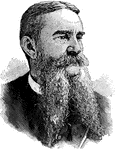
John Grimes Walker (20 March 1835 – 16 September 1907) was an admiral in the United States Navy who served during the Civil War. After the war, he served as Chief of the Bureau of Navigation and head of the Lighthouse Board. In retirement, he led commissions to investigate the construction of a Central American canal connecting the Atlantic and Pacific Oceans.

John Grimes Walker

John Grimes Walker (20 March 1835 – 16 September 1907) was an admiral in the United States Navy…
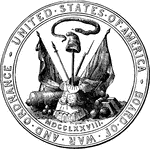
In 1776 the Board of War and Ordnance was created for issuing supplies to troops in the field, and the first Ordnance magazine was established at Carlisle, Pennsylvania the following year. An armory and arsenal at Springfield, Massachusetts (1777-1968) was also established along with later armories such as Harpers Ferry, West Virginia (1799-1861), and Watertown, Massachusetts (1816-1968).

Seal of the Board of War and Ordnance

In 1776 the Board of War and Ordnance was created for issuing supplies to troops in the field, and the…
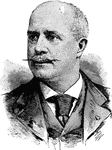
George Edwin Waring was born in Poundridge, NY, July 4, 1833. He was agricultural engineer of Central Park, New York City in 1857. He was the drainage engineer of the park until the Civil War broke out, when he entered the Union army as major of the 39th New York Volunteers, and later served as colonel of the 4th Missouri Cavalry, till its close. After the epidemic of yellow fever in Memphis in 1878, he changed the sewerage system of the city on an original plan, which was adopted in many cities of the United States.

George Edwin Waring

George Edwin Waring was born in Poundridge, NY, July 4, 1833. He was agricultural engineer of Central…
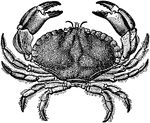
The Dungeness crab is a species of crab that inhabits eelgrass beds and water bottoms from the Aleutian Islands in Alaska to Santa Cruz, California. Its binomial name, Cancer magister, simply means "master crab" in Latin. They measure as much as 25 cm (10 inches) in some areas off the coast of Washington, but typically are under 20 cm (8 inches). They are a popular delicacy, and are the most commercially important crab in the Pacific Northwest, as well as the western states generally.

Dungeness Crab

The Dungeness crab is a species of crab that inhabits eelgrass beds and water bottoms from the Aleutian…
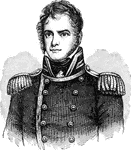
Lewis Warrington (3 November 1782 – 12 October 1851) was an officer in the United States Navy during the Barbary Wars and the War of 1812. He temporarily served as the Secretary of the Navy.Promoted to Master Commandant in July 1813, he took command of the sloop-of-war Peacock later in the year. On 12 March 1814, he put to sea with his new command bound for the naval station at St. Mary's, Georgia. After delivering supplies to that installation, he encountered the British brig Epervier off Cape Canaveral, Florida. Peacock emerged victorious from a brisk 45-minute exchange with that opponent, inflicting 10 times her own losses on the enemy. For his role in the victory, Warrington received the Thanks of Congress in the form of a Congressional Gold Medal.

Lewis Warrington

Lewis Warrington (3 November 1782 – 12 October 1851) was an officer in the United States Navy…
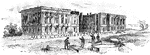
The Burning of Washington took place in 1814, during the Anglo-American War of 1812. British forces occupied Washington, D.C. and set fire to many public buildings. The facilities of the U.S. government, including the White House, were largely destroyed.

Remains of the Capitol After the Fire of 1814

The Burning of Washington took place in 1814, during the Anglo-American War of 1812. British forces…
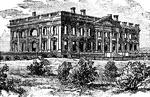
The Burning of Washington took place in 1814, during the Anglo-American War of 1812. British forces occupied Washington, D.C. and set fire to many public buildings. The facilities of the U.S. government, including the White House, were largely destroyed.

Remains of the White House After the Fire of 1814

The Burning of Washington took place in 1814, during the Anglo-American War of 1812. British forces…
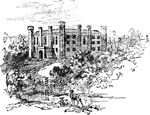
Willian de Wessyngton was a forebear of George Washington, the first President of the United States. Though it was not from Washington, Sunderland, that George Washington's great-grandfather John Washington left for Virginia, but from Essex, Washington Old Hall was the family home of George Washington's ancestors, and the present structure does incorporate small parts of the medieval home in which they lived.

Washington Old Hall

Willian de Wessyngton was a forebear of George Washington, the first President of the United States.…
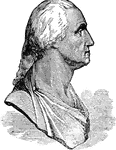
Bust of George Washington by Jean-Antoine Houdon. George Washington (February 22, 1732 — December 14, 1799) served as the first President of the United States of America (1789—1797), and led the Continental Army to victory over the Kingdom of Great Britain in the American Revolutionary War (1775—1783).

Houdon's Bust of Washington

Bust of George Washington by Jean-Antoine Houdon. George Washington (February 22, 1732 — December…
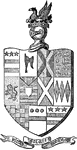
The coat of arms of George Washington, President of the United States of America from 1789 to 1797, were first used to identify the family in the twelfth century, when one of George Washington's ancestors took possession of Washington Old Hall, then in County Durham, in north-east England.

Combined Arms of the Washington Family

The coat of arms of George Washington, President of the United States of America from 1789 to 1797,…
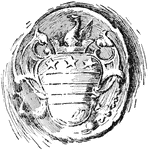
Washington's Seal incorporates the same design which can be found in Washington's Arms. The coat of arms of George Washington, President of the United States of America from 1789 to 1797, were first used to identify the family in the twelfth century, when one of George Washington's ancestors took possession of Washington Old Hall, then in County Durham, in north-east England.

Washington's Seal (From a Letter to Bouquet, 1758)

Washington's Seal incorporates the same design which can be found in Washington's Arms. The coat of…
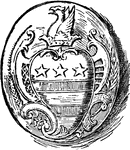
Washington's Private Seal incorporates the same design which can be found in Washington's Arms. The coat of arms of George Washington, President of the United States of America from 1789 to 1797, were first used to identify the family in the twelfth century, when one of George Washington's ancestors took possession of Washington Old Hall, then in County Durham, in north-east England.

Washington's Private Seal, 1783

Washington's Private Seal incorporates the same design which can be found in Washington's Arms. The…
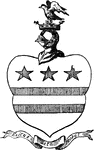
The coat of arms of George Washington, President of the United States of America from 1789 to 1797, were first used to identify the family in the twelfth century, when one of George Washington's ancestors took possession of Washington Old Hall, then in County Durham, in north-east England.

Washington Arms

The coat of arms of George Washington, President of the United States of America from 1789 to 1797,…
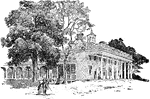
Mount Vernon, located near Alexandria, Virginia, was the plantation home of the first President of the United States, George Washington. The mansion is built of wood in neoclassical Georgian architectural style, and the estate is located on the banks of the Potomac River.

Mount Vernon in Washington's Day

Mount Vernon, located near Alexandria, Virginia, was the plantation home of the first President of the…
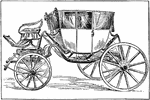
The coach that belonged to the first President of the United States, George Washington. A coach was originally a large, usually closed, four-wheeled carriage with two or more horses harnessed as a team, controlled by a coachman and/or one or more postilions. It had doors in the sides, with generally a front and a back seat inside and, for the driver, a small, usually elevated seat in front called a box, box seat or coach box.

Washington's Coach

The coach that belonged to the first President of the United States, George Washington. A coach was…
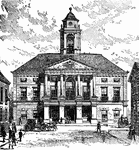
Federal Hall, located at 26 Wall Street in New York City, was the first capitol of the United States of America and the site of George Washington's first inauguration in 1789. It is also the place where the United States Bill of Rights was passed. The original building was demolished in the nineteenth century and replaced by the current structure.

Federal Hall, 1789

Federal Hall, located at 26 Wall Street in New York City, was the first capitol of the United States…
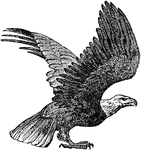
The Bald Eagle (Haliaeetus leucocephalus) is a bird of prey found in North America that is most recognizable as the national bird and symbol of the United States of America. This sea eagle has two known sub-species and forms a species pair with the White-tailed Eagle. Its range includes most of Canada and Alaska, all of the contiguous United States and northern Mexico. It is found near large bodies of open water with an abundant food supply and old-growth trees for nesting.

Bald Eagle

The Bald Eagle (Haliaeetus leucocephalus) is a bird of prey found in North America that is most recognizable…
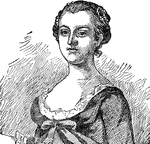
Martha Custis Washington (June 2, 1731 – May 22, 1802) was the wife of George Washington, the first president of the United States. Although the title was not coined until after her death, Martha Washington is considered to be the first First Lady of the United States. During her lifetime, she was simply known as "Lady Washington."

Martha Custis Washington

Martha Custis Washington (June 2, 1731 – May 22, 1802) was the wife of George Washington, the…
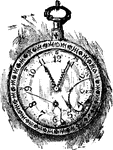
Watch belonging to Martha Custis Washington (June 2, 1731 – May 22, 1802), the wife of George Washington, the first president of the United States. Although the title was not coined until after her death, Martha Washington is considered to be the first First Lady of the United States. During her lifetime, she was simply known as "Lady Washington."

Martha Washington's Bridal Watch

Watch belonging to Martha Custis Washington (June 2, 1731 – May 22, 1802), the wife of George…
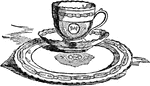
One of many teacups belonging to Mrs. Washington. A teacup is a small cup with a handle, generally a small one that may be grasped with the thumb and one or two fingers.

Martha Washington's Teacup

One of many teacups belonging to Mrs. Washington. A teacup is a small cup with a handle, generally a…
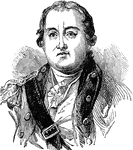
William Washington (February 28, 1752 to March 6, 1810), was a patriotic Southern cavalry officer during the American Revolutionary War, who held a final rank of Brigadier General in the newly created United States after the war.

William Washington

William Washington (February 28, 1752 to March 6, 1810), was a patriotic Southern cavalry officer during…
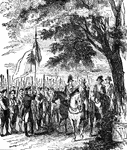
Although he did not explicitly seek the office of commander and even claimed that he was not equal to it, there was no serious competition. Congress created the Continental Army on June 14, 1775; the next day, on the nomination of John Adams of Massachusetts, Washington was appointed Major General and elected by Congress to be Commander-in-chief.

Washington Taking Command of the Army

Although he did not explicitly seek the office of commander and even claimed that he was not equal to…
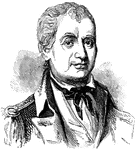
Lachlan McIntosh (March 17, 1725 – February 20, 1806) was an American military and political leader during the American Revolution and the early United States.

Lachlan McIntosh

Lachlan McIntosh (March 17, 1725 – February 20, 1806) was an American military and political leader…
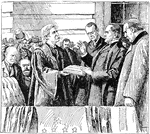
The first inauguration of William McKinley, the 25th President of the United States, on March 4, 1897.
First Inauguration of William McKinley

The first inauguration of William McKinley, the 25th President of the United States, on March 4, 1897.

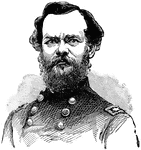
James Birdseye McPherson (November 14, 1828 – July 22, 1864) was a career United States Army officer who served as a General in the Union Army during the American Civil War.

James Birdseye McPherson

James Birdseye McPherson (November 14, 1828 – July 22, 1864) was a career United States Army officer…
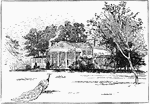
Montpelier was the estate of James Madison, fourth President of the United States.

Montpelier: The Home of James Madison

Montpelier was the estate of James Madison, fourth President of the United States.
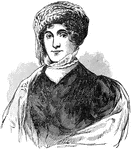
Dorothea Payne Todd "Dolley" Madison (May 20, 1768 – July 12, 1849) was the wife of the 4th President of the United States, James Madison, and was First Lady of the United States from 1809 to 1817.

Dolley Madison

Dorothea Payne Todd "Dolley" Madison (May 20, 1768 – July 12, 1849) was the wife of the 4th President…
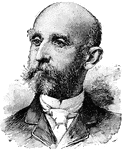
Alfred Thayer Mahan (September 27, 1840–December 1, 1914) was a United States Navy flag officer, geostrategist, and educator.

Alfred Thayer Mahan

Alfred Thayer Mahan (September 27, 1840–December 1, 1914) was a United States Navy flag officer,…
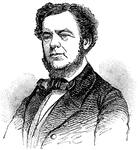
Stephen Russell Mallory (1813 – November 9, 1873) was a United States politician and the Confederate Secretary of the Navy during the American Civil War.

Stephen Russell Mallory

Stephen Russell Mallory (1813 – November 9, 1873) was a United States politician and the Confederate…
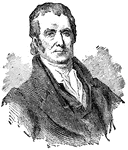
John Marshall (September 24, 1755 – July 6, 1835) was an influential Chief Justice of the United States who shaped American constitutional law and made the Supreme Court a center of power.

John Marshall

John Marshall (September 24, 1755 – July 6, 1835) was an influential Chief Justice of the United States…
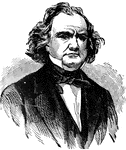
James Murray Mason (November 3, 1798 – April 28, 1871) was a United States Representative and United States Senator from Virginia.

James Murray Mason

James Murray Mason (November 3, 1798 – April 28, 1871) was a United States Representative and United…
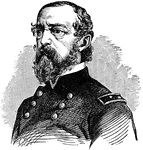
George Gordon Meade (December 31, 1815 – November 6, 1872) was a career United States Army officer and civil engineer involved in coastal construction, including several lighthouses.

George Gordon Meade

George Gordon Meade (December 31, 1815 – November 6, 1872) was a career United States Army officer…
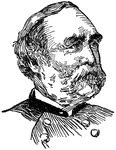
Montgomery Cunningham Meigs (May 3, 1816 – January 2, 1892) was a career United States Army officer, civil engineer, construction engineer, and Quartermaster General of the U.S. Army during and after the American Civil War.

Montgomery Cunningham Meigs

Montgomery Cunningham Meigs (May 3, 1816 – January 2, 1892) was a career United States Army officer,…
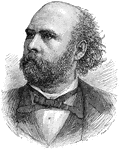
George Wallace Melville (10 January 1841 – 17 March 1912) was an engineer of the United States Navy who eventually rose to the rank of rear admiral.

George Wallace Melville

George Wallace Melville (10 January 1841 – 17 March 1912) was an engineer of the United States…
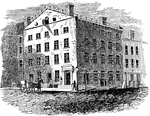
In August of 1775, Americans took possession of cannons from the Battery at the tip of Manhattan and exchanged fire with the HMS Asia (1764). They retaliated by firing a 32-gun broadside on the city, sending a cannon ball through the roof of Fraunces Tavern. When the victorious Americans re-occupied the city, it was Fraunces Tavern that hosted Washington and his officers in a victory banquet. On Dec. 4, 1783, Washington was again at Fraunces Tavern to say farewell to his officers in the Long Room. Saving America from the fate of many republics that turned quickly to military dictatorship, Washington resigned his post and returned to civilian life until chosen first President of the United States.

Fraunces Tavern

In August of 1775, Americans took possession of cannons from the Battery at the tip of Manhattan and…
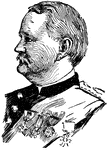
Wesley Merritt (June 16, 1836 – December 3, 1910) was a general in the United States Army during the American Civil War and the Spanish-American War. He is noted for distinguished service in the cavalry.

Wesley Merritt

Wesley Merritt (June 16, 1836 – December 3, 1910) was a general in the United States Army during…
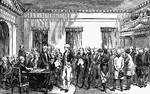
At Fraunces Tavern on December 4, Washington formally bade his officers farewell and on December 23, 1783, he resigned his commission as commander-in-chief, emulating the Roman general Cincinnatus, an exemplar of the republican ideal of citizen leadership who rejected power. During this period, the United States was governed under the Articles of Confederation without a President, the forerunner to the Constitution.

Washington Resigning His Commission

At Fraunces Tavern on December 4, Washington formally bade his officers farewell and on December 23,…
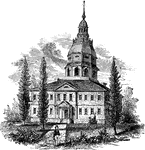
Construction began in 1772 and was not completed until 1779 due to the ongoing Revolutionary War. From November 26, 1783 to June 3, 1784, Annapolis served as the United States capital. The Congress of the Confederation met in the Maryland State House. Subsequently, Annapolis was a candidate to become the new permanent national capital before Washington, D.C. was built.

State House, Annapolis, MD

Construction began in 1772 and was not completed until 1779 due to the ongoing Revolutionary War. From…
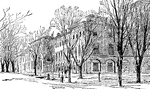
A drawing of the academic buildings of West Point, the United Stated Military Academy.

West Point Academic Buildings

A drawing of the academic buildings of West Point, the United Stated Military Academy.
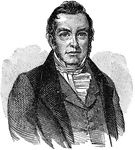
James Miller (25 April 1776 - 7 July 1851) was a member of the United States House of Representatives from New Hampshire, the first Governor of Arkansas Territory, and a Brigadier General in the United States Army during the War of 1812.

James Miller

James Miller (25 April 1776 - 7 July 1851) was a member of the United States House of Representatives…
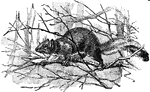
The Eastern Gray Squirrel (Sciurus carolinensis) is a tree squirrel native to eastern United States.
Eastern Gray Squirrel

The Eastern Gray Squirrel (Sciurus carolinensis) is a tree squirrel native to eastern United States.

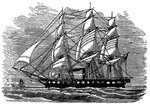
USS <em>Hartford</em>, a sloop-of-war, was the first ship of the United States Navy named for Hartford, the capital of Connecticut.

The Hartford

USS Hartford, a sloop-of-war, was the first ship of the United States Navy named for Hartford,…
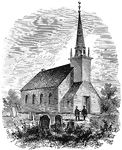
Her Majesty's Royal Chapel of the Mohawks, the oldest church in Ontario, is one of six Royal chapels outside of the United Kingdom, and one of two in Canada.

Mohawk Church

Her Majesty's Royal Chapel of the Mohawks, the oldest church in Ontario, is one of six Royal chapels…
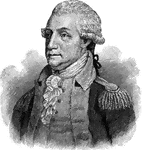
The Electoral College elected Washington unanimously in 1789, and again in the 1792 election; he remains the only president to receive 100% of electoral votes. John Adams was elected vice president. Washington took the oath of office as the first President under the Constitution for the United States of America on April 30, 1789 at Federal Hall in New York City although, at first, he had not wanted the position.

George Washington (1789)

The Electoral College elected Washington unanimously in 1789, and again in the 1792 election; he remains…
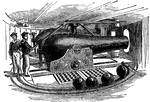
USS <em>Monitor</em> was the first ironclad warship commissioned by the United States Navy. <em>Monitor</em> consisted of a heavy round revolving iron gun turret on the deck, housing two 11 inch Dahlgren guns, paired side by side.

Interior of the Monitor's Turret

USS Monitor was the first ironclad warship commissioned by the United States Navy. Monitor

The residence of President James Monroe in Oak Hill, Virginia.

Monroe's Residence at Oak Hill, VA

The residence of President James Monroe in Oak Hill, Virginia.

In 1789, George Washington lived on Cherry Street, in a four-story mansion that belonged to Walter Franklin, a wealthy merchant. This house served as the first Executive Mansion of the President of the United States.

George Washington's House on Cherry Street, New York (1789)

In 1789, George Washington lived on Cherry Street, in a four-story mansion that belonged to Walter Franklin,…
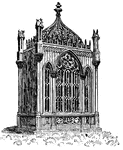
The tomb of the fifth President of the United States, James Monroe. His grave is at Hollywood Cemetery in Richmond, Virginia.

Tomb of Monroe

The tomb of the fifth President of the United States, James Monroe. His grave is at Hollywood Cemetery…