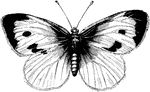
A female large white cabbage butterfly has two large black spots on each upper wing. The body is black and the anttenae are black and yellow.

Large White Cabbage Butterfly

A female large white cabbage butterfly has two large black spots on each upper wing. The body is black…
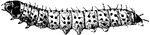
Larva are unlike the mature insect. Larva of the moth or butterfly resemble worms. It may have a distinct head and the rings of the body may differ in the three immediately behind the head.

Larva of a Leopard Moth

Larva are unlike the mature insect. Larva of the moth or butterfly resemble worms. It may have a distinct…
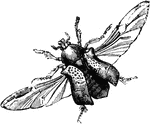
The body of the rose chafer is encased with a hard crust. The front wings are modified to form hard coverings extending over the hinder part of the body. The front wings protect the hind wings.

Rose Chafer with Hind Wings Extended

The body of the rose chafer is encased with a hard crust. The front wings are modified to form hard…
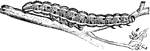
Caterpillar, larvae of the butterfly, are harmful to plants. These caterpillars sucker feet on the hinder rings of the body.

Large Cabbage Butterfly Caterpillar

Caterpillar, larvae of the butterfly, are harmful to plants. These caterpillars sucker feet on the hinder…
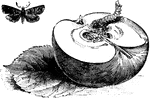
Caterpillar, larvae of the moth and butterfly, are harmful to plants. These caterpillars sucker feet on the hinder rings of the body.

Codlin Moth and Grub

Caterpillar, larvae of the moth and butterfly, are harmful to plants. These caterpillars sucker feet…
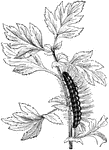
Gold-tail moth is the common name of liparis auriflua. The caterpillar has three rows of tubercles along the body. It feeds chiefly on hawthorn.

Caterpillar of the Gold-Tail Moth

Gold-tail moth is the common name of liparis auriflua. The caterpillar has three rows of tubercles along…

Millipedes are usually cylindrical. The origins of the legs are usually brought very close to the middle line of the body below. These insects feed on decaying vegetable tissue.

Millipede

Millipedes are usually cylindrical. The origins of the legs are usually brought very close to the middle…
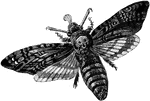
Death's head moth feeds on potato, goji berry, and jasmine plants. These moths often have a straight or curved horn, or tail, at the end of the body.

Death's Head Moth

Death's head moth feeds on potato, goji berry, and jasmine plants. These moths often have a straight…
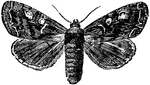
The hind wings of the potherb moth are frequently unspotted. The body is thick and heavy. The color is usually dull.

Potherb Moth

The hind wings of the potherb moth are frequently unspotted. The body is thick and heavy. The color…
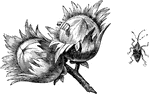
Nut weevil is the common name of balaninus nucum. The weevil is one third of an inch long with an egg shaped body. The body is brown or black and covered with gray, yellowish gray, or white gray hairs.

Nut Weevil and Grub

Nut weevil is the common name of balaninus nucum. The weevil is one third of an inch long with an egg…
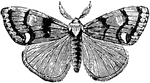
Vapourer moth is the common name of orgyia antiqua. Pictured is the male moth. The body is dark brown and the wings are rusty brown.

Vapourer Moth

Vapourer moth is the common name of orgyia antiqua. Pictured is the male moth. The body is dark brown…
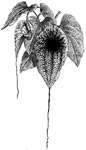
The common names of <I>Aristolochia grandiflora</I> are pelican flower, goose flower, swan flower, and duck flower. The flower bud is said to resemble the body and neck of a bird.

Aristolochia Grandiflora

The common names of Aristolochia grandiflora are pelican flower, goose flower, swan flower, and duck…
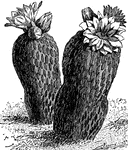
Illustrated is the extreme condensation of the plant body of pelecyphora aselliformis. The spines resemble miniature sow bugs or aselli.

Pelecyphora Aselliformis

Illustrated is the extreme condensation of the plant body of pelecyphora aselliformis. The spines resemble…
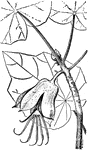
Hand flower is the common name of chiranthodendron platanoides. The bright red stamens resemble the fingers of a human hand. The other common names are mano de mico, monkey's hand, and devil's hand.

Hand Flower

Hand flower is the common name of chiranthodendron platanoides. The bright red stamens resemble the…
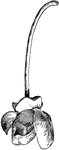
The flowers of cymbopetalum penduliflorum grow alone at the end of each stem. The petals and thick and fleshy and resemble the human ear. The flowers are pungently aromatic.

Cymbopetalum Penduliflorum

The flowers of cymbopetalum penduliflorum grow alone at the end of each stem. The petals and thick and…
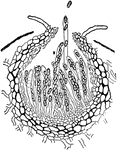
Illustrated is the fruiting body of the apple scab fungi showing the spores.

Apple Scab

Illustrated is the fruiting body of the apple scab fungi showing the spores.

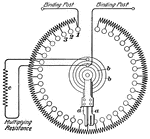
The inner workings of a rheostat (resistance box). Rheostat contacts (1, 2, 3) are arranged along the outer frame of the body. The contact arm has two contact strips (a, a'), instead of using a regular contact arm. The strips are insulated and press onto contact rings (b, b'). c is a small multiplying resistance, which is equivalent to one of the resistance sections of the rheostat

Rheostat

The inner workings of a rheostat (resistance box). Rheostat contacts (1, 2, 3) are arranged along the…
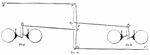
Truck riggings for a double truck that holds a single trolley car. A truck is the mechanism that consists of the trolley wheels and motors. This type of rigging was used in the early twentieth century. This mechanism allows the trolley to pull an extraordinary amount of weight: between 2,000 and 5,000 pounds. (P) is a lever that is secured to the car body by fulcrum (f) which is stationary. (C, C) are two pieces of metal bent to suit the movements of the trolley car.

Truck Riggings

Truck riggings for a double truck that holds a single trolley car. A truck is the mechanism that consists…
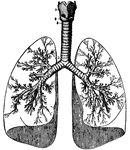
Human lungs. 1 and 2 make up the larynx, or voice box. 1 is thyroid cartilage, 2 is cricoid cartilage. A thin layer is held stretched from the top of the thyroid cartilage and extends to the hyoid bone, which is the only bone in the body that is not connected to another bone.

Human Lungs

Human lungs. 1 and 2 make up the larynx, or voice box. 1 is thyroid cartilage, 2 is cricoid cartilage.…
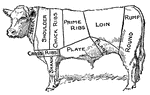
A diagram which shows how cows are cut. Various sections of the cow body are labelled with respect to the final product.

Meat of Cow

A diagram which shows how cows are cut. Various sections of the cow body are labelled with respect to…
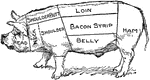
A diagram showing how a pig is cut for meats. The body of the pig is labelled with respect to the finished meat product.

Pig Diagram

A diagram showing how a pig is cut for meats. The body of the pig is labelled with respect to the finished…
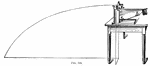
An illustration of what it would look like if ball e that is placed in a cup attached to lever o were to be pushed out by using a swinging arm activated by spring d. Spring d is arranged in a manner that when it is drawn back and released, it will strive lever o and ball b at the same time. In the experiment, ball b follows the curved line and ball e is dropped vertically. Both will meet the floor at the same time. This experiment is meant to show how Newton's second law works. The acceleration of a body is parallel and directly proportional to the net force and inversely proportional to the mass. F = ma

Second Law

An illustration of what it would look like if ball e that is placed in a cup attached to lever o were…
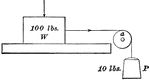
Friction is the tendency of a body to resist movement when it is being moved on a surface. The coefficient of friction is the ratio between the resistance of the motion and the perpendicular pressure between the surfaces as shown. P/W

Elementary Mechanics

Friction is the tendency of a body to resist movement when it is being moved on a surface. The coefficient…
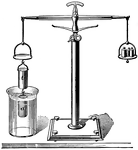
An illustration of Archimedes Principle. "If a body is immersed in a fluid, it will lose in weight an amount equal to the weight of the fluid it displaces.

Archimedes Principle

An illustration of Archimedes Principle. "If a body is immersed in a fluid, it will lose in weight an…
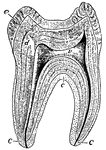
A sectional view of a human molar. The roots, or fangs, are shown covered by a layer of bone called "cement", which is represented by letter c. The center of the tooth is the vascular pulp-cavity v, d is ivory or dentine, and e is the hardest tissue of the body - enamel.

Human Tooth

A sectional view of a human molar. The roots, or fangs, are shown covered by a layer of bone called…
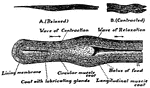
An Image of an esophagus showing how a mass of food, or bolus, passes through the esophagus into the stomach. The tissue in front is relaxed, while the tissue behind the bolus is in contraction. When food is not going through it, the esophagus looks like the wave of contraction in the picture.

Human Esophagus

An Image of an esophagus showing how a mass of food, or bolus, passes through the esophagus into the…
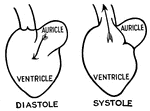
The cycle of the heart in its diastole (relaxation) state and its systole (contraction) state. The ventricles can be in a diastolic state, while the atria can be in a systolic state. An auricle is a small conical projection coming out of the atrium, but in some texts it represents the actual atrium. As the heart relaxes, blood enters from the other side and into the atria, then leaves and enters the ventricles. When the heart contracts, blood leaves the ventricles and goes back into the body.

Heart Cycle

The cycle of the heart in its diastole (relaxation) state and its systole (contraction) state. The ventricles…
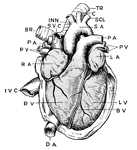
A complex anatomical view of the heart. RA is the right atrium, or auricle, which receives the deoxygenated blood by way of two superior vena cava (SVC) and one inferior vena cava (IVC). The blood passes through the right ventricle (RV) and is pumped up to the lungs via the pulmonary arteries (PA). At the lungs, the blood is reoxygenated and returns via the pulmonary vein (PV) and left atrium/auricle (LA). From there, the blood is passed to the left ventricle (LV) where the blood is pumped up through the systematic arch (SA) to the body. The systematic arch gives off a right innominate artery (INN), where the blood is then passed to the right and left carotid (C) and subclavian (SCL), where the blood goes to the head and arms respectively. It continues dorsally to the dorsal aorta (DA), which is the main artery that distributes blood to the whole body. TR is the windpipe, or trachea, BR is the bronchial tube that carries air to the lungs, and BV is a blood vessel on the wall of the heart.

Anatomy of Heart

A complex anatomical view of the heart. RA is the right atrium, or auricle, which receives the deoxygenated…
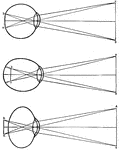
Diagrams of how an image is displayed with a normal eye (top image), myopic or nearsighted eye (middle image), and a hypermetropic or far-sighted eye. In a human, the retina "sees" an image upside down and the brain rights the image.

Human Eye

Diagrams of how an image is displayed with a normal eye (top image), myopic or nearsighted eye (middle…
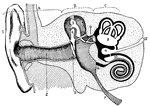
A diagram of the human ear. It is divided into the outer ear - A, middle ear - B, and inner ear - C. 1: ear trumpet or pinna, 2: outer ear passage with the drum that vibrates when sound waves hit it or the tympanum (3) across the inner ear, 4-5-6: the ear ossicles: hammer (malleus) anvil (incus) and stirrup (stapes) which transmit vibrations from the drum to the inner ear (they are also the smallest bones in the body), 7: the Eustachian tube, which connects to the mouth and through which air can indirectly enter, 8: largest chamber in the inner ear, called the utriculus, that has three semicircular canals, 9: the smallest chamber, called the sacculus, which is connected to the cochlea (10) which is the important hearing organ, 11: a "window" in the periotic bone, called the fenestra rotunda, 12: the endolymphatic duct.

Human Ear

A diagram of the human ear. It is divided into the outer ear - A, middle ear - B, and inner ear - C.…
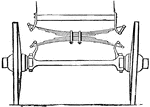
A double semi-elliptical spring attachment that is used on electric vehicles. The body gains benefits of spring action because it is suspended by links on the extremities of the springs

Spring Attachments

A double semi-elliptical spring attachment that is used on electric vehicles. The body gains benefits…
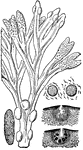
Fucus is the generic name of various species of brown seaweed which form the main vegetation of rocky shores between tide marks. Most common of all is F. vesiculosus (Rockweed, Bladderweed, sea wave, etc.), easily distinguished by its entire edges and paired air vesicles. On account of the large proportion of ash it forms a valuable manure. Besides manure, the only direct chemical utilization of of the Fuci is for the preparation of Iodine. The vegetative body of Fucus is usually a thallus; the branching is dichotomous in one plane. Of the inner, or medullary, cells of the thallus, the outer wall becomes mucilaginous, while the less superficial of the rind cells develop filaments which grow inward, thus surrounding the inner cells within a network of filaments. The ladders are formed by the simple separation of portions of the tissue, the cavities becoming distended by air. Fertilization takes place when the ripe, fertile fronds are left bare by the tide. The fertilized ovum soon develops a wall, becomes attached, and proceeds to divide and lengthen, forming a root-like attachment at one end, a growing point at the other. This illustration shows a Fucus, 1) a cross-section of a fertile frond, 2) a female conceptacle, 3) a male conceptacle, and 4) Zoospores and Antheridia.

Fucus

Fucus is the generic name of various species of brown seaweed which form the main vegetation of rocky…
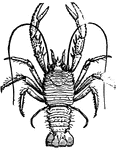
The Squat Lobster (the name often used for Galathea) is a genus of decapod crustacea. The body is lobster-like, but is broad and somewhat flattened, the tail being habitually carried in a bent position. Several species inhabit the northeastern Atlantic shores.

Squat Lobster

The Squat Lobster (the name often used for Galathea) is a genus of decapod crustacea. The body is lobster-like,…
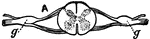
Nerve Ganglia, or Knots (sing. Ganglion; Knot) occur as collections of nerve cells on the course of a nerve, forming and obvious swelling. In surgery, it is the swelling caused by the collection of fluid in the fibrous sheath which surrounds a tendon. It arises from inflammation of the tendon-sheath, and occurs most often at the back of the wrist. Sometimes the cyst may be broken by firm pressure or by a smart blow, and the fluid be thus dispersed; or a puncture may be made, with proper antiseptic precautions, and the fluid be pressed out. Sometimes counter-irritation with iodine causes absorption. In any case, firm pressure with pad and bandage must be used afterwards, to prevent refilling until the cyst walls have united. This illustration shows a cross-section of a spinal cord and spinal nerve cells (g being ganglia).

Nerve Ganglia (Spinal)

Nerve Ganglia, or Knots (sing. Ganglion; Knot) occur as collections of nerve cells on the course of…
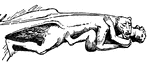
This illustration shows a Clermont Gargoyle in France. Gargoyles, in Gothic architecture, are spouts projecting from the gutters of a building which carry the rain-water clear of the walls. Gargoyles are usually carved into different forms  (animal, human, demonic, grotesque) and serve as a distinguishing feature of ecclesiastical architecture.

Clermont Gargoyle

This illustration shows a Clermont Gargoyle in France. Gargoyles, in Gothic architecture, are spouts…
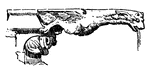
This illustration shows a Paris Gargoyle in France. Gargoyles, in Gothic architecture, are spouts projecting from the gutters of a building which carry the rain-water clear of the walls. Gargoyles are usually carved into different forms  (animal, human, demonic, grotesque) and serve as a distinguishing feature of ecclesiastical architecture.

Paris Gargoyle

This illustration shows a Paris Gargoyle in France. Gargoyles, in Gothic architecture, are spouts projecting…
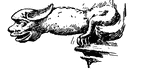
This illustration shows a Lincoln Gargoyle. Gargoyles (featured primarily in in Gothic architecture) are spouts projecting from the gutters of a building which carry the rain-water clear of the walls. Gargoyles are usually carved into different forms  (animal, human, demonic, grotesque) and serve as a distinguishing feature of ecclesiastical architecture.

Lincoln Gargoyle

This illustration shows a Lincoln Gargoyle. Gargoyles (featured primarily in in Gothic architecture)…
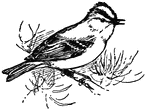
Also known as the Kinglet, the Golden-Crested Wren (Regulus cristatus) is the smallest of European birds. In America, only the hummingbird is less in size. It is one of the warblers (Sylviidæ). The length of the body is from three to six inches, there is a bright yellow crest, the back is yellowish olive green, the wings and tail ash brown with black and white markings. The Golden-Crested Wren is generally distributed over Europe. In spring it utters a sweet and surprisingly loud song.

Golden-Crested Wren

Also known as the Kinglet, the Golden-Crested Wren (Regulus cristatus) is the smallest of European birds.…
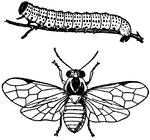
Gooseberry Caterpillar is the name applied to the larvæ of two different insects, both injurious to gooseberry and currant bushes. (1) the Magpie Moth (Abraxas grossulariata), appearing about midsummer, has usually a black head, yellow body, and white wings spotted  with black. (2) More destructive than the above is the larva of the Gooseberry Sawfly (Nematus ribesii), which plays havoc with the leaves of bushes. The larva is bluish green, with lack head, feet, tail, and spots, with twenty feet, and a length of about 3/4 of an inch when full grown.

Gooseberry Caterpillar (Nematus ribesii) and Sawfly

Gooseberry Caterpillar is the name applied to the larvæ of two different insects, both injurious to…
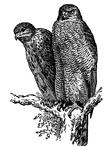
The Goshawk (Astur palumbarius) is a hawk abundant in the forest regions of northern Europe and Canada, but rarely seen southward, except occasionally in winter. The upper part of the body is ash-brown, with four broad dark bands on the tail; the under part white, barred with black. The bird is bold and rapacious, and remarkable for the skillful turns by means of which it follows every movement of the quarry. It was one of the favorite hawks in falconry.

Goshawk

The Goshawk (Astur palumbarius) is a hawk abundant in the forest regions of northern Europe and Canada,…
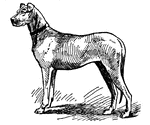
The Great Dane is a dog which has at different times been called the 'boar-hound', the 'German Mastiff', and the 'Ulmer dog'. It first began to attract attention about 1870. The grand figure, the bold outlook, and the commanding appearance of the type commended it to certain enthusiasts; and when it was found to be faithful, and intelligent, and of unfailing courage, it soon came into favor. The latest development of the breed is a harlequin-colored or black and white dog, sometimes with a wall eye and mottled nose. The Great Dane stands 34 in. high, and weighs as much as 180 lbs.; though the bitch is considerably smaller and lighter.

Great Dane

The Great Dane is a dog which has at different times been called the 'boar-hound', the 'German Mastiff',…
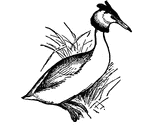
The Great Crested Grebe (Lophæthyia cristata) is a fresh-water, migratory, diving bird of the family Podicipidæ. It has a duck-like body, brownish and white plumage, long neck, short wings, no tail, and large, flattened toes furnished with lobate membranes serving the purpose of webs. Most of its life is spent in fresh water  lakes and ponds, but in winter and during migration, it often resorts to the sea. It is an excellent diver. The nest is made of rushes and other aquatic plants and usually floats on the water, being loosely anchored to weeds and grass. It is found in nearly all parts of Europe and Asia.

Great Crested Grebe

The Great Crested Grebe (Lophæthyia cristata) is a fresh-water, migratory, diving bird of the family…
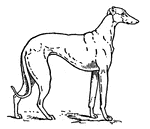
The Greyhound as a show dog is judged as follows: height and weight, ranging from 23 to 27 in. and from 40 to 70 lbs.; skull rather wide between the ears and flat on the top, with powerful, though not clumsy, jaws, and very strong teeth; eyes dark in color, and full of fire; ears rather small, and fine in texture; neck long and powerful (to enable it to reach the hare) yet graceful looking; chest of fair width, and very deep; body rather long, extremely powerful, especially at the loins, and slightly arched -- the back ribs being short, make the body appear tucked up; shoulders sloping; fore legs set in well under the dog, straight and powerful, with round, compact feet, the knuckles of the toes being well developed; hind quarters very powerful, with muscular thighs and well-bent stifles; tail long, and carried low; colors black, red, fawn, brindled, blue, white, either whole-colored or marked.

Greyhound

The Greyhound as a show dog is judged as follows: height and weight, ranging from 23 to 27 in. and from…
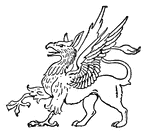
In heraldry, the griffin is a fabulous animal, with the head and forefeet of an eagle, and the body, hind legs, and tail of a lion. The head is represented with pricked ears, symbolical of its vigilance. In mythology, the griffin was a creature similar in form to the griffin of heraldry, which was supposed to find its especial function in watching over hidden treasure, especially in Scythia. It was dedicated to the sun-god Apollo, whose chariot appears in early art as drawn by griffins. It was a favorite ornamental 'theme' in ancient Babylonian and Persian art, and is also found in a similar way on art objects of the Phoenicians, the Mycenæan civilization, and the ancient Greeks. The Romans and art-workers of the renaissance used it as a purely decorative device.

Griffin

In heraldry, the griffin is a fabulous animal, with the head and forefeet of an eagle, and the body,…
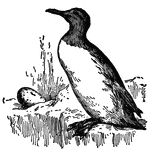
The Common Guillemot (<i>Uria troile</i>) is a member of the auk family. It breeds on all rocky coasts of the North Atlantic. The bill is long, straight, and strong, the wings and tail short. In spring, the upper surface of the body is brownish black, the under white, save for the dark throat; in winter, the throat becomes white or mottled. All guillemots lay a single pear-shaped on the ledge of a sea-cliff. They make no nest whatever, and large colonies brood in company.

Common Guillemot

The Common Guillemot (Uria troile) is a member of the auk family. It breeds on all rocky coasts of the…
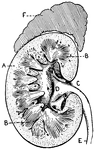
This illustration shows a section of a human kidney (A, Cortical substance; B, Pyramids; C, Hilum; D, Pelvis; E, Ureter; F, Suprarenal capsule).
Kidneys are excretory organs whose function is to get rid of nitrogenous waste.

Section of Human Kidney

This illustration shows a section of a human kidney (A, Cortical substance; B, Pyramids; C, Hilum; D,…
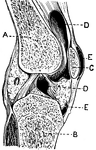
This illustration shows a section on the knee (A, Femur; B, Tibia; C, Patella; D, Synovial sac; E, bursæ). The knee is a hinge-joint, and the bones entering into its formation are the lower end of the femur, the upper end of the tibia, and the posterior surface of the patella (knee-cap).

Section of the Knee

This illustration shows a section on the knee (A, Femur; B, Tibia; C, Patella; D, Synovial sac; E, bursæ).…
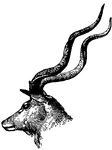
This illustration shows the head of a kudu. A kudu is a large African antelope related to the eland, but differing in that the horns are absent in the female, while those of the male are curved in a spiral. The tail is short, the neck is maned, and the body is marked by narrow, vertical white stripes. The common kudu (Strepsiceros kudu) occurs in wooded regions from the Cape to the highlands of Abyssinia. The lesser kudu (S. imberbis) is confined to Somaliland and its vicinity. Both are favorites with sportsmen.

Head of Kudu

This illustration shows the head of a kudu. A kudu is a large African antelope related to the eland,…
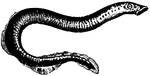
A lamprey is an animal which, though often regarded as a fish, differs from a fish in the absence of paired fins and scales, in the rounded suctorial mouth without supporting jaws, in the presence of gill-pockets in place of the gills of fish, as well as in numerous internal peculiarities. In consequence, the lamprey and the related hag are placed in a distinct class known as cyclostomes, or round mouths. the body is elongated and eel-like, its most conspicuous feature being the seven slits on either side of the neck which communicate with the gill-pockets. The mouth resembles that of the hag in the presence of a muscular rasp known as the tongue. The food consists of all sorts of small animals, as well as of the dead bodies of larger ones, and even of the flesh and blood of living creatures, to which the lampreys attach themselves after the fashion of the hag. They also attach themselves by their mouths to stones, whence the generic name, 'stone-sucker'. Internally there is much general resemblance to the hag; but the lamprey has well-developed eyes, and has a delicate series of cartilages known as as the branchial basket-work, which supports the pharynx. The adults die soon after spawning near the heads of rivers or creeks; the young, which in many respects differ from their parents, were formerly placed in a separate genus as Ammocoetes. The great sea lamprey (Petromyzon marinus), sometimes 3 feet long, is found on both coasts of the N. Atlantic. Several smaller species inhabit the lakes and rivers of the United States.

Sea Lamprey

A lamprey is an animal which, though often regarded as a fish, differs from a fish in the absence of…
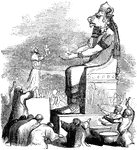
Moloch (or Mo'lech) is the name of an ancient deity which was worshipped by the Ammonites. The Israelites also worshiped this idol for a time. Human sacrifices were the primary offering made to Moloch.

Moloch Being Worshipped

Moloch (or Mo'lech) is the name of an ancient deity which was worshipped by the Ammonites. The Israelites…
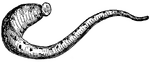
The medicinal leech is a leech used in bloodletting. It lives in fresh water, and is common in Germany, Bohemia, and Russia. Its diet consists of the blood of vertebrates, to which the leech attaches itself by its suckers. Of these, one is posterior and imperforate, the other anterior, with the mouth in the center. Within the mouth lie three triangular tooth-plates, by means of which a small triradiate incision is made in the skin of the animal attacked. This done, the leech proceeds to fill its crop, which extends almost from end to end of the body, and has eleven lateral pockets. When these have become distended with blood, the leech drops from its temporary host, and the slow process of digestion begins. Leeches usually move by attaching alternately the anterior and posterior suckers, somewhat after the fashion of a 'looping caterpillar', but they can also swim by movements of the whole body. The eggs are laid in cocoons in damp earth.

Medicinal Leech

The medicinal leech is a leech used in bloodletting. It lives in fresh water, and is common in Germany,…
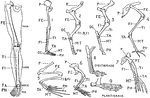
This illustration shows a human leg (front view), and comparative diagrams showing modifications of the leg:
1. Human, 2. Ox, 3. Horse, 4. Bird, 5. Frog, 6. Crocodile, 7. Seal, 8. Dog, 9. Bear
P. Pelvis, FE. Femur, TI. Tibia, FI. Fibula, TA. Tarsus, MT. Metatarsus, PH. Phalanges, OC. Os Calcis.

Human Leg (Front View), and Comparative Diagrams showing Modifications of the Leg

This illustration shows a human leg (front view), and comparative diagrams showing modifications of…
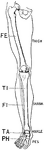
This illustration shows a front view of a human leg.
P. Pelvis, FE. Femur, TI. Tibia, FI. Fibula, TA. Tarsus, MT. Metatarsus, PH. Phalanges, OC. Os Calcis.

Human Leg (Front View)

This illustration shows a front view of a human leg. P. Pelvis, FE. Femur, TI. Tibia, FI. Fibula, TA.…
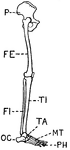
This illustration shows a side view of a human leg.
P. Pelvis, FE. Femur, TI. Tibia, FI. Fibula, TA. Tarsus, MT. Metatarsus, PH. Phalanges, OC. Os Calcis.

Human Leg (Side View)

This illustration shows a side view of a human leg. P. Pelvis, FE. Femur, TI. Tibia, FI. Fibula, TA.…
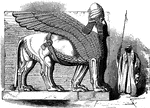
From the ninth to seventh century BCE in northern Iraq.

Human headed winged lion

From the ninth to seventh century BCE in northern Iraq.

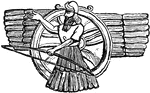
The ancient idol Nisroch, the god of agriculture, in human form with a bow and arrow.

Ancient idol

The ancient idol Nisroch, the god of agriculture, in human form with a bow and arrow.

Ashtaroth, or Astarte, was among the idols of Syria; this medal shows she was worshiped in Jerusalem.  In her left hand she holds a staff, her right a human head and walks on a prostrate figure.

Astarte

Ashtaroth, or Astarte, was among the idols of Syria; this medal shows she was worshiped in Jerusalem.…
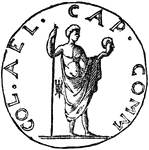
A coin of Hostilianus, with a figure standing with a blunt spear in his right hand and a human head in his left. The caduceus behind him, as well as his character, denotes him as Mercury.

Coin of Hostilianus

A coin of Hostilianus, with a figure standing with a blunt spear in his right hand and a human head…
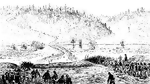
American soldiers retreating across the Rappahannock river in Northwest Virginia. It shows an example of a ford, which is a place in a river or other body of water where it is shallow enough for people to cross.

Rappahannock River

American soldiers retreating across the Rappahannock river in Northwest Virginia. It shows an example…
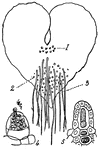
The flat, heart shaped body which results from the development of a spore of a fern.

Prothallus (under side)

The flat, heart shaped body which results from the development of a spore of a fern.