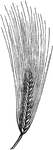
Barley is a cereal grain derived from the annual grass Hordeum vulgare, a common barley. It serves as a major animal feed crop, with smaller amounts used for malting and in health food, as well as the making of the alcoholic beverages beer. This is a winter species and is shorter. The seed is more slender than wheat with a firmer and rougher covering of husk or chaff.

Barley

Barley is a cereal grain derived from the annual grass Hordeum vulgare, a common barley. It serves as…

The Two-rowed Barley's spike, or ear, is long and somewhat compressed, and the grain is of a very good quality. It is sown in the spring. Barley succeeds best in soils of medium consistency, but accommodates itself to almost every variety of soil, except very moist ones. It endures a drought better than excessive moistures, but it requires as deep and good tillage as wheat.

Two-rowed Barley

The Two-rowed Barley's spike, or ear, is long and somewhat compressed, and the grain is of a very good…

Rye (Secale cereale) is a grass grown extensively as a grain and forage crop. Rye is characterized by long-bearded spikes, or ears, and a tall and slender stem. There are two prominent varieties known as winter and spring rye. The grain or kernel of rye is smaller in size than that of wheat.

Rye

Rye (Secale cereale) is a grass grown extensively as a grain and forage crop. Rye is characterized by…

The common oat (Avena sativa) is a species of cereal grain grown for its seed. While oats are suitable for human consumption as oatmeal and rolled oats, one of the most common uses is as livestock feed. Oats make up a large part of the diet of horses and are regularly fed to cattle as well. Oats are also used in some brands of dog and chicken feed.

Oat

The common oat (Avena sativa) is a species of cereal grain grown for its seed. While oats are suitable…
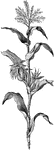
Maize known as corn by most English-speakers, is a cereal grain domesticated in Mesoamerica and subsequently spread throughout the American continents.        Indian Corn, or maize, grows with a strong, jointed stalk, rising to the height of five to fifteen feet. The male or sterile flowers are arranged in a loose, spreading panicle at the apex, called the tassel and the female fertile flowers on the side. Each plant bears from one to five ears which are are cylindrical and enclosed in a covering of leaves called husks. The ears consists of grain, arranged around a pithy cylinder, called the cob. The seeds are rounded on the surface and compressed on the sides. Indian Corn is annual and is one of the most important of all the cultvated plants.

Indian Corn

Maize known as corn by most English-speakers, is a cereal grain domesticated in Mesoamerica and subsequently…
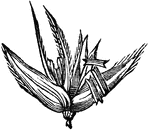
Maize known as corn by most English-speakers, is a cereal grain domesticated in Mesoamerica and subsequently spread throughout the American continents.        Indian Corn, or maize, grows with a strong, jointed stalk, rising to the height of five to fifteen feet. The male or sterile flowers , shown here, are arranged in a loose, spreading panicle at the apex, called the tassel and the female fertile flowers on the side. Each plant bears from one to five ears which are are cylindrical and enclosed in a covering of leaves called husks. The ears consists of grain, arranged around a pithy cylinder, called the cob. The seeds are rounded on the surface and compressed on the sides. Indian Corn is annual and is one of the most important of all the cultvated plants.

Indian Corn

Maize known as corn by most English-speakers, is a cereal grain domesticated in Mesoamerica and subsequently…

Maize known as corn by most English-speakers, is a cereal grain domesticated in Mesoamerica and subsequently spread throughout the American continents.        Indian Corn, or maize, grows with a strong, jointed stalk, rising to the height of five to fifteen feet. The male or sterile flowers , shown here, are arranged in a loose, spreading panicle at the apex, called the tassel and the female fertile flowers, shown here, on the side. Each plant bears from one to five ears which are are cylindrical and enclosed in a covering of leaves called husks. The ears consists of grain, arranged around a pithy cylinder, called the cob. The seeds are rounded on the surface and compressed on the sides. Indian Corn is annual and is one of the most important of all the cultvated plants.

Indian Corn

Maize known as corn by most English-speakers, is a cereal grain domesticated in Mesoamerica and subsequently…
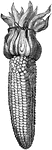
Maize known as corn by most English-speakers, is a cereal grain domesticated in Mesoamerica and subsequently spread throughout the American continents.        Indian Corn, or maize, grows with a strong, jointed stalk, rising to the height of five to fifteen feet. The male or sterile flowers are arranged in a loose, spreading panicle at the apex, called the tassel and the female fertile flowers on the side. Each plant bears from one to five ears, are cylindrical and enclosed in a covering of leaves called husks. A ear of corn is shown here. The ears consists of grain, arranged around a pithy cylinder, called the cob. The seeds are rounded on the surface and compressed on the sides. Indian Corn is annual and is one of the most important of all the cultvated plants.

Indian Corn

Maize known as corn by most English-speakers, is a cereal grain domesticated in Mesoamerica and subsequently…
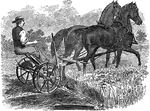
The Walter A. Wood Mowing and Reaping Machine Co. manufactured this reaper. By 1860 he had an improved mower and a new combined mower - reaper. He soon decided the combination machine wasn’t as good a mower as his separate mower. The mower version of the combined machine was sold as a separate mowing attachment to the reaper. This increased its cost to near that of the separate mower while providing a "combined" machine for those who insisted in buying one. The reaper was improved and became the chain-rake reaper – an early machine that no longer needed a second operator to rake the grain from the platform. Wood had all the patents for this early one-man machine, and was able to sell a license for the reaper and the improved mower to Hart Massey for sale in Canada.

Wood Mower

The Walter A. Wood Mowing and Reaping Machine Co. manufactured this reaper. By 1860 he had an improved…
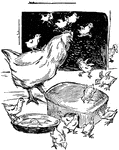
An illustration of a mother hen and her baby chicks eating grain out of a bowl.

Mother Hen & Baby Chicks

An illustration of a mother hen and her baby chicks eating grain out of a bowl.
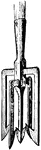
"Grains with Five Prongs. GRAIN. An iron instrument with four or more barbed points, and a line attached to it, used at sea for striking and taking fish." -Whitney, 1911

Grain Spear

"Grains with Five Prongs. GRAIN. An iron instrument with four or more barbed points, and a line attached…

Color flag of Ukraine. Two equal horizontal bands of azure (top) and golden yellow represent grain fields under a blue sky.

Flag of Ukraine, 2009

Color flag of Ukraine. Two equal horizontal bands of azure (top) and golden yellow represent grain fields…

Black and white outline flag of Ukraine. Two equal horizontal bands of azure (top) and golden yellow represent grain fields under a blue sky

Flag of Ukraine, 2009

Black and white outline flag of Ukraine. Two equal horizontal bands of azure (top) and golden yellow…
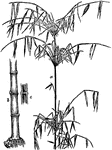
"Bamboo. a.- upper portion of the stem with foliage. b.- root stem. c.- section of stem. Bamboo, the common name of the arborescent grasses belonging to the genus Bambusa." -Vaughan, 1906

Bamboo

"Bamboo. a.- upper portion of the stem with foliage. b.- root stem. c.- section of stem. Bamboo, the…
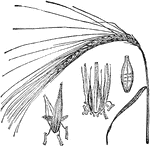
"Barley, the name of several cereal plants of the genus Hordeum, order Gramineae (grasses), yielding a grain used as food and also for making malt, from which are prepared beer, porter, and whisky." -Vaughan, 1906

Barley

"Barley, the name of several cereal plants of the genus Hordeum, order Gramineae (grasses), yielding…
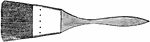
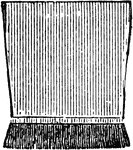
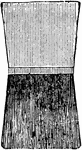
The fantail over-grainer brush is sized according to the width of the head from 1 inch up to 4 inches wide.

Fantail Over-grainer Brush

The fantail over-grainer brush is sized according to the width of the head from 1 inch up to 4 inches…
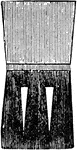
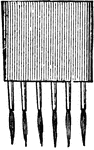
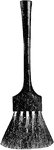
The piped over-grainer is a brush that is used to create the shaped grain found in hardwoods such as mahogany, maple, and walnut. It is referred to as piper over-grainer because of the way the bristles are clumped together on the brush.

Piped Overgrainer

The piped over-grainer is a brush that is used to create the shaped grain found in hardwoods such as…
The piped over-grainer is a brush that is used to create the shaped grain found in hardwoods such as mahogany, maple, and walnut. It is referred to as piper over-grainer because of the way the bristles are clumped together on the brush.

Piped Overgrainer

The piped over-grainer is a brush that is used to create the shaped grain found in hardwoods such as…
The piped over-grainer is a brush that is used to create the shaped grain found in hardwoods such as mahogany, maple, and walnut. It is referred to as piper over-grainer because of the way the bristles are clumped together on the brush.

Piped Overgrainer

The piped over-grainer is a brush that is used to create the shaped grain found in hardwoods such as…
The piped over-grainer is a brush that is used to create the shaped grain found in hardwoods such as mahogany, maple, and walnut. It is referred to as piper over-grainer because of the way the bristles are clumped together on the brush.

Piped Overgrainer

The piped over-grainer is a brush that is used to create the shaped grain found in hardwoods such as…
The piped over-grainer is a brush that is used to create the shaped grain found in hardwoods such as mahogany, maple, and walnut. It is referred to as piper over-grainer because of the way the bristles are clumped together on the brush.

Piped Overgrainer

The piped over-grainer is a brush that is used to create the shaped grain found in hardwoods such as…
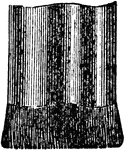
The piped over-grainer is a brush that is used to create the shaped grain found in hardwoods such as mahogany, maple, and walnut. It is referred to as piper over-grainer because of the way the bristles are clumped together on the brush.

Piped Overgrainer

The piped over-grainer is a brush that is used to create the shaped grain found in hardwoods such as…
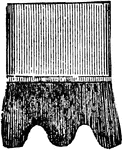
This is a 6 part pipe over-grainer. It is used to create the shaped grain found in hardwoods such as mahogany, maple, and walnut. It is referred to as a piper over-grainer because of the way the bristles are clumped together on the brush.

Piped Overgrainer

This is a 6 part pipe over-grainer. It is used to create the shaped grain found in hardwoods such as…
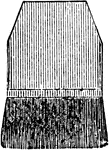
The piped over-grainer is a brush that is used to create the shaped grain found in hardwoods such as mahogany, maple, and walnut. It is referred to as piper over-grainer because of the way the bristles are clumped together on the brush.

Piped Overgrainer

The piped over-grainer is a brush that is used to create the shaped grain found in hardwoods such as…
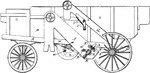
The thrashing machine was a machine first invented for use in agriculture. Originally invented for the separation of grain from stalks and husks.

Thrashing Machine

The thrashing machine was a machine first invented for use in agriculture. Originally invented for the…
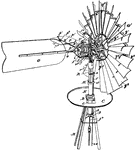
Fixed windmills, oriented to the prevailing wind were extensively used in the Cyclades islands of Greece. The economies of power and transport allowed the use of these 'offshore' mills for grinding grain transported from the mainland and flour returned. A 1/10th share of the flour was paid to the miller in return for his service. This type would mount triangular sails when in operation.

Fixed Axis Windmill

Fixed windmills, oriented to the prevailing wind were extensively used in the Cyclades islands of Greece.…
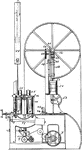
A resaw is a large band saw optimized for cutting timber along the grain to reduce larger sections into smaller sections or veneers. Resawing veneers requires a wide blade with a small kerf to minimize waste.

Band Resaw

A resaw is a large band saw optimized for cutting timber along the grain to reduce larger sections into…
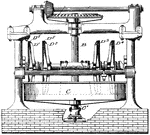
A grinding mill is a unit operation designed to break a solid material into smaller pieces. The grinding of solid matters occurs under exposure of mechanical forces that trench the structure by overcoming of the interior bonding forces. After the grinding the state of the solid is changed: the grain size, the grain size disposition and the grain shape.

Bed Pan Grinding Mill

A grinding mill is a unit operation designed to break a solid material into smaller pieces. The grinding…
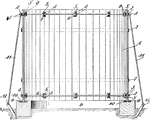
A silo is a structure for storing bulk materials. Silos are used in agriculture to store grain (see grain elevators) or fermented feed known as silage.

Bulk Storage Silo

A silo is a structure for storing bulk materials. Silos are used in agriculture to store grain (see…
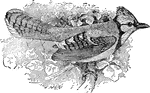
Also known as Cyanocitta cristata. These birds have a loud, harsh voice and striking colors. They occasionally prey upon the eggs or young of other birds, but mostly feed largely upon grain and other hard seeds. They are located broadly throughout North America.

The Common Blue Jay

Also known as Cyanocitta cristata. These birds have a loud, harsh voice and striking colors. They occasionally…

A mill which grounds grain into flour. This flour mill is located on a body of water.

Floating Flour Mill

A mill which grounds grain into flour. This flour mill is located on a body of water.
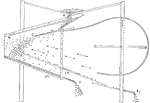
A machine used to separate immature seeds from wheat, oats, rye, barley, and other grains. This diagram shows the process of how the machine works.

Diagram of a Fanning Mill

A machine used to separate immature seeds from wheat, oats, rye, barley, and other grains. This diagram…
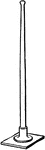

A garden tool used to flatten granular material.

Tamper

A garden tool used to flatten granular material.

A smut of oats with a normal head.

Smut of Oats

A smut of oats with a normal head.

A Crystalline Aggregate is mass of crystal grains, devoid of their characteristic forms and closely packed together.

Crystalline Aggregate

A Crystalline Aggregate is mass of crystal grains, devoid of their characteristic forms and closely…
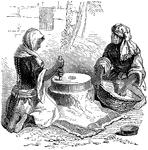
Women grinding grain in a mortar. The hole for receiving the grain was in the center of the upper millstone, and in the operation of grinding the lower stone was filed and the upper stone turned by means of a handle. The meal came out at the edges and was collected on a cloth spread under the mill  on the ground.

Using A Mortar

Women grinding grain in a mortar. The hole for receiving the grain was in the center of the upper millstone,…

A medal engraved with the portrait of Melita; the reverse side depicting a figure with two sets of wings holding a crook and a sickle in his hands. Traditionally a symbol for the production of grain, the image may also allude to the god of fertility.

Medal of Melita

A medal engraved with the portrait of Melita; the reverse side depicting a figure with two sets of wings…
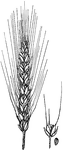
A head, spikelet, and grain of bearded wheat.

Wheat

A head, spikelet, and grain of bearded wheat.

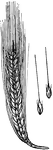
Head and grain of bearded barley.

Bearded Barley

Head and grain of bearded barley.

Men and women reap the grain from a field in the 14th century. Two women are bent over using sickles to cut the grain. One man stands behind them, gathering the reaped grain. He has a sickle tucked in his belt. A second man oversees the scene with his hands on his hips. A bundle of grain sits in the background. The original image is pictured in an old psalter.

Reaping Grain the 14th Century

Men and women reap the grain from a field in the 14th century. Two women are bent over using sickles…
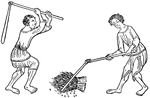
Two men thresh a sheaf of wheat using flails. The flails appear to be made from two sticks joined together at a bendable joint. The men are beating the grain. One man's flail is in the air, while the other man's flail hits the bundle of wheat. Both are wearing short, belted tunics and knee length pants. The original drawing is from a 14th century psalter called "The Luttrell Psalter".

Threshing Wheat with Flails in the 14th Century

Two men thresh a sheaf of wheat using flails. The flails appear to be made from two sticks joined together…
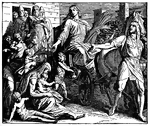
"48 And he gathered up all the food of the seven years which were in the land of Egypt, and laid up the food in the cities: the food of the field, which was round about every city, laid he up in the same. And Joseph laid up grain as the sand of the sea, very much, until he left off numbering; for it was without number." Genesis 41:48-49 ASV
<p>
Illustration of Joseph riding through Egypt's streets in a chariot with a herald leading the horse and announcing him. He holds several sheaves of wheat with his left arm and is collecting more from the people. A small child is handing him more sheaves. Pharaoh and four other royals emerge from a doorway behind Joseph and Pharaoh is pointing to him. An obelisk is visible in the background.

Joseph Collects Wheat as Governor of Egypt in Preparation for the Famine

"48 And he gathered up all the food of the seven years which were in the land of Egypt, and laid up…
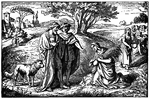
"And she went, and came and gleaned in the field after the reapers: and her hap was to light on the portion of the field belonging unto Boaz, who was of the family of Elimelech. And, behold, Boaz came from Bethlehem, and said unto the reapers, Jehovah be with you. And they answered him, Jehovah bless thee. Then said Boaz unto his servant that was set over the reapers, Whose damsel is this? And the servant that was set over the reapers answered and said, It is the Moabitish damsel that came back with Naomi out of the country of Moab:" Ruth 2:3-6 ASV
<p>Illustration of Ruth gleaning grain in the fields of Boaz. She is on her knees at the feet of Boaz, who walks with a staff and a dog behind him. His servant tells him about Ruth. Four men and women, also gleaning, watch in the background. A small town and some trees are pictured in the background.

Ruth Meets Boaz While Gleaning in the Fields

"And she went, and came and gleaned in the field after the reapers: and her hap was to light on the…
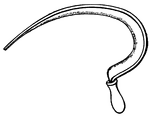
"A reaping hook; a curved blade of steel (anciently also of bronze) having the edge on the inner side of the curve, with a short handle or haft, for cutting with the right hand grain or grass which is grasped by the left." &mdash;Whitney, 1889
<p>This sickle has a serrated edge on the inside curve of the blade.

Sickle with Serrated Edge

"A reaping hook; a curved blade of steel (anciently also of bronze) having the edge on the inner side…
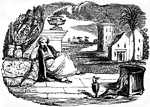
"And he spake a parable unto them, saying, The ground of a certain rich man brought forth plentifully: and he reasoned within himself, saying, What shall I do, because I have not where to bestow my fruits. And he said, This will I do: I will pull down my barns, and build greater; and there will I bestow all my grain and my goods. And I will say to my soul, Soul, thou hast much goods laid up for many years; take thine ease, eat, drink, be merry." Luke 12:16-19 ASV
<p>Illustration of a wealthy man, dressed in expensive robes, leaning on expensive pillows and linens, and looking over his riches. There is a chair and pitcher nearby and incense is burning in a large vase. His barns and granaries are visible in the background.

A Wealthy Man Relaxing and Surveying His Riches

"And he spake a parable unto them, saying, The ground of a certain rich man brought forth plentifully:…