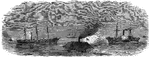
"A detachment of the First South Carolina [African American] Federal Volunteers, under command of Colonel Beard, in the United States transport steamer <em>Darlington</em>, picking off Confederate sharpshooters concealed in the trees on the banks of the Sapelo River, Ga."&mdash; Frank Leslie, 1896

African American Volunteers

"A detachment of the First South Carolina [African American] Federal Volunteers, under command of Colonel…
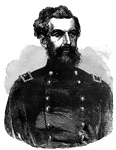
"General Howard, born in Leeds, Me., November 8th, 1830, was graduated at Bowdin in 1850, and at the United States Military Academy in 1854; became first lieutenant and instructor in mathematics in 1854, and resigned in 1861 to take command of the Third Maine Regiment. He commanded a brigade at the first battle of Bull Run, and for gallantry in that engagement was made to brigadier general of volunteers, September 3rd, 1861. He was twice wounded at the battle of Fair Oaks, losing his right arm on June 1st, 1862. In November, 1862, he became major general of volunteers. He commanded the Eleventh Corps during General Hooker's operations in the vicinity of Fredericksburg; served at Gettysburg, Lookout Valley and Missionary Ridge, and was on the expedition for the relief of Knoxville in December, 1863. He was in occupation of Chattanooga from this time till July, 1864, when he was assigned to the Army of the Tennessee in the invasion of Georgia; was at the surrender of Atlanta, and joined in pursuit of the Confederates in Alabama, under Hood, from October 4th till December 13th, 1864. In the march to the sea he commanded the right wing of General Sherman's army. He was in command of the Army of the Tennessee, and engaged in all the important battles from January 4th till April 26th, 1865."&mdash; Frank Leslie, 1896

General Oliver O. Howard

"General Howard, born in Leeds, Me., November 8th, 1830, was graduated at Bowdin in 1850, and at the…
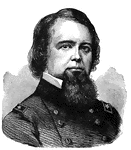
"General Pope, born in Louisville, Ky., March 16th, 1822, was graduated from the United States Military Academy in 1842, and made brevet second lieutenant of engineers. He served in Florida in 1842-'44, and took part in the Mexican War, being brevetted first lieutenant for gallantry at Monterey, and captain for his services in the battle of Buena Vista. In May, 1861, he was made brigadier general and assigned to command in Missouri. When General Curtis was sent in pursuit of Price, General Pope was dispatched to Commerce, Mo., where he organized rapidly an army of 12,000 men, and by his vigorous movements in March, 1862, captured New Madrid and Island No. 10, with thousands of prisoners. He was then promoted to be major general of volunteers and brigadier general in the regular army. He went into Washington, where he took command of the Army of Virginia, with which he fought the battle of Cedar Mountain and the second battle of Bull Run. He died September 23rd, 1892."&mdash; Frank Leslie, 1896

General John Pope

"General Pope, born in Louisville, Ky., March 16th, 1822, was graduated from the United States Military…
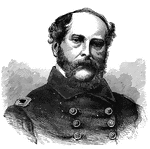
"Rear Admiral Winslow, born in Wilmington, N. C., November 19th, 1811, died in Boston, Mass., September 29th, 1873. He entered the navy as a midshipman, February 1st, 1827, and was made a lieutenant, February 9th, 1839. He was commissioned captain, July 16th, 1862, and commanded the steamer <em>Kearsarge</em> on special service in 1863-'64, in pursuit of the <em>Alabama</em>. Captain Winslow arrived off Cherbourg, June 14th, 1864, where he found the <em>Alabama</em>, and blockaded her in the harbor. The <em>Alabama</em> made preparations for fight, and Captain Raphael Semmes caused Winslow to be informed of this intention through the United States Consul. On Sunday, June 19th, 1864, he was lying three miles off the eastern entrance of the harbor when the <em>Alabama</em> came out. Winslow steamed off seven miles from the shore so as to be beyond the neutral ground, and then steamed toward the <em>Alabama</em>. The engagement lasted one hour and twenty minutes. After the last shot was fired the <em>Alabama</em> sank out of sight."&mdash; Frank Leslie, 1896

Rear Admiral John A. Winslow

"Rear Admiral Winslow, born in Wilmington, N. C., November 19th, 1811, died in Boston, Mass., September…
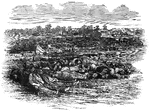
"Battle of Corinth, Miss., October 4th, 1862. Scene in the roundabouts of Fort Robinett after the repulse of the Confederates. We present an exact copy of a photograph showing the scene which presented itself to the Federals at Fort Robinett. As our readers are aware, the battle of Corinth, which took place on the 3rd and 4th of October, was one of the most sanguinary, in proportion to the numbers engaged, that occurred in the West, and it was contested on both sides with great valor and skill. The Federal troops were led by General Rosecrans, and those of the enemy by Van Dorn, Price and Villepigue. The Confederates lost two acting brigadier generals, Johnson and Rogers, who, by a singular coincidence, both fell at the same time and within a few feet of each other. In addition to those officers, they lost Colonels Ross, Morton and McLaine, and Major James. An officer of the Third Michigan Cavalry said: 'Fort Robinett was garrisoned by the First United States Artillery, and here the greatest slaughter took place. In the roundabouts of the fort were found the remains of Generals Johnson and Rogers, and close to them were the bodies of fifty-six of their men, principally of the Second Texas and Fourth Mississippi Regiments. General Rogers was a brave man; he was killed while planting the Confederate flag upon the parapet of the fort, from which the enemy were finally repulsed with great slaughter.'"&mdash; Frank Leslie, 1896

Battle of Corinth

"Battle of Corinth, Miss., October 4th, 1862. Scene in the roundabouts of Fort Robinett after the repulse…
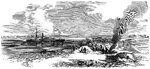
"The crew of the United States gunboat <em>Mahaska</em>, Captain Foxhall A. Parker destroying the water battery built by the Confederates at West Point, York River."— Frank Leslie, 1896

Mahaska Crew

"The crew of the United States gunboat Mahaska, Captain Foxhall A. Parker destroying the water…
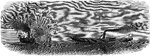
"Capture of the Anglo-Confederate steamer <em>Aries</em> off Bull's Bay, near Charleston, S. C., by the United States gunboat <em>Stettin</em>."&mdash; Frank Leslie, 1896

Aries

"Capture of the Anglo-Confederate steamer Aries off Bull's Bay, near Charleston, S. C., by…

"Confederate rams from Charleston Harbor attacking the Federal blockading squadron, January 31st, 1863. Official report of Rear Admiral Dupont: 'About four o'clock on the morning of the 31st of January, during the obscurity of a thick haze, two ironclad gunboats came out of Charleston by the main ship channel, unperceived by the squadron, and commenced a raid upon the blockading fleet. The <em>Mercedita</em> was the first vessel attacked. Captain Stellwagen had gone to his room for a short time, leaving Lieutenant Commanding Abbott on deck, when one of the ironclads suddenly appeared. Her approach was concealed by the haze and mist of the atmosphere. The vessel was immediately hailed and an order given to fire; but the ironclad being close aboard, and lying low in the water, no guns could be brought to bear. A heavy rifle shell was fired from the enemy, which entered the starboard side of the <em>Mercedita</em>, passed through her condenser, the steam drum of her port boiler, and exploded against her port side, blowing a hole in its exit some four or give feet square, killing the gunner, and, by the escape of steam, a number of the men, and rendering her motive power apparently useless. Unable to use his guns, and being at the mercy of the enemy, which was lying alongside on his starboard quarter, all further resistance was deemed hopeless by Captain Stellwagen, and he surrendered.'"&mdash; Frank Leslie, 1896

Confederate rams

"Confederate rams from Charleston Harbor attacking the Federal blockading squadron, January 31st, 1863.…
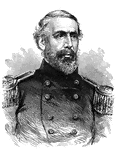
"General Ward, born in New York city, June 17th, 1823, was educated at Trinity Collegiate School; enlisted at the age of eighteen in the Seventh United States Infantry, and in four years rose through the several grades to that of sergeant major. In the Mexican War he participated in the siege of Fort Brown, received wounds at monterey, and was at the capture of Vera Cruz. At the beginning of the Civil War he recruited the Thirty-eighth New York volunteers, was appointed colonel of the regiment and let it at Bull Run and in all the battles of Peninsular campaign, and subsequently at the second Bull Run and Chantilly. Being promoted brigadier general of volunteers, October 4th, 1862, he commanded a brigade in the Third Corps at Fredericksburg, Chancellorsville, Gettysburg, where he was wounded, as also at Kelly's Ford and Wapping Heights, he was in temporary command of the division. He was wounded at Spottsylvania, and was frequently commended for courage and capacity in official reports."&mdash; Frank Leslie, 1896

General J. H. Hobart Ward

"General Ward, born in New York city, June 17th, 1823, was educated at Trinity Collegiate School; enlisted…
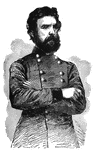
"General King, born in New York city, January 26th, 1814, died there, October 13th, 1876, was graduated at the United States Military Academy in 1833, and appointed to the Engineer Corps. He resigned from the army, September 30th, 1836, and became assistant engineer of the New York and Erie Railroad. From 1838 till 1843 he was adjutant general of the State of New York. He was then associate editor of the Albany <em>Evening Journal</em>, and of the Albany <em>Advertiser</em> from 1841 till 1845, when he removed to Wisconsin, and was editor of the Milwuakee <em>Sentinel</em> until 1861. He was United States minister to Rome from March 22nd till August 5th, 1861, but resigned, as he had offered his services in defense of the Union. He was made a brigadier general of volunteers, May 17th, 1861, and commanded a division at Fredericksburg, Groveton, Manassas, Yorktown and Fairfax, remaining in the army until 1863, when he was reappointed minister to Rome, where he resided until 1867."&mdash; Frank Leslie, 1896

General Rufus King

"General King, born in New York city, January 26th, 1814, died there, October 13th, 1876, was graduated…
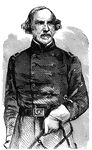
"General Tyler, born in Brooklyn, Windham County, Conn., January 7th, 1797, died in New York city, November 30th, 1882, was graduated from the United States Military Academy in 1819. He served as a lieutenant of artillery, was adjutant of the School of Practice at Fortress Monroe, 1824-'26; and while commanding the arsenal at Pikesville, Md., 1826-'27, translated 'Manoeuvres of Artillery' from the French. In 1828 he was sent abroad to observe the French improvements in artillery. This he did at Metz and elsewhere. In 1832 he was superintendent of the inspectors of arms furnished by contractors. Resigning in 1834, he became president of an iron and coal company. He was colonel of the First Connecticut Regiment in April, 1861; brigadier general of volunteers in March, 1862, and served in the Army of the Mississippi at the siege of Corinth in June. Served as one of the commission to investigate Buell's Kentucky campaign, and afterward in command at Harper's Ferry, in Baltimore and in Delaware. He withdrew from the army in April, 1864."&mdash; Frank Leslie, 1896

General Daniel Tyler

"General Tyler, born in Brooklyn, Windham County, Conn., January 7th, 1797, died in New York city, November…
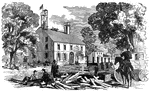
"The old Harrison Mansion, Harrison's Landing, Va., the birthplace of President William Henry Harrison, used as a hospital and the headquarters of the signal corps. This old-fashioned residence was situated at Berkeley, on the banks of the James River, only a few hundred yards from the water. It was constructed of brick and surrounded by a grove of poplar and other trees. Here, on February 9th, 1773, William Henry Harrison, ninth President of the United States, was born, and for this it remained famous till it became of still higher historical interest by being selected as the <em>point d'appui</em> of General McClellan's army, and the chief landing place of all its stores. It was at once chosen for hospital purposes, and upon its roof the Signal Corps erected a tower for the survey of the surrounding country."&mdash; Frank Leslie, 1896

Harrison Mansion

"The old Harrison Mansion, Harrison's Landing, Va., the birthplace of President William Henry Harrison,…
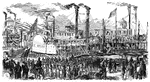
"Re-enforcements for Grant's army leaving Memphis, Tenn. Our sketch shows the <em>Alice Dean</em>, a crack Western steamer, leaving Memphis with re-enforcements, and with doctors, nurses, etc., for the wounded. She was in charge of the Cincinnati branch of the United States Sanitary Commission, and commanded by Mr. R. B. Moore, of Cincinnati. She was a very fast boat, having run up to Cincinnati from Memphis in 2 days, 23 hours and 5 minutes. The scene depicted was one of constant occurrence, as troops were pouring daily into Memphis from all parts."&mdash; Frank Leslie, 1896

Re-enforcements

"Re-enforcements for Grant's army leaving Memphis, Tenn. Our sketch shows the Alice Dean, a…
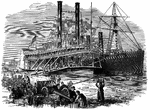
"The Banks Expedition- scene on the levee, Baton Rouge, La. Contrabands unloading military stores from the United States transport <em>North Star</em>, over the Mississippi steamer <em>Iberville</em>. The <em>Iberville</em> had quite a history in connection with the military operations on the Mississippi. She was taken possession of by the United States authorities on the surrender of New Orleans, and was engaged as a transport during the expedition. She several times ran the gantlet of Confederate batteries and guerrillas. On one occasion she sustained a running fire from a battery of six guns for at least twenty minutes, while passing Donaldsonville, having four men killed and four wounded, one of her engines disabled and her upper works riddled."&mdash; Frank Leslie, 1896

Banks Expedition

"The Banks Expedition- scene on the levee, Baton Rouge, La. Contrabands unloading military stores from…
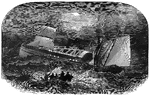
"The Banks Expedition- a Confederate Schooner running into the United States transport <em>Che-Kiang</em>, off the Florida reefs, on the night of December 11th, 1862, with the intention of sinking her. On the night of December 11th, 1862, as the United States transport <em>Che-Kiang</em>, laden with troops, was off the Florida Reefs, a schooner supposed to be a Confederate one, ran at full sail against the <em>Che-Kiang</em>. As the latter vessel was painted white and had no lights burning, there can be little doubt it was a daring and desperate attempt to wreck the transport, more especially as the schooner's crew, immediately after the collision, put off into a boat and rowed away with all expedition. After disengaging herself from the sinking schooner the <em>Che-Kiang</em> pursued her way, and reached Ship Island in such a leaky condition that the troops had to be landed."&mdash; Frank Leslie, 1896

Che-Kiang

"The Banks Expedition- a Confederate Schooner running into the United States transport Che-Kiang,…
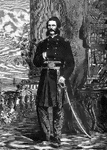
"General Baker, Chief of the United States Secret Service, born in Stafford, Genesee County, N. Y., October 13th, 1826, died in Philadelphia, Pa., July 2nd, 1868. In 1848 he went to New York and Philadelphia, and in 1853 to San Francisco, in each of these cities working as a mechanic. When the lawless element became dominant in San Francisco, in 1856, General Baker joined the Vigilance Committee and took an active part in the summary proceedings that restored order in the city. He went to New York on business in 1861, expecting to return at once, but the Civil War intervened, and he went to Washington and offered his services. At the suggestion of General Hiram Walbridge, of New York, he was introduced to General Scott, and as a result of the interview he started on foot for Richmond, where, in spite of arrest, imprisonment and several interviews with Jefferson Davis, while under suspension as a spy, he succeeded in collecting much information and returning to Washington after an absence of three weeks. This was but the first of a series of adventures involving high executive ability and a wonderful talent for tracing conspiracy and frustrating the designs of Confederate spies and agents. He was commissioned colonel, and subsequently brigadier general. His duties naturally made him enemies in influential quarters, and charges of a serious nature were several times preferred against him, but were never substantiated. When President Lincoln was assassinated General Baker organized the pursuit of the murderer, and was present at his capture and death."&mdash; Frank Leslie, 1896

General Lafayette C. Baker

"General Baker, Chief of the United States Secret Service, born in Stafford, Genesee County, N. Y.,…
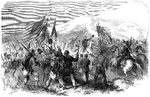
"The enthusiasm of the Northern armies- re-enlistment of the Seventeenth Army Corps. Financial tests convinced the supporters of the rebellion here and in Europe of one great fact, that the people of the North had faith in the United States Government, and that the people of the Southern States had no faith in their government, set up by a knot of disappointed politicians. While Alabama troops were shooting down Kentuckians who refused to re-enlist, the Federal Army almost unanimously re-enlisted. Hence the difference. There was no want of faith in the Federal cause, the Government, or success. In some corps almost all the regiments re-enlisted; in the Seventeenth Army Corps thirty-nine took their stand as verterans. We give artistically a view of this army enthusiasm."— Frank Leslie, 1896

Northern Armies

"The enthusiasm of the Northern armies- re-enlistment of the Seventeenth Army Corps. Financial tests…
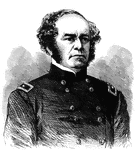
"General Benham, born in Connecticut in 1817, died in New York June 1st, 1884, was graduated from the United States Military Academy in 1837, and assigned to the Corps of Engineers. Served in the Mexican War, 1847-'8, and was brevetted captain for gallant and meritorious services in the battle of Buena Vista. At the beginning of the Civil War, in 1861, Captain Benham entered upon active service; was on General Morris's staff as engineer of the Department of the Ohio; was brevetted colonel for gallantry at the battle of Carrick's Ford, July 13th, 1861; in August was made brigadier general of volunteers, and was engaged in the Virginia campaigns. In 1862 he was present at the capture of Fort Pulaski and James Island; later in the year he superintended fortifications in Boston and Portsmouth harbors, and was in command of the Northern District of the Department of the South. He proved very efficient in throwing pontoon bridges across the Rappahannock, the Potomac and the James Rivers, and was in command of the Pontoon Department at Washington in 1864. In March, 1865, he was brevetted brigadier general and major general, United States Army, and major general, United States Volunteers, for gallant services during the Rebellion."&mdash; Frank Leslie, 1896

General Henry W. Benham

"General Benham, born in Connecticut in 1817, died in New York June 1st, 1884, was graduated from the…
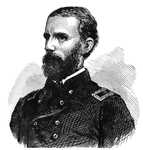
"General Grover, born in Bethel, Me., July 24th, 1829, died in Atlantic City, N. J., June 6th, 1885, was graduated from the United States Military Academy in 1850, entered the First Artillery, and served on frontier duty till 1853. He was promoted to first lieutenant March 3rd, 1855, and captain of the Tenth Infantry on September 17th, 1858, serving at various Western stations. He became brigadier general of volunteers April 14th, 1862, and was transferred to the Army of the Potomac, with which he took part in many battles, serving with distinction at the battles of Williamsburg, Fair Oaks and Bull Run. Being transferred to the Department of the Gulf, he took command of a division of the nineteenth Corps from December 30th, 1862, till July, 1864; was in command of the right wing of the army besieging Port Hudson, La., in May, 1863; and commanded a division in the Shenandoah campaign from August to December, 1864. He was wounded at the battle of Cedar Creek, on October 19th, 1864, and brevetted major general of volunteers on the same day for gallantry at Winchester and Fisher's Hill. On March 13th, 1865, he was brevetted brigadier general, United States Army, and major general, United States Army. He was mustered out of volunteer service August 24th, 1865."&mdash; Frank Leslie, 1896

General Cuvier Grover

"General Grover, born in Bethel, Me., July 24th, 1829, died in Atlantic City, N. J., June 6th, 1885,…

"Presentation of colors to the Twentieth United States [African American] Infantry, Colonel Bartram, at the Union League Clubhouse, New York, March 5th, 1864. The Twentieth Regiment, United States [African American] Troops, left Riker's Island at nine o'clock on the 5th of March, 1864, on board the steamer <em>John Romer</em>, and were conveyed to the foot of Twenty-first Street, East River, New York, where they were disembarked and formed in regimental line, and marched to Union Square, arriving in front of the Union League Clubhouse at one o'clock. A vast crowd of citizens, of every shade of color and every phase of social and political life, filled the square and streets, and every door, window, veranda, tree and housetop that commanded a view of the scene was peopled with spectators. Over the entrance of the clubhouse was a large platform, ornamented with flags and filled with ladies. In the street was another platform, tastefully decorated and occupied by prominent citizens. From the stand the colors were presented by President King of Columbia College, who addressed them with warmth and eloquence. After the presentation ceremony was over the men stacked arms and partook of a collation provided for them."— Frank Leslie, 1896

Presentation of Colors

"Presentation of colors to the Twentieth United States [African American] Infantry, Colonel Bartram,…
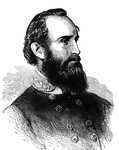
"General Stonewall Jackson, born in Clarkesburg, W. Va., January 21st, 1824, died at Chancellorsville, Va., May 10th, 1863, was graduated from the United States Military Academy, in 1846. He was ordered to Mexico, became a lieutenant in Magruder's battery, and took part in General Scott's campaign from Vera Cruz to the city of Mexico. He was twice brevetted for good conduct at Churubusco and Chapultepec. He resigned from the army in 1851, on his election as professor of philosophy and artillery tactics in Virginia Military Institute. A few days after the secession of Virginia he took command of the troops that were collecting at Harper's Ferry, and when Virginia joined the Confederacy, a few weeks later, he was relieved by General Joseph E. Johnston, and then became commander of a brigade in Johnston's army, which rank he held at the battle of Bull Run. For his conduct on that occassion he was made major general, and in November, 1861, was assigned to the command of the district that included the Shenandoah Valley and the portion of Virginia northwest of it. In 1862 Jackson defeated Banks at Front Royal and Winchester, Fremont and McDowell at Cross Keys, Shields at Port Republic, Fitzjohn Porter at Gaines's Mill, Banks at Cedar Run and Pope at the second Bull Run. He invested and captured Harper's Ferry with 13,000 prisoners, and joined Lee at Antietam. He defeated Hooker at Chancellorsville, where he received his death wounds, accidentally, at the hands of his own men."&mdash; Frank Leslie, 1896

General Thomas J. Jackson

"General Stonewall Jackson, born in Clarkesburg, W. Va., January 21st, 1824, died at Chancellorsville,…
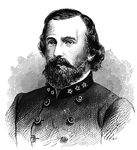
"General Ewell, born in Georgetown, D. C., February 8th, 1817, died in Springfield, Tenn., January 25th, 1872, was graduated at the United States Military Academy in 1840; served in the Mexican War, and was promoted captain, August 4th, 1849. When the Civil War began he resigned his commission, entered the Confederate Army, and was actively engaged throughout the war. He was promoted to the rank of major general, and fought at Blackburn's Ford, July 18th, and at Bull Run, July 21st, 1861. In the following year he distinguished himself under General Jackson. He lost a leg at Warrenton Turnpike, on August 28th, 1862. When Jackson was fatally wounded at Chancellorsville, Ewell, at the former's request, was promoted to lieutenant general and assigned to the command of the Second Corps. At the head of Jackson's veterans he fought valiantly at Winchester, at Gettysburg, and at the Wilderness on the Confederate left. He was captured, with his entire force, by Sheridan, at Sailor's Creek, April 6th, 1865. After the war he retired to private life."&mdash; Frank Leslie, 1896

General Richard S. Ewell

"General Ewell, born in Georgetown, D. C., February 8th, 1817, died in Springfield, Tenn., January 25th,…
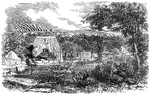
"The war in Georgia- Stevenson, Ala., depot for General Rosecrans's Army. The campaign of General Rosecrans brought him to a district where it was not easy to remember the State in which places were. Chattanooga the object of the struggle, was in Tennessee; but the battle of Chickamauga was fought in Georgia, and Rosecrans's depot of supplies was in Alabama. As a man may actually stand in three States, we may credit the assertion that from Lookout Mountain your eye can discern seven of the sovereignties of the New World. In the railroad line from Memphis, which at Cleveland branches to Lynchburg, Raleigh, Charleston, Savannah and Montgomery, Stevenson is an important point, as there a railroad from Nashville comes in."— Frank Leslie, 1896

War in Georgia

"The war in Georgia- Stevenson, Ala., depot for General Rosecrans's Army. The campaign of General Rosecrans…
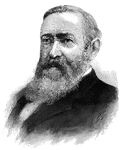
"General Harrison, twenty-third President of the United States, was born at North Bend, Ohio, August 20th, 1833."&mdash; Frank Leslie, 1896

General Benjamin Harrison

"General Harrison, twenty-third President of the United States, was born at North Bend, Ohio, August…
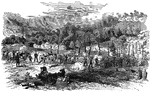
"Sherman's Campaign in Georgia- the attack of the Fourteenth, Sixteenth and Twentieth Army Corps on Kenesaw Mountain, June 22nd, 1864. Kenesaw Mountain, a second Lookout among its fellows, is about four miles in length and some four hundred feet high, difficult of ascent, with spurs on the flanks, and presenting a most dignified appearance. Sherman resolved to flank it, and on June 22nd the corps of the right and left of his army advanced, the centre maintaining its position around and upon the base of the mountain in the teeth of a very heavy artillery fire from the Confederate batteries. The Twentieth and Twenty-third wheeled on the left to hem in the Confederates between the Federal line and the railroad. The Fourteenth Kentucky met the enemy first, who charged furiously to check the movement. Schofield and Hooker were, however, ready. Williams's division drove back the enemy with artillery alone, without the employment of a musket. Batteries I and M of the First New York had second position, which gave them a cross fire upon the Confederates as they advanced over an open field, and it proved entirely too hot for them. Again, about six o'clock, they made the same attempt, and were driven back still more rapidly by a combined fire of artillery and musketry, which must, from the openness of the ground, have proved very destructive. The Federal losses were slight. They did not exceed two hundred killed and wounded during the day, and one-quarter of this loss was suffered by the Fourteenth Kentucky."— Frank Leslie, 1896

Sherman's Campaign

"Sherman's Campaign in Georgia- the attack of the Fourteenth, Sixteenth and Twentieth Army Corps on…

"The war in Virginia. The Twenty-second [African American] Regiment, Duncan's Brigade, carrying the first line of Confederate works before Petersburg. On the morning of the 15th of June, 1864, General Hinks formed his command in line of battle, and advanced upon the Confederates, with Duncan commanding his right and Holman his left. The result of this charge was waited for with great anxiety. The majority of the whites expected that the [African American] troops would run, but the sable forces astonished everybody by their achievements. With a wild yell that must have struck terror into the hearts of their foes, the Twenty-second and Fifth United States [African American] regiments, commanded by Colonels Kidder and Connor, charged, under a hot fire of musketry and artillery, over the Confederate ditch and parapet, and drove the enemy before them, capturing a large field-piece, and taking entire possession of their works, its defenders, Ferrybee's Fourth North Carolina Cavalry, and Graham's Petersburg Battery, seeking safety in rapid flight, leaving their dead and wounded in the works."— Frank Leslie, 1896

Duncan's Brigade

"The war in Virginia. The Twenty-second [African American] Regiment, Duncan's Brigade, carrying the…

"Siege of Petersburg. The [African American] infantry bringing in captured guns and cheers of the Ohio troops. When the [African American] troops found themselves within the works of the enemy no words could paint their delight. Numbers of them kissed the guns they had captured with extravagant satisfaction, and a feverish anxiety was minfested to get ahead and charge some more of the Confederate works. A number of the [African American] troops were wounded and a few killed in the first charge. A large crowd congregated, with looks of unutterable admiration, about Sergeant Richardson and Corporal Wobey, of the Twenty-second United States [African American] regiment, who had carried the colors of their regiment and been the first men in the works. Our artist gives a sketch of this gallant action."&mdash; Frank Leslie, 1896

Siege of Petersburg

"Siege of Petersburg. The [African American] infantry bringing in captured guns and cheers of the Ohio…
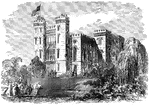
"Banks's Expedition- Executive Officer Parker, of the United States gunboat <em>Essex</em>, hoisting the national standard on the state capitol, Baton Rouge, La., on its occupation by the Federal forces commanded by General Grover, December 17th, 1863."&mdash; Frank Leslie, 1896

Banks's Expedition

"Banks's Expedition- Executive Officer Parker, of the United States gunboat Essex, hoisting…
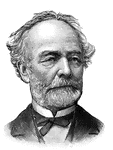
"General Johnston, born in Cherry Grove, near Farmville, Va., February 3rd, 1807; died at Washington, D. C., March 21st, 1891; was graduated at the United States Military Academy in 1829, and was commissioned second lieutenant in the Fourth Artillery. He served with great distinction in the Black Hawk, Seminole, Florida and Mexican wars. On June 28th, 1860, he was commissioned quartermaster general of the United States army, which post he resigned, April 22nd, 1861, to enter the Confederate service. He was commissioned major general of volunteers in the Army of Virginia, and, with General Robert E. Lee, organized the volunteers of that State. He was wounded at the battle of Seven Pines, May 31st, 1862, and incapacitated for duty until the following autumn. In May, 1863, General Johnston was ordered to take command of all the Confederate forces in Mississippi. On December 18th, 1863, he was transferred to the command of the Army of Tennessee. On February 23rd, 1865, General Johnston was ordered by General Lee to assume command of all troops in South Carolina, Georgia and Florida, 'to concentrate all available forces and drive back Sherman.' In the meantime, Richmond had been evacuated, and on April 9th Lee surrendered the Army of Northern Virginia to Grant, and on the 26th Johnston and Sherman signed an agreement surrendering the Confederate army on the terms of the agreement between Grant and Lee."&mdash; Frank Leslie, 1896

General Joseph E. Johnston

"General Johnston, born in Cherry Grove, near Farmville, Va., February 3rd, 1807; died at Washington,…
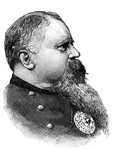
"General Lee, born in Clermont, Fairfax County, Va., November 19th, 1835, was graduated at the United States Military Academy in 1856, and commissioned second lieutenant in the Second Cavalry. At the beginning of the Civil War in 1861 he resigned his commission and entered on Confederate service. He was placed on staff duty, and was adjutant general of Ewell's Brigade until September, 1861, when he was made lieutenant colonel of First Virginia Cavalry, and later was promoted colonel, and he participated in all the campaigns of the Army of Northern Virginia. On July 25th, 1862, he was made brigadier general, and on the 3rd of September, 1863, major general. In March, 1865, he was put in command of the whole cavalry corps of the Army of Northern Virginia, and a month later he surrendered to General Meade at Farmville."&mdash; Frank Leslie, 1896

General Fitzhugh Lee

"General Lee, born in Clermont, Fairfax County, Va., November 19th, 1835, was graduated at the United…
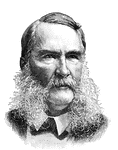
"General Longstreet, born in Edgefield district, S. C., January 8th, 1821, was graduated from the United States Military Academy in 1842, and assigned to the Fourth Infantry. He served in the Mexican war, and for gallant and meritorious conduct in the battles of Churubusco and Moleno del Rey he was brevetted captain and major. He became paymaster, July 19th, 1858, and resigned January 1st, 1861. He was commissoined a brigadier general in the Confederate service, and at the first battle of Bull Run commanded a brigade. He took part in the seven days' battles around Richmond, and at the second battle of Bull Run . He commanded the right wing of the Army of Northern Virginia at the battle of Gettysburg, and the First Corps in all the operations in 1864."&mdash; Frank Leslie, 1896

General James Longstreet

"General Longstreet, born in Edgefield district, S. C., January 8th, 1821, was graduated from the United…
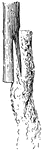
Cion and root united during the grafting process.

Root Grafting

Cion and root united during the grafting process.

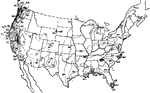
Map of the continental United States, illustrating the rainfall in different areas.

Map of rainfall in the United States

Map of the continental United States, illustrating the rainfall in different areas.
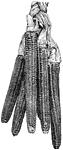
Good ears of flint corn. Grown for grain in the northeast United States.

Flint corn

Good ears of flint corn. Grown for grain in the northeast United States.

"The fork-tailed kite, (<em>N. furcatus</em>) is twenty-five inches long; the wings and tail black; neck and under parts white; the tail-feathers, twelve in number, are deeply forked, the lateral ones excessively elongated. It feeds on snakes, lizards, and frogs ; it also devours grasshoppers, locusts, and wasps, making attacks on the nests of the latter. This species is common in the South and Southwestern States, and also in the Western States, as far north as Wisconsin." &mdash Goodrich, 1859

Fork-Tailed Kite

"The fork-tailed kite, (N. furcatus) is twenty-five inches long; the wings and tail black;…
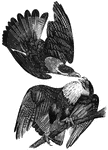
The caracara eagle, genus <em>Caracara</em> found in Cental and South America, as well as portions of the Southern and Southwestern United States. It is omnivorous, but prefers small reptiles.

Caracara Eagle

The caracara eagle, genus Caracara found in Cental and South America, as well as portions of…
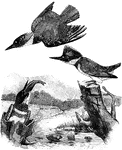
A trio of belted kingfishers, a species native to the United States.

Belted Kingfishers

A trio of belted kingfishers, a species native to the United States.

"General Newton, born in Norfolk, Va., August 24th 1823. He was graduated at the United States Military Academy in 1842."&mdash; Frank Leslie, 1896

General John Newton

"General Newton, born in Norfolk, Va., August 24th 1823. He was graduated at the United States Military…
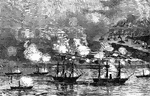
"Bombardment of Forts Jackson and St. Philip- the United States squadron, under Farragut, engaging the Confederate forts and fleet on its way to New Orleans, April 24th, 1862. The enemy's losses: In addition to the loss of their forts- Jackson, St. Philip, Pike, Chalmette, etc.- eighteen of their gunboats were destroyed, three iron rams, several floating batteries, booms, torpedoes, etc. The famous Hollins's ram <em>Manassas</em> was riddled, and, floating down a disabled wreck, it was destroyed by Porter's mortar fleet."&mdash; Frank Leslie, 1896

Fort Jackson

"Bombardment of Forts Jackson and St. Philip- the United States squadron, under Farragut, engaging the…
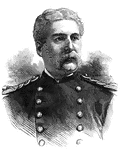
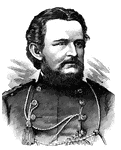
"General Hatch, born in Bangor, Me., December 22nd, 1832. In April, 1861, he was a member of the District of Columbia Volunteers, who were enlisted to defend the national capital, and subsequently had charge of the camp of instruction at Davenport, La. He was commissioned captain in the Second Iowa Cavalry August 12th, 1861; major, September 5th, and lieutenant colonel, December 11th, the same year. He commanded his regiment at New Madrid, Island No. 10, the battle of Corinth, the raid of Booneville and the battle of Iuka. He was promoted colonel, June 13th, 1862, and commanded a brigade of cavalry in General Grant's Mississippi campaign. He was afterward placed at the head of the cavalry division of the Army of the Tennessee and was present at the various engagements in which it took part. He was disabled by wounds in December, 1863, and on April 27th, 1864, was made brigadier general. Under General A. J. Smith, and still in command of a cavalry division, he was engaged in the battles of Franklin (for bravery in which he was brevetted brigadier general in the regular service) and Nashville, and in the pursuit of Hood's Confederate Army. For gallantry at Nashville he was, in 1864, brevetted major general of volunteers, and three years later promoted to the same rank by brevet in the United States Army. On January 15th, 1866, he was honorably mustered out of the volunteer service, and on July 6th following he was promoted colonel of the Ninth United States Cavalry."&mdash; Frank Leslie, 1896

General Edward Hatch

"General Hatch, born in Bangor, Me., December 22nd, 1832. In April, 1861, he was a member of the District…
"General Merritt, born in New York city June 16th, 1836. He was graduated at the United States Military Academy July 1st, 1860, assigned to the dragoons and promoted first lieutenant May 13th, 1861, and captain April 13th, 1861, and captain April 5th, 1862. He took part in General George Stoneman's raid toward Richmond in April and May, 1863, and was in command of the reserve cavalry brigade in the Pennsylvania campaign of the same year, being commissioned brigadier general of volunteers in June. For gallant and meritrious services during the battle of Gettysburg he was brevetted major. Still in command of his brigade, he took part in the various engagements in Central Virginia in 1863-4, and was brevetted lieutenant colonel and colonel in the regular army and major general of volunteers, for gallantry at the battle of Yellow Tavern, Hawes's Shop and Winchester, respectively. On March 13th, 1865, he was brevetted brigadier general and major general in the regular army for bravery at the battle of Five Forks, and his services during the final Virginia campaign."&mdash; Frank Leslie, 1896

General Wesley Merritt

"General Merritt, born in New York city June 16th, 1836. He was graduated at the United States Military…
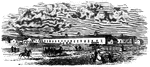
"United States General Hospital at Elmira, N. Y."— Frank Leslie, 1896

Elmira Hospital

"United States General Hospital at Elmira, N. Y."— Frank Leslie, 1896

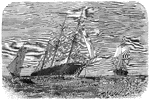
"The naval victory off Cherbourg, France, June 19th, 1864- the pirate <em>Alabama</em> Captain Semmes, sunk after an engagement of one hour by the United States steamer <em>Kearsarge</em>, Captain Winslow."&mdash; Frank Leslie, 1896

Victory off Cherbourg

"The naval victory off Cherbourg, France, June 19th, 1864- the pirate Alabama Captain Semmes,…
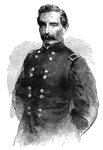
"General Beauregard, who opened the Civil War by bombarding Fort Sumter, made a brilliant record during the conflict between the States. He won the battle of Bull Run; distinguished himself at Shiloh; held General Halleck in check for two months; defended Charleston; and commanding at Petersburg, aided General Lee in the long and gallant defense of Richmond."&mdash; Frank Leslie, 1896

General P. G. T. Beauregard

"General Beauregard, who opened the Civil War by bombarding Fort Sumter, made a brilliant record during…
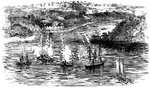
"The attack upon the batteries at the entrance of Acquia Creek, Potomac River, by the United States vessels <em>Pawnee</em>, <em>Yankee</em>, <em>Thomas Freeborn</em>, <em>Anacosta</em>, and <em>Resolute</em>, June 1st, 1861. On May 31st Captain Ward, in command on board of the <em>Thomas Freeborn</em>, and assisted by two more of his gunboats, the <em>Resolute</em> and the <em>Anacosta</em>, began the attack on the Confederate batteries, and after a two hours' fight, succeeded in silencing the batteries at the landing; but, for want of long-range ammunition, could not effectually respond to the heavy fire from the heights, and so had to withdraw. The following day, however, with aditional aid from the <em>Pawnee</em> and <em>Yankee</em>, the attack was resumed, and the batteries were at last silenced and the Confederates compelled to retreat."— Frank Leslie, 1896

Acquia Creek

"The attack upon the batteries at the entrance of Acquia Creek, Potomac River, by the United States…
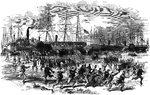
"Landing of United States troops at Fort Walker, after the bombardment, November 7th, 1861. In order to establish a naval rendezvous where vessels on the way to or from blockading squadrons could coal and take refuge in case of need, it was decided by the Federal authorities to capture the entrance to Port Royal, South Carolina. A large expedition was fitted out, and after a heavy bombardment of about four hours, signal was given that the two forts, Walker and Beauregard, had been abandoned. When the Federal troops landed at Fort Walker they found numbers of dead and dying amidst dismounted guns in all directions, and the hospital building shot through and through in many places. The loss on the fleet was 8 killed and 23 wounded."— Frank Leslie, 1896

Fort Walker

"Landing of United States troops at Fort Walker, after the bombardment, November 7th, 1861. In order…
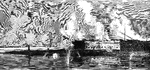
"The bombardment of Fort Pulaski, second day, Friday, April 11th, 1862. General Quincy A. Gilmore took personal command of Tybee Island on the 20th of February, 1862, and at once began construction of earthworks. On the 9th of April everything was in readiness for the bombardment, and early on the following morning a summons for the surrender of Fort Pulaski was sent, through Lieutenant J. H. Wilson, to its commander, Colonel Charles H. Olmstead, by General David Hunter. The surrender having been refused, order was given to immediately open fire. This was done at about eight o'clock on the morning of the 10th, from the two 13-inch mortars in charge of Captain Sanford. The remaining two batteries joined in, and their united fire thundered all day, and was steadily responded to from the fort. The bombardment of the fort was kept up until the next morning, and at daybreak of the 11th the firing again commenced on both sides. The Federal fire was mainly directed against the southeastern portion of the fort, and by two o'clock in the afternoon the breach had become so wide that the arches of the casemate were laid bare. This was followed by the hoisting of a white flag, when firing ceased. The immediate and unconditional surrender of the fort was agreed on."&mdash; Frank Leslie, 1896

Fort Pulaski

"The bombardment of Fort Pulaski, second day, Friday, April 11th, 1862. General Quincy A. Gilmore took…
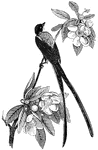
Found in the southern United States, the Savannah fly-catcher is notable for its long, forked tail.
Savannah Flycatcher

Found in the southern United States, the Savannah fly-catcher is notable for its long, forked tail.

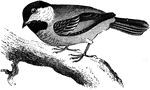
The common chickadee, found in the United States.

Common chickadee

The common chickadee, found in the United States.

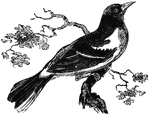
Familiar in orchards of the United States, the Baltimore oriole is also known as the golden oriole and the golden robin.

Baltimore Oriole

Familiar in orchards of the United States, the Baltimore oriole is also known as the golden oriole and…
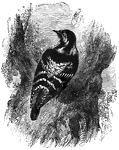
Common in England and distributed across Europe, the lesser spotted woodpecker measures about five and three-quarter inches in length.

Lesser Spotted Woodpecker

Common in England and distributed across Europe, the lesser spotted woodpecker measures about five and…
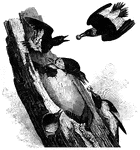
The most common type of woodpeckers found in the United States, the red-headed woodpecker feeds on various fruits, as well as insects that inhabit the trees it frequents.

Redheaded Woodpeckers

The most common type of woodpeckers found in the United States, the red-headed woodpecker feeds on various…
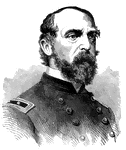
"General Meade, born in Cadiz, Spain, December 31st, 1815, died in Philadelphia, Pa., November 6th, 1872, was graduated from the United States Military Academy in 1835, and began active service in the Seminole War in the same year, as second lieutenant; upon the call to arms in 1861, he was made brigadier general; fought valiantly at Mechanicsville, Gaines's Mill and at Cross Roads, Va., where he was wounded; at Antietam he took charge of General Hooker's corps upon the latter being wounded. In 1862, he was made major general, and on June 28th, 1862, a message from Washington arrived on the field with orders for Meade to relieve hooker as commander of the Army of the Potomac. On July 1st he met Lee at Gettysburg, where the greatest battle of the war was fought."&mdash; Frank Leslie, 1896

General George G. Meade

"General Meade, born in Cadiz, Spain, December 31st, 1815, died in Philadelphia, Pa., November 6th,…
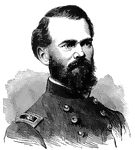
"General McPherson, born in Sandusky, Ohio, November 14th, 1828, died near Atlanta, Ga., July 22nd, 1864; was graduated at the United States Military Academy in 1853. At the beginning of the Civil War he applied for active duty with the army in the field, where his promotion was very rapid. When active operations began in the spring of 1862 he was transferred to the staff of General Grant, with whom he served as chief engineer at Fort Henry, Fort Donelson, Shiloh and the siege of Corinth. He repulsed the Confederates at Canton, Miss.; second in command to General Sherman in the expedition to Meridian in 1864; and commanded the Seventeenth Army Corps in the great four months' campaign of 1864 that ended in the capture of Atlanta, near where he was killed."&mdash; Frank Leslie, 1896

General James B. McPherson

"General McPherson, born in Sandusky, Ohio, November 14th, 1828, died near Atlanta, Ga., July 22nd,…
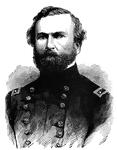
"General Thomas, born in Southampton County, Va., July 31st, 1816, died in San Francisco, Cal., March 28th, 1870; was graduated from the United States Military Academy, July 1st, 1840, and commissioned second lieutenant in the Third Artillery; served in the Florida war, 1840-42; Mexican War, 1846-48; war against the Seminoles, 1849-50. He was appointed brigadier general of volunteers, August 17th, 1861, and assigned to duty on the Department of the Cumberland. On 25th of April, 1862, he was made major general. General Thomas served with distinction to the close of the war, and was rewarded by receiving a vote of thanks from Congress."&mdash; Frank Leslie, 1896

General George H. Thomas

"General Thomas, born in Southampton County, Va., July 31st, 1816, died in San Francisco, Cal., March…
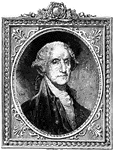
"George Washington, after a painting by Gilbert Stuart. (The Gibbs Portrait.)"—E. Benjamin Andrews, 1895

George Washington

"George Washington, after a painting by Gilbert Stuart. (The Gibbs Portrait.)"—E. Benjamin Andrews,…
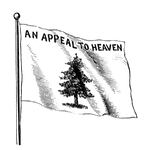
"Pine Tree Flag of Massachusetts."—E. Benjamin Andrews, 1895

Massachusetts Flag

"Pine Tree Flag of Massachusetts."—E. Benjamin Andrews, 1895

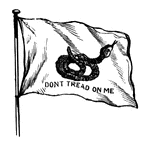
"Rattlesnake Flag of South Carolina, during independence of the states."&mdash;E. Benjamin Andrews, 1895

South Carolina flag

"Rattlesnake Flag of South Carolina, during independence of the states."—E. Benjamin Andrews,…
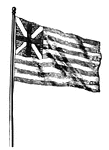
"Union Flag. The first recognized Continental Standard, raised for the first time January 2, 1776."—E. Benjamin Andrews, 1895

Union Flag

"Union Flag. The first recognized Continental Standard, raised for the first time January 2, 1776."—E.…
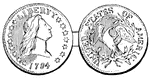
"Dollar of 1794, the first United States coin."&mdash;E. Benjamin Andrews, 1895

Dollar of 1794

"Dollar of 1794, the first United States coin."—E. Benjamin Andrews, 1895