
This rosette ornament is constructed of four stylized lotus flowers.

Lotus Flower Rosette

This rosette ornament is constructed of four stylized lotus flowers.

The lotus flower was often conbined with spirals to form all-over patterns

Lotus Flower Pattern

The lotus flower was often conbined with spirals to form all-over patterns

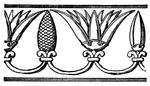
Repeating band motive with pine cones (a) and lotus flowers (b).

Assyrian Ornament

Repeating band motive with pine cones (a) and lotus flowers (b).

Antics are fancies having no foundation in nature, as sphinx, centaurs, etc., different flowers growing on one stem. Grotesque ornaments of all kinds.

Antic

Antics are fancies having no foundation in nature, as sphinx, centaurs, etc., different flowers growing…
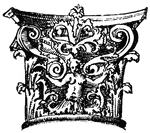
Antics are fancies having no foundation in nature, as sphinx, centaurs, etc., different flowers growing on one stem. Grotesque ornaments of all kinds.

Antic

Antics are fancies having no foundation in nature, as sphinx, centaurs, etc., different flowers growing…
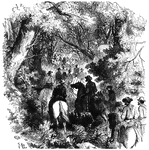
"Advance of General Rosecrans's division through the forests of Laurel Hill to attack the Confederate intrenchments at Rich Mountain. General McClellan's plan for attacking the Confederates under General Garnett in Western Virginia and driving them beyond the Alleghanies involved the surprise of a large body strongly intrenched at Rich Mountain, in a position commanding the turnpike over Laurel Hill. He detailed General Rosecrans to surprise them. This in turn involved a circuitous march through the dense forests of Laurel Hill, over a wild nd broken country. General Rosecrans's column of 1,600 men was guided by a woddsman named David L. Hart, who described the march as follows: "We started at daylight, and I led, accompanied by Colonel Lander, through a pathless wood, obstructed by bushes, laurels, fallen timber and rocks, followed by the whole division in perfect silence. It ended in the utter rout and final capture of the Confederates under Colonel Pegram, with a loss of 150 killed and 300 wounded." — Frank Leslie, 1896

Laurel Hill

"Advance of General Rosecrans's division through the forests of Laurel Hill to attack the Confederate…
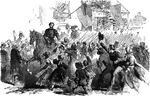
"General McClellan and the Federal troops passing through Frederick City, Md., in pursuit of the Confederate army- their enthusiastic reception by the inhabitants, September 12th, 1862. Most certainly it was distance that lent enchantment to the view of the eyes of the Marylanders, so far as the Confederate army was concerned, for it appeared that, instead of 50,000 recruits so confidently predicted by Mr. Miles, one of the Confederate Congress of Richmond, they did not actually realize more then 700, and of these nearly 300 refused to carry out their enlistments. All accounts proved that the Confederate army was of the Felstaffian regime, and not at all calculated to make a favorable impression upon the olfactory and pecuniary faculties of the Secessionists of Maryland. When the Confederate generals, with their staffs, entered Frederick City, they were at first welcomed, but when the ragged regiments made their appearance a change came over the spirit of their dream, and the inhabitants woke from their delusion. Our sketch reprsents the rapturous reception given to Gneral McClellan. It was a perfect ovation. Flowers were showered down upon the Federals, while the waving of flags and the cheers of the inhabitants completed the inspiring scene." —Leslie, 1896

Frederick City

"General McClellan and the Federal troops passing through Frederick City, Md., in pursuit of the Confederate…
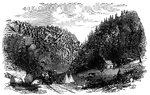
"Thoroughfare Gap, Va., a pass in the mountains on the Manassas Gap Railroad, near Strasburg, held by General Geary. This famous natural break in that part of the mountain ridge called Bull Run Mountain is about nine miles northeast of Warrenton, forty-seven miles southwest of Washington, and one hundred and twenty-four miles from Richmond. The western side is of granite, covered with soil, on which trees grow up to the summit. On the east side is the Gap, which has been called the Virginia Thermopylae, since a few determined men might hold it against thousands. This splendid defense caught the eye of General Geary, and had there been a necessity to act on the defensive he had resolved there to make his stand. The rocks lie scattered around in such wild confusion as to suggest the idea of being the result of some convulsion of nature. Near the Gap is a spring, issuing from under an immense rock, of the purest and coldest water, which is neither increased nor diminished in any season. It stands on the roadside, and is called by travelers 'The Diamond Spring in Palestine.'"— Frank Leslie, 1896

Thoroughfare Gap

"Thoroughfare Gap, Va., a pass in the mountains on the Manassas Gap Railroad, near Strasburg, held by…
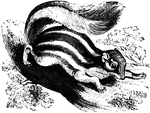
Tamia Striata. "It is about five inches long, and of a fawn-color above, striped wth five brown and two white bands; beneath, it is white. It is more wild that is preceding, and though it is lively, it has not the agility of the squirrel." — S. G. Goodrich, 1885

American Chipmunk

Tamia Striata. "It is about five inches long, and of a fawn-color above, striped wth five brown and…
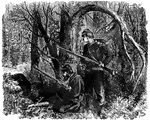
"The war in Tennessee. Federal pickets approached by Confederates in cedar bushes near Chattanooga. Our sketch shows the Confederate device for shooting down the Federal pickets. We have here not a whole wood marching, but single trees moving in the dusky twilight, continuously and stealthily, that their onward movement may be taken for the mere swaying of the trees in the wind. But the pickets in the third year of the war were keen of eye and quick of ear, and the hand on the trigger tells that some will fall in their cedar coffins to lie with no other cerements of the grave and molder away amid the crags and woods of that wild territory."— Frank Leslie, 1896

War in Tennessee

"The war in Tennessee. Federal pickets approached by Confederates in cedar bushes near Chattanooga.…
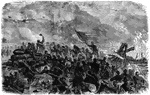
"The war in Tennessee. Hooker's Battle above the clouds, and capture of the Confederate position on Lookout Mountain, November 24th, 1863. The wild mountains of Tennessee, where nature reveals in producing the most fantastic forms, and piling rocks upon rocks, forms one of the mightiest ridges on the land, have been the scene of one of the most extraordinary battles in history; a battle fought with the mists and clouds rolling beneath the combatants, the flash and the roar of the guns appearing to the spectators in the plain below like the lightning and the thunder of heaven. By eight o'clock on Tuesday, November 24th, Hooker's column was moving up Lookout Valley, and, to the surprise of the enemy, disappeared in the woods south of Wauhatchie. But here, filing his troop to the left, General Hooker began the difficult task of the ascent of the mountain. The head of the column, having reached the palisades, went into line of battle facing to the north, and with the right resting against the palisades stretched down the mountain. Geary's division formed the front, with Greene's brigade of New York troops on the right. General Hooker then formed a second line of the two brigades of the Fourth Corps which had been sent him, placing Whittaker on the right and Grose on the left. General Osterhaus formed a third line, and held himself in readiness to aid any part of the line which might need it. Thus arranged, the corps was ordered forward, with a heavy line of skirmishers thrown out, and marching along the slope of the ridge, soon came upon the rear of the enemy, who were taken completely by surprise. Before those at the foot of the hill could comprehend the situation Colonel Ireland's skirmishers had penetrated far toward the point of the mountain, and got in a heavy fire upon the enemy, who were now trying to escape up the hill, while the Federals assaulted them from above. At the same time the Federal batteries on the Moccasin Point and those of the Confederates on Lookout Mountain opened a heavy fire upon each other, and soon the whole mountain was hid from the view in Chattanooga by the cloud of smoke which rose above and around it. The enemy made but little organized resistance, yet their skirmishers for a long time kept up a heavy fire from behind jutting rocks and from trees. Holding Ireland's right well against the palisades, Geary threw Kennedy forward on the left, and he, after being re-enforced by Grose, the enemy on the point of the mountain gradually gave way and fell back in some disorder to the line of breastworks on the east slope of the mountain, at Craven's House. General Geary swung around until his line was parallel with that of the enemy, and again advanced, but being met by organized and well-directed resistance, for a time recoiled. The enemy were now in strong position, Craven's House being the centre of a line of heavy breastworks; but they lacked numbers to man them, having lost severely. They were compelled to expose their right flank. Hooker then sent the Eighty-fourth and Seventy-fifth Illinois to hold the road across the mountain, and advanced on the enemy, with Geary on the right, Osterhaus on the left. Whittaker and Grose in the centre. Geary turned their left, as Osterhaus did the enemy's right, and then, with one charge of the whole line, Hooker carried the position."— Frank Leslie, 1896

Hooker's Battle

"The war in Tennessee. Hooker's Battle above the clouds, and capture of the Confederate position on…

"The war in Virginia. The Twenty-second [African American] Regiment, Duncan's Brigade, carrying the first line of Confederate works before Petersburg. On the morning of the 15th of June, 1864, General Hinks formed his command in line of battle, and advanced upon the Confederates, with Duncan commanding his right and Holman his left. The result of this charge was waited for with great anxiety. The majority of the whites expected that the [African American] troops would run, but the sable forces astonished everybody by their achievements. With a wild yell that must have struck terror into the hearts of their foes, the Twenty-second and Fifth United States [African American] regiments, commanded by Colonels Kidder and Connor, charged, under a hot fire of musketry and artillery, over the Confederate ditch and parapet, and drove the enemy before them, capturing a large field-piece, and taking entire possession of their works, its defenders, Ferrybee's Fourth North Carolina Cavalry, and Graham's Petersburg Battery, seeking safety in rapid flight, leaving their dead and wounded in the works."— Frank Leslie, 1896

Duncan's Brigade

"The war in Virginia. The Twenty-second [African American] Regiment, Duncan's Brigade, carrying the…
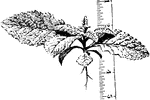
Wild mustard the proper size for spraying.

Wild Mustard

Wild mustard the proper size for spraying.

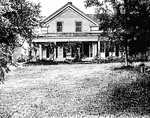
A well-planted farmyard, with trees at the sides, flowers in the corners and about the house, and an open lawn.

Farmhouse

A well-planted farmyard, with trees at the sides, flowers in the corners and about the house, and an…
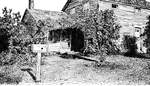
A dilapidated farmhouse made attractive by vines and flowers.

Dilapidated farmhouse

A dilapidated farmhouse made attractive by vines and flowers.

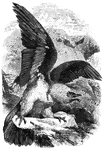
The lammergeyer (Swiss for "lamb-killer") is a member of the vulture family, but has a notably feathered neck. It generally preys on live animals, such as wild goats, mountain hare, and various species of birds.

Lammergeyer

The lammergeyer (Swiss for "lamb-killer") is a member of the vulture family, but has a notably feathered…
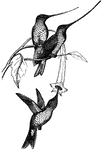
A group of humming birds with particularly long and narrow beaks, well-adapted for sipping nectar from flowers.

Hummingbirds

A group of humming birds with particularly long and narrow beaks, well-adapted for sipping nectar from…
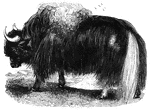
"The color of this animal in the wild and take, is black; the back and tail often white; the hair is thick and long; and the tail long, silky, and beautiful." — S. G. Goodrich, 1885

Yak

"The color of this animal in the wild and take, is black; the back and tail often white; the hair is…
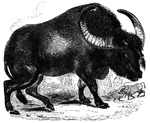
A wild buffalo.

Arna

A wild buffalo.

"The Prison Pen at Millen, Ga., as it appeared previous to the arrival of General Sherman's Army. Our special artist has sketched this Golgotha, and we doubt not it will create in the bosom of our readers the same sentiments of horror which it did in those of the gallant soldiers who viewed with silent rage the scene of their brother soldiers' persecutions and sufferings. Our illustration will prove more eloquent than any description. Here were brave and starved men compelled to burrow like wild beasts, enduring all the pangs of hunger and the insults of their brutal jailers. The stockade was a square of five hundred feet, or an area of nearly fifteen acres. It was among pines, on dry rolling ground, although in a swampy region. The stockade was of pine logs, rising from twelve to fifteen feet above the ground; sentry boxes were placed along the top of the stockade, fifty feet apart, and reached from the outside by ladders. On the eastern part extended a ravine, through which ran a small stream of good water. About three thousand prisoners had been confined here. In this space were their huts, without regularity in arrangement, roofed with loose earth, supported by sticks."— Frank Leslie, 1896

Millen Prison Pen

"The Prison Pen at Millen, Ga., as it appeared previous to the arrival of General Sherman's Army. Our…
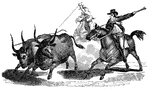
Two men capturing wild cattle for domestic use.

Wild Cattle

Two men capturing wild cattle for domestic use.

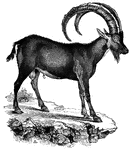
"All noted for their large horns bending over the back, their love of the wild, rocky heights of the mountainous regions, and the activity and daring with which they bound along the verges of the most lofty precipices." — S. G. Goodrich, 1885

Ibex

"All noted for their large horns bending over the back, their love of the wild, rocky heights of the…
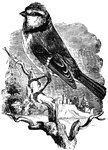
Commonly found throughout Europe, the blue titmouse is known for destroying the buds of flowers, and is not well-liked by gardeners for this reason.

Blue Tit

Commonly found throughout Europe, the blue titmouse is known for destroying the buds of flowers, and…
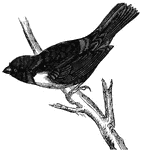
The scarlet tanager (also known as the black-winged summer redbird, or fire bird) feeds on insects, wasps, hornets, wild bees, beetles, and some berries

Scarlet Tanager

The scarlet tanager (also known as the black-winged summer redbird, or fire bird) feeds on insects,…
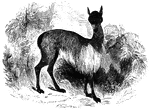
"Its color is reddish yellow on the back and whitish on the belly. It is a wild species, which is principally sought after for the sake of its fine wool, from which esteemed stuffs are largely woven." — S. G. Goodrich, 1885

Vicuna

"Its color is reddish yellow on the back and whitish on the belly. It is a wild species, which is principally…
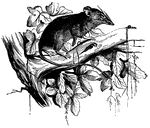
"A small, pretty, mouse-like animal, about three inches long, having a rostrated or beak-shaped snout, wth a long prehensile tail. It lives on insects and the nectar of flowers, and is found in the Swan River country, Australia." — S. G. Goodrich, 1885

Rostrated Tarsipede

"A small, pretty, mouse-like animal, about three inches long, having a rostrated or beak-shaped snout,…
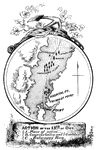
Isle Aux Noix, in the Sorel. The sketch was made from the pilot's room of the steam-boat, about half a mile above the island, looking east-northeast. The landing is a little beyond the trees on the right, where sentinels are stationed. The island is small, and wholly occupied by the military works. A broad fen extends some distance from the northern side, and the wild ducks that gather there afford fine amusement for sportsment during the hunting season.

Isle Aux Noix

Isle Aux Noix, in the Sorel. The sketch was made from the pilot's room of the steam-boat, about half…
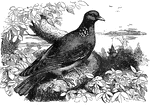
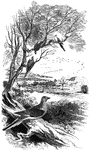
The ring-dove, of the order <em>Columb&aelig;</em>, is one of Europe's largest wild pigeons.

Ring Dove

The ring-dove, of the order Columbæ, is one of Europe's largest wild pigeons.

Once one of the most numerous bird species in the world, the common wild pigeon of the United States is now extinct.

Wild Pigeons

Once one of the most numerous bird species in the world, the common wild pigeon of the United States…
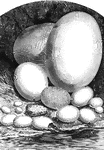
1, Epyornis; 2, Ostrich; 3, Cassoway; 4, Wild Goose; 5, hen; 6, Pigeon; 7, Humming-bird; 8, Eagle; 9, Vulture; 10, Penguin; 11, Crocodile; 12, Python; 13, Fresh-water Tortoise; 14, Boa of St. Lucia; 15, Tortoise; 16, Ophidan; 17, Dog-fish; 18, Ray-fish. The figure in the background without a number represents the egg of the Moa (extinct).

Comparative view of the size of the eggs of different animals

1, Epyornis; 2, Ostrich; 3, Cassoway; 4, Wild Goose; 5, hen; 6, Pigeon; 7, Humming-bird; 8, Eagle; 9,…
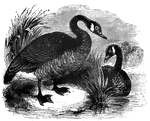
Also known as the wild goose of America, the Canada goose averages about forty inches in length fully-grown, and is known for its yearly migration between Canada and the United States.

Canada Goose

Also known as the wild goose of America, the Canada goose averages about forty inches in length fully-grown,…
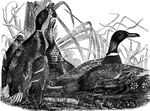
The mallard, also known as the common wild duck averages about twenty-four inches in length. It inhabits Europe and North America.

Mallard Ducks

The mallard, also known as the common wild duck averages about twenty-four inches in length. It inhabits…
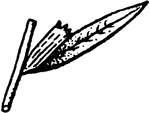

A modified leaf usually subtending a flower or flowers.

Bract

A modified leaf usually subtending a flower or flowers.

A dense cluster of sessile or almost sessile flowers borne on a very short axis.

Head

A dense cluster of sessile or almost sessile flowers borne on a very short axis.

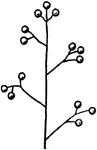
An irregularly compund flower cluster with stalked flowers.

Panicle

An irregularly compund flower cluster with stalked flowers.

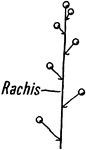
A flower cluster with the flowers stalked and comming off a commonand more or less elongated axis.

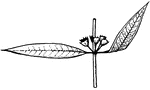
Raceme

A flower cluster with the flowers stalked and comming off a commonand more or less elongated axis.
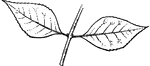
A flower cluster with flowers sessile along a common more or less elongated axis.

Spike

A flower cluster with flowers sessile along a common more or less elongated axis.

Stems weakly arching; leaves lanceolate; flowers showy purplish.

Leaves

Stems weakly arching; leaves lanceolate; flowers showy purplish.

Leaves remotely toothed, acumnate at apex; flowers appearing before the leaves.

Leaves

Leaves remotely toothed, acumnate at apex; flowers appearing before the leaves.

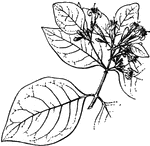
Flowers clusters conspicuous because of large, leaf like, pink sepals.

Flowers

Flowers clusters conspicuous because of large, leaf like, pink sepals.

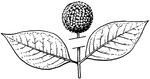
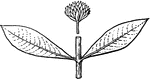
Flowers white in stalked globose clusters; fruits aggregated in spherical.

Flowers

Flowers white in stalked globose clusters; fruits aggregated in spherical.

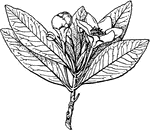
Leaves leathery; evergreen; flowers showy, white, large.

Gordonia

Leaves leathery; evergreen; flowers showy, white, large.

Distant view of Cherry Valley. Cherry Valley derived is name, according to Campbell, from the following circumstance: "Mr. Dunlop [the venerable pastor whose family suffered at the time of the massacre in 1778], engaged in writing some letters, inquired of Mr. Lindesay [the original proprietor of the soil] where he should date them, who proposed the name of a town in Scotland. Mr. Dunlop, pointing to the fine wild cherry-trees and to the valley, replied, 'Let us give our place an appropriate name, and call it Cherry Valley,' which was readily agreed to."

Cherry Valley

Distant view of Cherry Valley. Cherry Valley derived is name, according to Campbell, from the following…
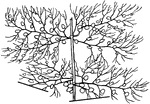
Submerged leaves bearing bladders; flowers irregular, showy ellow or purple.

Utricularia

Submerged leaves bearing bladders; flowers irregular, showy ellow or purple.

Leaves without midribs evident when examined against transmitted light; flowers yellow.

Heteranthera

Leaves without midribs evident when examined against transmitted light; flowers yellow.
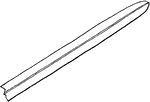
Leaves with midribs evident when examined against light; flowers inconspicuous, not yellow.

Potamogeton

Leaves with midribs evident when examined against light; flowers inconspicuous, not yellow.
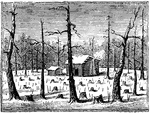
"Scene at the Cowpens. This name is derived from the cirumstance that, some years prior to the Revolution, before this section of country was settled, some persons in Camden (then called Pine-tree) employed two men to go up to the Thicketty Mountain, and in the grassy intervales among the hills, raise cattle. As a compensation, they were allowed the entire use of the cows during the summer for making butter and cheese, and the steers for tilling labor. In the fall, large numbers of the fattest cattle would be driven down to Camden to be slaughtered for beef, on account of the owners. This region, so favorable for rearing cows, on account of the grass and fine springs, was consequently called <em>The Cowpens</em>. The field was covered with blasted pines, stumps, and stocks of indian corn, and had a most dreary appearance."&mdash;Lossing, 1851

Cowpens

"Scene at the Cowpens. This name is derived from the cirumstance that, some years prior to the Revolution,…

"View of the remains of the French Works. These remains are in the southeastern suburbs of the city, about half way between the [African American] Cemetary and the residence of Major William Bowen, seen toward the right of the picture. The banks have an average height, from the bottom of the ditch, of about five feet, and are dotted with pines and chincapins or dwarf chestnuts, the former draped with moss. The ground is an open common, and although it was mid-winter when I was there, it was covered with green grass, bespangled with myriads of little flowers of stellar form. This view is from the direction of the town looking southeast."&mdash;Lossing, 1851

French Works

"View of the remains of the French Works. These remains are in the southeastern suburbs of the city,…
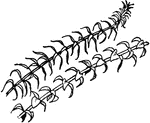
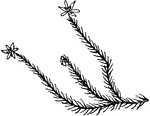
Leaves usually three in whorls (sometimes four); flowers minute and inconspicuous

Anacharis

Leaves usually three in whorls (sometimes four); flowers minute and inconspicuous

Leaves crowded on stem; flowers three petaled, pink and fairly conspicuous.

Mayaca

Leaves crowded on stem; flowers three petaled, pink and fairly conspicuous.

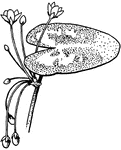
Leaves small, mostly less than 15cm. long, heart-shaped; flowers white and less than 2.5cm across.
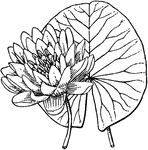
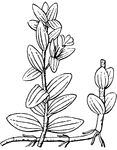
Nymphoides

Leaves small, mostly less than 15cm. long, heart-shaped; flowers white and less than 2.5cm across.
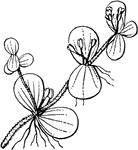
Flowers white; leaf-blade round.

Nymphaea

Flowers white; leaf-blade round.

Plants aromatic when crushed; flowers blue.

Hydrotrida

Plants aromatic when crushed; flowers blue.

Stem finely pubescent, flowers 3-4 mm long.

Herpestris

Stem finely pubescent, flowers 3-4 mm long.

Stem not finely pubescent; flowers not more than 1.5mm long.

Micranthemum

Stem not finely pubescent; flowers not more than 1.5mm long.

flowers solitary in the axils of the leaves; leaves less than 3.5cm long.

Ludwigia

flowers solitary in the axils of the leaves; leaves less than 3.5cm long.

Flowers in stalked head-like spikes; leaves over 3.5cm long.

Alternanthera

Flowers in stalked head-like spikes; leaves over 3.5cm long.

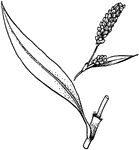
Stems with a sheath just above attachment point of leaf; flowers individually small, white to pink.
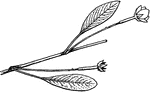
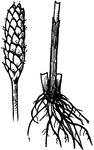
Polygonum

Stems with a sheath just above attachment point of leaf; flowers individually small, white to pink.

Flowers large, showy yellow; fruit a four angled capsule.

Jussiaea

Flowers large, showy yellow; fruit a four angled capsule.

Leaf-sheaths present only at the base of stem; flowers in one group.

Eleocharis

Leaf-sheaths present only at the base of stem; flowers in one group.