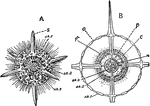
"Actinomma Asteracanthion, a Radiolarian with a limited number of specialized radii (axes), symmetrically arranged about the center. A, whole animal with portion of two spheres of shell removed. B, section, showing relation of the protoplasm to the skeleton. n, nucleus; p, protoplasm; sk., skeleton." — Galloway

Actinomma Asteracanthion

"Actinomma Asteracanthion, a Radiolarian with a limited number of specialized radii (axes), symmetrically…
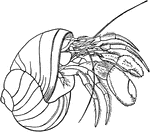
"Hermit crab in the shell of a Gasteropod." — Galloway

Hermit Crab

"Hermit crab in the shell of a Gasteropod." — Galloway

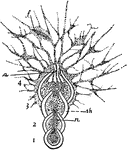
"A compound foraminiferan, Nodosaria. a, aperture of shell; f, food particles captured by the strands of protoplasm outside the shell; n, nucleus; sh, shell, 1-4, the successive chambers of the shell; 1, being the oldest." — Galloway

Nodosaria

"A compound foraminiferan, Nodosaria. a, aperture of shell; f, food particles captured by the strands…
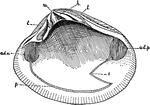
"Shell of a Bivalve Mollusk, inner surface. ad.a., depression showing the attachment of the anterior adductor muscle; ad.p., posterior adductor muscle; h, hinge with teeth; l, attachments of the ligaments; p, pallial line, marking the attachment of the mantle muscles; s, the pallial sinus, marking the attachment of the retractor muscles of the siphon; u, umbo or beak." — Galloway

Bivalve Mollusk

"Shell of a Bivalve Mollusk, inner surface. ad.a., depression showing the attachment of the anterior…
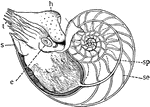
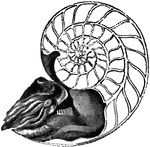
"Pearly Nautilus. e, eye; h, hood, a muscular portion of the foot which protects the softer parts; s, siphon; se, septa, separating the successive chambers of the shell; sp, siphuncle; t, tentacles." — Galloway

Pearly Nautilus

"Pearly Nautilus. e, eye; h, hood, a muscular portion of the foot which protects the softer parts; s,…
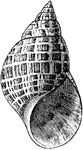
A pheasant sea shell.

Shell

A pheasant sea shell.

A small mollusk. Burrows in soft rocks and is frequently killed by the cold when exposed during times of low tide.

Piddock

A small mollusk. Burrows in soft rocks and is frequently killed by the cold when exposed during times…
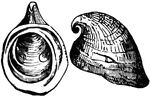
A limpet having the shell pileate in form, with rounded apeture, posterior spirally recurved apex, and horseshoe-shpaed muscular impressions.

Foolscap Limpet

A limpet having the shell pileate in form, with rounded apeture, posterior spirally recurved apex, and…
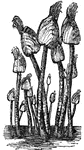
"An animal of one of the lower orders. It fastens itself to some floating object and becomes glued to it by a secretion of cement, and develops a valved shell."

Barnacle

"An animal of one of the lower orders. It fastens itself to some floating object and becomes glued to…
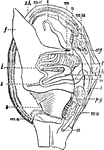
"Anatomy of an Acephalous Mollusc (Mactra): s, stomach; ii, intestine; ag, anterior ganglions; pg, posterior ganglions; mn, muscles; a, anus; h, heart; l, liver; f, foot; sh, shell; ma, mantle; b, branchiae; t, tentacula; r, oral, or respiratory syphon; t, anal syphon." — Chambers, 1881

Mollusc Anatomy

"Anatomy of an Acephalous Mollusc (Mactra): s, stomach; ii, intestine; ag, anterior ganglions; pg, posterior…
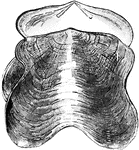
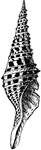
A shell resembling a saddle.

Saddle Shell

A shell resembling a saddle.

A long, slender sea shell.

Shell

A long, slender sea shell.

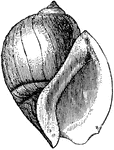
A short and wide sea shell.

Shell

A short and wide sea shell.

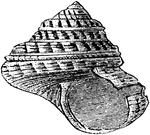
A spiral shaped sea shell.

Shell

A spiral shaped sea shell.

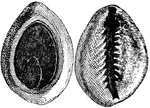
A shell used for games.

Sea Shell

A shell used for games.

A sea shell.

Shell

A sea shell.

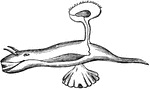
A shell&mdashless heteropod.

Heteropod

A shell&mdashless heteropod.

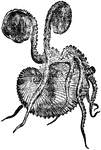
"Argonauta argo, the "Paper Nautilus," female. The animal is represented in its shell, but the webbed dorsal arms are separated from the shell, which they ordinarily embrace." — Encyclopedia Britannica, 1893

Paper Nautilus

"Argonauta argo, the "Paper Nautilus," female. The animal is represented in its shell, but the webbed…
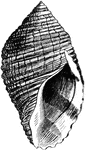
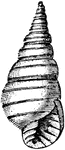
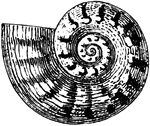
A swirl shaped shell.

Shell

A swirl shaped shell.

A spiral shaped shell.

Shell

A spiral shaped shell.

"Many species hibernate. The land-snails bury themselves in the ground, or conceal themselves under the back of trees, in holes in walls, or even in the stems of large umbelliferous plants. They close the mouth of the shell with a calcareous plate, technically called an epiphragm, which they secrete by means of their mantle, and which is perforated by a small hole to admit the air." — Encyclopediia Britannica, 1893

Helix Descrtorun

"Many species hibernate. The land-snails bury themselves in the ground, or conceal themselves under…
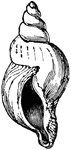
A shell reversed in its spiral.

Reverse Shell

A shell reversed in its spiral.

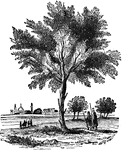
"A genus of the natural orer Rosaceae, sub-order Amygdaleae or Drupaceae, consisting of trees or shrubs, distinguished by the coarsely furrowed and wrinkled shell of the drupe, and by the young leaves being conduplicate, or having their sides folded together." — Chambers' Encyclopedia, 1875

Almond Tree

"A genus of the natural orer Rosaceae, sub-order Amygdaleae or Drupaceae, consisting of trees or shrubs,…
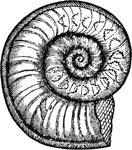
"Ammonites obtusus." — Chambers' Encyclopedia, 1875

Ammonite

"Ammonites obtusus." — Chambers' Encyclopedia, 1875

"Ammonites nodosus." — Chambers' Encyclopedia, 1875

Ammonite

"Ammonites nodosus." — Chambers' Encyclopedia, 1875

"A genus of cephalapodous mollusca, pretty generally known by the name of Paper Nautilus, and in consequence of similarity in the form of the shell, often confounded with the genus Nautilus, but in fact much more nearly allied to the Poulpe (Octopus)." — Chambers' Encyclopedia, 1875

Argonaut

"A genus of cephalapodous mollusca, pretty generally known by the name of Paper Nautilus, and in consequence…
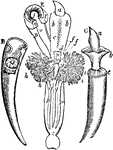
"Dentalium: B, the shell of Dentalium Entalis, broken longitudinally, showing the animal in a contracted state. C, the shell, showing the animal advancing out; a and b, the foot, the lobes of which are developed in the form of a corolla; c, a part of the collar of the mantle. E, the animal, magnified, extricated from the shell, with them antle slit along the dorsal and medial line, detached in part from its posterior insertion, and turned aside so as to show the parts enclosed; a, the extremity of the foot, which closes the aperture j, of the collar lm, of the mantle nop; bb, lobes of the fot; c, the foot itself, presenting a depression or a channel, running its whole length; d, the head; e, the cerebral ganglion; f, f, the two sides of the mouth; g, g, the membranes which support the branchiae; gg, ii, the branchiae; pp, qq, the retractor muscles; s, the muscle of insertion; t, the expanded posterior extremity, in which is situated the vent." — Chambers' Encyclopedia, 1875

Dentalium

"Dentalium: B, the shell of Dentalium Entalis, broken longitudinally, showing the animal in a contracted…
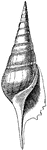
A shell with sharp points on each end.

Shell

A shell with sharp points on each end.

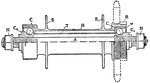
"A ball-bearing hub with outward cups. The hub-shell H is turned out of mild steel, and the cups C are forced into the ends of the hub-shell and soldered thereto. A thin washer W is then spun into the end, for the purpose of retaining oil, and a thin internal tube T unites the two cups, and guides the oil fed in at the middle of the hub to the balls. The projecting flanges S are for the attachment of the tangent spokes used to build the hub into the wheel. The spindle A has the two cones screwed on it, one C, against the shoulder, the other C, adjustable. The-spindle ends are passed through the back-fork ends and are there adjusted in position by the chain-tension adjusters. After adjustments the nuts N clamp the spindle securely between the fork-ends. The chain-wheel or free-wheel clutch is screwed on the end of the hub-shell with a right-hand thread." — The Encyclopedia Britannica, 1910

Ball-bearing Hub

"A ball-bearing hub with outward cups. The hub-shell H is turned out of mild steel, and the cups C are…
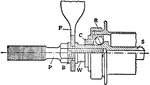
"One end of the cup-adjusting hub, with inward bearings. The cones are formed of one piece with the spindles, and the adjusting cp C is screwed in the end of the hub shell, and locked in position by the screwed locking-ring R. The figure also illustrates a divided spindle for facilitating the removal of the tire for repair when required without disturbing the wheel, bearings, chain or gear-case. The chain side of the hub-spindle, not shown in the figure, is secured to the frame in the usual way; on the left side the spindle S projects very little beyond the adjusting cup. A distance washer W is placed between the end of the spindle S and the fork-end F. A detachable screw-pin, or the footstep, P, passes through the washer W, and is screwed into the end of the spindle S, the hexagod head of the detachable pin drawing all the parts securely together." — The Encyclopedia Britannica, 1910

Cup-adjusting Hub

"One end of the cup-adjusting hub, with inward bearings. The cones are formed of one piece with the…
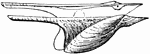
A shell in the shape of a wing.

Wing Shell

A shell in the shape of a wing.

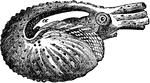
"Pearly nautilus with half the shell removed." —Davison, 1906

Pearly Nautilus

"Pearly nautilus with half the shell removed." —Davison, 1906

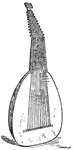
"The European lute is derived in form and name from the Arabic "el ud," "the wood," the consonant of the article "el" having been retained in the European languages for the initial of the name. The Arab instrument, with convex sound-body, pointing to the resonance board or membrane having been originally placed upon a gourd, was strung with silk and played with a plectrum of shell or quill. It was adopted by the Arabs from Persia." —The Encyclopedia Britannica, 1903

Lute

"The European lute is derived in form and name from the Arabic "el ud," "the wood," the consonant of…
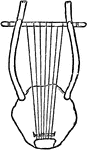
"Chelys, from a vase in the British Museum, where also are fragments of such an instrument, the back of which is of shell." —The Encyclopedia Britannica, 1903

Chelys

"Chelys, from a vase in the British Museum, where also are fragments of such an instrument, the back…

Section of the femur. 1: External view; 2: Cellular portion at end; 3: Hollow in middle; 4: Thick shell of middle.

Femur

Section of the femur. 1: External view; 2: Cellular portion at end; 3: Hollow in middle; 4: Thick shell…
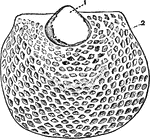

Shell of larval Brachiopod, Phylembryo stage.

Brachiopoda

Shell of larval Brachiopod, Phylembryo stage.

This banner contains a little cherub sitting in a sea shell surrounded by vines and flowers.

Banner

This banner contains a little cherub sitting in a sea shell surrounded by vines and flowers.

Oyster-shell scale, Mytilaspis Pomorum species; a female scale, from beneath, feilled with eggs.

Oyster-shell Scale

Oyster-shell scale, Mytilaspis Pomorum species; a female scale, from beneath, feilled with eggs.
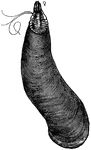
Oyster-shell scale, Mytilaspis Pomorum species; a female scale, from above, filled with eggs.

Oyster-shell Scale

Oyster-shell scale, Mytilaspis Pomorum species; a female scale, from above, filled with eggs.
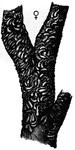
Oyster-shell scale, Mytilaspis Pomorum species; a twig infested by female scales.

Oyster-shell Scale

Oyster-shell scale, Mytilaspis Pomorum species; a twig infested by female scales.
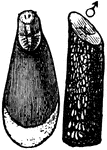
Oyster-shell scale, Mytilaspis Pomorum species; a male scale and a twig infested therewith.

Oyster-shell Scale

Oyster-shell scale, Mytilaspis Pomorum species; a male scale and a twig infested therewith.
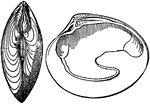
Shell of a bivalve, those mollusks whose coverings consist of two concave shelly plates or valves.
Bivalve

Shell of a bivalve, those mollusks whose coverings consist of two concave shelly plates or valves.

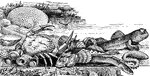
24. Various corals, 25. Razor-shell, 26. Cockle, 27. Various winkels, 28. Shore crab, 29. Father lasher, 30. Periophthalamus, 31. Lobworm, 32. Gunnel

Types of Seashore Life

24. Various corals, 25. Razor-shell, 26. Cockle, 27. Various winkels, 28. Shore crab, 29. Father lasher,…
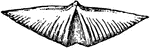
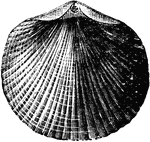
Spirifer sowerbyi, an extinct brachiopod.

Spirifer sowerbyi

Spirifer sowerbyi, an extinct brachiopod.

"A verticle section of one form of blast-furnace is represented [here]. the crucible (C) is the part of the furnace in which the molten matte and slag collect. The body of the furnace consists of two concentric shells (cs), made either of wrought iron or of steel, between which cold water (W) is caused to circulate to precent the inner shell becoming heated...Pipes called tuyeres (T) enter the furnace a short distance above the hearth...Above the body of the furnace extend the hood (H) and the stack (S). A door (D), used in charging the furnace, is placed in the hood." -Brownlee 1907

Blast-furnace

"A verticle section of one form of blast-furnace is represented [here]. the crucible (C) is the part…
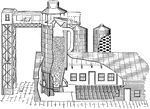
"Iron ores are smelted in a blast furnace which is operated in a manner similar to that employed in the production of copper matte. An iron blast furnace consists of a steel shell from 75 to 90 feet in height, lined with a thick layer of fire-brick." -Brownlee 1907

Blast Furnace for Cast Iron

"Iron ores are smelted in a blast furnace which is operated in a manner similar to that employed in…
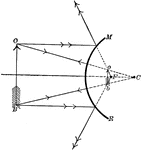
"A convex mirror is generally a part of the other surface of a spherical shell. It increases the divergence, or decreases the convergence of light that falls upon it. The foci are virtual; the principal focus is midway between the center of the mirror and the center of curvature. The foci may be located and the images determined by processes closely similar to those used for concave mirrors, as illustrated." -Avery 1895

Convex Mirror

"A convex mirror is generally a part of the other surface of a spherical shell. It increases the divergence,…
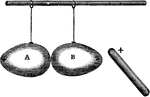
"Suspend two egg-shell conductors as shown. Be sure that the shells are in contact. Bring an electrified glass rod near one of them, and slide one of the loops along the supporting rod until the shells are about 10 cm. apart. Hold the electrified rod between the shells. It will attract one and repel the other, showing that thye are oppositely electrified." -Avery 1895

Electrostatic Induction

"Suspend two egg-shell conductors as shown. Be sure that the shells are in contact. Bring an electrified…
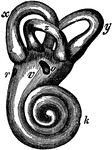
In this figure are shown the winding passages of the ear (the labyrinth of the ear). The middle part of it (v) is the vestibule. From this go out on the upper side the semi-circular canals (x,y,z) and on the lower side of the passages of the cochlea (k). The opening into the vestibule (o) is covered by the second drum. Another opening (r) is also covered by a membrane or drum. The cochlea (k) is so called because it is shaped like a snail's shell.

The Cochlea and Passages of the Ear

In this figure are shown the winding passages of the ear (the labyrinth of the ear). The middle part…
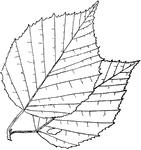
Leaves - simple; alternate; edge sharply and unequally double-toothed. Outline - egg-shaped. Apex - pointed. Base - rounded, slightly heart-shaped, or, rarely, wedge-shaped. Leaf/Stem - downy. Leaf - two to three inches long; dark green and smooth above; beneath, dull, and with the ribs somewhat hairy, especially in their angles. Bark - of trunk very tough and durable; thick; snow-white on the outside; easily removed from the wood, and then itself very separable into paper-like sheets. The inner sheets are of a reddish tinge. Found - in the mountains of Northern Pennsylvania, New England, and far northward, farther than any other non-evergreen tree of America, excepting the aspen.    General Information - A tree, forty to seventy feet high. The wood is light, hard, and very close-grained, but decays rapidly when exposed - more rapidly than the bark, which often remains as a shell long after the wood within has disappeared. It is very largely used in making spools, pegs, shoe-lasts, in turnery, for wood-pulp, and for fuel. The waterproof bark is much used by Indians and trappers for their canoes. "Give me of your bark, O Birch-Tree! Of your yellow bark, O Birch-Tree! Growing by the rushing river, Tall and stately in the valley! I a light canoe will build me, That shall float upon the river, Like a yellow leaf in autumn, Like a yellow water-lily. 'Lay aside your cloak, O Birch-Tree! Lay aside your white-skin wrapper, For the summer time is coming, And the sun is warm in the heaven, And you need no white-skin wrapper!'" Hiawatha

Genus Betula, L. (Birch)

Leaves - simple; alternate; edge sharply and unequally double-toothed. Outline - egg-shaped. Apex -…
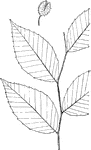
Leaves - simple; alternate; edge sharp-toothed, with small and remote teeth. Outline - oval or egg-shape. Apex - taper-pointed. Base - rounded. Leaf - three to six inches long, about half as wide; a very "finished" leaf; when young, fringed with soft white hairs; becoming smooth and polished; with distinct and straight unbranched side-ribs, ending in the teeth of the edge. The dead, bleached leaves often cling thickly to the branches throughout the winter. Bark - of the trunk, light gray, smooth, and unbroken. Fruit - a small four-celled prickly burr, splitting half-way to the base when ripe, and with two sweet, three-sided nuts in each shell.Found - in rich woods, Nova Scotia to Florida and westward, with it finest growth on the "bluffs" of the lower Mississippi basin. General Information - Large stately trees, with spreading branches and a delicate spray, fifty to eighty feet high. The wood is hard and very close-grained, and is used largely in the making of chairs, handles, plan-stocks, shoe-lasts, and for fuel. When the tree is not crowded, it sends out its nearly horizontal or drooping branches as low as from ten to thirty feet above the ground. Lumber-men make the distinction of "red Beech" and "White Beech," claiming that the former is harder, with a redder and thicker heart-wood.  Among woodsmen and the Indians, the Beech is said to be a favorite refuge in thunder-storms. They claim that it is scarcely ever struck by lightning. Lumber-men claim a difference in the quality of trees which retain their leaves and those which shed them. "Said a neighbor to me one day: 'You might 'a knowed that beech would split hard with all the dry leaves on it,' -- and it did. That was the first I'd ever heard of the sign, but I've never known it fail since."

Genus Fagus, L. (Beech)

Leaves - simple; alternate; edge sharp-toothed, with small and remote teeth. Outline - oval or egg-shape.…
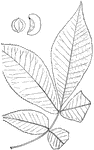
Leaves - compound (odd-feathered; leaflets, five); alternate; edge of leaflets sharp-toothed. Outline - of leaflet, long oval, reverse egg-shape or egg-shape, the lower pair differing in shape from the others, and much smaller. Apex - long-pointed. Base - of the end leaflet, wedge-shape; of the others, more or less blunted. Leaf/Stem - rough throughout. Buds - large and scaly, often of a green and brown color. Leaflet/Stems - lacking (or scarcely noticeable), excepting the roughish stem of the end leaflet. Leaflets - four to eight inches long; roughish below. Bark - dark and very rough in the older trunks, peeling up and down in long, shaggy strips. Often the strips cling at their middle and are loose at each end. Fruit - round, nearly one and a half to two inches in diameter; the husk, thick (nearly half an inch), depressed at the center, grooved at the seams, and wholly separating into four inches at maturity; the nut, about one inch long, often the same in breadth, slightly flattened at the sides, angular, nearly pointless, whitish, with a rather this shell, and a large finely flavored kernel. October. Found - from the valley of the St. Lawrence River to Southeastern Minnesota, and southward to Western Florida. Its finest growth is west of the Alleghany Mountains.General Information - A tree, fifty to eighty feet high, of great value. Its tough and elastic wood is used in making agricultural implements, carriages, axe-handles, etc. It ranks also among the best of woods for fuel. Most of the "hickory nuts" of the markets are from this species. All the Hickories are picturesque trees. Their tendency, even when standing alone, is to grow high, and with heads that, instead of being round, are cylinder-shaped to the very top, with only enough breaks and irregularities to add to the effect. This tendency is more marked in the Hickories than in any other of the leaf-shedding trees of North America. They are worthy of the name sometimes given them of 'the artist's tree." Hicoria, from a Greek word meaning round, in allusion to the shape of the nut.

Genus Hicoria, Raf., Carya, Nutt. (Hickory)

Leaves - compound (odd-feathered; leaflets, five); alternate; edge of leaflets sharp-toothed. Outline…
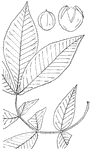
Leaves - compound (odd-feathered, leaflets, seven to nine); alternate; edge slightly and rather roundly toothed. Outline - of leaflets, mostly long oval, the lower pairs becoming smaller and more egg-shaped. Apex - long-pointed. Base - of the end leaflet, wedge-shape; of the others, more or less blunted. Leaf/Stem - rough throughout. Buds - large and round and covered with downy, yellowish-brown scales, or, in winter, with hard and grayish-white scales. Leaflet/Stem - lacking (or scarcely noticeable), except the short, roughish stem of the end leaflet. Leaflets - two to seven inches long, rough beneath, especially on the ribs; fragrant when crushed. Bark - rough, becoming cracked across, but not scaly. Fruit - rounded, slightly egg-shaped or oval, one and one half to two inches or more in length. The husk is about one fourth of an inch thick and splits nearly to the base when ripe. Nut - slightly six-angled, light brown, with a very thick and hard shell. Kernel - is sweet, but small. October. Found - common in dry woods, especially southward and westward. It grows in Southern Canada and I all the Atlantic States. General Information - All the Hickories are picturesque trees. Their tendency, even when standing alone, is to grow high, and with heads that, instead of being round, are cylinder-shaped to the very top, with only enough breaks and irregularities to add to the effect. This tendency is more marked in the Hickories than in any other of the leaf-shedding trees of North America. They are worthy of the name sometimes given them of 'the artist's tree." Hicoria, from a Greek word meaning round, in allusion to the shape of the nut.

Genus Hicoria, Raf., Carya, Nutt. (Hickory)

Leaves - compound (odd-feathered, leaflets, seven to nine); alternate; edge slightly and rather roundly…
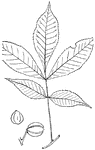
Leaves - compound (odd-feathered; leaflets, five to seven, oftenest five); alternate; edge of leaflets sharp-toothed. Outline - of leaflets, mostly long oval. Apex - pointed. Base - pointed. Leaf/Stem - smooth. Leaflet/Stems - lacking (or scarcely noticeable), excepting the short stem of the end leaflet. Leaflets - mostly four to eight inches long, remarkable smooth, excepting that the under surface is tufted in the angles of the ribs and usually dotted with dark glandular spots. Bark - rough and close. Fruit - broad egg-shape. Husk - thin, splitting part way to the base. Nut - small (three fourths of an inch in diameter), not angled, not sharp-pointed, and with a thin shell.Found - on moist ground, New York to Delaware, west to Michigan and Illinois, rarely, if ever, in New England. General Information - All the Hickories are picturesque trees. Their tendency, even when standing alone, is to grow high, and with heads that, instead of being round, are cylinder-shaped to the very top, with only enough breaks and irregularities to add to the effect. This tendency is more marked in the Hickories than in any other of the leaf-shedding trees of North America. They are worthy of the name sometimes given them of 'the artist's tree." Hicoria, from a Greek word meaning round, in allusion to the shape of the nut.

Genus Hicoria, Raf., Carya, Nutt. (Hickory)

Leaves - compound (odd-feathered; leaflets, five to seven, oftenest five); alternate; edge of leaflets…
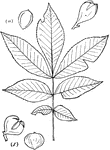
Leaves - compound (odd-feathered; leaflet, five to nine, usually seven) ; alternate, edge of leaflets sharp-toothed. Outline - of leaflets, usually long oval. Apex - taper-pointed. Base - of end leaflet, wedge-shaped, of the others more or less rounded or slightly pointed. Leaf/Stem - smooth. Leaf/Buds - egg-shape and pointed or rounded, and with their outer scales a polished-brown. Leaflet/Stems - lacking, except the smooth, very short stem of the end leaflet. Leaflets - mostly two to five inches long (the lower ones much the smallest), smooth above and below. Bark - not shaggy. Fruit - of two forms: (a) pear-shape, (b) rounded. Husks - very thin, splitting about half-way to the base. Nut - about one inch in diameter; in (b) somewhat flattened at the sides and slightly hollowed above, and with the apex a sharp point. Shell - rather thin, smooth, hard, and bluish-gray. Meat - small and sweetish or slightly bitter. Found - from Southern Maine westward and southward. General information - All the Hickories are picturesque trees. Their tendency, even when standing alone, is to grow high, and with heads that, instead of being round, are cylinder-shaped to the very top, with only enough breaks and irregularities to add to the effect. This tendency is more marked in the Hickories than in any other of the leaf-shedding trees of North America. They are worthy of the name sometimes given them of 'the artist's tree." Hicoria, from a Greek word meaning round, in allusion to the shape of the nut.

Genus Hicoria, Raf., Carya, Nutt. (Hickory)

Leaves - compound (odd-feathered; leaflet, five to nine, usually seven) ; alternate, edge of leaflets…
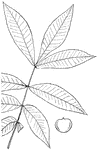
Leaves - compound (odd-feathered; leaflets, seven to eleven); alternate; edge of leaflet sharp-toothed. Outline - of leaflet, long oval or long egg-shape. Apex, taper-pointed. Base, pointed or blunted. Leaf/Stem - rather slender, somewhat downy, and often flattened and winged. Leaf/buds - small, slightly rounded or (at the ends of the branchlets) pointed, and yellow. Leaflet/Stems - lacking, except the short stem of the end leaflet. Leaflets - four to six inches long, the upper one usually short; smooth on both sides, or with a slight, scattered down below. Bark - rather smooth. Fruit - rounded or slightly egg-shaped, dark green. Husk - very thin and fleshy, never becoming entirely hard, with prominent winged edges at the seams, only two of which reach more than half-way to the base. It divides half-way down when ripe. Nut - barely one inch long, heart-shaped at the top, broader than long, white and smooth. Shell - so thin that it can be broken with the fingers. Kernel - intensely bitter. Found - usually in wet grounds, though often also on rich uplands, from Southern Maine westward and southward. It reaches its finest growth in Pennsylvania and Ohio. General information - A rather smaller and less valuable tree than the rest of the hickories.

Genus Hicoria, Raf., Carya, Nutt. (Hickory)

Leaves - compound (odd-feathered; leaflets, seven to eleven); alternate; edge of leaflet sharp-toothed.…
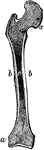
The above cut represents a section of the thigh bone. The extremities (a, w) having a shell or thin plate of compact texture, crowded with small cells, diminishing in size, but increasing in number as they approach the articulation (c), the cavity for containing the marrow; the walls of the shaft are very firm and solid (b, b). The compact part is thickest near the middle of the bone where the greatest strength is required.

Thigh Bone Section

The above cut represents a section of the thigh bone. The extremities (a, w) having a shell or thin…
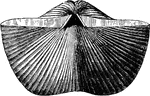
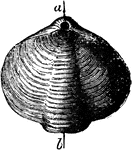
The shell of Spirifer striatus, a species of brachiopod.

Spirifer Brachiopod

The shell of Spirifer striatus, a species of brachiopod.

The shell of Athyris concentrica, a species of brachiopod.

Athyris Brachiopod

The shell of Athyris concentrica, a species of brachiopod.

The shell of Atrypa reticularis, a species of brachiopod.

Atrypa Brachiopod

The shell of Atrypa reticularis, a species of brachiopod.