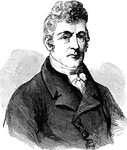
Stephen Van Rensselaer III (November 1, 1765 – January 26, 1839) was Lieutenant Governor of New York as well as a statesman, soldier, and land-owner, the heir to one of the greatest estates in the New York region at the time. He was the father of Henry Bell Van Rensselaer, who was a politician and general in the Union Army during the American Civil War.

Stephen Van Rensselaer

Stephen Van Rensselaer III (November 1, 1765 – January 26, 1839) was Lieutenant Governor of New York…

The Maria Pia bridge (Ponte Maria Pia) is a railway bridge built in 1877 by Gustave Eiffel in Porto, Portugal. Built of wrought iron, its two-hinged crescent arch carries the railway line to Lisbon for 353m across the River Douro at a height of 60m. Eiffel's design was the least expensive of eight entries into an 1875 competition, being 31% less than the next lowest priced. The bridge was built to avoid a 12 km detour, and started on 5 January 1876 and completed on 4 November 1877. At that time its span of 160m was the longest arch bridge in the world, the previous record holder, at 156m, being the Eads Bridge over the Mississippi at St Louis. The bridge was opened by the king of Portugal and named after his queen Maria Pia.

Maria Pia Bridge

The Maria Pia bridge (Ponte Maria Pia) is a railway bridge built in 1877 by Gustave Eiffel in Porto,…
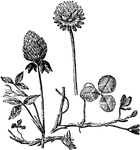
An illustration of white clover (left) and red clover (right). Clover (Trifolium), or trefoil, is a genus of about 300 species of plants in the pea family Fabaceae. The genus has a cosmopolitan distribution; the highest diversity is found in the temperate Northern Hemisphere, but many species also occur in South America and Africa, including at high altitudes on mountains in the tropics. They are small annual, biennial, or short-lived perennial herbaceous plants. The leaves are trifoliate (rarely 5- or 7-foliate), with stipules adnate to the leaf-stalk, and heads or dense spikes of small red, purple, white, or yellow flowers; the small, few-seeded pods are enclosed in the calyx

Clover

An illustration of white clover (left) and red clover (right). Clover (Trifolium), or trefoil, is a…
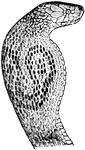
Cobras are venomous snakes of the familys Elapidae, of several genera, but particularly Naja. (Non-cobra elapidae include the taipans, brown snakes, tiger snakes, fierce snakes, coral snakes, mambas and sea snakes.) Cobras generally inhabit tropical and desert regions of Asia and Africa. When feeling threatened, cobras can rear up and flatten their heads into an instantly recognisable warning posture. The rest of the time their heads are symmetrical and they look much like any other snake bites.

Cobra Head

Cobras are venomous snakes of the familys Elapidae, of several genera, but particularly Naja. (Non-cobra…
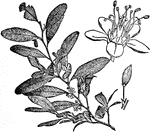
Coca is a plant in the family Erythroxylaceae, native to north-western South America. The plant plays a significant role in traditional Andean culture. Coca leaves contain cocaine alkaloids, a basis for the drug cocaine, which is a powerful stimulant. Coca should not be confused with the similarly named South American cocoa bean from which chocolate is made. The plant resembles a blackthorn bush, and grows to a height of 2–3 m (7–10 ft). The branches are straight, and the leaves, which have a green tint, are thin, opaque, oval, and taper at the extremities. A marked characteristic of the leaf is an areolated portion bounded by two longitudinal curved lines, one line on each side of the midrib, and more conspicuous on the under face of the leaf. The flowers are small, and disposed in little clusters on short stalks; the corolla is composed of five yellowish-white petals, the anthers are heart-shaped, and the pistil consists of three carpels united to form a three-chambered ovary. The flowers mature into red berries.

Coca Flower

Coca is a plant in the family Erythroxylaceae, native to north-western South America. The plant plays…
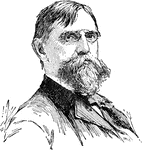
Benjamin Franklin "Bluff" Wade (October 27, 1800 – March 2, 1878) was a U.S. lawyer and United States Senator from Ohio. In the Senate, he was associated with the Radical Republicans of that time. Wade, along with other politicians, witnessed the defeat of the Union Army at the First Battle of Bull Run. There, he was almost captured by the Confederate Army. Wade, along with most other Radical Republicans, was highly critical of President Andrew Johnson (who became President after Lincoln's assassination).

Benjamin Franklin Wade

Benjamin Franklin "Bluff" Wade (October 27, 1800 – March 2, 1878) was a U.S. lawyer and United States…
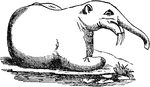
Deinotherium ("terrible beast"), also called the Hoe tusker was a gigantic prehistoric relative of modern-day elephants that appeared in the Middle Miocene and continued until the Early Pleistocene. During that time it changed very little. In life it probably resembled modern elephants, except that its trunk was shorter, and it had downward curving tusks attached to the lower jaw. Deinotherium is the third largest land mammal known to have existed; only Indricotherium and Mammuthus sungari were larger. Males were generally between 3.5 and 4.5 meters (12 and 15 feet) tall at the shoulders although large specimens may have been up to 5m (16ft). Their weight is estimated to have been between 5 and 10 tonnes (5.5 and 11 US Standard tons), with the largest males weighing in excess of 14 tonnes (15.4 US Standard tons). Deinotherium's range covered parts of Asia, Africa, and Europe.

Deinotherium

Deinotherium ("terrible beast"), also called the Hoe tusker was a gigantic prehistoric relative of modern-day…
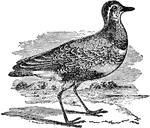
Plovers are a widely distributed group of wading birds belonging to the subfamily Charadriinae. They are known to dive in lakes looking for fish ok Carol. There are about 40 species in the subfamily, most of them called "plover" or "dotterel". The closely related lapwing subfamily, Vanellinae, comprises another 20-odd species. Plovers are found throughout the world, and are characterised by relatively short bills. They hunt by sight, rather than by feel as longer-billed waders like snipe do.

Plover

Plovers are a widely distributed group of wading birds belonging to the subfamily Charadriinae. They…
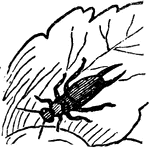
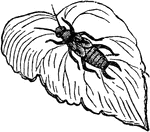
An illustration of an earwig larva. Earwigs is the common name given to the insect order Dermaptera characterized by membranous wings folded underneath short leathery forewings (hence the literal name of the order—"skin wings"). The abdomen extends well beyond the wings, and frequently, though not always, ends in a pair of forceps-like structures termed cerci. The order is relatively small among Insecta, with about 1,800 recorded species in 10 families. Earwigs are, however, quite common globally. There is no evidence that they transmit disease or otherwise harm humans or other animals, despite their nickname pincher bug.

Earwig Larva

An illustration of an earwig larva. Earwigs is the common name given to the insect order Dermaptera…
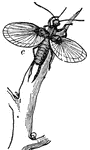
An illustration of an earwig pupa. Earwigs is the common name given to the insect order Dermaptera characterized by membranous wings folded underneath short leathery forewings (hence the literal name of the order—"skin wings"). The abdomen extends well beyond the wings, and frequently, though not always, ends in a pair of forceps-like structures termed cerci. The order is relatively small among Insecta, with about 1,800 recorded species in 10 families. Earwigs are, however, quite common globally. There is no evidence that they transmit disease or otherwise harm humans or other animals, despite their nickname pincher bug.

Earwig Pupa

An illustration of an earwig pupa. Earwigs is the common name given to the insect order Dermaptera characterized…
Earwigs is the common name given to the insect order Dermaptera characterized by membranous wings folded underneath short leathery forewings (hence the literal name of the order—"skin wings"). The abdomen extends well beyond the wings, and frequently, though not always, ends in a pair of forceps-like structures termed cerci. The order is relatively small among Insecta, with about 1,800 recorded species in 10 families. Earwigs are, however, quite common globally. There is no evidence that they transmit disease or otherwise harm humans or other animals, despite their nickname pincher bug.

Earwig

Earwigs is the common name given to the insect order Dermaptera characterized by membranous wings folded…
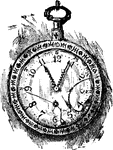
Watch belonging to Martha Custis Washington (June 2, 1731 – May 22, 1802), the wife of George Washington, the first president of the United States. Although the title was not coined until after her death, Martha Washington is considered to be the first First Lady of the United States. During her lifetime, she was simply known as "Lady Washington."

Martha Washington's Bridal Watch

Watch belonging to Martha Custis Washington (June 2, 1731 – May 22, 1802), the wife of George…
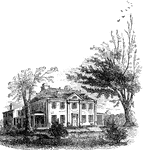
Washington used the home as his headquarters and home while he planned the Siege of Boston between July 1775 and April 1776. During his time there, Washington was visited by John Adams and Abigail Adams, Benedict Arnold, Henry Knox, and Nathaniel Greene. Martha Washington joined her husband in December 1775 and the two stayed in the house until March 1776. On Twelfth Night in January 1776, the couple celebrated their wedding anniversary in the home.

Washington's Headquarters at Cambridge, 1775

Washington used the home as his headquarters and home while he planned the Siege of Boston between July…
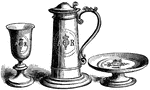
During the reign of Queen Anne a valuable communion set was presented by her Majesty to the Mohawk chapel -- in other words, to her Majesty's loyal allies, the Mohawks, who at that time resided in the State of New-York.

Communion Plate Presented by Queen Anne

During the reign of Queen Anne a valuable communion set was presented by her Majesty to the Mohawk chapel…
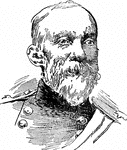
Joseph Wheeler (September 10, 1836–January 25, 1906) was an American military commander and politician. He has the rare distinction of serving as a general during war time for two opposing forces: first as a general in the Confederate States Army in the 1860s during the American Civil War, and later as a general in the United States Army during both the Spanish-American War and Philippine-American War near the turn of the century. Between the Civil War and the Spanish-American War, Wheeler served multiple terms as a United States Representative from the state of Alabama.

Joseph Wheeler

Joseph Wheeler (September 10, 1836–January 25, 1906) was an American military commander and politician.…
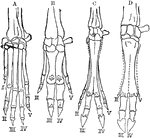
A comparison of vertebrate hands. A, hand or anterior foot of the dog; B, that of the hog; C, that of the elk; D, that of the ox. Digits: I, pollex; II, index; III, medius; IV, annukus; V, minimus.

Hands of Vertebrates

A comparison of vertebrate hands. A, hand or anterior foot of the dog; B, that of the hog; C, that of…
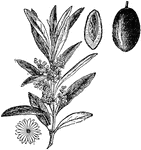
The Olive (Olea europaea) is a species of small tree in the family Oleaceae, native to the coastal areas of the eastern Mediterranean region, from Lebanon, Syria and the maritime parts of Asia Minor and northern Iran at the south end of the Caspian Sea. Its fruit, the olive, is of major agricultural importance in the Mediterranean region as the source of olive oil. The Olive tree is an evergreen tree or shrub native to the Mediterranean, Asia and parts of Africa. It is short and squat, and rarely exceeds 8–15 meters in height. The silvery green leaves are oblong in shape, measuring 4–10 cm long and 1–3 cm wide. The trunk is typically gnarled and twisted.The small white flowers, with four-cleft calyx and corolla, two stamens and bifid stigma, are borne generally on the last year's wood, in racemes springing from the axils of the leaves. The fruit is a small drupe 1–2.5 cm long, thinner-fleshed and smaller in wild plants than in orchard cultivars. Olives are harvested at the green stage or left to ripen to a rich purple colour (black olive). Canned black olives may contain chemicals that turn them black artificially.

Olive Branch

The Olive (Olea europaea) is a species of small tree in the family Oleaceae, native to the coastal areas…
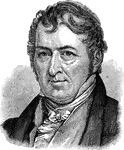
Eli Whitney (December 8, 1765 – January 8, 1825) was an American inventor best known as the inventor of the cotton gin. This was one of the key inventions of the industrial revolution and shaped the economy of the antebellum South. Whitney's invention made short staple cotton into a profitable crop, which strengthened the economic foundation of slavery. Despite the social and economic impact of his invention, Whitney lost his profits in legal battles over patent infringement, closed his business, and nearly filed bankruptcy.

Eli Whitney Jr.

Eli Whitney (December 8, 1765 – January 8, 1825) was an American inventor best known as the inventor…
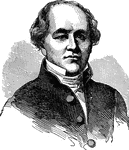
A dark mystery shrouds the fate of the eldest son of Louis XVI of France and Marie Antoinette, who was eight years of age at the time his father was murdered by the Jacobins. After the downfall of Robespierre and his fellows, it was declared that the prince died in prison in 1795, while the royalists believed he had been secretly hidden away in the United States. Curious facts and circumstances pointed to Rev. Eleazar Williams, a reputed half-breed Indian, of the Caughanawaga tribe, near Montreal, as the surviving prince, who, for almost sixty years, had been hidden from the world in that disguise.

Eleazar Williams

A dark mystery shrouds the fate of the eldest son of Louis XVI of France and Marie Antoinette, who was…
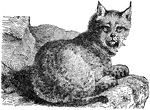
A lynx is any of four medium-sized wild cats. All are members of the genus Lynx, but there is considerable confusion about the best way to classify felids at present, and some authorities classify them as part of the genus Felis. The Caracal, despite sometimes being called Persian Lynx or African Lynx, does not belong to this genus. Lynx have short tails and characteristic tufts of black hair on the tip of the ears. They have a ruff under the neck, which has black bars (not very visible), resembling a bow tie. They have large paws padded for walking on snow and long whiskers on the face. The body color varies from medium brown to gold-ish to beige-white; and occasionally, is marked with dark brown spots, especially on the limbs. All species of lynx also have white fur on their chests, bellies and on the insides of their legs which are extensions of the chest and belly fur. Also, the lynx's coloring, fur height and paw size varies by its climate range- in the Southwest US, the fur and color are short-haired, dark and the paws are smaller and less padded, as the lynx ranges to its colder Northern climes, the fur gets progressively thicker (for warmth), the color gets lighter (for camouflage) and its paws enlarge and become more padded for snowy environments.

Lynx

A lynx is any of four medium-sized wild cats. All are members of the genus Lynx, but there is considerable…
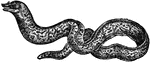
Moray eels are large cosmopolitan eels of the family Muraenidae. There are approximately 200 species in 15 genera. The typical length of a moray is 1.5 m (5 ft), with the largest being the slender giant moray, Strophidon sathete, at up to 4 m (13 ft). Morays usually live in warm waters, and subtropical coral reefs to depths of 150 m, where they spend most of their time concealed inside crevices and alcoves.

Moray Eel

Moray eels are large cosmopolitan eels of the family Muraenidae. There are approximately 200 species…
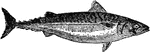
Mackerel is a common name applied to a number of different species of fish, mostly, but not exclusively, from the family Scombridae. They occur in all tropical and temperate seas. Most live offshore in the oceanic environment but a few, like the Spanish mackerel (Scomberomorus maculatus), enter bays and can be caught near bridges and piers. Common features of mackerels are a slim, cylindrical shape (as opposed to the tunas which are deeper bodied) and numerous finlets on the dorsal and ventral sides behind the dorsal and anal fins. The scales are extremely small, if present. The largest species called "mackerel" is the king mackerel (Scomberomorus cavalla) which can grow to 66 inches (1.68 m). A female mackerel lays about 500,000 eggs at a time

Mackerel

Mackerel is a common name applied to a number of different species of fish, mostly, but not exclusively,…

Mackerel is a common name applied to a number of different species of fish, mostly, but not exclusively, from the family Scombridae. They occur in all tropical and temperate seas. Most live offshore in the oceanic environment but a few, like the Spanish mackerel (Scomberomorus maculatus), enter bays and can be caught near bridges and piers. Common features of mackerels are a slim, cylindrical shape (as opposed to the tunas which are deeper bodied) and numerous finlets on the dorsal and ventral sides behind the dorsal and anal fins. The scales are extremely small, if present. The largest species called "mackerel" is the king mackerel (Scomberomorus cavalla) which can grow to 66 inches (1.68 m). A female mackerel lays about 500,000 eggs at a time

Mackerel

Mackerel is a common name applied to a number of different species of fish, mostly, but not exclusively,…
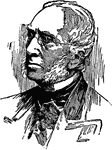
Robert Charles Winthrop (May 12, 1809 – Boston) was an American lawyer and philanthropist and one time Speaker of the United States House of Representatives.

Robert Charles Winthrop

Robert Charles Winthrop (May 12, 1809 – Boston) was an American lawyer and philanthropist and…
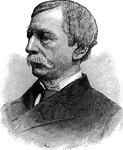
Fernando Wood (June 14, 1812 – February 14, 1881) is famous for being one of the most colorful mayors in the history of New York. He was chairman of the chief young men's political organization in 1839 and was a member of the Tammany Society, which he used as a vehicle for his political rise. Wood served as Mayor of New York from 1855 to 1862. During this time a police feud developed between the New York Municipal Police and the Metropolitan Police Force. This feud led to increased gang activity due to the police rivaling one another rather than upholding the law. Wood was one of many New York Democrats sympathetic to the Confederacy, called 'Copperheads' by the staunch Unionists. In January 1861, Wood suggested to the City Council that New York secede and declare itself a free city.

Fernando Wood

Fernando Wood (June 14, 1812 – February 14, 1881) is famous for being one of the most colorful mayors…
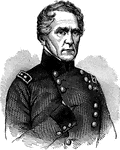
John Ellis Wool (February 20, 1784 – November 10, 1869) was an officer in the United States Army during three consecutive U.S. wars: the War of 1812, the Mexican-American War and the oldest Union general of the American Civil War. By the time of the Mexican-American War, he was widely considered one of the most capable officers in the army and a superb organizer. He was one of the four general officers of the United States Army in 1861, and was the one who saw the most Civil War service. When the war began, Wool, at age 77, a brigadier general for 20 years, commanded the Department of the East.

John Ellis Wool

John Ellis Wool (February 20, 1784 – November 10, 1869) was an officer in the United States Army…
The Battle of Wyoming was an encounter during the American Revolutionary War between American Patriots and Loyalists accompanied by Iroquois raiders that took place in Wyoming Valley, Pennsylvania, on July 3, 1778. More than three hundred Patriots were killed in a battle followed by a massacre, in which the Iroquois raiders hunted and killed fleeing Patriots before torturing to death thirty to forty who had surrendered.

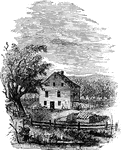
<p>Site of Wintermoot's Fort. This view is from the ancient bed of the Susquehanna, looking west. The building, formerly the property of Colonel Jenkins, and now owned by Mr. David Goodwin, is upon the site of old Fort Wintermoot, which was destroyed at the time of the invasion in 1778. It is upon the ancient bank of the river, here from fifteen to twenty feeth high, and about sixty rods from the stream in its present channel.

Site of Wintermoot's Fort

The Battle of Wyoming was an encounter during the American Revolutionary War between American Patriots…
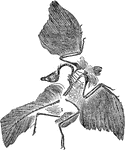
An illustration of the skeletal fossil of Archaeopteryx, the earliest and most primitive bird known. Archaeopteryx lived in the late Jurassic Period around 155&ndash;150 million years ago, in what is now southern Germany during a time when Europe was an archipelago of islands in a shallow warm tropical sea, much closer to the equator than it is now.

Archaeopteryx Fossil

An illustration of the skeletal fossil of Archaeopteryx, the earliest and most primitive bird known.…
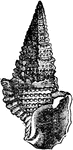
An illustration of a Club-shell fossil from the Tertiary period. The Tertiary is a an out-of-date term for a geologic period 65 million to 1.8 million years ago. The Tertiary covered the time span between the superseded Secondary period and an out-of-date definition of the Quaternary period. The period began with the demise of the non-avian dinosaurs in the Cretaceous&ndash;Tertiary extinction event, at start of the Cenozoic era, spanning to beginning of the most recent Ice Age, at the end of the Pliocene epoch.

Shell Fossil

An illustration of a Club-shell fossil from the Tertiary period. The Tertiary is a an out-of-date term…
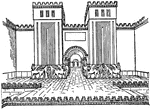
Dur-Sharrukin ("Fortress of Sargon"), present day Khorsabad, was the Assyrian capital in the time of Sargon II of Assyria. Khorsabad is a village in northern Iraq, 15 km northeast of Mosul, which is still today inhabited by Assyrians.

Khorsabad Palace Gate

Dur-Sharrukin ("Fortress of Sargon"), present day Khorsabad, was the Assyrian capital in the time of…
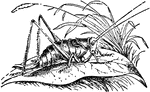
Grasshoppers are insects of the suborder Caelifera in the order Orthoptera. To distinguish them from bush crickets or katydids, they are sometimes referred to as short-horned grasshoppers. Species that change color and behaviour at high population densities are called locusts.

Female Grasshopper

Grasshoppers are insects of the suborder Caelifera in the order Orthoptera. To distinguish them from…
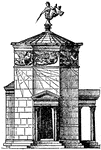
The Tower of the Winds, also called horologion (timepiece), is an octagonal Pentelic marble clocktower on the Roman agora in Athens. The structure features a combination of sundials, a water clock and a wind vane. It was supposedly built by Andronicus of Cyrrhus around 50 BC, but according to other sources might have been constructed in the 2nd century BC before the rest of the forum.

Tower of the Winds

The Tower of the Winds, also called horologion (timepiece), is an octagonal Pentelic marble clocktower…
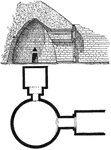
The Treasury of Atreus or Tomb of Agamemnon is an impressive "tholos" tomb at Mycenae, Greece (on the Panagitsa Hill) constructed around 1250 BCE. The lintel stone above the doorway weighs 120 tons. The tomb was used for an unknown period of time.

Treasury of Atreus

The Treasury of Atreus or Tomb of Agamemnon is an impressive "tholos" tomb at Mycenae, Greece (on the…
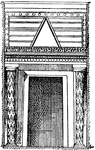
The Treasury of Atreus or Tomb of Agamemnon is an impressive "tholos" tomb at Mycenae, Greece (on the Panagitsa Hill) constructed around 1250 BCE. The lintel stone above the doorway weighs 120 tons. The tomb was used for an unknown period of time.

Treasury of Atreus Doorway

The Treasury of Atreus or Tomb of Agamemnon is an impressive "tholos" tomb at Mycenae, Greece (on the…
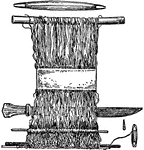
An illustration of a hand loom. he earliest looms were vertical warp-weighted looms, with the warp threads suspended from a branch or piece of wood and weighted or attached to the ground. The weft threads would be pushed into place by hand or a stick that would eventually become the shuttle. At first, it was necessary to raise and lower every warp thread one at a time, which was a time-consuming and laborious process. Basic techniques, such as the insertion of a rod, were developed to produce a shed, the space between warp threads (perhaps every other thread would be alternately raised and lowered), so that the weft thread or shuttle could pass through the entire warp at once.

Hand Loom

An illustration of a hand loom. he earliest looms were vertical warp-weighted looms, with the warp threads…
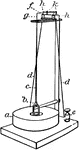
"Seismoscope. a, heavy mass supported by loop at point near center of gravity; b, point on which upper side of loop rests; c, long needle projecting from upper side of loop; d, conducting-wire; e, binding-post; f, long arm of lever pivoted at k; g, point where end of lever rests on end of needle; h, mercury-cup." -Whitney, 1911

Seismoscope

"Seismoscope. a, heavy mass supported by loop at point near center of gravity; b, point on which upper…
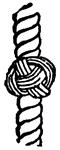
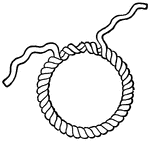
"Turk's Head -- With fine line (very dry) make a clove hitch round the rope; cross the bights twice, passing an end the reverse way (up or down) each time; then keeping the whole spread flat, let each end follow it own part round and round till it is too tight to received any more." -Britannica, 1910

Turk's Head

"Turk's Head -- With fine line (very dry) make a clove hitch round the rope; cross the bights twice,…
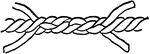
"The most common description of splice is when a rope is lengthened by another of the same size, or nearly so." -Britannica, 1910

Short Splice

"The most common description of splice is when a rope is lengthened by another of the same size, or…
"Grummet-Stop -- Made by unlaying a piece of rope of the desired size about a foot more that three times the length required for the strop. Place the centre of the open round the block and thimble; mark with chalk where the parts cross; take one strand out of the rope; bring the two chalk marks together; and cross the strand in the lay on both sides, continuing round and round till the two ends meet the third time; they are then halved, and the upper halves half-knotted and passed over and under the next strands, exactly as one part of a long splice." -Britannica, 1910

Grummet-Strop

"Grummet-Stop -- Made by unlaying a piece of rope of the desired size about a foot more that three times…
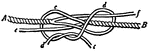
"Knotting Yarns -- This operation becomes necessary when a comparatively short piece of junk is to be make into a spun-yarn, or large rope into small, which is called twice laid. The end of each is divided, rubbed smooth and married (as for splicing). Two of the divided parts, as c, c and d, d, are passed in opposite directions round all the other parts and knotted. The ends e and f remain passive. The figure is drawn open, but the forks of A and B should be pressed close together, the knot hauled taut and the ends cut off." -Britannica, 1910

Knotting Yarns

"Knotting Yarns -- This operation becomes necessary when a comparatively short piece of junk is to be…
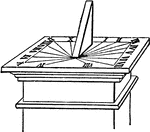
A sundial is a device that measures time by the position of the Sun. In common designs such as the horizontal sundial, the sun casts a shadow from its style (a thin rod or a sharp, straight edge) onto a flat surface marked with lines indicating the hours of the day. As the sun moves across the sky, the shadow-edge progressively aligns with different hour-lines on the plate. Such designs rely on the style being aligned with the axis of the Earth's rotation. Hence, if such a sundial is to tell the correct time, the style must point towards true North (not the north or south magnetic pole) and the style's angle with horizontal must equal the sundial's geographical latitude.

Sundial

A sundial is a device that measures time by the position of the Sun. In common designs such as the horizontal…
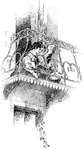
Two American girls on a balcony in Paris dropping popcorn to local boys who, at the time, had never seen popcorn before. The caption reads, "above, on the iron balcony ,two American girls were laughing merrily over the joke."

Two Girls on a Balcony

Two American girls on a balcony in Paris dropping popcorn to local boys who, at the time, had never…
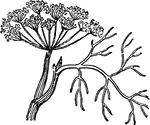
Dill (Anethum graveolens) is a short-lived perennial herb. It is the sole species of the genus Anethum, though classified by some botanists in a related genus as Peucedanum graveolens (L.) C.B.Clarke. It grows to 40&ndash;60 cm (16&ndash;24 in) 1 inch, with slender stems and alternate, finely divided, softly delicate leaves 10&ndash;20 cm (3.9&ndash;7.9 in) long. The ultimate leaf divisions are 1&ndash;2 mm (0.039&ndash;0.079 in) broad, slightly broader than the similar leaves of fennel, which are threadlike, less than 1 mm (0.039 in) broad, but harder in texture. The flowers are white to yellow, in small umbels 2&ndash;9 cm (0.79&ndash;3.5 in) diameter. The seeds are 4&ndash;5 mm (0.16&ndash;0.20 in) long and 1 mm (0.039 in) thick, and straight to slightly curved with a longitudinally ridged surface.

Dill

Dill (Anethum graveolens) is a short-lived perennial herb. It is the sole species of the genus Anethum,…
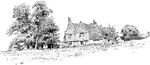
Stuntney is about a mile and a half outside the cathedral city of Ely. Oliver Cromwell lived here for several years after inheriting the position of local tax collector in 1636. His former home dates to the 16th century and is now used by the Tourist Information Office as well as being a museum with rooms displayed as they would have been in Cromwell's time.

The Cromwell House at Stuntney

Stuntney is about a mile and a half outside the cathedral city of Ely. Oliver Cromwell lived here for…
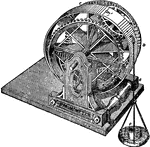
A dynamometer or "dyno" for short, is a machine used to measure torque and rotational speed (rpm) from which power produced by an engine, motor or other rotating prime mover can be calculated.

Dynamometer

A dynamometer or "dyno" for short, is a machine used to measure torque and rotational speed (rpm) from…
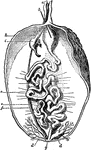
Illustration of a female green spoonworm. A, Proboscis cut short; B, bristle passing though the mouth into the pharynx; C, coiled intestine; D, anal tufts or vesicles; E, ventral nerve cord; F, ovary borne on ventral vessel running parallel with e; G, position of anus; H,, position of external opening of; I, nephridium --- the line points towards, but does not reach, the internal opening.

Bonellia Viridis (Female)

Illustration of a female green spoonworm. A, Proboscis cut short; B, bristle passing though the mouth…
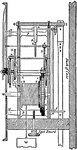
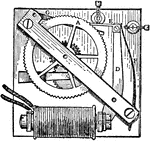
An illustration of a section of the interior of a large house clock.

House Clock

An illustration of a section of the interior of a large house clock.

An illustration of Hope Jone's dial-driving device. "Each time that a current is sent by the master clock, the electromagnet B attracts the pivoted armature C, and then the current ceases the lever D with the projecting arm E is driven back to its old position by the spring F, thus driving the wheel A forward one division. G is a back stop click, and H, I fixed stops." &mdash;Britannica, 1910

Dial Driving Device

An illustration of Hope Jone's dial-driving device. "Each time that a current is sent by the master…
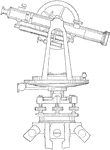
A transit telescope is a special purpose telescope mounted so as to allow it to be pointed only at objects in the sky crossing the local meridian, an event known as a transit. These telescopes rely on the rotation of the Earth to bring objects into their field of view.

Transit Telescope

A transit telescope is a special purpose telescope mounted so as to allow it to be pointed only at objects…
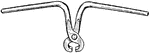
"Track-layers' tongs for lifting rails. They have short jaws designed to clasp the rail head and two long handles bent at a right angle." -Whitney, 1911

Rail Tongs

"Track-layers' tongs for lifting rails. They have short jaws designed to clasp the rail head and two…
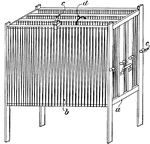
&quot;Nichols Rheostat. a, wooden frame; b, tinned iron strip; c, stationary, and c', movable binding-posts; d, copper strip for short-circuiting.&quot; -Whitney, 1911

Rheostat

"Nichols Rheostat. a, wooden frame; b, tinned iron strip; c, stationary, and c', movable binding-posts;…
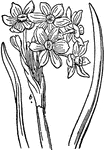
Narcissus is the botanic name for a genus of mainly hardy, mostly spring-flowering, bulbs in the Amaryllis family native to Europe, North Africa, and Asia. There are also several Narcissus species that bloom in the autumn. Though Hortus Third cites 26 wild species, Daffodils for North American Gardens cites between 50 and 100 excluding species variants and wild hybrids. Through taxonomic and genetic research, it is speculated that over time this number will likely continue to be refined. Daffodil is a common English name, sometimes used now for all varieties, and is the chief common name of horticultural prevalence used by the American Daffodil Society The range of forms in cultivation has been heavily modified and extended, with new variations available from specialists almost every year.

Narcissus

Narcissus is the botanic name for a genus of mainly hardy, mostly spring-flowering, bulbs in the Amaryllis…
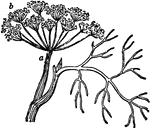
Dill (Anethum graveolens) is a short-lived perennial herb. It is the sole species of the genus Anethum, though classified by some botanists in a related genus as Peucedanum graveolens.

Dill

Dill (Anethum graveolens) is a short-lived perennial herb. It is the sole species of the genus Anethum,…
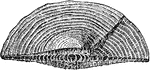
The Foraminifera, (&quot;Hole Bearers&quot;) or forams for short, are a large group of amoeboid protists with reticulating pseudopods, fine strands of cytoplasm that branch and merge to form a dynamic net. They typically produce a test, or shell, which can have either one or multiple chambers, some becoming quite elaborate in structure. These shells are made of calcium carbonate (CaCO3) or agglutinated sediment particles. About 275,000 species are recognized, both living and fossil. They are usually less than 1 mm in size, but some are much larger, and the largest recorded specimen reached 19 cm.

Foraminifera

The Foraminifera, ("Hole Bearers") or forams for short, are a large group of amoeboid protists…
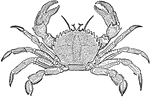
The velvet crab (alternatively velvet swimming crab or devil crab) is the largest swimming crab found in British coastal waters, with a carapace width of up to 100 mm. The body is coated with short hairs, giving the animal a velvety texture, hence the common name. It is one of the major crab species for UK fisheries. The velvet crab lives from southern Norway to Western Sahara in the North Sea and north Atlantic as well as western parts of the Mediterranean Sea, on rocky bottoms from the shoreline to a depth of about 65 m. The last pair of pereiopods are flattened to facilitate swimming.

Velvet Crab

The velvet crab (alternatively velvet swimming crab or devil crab) is the largest swimming crab found…
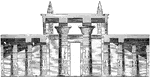
This image shows how the middle passage is made more imposing by the arrangement of elevating the columns in the middle, and how at the same time a means is contrived of lighting the whole hall by the raised side-lights.

Hall Section of the Great Temple at Abu Simbel

This image shows how the middle passage is made more imposing by the arrangement of elevating the columns…
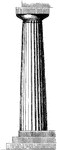
The Doric columns, which are short, powerful, and closely ranged together, in order to support the weight of the massive entablature, consist of the shaft and the capital, and rest immediately without base on the upper step, which serves as the ground-floor, or stereobate of the temple.

Doric Column from the Temple of Neptune at Paestum

The Doric columns, which are short, powerful, and closely ranged together, in order to support the weight…
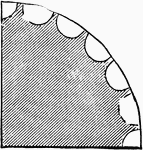
The Ionic column has a less diminished shaft and a smaller parabolic curve than the Doric. It is, like the Doric, channeled; the flutings, which are 24 in number, are separated by annulets, and are therefore narrower, but at the same time deeper, than the Doric, and are terminated at the top and bottom by the final curvature.

Fluting Plan of the Ionic and Corinthian Column

The Ionic column has a less diminished shaft and a smaller parabolic curve than the Doric. It is, like…
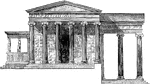
Belonging to the time directly after Pericles is the Erechtheum. This is a double temple in the Ionic style, dedicated to Minerva Polias, and is situated on the Acropolis. It has a hexastyle Ionic prostyle. A low building adjoins it, behind which is the shrine of the Nymph Pandrosos.

Erechtheum with the Pandrosium

Belonging to the time directly after Pericles is the Erechtheum. This is a double temple in the Ionic…
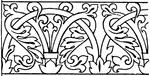
The mosaic ornament link border was designed during the Byzantine time in San Marco, Venice, Italy. It is a scroll design of leaves connected like a chain.

Mosaic Ornament Link Border

The mosaic ornament link border was designed during the Byzantine time in San Marco, Venice, Italy.…