Coin of the old Roman Empire.

Ancient Roman coin

Coin of the old Roman Empire.

"Plutarch, as the great interpreter of Greece and Rome, exerted on generations succeeding him in influence perhaps greater than any other classical writer." — The Delphian Society, 1913

Plutarch

"Plutarch, as the great interpreter of Greece and Rome, exerted on generations succeeding him in influence…
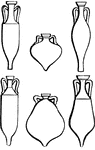
"A vessel used for holding wine, oil, honey. The following cut represents amphorae in the British Museum. They are of variouss forms and sizes; in general they are tall and narrow, with a small neck, and a handle on each side of the neck, and terminating at the bottom in a point, which was let into a stand or stuck in the ground, so that the vessel stood upright: several amphorae have been found in this position in the cellars at Pompeii. Amphorae were commonly made of earthenware. Homer mentions amphorae of gold and stone, and the Egyptians had them of brass; glass vessels of this form have been found at Pompeii. The most common use of the amphora, both amoung the Greeks and the Romans, was for keeping wine. The cork was covered with pitch or gypsum, and on the outside the title of the wine was painted, the date of the vintage being marked by the names of the consuls then in office; or, when the jars were of glass, little tickets were suspended from them, indicating these particulars." — Smith, 1873

Amphorae

"A vessel used for holding wine, oil, honey. The following cut represents amphorae in the British Museum.…
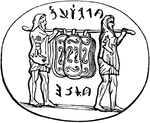
"Ancilia carried by Salii. The sacred shield carried by the Salii, and made of bronze. The original ancile was found, according to tradition, in the palace of Numa; and, as no numan hand has brought it there, it was concluded that it had been sent from heaven. At the same time, the haruspices declared that the Roman state would endure so long as this shield remained in Rome. To secure its preservation in the city, Numa ordered eleven other shields, exactly like it, to be made by the armourer, Mamurius Veturius, and twelve ancilia. They were kept in the temple of that divinity, on the Palatine mount, and were taken from it only once a year, on the calends of March. The feast of the god was then observed during several daysl when the Salaii carried their shields about the city, singing songs in praise of Mars, Numa, and Mamurius Veturius, and at the same time performing a dance, which probably in some degree resembled our morris with rods, so as to keep time with their voices, and with the movements of their dance. The preceding cut shows one of these rods, as represented on the tomb of pontifex salius, or chief of the Salii" — Smith, 1873

Ancile

"Ancilia carried by Salii. The sacred shield carried by the Salii, and made of bronze. The original…
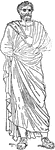
"Marcus Aurelius Antoninus stands almost alone in the history of the world as a philosopher and philanthopist clothed in royal purple. He was born A.D. 121, adopted by Antoninus Pius in 138, became consul in 140, and succeeded his adoptive father as emperor in 161." — The Delphian Society, 1913

Marcus Aurelius Antoninus

"Marcus Aurelius Antoninus stands almost alone in the history of the world as a philosopher and philanthopist…
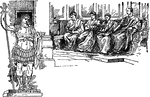
"Constantine, the first Christian emperor, removed the capital of the world-empire from Rome to Byzantium, henceforth to be called Constantinople. Though the court, with all its splendor and power, was thus transferred to a city where Greek was the vernacular, the change did not retard, but rather hastened, the decline of literature." — The Delphian Society, 1913

Byzantine court

"Constantine, the first Christian emperor, removed the capital of the world-empire from Rome to Byzantium,…
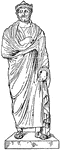
"Thus the prince, both when present and when coming, was alike victorius: and these things he achieved just starting up from amidst his books; or rather, in marching against the adversary, he marched with his books, for he had always in his hands either books or arms, believing that war was wonderfully assisted by philosophy, and that a prince competent to give counsel threw more weight into the scale than a fighting one." — The Delphian Society, 1913

Julian

"Thus the prince, both when present and when coming, was alike victorius: and these things he achieved…
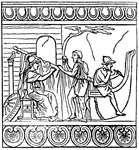
"Antefixa representing Minerva superintending the construction of the Ship Argo. Antefixa are terra-cottas, which exhibited various ornamental designs, and were used in architecture to cover the frieze of the entablature. These terra-cottas do not appear to have been used among the Greeks, but were probabl Etruscan in their origin, and were thence taken for the decoration of Roman buildings. The name antefixa is evidently derived from the circumstance that they were fixed before the buildings which they adorned. Cato, the censor, complained that the Romans of his time began to despise ornaments of this description, and to prefer the marble friezes of Athens and Corinth. The rising taste which Cato deplored may account for the superior beauty of the antefixa preserved in the British Museum, which were discovered at Rome." — Smith, 1873

Antefixa

"Antefixa representing Minerva superintending the construction of the Ship Argo. Antefixa are terra-cottas,…
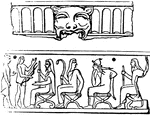
"The two imperfect antefixa, are amoung those found at Velletri, and described by Carloni. Antefixa are terra-cottas, which exhibited various ornamental designs, and were used in architecture to cover the frieze of the entablature. These terra-cottas do not appear to have been used among the Greeks, but were probabl Etruscan in their origin, and were thence taken for the decoration of Roman buildings. The name antefixa is evidently derived from the circumstance that they were fixed before the buildings which they adorned. Cato, the censor, complained that the Romans of his time began to despise ornaments of this description, and to prefer the marble friezes of Athens and Corinth. The rising taste which Cato deplored may account for the superior beauty of the antefixa preserved in the British Museum, which were discovered at Rome." — Smith, 1873

Antefixa

"The two imperfect antefixa, are amoung those found at Velletri, and described by Carloni. Antefixa…
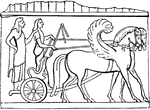
"The rim or border of anything, especially of a shield or chariot. The trim of the large round shield of the ancient Greeks, was thinner than the part which it enclosed: but on the other hand, the antyx of a chariot must have been thicker than the body to which it gave both form and strength. In front of the chariot the antyx was often raised above the body, into the form of a curvature, which served the purpose of a hook to hang the reins upon." — Smith, 1873

Antyx

"The rim or border of anything, especially of a shield or chariot. The trim of the large round shield…
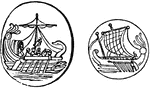
"An ornament of wooden planks, which constituted the highest part of the poop of a ship. From the representations of two ancient ships annexed, we see the position of the aplustre. It rose immediately behind the gubernator, who held the rudder and guided the ship, and it served in some degree to protect him from the wind and the rain." — Smith, 1873

Aplustre

"An ornament of wooden planks, which constituted the highest part of the poop of a ship. From the representations…
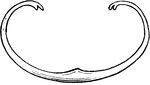
"The bow used for shooting arrows, is one of the most ancient of all weapons, but is characteristic of Asia rather than of Europe. In the Roman armies it was scarcely ever employed except by auxiliaries; and these auxiliaries, called sagittarii, were chiefly Cretans and Arabians. This image shows the Scythian or Parthian bow unstrung." — Smith, 1873

Arcus

"The bow used for shooting arrows, is one of the most ancient of all weapons, but is characteristic…

"The bow used for shooting arrows, is one of the most ancient of all weapons, but is characteristic of Asia rather than of Europe. In the Roman armies it was scarcely ever employed except by auxiliaries; and these auxiliaries, called sagittarii, were chiefly Cretans and Arabians. This image shows the usual form of the Grecian bow, which had a double curvature, consisting of two circular portions united by the handle. When not used the bow was put into a case which was made of leather, and sometimes ornamented." — Smith, 1873

Arcus

"The bow used for shooting arrows, is one of the most ancient of all weapons, but is characteristic…
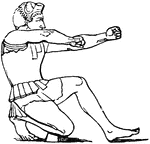
"The bow used for shooting arrows, is one of the most ancient of all weapons, but is characteristic of Asia rather than of Europe. In the Roman armies it was scarcely ever employed except by auxiliaries; and these auxiliaries, called sagittarii, were chiefly Cretans and Arabians. When not used the bow was put into a case which was made of leather, and sometimes ornamented. This image shows a drawing the bow." — Smith, 1873

Arcus

"The bow used for shooting arrows, is one of the most ancient of all weapons, but is characteristic…
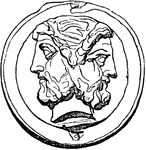
"The unit of value in the Roman and old Italian coinages, was made of copper, or of the mixed metal called Aes. It was originally of the weight of a pound of twelve ounces whence it was called as libralis and aes grave. The oldest form of the as is that which bears the figure of an animal. The next and most common form is that which has the two-faced head of Janus on one side, and the prow of a ship on the other (whence the expression sed by Roman boys in tossing up)" — Smith, 1873

As

"The unit of value in the Roman and old Italian coinages, was made of copper, or of the mixed metal…
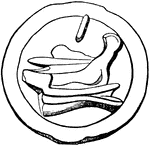
"The unit of value in the Roman and old Italian coinages, was made of copper, or of the mixed metal called Aes. It was originally of the weight of a pound of twelve ounces whence it was called as libralis and aes grave. The oldest form of the as is that which bears the figure of an animal. The next and most common form is that which has the two-faced head of Janus on one side, and the prow of a ship on the other (whence the expression sed by Roman boys in tossing up)" — Smith, 1873

As

"The unit of value in the Roman and old Italian coinages, was made of copper, or of the mixed metal…
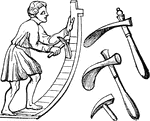
"An adze. Muratori has published numerous representations of the adze, as it is exhibited on ancient monuments. We select the three following, two of which show the instrument itself, with a slight variety of form, while the third represents a ship-builder holding it in his right hand, and using it to shape the rib of a vessel." — Smith, 1873

Ascia

"An adze. Muratori has published numerous representations of the adze, as it is exhibited on ancient…
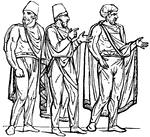
"Trowsers, pantaloons, were common to all the nations which encircled the Greek and Roman population, extending from the Indian to the Atlantic ocean, but were not worn by the Greeks and Romans themselves. Accordingly the monuments containing representations of people different from the Greeks and romans exhibit them in trowsers, thus distinguishing them from the latter people. An example is seen in the preceding group of Sarmatians." — Smith, 1873

Bracae

"Trowsers, pantaloons, were common to all the nations which encircled the Greek and Roman population,…
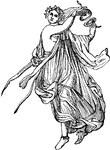
"A shoe or boot, anything adapted to cover and preserve the feet in walking. The use of shoes was by no means universal amount the Greeks and Romans. The Homeric heroes are represented without shoes when armed for battle. Socrates, Phocion, and Cato, frequently went barefoot. The Roman slaves had no shoes. the covering of the feet was removed before reclining at meals. People in grief, as for instance at funerals, frequently went barefooted. Shoes may be divided into those in which the mere sole of a shoe was attached to the sole of the foot by ties or bands, or by a covering for the toes or the instep; and those which ascended hgher and higher, according as they covered the ankles, the calf, or the whole of the leg. To calceamenta of the latter kind, i.e. to shoes and boots, as distinguished from sandals and slippers, the term calceus was applied in its proper and restricted sense." — Smith, 1873; This image shows Calcei, Women's Shoes.

Calceus

"A shoe or boot, anything adapted to cover and preserve the feet in walking. The use of shoes was by…
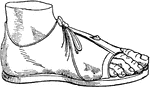
"A shoe or boot, anything adapted to cover and preserve the feet in walking. The use of shoes was by no means universal amount the Greeks and Romans. The Homeric heroes are represented without shoes when armed for battle. Socrates, Phocion, and Cato, frequently went barefoot. The Roman slaves had no shoes. the covering of the feet was removed before reclining at meals. People in grief, as for instance at funerals, frequently went barefooted. Shoes may be divided into those in which the mere sole of a shoe was attached to the sole of the foot by ties or bands, or by a covering for the toes or the instep; and those which ascended hgher and higher, according as they covered the ankles, the calf, or the whole of the leg. To calceamenta of the latter kind, i.e. to shoes and boots, as distinguished from sandals and slippers, the term calceus was applied in its proper and restricted sense." — Smith, 1873; This image shows Calceus, Men's Shoes.

Calceus

"A shoe or boot, anything adapted to cover and preserve the feet in walking. The use of shoes was by…
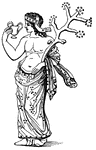
"A king of drinking cup, furnished with handles. It was the cup scred to Bacchus, who is frequently represented on ancient vases holding it in his hand." — Smith, 1873;

Cantharus

"A king of drinking cup, furnished with handles. It was the cup scred to Bacchus, who is frequently…
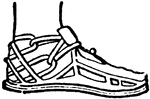
"The Sandal is a protection for the foot, worn in ancient times. It was usually a sole of hide, leather, or wood, bound on the foot by thongs. It was undoubtedly the custom to take off the sandals on holy ground, in the act of worship, and in the presence of a superior. This is still the well-known custom of the East– an Oriental taking off his shoe in case in which a European would remove his hat."—(Charles Leonard-Stuart, 1911)

Sandal

"The Sandal is a protection for the foot, worn in ancient times. It was usually a sole of hide, leather,…
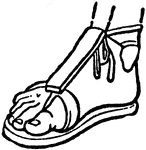
"The Sandal is a protection for the foot, worn in ancient times. It was usually a sole of hide, leather, or wood, bound on the foot by thongs. It was undoubtedly the custom to take off the sandals on holy ground, in the act of worship, and in the presence of a superior. This is still the well-known custom of the East– an Oriental taking off his shoe in case in which a European would remove his hat."—(Charles Leonard-Stuart, 1911)

Sandal

"The Sandal is a protection for the foot, worn in ancient times. It was usually a sole of hide, leather,…
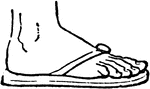
"The Sandal is a protection for the foot, worn in ancient times. It was usually a sole of hide, leather, or wood, bound on the foot by thongs. It was undoubtedly the custom to take off the sandals on holy ground, in the act of worship, and in the presence of a superior. This is still the well-known custom of the East– an Oriental taking off his shoe in case in which a European would remove his hat."—(Charles Leonard-Stuart, 1911)

Sandal

"The Sandal is a protection for the foot, worn in ancient times. It was usually a sole of hide, leather,…
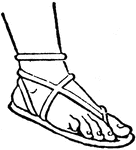
"The Sandal is a protection for the foot, worn in ancient times. It was usually a sole of hide, leather, or wood, bound on the foot by thongs. It was undoubtedly the custom to take off the sandals on holy ground, in the act of worship, and in the presence of a superior. This is still the well-known custom of the East– an Oriental taking off his shoe in case in which a European would remove his hat."—(Charles Leonard-Stuart, 1911)

Sandal

"The Sandal is a protection for the foot, worn in ancient times. It was usually a sole of hide, leather,…
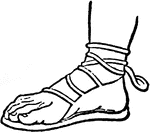
"The Sandal is a protection for the foot, worn in ancient times. It was usually a sole of hide, leather, or wood, bound on the foot by thongs. It was undoubtedly the custom to take off the sandals on holy ground, in the act of worship, and in the presence of a superior. This is still the well-known custom of the East– an Oriental taking off his shoe in case in which a European would remove his hat."—(Charles Leonard-Stuart, 1911)

Sandal

"The Sandal is a protection for the foot, worn in ancient times. It was usually a sole of hide, leather,…
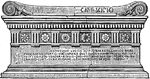
"Sarcophagus, plural Sarcophagi, is a kind of stone used among the Greeks for making coffins, and so called because it was believed to have the property of consuming the flesh of dead bodies deposited in it within a few weeks. Hence a coffin or tomb of stone; a kind of stone chest used for containing a dead body. In modern times stone coffins are occasionally used for royal or distinguished persons."—(Charles Leonard-Stuart, 1911)

Sarcophagus of Scipio

"Sarcophagus, plural Sarcophagi, is a kind of stone used among the Greeks for making coffins, and so…

Janus, the Roman god, seated.

Janus

Janus, the Roman god, seated.

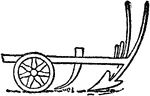
An old Roman plow.

Roman plow

An old Roman plow.

The Palladium, an ancient statue.

The Palladium

The Palladium, an ancient statue.

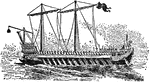
"Elated by the victory, the Romans now determined to drive Carthage out of the island altogether. This, however, could not be accomplished without a fleet. Such ships as Rome possessed were old and out of date, and a wrecked Carthaginian galley was taken as a model for the new fleet." — The Delphian Society, 1913

Roman galley

"Elated by the victory, the Romans now determined to drive Carthage out of the island altogether. This,…
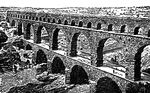
A Roman aqudect.

Roman aqueduct

A Roman aqudect.

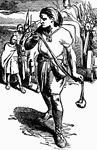
"A Sling is a short leather strap having a string secured to each end, by which a stone is hurled."—(Charles Leonard-Stuart, 1911)

Sling and Slinger

"A Sling is a short leather strap having a string secured to each end, by which a stone is hurled."—(Charles…
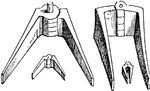
A hinge or pivot. The first figure, in the annexed woodcut, is designed to show the general form of a door, as we find it with a pivot at the top and bottom in ancient remains of stone, marble, wood, and bronze. The second figure represents a bronze hinge in the Egyptian collection of the British Museum: its pivot is exactly cylindrical. Under these is drawn the threshhold of a temple, or other large edifice, with the plan of the folding-doors. The pivots move in holes fitted to receive them, each of which is in an angle behind the antepagmentum. The Greeks and Romans also used hinges exactly like those now in common use. Four Roman hinges of bronze, preserved in the British Museum, are shown in the following woodcut.

Cardo

A hinge or pivot. The first figure, in the annexed woodcut, is designed to show the general form of…
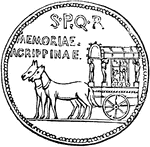
"A cart; also a two-wheeled carriage enclosed, and with an arched or sloping cover overhead. The carpentum was used to convey the Roman matrons in the public festal processions; and, as this was a high distinction, the privilege of riding in a carpentum on such occasions was allowed to particular females by special grant of the senate. This carriage contained seats for two, and sometimes for three persons, besides the coachman. It was commonly drawn by a pair of mules, but more rarely by oxen or horses, and sometimes by four horses like a quadriga. Carpenta, or covered carts, were much used by the Britons, the Gauls, and other northern nations. These, together with the carts of the more common form, including baggage waggons, appear to have been comprehended under the term carri, or carra, which is the Celtic name with a Latin termination. The Guals took a great multitude of them on their military expeditions, and when they were uncamped, arranged them in close oder, so as to form extensive lines of circumvallation." — Smith, 1873

Carpentum

"A cart; also a two-wheeled carriage enclosed, and with an arched or sloping cover overhead. The carpentum…
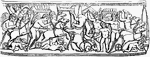
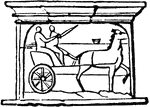
"Spina of the Circus, from an ancient bas relief." — Smith, 1873

Circus

"Spina of the Circus, from an ancient bas relief." — Smith, 1873

"A light open carriage with two wheels, adapted to carry two persons rapidly from place to place. The cisia were quickly drawn by mules. Cicero mentions the case of a messenger who travelled 56 miles in 10 hours in such vehicles, which were kept for hire at the stations along the great roads; a proof that the ancients considered six Roman miles per hour as an extraordinary speed." — Smith, 1873

Cisium

"A light open carriage with two wheels, adapted to carry two persons rapidly from place to place. The…
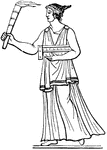
"A small box or chest, in which anything might be placed, but more particularly applied to the small boxes which were carried in procession in the festivals of Ceres and Bacchus. These boxes, which were always kept closed in the public processions, contained sacred things connected with the worship of these deities. In the representations of Dionysiac processions of ancient vases, women carrying cistae are frequently introduced. The cista was also the name of the ballotbox, into which those who voted in the comitia and in the courts of justice cast their tabellae." — Smith, 1873

Cista

"A small box or chest, in which anything might be placed, but more particularly applied to the small…
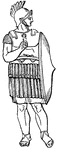
"The large shield worn by the Greeks and Romans, which was originally of the circular form, and is said to have been first used by Proetus and Acrisius or Argos, and therefore is called clipeus Argolicus, and likened to the sun. But the clipeus is often represented in Roman sculpture of an oblong oval, which makes the distinction between the common buckler and that of Argos." — Smith, 1873

Clipeus

"The large shield worn by the Greeks and Romans, which was originally of the circular form, and is said…
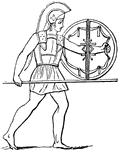
"The large shield worn by the Greeks and Romans, which was originally of the circular form, and is said to have been first used by Proetus and Acrisius or Argos, and therefore is called clipeus Argolicus, and likened to the sun. But the clipeus is often represented in Roman sculpture of an oblong oval, which makes the distinction between the common buckler and that of Argos." — Smith, 1873

Clipeus

"The large shield worn by the Greeks and Romans, which was originally of the circular form, and is said…
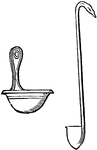
"A Greek and Roman liquid measure, containing one-twelfth of the sextarius, or .0825 of a pint English. The form of the cyathus used at banquets was that of a small ladle, by means of which the wine was conveyed into the drinking-cups from the large vessel in which it was mixed. Two of these cyathi are represented in this following woodcut." — Smith, 1873.

Cyathus

"A Greek and Roman liquid measure, containing one-twelfth of the sextarius, or .0825 of a pint English.…
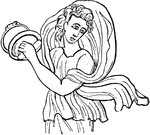
"A musical instrument, in the shape of two half globes, which were held one in each hand of the performer, and played by being struck against each other. The cymbal was a very ancient instrument, being used in the worship of Cybele, Bacchus, Juno, and all the earlier deities of the Grecian and Roman mythology. It probably came from the east. for sistrum, which some have regerred to the class of cymbala." — Smith, 1873.

Cymbalum

"A musical instrument, in the shape of two half globes, which were held one in each hand of the performer,…
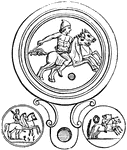
"A rider in the Roman games, who generally rode two horses at the same time, sitting on them without a saddle, and vaulting upon either of them at is pleasure. The annexed woodcut shows three figures of desultores." — Smith, 1873.

Desultor

"A rider in the Roman games, who generally rode two horses at the same time, sitting on them without…
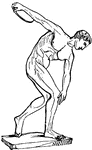
"A circular plate of stone or metal, made for throwing to a distance as in exercise of strength and dexterity. It was one of the principal gymnastic exercises of the ancients, being included in the Penthathlum. The preceding woodcut represents a player with the discus, and is copied from an ancient statue by Myron." — Smith, 1873.

Discus

"A circular plate of stone or metal, made for throwing to a distance as in exercise of strength and…
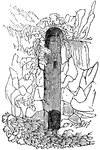
"An artificial channel formed to carry off any stagnany body of water, like the sluices in modern use. Some works of this kind are among the most remarkable efforts of Roman ingenuity. That through which the waters of the lake Fucinus discharged themselves into the Liris, is represented in the preceding woodcut." — Smith, 1873.

Emissarium

"An artificial channel formed to carry off any stagnany body of water, like the sluices in modern use.…

"An ancient Greek or Roman temple, of rectangular construction, is terminated at its upper extremity by a triangular figure, both in front and rear, which rests upon the cornice of the entablature as a base, and has its sides formed by the cornices which terminate the roof. The whole of this triangle above the trabeation is implied in the term fastigium." — Smith, 1873.

Fastigium

"An ancient Greek or Roman temple, of rectangular construction, is terminated at its upper extremity…
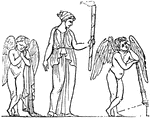
"A torch. In the annexed woodcut, the female figure is copied from a fictile vase. The winged figure on the left hand, asleep and leaning on a torch, is from a funeral monument at Rome. The other winged figure represents Cupid as Lethaus Amor. In ancient marbles the torch is sometimes more ornamened than the examples now produced, but it always appears to be formed of wooden staves or twigs, either bound by a rope drawn round them in a spiral form, as in the middle figure blow, or surrounded by circular bands at equal distances, as in the two exterior figures. The inside of the torch may be supposed to have been filled with flax, tow, or other vegetable fibres, the whole being abundantly impregnated with pitch, rosin, wax, oil, and other inflammable substances." — Smith, 1873.

Fax

"A torch. In the annexed woodcut, the female figure is copied from a fictile vase. The winged figure…
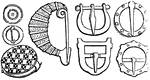
"A brooch, consisting of a pin, and of a curved portion furnished with a hook. The curved portion was sometimes a circular ring or disc, the pin passing across its centre and sometimes an arc, the pin being as the chord, of the arc. The forms of brooches, which were commonly of gold or bronze, and more rarely of silver, were, however, as various in ancient as in modern times; for the fibula served in dress not merely as a fastening, but also as an ornament." — Smith, 1873.

Fibula

"A brooch, consisting of a pin, and of a curved portion furnished with a hook. The curved portion was…
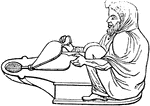
"Two inflated skins, constituting a pair of bellows. The following woodcut is taken from an ancient lamp, and represents a pair of bellows like those we now employ." — Smith, 1873.

Follis

"Two inflated skins, constituting a pair of bellows. The following woodcut is taken from an ancient…
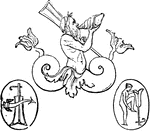
"A rudder. Before the invention of the rudder, which Pliny ascribes to Tiphys, the pilot of the ship Argo, vessels were both propelled and guided by oars alone. This circumstance may account for the form of the ancient rudder, as well as for the mode of using it. It was like an oar with a very broad blade, and was commonly placed on each side of the stern, not at its extremity. The annexed woodcut presents examples of its appearance as it is frequently exhibited on coins, gems, and other works of art." — Smith, 1873.

Gubernaculum

"A rudder. Before the invention of the rudder, which Pliny ascribes to Tiphys, the pilot of the ship…
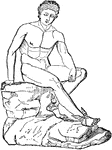
Statue of Hermes (Mercury).

Hermes

Statue of Hermes (Mercury).

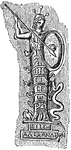
"Athena (Minerva) superintending the building of the Argo." — Smith, 1882

Athena and Argo

"Athena (Minerva) superintending the building of the Argo." — Smith, 1882

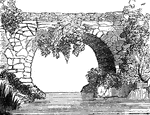
"Ancient bridge in Laconia." — Smith, 1882

Bridge

"Ancient bridge in Laconia." — Smith, 1882

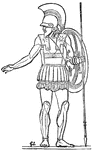
"Greek Soldier. (From an ancient Vase.)" — Smith, 1882

Greek soldier

"Greek Soldier. (From an ancient Vase.)" — Smith, 1882

"The Theseum is situated on a height to the north of the Areopagus, and was built to receive the bones of Theseus, which Cimon brought from Seyros in B.C. 469. It was probably finished about 465, and is the best preserved of all the monuments of ancient Athens. It was at once a tomb and a temple, and possessed the privileges of an asylum. It is of the Doric order, 104 feet in length by 45 feet broad, and surrounded with columns." — Smith, 1882

Thesium restored

"The Theseum is situated on a height to the north of the Areopagus, and was built to receive the bones…
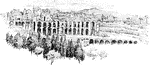
A Roman doodad.

Roman doodad

A Roman doodad.

"The Palantine from the Aventine." — Young, 1901

Palatine

"The Palantine from the Aventine." — Young, 1901

"The columns of <em>cipollino</em>, which belonged to the Palace of Domitian." &mdash; Young, 1901

Columns of Domitian

"The columns of cipollino, which belonged to the Palace of Domitian." — Young, 1901
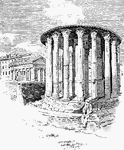
"The Round temple in the Piazza Bocca Della Verita." &mdash; Young, 1901

Round temple

"The Round temple in the Piazza Bocca Della Verita." — Young, 1901

"The Municipal Arms of Rome." &mdash; Young, 1901

Arms of Rome

"The Municipal Arms of Rome." — Young, 1901