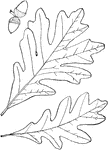
Leaves - simple; alternate; edge lobed; (edge of the lobes entire or sometimes coarsely notched and hollowed at their ends.) Outline - reverse egg-shape. Apex - of lobes, rounded. Base - wedge-shape. Leaf - quite variable in size and shape; four to seven inches long; smooth; pale beneath; the lobes oftenest five to nine, long and narrow, and sometimes widening toward the end, but at other times only three to five, short and broad, and radiating obliquely from the middle rub. Bark - of trunk, slightly roughened (comparatively smooth for an oak), light-gray; in older trees loosening in large, thin scales; the inner bark white. Acorns - usually in pairs on a stem one fourth of an inch or more in length. Cup - rounded saucer-shape, not scaly, but rough and warty and much shorter than the nut. Nut - three fourths to one inch long, slightly egg-shape or oval; brown, sweet, and edible. October. Found - from Ontario and the valley of the St. Lawrence southward to Florida, and westward to Southeastern Minnesota, Arkansas, and Texas. Its finest growth is on the western slopes of the Alleghany Mountains, and in the Ohio basin. General Information - A noble tree, sixty to eighty feet or more in height, with hard, touch wood of very great value in many kinds of manufacturing, and for fuel. The withered, light-brown leaves often cling throughout the winter. The "oak-apples" or "galls" often found on oak-trees are the work of 'gall-flies" and their larvae. When green tiny worms will usually be found at their centre. Quaint reference is made to these galls in Gerardes' "Herbal": "Oak-apples being broken in sunder before they have an hole thorough them do fore shewe the sequell of the yeere. If they conteine in them a flie, then warre insueth; if a creeping worme, then scarcitie of victuals; if a running spider, then followeth great sickness or mortalitie." The oak, probably more than any other tree, has been associated with workshop of the gods. The "Talking Tree" of the sanctuary in Dodona (the oldest of all the Hellenic sanctuaries, and second in repute only to that at Delphi) was an oak. Oak groves were favorite places for altars and temples of Jupiter. The Druids worshipped under the oak-trees. Quercus, possible from a Celtic word meaning to inquire, because it was among the oaks that the Druids oftenest practised their rites.

Genus Quercus, L. (Oak)

Leaves - simple; alternate; edge lobed; (edge of the lobes entire or sometimes coarsely notched and…
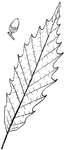
Leaves - simple; alternate; edge evenly and sharply (or sometime bluntly) toothed. Outline - very narrow oval (or sometimes wide). Apex - taper-pointed. Base - pointed or blunt. Leaf/Stem - three fourths to one inch long. Leaf - usually about five to seven inches long, by one and one half to two inches wide, but sometimes so wide as to resemble Q. prinus), from which, however, it is distinguished by its think bark. Of all the "chestnut-oak: leaves it most closely resembles the chestnut leaf. It is smooth above, whitish and minutely downy beneath. Bark - of trunk, light, flaky, and thin. Acorn - nearly stemless. Cup - about five twelfths to seven twelfths of an inch across; rounded; thin, with very small, closely pressed scales. Nut - seven twelfths to nine twelfths of an inch long; egg-shape or narrow oval, light brown, about one third covered by cup; sweet. October. Found - from Massachusetts to Delaware, along the mountains to Northern Alabama and westward. Very common west of the Alleghany Mountains. General Information - A tree forty to sixty feet high, with strong and durable wood. Quercus, possible from a Celtic word meaning to inquire, because it was among the oaks that the Druids oftenest practised their rites.

Genus Quercus, L. (Oak)

Leaves - simple; alternate; edge evenly and sharply (or sometime bluntly) toothed. Outline - very narrow…
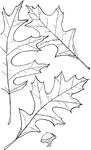
Leaves - simple; alternate; edge lobed (edges of the lobes mostly entire, but notched and toothed towards the ends). Outline - narrow oval or broad oval. Base - from long wedge-shape to squared. Ends of lobes and of the teeth pointed and bristle-tipped. Leaf - three to five inches long; both sides bright green, smooth, and shining; downy in the angles of the ribs below. Lobes - seven to nine, usually seven, with the hollows between them broad and round and usually reaching about three fourths of the way or more to the middle rib. The wide type of leaf closely resembles the leaves of the scarlet oak, but it is smaller and usually the hollows reach nearer to the middle rib. Bark - smoothish (comparatively), inner bark reddish. Acorns - numerous, small, on short stems. Cup - top-shaped, shallow, and nearly smooth. Nut - rounded, one half inch long or less, sometimes broader than long, light brown. October. Found - from the valley of the Connecticut to Central New York, southward to Delaware and the District of Columbia; in Southern Wisconsin and southward; usually along streams and on low, wet land. Most common and reaching its finest growth west of the Alleghany Mountains. General Information - A handsome tree forty to sixty feet high, usually with a pointed top and with light and delicate foliage. The wood is rather coarse and not durable. It takes its name of Pin Oak from the peg-like look of the dead twigs and short branches with which the lower parts of the tree are usually set. Quercus, possible from a Celtic word meaning to inquire, because it was among the oaks that the Druids oftenest practised their rites.

Genus Quercus, L. (Oak)

Leaves - simple; alternate; edge lobed (edges of the lobes mostly entire, but notched and toothed towards…
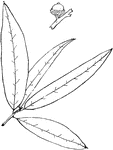
Leaves - simple; alternate; edge entire. Outline - long and narrow. Apex - pointed and bristle-tipped. Base - pointed. Leaf - three to four inches long (sometimes five); one half to seven eighths of an inch wide; rather thick and stiff; smooth and shining above; somewhat dull beneath; very young leaves, light green above and soft, white-downy beneath. Bark - thick and smoothish. Acorns - small. nearly stemless. Cup - rather shallow, saucer-shaped, or somewhat rounded top-shape. Nut - about three eighths of an inch long, rounded, brown; Kernel, bitter and bright orange. October. Found - from Staten Island and New Jersey southward along the coast to Northeastern Florida and the Gulf States, and from Kentucky southwestward. Usually on the borders of swamps and in sandy woods. General Information - a tree thirty to fifty feet high, with poor wood. Quercus, possible from a Celtic word meaning to inquire, because it was among the oaks that the Druids oftenest practised their rites.

Genus Quercus, L. (Oak)

Leaves - simple; alternate; edge entire. Outline - long and narrow. Apex - pointed and bristle-tipped.…
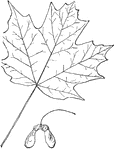
Leaves - simple; opposite; edge lobed, with the lobes very sparingly and coarsely sharp-toothed or the lower pair entire. Outline - rounded, with three to five lobes, usually five, with the hollows between the lobes and between the coarse teeth rounded. Apex - of the lobes, pointed. Base - heart-shaped or nearly squared. Leaf - dark green above; slightly lighter beneath; smooth or somewhat downy on the ribs; closely resembling that of the introduced "Norway Maple" by lacking the latter's milky-juiced leaf-stem. Bark - light gray, usually smoothish when young, becoming rough and scaly. Flowers - yellow-green and very abundant. April, May.  Fruit - greenish-yellow, smooth, drooping, on thread-like and hairy stems one to two inches long, with wings about one inch long, broad and slightly spreading. September. Found - from Southern Canada through the Northern States, southward along the Alleghany Mountains, and westward to Minnesota, Eastern Nebraska, and Eastern Texas. Its finest development is in the region of the Great Lakes. It grows in rich woods; often it forms "groves," sometimes extensive forests.

Genus Acer, L. (Maple)

Leaves - simple; opposite; edge lobed, with the lobes very sparingly and coarsely sharp-toothed or the…
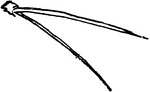
Leaves - simple; indeterminate in position because of their closeness, but arranged along the branches in two-leaved, sheathed bunches. Leaf - needle-shape, about one inch long, pointed, stiff, curved, rounded on the back, grooved above. Cones - nearly two inches long, gray, usually in pairs, and curved like small horns, with a peculiar habit of always pointing in the same direction as the branches. Scales - blunt, smooth, not armed with points or knobs. Found - along the northern frontier of the United States and far northward. Its best growth is north of Lake Superior. General Information - A small evergreen tree, or often a shrub, five to thirty feet high, with long, spreading branches, and light, soft wood that is of but slight value.

Genus Pinus, L. (Pine)

Leaves - simple; indeterminate in position because of their closeness, but arranged along the branches…
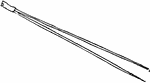
Leaves - simple; indeterminate in position because of their closeness, but arranged along the branches in two-leaved sheathed bunches. Leaf - needle-shape, about two and one half inches long, stiff; outer side smooth and rounded; inner side hollowed. Cones - about three and one half inches long, of a light yellow color, stemless, often united in clusters of fours. Scales - with a stout spine, widening at its base, one sixth of an inch in length. Found - within narrower limits than any other American Pine; along the Alleghany Mountains from Pennsylvania to Tennessee, especially upon Table Mountain in North Carolina, one of the highest peaks of the range. General Information - A tree ten to fifty feet high, with light and soft wood, largely used for charcoal.

Genus Pinus, L. (Pine)

Leaves - simple; indeterminate in position because of their closeness, but arranged along the branches…
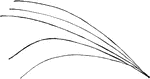
Leaves - simple; indeterminate in position because of their closeness, but arranged along the branches in five-leaved bunches, with their sheaths lacking or very short, excepting when young. Leaf - needle-shape, three to five inches long, light bluish-green, three-sided, soft, and very slender. Cones - four to six inches long, cylinder-shape, about one inch in diameter before the scales loosen; solitary, drooping, slightly curved. Scales - thin, without prickles. Bark - of trunk, lighter than in the other pines; in young trees smooth, and only slightly rough when older. Found - from Newfoundland to the Winnipeg River, southward through the Northern States, and along the Alleghany Mountains to Georgia. Its finest growth is in the region of the Great Lakes. General Information - An evergreen tree of soft and delicate foliage, eighty to one hundred and fifty feet high; one of the most valuable timber trees of any country. The wood is clear of knots, straight-grained, and soft, and is used in immense quantities for building and many kinds of manufacturing. The branches are given off in flat, regular whorls around the straight trunk.

Genus Pinus, L. (Pine)

Leaves - simple; indeterminate in position because of their closeness, but arranged along the branches…
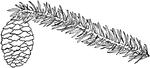
Leaves - simple; indeterminate in position because of their closeness; arranged singly and thickly all around the branchlets. Leaf - needle-shape, five twelfths to two thirds of an inch long, four-sided, mostly straight, stiff, and sharp; dark green. Cones - three fourths to one and one half inches long, drooping at the ends of the branchlets; broad oval; dark purple when young, becoming reddish-brown as they ripen. Scales - long reverse egg-shape, thin, with a wavy or toothed edge toward their apex. Found - along the Alleghany Mountains from the high peaks of North Carolina to Pennsylvania, through the Northern States, andGeneral Information - An evergreen tree thirty to sixty feet high, with straight, tapering trunk. The wood is light and straight-grained and is used for lumber, for the masts and spars of ships, in building, etc. From its twigs is prepared the "essence of spruce."

Genus Picea, Link. (Spruce)

Leaves - simple; indeterminate in position because of their closeness; arranged singly and thickly all…
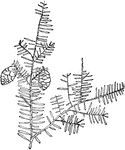
Leaves - simple; indeterminate, in position because of their closeness; arranged singly in two flat distinctly opposite ranks up and down the branchlets. Leaf - one half inch long, narrow; blunt sometimes minutely toothed toward the apex; flat; green above; silvery white beneath. Bark - reddish and scaly; when old, somewhat roughened by long, shallow furrows. Cones - very small (three fourths of an inch long); drooping; oval or egg-shape. Scales - few, thin, rounded and entire. The seed with the wing is about three fourths the length of the scale. The cone does not fall apart when ripe. Found - from Southern New Brunswick and the Valley of the St. Lawrence through the Northern States to Delaware, and along the Alleghany Mountains to Alabama. Common northward, often forming large forests. General Information - An evergreen tree, sixty to eighty feet high, irregular in outline, very graceful, especially when young, with light and delicate foliage and horizontal or drooping branches. The timber is very coarse; the bark much used for tanning, and with medicinal qualities.

Genus Tsuga, Carr. (Hemlock)

Leaves - simple; indeterminate, in position because of their closeness; arranged singly in two flat…
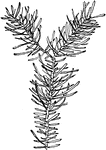
Leaves - Simple; indeterminate in position because of their closeness; arranged singly up and down the branchlets, at first radiating about equally on every side, afterward flattened into two ranks, as in the Hemlock. Leaf - one half to one inch long, narrow; apex blunt or notched; edge entire; flat, with a grooved line above and a corresponding raised line below; bright green above; silvery white below. Bark - smooth and unbroken (especially when young), and usually covered with "blisters." Cones - two to four inches long, one inch broad, erect, at the sides of the branchlets; violet-colored. Scales - thin and flat, broad and rounded. The thin bracts between the scales are tipped with a slender bristle. The cone falls apart when ripe. Found - from the far North through the Northern States to Pennsylvania, and along the Alleghany Mountains to the high peaks of West Virginia. Common northward in damp forests. General Information - A slender, evergreen tree, twenty to sixty feet high; pyramid-shaped, with regular horizontal branches; its wood is very light and soft. From the "blisters," which form under the bark of the trunk and branches, the valuable Canada balsam is obtained. The tree is short-lived, and therefore of less value in cultivation.

Genus Abies, Link. (Fir)

Leaves - Simple; indeterminate in position because of their closeness; arranged singly up and down the…
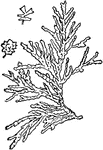
Leaves - simple; indeterminate in position because of their smallness and closeness. They are scale-like, somewhat egg-shape, overlapping each other, and closely pressed in four rows up and down the very flat branchlets. Each leaf has at its centre a raised gland, easily distinguished if held between the eye and the light. Bark - fibrous. The "spray" (formed from the flat branchlets) is itself flat and very delicate and of a dull green. Cones - about one fourth of an inch in diameter, round, variously placed, compact, purplish as they ripen; opening when ripe toward the centre line (i. e., not toward its base). Scales - fleshy, shield-shaped and apparently fastened near their centres, with the edge several-pointed, and with a sharp point or knob in the centre. Seeds - usually four to eight under each scale, oval, with wide wings at the sides. Found - in deep, cold swamps (filling them densely and exclusively), from Southern Maine along the coast to Florida, and along the Gulf coast to Mississippi. General Information - A tapering evergreen tree, thirty to seventy feet high, with light and durable wood, largely used in boat-building, for wooden-ware, shingles, etc.

Genus Chamaecyparis, Spach. (White Cedar)

Leaves - simple; indeterminate in position because of their smallness and closeness. They are scale-like,…
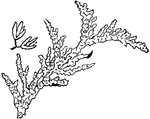
Leaves - simple; indeterminate in position because of their smallness and closeness. They are scale-like, somewhat egg-shape, overlapping each other, and closely pressed in four rows up and down the very flat branchlets. Each leaf has at its centre a raised gland, easily distinguished if held between the eye and the light. Bark - fibrous. The "spray" (formed from the flat branchlets) is itself flat and of rather a bright green. Cones - about five twelfths of an inch in length, long oval or reverse egg-shape, nodding, yellowish-brown as they ripen, dry and opening to the base when ripe. Scales - pointless, oval or egg-shape, smooth (i. e., not pointed on the edge or near the centre.) Seeds - one to two under each scale, long and narrow (like a small caraway seed); broadly winged all around, with the wing notched at one end. Found - along the Alleghany Mountains from the high peaks of North Carolina to Northern Pennsylvania and Central New York, northward into Southern Canada and westward; along rocky banks of streams and in swamps; very common at the North, where it often occupies large areas of swamp land. It is very widely cultivated, especially in hedges. General Information - A tapering evergreen tree, twenty to fifty feet high, with close, dense branches, and a light and durable wood.

Genus Thuya, L. (Arbor Vitae)

Leaves - simple; indeterminate in position because of their smallness and closeness. They are scale-like,…
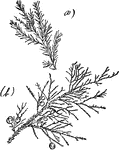
Leaves - simple; indeterminate in position because of their smallness and closeness. They are arranged in four rows up and down the branchlets. In younger or rapidly growing sprouts the leaves are awl-shaped or needle-shaped, somewhat spreading from the branch, very sharp and stiff, placed in pairs (or sometimes in threes), usually about one fourth of an inch long, and with the fine branchlets, which they cover, rounded. In the older and slower-growing trees the leaves are scale-like and overlapping, egg-shape, closely pressed to the branchlets which they cover, and with the branchlets square. As the branchlets grow, the lower scales sometimes lengthen and become dry and chaffy and slightly spreading. Bark - brown and sometimes purplish-tinged, often shredding off with age and leaving the trunk smooth and polished. Berries - about the size of a small pea, closely placed along the branchlets, bluish, and covered with a whitish powder. Found - in Southern Canada, and distributed nearly throughout the United States - more widely than any other of the cone-bearing trees. General information - An evergreen tree, fifteen to thirty feet high (much larger at the South), usually pyramid-shaped, with a rounded base, but varying very greatly, especially near the coast, where it is often twisted and flattened into angular and weird forms. The wood is very valuable, light, straight-grained, durable, fragrant. It is largely used for posts, for cabinet-work, for interior finish, and almost exclusively in the making of lead pencils. The heart-wood is usually a dull red (whence the name), the sap-wood white.  Among the most picturesque objects in the Turkish landscape, standing like sentinels, singly or in groups, and slender and upright as a Lombardy Poplar, are the black cypress trees (C. sempervirens). They mark the sites of graves, often of those which have long since disappeared. In America, more than any other northern tree, the red cedar gives the same sombre effect, whether growing wild or planted in cemeteries. The Common Juniper (J. communis, L.), common as a shrub, is occasionally found in tree form, low, with spreading or drooping branches, and with leaves resembling those of a young Red Cedar, awl-shaped and spreading, but arranged in threes instead of opposite.

Genus Juniperus, L. (Red Cedar)

Leaves - simple; indeterminate in position because of their smallness and closeness. They are arranged…
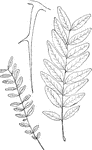
Leaves - compound; )even-feathered, leaflets, ten to twenty-two or more, usually about fourteen), sometimes twice compound; alternate; edge of leaflets entire as seen above, but as seen below often remotely and slightly toothed. Outline of leaflet - long oval or long egg-shape. Base - and narrowed. Apex - rounded. Leaf/Stem - and very short. Leaflet/Stem - downy. Leaflets - three fourths to one and a half inches long; about one third as wide. Often several of them (one to three) are partly or wholly divided into smaller leaflets. Surfaces smooth and shining. Bark - of trunk, gray, and much less rough than that of the common Locust (which has a somewhat similar leaf); branchlets brown and often warty. The branches and the trunk, excepting in very young and quite old trees, are usually thickly covered with spines, two to four inches long, which are curved at the base, often two- to three-branches, and of a reddish-brown color. Flowers - small and greenish. Fruit - a long, flat pod (nine to eighteen inches long) reddish; somewhat twisted, and filled between the seeds with a pulp which at first is sweet (whence the name "Honey" Locust) but which soon becomes sour. The seeds are flat, hard, and brown. Found - native in Pennsylvania, westward and southward, but also somewhat naturalized and widely introduced northward.  General Information - A tree sometimes seventy feet high, with wide-spreading and graceful branches, and light and delicate foliage. It is often used as a hedge plant. A variety entirely bare of thorns (var. inermis) is sometimes found; also a variety (var. brachycarpos) with shorter fruit and thorns.

Genus Gleditschia, L. (Honey Locust)

Leaves - compound; )even-feathered, leaflets, ten to twenty-two or more, usually about fourteen), sometimes…
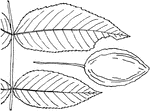
Leaves - compound (odd-feathered; leaflets, fifteen to seventeen); alternate; edge of leaflets sharp-toothed. Outline - of leaflet, long egg-shaped or long oval. Apex - taper-pointed. Base - rounded. Leaf/Stem - downy and sticky. Leaf - twelve to twenty inches long. Leaflet - three inches or more in length; downy, especially beneath. Bark - of the branches, light gray and smoothish. Twigs - as well as leaf-stems and fruit, very sticky. Fruit - long (two to three inches), pointed. Husk - very sticky; green at first; brown when ripe, becoming very dark; not splitting in sections. Nut - deeply and roughly furrowed and sharp-ridged, with a sweet oily kernel. September.Found - in Southern Canada, and common in New England and the Middle and Western States. General Information - A tree twenty to fifty feet high, with a short, stout trunk and very wide-reaching, horizontal branches. The heart-wood is reddish or light brown, not as dark nor as hard as in the Black Walnut. It is used for ornamental cabinet-work and interior finish.

Genus Juglans, L. (Walnut)

Leaves - compound (odd-feathered; leaflets, fifteen to seventeen); alternate; edge of leaflets sharp-toothed.…
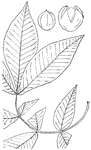
Leaves - compound (odd-feathered, leaflets, seven to nine); alternate; edge slightly and rather roundly toothed. Outline - of leaflets, mostly long oval, the lower pairs becoming smaller and more egg-shaped. Apex - long-pointed. Base - of the end leaflet, wedge-shape; of the others, more or less blunted. Leaf/Stem - rough throughout. Buds - large and round and covered with downy, yellowish-brown scales, or, in winter, with hard and grayish-white scales. Leaflet/Stem - lacking (or scarcely noticeable), except the short, roughish stem of the end leaflet. Leaflets - two to seven inches long, rough beneath, especially on the ribs; fragrant when crushed. Bark - rough, becoming cracked across, but not scaly. Fruit - rounded, slightly egg-shaped or oval, one and one half to two inches or more in length. The husk is about one fourth of an inch thick and splits nearly to the base when ripe. Nut - slightly six-angled, light brown, with a very thick and hard shell. Kernel - is sweet, but small. October. Found - common in dry woods, especially southward and westward. It grows in Southern Canada and I all the Atlantic States. General Information - All the Hickories are picturesque trees. Their tendency, even when standing alone, is to grow high, and with heads that, instead of being round, are cylinder-shaped to the very top, with only enough breaks and irregularities to add to the effect. This tendency is more marked in the Hickories than in any other of the leaf-shedding trees of North America. They are worthy of the name sometimes given them of 'the artist's tree." Hicoria, from a Greek word meaning round, in allusion to the shape of the nut.

Genus Hicoria, Raf., Carya, Nutt. (Hickory)

Leaves - compound (odd-feathered, leaflets, seven to nine); alternate; edge slightly and rather roundly…
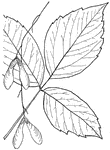
Leaves - compound (odd-feathered; leaflets, three, sometimes five, rarely seven); opposite; edge of leaflet remotely and unequally coarse-toothed. Outline - of leaflets, egg-shape or oval. Apex - taper-pointed. Base - variable and often uneven. Leaflets - slightly rough; the ribs very marked. Bark - of young trunks, smoothish and yellowish-green; twigs, light green. Flowers - small and greenish, in delicate, drooping clusters from the sides of the branches. Fruit - large, yellowish-green, smooth, in long, loose, late-hanging clusters. Found - North, South, and West. One of the most widely distributed of the North American trees, with its finest growth in the region of the Wabash and Cumberland rivers. General Information - A tree twenty to thirty feet high, with spreading branches. Its wood is light and of slight value.

Genus Negundo, Moench

Leaves - compound (odd-feathered; leaflets, three, sometimes five, rarely seven); opposite; edge of…
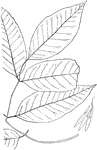
Leaves - compound (odd-feathered; leaflets, seven to nine); opposite; edge of leaflets slightly toothed or entire; entire at base. Outline - of leaflet, long oval or long egg-shape. Apex - taper-pointed. Base - somewhat pointed. Leaf/Stem - smooth. Leaflet/Stem - about one fourth of an inch long, or more; smooth. Leaf/Bud - rusty-colored and smooth. Leaflet - two to six inches long; pale beneath; downy when young, but becoming nearly smooth, except on the ribs. Bark - of the trunk, light gray. In very young trees it is nearly smooth, but it soon becomes deeply furrowed - the furrows crossing each other, and so breaking the bark into irregular, somewhat square or lozenge-shaped plates. Then in very old trees it becomes smooth again, from the scaling off of the plates. The branches are smooth and grayish-green. The young shoots have a polished, deep-green bark, marked with white lines or dots. Winged seeds - one and a half to two inches long, with the "wing" about one fourth of an inch wide, hanging in loose clusters from slender stems. The base of the seed it pointed and not winged. Found - in rich woods, from Southern Canada to Northern Florida and westward. It is most common in the Northern States. The finest specimens are seen in the bottom lands of the lower Ohio River basin. General Information - a tree forty to eighty feet high. Often the trunk rises forty feet without branching. Its tough and elastic timer is of very great value, being widely used in the manufacture of agricultural implements, for oars, and the shafts of carriages, and in cabinet-work. Fraxinus from a Greek word meaning "separation," because of the ease with which the wood of the Ash can be split. I find in the notes of an old copy of White's "Natural History of Selborne" this comment: "The Ash, I think, has been termed by Gilpin the Venus of British trees." Gerardes' "Herbal" comments: "The leaves of the Ash are of so great a vertue against serpents, as that the serpents dare not be so bolde as to touch the morning and evening shadowes of the tree, but shunneth them afarre off, as Pliny reporteth in his 16 book, 13 chap. He also affirmeth that the serpent being penned in with boughes laide rounde about, will sooner run into the fire, if any be there, than come neere to the boughes of the Ash."In Scandinavian mythology the great and sacred tree, Yggdrasil, the greatest and most sacred of all trees, which binds together heaven and earth and hell, is an Ash. Its roots spread over the whole earth. Its branches reach above the heavens. Underneath lies a serpent; above is an eagle; a squirrel runs up and down the trunk, trying to breed strife between them.

Genus Fraxinus, L. (Ash)

Leaves - compound (odd-feathered; leaflets, seven to nine); opposite; edge of leaflets slightly toothed…
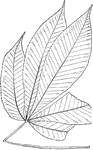
Leaves - compound (hand-shaped; leaflets, usually five, sometimes seven); opposite; edge toothed. Outline - of leaflet, long oval, long egg-shape, or long reverse egg-shape. Apex - taper-pointed. Base - pointed. Leaflet - four to nine inches long, one to three inches wide, usually minutely downy beneath. Flowers, pale yellow. April, May. Fruit - two to two and one half inches in diameter, rounded. Husk - not prickly, but uneven. Nut - one or two in a husk, large and brown. Found - from Alleghany County, Pennsylvania, southward along the Alleghany Mountains to Northern Georgia and Alabama, and westward. General Information - A tree thirty to seventy feet high. Its wood is light and hard to split. With the other species of the same genus it is preferred, above any other American wood, for the making of artificial limbs.

Genus Aesculus, L. (Buckeye, Horse Chestnut)

Leaves - compound (hand-shaped; leaflets, usually five, sometimes seven); opposite; edge toothed. Outline…
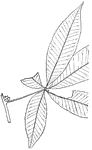
Leaves - compound (hand-shaped; leaflets, five); opposite; edge toothed. Outline - of leaflet, oval or long oval. Apex - taper-pointed. Base - pointed. Leaflets - three to seven inches long; one and a half to three inches wide. Bark - with a disagreeable odor. Flowers - small, yellowish-white. June. Fruit - about three fourths of an inch in diameter. Husk - prickly when young. Nut - smooth. Found - along the western slopes of the Alleghany Mountains - Pennsylvania to Northern Alabama and westward. General Information - A small, ill-scented tree (eighteen to thirty-five feet high). Its wood is light and hard to split. With the other species of the same genus it is preferred, above any other American wood, for the making of artificial limbs.

Genus Aesculus, L. (Buckeye, Horse Chestnut)

Leaves - compound (hand-shaped; leaflets, five); opposite; edge toothed. Outline - of leaflet, oval…
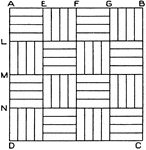
Square pattern exercise: Divide A D and A B into 4 equal parts and draw horizontal and vertical lines. Now divide these dimensions, A L, M N, etc., and E F, G B, etc., into 4 equal parts- each 1/4 inch- and draw light pencil lines with the T-square and triangle.

Square Exercise

Square pattern exercise: Divide A D and A B into 4 equal parts and draw horizontal and vertical lines.…
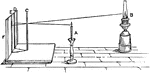
A diagram of how photometry works. The light from each object is measured by comparing the intensity of their shadows on a screen behind a standing rod.

Photometry

A diagram of how photometry works. The light from each object is measured by comparing the intensity…
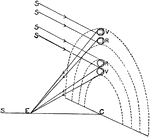
A bow of prismatic colors formed from the reflection and refraction of the sun and water. In the diagram, S is the sun's rays, E is the eye. There are two bows: the primary is the inner brighter rainbow, and the secondary is dimmer and sometimes unseen.

Rainbow Diagram

A bow of prismatic colors formed from the reflection and refraction of the sun and water. In the diagram,…
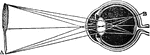
The convergence of light rays in the eyeball begins in the aqueous humor is perfected in the crystalline. But when they strike the vitreous humor, which is concave on its front surface, and also less dense than the crystalline, they diverse or spread out, and are thrown upon the back part of the eye.

Convergence of Rays in the Aqueous Humor of the Eyeball

The convergence of light rays in the eyeball begins in the aqueous humor is perfected in the crystalline.…
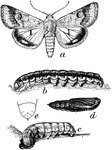
"False bud worm or cotton boll worm (Heliothis armiger): a, adult moth; b, dark full-grown larva; c, light-colored full-grown larva; d, pupa- natural size." -Department of Agriculture, 1899

False Bud Worm

"False bud worm or cotton boll worm (Heliothis armiger): a, adult moth; b, dark full-grown larva; c,…

"Diagram of the progress of a dune, from a to be. The arrow flies with the wind. A live tree standing before the dune when it is at a will be buried by the advance to b. Another tree, previously killed and still covered by the dune, will be brought to light when it has reached b." -Johnson, 1910

Dune Progress

"Diagram of the progress of a dune, from a to be. The arrow flies with the wind. A live tree standing…
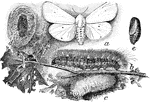
"Spilosoma virginica: a, female moth; b, full-grown larva; c, light form of larva, not quite mature; d, cocoon; e, pupa." -Department of Agriculture, 1899

Yellow Bear Stages

"Spilosoma virginica: a, female moth; b, full-grown larva; c, light form of larva, not quite mature;…
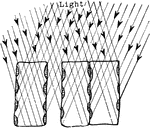
"Diagram showing how the position of the chlorplasts against the vertical walls of the palisade cells exposes them to good advantage to light from all quarters of the sky." -Stevens, 1916

Plant Light Intake

"Diagram showing how the position of the chlorplasts against the vertical walls of the palisade cells…
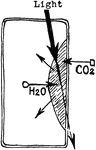
"Diagram to show the activities going on in a palisade cell. The arrows from the chloroplasts into the cell cavity indicate movement of photosynthesized product. The thickness of the arrow shafts under "Light" indicate the relative light intensities." -Stevens, 1916

Palisade Cell

"Diagram to show the activities going on in a palisade cell. The arrows from the chloroplasts into the…
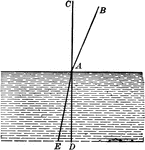
"BA is the ray of light passing through a rare medium (as, for instance, air); and upon its entrance into a denser medium (as, for instance, water) the ray will be deflected from the direction of its path BA, and will take the course AE. If the line CD is perpendicular to the dividing surface between the two media, then BAC is the angle of incidence and DAE is the angle of refraction." -Waldo, 1896

Atmospheric Optics

"BA is the ray of light passing through a rare medium (as, for instance, air); and upon its entrance…
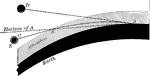
The figure "illustrates the bending of the solar rays entering the atmosphere. When the sun is below the horizon, at C, it would be invisible at A, on account of the curvature of the earth, if there were no atmosphere; but the solar rays entering the atmosphere near the point B are refracted so that they reach A, and the sun appears to be at D, though really at C below the horizon, either in the morning or in the evening. So that, in the polar regions, the sun is visible while it is in reality below the horizon, and is thus seen earlier and later during the time of polar sunlight." -Waldo, 1896

Atmospheric Optics

The figure "illustrates the bending of the solar rays entering the atmosphere. When the sun is below…
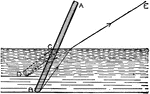
"The stick AB appears bent at C, on account of the refraction caused by the water. The eye sees the end B in the direction of the refracted ray, and it appears at D instead of where it really is." -Foster, 1921

Refraction

"The stick AB appears bent at C, on account of the refraction caused by the water. The eye sees the…
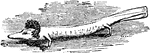
"The Proteus anguinus attains a length of about 1 foot. The body is smooth, naked, and eel-like, the legs four in number, small and weak, the forefeet three-toed, the hinder four-toed, and in addition to permanent external gills, it possesses lungs in the form of slender tubes. From its inhabiting places devoid light the power f vision is unnecessary and in point of fact its eyes are rudimentary and covered by the skin." -Marshall

Proteus Anguinus

"The Proteus anguinus attains a length of about 1 foot. The body is smooth, naked, and eel-like, the…
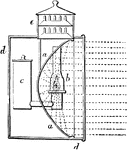
A polished surface of metal, or any other suitable material, applied for the purpose of reflecting rays of light, heat, or sound in any required direction.

Parabolic, Reflector

A polished surface of metal, or any other suitable material, applied for the purpose of reflecting rays…
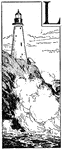
"A tower or other elevated structure bearing a light at the top and erected at the entrance of a harbor or on some rock or headland to serve as a guide or warning of danger to navigators at night." -Foster, 1921

Lighthouse

"A tower or other elevated structure bearing a light at the top and erected at the entrance of a harbor…
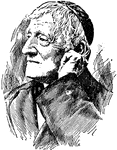
(1801-1890) Roman Catholic cardinal and venerable.

Cardinal John Henry Newman

(1801-1890) Roman Catholic cardinal and venerable.

A tree belonging to the East Indies and the Malayan and Polynesian islands, remarkable for its fragrance. Its wood is used as a perfume, and is manufactured into glove-boxes and other light articles.

Sandal Wood

A tree belonging to the East Indies and the Malayan and Polynesian islands, remarkable for its fragrance.…
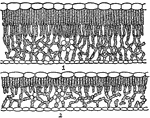
"Cross-sections of leaves of an oak (Quercus novimexicana), showing the effect of different light conditions on the internal anatomy. 1, from leaf growing in sunlight; 2, from leaf growing in the shade." -Gager, 1916

Oak Leaf Cross-Section

"Cross-sections of leaves of an oak (Quercus novimexicana), showing the effect of different light conditions…
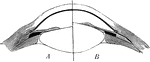
A convex lens, bends the ray of light which pass through it, so that they meet at a point called a focus. The crystalline lens converges the rays of light which enter the eye, and brings them to a focus on the retina. The healthy lens has a power of changing its convexity so as to adapt itself to near and to distant objects.

The Use of the Crystalline Lens

A convex lens, bends the ray of light which pass through it, so that they meet at a point called a focus.…
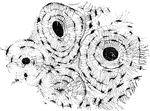
The bone contains a multitude of small irregular spaces, approximately fusiform in shape, called lacunae, with very minute canals leading from them and anastomosing with similar little prolongations from the other lacunae. Shown is a transverse section of compact bony tissue of a humerus. Three of the Haversian canals are seen, with their concentric rings; also the lacunae, with the canaliculi were filled with debris in grinding down the section, and therefore appear black in the figure, which represents the object as viewed with transmitted light. The Haversian systems are so closely packed in this section that scarcely any interstitial lamellae are visible.

Microscopic Structure of Bone

The bone contains a multitude of small irregular spaces, approximately fusiform in shape, called lacunae,…
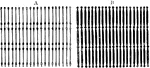
Diagram of the appearance in fresh muscle fiber. Labels: A, At low focus (B) the muscle columns appear dark and in a line with the granules, sarcoplasm light. At high focus (A) the sarcoplasm is dark, muscle columns light, and two rows of granules appear in a line with the sarcoplasm and alternating with the muscle columns.

Muscle Fiber

Diagram of the appearance in fresh muscle fiber. Labels: A, At low focus (B) the muscle columns appear…
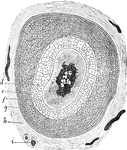
Transverse section of a hair and hair follicle made below the opening of the sebaceous gland. Labels: a, medulla or pith of the hair; b, fibrous layer or cortex; c, cuticle; d, Huxley's layer; e, Henle's layer of internal root sheath; f and g, layers of external root sheath, outside of g is a light layer, or "glassy membrane" which is equivalent to the basement membrane; h, fibrous coat of hair sac; i, vessels.

Hair Follicle

Transverse section of a hair and hair follicle made below the opening of the sebaceous gland. Labels:…
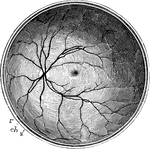
The posterior half of the retina of the left eye, viewed from before; s, the cut edge of the sclerotic coat; ch, the choroid; r, the retina; in the interior at the middle the macula lutea with the depression of the fovea centralis is represented by a slight oval shade; towards the left side the light spot indicates the colliculus or eminence at the entrance of the optic nerve, from the center of which the arteria centralis is seen spreading its branches into the retina, leaving the part occupied by the macula comparatively free.

Posterior Half of the Retina

The posterior half of the retina of the left eye, viewed from before; s, the cut edge of the sclerotic…
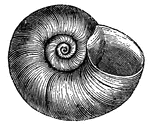
The shell of the Planorbis is thin, light and disk-like in form. The can creep along solid bodies, or swim upside-down through the water.

Planorbis Corneus (Linnaeus)

The shell of the Planorbis is thin, light and disk-like in form. The can creep along solid bodies, or…
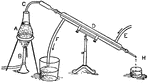
Apparatus used for distillation, separating liquid from the impurities contained in it. A, reservoir; B, light for heating; C, connecting tube; D, steam passes into; E, pipe where cold water is supplied; F, discharged liquid; H, pure water.

Distillation

Apparatus used for distillation, separating liquid from the impurities contained in it. A, reservoir;…
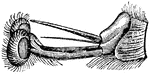
"In order that the may pierce the skin, the fly is provided with a very small lancet, which has a very fine point, and is of light color."

Lancet of the Meat-Fly

"In order that the may pierce the skin, the fly is provided with a very small lancet, which has a very…
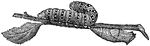
"One of the largest and most beautiful butterflies. The chrysalis, attached to a grass stalk, is sometimes light green, sometimes grayish."

Larva and Chrysalis of Papilio Machaon

"One of the largest and most beautiful butterflies. The chrysalis, attached to a grass stalk, is sometimes…
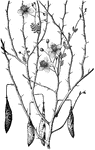
The palo verde is a very peculiar naked evergreen tree. It has small freen leaves in the rainy season, but these soon drop off and the smooth, light green surface makes it appear as if stripped of bark as well as leaves.

Palo verde (parkinsonia torreyana).

The palo verde is a very peculiar naked evergreen tree. It has small freen leaves in the rainy season,…
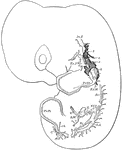
Developing lymphatics in rabbit embryo of 14 days. Lymphatic vessels are heavily shaded; veins are light. Labels: In.J., Ex.J., internal and external jugular veins; Pr.U., primitive ulnar; Ex.M., external mammary; Az., azygos; VCI., inferior vena cava; G., gastric; S.M., superior mesenteric; V., vitelline; Sc., subcardinal; R.A., renal anastomosis of subcardinals; Pr.Fi.,primitive fibular; c.b., connecting branch; An.T., anterior tibial; c., caudal; 3,4,5,6, position of corresponding cervical nerves.

Lymphatics in a Rabbit Embryo

Developing lymphatics in rabbit embryo of 14 days. Lymphatic vessels are heavily shaded; veins are light.…
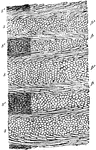
Longitudinal section of enamel, treated with acid, showing disposition of ranges of enamel prisms (p, p') in striped of Schreger. Left third of figure shows alternative light(s) and dark (s') bands as seen by reflected light.

Longitudinal Section of Enamel

Longitudinal section of enamel, treated with acid, showing disposition of ranges of enamel prisms (p,…
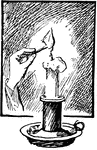
A candle is a light source consisting of a solid block of wax and a wick. Pictured is a hand lighting the candle with a match.

Candle

A candle is a light source consisting of a solid block of wax and a wick. Pictured is a hand lighting…
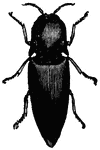
"An insect very common in Havana, Brazil, Guiana and Mexico. It may be seen at night in great numbers amongst the foliage of trees. They sometimes are so numerous that they light up the forests for travelers in those countries where the heat prevents traveling by day."

Cucuyo (Pyrophorus Noctilucus)

"An insect very common in Havana, Brazil, Guiana and Mexico. It may be seen at night in great numbers…
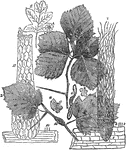
"Under the power of about 90 diameters the general character of the peridia is seen. They are densely aggregated, elongated, submerged, pale-brown, irregularly torn. The sporidia are copius...Nos. 1 and 2, indicate the general points of growth of this fungus. I find frequently on the leaf-ribs and terminal points of the leaves, and very often dispersed over the smooth parts of the leaf; sometimes, although rarely, the peridia are on the upper surface which, when matured, resembles net work. At the juncture of the leaf (see 4) the cells of the peridia are nearly round, at 5, oblong. From 3 to 4 the cellular structure is of light Vandyke brown; at 5, a pale yellow...6 represents the appearance of the peridia as see by the naked eye; 7, their general arrangements and their groupings on the leaves; 8, three cells, showing the parts of which the peridia are composed being magnified about 125 diameters." -Watts, 1874

Cellular structure of peridia

"Under the power of about 90 diameters the general character of the peridia is seen. They are densely…
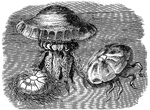
"These fragile creatures are able to make long voyages on the surface of the sea. Their nature is such that they are required to keep constantly moving in order to sustain themselves in the fluid which they inhabit. There is a double movement of their light skeletons, which may be compared to the action of respiration in the human hest."

Rhyzostoma Cuvierii

"These fragile creatures are able to make long voyages on the surface of the sea. Their nature is such…
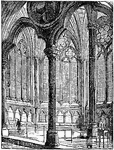
The stone Abbey was built around 1045–1050 by King Edward the Confessor, who had selected the site for his burial: it was consecrated on December 28, 1065, only a week before the Confessor's death and subsequent funeral. The attached Chapter House was built under King Henry III between 1245 and 1253. This octagonal room was built in the Geometric gothic style. A pier of eight shafts carries the vaulted ceiling. To the sides are blind arcading, remains of 14th-century paintings and numerous stone benches above which are innovatory large 4-light quatre-foiled windows. originally used by the monks for their daily meetings, it later became a meeting place of the King's Great Council and the Commons.

Chapter House, Westminster Abbey

The stone Abbey was built around 1045–1050 by King Edward the Confessor, who had selected the site…

Thomas Alva Edison (February 11, 1847 – October 18, 1931) was an American inventor and businessman who developed many devices that greatly influenced life around the world, including the phonograph and the long-lasting, practical electric light bulb.

Thomas Alva Edison

Thomas Alva Edison (February 11, 1847 – October 18, 1931) was an American inventor and businessman…
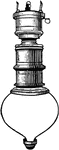
An arc lamp or arc light is the general term for a class of lamps that produce light by an electric arc (also called a voltaic arc). The lamp consists of two electrodes typically made of tungsten which are separated by a gas.

Arc Light

An arc lamp or arc light is the general term for a class of lamps that produce light by an electric…
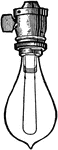
The incandescent light bulb, incandescent lamp or incandescent light globe is a source of electric light that works by incandescence, (a general term for heat-driven light emissions which includes the simple case of black body radiation).

Incandescent Lamp

The incandescent light bulb, incandescent lamp or incandescent light globe is a source of electric light…
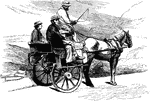
The Irish form of the sprung cart, called a jaunting car or jaunty car, was a light, horse-drawn, two-wheeled open vehicle with seats placed lengthwise, either face to face or back to back. It was a popular mode of transportation in 19th Century Dublin popularized by Valentine Vousden in a song by that name. Also called an outside car or sidecar, it was peculiar in that its seats ran longitudinally and the passengers' feet were placed on a footboard outboard of the wheels.

Jaunting Car

The Irish form of the sprung cart, called a jaunting car or jaunty car, was a light, horse-drawn, two-wheeled…